Even in July, the grit of winter is still around

The extreme heat warning was first issued for Richmond, Virginia on Thursday, July 2, 2026.

Two days later on Saturday, July 4, the extreme heat warning was still in place.

When I left for my run that Saturday morning, the temperature was 77 degrees, humidity 88%, dew point, 73 degrees, and wind out of the south at 3 mph. If you moved an inch in any direction on this miserably uncomfortable morning, you were guaranteed to perspire.

For the next 35:49, that’s all I did. When I finished my run, I was drenched. No part of my old sack of bones was dry.

Despite these conditions, I saw walkers, a couple of runners, and neighbors walking their dogs. One neighbor said to me that he was simply trying to beat the heat.

The only way to beat the heat on a day like this is to hope that you have an air conditioned home.

Despite the heat, I did enjoy my run.

Yes, I said I enjoyed my run.

It is always an enjoyable run if I spot a bluebird.

This morning near the end of the service road that runs parallel to Westham Parkway, a bluebird briefly zoomed in front of me. Just like the blue on a blue crab, there is nothing like the blue of a bluebird.

Bluebirds are so flitty. Rarely do these pretty birds stay in one spot. Any movement causes them to quickly exit.

Once I was back home, I was fortunate to see another favorite bird the gold finch. This was my first spotting of the summer. Two of these bright yellow birds were enjoying a breakfast of coneflower seeds.

Even though the harsh, bitter cold of our 2026 winter is gone. Winter in a very small way is still hanging around our neighborhood.

On this run, there is an unusual intersection. Brookside Road and Bryn Mawr Road empty out on to Westham Parkway. There are three stop signs, one for each road.

Where those roads intersect, I find the remnants of winter.

To try to help drivers gain traction on our ice covered roads, snowplow drivers sometimes spread a mixture of salt with tiny granules of gravel and sand. As winter melted away, those particles of gravel and sand with the help of wind, rain, and car tires have worked their way down Brookside and Bryn Mawr.
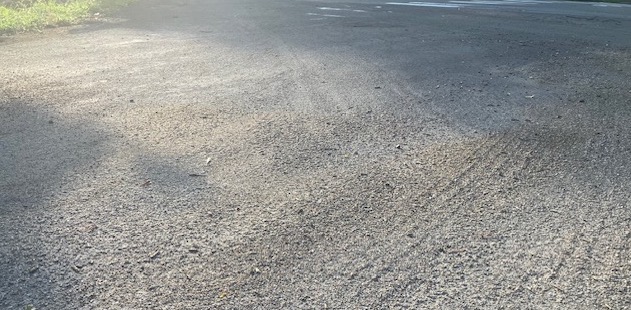
The grit of winter still hanging around (Photo Bill Pike)

Unless we have a succession of cloud bursting showers, I don’t think this left over grit from winter is going to be leaving the flat area of this intersection.

I admire the grittiness of these tiny particles of sand and gravel. They have endured a harsh winter, the energy of spring, and the stubborn heat and humidity of summer.

Who knows some day, they might be washed into Westham Creek and flow into Westhampton Lake on the campus of the University of Richmond.

From there it is conceivable to flow over the spillway by the student commons heading toward the Kanawha Canal, the James River, and the Atlantic Ocean. I can only begin to imagine such a journey.

But, it is also possible that most of the gritty particles will stay put. They will not be swept away by rainwater, blown by the wind, or dispersed by the friction from car tires.

Deep in what’s left of my old brain, I compare those grains of sand and gravel to people. People who stand at the intersection of their lives.

Maybe they are trying to figure out a new direction in life.

Maybe they are worn and frazzled by the daily struggles they encounter.

Maybe they are weary from being run over by the meanness of life, the struggle to find stability and success.

Maybe they are in a vicious generational cycle full of instability and constant failures.

Maybe, they are in need of hope, grace, and mercy.

Maybe, they just need someone to reach out to them.

Someone to listen without judging.

Someone to acknowledge that despite the burdens they are carrying, these people at the intersection of life do matter, and the struggles in their lives matter.

To them hope, grace, and mercy might be just as flitty and unattainable as a streaking bluebird or gold finch.

1 Thessalonians Chapter 5 verse 11 offers these simple words of wisdom: “Therefore encourage one another and build up each other.”

At church, this past Sunday, I spent a few minutes talking with one of our older members. When I asked him how he was doing, the dedicated husband and father talked about his wife.

For many years, his wife has been impacted by the devastation of Alzheimer’s disease. Recently, her conditions took a turn for the worse.

This change necessitated a different living arrangement. His wife needed more around the clock care. He told me how much he missed having his wife with him.

In these difficult circumstances, I attempted to follow the guidance from 1 Thessalonians Chapter 5 verse 11, but I’m certain my words were way off the mark. His sadness is breaking his heart.

If you are looking for a good piece of fiction to read, I recommend The Correspondent by Virginia Evans.

The book focuses on Sybil Van Antwerp. Sybil was an accomplished attorney who uses her letter writing to try and make sense of her life and the world around her.

In a letter she wrote to Larry McMurtry, the author of Lonesome Dove, she states: “and I suppose, back then, I was reading fiction in search of assurances that there was still a reason for hope.”

Clearly, I’m not the brightest grump in this old world, but at the challenging crossroads and troublesome intersections of life isn’t that what we are searching to find—just a tiny grain of hope?

In the miserable heat and humidity of another summer in the South, might the gritty remnants of a weary winter give us a bit of hope?

And I wonder what might give that much needed hope to those trapped in the crossroads and intersections of an unstable life?

I think the answer depends how much you, me, we, us can put into action these words: “encourage one another and build up each other.”
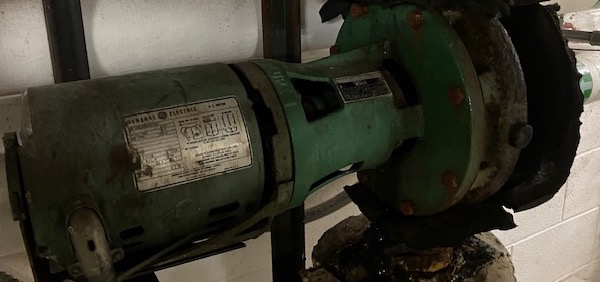
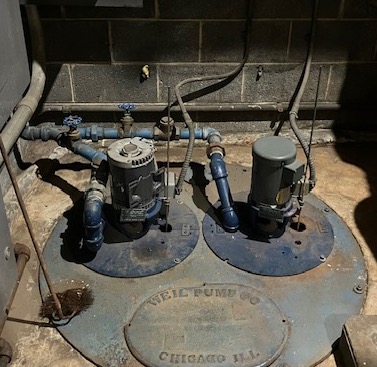
Last rites for a dying pump

The sound I could hear coming from the Trinity Hall Mechanical Room wasn’t a happy one.

For sure, circulating pumps make noise when they are working. But these sounds were beyond the normal whirring of a motor that was working properly.

I could hear metal vibrating and bearings that were thinking to themselves—“I’ve grown weary of this same predictable redundancy day after day, I’m ready to check out.”

Eventually, the I’m not happy sound was annoying staff members who could hear something, but they weren’t quite sure what that sound was.

Our associate pastor asked, “What is that sound?”

I responded, “A pump in need of its last rites.”

So, I asked our HVAC company to stop by to offer an assessment of the ailing pump.

Their assessment was bleak.

The pump needed to be placed in mechanical hospice.

This highly reliable and well-built pump had been circulating chilled water during the often brutal Richmond summers since July 1987. The pump kept people in the Trinity Hall wing of the building from melting on those unbearable summer days.

The estimated cost for the pump’s funeral was close to $13,800. The pump alone was nearly $8,000.

I protested the high cost of that funeral to the estimator. I asked him to sharpen his pencil. He obliged this request. The price reduced almost a thousand dollars.


There was no way that our current budget could afford the funeral cost for a new pump. The harsh winter had been rough on our HVAC systems and budget.

I pushed back.

I thought to myself.

I appreciate the almost forty years of loyalty from this pump.

In this fast-paced, every changing world, I sense that loyalty is becoming a scarce commodity.

I asked if the loyal pump could be rebuilt?

Our lead HVAC technician said that was a possibility.

So with a bit more investigation, we determined that we could shutdown the pump and still keep that section of the building cool.

Late on Thursday afternoon, I pulled down on the arm of the singular circuit for that pump. In a matter of seconds the pump was quiet.

On Friday morning, another technician stopped by to remove the pump. This was no easy task. The pump is bulky, heavy, and in a tight location. Eventually, the technician won.

The pump was transported to Roy’s Electric. For over seventy five years, Roy’s has developed a reliable reputation for assessing old pumps and determining if they are salvageable and able to be rebuilt. This $90.00 assessment will hopefully give us a positive answer to rebuild the pump.

If the pump can be rebuilt with new parts and quality hands on assembly, the cost to bring it back to life is $3,000.

My fingers are crossed that the pump can be rebuilt. Our church budget will appreciate the difference in price.

Keeping an eye on the daily workings of a church is not much different from keeping a daily eye on the workings of our own bodies. Just as mechanical rooms are complicated—so are our human bodies.

We never know when our bodies might opt to have a difficult conversation with us.

I’m sure God and Jesus hear difficult prayers everyday from people around the world.

These people are reaching out because a loved one might be nearing the end.

Clearly, human beings are a lot different from mechanical room HVAC pumps. A pump can be replaced, or maybe rebuilt.

That’s not always the case for human beings. Sometimes, doctors with lots of dignity, grace, and respect must tell families— I’m sorry, but we have no other options.

If I’m lucky before the end of June, I’ll turn seventy-three.

I think how fortunate I’ve been. I wonder how many more birthdays I might have in me?

Despite my efforts to take care of myself, I wonder when will my luck run out?

Today at church, I had a long conversation with a friend who had lost his wife to cancer. Despite this devastating loss, he found comfort in a recent research breakthrough for the type of cancer she battled. That breakthrough was a ray of hope for the future.

Isaiah 41:10 states: “Don’t be afraid, for I am with you. Don’t be discouraged, for I am your God. I will strengthen you and help you. I will hold you up with My victorious right hand.”

In her book, “The Wings of Hope: Survivor,” Lailah Gifty Akita wrote: “Hope is hanging on to the promises of God.”

Doesn’t matter if you’re dealing with a weary old HVAC pump, or the frailty of human life, sometimes, the only hope we have is “hanging on to the promises of God.”

The dying pump (Photo Bill Pike)

Tightening A Loose Screw

In the Eaton Hall mechanical room, there are two boilers. A hot water heater. A couple of air handlers. All kinds of electrical panels—some dead, some living.

There are pumps, pipes, conduits where phone and communication lines merge and disperse.

We even have a tunnel.

A crawl space that connects the Eaton Hall mechanical room to a small mechanical room in the basement of the Preschool.

Maybe, the youth should forget about selling pumpkins in the Fall. Consideration should be given to transitioning to a haunted bowels of the basement tour at Trinity during Halloween.

Who knows Chip and Flip could make cameo appearances as the sump pump mudmumblers or the boiler buzzards with a guaranteed admission discount slashed from $39.95 to $19.95.

Mechanical rooms in this old church building make me weary.

Financial disaster, in the form of a piece of equipment failing is always lurking in a mechanical room. Its the law of the darkness— where deep inside a pump a worn coupler shreds, fails. The pump squawks and shrieks in its mechanized death until the power is cut.

For months, we’ve been carefully monitoring two sump pumps in a well deep in the concrete floor. These pumps perform a critical function—they remove intruding ground water.

On Tuesday, a skilled technician who is familiar with cantankerous sump pumps came back to install a new switch for a supposedly faulty one.

In preparing for this installation, the technician discovered a loose screw. This screw was impacting the proper operation of that pump.

The technician simply tightened down the screw. Following this reconnection, he adjusted a float mechanism, and turned back on the electricity. In a matter of seconds, the pump was engaged and working properly.

When the technician reported his findings, I was relieved to hear this good news, and yet, I wondered why can’t the complications of daily living be so simple?

How different this world might be if it simply came down to finding and tightening a loose screw.

James Taylor is a gifted songwriter, singer, and musician.

He is also a survivor.

At some point in his career, Mr. Taylor had to tighten the screws of his lifestyle in order to make it to another day.

In the third stanza of his song “Fire and Rain,” Mr. Taylor wrote:
“Won’t you look down upon me, Jesus?
You’ve got to help me make a stand.
You’ve just got to see me through another day.
My body’s aching and my time is at hand,
And I won’t make it any other way.”

In this chaotic world, at this very moment, there is a human being who is hoping that Jesus is looking down upon them. That person no matter his/her circumstances needs help in making a stand.

What does it take to be seen through another day when no other options seem possible?

What are the chances that the right person with the right screwdriver will arrive and tighten down the loose screw for the person in need?

Might that screw tightener be you, me, we, us?

The other day, I stumbled upon this line of scripture: “Let me alone, for my days are a breath.”

Those words came from Job chapter 7 verse 16.

“For my days are a breath” reminds me of how quick time moves.

For that person who needs a screw tightened his/her time “is at hand.”

How will I respond if it is up to me to help that person to “make a stand?”

Making a stand is a “breath.”

So is tightening a screw.

My sump pump pals (Photo Bill Pike)

Virginia Tech you’re not alone

During the course of a year at our home, we receive alumni magazines from five colleges and universities.

I skim through these magazines. Quite often, I will find one or more articles that interests me, and I read those articles.

In the Fall 2025, Virginia Tech Magazine, an advertisement, a story about feeding Virginia Tech athletes, and a news release about a $229 million investment in student athletics caught my attention.

The advertisement and two articles made me think about a December 18, 2025 report from NPR. The reporter for NPR cited research from a national nonprofit, Swipe Out Hunger, who estimates that 2 in 5 college students face food insecurity.

Considering this information, I wrote a letter to the editor of the Virginia Tech Magazine.

At this point, I haven’t heard back from the editor of the magazine. But, I did hear receive an email from an administrator at Virginia Tech.

You can draw your own conclusions about my letter.

However, I think this is a solvable problem as Virginia Tech has an endowment of $1.95 billion dollars (June 30, 2024)

Letter

Tuesday, January 6, 2026

vtmag@vt.edu

I am not a graduate of Virginia Tech.

My connection to your outstanding university comes from our oldest daughter, a graduate of the Class of 2005.

I always enjoy skimming and reading the Virginia Tech Magazine.

In the Fall 2025 edition, Virginia Tech President, Tim Sands, starts his message with an interesting question—“Do you remember your first day on campus?”

Based upon a full page advertisement on page eight for The Market, I wonder how many current Virginia Tech students remember their first day on campus when they realized they were not going to be able to eat because of their financial situation.

The advertisement for The Market reveals “impact points” for the 2024-25 academic year. Ponder these points: over 69,000 pounds of food distributed, experienced a 375% increase in visits from students, 829 students received free meals, and $130,520 in funds were raised for keeping the pantry stocked. Additionally, there is a plea to make a gift to keep the shelves stocked.

In contrast to this plea to support The Market, on page seventeen is an article titled Fuel For Victory. This article is about feeding Virginia Tech’s “600 plus student-athletes across 22 sports.” Author Carter Brown states—“behind every athlete stands a dietitian equipped with a fueling strategy to help them feel and perform their best.”

I wonder if there is a dietitian behind the 829 students who received free meals from The Market?

And to carry this disparity further, on page forty-nine is the announcement that Virginia Tech has approved a $229 million investment in athletics. This funding is allocated “to position the university to compete with top Atlantic Coast Conference programs.” I wonder how many of those millions will be spent luring and paying upper tier athletes to play for Virginia Tech in hope that an elusive national championship be won?

Look, I know how important athletics are to college campuses. But along the way money has become the brain trust, not practical thinking.

In the January 2026 edition of the Kiplinger Personal Finance Magazine, I read with interest an interview with Julie Garcia. Miss Garcia is the Founder of Jewels Helping Hands in Spokane, Washington. This nonprofit offers a variety of services to the homeless in their community.

When asked about the hopes for the future of Jewels Helping Hands, Miss Garcia stated: “We hope that we’re out of a job at some point because we no longer have to fill these gaps in the community.”

As a leading public research university, might President Sands direct Virginia Tech toward solving the food challenges of its students so that The Market is no longer needed? How much of that $229 million could be redirected toward leveling the food playing field for all Virginia Tech students, not just student athletes?

Virginia Tech might not ever be able to invest enough in athletics to win a national championship.

But, how amazing would it be, if a cure for a type of cancer came from a Virginia Tech student who no longer had to worry about food insecurity.

President Sands, Virginia Tech has the ingenuity and the financial resources to solve this challenge.

This is a risk worth taking.

Do it.

Bill Pike
Richmond, Virginia

More rejections from William Whiner Part II: snow days


A long time ago when I was a public school student in Burlington, North Carolina, I prayed for snow. Now as a rapidly aging, grumpy, geezer, snow has lost my affection. That endearment to snow has been shifted to our four school age grandchildren.

Even with my 31 years of work in public education, I watched faculty and staff members do their chants, dances, and prayers for a snow day. There is something about a snow day that is good for morale and a weary teacher’s mental health.

The challenge with snow is that it disrupts our regular routines. For parents with school age children that means being able to adjust those routines so that the daily needs of the children are met. Not every family has the built-in luxury of having grandparents who can pinch-hit when a snowstorm upsets those routines.

For school superintendents closing school due to inclement weather is never an easy decision. No matter the choice made by the superintendent that decision is always under the scrutiny of the public.

Thus far in the Richmond area, two storms have disrupted the routine for local school systems. It is easy to second guess those decisions.

For example, I wonder if the mild winter storm that closed schools in the Richmond area on December 5 could have merited a delayed opening?

With the December 8 storm, the snowflakes really didn’t start to accumulate on road surfaces until late morning. Could schools have opened and then closed early in the afternoon?

I know superintendents and their staffs do not take weather related closings of school lightly. In making that decision they carefully review the forecast, consult with local police and road departments about street conditions, and depend upon personnel in pupil transportation to make real time assessments.

Despite every effort to carefully make the right decision, a superintendent can’t please everyone.

I experienced this when I served as an assistant principal at Hermitage High School. Several days after a significant winter storm schools reopened.

With that reopening, a phone call came in from an upset mother. While driving to school that morning, her son had been involved in an accident. She was angry at the school system for reopening. Nothing I said calmed the mother’s fury.


Honestly, at the heart of closing a school system for winter weather, you will find an attorney. Attorneys are thinking about safety from multiple angles. They ask lots of questions all related to reducing the potential for liability:

Can school system maintenance personnel properly clear parking lots and sidewalks?

Can bus drivers safely maneuver their buses through less traveled neighborhood streets?

Can faculty and staffs, student drivers, and parents who are responsible for transporting their children arrive at school safely?

No one associated with the school system wants any injuries from slippery sidewalks, fender benders in high school parking lots, or a school bus accident.

Perhaps, the greatest pressure is on school bus drivers. Driving a school bus under normal conditions is challenging enough. Mix in frozen winter precipitation with impatient civilian drivers who believe they are invincible with their all wheel drive vehicles, and the potential for accidents rises.

Recently, another phenomena has occurred in the decision to close schools related to winter weather. More frequently, superintendents are closing schools before the first snowflake has fallen.

I suppose this early announcement helps families to better implement their alternative plans for a snow day. However, I can only imagine what a superintendent will endure if that forecast fails to materialize.

As difficult as it is to close schools, making the decision to reopen can be challenging too. Depending how much instructional time has been missed, superintendents must also figure out how to recoup the missed time.

Perhaps, these questions are worth reviewing:

Do superintendents know of alternatives beyond the traditional make up days or extending the hours of the school day for regaining instructional time?

Might developing a year round school calendar reduce winter weather interruptions?

Could attorneys find a year round school calendar more compatible for reducing potential liability?

Do superintendents solicit post-winter storm feedback from students, parents, teachers, bus drivers, and maintenance personnel as a means for helping to shape future weather closing decisions?

And of course, there is always the insights of our friends and neighbors from other parts of America who rarely close their schools for winter weather. What might Southern superintendents learn from these “no fear of snow” superintendents?

As we waddle our way through the remainder of winter, maybe the weather gods will be kind to us with no more snow days. While that might disappoint students, superintendents will sleep better.

Note from the author: This rejected Op-Ed piece was sent to the Richmond Times-Dispatch in response to December 2025 school system closures from wintry weather. Bill Pike Richmond, Virginia

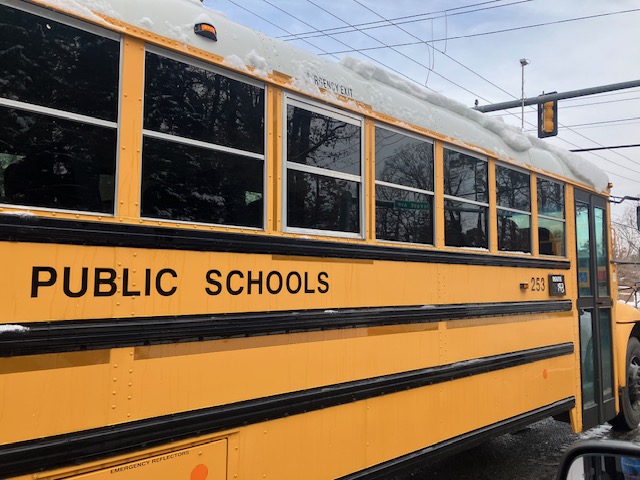
School bus with snow along its roof line (Photo Bill Pike)

Monday morning key fob blues

I’ve got the Monday morning key fob blues, that old key fob has made me weary right down to the soles of my shoes. Like a vengeful woman on Sunday night, that key fob battery has made my revengeful Monday morning a sorrowful plight.

On the morning of Monday, December 1, I had a plan.

Step one—drop off a letter that had been incorrectly delivered to our home to a US Postal service mailbox at a neighborhood shopping center.

Step two— open up Trinity United Methodist Church.

Step three—return home and work out on my old exercise bike.

Just before 6:30, I started my plan.

I drove to the shopping center.

I did not park in a parking space. I looped my car around parallel to the building with the car pointing in the direction I needed to go to exit the parking lot.

Turned off the car, walked a few steps to the postal box, and dropped in the letter.

Walked the few steps back to my car and attempted to start the car.

The car would not start.

A message flashed on the panel in front of me: Key ID incorrect.

No matter what I tried. The car would not start. The message remained the same—Key ID incorrect.

How in the world could the Key ID be incorrect? I wondered if the key fob had been overtaken by some outer space alien who wanted to disrupt my Monday.

A young man from a local construction company pulled in a parking space in front of the 7-11. I politely interrupted his entry and asked if he had any ideas?

He didn’t, but we had a good conversation about his company who had replaced the steeple at our church a few years ago.

With that I started a walk home. I was worried that my improper parking might get the car towed before I could get home and return with the backup key fob.

The Mobil service station was open. I stopped in and asked Jeff, the attendant, if he had any ideas. He suspected the key fob’s battery, but was perplexed by the message.
I thanked him and returned to my walk back home.

At the corner of Rock Creek Road and Forest Avenue, the young man from the construction company pulled over and offered me a ride to my house. I gladly accepted. Turns out two of his four children attend Trinity’s preschool.

I thanked him profusely, and rushed in the house to get the second key fob.

With that key, I started my walk back to the shopping center.

I decided to stop at Trinity on the way back to open up the building.

Once that was done, I started a slow, sprint back to my car.

It was cold and my fingers were frozen. When I arrived at the car, those frigid fingers had a hard time working the second fob.

Unfortunately, the key fob gods were not in my favor on this Monday. The second fob greeted me with the same message— key ID incorrect.

Good thing I didn’t have a hammer.

I noted that my friend, James, was working in the 7-11. James also works part-time at the Mobil station. I walked in and explained to James my Monday morning key fob blues.

James walked outside and tested the fobs for opening the car’s doors. Neither fob responded—both fob batteries were dead.

As James walked back into the 7-11, Jeff from the Mobil station pulled up in his truck. Jeff had done an internet check. He discovered that by holding the fob directly against the ignition button that the car should start.

I got back in the car. My still icy fingers struggled to make the proper connection.

I tried a couple of times with no luck.

With Jeff’s insistence, he suggested that I align the fob again, and for whatever quirky reason—the car started.

Again, I thanked Jeff for his diligence.

Back home, I explained to my Commander Supreme what had transpired. She couldn’t believe it. I felt drained.

But, my Monday morning key fob blues were not as draining as this headline: 4 dead and 10 wounded in shooting at banquet hall in Stockton, California.

Among the dead were three children ages 8, 9, and 14. This event was a birthday celebration for a child.

Regrettably, this event only reconfirms what we already know about America—the trigger puller had no respect for his/her life, nor the respect for the lives of the people attending the birthday party.

San Joaquin County, Sheriff Patrick Withrow, made this statement: “I am confident in our team and with the work that we have done so far that we will find these animals that did this and bring them justice, but we still need the public’s help.”

“Animals”

Is this what America has sadly become?

I’ve got the Monday morning Stockton, California birthday party blues, with broken hearts that never heal as senseless shootings continue no matter the venue in a disrespectful America with a dying red, white, and blue.

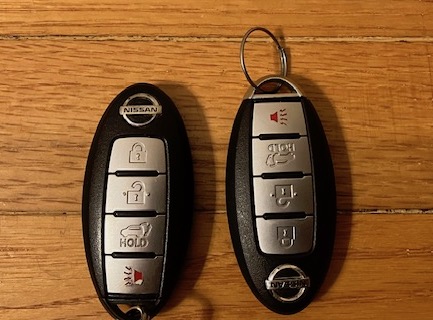
My troublesome friends (Photo Bill Pike)

Thanksgiving: “I don’t get no respect.”

Rodney Dangerfield was a gifted comedian.

His self-deprecating humor made me laugh.

In his rapid fire delivery of jokes, he always found a way to work in what became his identifying line—“I don’t get no respect.”

For lots of reasons, that’s how I’ve come to feel about Thanksgiving.

Over the last several years, it appears to me that our respect for Thanksgiving is eroding.

Retailers know this.

For example, the National Retail Federation expects Christmas sales in 2025 to “exceed a trillion dollars.”

Forecasters predicted that Halloween sales for 2025 would be in the range of twelve billion.

Thanksgiving is projected to be in the four to five billion range.

Growing up in North Carolina, Thanksgiving was always a drive on U.S. 70 to my grandmother’s home in Greensboro.

Sometimes, there was a stop on this twenty minute drive at Mt. Pleasant United Methodist Church for a morning Thanksgiving service.

The spread of home cooked food for our lunch time gathering was amazing. As an overweight kid, I was in heaven.

And yes, I like pumpkin pie. However, my favorite Thanksgiving dessert was persimmon pudding. I think my Aunt Evelyn always made sure we had persimmon pudding.

The other thing that I remember about those gatherings was being huddled in a small den with a television that projected a black and white picture of the Detroit Lions and Green Bay Packers playing their traditional Thanksgiving Day game. At the time, that was the only game broadcast or played.

Money has changed that. From Thursday through Sunday, football games at the collegiate and professional level are non-stop.

In November 1975, I spent my first Thanksgiving away from home. I was in Milton, Massachusetts, a pretty New England town just south of Boston.

I was with my future wife’s family. Two days later, that beautiful lady and I were married in West Hartford, Connecticut.

Lots has transpired in those fifty years.

And even though, Thanksgiving is squashed between the billions and trillions of Halloween and Christmas, it continues to survive.

We must never take the survival of Thanksgiving for granted.

The survival of Thanksgiving depends upon you, me, we, us.

We can’t let Thanksgiving die.

If Thanksgiving dies, so will we.

Maya Angelo said it better: “If we lose love and self-respect for each other, this is how we finally die.”

For Thanksgiving to continue to have a life, we must ensure that our children and grandchildren understand why it is so important to be thankful.

Being thankful can’t be taken for granted.

In the fall of my sophomore year at Greensboro College, biology professor, Dr. Kemper Callahan, put that into perspective for me.

This is what I have come to Dr. Callahan’s Thanksgiving Lecture. He simply told our class that we should never take Thanksgiving for granted. That included appreciating all of the people who make Thanksgiving happen. Dr. Callahan put a strong emphasis on farmers—no farmers, no Thanksgiving.

Successful Farming reported in July of 2025: “More farms nationwide filed for bankruptcy in the first three months of the year this year than across the entirety of 2024.”

What will the continuing struggles of our farmers mean for future Thanksgivings?

While I love the Thanksgiving food, Thanksgiving is also about family.

How lucky I have been to have been nurtured by a family every day of my life. That is a luxury not available to everyone.

As crazy as families can be, even an ounce of stability can make all the difference in a person’s life.

I see that generational stability in our Thanksgiving gatherings. Internally I ask—how different would my life have been without that stability?


I also ponder how much better America could be if that stability was present for all of our families. We might be surprised at how lives could improve by solving those generational cycles of instability.

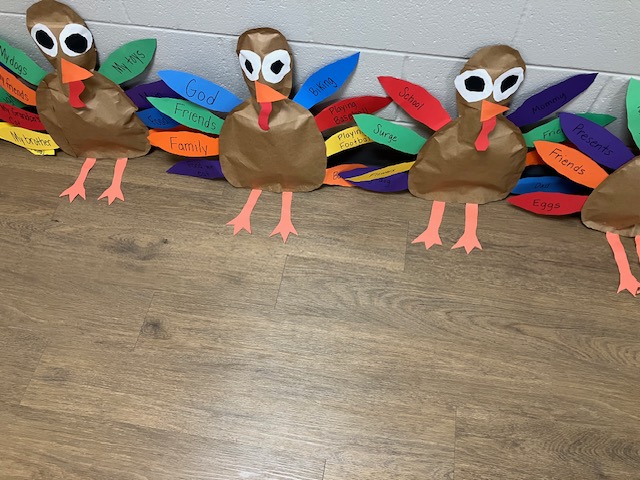
In my work at Trinity United Methodist Church, I see hope for Thanksgiving. That hope comes through the art work of the children in the preschool.

(Photo by Bill Pike)

I love walking through the hallways in the days before Thanksgiving. I get to see the Thanksgiving artwork gracefully resting on the floor or gently hanging from a wall mounted hook. These masterpieces are in their curing stage with glue and paint drying before they are transported home.

(Photo by Bill Pike)

Who knows maybe these heartfelt creations will be cherished and preserved for future Thanksgiving celebrations.

Isn’t that part of what makes up respect—preserving what we value?

Rodney Dangerfield figured that out.

Mr. Dangerfield learned that his audiences anticipated and valued his famous line—“I don’t get no respect.”

I can hear him now.

Thanksgiving is coming. I gotta tell you, when I was a kid Thanksgiving got a lot of respect. Not now. Thanksgiving is like a panini sandwich flatten on a press by Halloween pumpkins and retailers overstuffing our Christmas stockings.

I hope you and your families have a good Thanksgiving.

And remember to endure, Thanksgiving needs our respect, our hope, and our thankful hearts.

A Mrs. Schmidt production (Photo Bill Pike)

October finger-tippers

Even though I know that the dew covering the windows on my car will soon become frost, October, I’m glad you’re back.

(Photo Bill Pike)

You are my favorite month.

I don’t want you to leave.

I know when you depart, November moves me one step closer to winter.

Mentally, I fight winter.

While I still respect winter, I’ve lost my constant school boy hope and prayer for snow.

At 72, my old brain doesn’t revere snow anymore. That wish for snow is for our grandchildren and school teachers.

So October, I’m going to cherish you.

The last few days the harvest moon has been like a spotlight in the predawn western sky. Its brightness teasing as it hovers by church steeples and plays hide and seek descending behind tree lines.

(Photo Bill Pike)

To my west, cold fronts hurtle their northwest winds over the Blue Ridge Mountains. Rushing east toward Richmond, these winds paint your sky with the clearest, bluest blue my eyes have ever seen. I want to daydream into that blue forever.

Although I dread my annual battle with your fallen leaves, I adore the palette of colors found in the bright sun against that blue sky backdrop.

Even though, my affection for today’s baseball is gone, October brings the world series. I remember sneaking my transistor radio and earplug into Miss Avery’s sixth grade class at Hillcrest Elementary School. She figured out that I was trying to listen to the world series. For some reason, she didn’t kill me.

And just to be fair, I can grumble about October too.

I whine about the retailers who thrust Christmas on us way too early. I couldn’t believe that even our neighborhood hardware store had a Christmas Sale display today.

(Photo Bill Pike)

And to continue the fairness, I will confess that I do not understand our increased fondness for Halloween. Yards throughout our neighborhood are transformed with all kinds of displays. I’m surprised someone hasn’t come up with a tacky Halloween tour like we have for tacky Christmas lights.


On a recent morning run, I turned off Horsepen Road and made a right on Devon. A few yards down the street two houses across from each other are decked out in Halloween gear. What caught my attention were the skeletons.

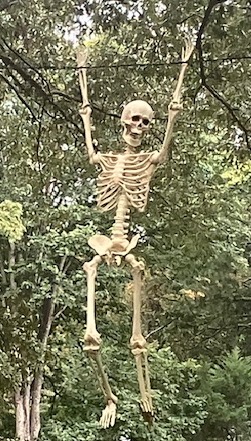
Each yard has an array of skeletons. Yet, my eyes were drawn to the high wire that stretches across the street from a tree in each yard. Skeletons in a variety of positions dangle from that high wire.

In particular, there is one skeleton that I really focused on. High above the yard, this skeleton is hanging by its fingertips. I wonder how many people I encounter on a daily basis who are hanging on by his or her fingertips?

(Photo Bill Pike)

I worry about those finger-tippers.

Unless we are completely oblivious, day to day living in this challenging world is tough.There is a tension that makes people more fragile, more vulnerable.

What really worries me about those finger-tippers is I might never know how close they are to letting go.

The constant barrage of discouraging news headlines makes me a pessimist at heart. I wonder when are we going to wake up? Perhaps that’s what keeps a bit of optimism—a bit of hope in my old heart. Hope that we will find our hearts again.

Maybe those finger-tippers can find some hope in October.

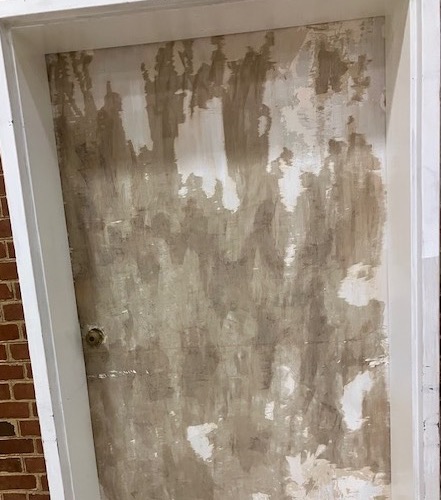
Maybe finding hope requires us to strip away the layers of hurt in our hearts like stripping layers of paint off on an old battered door.

(Photo Bill Pike)

Maybe that hope is in the October bloom of a camellia shrub.

(Photo Bill Pike)

Maybe that hope is the shiny red berries from a dogwood tree.

(Photo Bill Pike)

Maybe that hope is early morning sunlight coming through window shutters as it cast a pattern of light against a sanctuary wall.

(Photo Bill Pike)

Maybe that hope is you, me, we, us realizing that a finger-tipper is in close proximity.

Maybe that hope is you, me, we, us starting a conversation with the finger-tipper.

Bruce Springsteen said: “At the end of every hard day, people find some reason to believe.”

Maybe for finger-tippers, you, me, we, us, and October can become a reason to believe at the end of their hard day.

After all, 1 Thessalonians 4:18 states: “Therefore, encourage one another with these words.”

First Visit To The Allianz Amphitheater At Riverfront

On the evening of Monday, September 1, 2025, my wife and I went with neighbors to the James Taylor concert at the Allianz Amphitheater At Riverfront. This new outdoor concert venue is on the banks of the James River.

A few days prior to the concert, our neighbors did a reconnaissance drive to check out parking options and the walking distance to the entrance.

Additionally, a day before the event, my wife received a courtesy email stating the concert was sold out. Arriving early was recommended.

The reconnaissance for the parking was smart. We parked in a lot within reasonable walking distance to the amphitheater. Additionally, the price for parking was acceptable.

It was a bit after six when we finished up at the parking lot and started our walk to the entrance. What we didn’t expect was the long, long line of people waiting to enter the amphitheater.

Richmond police officers did good work monitoring pedestrian and vehicle traffic at the intersection of Second and Byrd. That long, long line worked its way up a very steep hill along Byrd Street well past the Afton Chemical Corporation.

For a person with worn-out legs, challenges with their cardiovascular system, or wheelchair dependency getting up this hill was a challenge.

At some point the line started to move. The movement toward the entrance was slow, but steady. We cleared the security checkpoint, and the next challenge was finding a space on the lawn for us to sit.

We found a spot, but then we relocated. We relocated to the back of the lawn area. A fence runs the length of the lawn. We had two chairs reserved for seating. Our thinking was the fence would be like the back of a chair while sitting on blanket.

Again, the line to pickup our two chairs was long. We tolerated the wait time. Good news, the chairs were sturdy and comfortable.

When we relocated to the fence, the chair line was directly in front of us. Numerous people came to the chair line not realizing that a reservation had to be made to secure a chair. Just before the concert started, another problem surfaced. Apparently, the supply of chairs for people who had made a chair reservation was depleted.

As we settled into our spot, we learned that there are still some kindhearted souls in the world. A lady with two chairs stopped in front of our group. She offered us her chairs. Where her friends were seated on the lawn was too crowded for chairs, so she offered them to us.

Prior to the opening act, I spent thirty minutes exploring the amphitheater.

The stage is massive and it appears to be outfitted with all the latest bells and whistles for concert technology.

Seating options are varied with some unique locations, and the sight-lines seem good. This is despite at least three large light poles that can impact those sight-lines.

Large video monitors grace either sided of the stage. So, if your sight-lines are lousy, and the tall and lanky, James Taylor, looked tiny, the monitors capture all of the action on stage.

The space provided for food, beverage, and merchandise seemed to be adequate. This area was full of people, but despite some long lines people were able to move freely.

Can’t speak for the women, but there was no wait time for the mens’ restroom area. Urinals, sinks, and toilets were numerous.

No one from our group purchased any food or beverages. I’m not sure about food prices, but a variety of items were offered.

I had read about the grumbling over the pricing of alcoholic beverages, and I now understand the grumbling.

Interesting to me that pricing for all wine options was prominently posted. Wine pricing was expensive. A can of wine was $14.00. Wine by the bottle fell into three price ranges from $40.00 to one Cabernet Sauvignon topping out at $110.00.

As far as I could tell pricing for beer was not posted. It is my understanding that beers in 24 ounce cans cost from $16.50 to $23.00. I did see one beer sign advertising a Value Beer for $5.00.

(Photo Bill Pike)

When I inquired about the value beer was I shown a 12 ounce can of Busch Light. While I’m sure Busch Light has its fans, I don’t value it as a beer. Plus, a consumer can purchase a 30 can case of Busch Light in a local grocery store for $27.99. With that pricing, each can of beer in that case cost about 93 cents a can. Even for a value beer, that’s a significant mark up, but nothing like the mark up on the other beers.

The concert started on time with opening act Tiny Habits hitting the stage at 7:30. After their set, the roadies made some adjustments to the stage, and then we were treated to two solid hours of James Taylor and his very gifted band.

On September 15, 2024, my wife and I made our first trip to Wolf Trap National Park for the Performing Arts. We made this trip to see James Taylor.

Clearly, Wolf Trip has been presenting concerts much longer than the rookies at the Allianz Amphitheater. However, getting into Wolf Trap, working our way to the lawn, and picking up our reserved chairs was seamless.

Part of me wants to know if anyone involved with the development of the Allianz Amphitheater spent anytime picking the brains of the staff at Wolf Trap.

It is my hope that the management team will conduct a detailed review of this first season. That review should include receiving feedback from the people who attended the concerts, and all Allianz personnel.

The day after the concert, my wife did receive an email from Live Nation, a survey that opened with: “What did you(really) think of James Taylor? Share your review!”

That opening was followed with these question prompts:
How was the event? Best ever? Room for improvement? Leave feedback on your recent concert or event, so Ticketmaster, a division of Live Nation Entertainment, can help enhance your next live experience.

I wonder how many people responded to the request for feedback? Additionally, I wonder how diligently the survey comments are discussed and studied by Live Nation and Ticketmaster?

From my perspective, here are some questions that management needs to ponder:

When a concert is sold out, how might the long line and wait time for getting into the amphitheater be reduced?

If I reserve a chair, how does management ensure that the chair will be available for me?

For consumers of alcoholic beverages, the pricing must be clearly posted for all options, and the pricing of these beverages must be restructured to be more sensible.

How might the seating in the lawn area be more balanced between blankets and chairs? Should the lawn area have a designated section only for chairs?

Hopefully, management will listen and improvements will be ready to be implemented by next summer.

At the age of 77, James Taylor enjoyed performing in this new venue. He was complimentary of the facility, the setting, and the crowd. His compliments also hinted that he would like to return next summer for another performance.

I’m 72, I anticipate returning to the Allianz Amphitheater At Riverfront for another concert. However, if I opt to return, I certainly hope that the management team will collectively work to make improvements. Improvements that will make the concert experience better for all who attend a performance in this amphitheater.

Failure to listen to feedback and institute reasonable changes based upon that constructive criticism could potentially hurt the success of the amphitheater.

At the end of this first season, I know everyone will be looking at the profit numbers. I won’t deny the importance of that data. But did concert attendees have a good experience also drives that revenue, and that can’t be overlooked.

And thinking of people, there is one more important part of our concert experience that also can’t be disregarded—the Allianz personnel. From my interactions with them, I found these employees to be patient, polite, and knowledgeable. In our impatient world those traits are important, especially in a public setting—nice work.

Ants, Car Creatures, Compressors, Peeps, Termites

I think some days that God is out to get me.

During Holy Week at our church, for some unknown reason, termites decided to erupt out of the wooden baseboard in the Forest Avenue foyer of the Sanctuary.

Our head building caretaker had been spiffing up the old black and white tile floor when he noticed my new best friends.

Sure enough, the termites had staged quite an invasion. They were curiously crawling around and inspecting these unfamiliar surfaces.

Maybe they were communicating to themselves, “Hey, where did the soft wood go, how did we end up here, we’re usually crunching wood in the dark, where did this light come from, who is this old guy holding a spay bottle?

Down on my knees, I probed deeper. Sometimes when we probe deeper into the outer layers more challenges are revealed. As I gently pried off the first piece of stained wood, I quickly saw that the next piece of trim work had been decimated by the termites.

No telling how long they had been silently chomping on the wood.

With a touch of agitation, I grabbed the spray bottle of Windex with ammonia in it. I started spraying. A long time ago, an exterminator told me that Windex with ammonia can temporarily help in eliminating creatures that show up at the wrong time.

I made the call to the company who has our termite contract. One of their technicians would stop by early on Thursday morning.

Not long after that encounter, a church member told me she forgot to tell me that ants had been sighted by one of the windows in the nursery on Sunday.

Sure enough, the ants were all over the window ledge and the HVAC register.

Once again, the ants met Windex.

Maybe in their defense, the ants were responding to the disruption they had experienced during our summer of 2024 building renovation project. That extensive project had peeled back all layers in one section of our building. I’m sure we intruded into the ants’ space.

Perhaps, the ants were seeking revenge. My guess is they were on a secret mission. The ants were working their way to the office of our Kids Director, Jen Williams, and her stash of Peeps. The ants were planning to disrupt Easter.

Again, I made a call to our pest control company, and our reliable technician was scheduled to visit the ants on Friday.

In the interim, I spent time cleaning up the ant massacre. I’d learn from past encounters its about eliminating access. I found no evidence of intrusion from the outside, so I concentrated on caulking up any openings and seams around the window trim and the HVAC unit.

Early on Thursday morning, I met the termite technician. He confirmed that the visitors were termites, not flying ants. For a few minutes, he share his options for treating the damaged area. For sure, he would treat the visible wood, but he also wanted to get inside the plaster wall above the trim work.

With this, we agreed on him drilling three small holes into the plaster. This gave access for treating the inside of the wall area. In turn, I agreed to patch the three holes.

Later on Thursday afternoon, I was able to get the damaged baseboard presentable for Easter.

Over in the nursery, the caulk work from Wednesday afternoon worked. No ants were scurrying around the window or the HVAC unit.

Easter Sunday was a pretty, warm day in Richmond. We had made the switch over to the summer season with the HVAC systems in the older sections of the building. Initially, these chillers with their compressors, pumps, and air handlers fired up properly.

While that initial start up had gone well on Thursday afternoon, that wasn’t the case on Sunday morning. The chiller for the Trinity Hall wing of the building was a bad bunny. The chiller despite prompting would not fire up.

Luckily, no one croaked from heat stroke in that section of the building on Sunday. However, the news wasn’t good when the unit was checked out by our HVAC service company the following week. One of the compressors for that chiller decided—“I’m done, I’m not working another Richmond summer, find another compressor to battle that heat and humidity.”

Now, our Trustees are reviewing a quote for replacing the uncooperative compressor. The cost is not pretty.

On Friday, May 2, the call came on my cell phone at 9:28 a.m.

Our youngest daughter, Elizabeth, had started her drive to Richmond from Raleigh. She was coming to attend a dance recital for two of our granddaughters on Saturday afternoon.

But this call wasn’t about how much napping I would do during the recital. No there was a sense of urgency. I could hear concern in Elizabeth’s voice.

She explained there was a noise coming from the dashboard of her car. The noise reminded her of the type of the scratching sounds that an agitated squirrel or mouse make when they are trapped inside the wall of a house.

Elizabeth was convinced that some crazed furry creature was going to explode through the dashboard or floorboard of the car as she sped up the interstate.

When I finally was able to settle her down, we walked through a series of unscientific tests. No creature exploded out from under the hood, nor from the dashboard.

At the gas station where Elizabeth had pulled over, a nice man noticed the raised hood. Clearly, he saw this young lady going through a sequence of unusual maneuvers while holding a cell phone. Possibly, he thought she was about to lose one or all of her marbles by the actions he saw.

He decide to investigate. With me listening in on the phone, he asked if she needed help?

Calmly, Elizabeth told him about the noise and what she was attempting to do.

Upon hearing her concerns, this kind stranger suggested that leaf debris might be in her ventilation system. He talked about the “squirrel cage” for this system and how debris can become trapped and blown around.

For now, that explanation made sense.

Elizabeth thanked him for his willingness to help. She continued her drive toward Richmond.

Later on Friday afternoon, we had a father-daughter bonding session.

First, we removed all tree debris from the windshield wiper area of the car and under the hood too.

Then, per the advice of the helpful stranger, we went inside the glove box of the car to remove the air filter for the car’s HVAC system. Yes, the filter for the HVAC system is located behind the glove box.

Despite watching helpful Youtube videos on how to access the filter, this work was not profanity free.

But inside the filter and the surrounding area, we did find leaf debris particles that could have been the noisy culprit.

During this endeavor, I did as all fathers are supposed to do. I put my hand into the cylinder for the vent, and I let out a scream. A scream that conveyed a furry creature had my hand.

Of course, this tactic worked. Elizabeth’s was initially quite startled, but not impressed with her immature father.

Elizabeth led the way in getting the filter and glove box back into the proper positions. Remarkably, we didn’t break anything.

Usually, situations with ants, termites, compressors, and car creatures can be remedied. However, that is not always the case for human beings.

Right now, despite fighting with all of their strength, and the best efforts of oncologists, someone within this hour is going to lose their battle with cancer.

Today, a darkness so deep and desperate will push a person to die by suicide.

With the end of another school year in sight, a single parent with three elementary age children wonders how they will survive the summer. Her concerns are based on the gutting of funding from leaders in Washington who have no clue about the reality of real American life.

Easter is over.

For me, Easter, despite its resurrection ending, is a difficult story.

Life is a difficult story too. Disruptive challenges are always, always part of that difficulty.

But with Easter, I always come back to Thomas. That’s right Thomas.

I identify with Thomas because he is honest. Like me he doubts. He doubted that Jesus had appeared before the disciples after his death.

Thomas wanted proof.

He wanted to see the wounds Jesus had suffered during his crucifixion.

How do we confront our doubts during life’s challenging moments?

Maybe, the key is to always hold on to hope.

Even when we doubt, and our faith is fading, we must not let go of hope.

And here’s why— Romans Chapter Five verses three and four: “because we know that suffering produces perseverance; 4 perseverance, character; and character, hope.”

Remember in the post Easter story, someone you encounter needs your perseverance, your character, and your hope.

Doesn’t matter if this person is confronting ants, compressors, car critters, termites, or the true reality of real life— someone needs hope.

On those bad days in an old church building when I’m convinced that God is out to get me, maybe he’s simply reminding me, “Hey knucklehead, someone you encounter today needs to hear that hope from Romans. Don’t let them down.”

Peeps saved from the ants. (Photo Bill Pike)