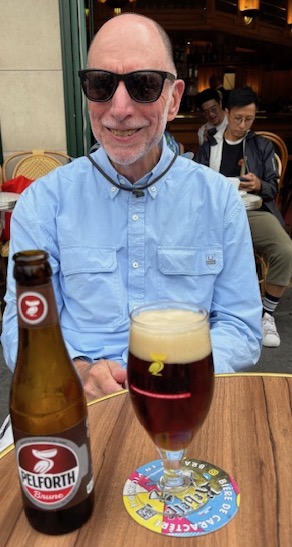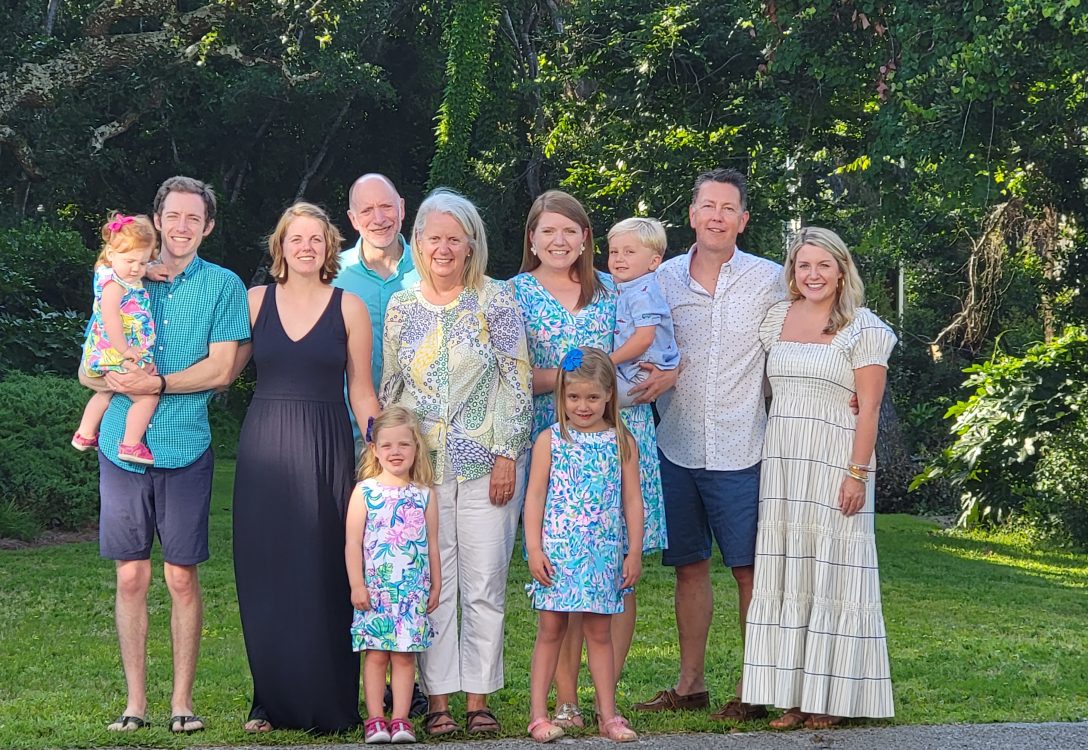
It features the good heart of my college roommate, the Reverend H. D. Sherrill, Jr. (Butch).
When I was growing up, I will always cherish two gifts from Santa—a transistor radio with an ear plug and a bicycle.
I loved them both for different reasons.
The bicycle was nothing special. No gears, no handbrakes, just a simple bicycle.
That bicycle was a part of my life until some point in junior high school.
With an almost flat tire, I road the bike to Johnny Huffman’s house.
Huffman had a hand pump. We made the connection to the valve on the tire and started pumping air into the tube.
We pumped too much air. The old tire exploded.
I never owned a bike again until now.
Back in the fall, we were in Greensboro, North Carolina.
We were there for our 50th college reunion at Greensboro College.
Over the years, I had talked with Butch about his exercising. Running, hiking, golfing, kayaking, and riding a bike were in the mix. I told him that I would like to look into bike riding again. There is now a bike trail that runs from Richmond to Williamsburg, Virginia.
From his very successful career in Greensboro, Butch was always, always working with people, lots of people know Butch Sherrill.
Turns out a friend of Butch’s developed a health issue that was going to prevent him from bike riding. This friend handed the bike over to Butch trusting him to find a good home for it.
Butch checked with his four grandsons who all live in Greensboro. They were already set with bikes of their own. Butch had a bike, and so he decided to offer this lightly used bicycle to me.
After the 50th anniversary celebrations, we scrunched that bicycle into the back of our SUV and drove back home to Richmond.
Once home, I parked the bike into our toolshed. A few days later I dropped it off at Pedal Power RVA. A good friend and neighbor, Mark Friedrich is the owner of this exceptional bike shop.
Mark’s technicians made sure all the parts were lubricated and working properly. I also purchased a helmet to protect what few braincells I have left.
I brought the bike home and returned it to the toolshed.
I’m not sure why, but for some reason on the morning of Tuesday, August 18, I decided I was going to ride the bike to work at Trinity.
With my backpack hanging on my shoulders, and my helmet snapped together under my chin, I found my balance and wobbled off toward Trinity.
We basically live two blocks from Trinity. For this initial ride, I opted to travel from Sweetbriar to Rock Creek Road, cross Baldwin Road, ride over the creek, and then turn into the back parking lot at Trinity.
I made friends with the rear handbrake as the ride toward Trinity is pretty much downhill. The most pedaling I did was after I crossed the creek and turned into the Trinity parking lot.
At the back of Trinity Hall, I came to a stop, and removed myself from the bike.
I considered this a successful ride—I didn’t crash.
I parked the bike in Trinity Hall.
At the end of the bike’s quiet day, it was waiting for me.
I wonder what the bike was thinking?
Oh no, here comes this wobbly old geezer again. I hope I can get him home safely. I wonder how much he is going to ride the brake as he finds his balance and comfort?
The ride back home on Rock Creek had more pedaling. Except for one short section before the creek bed, all that coasting I did in the morning was gone. The ride home was slightly uphill.
And of course, I’ve known this for a long, long time—life can be slightly uphill too. Sometimes, life is more than slightly uphill.
Reconnecting with the bicycle carried me back to my youth and my first bicycle. I rode that bike everywhere.
I rode it to the Huffmans, to softball practices at Turrentine Junior High School, Edgewood United Church of Christ, and the fields at City Park.
I rode it to yards I mowed off of Edgewood Avenue. There were stops at Barbour Drugs for a fountain made orange aid and a honey bun.
One summer morning, I rode it from our house on West Front Street to where my grandmother resided in Elon College out on Williamson Avenue. I must have been nuts. That was a tough ride.
And yet, I rode, no helmet, no fear. I never thought about a car or truck flattening me. I followed the rules of the road and pedaled like a maniac.
Today, I wonder—why was I so lucky on all those journeys?
I’m going to guess that prayer had something to do with it. My mother, the worrier, must have worn God out praying for me.
My mother and father started their day together with breakfast and the Upper Room devotional. They prayed together, and maybe buried in those prayers was a simple request “watch over our knucklehead son.” For better or worse, I’m still here. God must have heard.
I’ve ridden the bike to work four consecutive days. If no cars are coming, I “thread the wide needle” between the speed humps on Rock Creek Road near the creek.
My wife, the Commander Supreme, doesn’t need to worry about potential wild bike riding shenanigans from me—my old body doesn’t like pain.
Who knows, I might try an alternate route on the ride to and from work, and maybe, but this is a long maybe, maybe the bike will replace my runs through our cherished neighborhood. Maybe.
But back to those hills for a minute.
The hills of life are all around us.
Might you just be the nudge, the extra push that a friend or stranger needs to overcome that challenge of getting up one of life’s hills.
I know there was a gentle hand pushing behind me on all those growing up rides.
In these growing old rides, up the steeper hills of life, be that gentle hand for someone.
In the Richmond Times-Dispatch, I always read with interest the annual report about Richmond’s grocery store rankings.
I appreciate reporter, Sean Jones’ article related to the data provided from Food World, which tracks grocery stores sales.
This year’s graphic offered a good listing of the top 20 rankings in Richmond. However, I would still argue that stores like CVS, 7-Eleven, and big box stores like Costco truly aren’t grocery stores.
The inclusion of CVS, 7-Eleven, Wawa, Walgreens, Sheetz, and Fas Mart makes me wonder if customers shop for their groceries there out of convenience or necessity?
If it is necessity, is that because they live in a “food desert” where grocery stores are absent?
That makes me curious about how the Market at 25th is doing? Richmonders might recall this bold initiative to build from the ground up a full-service grocery store in the middle of a food desert in Richmond’s Church Hill.
If the Market at 25th has been successful, then why hasn’t that footprint been expanded?
Maybe that is because the article makes clear that “new supermarket development has slowed.” To me this means that opportunities for Walmart, Kroger, Food Lion, Publix, and Aldi to consider developing stores in known food desert zip codes seems less likely.
The annual report from Food World will continue to focus on market share and trends.
Perhaps in the future, Food World might consider adding two new data fields for Richmond: How many food deserts do we have, and who from the top 20 list is the market share leader in supplying surplus food to the non-profits and food pantries in our communities?
Might the inclusion of this data help to see that market share and annual sales isn’t the whole story?
Bill Pike
Tuckahoe
Note from author: I was honored to have this letter published in the Richmond Times-Dispatch on Thursday, August 13, 2026.
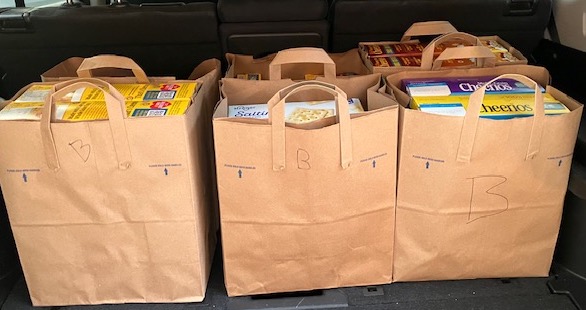
Bags of groceries destined for the Belmont UMC Food Pantry (Photo Bill Pike)
When I write about the music of Brian Wilson and the Beach Boys, I start with this disclaimer—I’ve been a fan since “Little Saint Nick” was released as a single in 1963.
That was over sixty years ago, but I still have a place in my old heart for their music.
When Al Jardine, one of the founding members of the Beach Boys, announced that he and the Pet Sounds Band would be playing at the Shenandoah Valley Music Festival in Orkney Springs, Virginia on Friday, August 7, 2026, within a day, I had purchased tickets for my wife and me.
Needless to say, I couldn’t wait for August 7 to arrive.
I also made arrangements to stay on the grounds for the concert. Shrine Mont, the organization responsible for the facilities where the festival takes place also offers lodging and family style meals. So we booked accommodations for staying overnight after the concert.
As we neared August 7, we made final checks about our tickets and room reservations. My sister and her husband followed our game plan for attending the concert. They would be making the drive from Snow Camp, North Carolina.
On the morning of Friday, August 7, our goal was to be on the road by 9. We only missed that mark by a few minutes.
From Richmond, we took Interstate 64 west, to Interstate 81 north, followed by US 11, and a couple of turns on Virginia roads that would take us into Orkney Springs.
A significant, single car accident on I-64 west just before Wintergreen slowed us down as did a paving project on the main road into Orkney Springs.
But by 5 p.m. we were all checked in and ready for dinner. Prior to the start of dinner, the Pet Sounds Band was doing a sound check. Hearing the music and voices only made me more excited.
Even though the band was playing under a roof, and our seats were inside the covered pavilion, the forecast leaned toward rain and maybe a thunderstorm hitting the area by 8 p.m. The concert was scheduled to start at 8.
After dinner, we could hear rumbling of thunder about the mountains. With rain in the forecast, we were in our seats by 7:30.
While waiting for the concert to start, occasionally, we would catch a glimpse of one of the musicians from the Pet Sounds Band coming on stage for a last minute equipment check. Even Al was backstage for some conversation.
Al Jardine backstage (Photo Bill Pike)
At some point, everyone from the band cleared the stage. They disappeared into a couple of Shrine Mont houses that served as dressing rooms.
Prior to the start of the concert, the Director of the Shenandoah Valley Music Festival took the stage and made a few announcements.
Just before eight, the wind picked up, and by the time the concert started a steady rain was coming down.
From there, the band ambled on to the stage to applause, and when the audience saw Al, there was more applause.
Taking the stage (Photo Bill Pike)
The opening song was “California Girls,” and from that point on, it was like a gentle Pacific Ocean swell of Brian Wilson’s music had rolled into the tranquil Shenandoah Valley and the surrounding Blue Ridge Mountains.
Except for an intermission, the songs were non-stop. Al’s patter between songs was heartfelt and insightful. He did so with honesty, humor, and a respect for the creativity of Brian’s music.
We laughed as he shared how Dennis Wilson, the original surfer in the Beach Boys attempted to teach Al how to surf. Al said despite Dennis’ skilled instruction, he(Al) sunk like a stone into the Pacific.
In a little over two hours, this talented group of musicians and singers performed thirty four songs. I do not have the ears of a musician, but I heard no miscues.
This included complicated arrangements showcasing seven songs from Pet Sounds(1966) and seven songs from the Love You(1977) album.
The harmonies were crisp, clean, tight, and light as air.
Like the original Beach Boys, the band features strong solo vocalists.
Most notable is Al Jardine who will turn 84 in September. Al still sounds strong. Yes, a tour can wear down a lead singer’s voice, but his lead vocal on “Help Me Rhonda” sounded like 1965 again.
Al’s son, Matt, is blessed with a beautiful voice too. Matt is able to hit those Brian Wilson falsetto parts to perfection. His leads on songs that originally featured either Brian or Brian’s brother Carl’s voices were angelic. Matt also blends well with his dad.
Supplementing the lead vocals is guitarist, Rob Bonfiglio, who is married to Brian Wilson’s daughter, Carney. His lead vocal on “Sail On Sailor” from the 1972 Beach Boys’ album Holland was soulful and spirited. Former Beach Boy, Blondie Chaplain, who sang the lead on the original would have been proud of Rob’s work. Rob is also a fine guitar player.
That lead vocal work continued to Darian Sahanaja. Darian, the musical director for the band and keyboard master, shared his clear and powerful voice on “Darlin” and “I Can Hear Music.” Also, Darian took the leads on songs from Pet Sounds and Love You. Again, Carl Wilson, the Beach Boy who sang lead on those songs would have been impressed with Darian’s voice.
With a couple of the tunes from the Love You album, keyboard player, Gary Griffin, sounded just like Mike Love, and percussionist, Jim Laspesa, sounded like Brian Wilson’s back in 1977.
Instrumentally, all of these guys and one brave lady, keyboardist, Debbie Shair, are gifted musicians. They know their chops and the intricate arrangements found in each song.
Individually and collectively, they are able to reproduce the instrumental tracks from the original recordings. The 1960s session musicians the Wrecking Crew who played on lots of Beach Boys recordings would affirm the skills of the Pet Sounds Band.
The mastery of their musician skills were showcased nicely on the instrumental song, “Pet Sounds.”
Horn player, Paul Von Mertens, handles flute, a couple of saxophones, harmonica, and the bass harmonica. On any song that needs that extra touch, Paul is the guy who adds that depth to the background. Even in the same song, he is capable of switching instruments to meet the requirements of the arrangement.
Debbie Shair and Gary Griffin are a part of the keyboard team with Darian. Need a French horn or a synthesizer sound, Debbie and Gary have you covered. Plus, they provide back up vocals to the blend of harmonies.
And I’m not sure, but Debbie might be the secret choreographer who added the comical, maybe penguin like body movements to the song “Johnny Carson.” Her high leg kicks worked well with the song too.
Percussionist, Jim Laspesa, played to perfection the bicycle horn in the fade out to “You Still Believe In Me” and the slide whistle in “Heroes and Villains.” And Jim is part of the background vocals blend.
If there was a shortcoming to the show, it was that not all of the band was introduced.
On bass is the incomparable, Bob Lizik. Bob has been a part of this band when Brian Wilson started going back out on the road.
His playing is steady and seasoned. This includes the required nuances in every song like “Here Today” from Pet Sounds. Throughout the show, whether the song was simple or complicated, Bob was the foundation for the band.
Set up beside Bob is drummer, Mike D’Amico. Going back to the Wrecking Crew musicians, Mike reminds me of drummer, Hal Blaine.
Mike’s timing is remarkable. He is quick and powerful when needed, but he also possesses a deft, finesse for quieter songs like “In My Room.” Mike anchors and drives the energy of the band. He is relentless.
Tucked away behind the keyboard players is guitarist and backup vocalist, Emeen Zarookian. Emeen is an exceptionally gifted guitarist. I don’t know who found and added Emeen to the band, but that was a wise move. His guitar playing is superb.
No matter the song, Emeen captures with high quality the range of tone needed. His fingers can fly like on “Dance, Dance, Dance” or be graceful, subtle as found on “You Still Believe In Me.”
Vocals especially harmonies have always been a trademark of Brian Wilson and the recordings of the Beach Boys. As I said earlier, I do not have the ears of a musician, but the harmonies tonight were impeccable.
A clear example of this would be “Heroes and Villains.” These gifted singers captured every part of this complex, but magical song.
I could have sat in that pavilion and listened to this band sing and play until the first rays of the sun skimmed the crested tree lines of the Blue Ridge Mountains.
I don’t think I was the only one with that wish. I saw people sitting near me who seemed to stare into that wall of music mesmerized by what they were hearing and seeing.
For fans of the Beach Boys, 2026 has been busy.
In February, Capitol Records released a boxed set that focused on the Beach Boys’ 1977 album Love You.
Then later in May, Capitol Records released a double CD and two different high quality vinyl records celebrating the 60th anniversary of the landmark album Pet Sounds.
For Al Jardine and the Pet Sounds Band, they would be active as well. This included live concert performances of the entire Love You album in support of the box set release. Then in late June and early July, Al and the band toured in Australia and New Zealand.
Long time followers of the Beach Boys know that another founding member and Brian Wilson’s cousin, Mike Love, also tours using the name the Beach Boys. Years ago, it was determined that Mike had the rights to use the Beach Boys name for touring purposes.
It is noteworthy that in late July, Mike and his Beach Boys band paused the summer tour to allow Mike time to rest and “recharge.” Those remaining summer dates have been rescheduled for the fall.
My advice to you—if Al Jardine and the Pet Sounds Band come within driving distance of your home town—you must buy a ticket and go.
The show as billed is a tribute to the music of Brian Wilson. Al and the band’s loyalty and respect for Brian are present from beginning to end. If Brian’s music that he created with the Beach Boys is special to you, you have no options, you must attend.
In closing, I have no idea how much longer Al will continue to tour.
I hope Al will have the good sense to know when it is time to stop performing.
Personally, as much as Brian Wilson loved reconnecting with his fans by performing live, I think Brian stayed on the road too long.
And from the video clips I saw of Mike Love’s performances earlier this summer, I sense that he has over stayed his touring ability.
I hope Al out of respect and loyalty to Brian and the Pet Sounds Band will not stay on the road too long.
For now, I hope the remainder of the tour goes well for Al and the band.
Looking to the future, I would love for a double live album that captures the performances of this tour to be released. Not compiling an album for release would be an insult to the hearts and souls of the Pet Sounds Band.
Continuing that look into the future, might Al consider writing a book about all of his years as a Beach Boy. I think he could offer a unique perspective.
And finally thanks to everyone who is a part of the Shenandoah Valley Music Festival. The director told the audience this is year number sixty three for the organization.
I hope they can continue to be successful for a long, long time. It is a beautiful setting and venue at Shrine Mont in Orkney Springs—long may that stage host gifted musicians.
On the afternoon of Tuesday, July 21, 2026, rain poured from a dark sky.
In truth, I wasn’t surprised because it felt like the air was beyond heavy with moisture.
A body knew that at some point the sky was going to burst wide open, and it did.
At Trinity, I always worry about Eaton Hall, the original social hall of the church.
It is a basement below the Sanctuary.
Over time, I have figured out its bad habits.
This old room doesn’t like cloudbursts.
Keeping the drain clear at the base of the exterior stairs is critical. Keep that drain clear, and less water intrudes.
This afternoon, the challenge wasn’t that drain. No, the challenge came from the window wells that surround Eaton Hall.
The window well drains couldn’t handle the deluge. A few of the wells filled like a bucket under a spigot.
I learned a long time ago that water has a mind of its own. Some water from the window wells did come into Eaton Hall, but I could manage it.
When the storm passed, I checked the window wells from the outside. I saw the problem— lots of tree debris.
The next afternoon, I had a date with the window wells.
One of the window wells (Photo Bill Pike)
To get into the window well requires lifting up the heavy duty wire grate that covers the well.
The grate must be precisely angled across the top of the window well.
This prevents it from tumbling back over me.
Next, I use a broom to clear spider webs and other crawling creatures.
Then I position a short step ladder into the well, and I crawl over the three sided railing.
I step gingerly on to the ladder and get into the well.
I use a small rake, a bucket, and my gloves to clean up the debris.
In the first well there had been a lot of debris and water.
As I worked, I noticed a sluggish, water logged toad was in the well. He didn’t offer much resistance as I scooped him up with both hands.
I was able to place him on some wood chips outside the window well.
My water logged friend (Photo Bill Pike)
With that well clean and clear of debris, I climbed out and checked on my friend.
A cleaned out window well (Photo Bill Pike)
It would take several minutes for the toad to acclimate. His eyes seemed to be carefully studying me.
Finally, I nudged him toward the grass where he continued to rest. I checked on him one more time, and then he was gone.
During the course of the afternoon, I made two more rescues of small slippery frogs that had fallen into the window wells. They appeared to be less water logged than my toad friend.
In the Richmond area this summer, we lost two young men by drowning in local pools.
A couple of weeks ago when were enjoying the beach of Surf City on Topsail Island, North Carolina, we learned that a man was pulled from the ocean in distress. Attempts to revive him were unsuccessful.
I’m not a strong swimmer. I do not take chances in any body of water.
In the Bible, Noah and God took their chances with each other.
I wonder what God saw in Noah who is described as a righteous man.
God must have had a hunch that Noah, despite his age could build the ark, collect the creatures, and explain to his family what God was doing.
God was displeased with how things were going on Earth. The words corruption and violence were used to describe how we humans were making their way through the world.
Sadly, corruption and violence are still at work today.
At times this summer with the extreme temperatures and humidity, I wondered if God was trying to bake us into being better people.
With the heavy rainfall on Tuesday afternoon, I wondered if God was returning to his forty days of rain to flood out the world again.
I was happy when the last window well had been cleared of debris.
My guess is that God would be happier with us if we made the commitment to solve the troubling debris in our lives that divides us.
We appear to have the will to do lots of things, but I’m not sure we have the will to solve our troubling debris.
Why is that?
Dietrich Bonhoeffer wrote: “The will of God to which the law gives expression is that men should defeat their enemies by loving them.”
I did not love crawling down into those window wells.
Yet, I knew if that debris wasn’t removed, only more severe problems for Eaton Hall would develop.
Within the window wells of our lives isn’t it time that we crawl down inside and work to remove the debris—the division, the incivility, the disrespect that is hurting us?
Are these the enemies within our souls that are preventing us from being the people that God’s heart needs us to be?
I was up early this morning. Rarely, rarely am I not up early. My body’s internal clock must be locked to civil twilight.
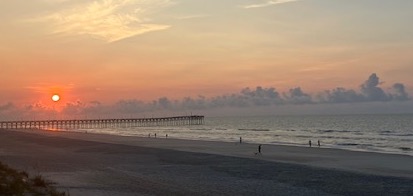
Initially, I didn’t see the sunrise. I saw the power of its early predawn light casting shades of orange and pink into scattered clouds.
Predawn colors starting to show (Photo Bill Pike)
Over the next fifteen minutes, the sun kept slowly rising, and gradually, the familiar orange ball peered over the Atlantic Ocean.
The sun appears (Photo Bill Pike)
As the sun is waking, I do some exploring on the beach.
I notice the lightweight pattern of a bird’s feet or a crab’s scrabble leaving an imprint on the sand.
Someone has been here. (Photo Bill Pike)
With help of the wind, in some sections, the sand is shaped and rippled.
Pretty swells of sand (Photo Bill Pike)
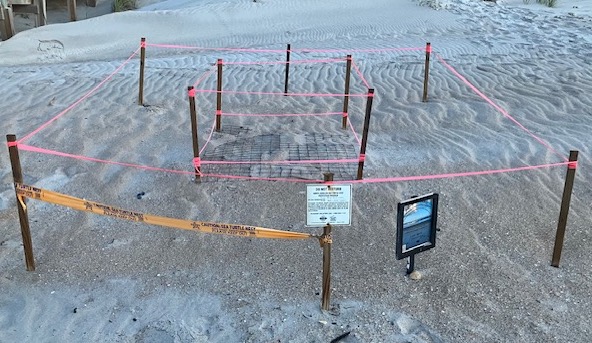
And there is nothing better than discovering a protected location for a sea turtle nest.
A well marked sea turtle nest (Photo Bill Pike)
Since our rental house was close to the center of Surf City, I opted to go for a run—a run that would take me across the massive Surf City Bridge.
I don’t know how much longer my old body will take me out for a morning run, but I secretly hope— forever.
In working my way toward the bridge, the road is flat and straight as it parallels the beach front. Earlier this morning, our son had run across the bridge. He gave me a few pointers for accessing it.
Careful to abide by pedestrian crosswalks, and early morning traffic merging into the roundabout, I found my way to the bridge.
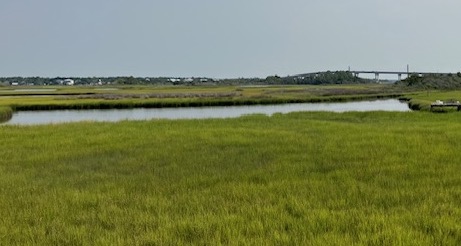
The flatness of the road surface disappeared. Eventually, my legs were working me up an incline were the arch of the bridge construction peaks. This incline is gradual as the bridge sits 65 feet above the water.
Planners were thoughtful with the design. The bridge not only features stunning views of the tidal areas along the Intracoastal Waterway, but a bike lane and a wide walkway for walkers and runners. I have ample room to run, but I am mindful of other runners, walkers, and bicycle riders. We all appear to be mindful of each other.
The view no matter where I look is remarkable.
I can only begin to imagine what accessing the island was like before any type of bridge was in place. My guess is that Topsail Island enjoyed its solitude.
I know this—I will cherish this 36:59 run for many years.
By midday, our oldest daughter and her family had arrived. Unfortunately due to work commitments, our son-in-law would only be with us until Wednesday.
The energy level in the house picked up as our four grandchildren enjoyed their beach time and an assortment in-house activities.
In the pre-trip planning, a meal schedule was worked out. Culinary skills would be showcased and tested, but this was no Food Network contest. Nope, just an opportunity to feed twelve hungry beach lovers at the end of the day.
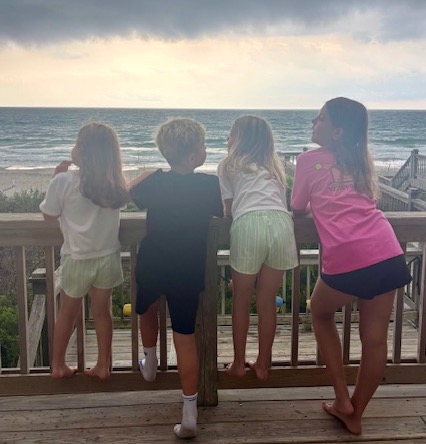
After dinner, the four cousins converge on the deck. They watch storm clouds starting to roll in over the ocean.
Cousins checking out the weather (Photo Elizabeth Cates)
My mind thinks back to our ride through the tiny coastal plain communities we saw yesterday. That apparent poverty is such a contrast to the real estate wealth on the island.
We design and build a $54 million dollar bridge, but we appear to be incapable solving our poverty in America.
Why is that?
If we have the will to build a $54 million dollar bridge, shouldn’t we have the will to solve poverty?
More importantly, what am I doing with my will toward helping to solve that poverty?
When she married the love of her life, Ed, Alice left her Baptist roots for Catholicism.
With their marriage, Ed’s work led them to multiple cities across America.
Not matter where they lived, Alice adjusted.
During those years, Alice became a highly skilled teacher.
No matter where she and Ed lived, children benefited from her teacher heart.
That same heart was useful in the raising of a daughter and son.
That heart is still a source of guidance and love for Ed and Alice’s four grandchildren. Those grands feel that love and support in any number of ways.
Over the last few years, Alice has been battling her health.
A mean melanoma and at times a quirky heart have attempted to wear Alice down.
Despite these health concerns, Alice has kept moving.
A girls trip to England, a family celebration in Boston, holiday family gatherings, beach trips(the latest to Anna Marie Island, Florida), and theater trips to watch her gifted brother perform in local productions.
At the end of May, Alice and Ed traveled to Richmond for the marriage of our youngest daughter. We were honored to have them with us.
That movement to those places is grounded in courage, a courage that says in a quiet way—“go to hell melanoma!”
On Sunday, July 12, we received a health update from Alice. She describe a long day at Duke Hospital on Friday, July 10 with lots of tests.
The doctor found that the current medication has lost its effectiveness in combatting the melanoma.
Options were discussed. Alice has decided to try one more medication.
Sadly, options are limited at this stage of Alice’s life.
In advocating for herself for other optional treatments, Alice said to her doctor, “but, I’m a young 77.”
What this conveyed to the doctor is—I can still fight. I’ve kept moving and active through all of these treatments. Don’t underestimate me because of my age.
Back on July 19, our senior pastor at Trinity United Methodist Church, Gina-Anderson Cloud focused on Luke Chapter 8. Part of these verses are about the woman with a lingering health challenge.
A large crowd of people had gathered around Jesus. Knowing his healing powers, the woman sees him and thinks— “if I can just touch his clothing I will be cured.”
She presses through the crowd just enough to briefly touch his clothing. Instantly, the woman’s health changes. And in that same instant, Jesus senses that a power has left his body.
Jesus challenges the crowd of people asking who had touched him.
Knowing that she couldn’t hold back the truth, the woman confirms to Jesus that she was the one touching his clothing. Jesus says to the woman: “Daughter, your faith has healed you. Go in peace.”
On Monday following the service, I told our senior pastor, I could not hold back my truth—I have always struggled with that scripture.
My struggle is because of my cousin Alice, and the millions like her who want to experience that same touch, that same instant cure from Jesus.
If way back then a person could be cured in a blink, why can’t right now a person be cured by that same touch?
I have written about this scripture before. I’m certain I’m not the only person in this weary, worn world who has the same question.
I will go to my own death with that question on my heart, and so will million others.
Maybe God and Jesus understand, but as a mere human being, I’m sorry, I don’t.
I’m not a subscriber to Bible Gateway, but I do look at the daily scripture reading.
Today on Sunday, July 26 the reading was from Hebrew Chapter 11 verse 1: “Now faith is confidence in what we hope for and assurance about what we do not see.”
With our health, when we’re “77 years young” we want to have confidence in hope.
And undoubtedly, we want an assurance—no matter how dire our circumstances, we want to be able to touch like the woman in Luke did.
And, we want to hear the same words she heard with her honest, heartfelt confession: “your faith has healed you. Go in peace.”
My young “at 77” cousin Alice (Photo courtesy of Pike family archives}
The goal was to be on the road by 10 a.m. By 9:45, we were pulling out of our Richmond driveway.
Earlier that morning, I commiserated with our next door neighbor whose family was heading to Atlantic Beach, North Carolina. While our destination was Topsail Island, North Carolina, we both would be at the whims of I-95.
From Maine to Florida, I-95, America’s east coast interstate, eagerly awaited us.
No matter how many attempts designers and engineers with expertise in road construction and traffic control have made to improve this connector of cities and states, in a blink I-95 can become a nightmare.
We did pretty well until 12 noon. That’s when my Commander Supreme’s phone turned bright red.
Slowed traffic on I-95 (Photo Bill Pike)
It wasn’t long before both southbound lanes began a slow crawl down the overheated road surface. We heard no sirens from emergency vehicles. Saw no flashing blue lights from state troopers rushing along the breakdown lane. No flashing signs telling drivers to move into the left lane. No tow truck drivers with yellow lights flashing following the state troopers.
No, what caused this two lane backup was a broken down tractor trailer in the travel lane. Apparently, the truck decided to die in such a way that the driver was not able to coax the monster into the breakdown lane.
Eventually, we worked our way off the interstate to a maze of North Carolina highways that with the correct turns would lead us on to Topsail Island. I can tell you this—I wouldn’t recommend making this drive in the dark of night.
The further east we drove into the coastal plain the deeper you move away from what I take for granted in Richmond.
Way out here, drugstores and storage units are not on every corner. There is no sprawl.
Much of what drivers see in these tiny communities are single, stand alone businesses— a Family Dollar store, a service station at an intersection, and an occasional non-chain restaurant.
Interestingly, we did pass multiple churches, sometimes a school, lots of trailers, and large plots of farmland with corn, soybeans, tobacco, and cotton. It was clear that North Carolina like Virginia is in the midst of a significant drought.
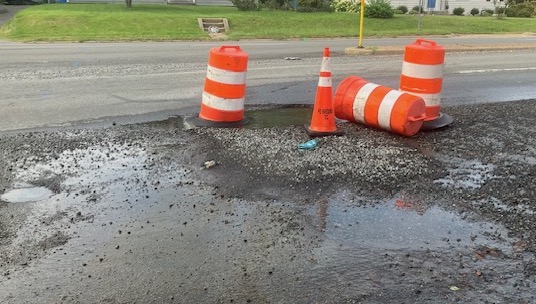
The impact of the drought was most notable with the corn. The corn was parched, stunted by the lack of rain. The corn’s normal lush green has been baked by the sun squeezing out its internal moisture and fading the green.
Hopefully, the drought will gradually resolve itself without too much hurt to farmers and consumers.
On the last miles before the beach, the real challenge for me is trying to figure out why we have been unable to solve and stop the generational cycles of poverty.
All along this route, I see weary looking house trailers. Abandoned, overgrown, houses dot the landscape too. I wonder how many families on either side of the road are barely hanging on? Do they feel any betrayal from the politicians they have supported over the years? Why can’t we break these cycles?
As we approach Surf City on Topsail Island, the traffic lights are blinking red. Trained volunteers are placed at these critical intersections. The volunteers had the challenge of directing all of us crazed tourists before we crossed the intercostal waterway on the Surf City Bridge.
Once over the bridge, we worked our way around the traffic circle to our exit. We drove a short distance before we hooked a left on Raleigh Avenue followed by a quick right on to South Shore Drive. A few more feet, and we arrived at our home for the week—Sitting In The Sand.
Hot, humid air greeted us. Unloading cars started.
Members of our family who were scheduled to arrive on Saturday made it safely.
As we settled in, plans were made to visit the beach and order pizza for dinner.
The house appears to be perfect for our needs. The restless Atlantic Ocean will be in our sight lines all week.
And, I’ll have lots of time to ponder my generational poverty question.
I haven’t forgotten my first visit to Virginia Tech.
In the late 1970s, on a beautiful fall afternoon, a friend, a Tech graduate, with whom I taught at Martinsville Jr. High School, took me to a football game.
Even then, I sensed there was something unique about this outstanding university. Years later, that admiration continued. Our oldest daughter is a successful graduate and diehard Hokie.
As an old North Carolina boy, I cheered when Tech entered the Atlantic Coast Conference. Academically and geographically, this was a win for the conference.
Photo of my Virginia Tech hat (Bill Pike)
Despite this affection for a university that has impacted the world beyond Blacksburg’s town limits, I do not understand the school’s relentless pursuit of becoming a dominant player in college athletics.
The recent anonymous gift of $75 million dollars to the school is an example of this quest. I appreciate the donor’s twofold focus with the gift benefiting the school’s athletic department and honors program.
However, there are no guarantees that using these millions to buy the best players, coaches, and building state of the art athletic facilities equals automatic national championships.
Founded as a “land-grant” university in 1872, I wonder how many of Virginia Tech’s “land-grant” peers are consumed by this same push for athletic prominence?
My guess is Virginia Tech’s new football coach, James Franklin, is publicly thrilled with this financial gift.
However, I can only begin to imagine the pressure he must feel to quickly develop his team into a national powerhouse.
Speaking of pressure, does the university’s leadership feel any of that stress to succeed?
If Virginia Tech’s athletic department squanders this investment, other than a coach, who will be held accountable?
Where does that accountability apply to the $95 million in debt that the athletic department already has?
The world was less complicated on my first visit to Virginia Tech.
And yet, I suspect the “lunch pail” in Lane Stadium knows this wisdom from Seneca: “It is not the man who has too little, but the man who craves more, that is poor.”
Hokies, I hope your craving works out.
Bill Pike, Richmond
Note from author: I am always honored when a piece I submit to a newspaper is published. This letter to the editor was published in the Sunday, July 19, 2026 edition of the Roanoke Times. I have many dear friends who are graduates from Virginia Tech. I apologize if the letter offends you. My goal was not to offend. The goal was to ponder one more example of how money continues to rule college sports.
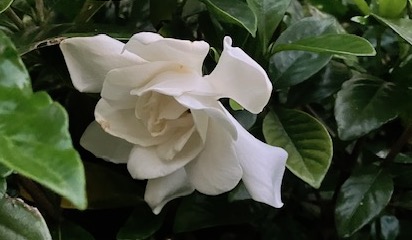

The extreme heat warning was first issued for Richmond, Virginia on Thursday, July 2, 2026.
Two days later on Saturday, July 4, the extreme heat warning was still in place.
When I left for my run that Saturday morning, the temperature was 77 degrees, humidity 88%, dew point, 73 degrees, and wind out of the south at 3 mph. If you moved an inch in any direction on this miserably uncomfortable morning, you were guaranteed to perspire.
For the next 35:49, that’s all I did. When I finished my run, I was drenched. No part of my old sack of bones was dry.
Despite these conditions, I saw walkers, a couple of runners, and neighbors walking their dogs. One neighbor said to me that he was simply trying to beat the heat.
The only way to beat the heat on a day like this is to hope that you have an air conditioned home.
Despite the heat, I did enjoy my run.
Yes, I said I enjoyed my run.
It is always an enjoyable run if I spot a bluebird.
This morning near the end of the service road that runs parallel to Westham Parkway, a bluebird briefly zoomed in front of me. Just like the blue on a blue crab, there is nothing like the blue of a bluebird.
Bluebirds are so flitty. Rarely do these pretty birds stay in one spot. Any movement causes them to quickly exit.
Once I was back home, I was fortunate to see another favorite bird the gold finch. This was my first spotting of the summer. Two of these bright yellow birds were enjoying a breakfast of coneflower seeds.
Even though the harsh, bitter cold of our 2026 winter is gone. Winter in a very small way is still hanging around our neighborhood.
On this run, there is an unusual intersection. Brookside Road and Bryn Mawr Road empty out on to Westham Parkway. There are three stop signs, one for each road.
Where those roads intersect, I find the remnants of winter.
To try to help drivers gain traction on our ice covered roads, snowplow drivers sometimes spread a mixture of salt with tiny granules of gravel and sand. As winter melted away, those particles of gravel and sand with the help of wind, rain, and car tires have worked their way down Brookside and Bryn Mawr.
The grit of winter still hanging around (Photo Bill Pike)
Unless we have a succession of cloud bursting showers, I don’t think this left over grit from winter is going to be leaving the flat area of this intersection.
I admire the grittiness of these tiny particles of sand and gravel. They have endured a harsh winter, the energy of spring, and the stubborn heat and humidity of summer.
Who knows some day, they might be washed into Westham Creek and flow into Westhampton Lake on the campus of the University of Richmond.
From there it is conceivable to flow over the spillway by the student commons heading toward the Kanawha Canal, the James River, and the Atlantic Ocean. I can only begin to imagine such a journey.
But, it is also possible that most of the gritty particles will stay put. They will not be swept away by rainwater, blown by the wind, or dispersed by the friction from car tires.
Deep in what’s left of my old brain, I compare those grains of sand and gravel to people. People who stand at the intersection of their lives.
Maybe they are trying to figure out a new direction in life.
Maybe they are worn and frazzled by the daily struggles they encounter.
Maybe they are weary from being run over by the meanness of life, the struggle to find stability and success.
Maybe they are in a vicious generational cycle full of instability and constant failures.
Maybe, they are in need of hope, grace, and mercy.
Maybe, they just need someone to reach out to them.
Someone to listen without judging.
Someone to acknowledge that despite the burdens they are carrying, these people at the intersection of life do matter, and the struggles in their lives matter.
To them hope, grace, and mercy might be just as flitty and unattainable as a streaking bluebird or gold finch.
1 Thessalonians Chapter 5 verse 11 offers these simple words of wisdom: “Therefore encourage one another and build up each other.”
At church, this past Sunday, I spent a few minutes talking with one of our older members. When I asked him how he was doing, the dedicated husband and father talked about his wife.
For many years, his wife has been impacted by the devastation of Alzheimer’s disease. Recently, her conditions took a turn for the worse.
This change necessitated a different living arrangement. His wife needed more around the clock care. He told me how much he missed having his wife with him.
In these difficult circumstances, I attempted to follow the guidance from 1 Thessalonians Chapter 5 verse 11, but I’m certain my words were way off the mark. His sadness is breaking his heart.
If you are looking for a good piece of fiction to read, I recommend The Correspondent by Virginia Evans.
The book focuses on Sybil Van Antwerp. Sybil was an accomplished attorney who uses her letter writing to try and make sense of her life and the world around her.
In a letter she wrote to Larry McMurtry, the author of Lonesome Dove, she states: “and I suppose, back then, I was reading fiction in search of assurances that there was still a reason for hope.”
Clearly, I’m not the brightest grump in this old world, but at the challenging crossroads and troublesome intersections of life isn’t that what we are searching to find—just a tiny grain of hope?
In the miserable heat and humidity of another summer in the South, might the gritty remnants of a weary winter give us a bit of hope?
And I wonder what might give that much needed hope to those trapped in the crossroads and intersections of an unstable life?
I think the answer depends how much you, me, we, us can put into action these words: “encourage one another and build up each other.”
CHANGING THE CRAFT Stone Brewery’s closure and Legend’s pivot: What’s next for Virginia craft beer? | Guest column BILL PIKE Jun 29, 2026
Thanks to Times-Dispatch reporters Sean Jones and Eric Kolenich for reporting about changes in Richmond’s craft brewing community.
Recently, stories about the closing of Stone’s brewery and a shift in the brewing process at Legend Brewery caught my attention.
I’ve never forgotten my first beer at Legend, nor will I forget my final beer at Stone.
Last beer at Stone (Photo Bill Pike)
In terms of square footage and brewing capacity, Legend and Stone are opposites. However, both breweries were part of the rapid expansion of craft breweries across Virginia and America.
During this unprecedented growth, it was hard to imagine that craft breweries would oversaturate and peak out. The changes at Stone and Legend are also being felt throughout America.
In their annual report, the Brewers Association noted that in 2025, “production declined amid softer beer sales nationwide.” Despite this decline, “craft beer outperformed the broader beer category, and craft beer market share edged higher.”
For craft brewers still in the game, this is good news. But what this truly means is that brewers will need to continue to find ways to maintain the integrity of their quality while keeping their loyal customers happy.
Speaking of happy, the closing of the Stone Brewery is not a happy one. Good, competent, and dedicated employees lost their jobs.
Signage outside the former Stone brewery after its closing (Photo Bill Pike)
In 2022, the large Japanese brewer Sapporo purchased Stone. Four years later, Sapporo decided to sell Stone.
This is the second time that Sapporo has bought an iconic American brewery. In 2017, Sapporo purchased Anchor Steam Brewing in San Francisco. Thanks to what some employees and industry experts called Sapporo’s poor management decisions, Anchor Steam was closed in July 2023.
Now, the former Stone Brewery will be brewing Sapporo’s lightweight beers. I hope Sapporo doesn’t have plans to purchase and destroy any more American breweries.
I’m glad that Legend has worked out an arrangement with another Richmond brewery, Hardywood, to keep brewing Legend’s best-selling beer, their Brown Ale. This is an excellent example of the quiet camaraderie found amongst brewers.
Unfortunately, I don’t think we’ve seen the end of changes in the craft brewing industry in Virginia or America.
The first brewers to set up shop in America also experienced success throughout the Northeast and Midwest. Those early brewers also developed loyal followers and welcoming halls for gatherings.
Today, some of those brewers like Miller, Coors, Budweiser and Yuengling are still around, but they’ve had their struggles, too.I’ve always admired the creativity and ingenuity of craft brewers. Their cleverness helped them to survive the pandemic.
I sense craft brewers are always thinking and working to figure out how to sustain, innovate and keep their loyal followers. Every week, craft brewers are not sitting still. Whether it’s a new beer, a collaboration with another brewer, providing local entertainment or offering hot trends in food, craft brewers keep pushing.
I’d like to know if that constantly pushing mentality could be used to help other businesses and organizations that are struggling. Could those inventive marketing strategies be applied to help declining churches rethink their outreach action plans?
Craft brewers have also been good at finding ways to give back a percentage of their sales by investing in good causes in their own backyards.
Might craft brewers be interested in expanding those community investments? In the art of brewing, lots of science is involved. Is there a way for the science of brewing to be applied to develop brewing apprenticeships or scholarships through our local community colleges and beyond?
In the same way, might our Richmond craft brewers be willing to create a series of beers that capture the goodness of Richmonders and their accomplishments? Could a portion of those sales be used to establish scholarships for students? Some bold Richmond brewer might develop — Michael Paul Williams Pulitzer Pilsner, Maggie Walker Penny Lager, Jonathan Austin Juggling IPA or Arthur Ashe Love 40 Saison.
Can craft brewers survive this downturn? I want to say yes.
But my yes is linked to their ability to understand how they became successful. This requires an exhaustive internal and external review of their strengths and areas for improvement. At the heart of that assessment lies their ability to pivot not only quickly, but with rational thinking.
In truth, I’m not a daily, weekly or monthly visitor to craft breweries. But when I do venture out, I love it when the people in those tasting rooms are a true cross-section of our communities.
For those special moments of diversity, I hope that our craft brewers survive.
Note from author: I was honored to have this op-ed piece published in the Richmond Times-Dispatch. The piece first appeared in the on-line edition on June 29, and it was published in print on Wednesday, July 8, 2026. The two photos included here were supplied by me. Neither appeared with the Richmond Times-Dispatch editions. Thanks, Bill Pike