On the afternoon of Friday, October 9, 2026, our yard needed to be mowed.
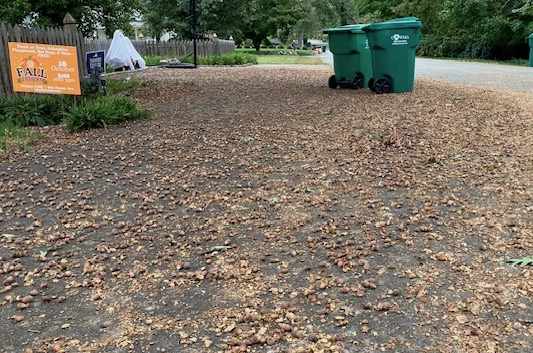
Before I could start mowing the front yard, I needed to remove about ten million acorns.
In truth, I can’t believe we have so many acorns. I thought the summer’s excessive heat and timid rainfall might curtail the acorns this year. I was wrong.
The acorns have been falling from a stately oak tree that lives in the corner of our neighbor’s yard.
This majestic oak has quite a canopy. The spread of this canopy intrudes into our yard.
There are so many acorns that even squirrels are disinterested. Wacky as squirrels are, they might regret their indifference this winter.
Our flower border along the fence line and a mulched section under the dogwood tree have some of those ten million acorns.
The acorns thud when they hit the ground. They bounce off the asphalt. The acorns pop loudly when they careen off the roof of my parked car or its windshield.
Driving over the acorns, sounds like ice cracking on a road surface on a frozen winter morning.
After I had finished raking as many as I could out of the yard, a neighbor who was walking by looked at my pile. She commented, “Wow, that’s a lot of acorns.”
She is correct. I expect after the acorns stop falling that between both yards we will conservatively estimate close to twenty million.
Perhaps you remember from the movie, Forrest Gump, this introduction from Forrest’s new best friend: “My name is Benjamin Buford Blue, people call me Bubba.”
You might recall that young Bubba was all about starting his own shrimping business after the Vietnam war. Bubba could reel off all the possibilities for preparing and selling their harvested shrimp.
Based upon Bubba’s list, I’m beginning to wonder if there might be a market for acorns. According to several sources, some reliable, and some probably unreliable, acorns can be eaten.
If I believed more in the reliable, I could like Bubba name multiple culinary possibilities for the acorns—acorn pancakes, acorn ice cream, acorn muffins, spiced acorn cider, lightly salted acorns, acorn brittle, acorn upside down cake, emulsified acorn soup, acorn slurpy, acorn pudding. You get the idea.
Perhaps, it might be worth calling the Rose Bowl Parade. I’ll bet those clever float makers could find a place for the acorns on their floats.
Seriously, I’m thinking about reaching out to the Virginia Department of Forestry. They might take a million of the higher quality acorns off my hands for potential seedlings.
I know next spring at least half of our front yard will be sprouting oak leaves from the buried acorns.
Meanwhile if you live in a part of America where there are no oak trees producing acorns, for $29.95, I will gladly ship you a pound of acorns.
Before heading out to the Richmond Folk Festival on the afternoon of Saturday, October 10, we had grandparent soccer duty.
The Commander Supreme drove west to the Shady Grove YMCA facilities to watch our third grade granddaughter, Josie, play soccer.
The Commander left early so that she could survey the sale at Tweed. Tweed is one of the most dangerous retailers in Richmond for wives to visit. Husbands cringe when their wives say I’m going to Tweed.
I made no stop at a retailer on my way to Tuckahoe Middle School where our first grader, Ellie, would be playing her game. Both Josie and Ellie play in leagues coordinated through the Tuckahoe YMCA. Ellie’s team holds their weekly practice before the start of the game.
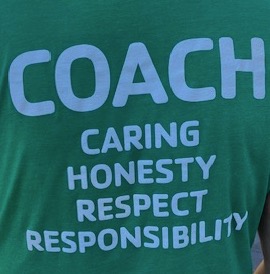
I think the Tuckahoe YMCA does a good job with this program. I particularly like the wording found on the back of the t-shirts worn by the coaches. It reads: COACH CARING, HONESTY, RESPECT, RESPONSIBILITY.
Despite efforts from my friend, Robb Spotts, who played collegiate soccer, coached at the high school level, and still officiates local soccer games, I do not understand the rules of soccer. Perhaps our granddaughters can assist my soccer mentor, Coach Spotts, in my tutelage.
Despite my soccer denseness, I do appreciate with lots of patience from their coaches how these young ladies improve their soccer skills.
I know grandparents are not supposed to brag about their grandchildren, but I’m going to break that rule.
The Commander Supreme reported to me that Josie has improved her skills. Josie scored a goal, and she had multiple saves when playing goalie.
At one point during the game on Saturday morning, I saw that improvement in Ellie’s soccer skills. I have no photographic proof, but here is what I saw.
The other team had the ball. One of their players was pushing the ball down the sideline on the side opposite from where Ellie was positioned. The player had an open field down that sideline.
Ellie from the other side of midfield saw this player breaking away. She ran with the grace of a yearling who had just discovered its stride. Ellie turned on her afterburners, caught up with the player, steered the ball away from her, took the ball back up field, and with some soccer gods’ luck kicked in a goal.
I wanted to see a replay. I wanted to hear a commentator compliment Ellie on her field of vision, her foot speed, and her pivot to work the ball back down field to score a goal.
Until I croak, I will replay Ellie’s play in my mind forever.
The remnants of Hurricane Isaias came to Richmond with a much needed, gentle rain on Sunday morning.
In opening up our church, Trinity Methodist, I was greeted with a text message from our Kids Director, Jen. A slow rotting pumpkin had slimmed a carpet tile in a classroom.
And, I remembered that I needed to replace a burned out light in the mini-kitchen in the Welcome Center.
I popped up the carpet tile, replaced it with a substitute, and disposed of the rotting pumpkin. With warm soapy water, I scrubbed the stained carpet tile, rinsed it, and placed the soggy tile in the Trinity Hall mechanical room to dry.
Next, I worked my way to replacing the burned out light.
Someday, I would like to have a long conversation with the designer of the light fixtures that grace our Welcome Center. That conversation would also include the architect who thought it would be a good idea to install these fixtures in the Welcome Center.
My battles with these fixtures are not pretty.
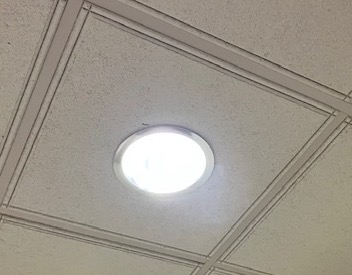
God’s ears burn when the confrontation with the dead bulb starts. Any slim chance that I had for even seeing the pearly gates of heaven slip further and further away when wrestling with replacing these lights.
This Sunday morning was to be no different.
Armed with a ladder, a Phillips head screwdriver, a pencil, gloves, and a new bulb, I started.
The first challenge is to remove the bulb from the socket without it breaking. Just so you know these bulbs are not your standard screw in type. With a gloved hand, I gently try to remove the bulb. Step one failed.
Eventually, I was able to coax the bulb to release. With its cracks, I placed the bulb, into a small cardboard box.
Next, I used the screwdriver to unscrew two screws holding the metal canister in place in the ceiling tile opening.
Quickly, with the pencil, I attempted to push in the new light bulb. The pencil is just the right length, and with the eraser I can apply pressure to push in the bulb. Rushing, I failed again. I did not have the new bulb snug in its four sided opening. The bulb landed hard and cracked on the countertop.
More muttering of unacceptable language spewed.
So, I regrouped. Went down into Eaton Hall to grab a new bulb. Came back into the Welcome Center, repositioned the ladder, and started over.
This time the bulb was snug. I put the bulb back into the cone, realigned and tightened the two screws and shoved the fixture back into the ceiling. Unfortunately, the base of the fixture was not flush with the ceiling tile.
Now, I had an unacceptable gap. I removed another ceiling tile, shoved my head into that space, and saw the problem.
To hold the fixture in place on the metal grids where the ceiling tiles lie are two adjustable metal bars. These two bars were not positioned properly. With the assist of more rotten language, I finally found the correct position for the bars. Now the base of the light canister was flush with the ceiling tile.
If you’re still reading this baloney, you are either laughing hysterically, crying for my incompetence, or wondering why, why does God and this church keep this old guy around?
I can’t answer that question.
But, I do think about the words on the back of that YMCA t-shirt worn by their coaches.
Where have caring, honesty, respect, and responsibility gone in our world?
Have they become lost in the chaos of our headlines?
What do acorns, a soccer game, and a light fixture have to do with those words?
The over productive oak tree is simply being responsible to the rules of nature that it has followed since its birth.
Luckily for our granddaughters, the YMCA is still an organization that values caring, honesty, respect, and responsibility. Just imagine the impact we could have on each other and the world if we thoughtfully applied these words.
As for me and that light fixture, despite all of the heartburn it gave me, I do respect the light it provides.
And continuing on the as for me, my wife will tell you that at times I care too much.
I had a school leader tell me one time that I was “honest to a fault.”
And as for responsibility, it is in my DNA.
Where are caring, honesty, respect, and responsibility in our collective DNA?
Maybe acorns pinging off our noggins, the innocent hope of children on a soccer field, and the stubborn collision between an old grump and a light fixture will remind us that we need caring, honesty, respect, and responsibility more that ever.
You, me, we, us need to reconnect with these words.
They are in our DNA.
Winston Churchill said, “Words are the only things which last forever.”
You, me, we, us need to make sure that caring, honesty, respect, and responsibility last forever.