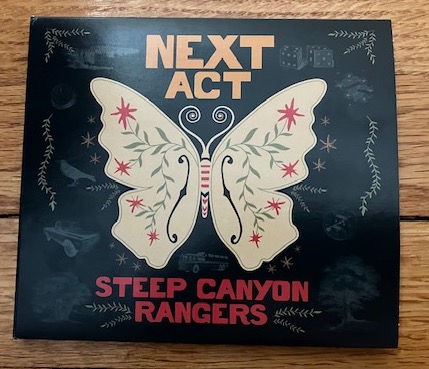
The new Steep Canyon Rangers’ album, Next Act: “we can order it for you.”

(Photo taken of album cover by Bill Pike)

Dear Steep Canyon Rangers,

Sadly, I was not able to attend your May 28 and 29 concerts at the Sierra Nevada Brewing Company Amphitheater in Mill River, North Carolina.

I had a tiny distraction to deal with here in Richmond, Virginia. Our youngest daughter’s wedding was scheduled for Saturday, May 30.

No matter what I tried, neither my wife nor daughter could be persuaded to let me attend either show. Even though, I was just the lowly father of the bride, I guess from a distance or up close the optics didn’t look good for such an escape. Maybe next year.

Congratulations on the release of your new album—Next Act.

I’m one of those old guys who hasn’t returned to vinyl. I prefer having a CD in my hands as opposed to all that digital downloading stuff.

I made a short drive into Richmond to my usually reliable independent record store to purchase Next Act.

Sadly, they did not even have a bin divider with Steep Canyon Rangers printed on it.

In the bin labeled S, much to my dismay they did not have a copy of your new album. They did have a copy of your excellent live album—Live At Greenfield Lake. I already own a copy of this album.

I made another check through the S bin, and rechecked the latest releases section at the front of the store, but no Next Act was present. I questioned an employee about the album, and he simply said, “we can order it for you.”

The Eddie Haskel in me, or maybe that should be the Ernest T. Bass in me wanted to say: “ I can order it too, but I was trying to support your store, you know my local independent record store.”

So, I thought I would try our local Barnes and Noble. They have a small section featuring recordings.

At Barnes and Noble, a nice young lady checked to see if Next Act was in the store, and of course, it wasn’t. And she too said, “we can order it for you.” By that time, the Eddie Haskell and Ernest T. Bass had died in me—no snarky comment.

A few days later, I ordered the CD from The Steep Canyon Rangers’ website. It arrived in the US Mail on Thursday, June 11.

At our church on Friday, June 12, while setting up Trinity Hall for a Saturday evening event, I listened to Next Act.


In some of the preliminary reading I did about the album, I read that instrumentally the recording marked a return to the band’s bluegrass roots. No drum set for Mike Ashworth, and no banjo-caster for Graham Sharp on this recording.

This back to the basics has happened with other bands too.

While mostly overlooked, the Beach Boys attempted to move away from the complexities of Pet Sounds and Smile with their Wild Honey album.

The Beatles made a similar push with the Get Back sessions. This was a significant step away from the legendary Sgt. Pepper’s Lonely Hearts Club Band and to some extent The White Album. However, the shelved Get Back sessions did eventually birth the magnificent Abbey Road.

For the Steep Canyon Rangers, I think Next Act is a winner. There are no clunker songs on the album. I know this because the songs from this recording stuck what’s left of my memory bank.

This album pivots off of the the band’s multiple strengths.

No doubt they are gifted players, masters of their instruments. Their playing can be fiery hot, or deftly simple and pretty.

Mandolin player and harmony singer, Mike Guggino, is an example of this. At times on these recordings, his fingers sear the fretboard of his mandolin.

I’ve always loved their harmonies. But a extra dimension is added to the band with four lead vocalist in Aaron, Graham, Barrett, and Mike. Barrett and Mike are at their best with “Some Days” and “Babylon Stone.”
I continue to be impressed with the band’s songwriters. Aaron Burdett and Graham Sharp are good storytellers. They have a gift for weaving the past and the present into their lyrics. Their stories reflect what feels like real people, real lives—people that you might encounter in any town in America. I like what I hear in the realness of these heartfelt words.

Edie Brickell and Steve Martin lend support on a couple songs. Both performers easily blend into the structure of each song. That’s not surprising considering Miss Brickell and Mr. Martin have histories with the band.

Perhaps not a first, but the Ranger’s gifted fiddle player, Nicky Sanders, puts in some nice piano playing on “Hard Luck Kid.”

Even though I miss his creative and well-timed drum work, Mike Ashworth contributes dobro, guitar, banjo, and some quiet percussion to the recording along with vocals. He is also credited in sharing production work with the group. This is a testament to his talent.

Despite my frustration in securing a copy of the album, my only other complaint is there is no photo of the band anywhere on the CD packaging. Perhaps, the record label, Yep Roc, was saving pennies.

I would like to see the Steep Canyon Rangers in concert again. I’m curious to see if Mike Ashworth will be set up behind a drum kit.

While bluegrass purists are probably dismayed about the drums being a part of the Steep Canyon Rangers, I think Mr. Ashworth’s drumming added a nice punch and texture to the band.

Hope your summer tour goes well.

Thanks for recording and releasing Next Act.

I know this was your fifteenth studio album, and I hope there are fifteen more in the future.

For my rapidly aging, non-musician ears, you gentlemen, the Steep Canyon Rangers, are required listening.

“Long may you run.”

Bill Pike
Richmond, Virginia
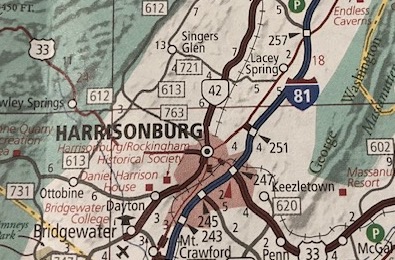
Annual Conference: Methodists in Harrisonburg, Virginia

From June 17-20, Methodist from across Virginia hunkered down at the Atlantic Union Bank Center for the 244th Annual Conference in Harrisonburg, Virginia.

Methodist are pretty tame. I doubt if they needed extra security at the Atlantic Union Bank Center.

Occasionally, Methodist do get riled up on a social issue.

Related to Methodist clergy to be able to perform same sex marriages, it felt like the Methodist church took a million years to make a decision.

Even when common ground was found and changes were made, some congregations weren’t happy and left the denomination.

At this year’s annual conference, Bishop Sue Haupert Johnson will preside. Bishop Sue has a tough job.

Her job is not much different from being the superintendent of schools for a large school system. On some days, no matter what a bishop or superintendent tries, they can’t please everyone.

As a life long Methodist, I’ve attended a few annual conferences. The agenda for the gathering is grounded in reports, voting related to conference business, worship services, and opportunities to learn from fellow Methodist across Virginia.

Worrier that I am, I worry that we Methodists are still too resistant to change. At times, I sense we are trapped in the “that’s the way we’ve always done it’ mindset.

Hanging on to that mentality in the future won’t be helpful to Methodist churches.

In the Winter 2026 issue of the William and Mary alumni magazine, I read an interesting article about Will Payne, a 2001 graduate of the school. (Article written by Jeremy Norman)

The article covers many things that Mr. Payne has been involved since graduating.

At this stage of his life, Mr. Payne is heading up Squabble State Hard Cider and Spirits in Bristol, Virginia. This is a 68 acre agritourism destination.

At the core of Mr. Payne’s work are two dedications—“a drive to build things that matter and an unwavering belief in the potential of people.”

Those two givens are not dissimilar to church thinking—build opportunities for people to participate in programs that matter and utilizing the untapped potential of people.

For years, church attendance and participation has been in decline. Mr. Payne’s investments in southwest Virginia, an area that has struggled economically caused him to rethink what was before him.
He did not focus on that “decline.” Instead, he shifted his thinking to “opportunity” and believing that the region could be “reimagined.”

The keys to “reimagining” were linked to building relationships, understanding the region’s “undervalued assets” and wrestling with how “outdated perceptions limited the region’s potential.”

Reimagining churches could pivot off this template too. Developing new relationships, identifying a church’s “undervalued assets,” and understanding how “perceptions” of a church can limit its future are essential for church leaders and their congregations to consider.

Mr. Payne also learned quite a bit in the reimagining of the farm that was purchased and redeveloped. He stated that “farming teaches humility, weather, pests, disease. If it can go sideways, it will.”

Churches know about humility too. But I wonder if we truly understand humility?

How much of churches going “sideways” was caused by our inability to embrace Mr. Payne’s thinking—“honoring a region’s past and building its future are not opposing ideas.” Going forward can churches find a compatible balance between the two?

In his pursuit to make Squabble State a regional destination, Mr. Payne believes this—“Give people more than a reason to stop. Give them a reason to come back. That’s how you become a destination.”

For churches this means if a new family stops in on a Sunday morning for a visit, then what the church offers that Sunday morning must be compelling enough to make them want to come back. For a church staff and its congregation, that means from the pulpit to the last pew everyone must be at their very best every Sunday— not occasionally.

I hope annual conference went well.

And as clergy and their congregations begin another church year maybe some of these observations about Will Payne from his peers can be put to use toward reimagining our churches:

“Will is a problem solver, a uniter, and a natural servant leader.”

“Will has been successful mainly because he listens. Most people talk more frequently than they listen, and they believe they can persuade people to agree. Will approaches things differently. He allows people the space to express themselves, and then finds common ground.”

If the Methodist church in Virginia expects to impact the future of the communities it serves, the church will need to think differently.

Maybe E. B. White said it best: “The only sense that is common in the long run, is the sense of change – and we all instinctively avoid it.”

Methodist, we can no longer avoid change.

(Photo Bill Pike)

Last rites for a dying pump

The sound I could hear coming from the Trinity Hall Mechanical Room wasn’t a happy one.

For sure, circulating pumps make noise when they are working. But these sounds were beyond the normal whirring of a motor that was working properly.

I could hear metal vibrating and bearings that were thinking to themselves—“I’ve grown weary of this same predictable redundancy day after day, I’m ready to check out.”

Eventually, the I’m not happy sound was annoying staff members who could hear something, but they weren’t quite sure what that sound was.

Our associate pastor asked, “What is that sound?”

I responded, “A pump in need of its last rites.”

So, I asked our HVAC company to stop by to offer an assessment of the ailing pump.

Their assessment was bleak.

The pump needed to be placed in mechanical hospice.

This highly reliable and well-built pump had been circulating chilled water during the often brutal Richmond summers since July 1987. The pump kept people in the Trinity Hall wing of the building from melting on those unbearable summer days.

The estimated cost for the pump’s funeral was close to $13,800. The pump alone was nearly $8,000.

I protested the high cost of that funeral to the estimator. I asked him to sharpen his pencil. He obliged this request. The price reduced almost a thousand dollars.


There was no way that our current budget could afford the funeral cost for a new pump. The harsh winter had been rough on our HVAC systems and budget.

I pushed back.

I thought to myself.

I appreciate the almost forty years of loyalty from this pump.

In this fast-paced, every changing world, I sense that loyalty is becoming a scarce commodity.

I asked if the loyal pump could be rebuilt?

Our lead HVAC technician said that was a possibility.

So with a bit more investigation, we determined that we could shutdown the pump and still keep that section of the building cool.

Late on Thursday afternoon, I pulled down on the arm of the singular circuit for that pump. In a matter of seconds the pump was quiet.

On Friday morning, another technician stopped by to remove the pump. This was no easy task. The pump is bulky, heavy, and in a tight location. Eventually, the technician won.

The pump was transported to Roy’s Electric. For over seventy five years, Roy’s has developed a reliable reputation for assessing old pumps and determining if they are salvageable and able to be rebuilt. This $90.00 assessment will hopefully give us a positive answer to rebuild the pump.

If the pump can be rebuilt with new parts and quality hands on assembly, the cost to bring it back to life is $3,000.

My fingers are crossed that the pump can be rebuilt. Our church budget will appreciate the difference in price.

Keeping an eye on the daily workings of a church is not much different from keeping a daily eye on the workings of our own bodies. Just as mechanical rooms are complicated—so are our human bodies.

We never know when our bodies might opt to have a difficult conversation with us.

I’m sure God and Jesus hear difficult prayers everyday from people around the world.

These people are reaching out because a loved one might be nearing the end.

Clearly, human beings are a lot different from mechanical room HVAC pumps. A pump can be replaced, or maybe rebuilt.

That’s not always the case for human beings. Sometimes, doctors with lots of dignity, grace, and respect must tell families— I’m sorry, but we have no other options.

If I’m lucky before the end of June, I’ll turn seventy-three.

I think how fortunate I’ve been. I wonder how many more birthdays I might have in me?

Despite my efforts to take care of myself, I wonder when will my luck run out?

Today at church, I had a long conversation with a friend who had lost his wife to cancer. Despite this devastating loss, he found comfort in a recent research breakthrough for the type of cancer she battled. That breakthrough was a ray of hope for the future.

Isaiah 41:10 states: “Don’t be afraid, for I am with you. Don’t be discouraged, for I am your God. I will strengthen you and help you. I will hold you up with My victorious right hand.”

In her book, “The Wings of Hope: Survivor,” Lailah Gifty Akita wrote: “Hope is hanging on to the promises of God.”

Doesn’t matter if you’re dealing with a weary old HVAC pump, or the frailty of human life, sometimes, the only hope we have is “hanging on to the promises of God.”

The dying pump (Photo Bill Pike)

Wedding Day Saturday, May 30, 2026: A Toast

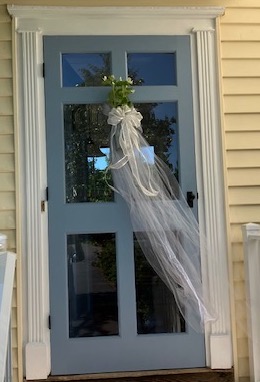
(Photo Bill Pike)

Before, I start, how about this weather. Since Thursday, we’ve had spectacular weather.

I was told to keep this short, no goofy humor, no preachiness, and above all don’t embarrass us.

Nice try.

I’d like to start by thanking everyone for being here this evening.

Over the last few days, we had family and friends arrive from London, England, Hawaii, California, Texas, Tennessee, Illinois, Georgia, Massachusetts, New York, Maryland, North Carolina, and Virginia.

We are honored to have you with us.

But in truth, my most heartfelt thanks goes to those who opted not to attend—bless your hearts.

We are deeply appreciative of our friends, Bill and Cabell Longan for helping Elizabeth and Jackson reserve the Commonwealth Club.

Thanks for every staff member at the Commonwealth Club and our wedding coordinators.

Appreciate the staff and volunteers at Trinity United Methodist Church for their help too.

Thanks to those “dangerous” steel magnolias who hosted bridal showers in North Carolina and Virginia, and the bridal luncheon yesterday.

We also want to thank the Cates and Phipps families for their gracious hospitality at the rehearsal dinner.

The whole evening was delightful—delicious food, connecting conversations, and heartfelt toasts to honor Jackson and Elizabeth.

We look forward to being with you at more family gatherings in the future.

That thanks goes also to some special heavenly guests Ken and Liz, Bill and Louise, Susan and Larry, and two of my uncles Harry and Ralph who adored Elizabeth.

I’ve been thinking about this day for a long time.

I have determined that weddings are not about fathers.

Weddings are all about the mother of the bride or groom.

Our family has been exceptionally lucky to have my wife to be our leader for these events.

Her command center was the kitchen table. All of the lists, notes, and orders were developed there.

Betsy, I love and thank you for all of this.

The words—“Just Chill William” are engrained in what remains of my gnat size brain.

Perhaps that might make a good two-sided t-shirt. On the front “Just Chill William” and on the back a rendering of William in a block of ice with the words “William Is Frozen.”

For a wedding, fathers lose their “Miranda” rights.

George Banks played by Steve Martin in the remake of the movie Father of the Bride showed us that.

I will spare you my George Banks inspired “flipping out” grievances.

Relatives and friends offered me advice related to the wedding.

My sister-in-law, Abby, told me to stock up my basement office with survival supplies and stay down there until a couple days before the wedding.

At one point, I told my college pal, Dan Callow, I’d like to pull a Forrest Gump, and start running away. But in true Dan wisdom, he told me that would be too easy.

So, Jackson, every father prays that his daughter will not end up with Mr. Wrong.

I guess the good Lord was listening, because I think for Elizabeth you are Mr. Right.

I say that for lots of reasons. But over these last couple of years, I’ve seen and admired your quiet endurance and resilience.

And in the ups and downs of that endurance and resilience, I’ve witnessed your love and respect for Elizabeth.

Jackson, we love you and welcome you to our family.

Elizabeth, where do I start?

Quite honestly, I thought at one point during your senior year of high school that I would be faced with two options.

At that time, you and your mother “loved” each other so much that I thought I’d be visiting one of you in prison and the other at the cemetery.

I’m thankful that eventually “love” intervened and persevered.

Jackson, I’m sorry, but the shopping gene that Elizabeth possesses is from the Cloud side of the family.

That is countered by her stubbornness which has long been linked to an unmuted gene from the Pike family.

Elizabeth, I want you to know that I love your endurance and resilience too. I’ve seen that at work in your personal and professional life, and I’ve seen this with your love and respect for Jackson.

The March 2026 issue of Southern Living Magazine has an article titled “She’s Got Game.” The article focuses on six Southern women who have impacted women’s basketball “both on and off the court.”

One of those women is Kara Lawson. She is the coach of Duke University women’s team.

A 2022 video of Coach Lawson talking to her Duke players gained much attention through social media.

Here is part of what Coach Lawson said to her players:

“We all wait in life for things to get easier. Most people think that it’s going to get easier. Life is gonna get easier, basketball’s gonna get easier, school is gonna get easier—it never gets easier. What happens is you become someone that handles hard stuff better.”

Elizabeth and Jackson, I know you know that marriage isn’t easy, but through your experiences with each other you will learn to handle the hard stuff better.

Handling that hard stuff better is grounded in what might be a dying word—loyalty.

Your love and loyalty to each other won’t make life easier.

But your love and loyalty for each other can carry a marriage for a long, long, long time.

Years ago, at Lakeside Elementary School, one of the young teachers on our faculty was engaged.

From her wedding invitation, I cut out and saved these words from the Song of Solomon Chapter 3 verse 4: “I found the one who loves my soul.”

To Elizabeth and Jackson, it is clear to me and everyone here that you “found and love each others souls.”

We pray that love will sustain you and your souls for forever.

All the best!

Note from the author: A few minutes after 4:30 p.m. on Saturday, May 30, 2026, I had the honor and privilege of walking our youngest daughter down the church aisle and to the altar for the wedding ceremony. On behalf of her mother and me, I handed her over to Jackson. Long may they endure.

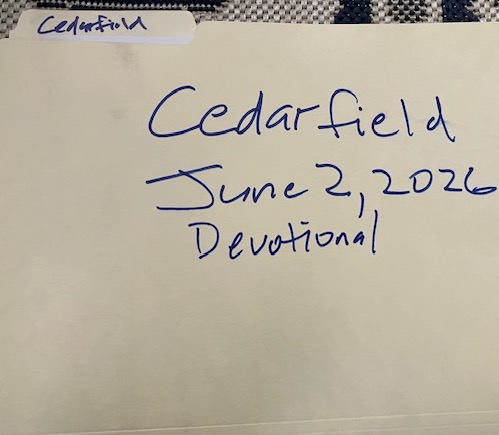
Cedarfield Devotional: “do whatever he tells you”

I’m honored to be with you this afternoon.

Perhaps, we’ll learn a little bit more about each other over the next hour.

That’s right.

I was told to fill up an hour.

Just kidding. I don’t want you to be late for dinner.

Let’s see if I can do better with the humor.

Perhaps, you recall the comedian, Red Skelton.

I can remember watching his show on television.

Here is some humor from Mr. Skelton:

All men make mistakes, but married men find out about them sooner.

There are three signs of old age—loss of memory—I forget the other two.

I put on a lot of weight. I was only six and half pounds when I was born.

I married Miss Right. I just didn’t know her first name was Always.

I asked my wife where she wanted to go for our anniversary. She said, “Somewhere I haven’t been in a long time.” I suggested the kitchen.

There is nothing like a bit of humor to distract us from the challenges that might be whirling around us.

During his career, Red Skelton knew it was important for him to help people to laugh.

Mr. Skelton said this: “I personally believe that each of us was put here for a purpose — to build not to destroy. If I can make people smile, then I have served my purpose for God.”

Do you ever wonder what God was thinking when he brought his son, Jesus, into the world?

What was God’s purpose for sending us Jesus?

Was it to frighten us?

Teach us?

Make us think?

Was it to nudge us to understand our purpose in this challenging and complicated world?

Maybe you are familiar with John Chapter 2 verses 1-12.

This is the wedding in Galilee where Jesus changes water into wine. Let’s read through that scripture passage.

Jesus Changes Water Into Wine


 On the third day a wedding took place at Cana in Galilee. Jesus’ mother was there. Jesus and his disciples had also been invited to the wedding.

When the wine was gone, Jesus’ mother said to him, “They have no more wine.”


 “Woman, why do you involve me?” Jesus replied. “My hour has not yet come.”


His mother said to the servants, “Do whatever he tells you.”


Nearby stood six stone water jars, the kind used by the Jews for ceremonial washing, each holding from twenty to thirty gallons.


Jesus said to the servants, “Fill the jars with water”; so they filled them to the brim.


Then he told them, “Now draw some out and take it to the master of the banquet.”


They did so, and the master of the banquet tasted the water that had been turned into wine.


He did not realize where it had come from, though the servants who had drawn the water knew.


Then he called the bridegroom aside and said, “Everyone brings out the choice wine first and then the cheaper wine after the guests have had too much to drink; but you have saved the best till now.”


 What Jesus did here in Cana of Galilee was the first of the signs through which he revealed his glory; and his disciples believed in him.


 After this he went down to Capernaum with his mother and brothers and his disciples. There they stayed for a few days.

In this setting where we are today, I always have a disclaimer, I’m no Biblical scholar or theologian.
I’m just a below average knucklehead who is still trying to figure out why the good Lord put me here.

So with water to wine story, I’m drawn immediately to the presence of Jesus’ mother, Mary.

She notes that the wedding has a little challenge—they have run out of wine.

I wonder if Mary is thinking to herself— I know how to resolve this dilemma, I’ll get my son to work some of his magic.

Maybe it’s just me, but I sense a bit of terseness in Jesus’ response to Mary—“Woman, why do you involve me?” Jesus replied. “My hour has not yet come.”

Despite that response, Mary says to the servants— “Do whatever he tells you.”

For me, Mary’s response is an indication that she knows that Jesus will not let his mother down.

This past weekend, I was invited to a wedding.

The wedding was for our youngest daughter.

Perhaps, you have watched the remake of the movie, Father of the Bride. This movie starring Steve Martin as George Banks, the father of the bride, clearly illustrates that for a wedding fathers have no rights—their “Miranda” rights are removed.

There is a scene in the movie where George Banks experiences a meltdown—a humorous meltdown. George’s meltdown is grounded in his minimal input for his daughter’s wedding.

Planning for our daughter’s wedding took almost a year.

During that time frame, I could identify with George Banks.

For example, I still do not understand why an invitation to our daughter’s wedding was mailed to our house. I knew she was getting married.

Why did we waste a whopping 78 cents to officially notify us? I filed it with my long list of “fathers have no wedding rights grievances.”

Subsequently, any attempted whine from me about the planning of our daughter’s wedding was met with this frequent rebuttal from my wife: “just chill William.”

Indirectly, “just chill William” is similar to Mary’s instructions to the servants—“do whatever he tells you.”

In the end, for our daughter’s wedding, I did what I was told to do.

Mary says to the servants “do whatever he tells you.”

In my almost seventy three years of living, I wonder if I’ve complied with those words.

Have I been able to do whatever Jesus tells me to do?

When you look back at your lives, have you been able to do whatever Jesus has told you to do?

A few years ago, I began the process to become a local licensed pastor in the Virginia Conference for the United Methodist Church.

At the time, I received exceptional support from Trinity’s senior pastor, Larry Lenow, and my mentor, Katie Gooch, the director of the Pace Center on the campus of Virginia Commonwealth University.

That initial support nudged me along, but I became frustrated with the process. I became mired in attempting to understand and respond to the multiple layers of work ahead of me.

So, I bailed out. I quit. I did not do what I felt like Jesus had told me to do.

What might have happened at that wedding in Galilee if the servants had not responded to “do whatever he tells you to do?”

I don’t think Jesus is looking for us to turn water into wine.
However, there are times in our daily living when he needs us to do our part and help people.

At Trinity, we attempt to do our part by helping people through our mission work. Goochland Cares, the Tuckahoe YMCA, the Park at Oak Grove-Bellemeade, the food pantries at Belmont, Sherbourne, and Welborne, the recent United Women In Faith collection for UMCOR care kits, an upcoming youth mission trip to serve people in need in western North Carolina, and the upcoming Joy Circle are examples of “do whatever he tells you to do.”

In case, we didn’t notice, there is another important part of the “water to wine” scripture.

This is the first time that his disciples encounter Jesus performing a miracle. With this conversion of liquids, their journey as believers and followers truly begins.

Being a believer, a follower isn’t always easy.

Sometimes, believers and followers of Jesus are faced with making difficult decisions.

Even Jesus, and his mother, Mary, had to make difficult decisions in their lives.

“Do whatever he tells you to do” impacted them.

How difficult it must have been for Mary to “believe” and trust God with her unexpected pregnancy.

How difficult it must have been for Jesus to “believe” and trust God knowing that Jesus was to die on the cross.

Every month, a copy of Southern Living magazine is delivered to our house. My first read in the magazine is the Rick Bragg column. I look forward to Mr. Bragg’s writing because he usually makes me laugh.
At one time during his career, Mr. Bragg was an accomplished newspaper reporter. In 1996, Mr. Bragg earned a Pulitzer Prize for his work at the New York Times.

Mr. Bragg’s book “Somebody Told Me” is a collection of newspaper articles he has written.

In late October 1994, Mr. Bragg wrote a series of articles about Susan Smith. You might recall that Mrs. Smith was the mother who claimed that her car had been hijacked with her two sons remaining in the car as the hijacker stole the car and drove off.

Howard Wells was the sheriff in Union, South Carolina. In the end, it was Sheriff Wells who was able to get Susan Smith to confess. There was no hijacker and stealing of her boys. Mrs. Smith with her boys in the car drove her car into a local lake where they drowned.

Suspicious of Mrs. Smith from the start, Sheriff Wells who describes himself as “I’m not a smart fellow” was smart enough to know that he had to build a rapport, a trust with Mrs. Smith.

Sheriff Wells’ patience and understanding in working with Mrs. Smith allowed him to tell a lie to catch her.

Sheriff Wells admits “I had a problem telling the lie, but if that’s what it takes, I’d do it again.”(Bragg)

I wonder how Jesus would respond to Sheriff Wells’ “lie?”

How does “do whatever he tells you to do” apply in this set of circumstances?

At the wedding Jesus responded to a plea for help from his mother.

Even though, Jesus might have expressed some initial reluctance to his Mother’s request— he followed through and converted the water to wine.

And yes, Sheriff Wells didn’t like telling the “lie”, but deep inside his soul he knew he had to try this tactic for the sake of those two drowned boys. Sheriff Wells did what his soul, his conscience told him to do to solve a horrible, horrible tragedy.

Remember, Red Skelton stated that he believes each of us was “put here for a purpose.”

The real question for you, me, we, us is will we have the courage “to do whatever he tells us to do” when we are called to help someone?

Let us pray: Father of us all, help us to be better “ to do whatever you tell us to do” to help the people we encounter in our complicated world. Amen

(Photo Bill Pike)