Growing up in North Carolina, I felt like the summer break from school lasted forever. When I entered the teaching profession in the fall of 1975, summers started zooming by me.
For 31 years, I had the privilege of working in the public schools of Virginia. I would not trade those experiences for anything.After my career in education, I started working at our church.
Over the past 15 years, I’ve seen that schools and churches share common ground.
Between now and the end of August, public schools in Virginia will be opening. This is a hectic time for school officials as they attempt to fill last-minute teaching vacancies, ensure that bus routes are correct, and that air conditioning systems are working properly.
In the summer, churches can experience lighter attendance.
However, vacations don’t limit churches from supporting community organizations that assist our local schools. This summer, our congregation has provided school supplies for Oak Grove-Bellemeade Elementary School, volunteers for the YMCA’s Bright Beginnings, and shoes and volunteers for Third Street Bethel AME’s New Shoes for Back to School.
A common pivot point for schools and churches is people. During the summer, school and church staff are prepping for the start of a new year. That prep culminates in the first day of school and the first Sunday, signaling the end of summer as students and congregations return.
So how do schools and churches ensure that they are ready? They work. In that readiness work, leaders must convey a vision that includes an understanding of the pulse, the capacity to listen, a framework for building relationships, a willingness to serve and the telling of stories that matter.
It doesn’t matter if you are leading a school or a church; people want to know your vision. Where are you taking them?
To do this, principals and pastors must learn and understand the pulse of their students, parents, staff, congregations and communities. No matter the size of the school or church, learning the pulse is grounded in taking the time to listen.
Learning the pulse and listening to voices in that pulse will develop an important framework for building relationships. Those relationships will enhance opportunities for schools and churches to serve their communities.
From vision, pulse, listening, relationships and service will come the sharing of their stories that matter.
Throughout the year, school and church leaders must invest in telling stories of success. In every classroom, in every sanctuary, there is a story of human interest.
That story might be about the perseverance of a homeless high school senior who lives in a motel with her family, but who is an honors student. That story might be about a church couple volunteering every summer at a respite camp for adults with intellectual disabilities.
Neither schools nor churches are immune to the ups and downs of human behavior or the whims of society. In those challenging moments when school or church life hasn’t been at its best, the storytelling must be honest.
School and church communities need to know that pressure is present in these cherished environments.
I can only begin to imagine the pressure on a principal working in a school where accreditation by the Virginia Department of Education has been denied. That same level of pressure can be felt on a pastor who has been sent to resurrect a dying congregation.
Overlooked in that pressure to serve at a high level is morale. The school and church year is long — work in some celebrations, humor and quiet time.
Both schools and churches have access to all types of data. Researchers have known for a long, long time the impact an outstanding classroom teacher can have on students. At the heart of that impact is the ability to build and grow relationships.
For some students, their six hours at school are the best six hours of their day. That same logic can apply to a person in a congregation who needs support adjusting to the loss of a loved one. Neither schools nor churches will succeed if leaders can’t build beneficial relationships both inside and outside their walls. Winning over a difficult parent or a challenging member of a congregation depends upon building a relationship.
Having worked in each environment, I know schools and churches can be tough places.
Despite their imperfections, I believe in our public schools and our churches. I hope our public schools and local churches get off to a good start.
Perhaps, a good start for students, parents, faculty, staff and congregations is grounded in this wisdom from Richmonder Ernest Parker, Jr.: “It does not cost a dime to be kind to all human beings.”
Amen.
Note from author: Friends, I was honored to have this op-ed piece published in the Richmond Times-Dispatch today Friday, August 28, 2026.
One of the best decisions our church ever made was to build the Welcome Center.
This is an interior, open space behind the Sanctuary.
The space is a perfect place for the congregation to gather after a worship service.
Prior to our kickoff Sunday, August 23, I spent some long hours in the Welcome Center putting together a small desk. The desk would be positioned near one of the Sanctuary exits.
The strategy is that our senior pastor, Gina, can direct visitors to the desk where a friendly church member will be waiting to greet the guest and answer questions.
I do not relish putting together furniture.
From my wife’s side of the family, there is a Christmas Eve story about my father-in-law struggling to put together a child’s Christmas present. My mother-in-law was a great teller of family stories. Every Christmas when the story was retold, the descriptions of this maddening challenge and how her dear husband was handling the madness just kept getting better.
I had a madness moment meltdown with this welcome desk. The instructions were quite sparse. Details weren’t clear or were just left out.
Of course, the lack of clear instructions occurs at exactly the wrong time. I called the manufacturer. They wanted the information off the shipping label.
I impatiently flipped over the large box that had housed the disassembled desk’s packaging. When I did this, styrofoam packaging spewed on to the Welcome Center floor. By that time, styrofoam wasn’t the only thing spewing. Lots of inappropriate words were about to roll off the edge of my tongue.
Sensing my impatience, the technician on the phone quickly sent me information from a video that showed the step by step process for assembling the desk.
Once the link to the video arrived on my computer, I watched the person on the screen rapidly put the welcome desk together. I saw how he worked with two tiny plastic release clips inside the glide framing for the drawer. Without the video, I would not have been able to find those release clips.
Life can be tough to assemble too.
I can’t begin to imagine what it is like to be a visitor at an unfamiliar church on a Sunday morning.
I wonder if visitors dread the passing of the peace moment/greeting of a visitor as much as I do.
Congregations familiar with each other eagerly greet and chat. Our congregation loves this thirty to sixty seconds of interaction. The decibel level rises with this chatter. They love it so much that is tough to shift them back into the next section of the service.
In that roar of happy voices, I wonder if visitors are awkwardly ticking off those seconds waiting anxiously for the service to move forward.
Speaking for myself, I think those are awkward moments.
It is one thing to greet a visitor, but it is an added dimension to engage a visitor in a short conversation that doesn’t scare them off, including asking the wrong question.
I’ve been thinking about this past Sunday.
I sat way up in the balcony, a good place to nap.
A couple was sitting a couple of pews down from me that I didn’t know.
When the passing of the peace arrived, they looked around, yes, awkwardly.
Slowly, I and others in the balcony worked our way toward the couple.
Handshakes exchanged and peace be with you were spoken. But then, we fell silent and walked back to our pew seats.
The couple remained standing—awkwardly.
Just like I assembled that troublesome desk, I suspect that I need some assembling on how to better engage visitors on Sunday morning.
Specifically, how do I move beyond the awkward? How do I engage without alienating, or offending? How do I encourage a return visit or answer possible questions?
Churches spend gobs of money on communication—exterior banners, traditional marquees, electronic marquees, social media, postcards, static displays with information flyers, strategies to capture contact information from visitors, paper and on-line newsletters, videos, a gift, and on, and on, and on.
I don’t take much stock in exterior banners and marquees. I think the world moves too fast out on Forest Avenue.
Paper isn’t a favorite of younger generations. They prefer messaging utilizing technology. Some savvy seniors can handle that, but a few seniors still lean toward paper communication.
Eventually, the desk and I came to terms. I figured it out with a bit of coaching from a video, but with a real human being in it.
Resurrecting a church, its congregation so that it can attempt to grow is a “big rock” challenge.
But meeting that challenge is in the details—the small rocks. Disassembling the awkwardness for the member and the visitor is essential on every Sunday morning.
Disassembling that awkwardness is essential, critical, necessary, required for this reason—Hebrews 13:2: “Do not forget to show hospitality to strangers, for by so doing some people have shown hospitality to angels without knowing it.”
Even with limited skills, I was better at assembling that welcome desk than I was at disassembling the silent awkwardness between myself and visitors on Sunday morning.
I must do better.
The challenging desk and packaging (Photo Bill Pike)
On the afternoon of Tuesday, July 21, 2026, rain poured from a dark sky.
In truth, I wasn’t surprised because it felt like the air was beyond heavy with moisture.
A body knew that at some point the sky was going to burst wide open, and it did.
At Trinity, I always worry about Eaton Hall, the original social hall of the church.
It is a basement below the Sanctuary.
Over time, I have figured out its bad habits.
This old room doesn’t like cloudbursts.
Keeping the drain clear at the base of the exterior stairs is critical. Keep that drain clear, and less water intrudes.
This afternoon, the challenge wasn’t that drain. No, the challenge came from the window wells that surround Eaton Hall.
The window well drains couldn’t handle the deluge. A few of the wells filled like a bucket under a spigot.
I learned a long time ago that water has a mind of its own. Some water from the window wells did come into Eaton Hall, but I could manage it.
When the storm passed, I checked the window wells from the outside. I saw the problem— lots of tree debris.
The next afternoon, I had a date with the window wells.
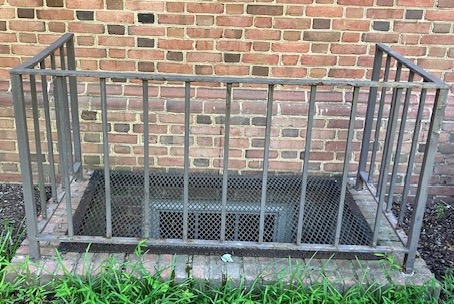
One of the window wells (Photo Bill Pike)
To get into the window well requires lifting up the heavy duty wire grate that covers the well.
The grate must be precisely angled across the top of the window well.
This prevents it from tumbling back over me.
Next, I use a broom to clear spider webs and other crawling creatures.
Then I position a short step ladder into the well, and I crawl over the three sided railing.
I step gingerly on to the ladder and get into the well.
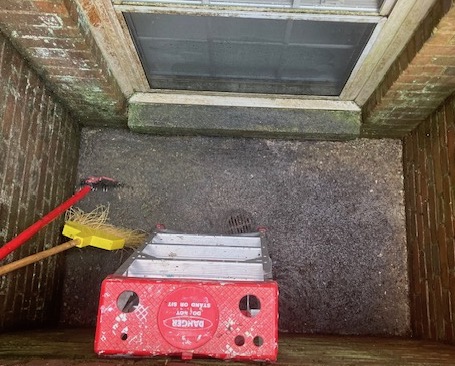
I use a small rake, a bucket, and my gloves to clean up the debris.
In the first well there had been a lot of debris and water.
As I worked, I noticed a sluggish, water logged toad was in the well. He didn’t offer much resistance as I scooped him up with both hands.
I was able to place him on some wood chips outside the window well.
My water logged friend (Photo Bill Pike)
With that well clean and clear of debris, I climbed out and checked on my friend.
A cleaned out window well (Photo Bill Pike)
It would take several minutes for the toad to acclimate. His eyes seemed to be carefully studying me.
Finally, I nudged him toward the grass where he continued to rest. I checked on him one more time, and then he was gone.
During the course of the afternoon, I made two more rescues of small slippery frogs that had fallen into the window wells. They appeared to be less water logged than my toad friend.
In the Richmond area this summer, we lost two young men by drowning in local pools.
A couple of weeks ago when were enjoying the beach of Surf City on Topsail Island, North Carolina, we learned that a man was pulled from the ocean in distress. Attempts to revive him were unsuccessful.
I’m not a strong swimmer. I do not take chances in any body of water.
In the Bible, Noah and God took their chances with each other.
I wonder what God saw in Noah who is described as a righteous man.
God must have had a hunch that Noah, despite his age could build the ark, collect the creatures, and explain to his family what God was doing.
God was displeased with how things were going on Earth. The words corruption and violence were used to describe how we humans were making their way through the world.
Sadly, corruption and violence are still at work today.
At times this summer with the extreme temperatures and humidity, I wondered if God was trying to bake us into being better people.
With the heavy rainfall on Tuesday afternoon, I wondered if God was returning to his forty days of rain to flood out the world again.
I was happy when the last window well had been cleared of debris.
My guess is that God would be happier with us if we made the commitment to solve the troubling debris in our lives that divides us.
We appear to have the will to do lots of things, but I’m not sure we have the will to solve our troubling debris.
Why is that?
Dietrich Bonhoeffer wrote: “The will of God to which the law gives expression is that men should defeat their enemies by loving them.”
I did not love crawling down into those window wells.
Yet, I knew if that debris wasn’t removed, only more severe problems for Eaton Hall would develop.
Within the window wells of our lives isn’t it time that we crawl down inside and work to remove the debris—the division, the incivility, the disrespect that is hurting us?
Are these the enemies within our souls that are preventing us from being the people that God’s heart needs us to be?
When she married the love of her life, Ed, Alice left her Baptist roots for Catholicism.
With their marriage, Ed’s work led them to multiple cities across America.
Not matter where they lived, Alice adjusted.
During those years, Alice became a highly skilled teacher.
No matter where she and Ed lived, children benefited from her teacher heart.
That same heart was useful in the raising of a daughter and son.
That heart is still a source of guidance and love for Ed and Alice’s four grandchildren. Those grands feel that love and support in any number of ways.
Over the last few years, Alice has been battling her health.
A mean melanoma and at times a quirky heart have attempted to wear Alice down.
Despite these health concerns, Alice has kept moving.
A girls trip to England, a family celebration in Boston, holiday family gatherings, beach trips(the latest to Anna Marie Island, Florida), and theater trips to watch her gifted brother perform in local productions.
At the end of May, Alice and Ed traveled to Richmond for the marriage of our youngest daughter. We were honored to have them with us.
That movement to those places is grounded in courage, a courage that says in a quiet way—“go to hell melanoma!”
On Sunday, July 12, we received a health update from Alice. She describe a long day at Duke Hospital on Friday, July 10 with lots of tests.
The doctor found that the current medication has lost its effectiveness in combatting the melanoma.
Options were discussed. Alice has decided to try one more medication.
Sadly, options are limited at this stage of Alice’s life.
In advocating for herself for other optional treatments, Alice said to her doctor, “but, I’m a young 77.”
What this conveyed to the doctor is—I can still fight. I’ve kept moving and active through all of these treatments. Don’t underestimate me because of my age.
Back on July 19, our senior pastor at Trinity United Methodist Church, Gina-Anderson Cloud focused on Luke Chapter 8. Part of these verses are about the woman with a lingering health challenge.
A large crowd of people had gathered around Jesus. Knowing his healing powers, the woman sees him and thinks— “if I can just touch his clothing I will be cured.”
She presses through the crowd just enough to briefly touch his clothing. Instantly, the woman’s health changes. And in that same instant, Jesus senses that a power has left his body.
Jesus challenges the crowd of people asking who had touched him.
Knowing that she couldn’t hold back the truth, the woman confirms to Jesus that she was the one touching his clothing. Jesus says to the woman: “Daughter, your faith has healed you. Go in peace.”
On Monday following the service, I told our senior pastor, I could not hold back my truth—I have always struggled with that scripture.
My struggle is because of my cousin Alice, and the millions like her who want to experience that same touch, that same instant cure from Jesus.
If way back then a person could be cured in a blink, why can’t right now a person be cured by that same touch?
I have written about this scripture before. I’m certain I’m not the only person in this weary, worn world who has the same question.
I will go to my own death with that question on my heart, and so will million others.
Maybe God and Jesus understand, but as a mere human being, I’m sorry, I don’t.
I’m not a subscriber to Bible Gateway, but I do look at the daily scripture reading.
Today on Sunday, July 26 the reading was from Hebrew Chapter 11 verse 1: “Now faith is confidence in what we hope for and assurance about what we do not see.”
With our health, when we’re “77 years young” we want to have confidence in hope.
And undoubtedly, we want an assurance—no matter how dire our circumstances, we want to be able to touch like the woman in Luke did.
And, we want to hear the same words she heard with her honest, heartfelt confession: “your faith has healed you. Go in peace.”
My young “at 77” cousin Alice (Photo courtesy of Pike family archives}
Doesn’t matter if you are watching on-line or here in the Sanctuary, we are happy that you joined us.
Will you join me in prayer?
Father of us all, we thank you for the privilege of worshipping this morning. Over the next few minutes, touch our hearts. Amen
I truly am honored to be with you.
When I have this opportunity to pinch-hit in the pulpit, I always offer some disclaimers.
First, I’m no expert on anything. My wife can affirm that.
Second, I’m no theologian or Biblical scholar.
And finally, while I did complete the process to become a certified lay speaker, I’m sure if leaders for the district and conference checked carefully, they might find that my credentials need renewal.
Despite those disclaimers let’s get started.
On the afternoon of Monday, June 15, I was in Trinity Hall. I was quietly putting away chairs and tables from a Saturday afternoon event.
At some point, I took a break, and checked my phone.
I saw I had a missed call. The person had left a voice mail.
That’s when I learned your pastor, Mark, was looking for a substitute, a pinch hitter for this morning.
My mind slipped back into my years in public education and as a student too. When the regular teacher was out for a day, sometimes good students took on a different persona. Depending upon their skills, often a substitute teacher could have a challenging day.
So, I accepted Mark’s invitation, and with some regret, I promise to behave.
Today is Father’s Day.
At Trinity on Father’s Day, the men have a tradition of wearing Hawaiian shirts. Years ago, one of our usher teams brought in this practice. In truth, its been fun. But for the benefit of your eyes, I opted to spare you the vision of an old guy in a flamboyant Hawaiian shirt.
In preparing for this morning, I pondered multiple scripture options related to fathers. As you know, the Bible has many stories linked to fathers.
I considered Abraham. I thought about the father of the Prodigal Son, and even Mary’s husband, Joseph.
But for some reason, I was drawn to Proverbs Chapter 4 verses 1-15. I think my pull was the multiple references to wisdom.
The movie The Shooter is too violent for me to recommend that you watch it. However, there is a memorable scene in the film about wisdom.
Two of the characters, who are in a bit of hot water, meet with an elderly man who is known for his expertise as a gunsmith.
This expert looks at his two guests and says to them, “You boys come along way, what you looking for?”
One of the guest’s replies: “wisdom.”
With no hesitation, the gunsmith responds, “You come to the wrong place.”
I’m not sure about you, but often in my attempts to deal with this crazy world of ours, I find that I need wisdom.
I wonder where do you go to get wisdom today?
Do you sit at your computer and ask AI your wisdom question?
Do you phone a friend?
In looking for your much needed wisdom, might you do some in depth research?
Or, do you still come to this Sanctuary on Sunday mornings to find the wisdom you need?
Years ago, my search for wisdom would take me to my father or to my father-in-law. Even though their growing up environments were very different, their experiences in life had made them wise. I knew these cherished men would be able to guide me.
Today, I have a very predictable wisdom routine. I start my day by reading the daily devotional in the Upper Room. That quiet time also includes a long prayer connected to my lengthy prayer list.
Yet, I can tell you— nothing else related to the day ahead of me starts until my devotion and prayer time is completed.
Somedays, I find wisdom in the words from strangers who have written those devotionals and live on the other side of the world.
Other days, the scripture reading pushes me to carefully think about the life lessons available from these verses.
Part of what drew me to our scripture reading this morning from Chapter Four of Proverbs were the references to wisdom.
Additionally, from those fifteen verses, I’m drawn to these words: listen, insight, teaching, heart, paths, and evildoers.
The author makes it clear that if you gain wisdom you also need to pickup some insight.
How many times in your life has your insight come from reliving a challenging moment through your rearview mirror? In that reflection, do you ever silently say to yourself, I wish I had responded differently?
Our lives take us down many paths. The scripture warns us that evildoers can be along the way. We are advised not to go down that path to turn away.
Despite those warnings, that wisdom, that insight, some of us fall in with the evildoers. Why is that?
In his book Somebody Told Me, author, Rick Bragg, writes about America. The book is based upon articles that he wrote as a reporter for the New York Times. Mr. Bragg won a Pulitzer Prize for his work. Included in the book are several articles related to the tragic mass shootings that have plagued America.
One of the saddest of these shootings is about Mitchell Johnson and Andrew Golden. When these two opened fire on their school, Mitchell was fourteen and Andrew eleven.
Everyone wants to know how can a fourteen year old and an eleven year old do such a thing? Where did the shooters go wrong? Did these troubled individuals go wrong because they had no wisdom, no insight, no one to guide them in their lives?
How much of that “why” is linked to these findings:
According to a report from the US Census Bureau: In 2023, nearly one in four children in America aged 0‒17 years, totaling about 19 million, were living in a household without their biological, step, or adoptive father, mostly with their mother (85% of cases). In fact, living in a single-parent households with a father absent is the second most common U.S. living arrangement, and the proportion of these households has doubled since 1970 (US Census Bureau, 2023).
That’s right, I said 19 million with no father in the household.
Let me be clear. As a retired educator, I saw how challenging parenting can be in all circumstances. I worked with many gifted single parents. Yet, I wonder how much better life might be for those 19 million children if there was a reliable, steady father in their lives.
And yes, I know that all fathers aren’t perfect.
Even when fathers are reliable, loyal, and steady in their support of their children and families, they can be challenged.
In the Bible, let’s go back for a moment and think about Abraham, and the father of the Prodigal Son, and Joseph.
To be truthful with you, I struggle with God directing Abraham to sacrifice his son Isaac. Yes, I know God tests us. Thank goodness for the angel’s intervention, but I can’t begin to imagine the emotional scarring for Abraham and Isaac.
And to continue that truthfulness, I struggle with the story of the Prodigal Son. I think my struggle with this scripture is because I know there were many times in my life where I disappointed my father. I let him down.
I know there was never a moment in my life when my father let me down—his heart was too good. Perhaps, my father learned from the good heart of the father of the Prodigal Son.
And speaking of good hearts, what about Joseph?
Engaged to Mary. Out of the blue, he learns that she is expecting a child. The angel of the Lord comes to Joseph in a dream telling him to continue to stand by Mary. What trust Joseph must have had in his heart to comply and remain loyal.
When I think about Abraham, and the father of the Prodigal Son, and Joseph, I want to know who taught them to be reliable, steady, and loyal? Where did they receive this wisdom?
For thirty one years, I worked in the public schools of Virginia. Initially, teaching was at the core of my daily work. Yes, I have lots of stories swirling around my old noggin’.
But, I have never forgotten one day during lunch duty in the cafeteria at Lakeside Elementary School. I sat down with a class of second graders. They were waiting for their teacher to pick them up.
One student, who was new to our school, moved closer to me and said clearly “my daddy is in jail.”
I’ve had students confide and say lots of things to me, but that was the first time for “my daddy is in jail.”
Let’s think back to those 19 million children with no father in the home. How many of those children have a “daddy in jail?”
I think we know the answer.
According to the Sentencing Project, 2.7 million children have a parent serving time in prison or jail on any given day, and over 5.2 million have had an incarcerated parent at some point during their lives.
At this point, you might be thinking, hey Bill, can you lightened up a bit?
And the answer is yes.
Why wasn’t one Father’s Day gift better than the other? It was a tie!
Where do dads go to dance on Father’s Day? Golf clubs.
What’s a groundbreaking Father’s Day gift to give to your dad? A shovel.
That was a pitiful attempt at humor.
Maybe, you were distracted from “My daddy is in jail” for a few seconds.
Despite that brief interruption, that challenge, those 19 million children without a father aren’t going to disappear from our communities, our states, and our country.
Perhaps, you have enjoyed some of the documentaries created by American filmmaker, Ken Burns. In the editing room where Mr. Burns and his team work, there is a sign that states “It’s complicated.”
Marriage, having children, and parenthood are complicated.
It takes quite a commitment to work through the ups and downs of marriage, having children, and parenthood.
In a few days, I’ll turn seventy-three. I often wonder how my wife and I made it through raising our three children.
One constant in my reflections is our teamwork.
Our commitment to see each other through never wavered.
Yes, it was challenging, demanding, and frustrating.
But, we survived because of that teamwork. Somewhere along the way, without us realizing it, the wisdom, the insight, the teaching, the listening from Proverbs Chapter Four was with us.
And that included those aggravating, heart wrenching moments when a wrong path or an “evildoer” interrupted the flow of life for our children.
I have no idea where that young man is today who confided in me— “my daddy is in jail.”
I hope that young man’s father was able to return to his son.
With the grace of God, I hope that wisdom, insights, listening, and teaching reconnected their lives. And if in that journey, a wrong path or “evildoers” appeared for the father and son, I hope that the path and the “evildoers” were quickly overpowered and sent on their way by the collective bond found in wisdom, insights, listening, and teaching.
The Steep Canyon Rangers are a successful bluegrass band from Asheville, North Carolina. Through the lyrics of their songs, their songwriters convey some memorable stories.
When I think about those 19 million children, I’m reminded of a song by the Steep Canyon Rangers titled “Hard Luck Kid.”
These words spoke to my old heart:
“He was looking to me with eyes so tired, so young, saying, “Can’t you see I’m worth just as much as anyone?” Give me just one chance, a little grace, and let me in, a little grace for the hard luck kid.”
Out of those 19 million children, you, me, we, us know there are going to be some “hard luck kids” in our paths.
Kids that are “tired,” who just need a “chance,” just a little “grace.”
Proverbs Chapter 4 verse 4 states: “Let your heart hold fast my words.”
Abraham, and the father of the Prodigal Son, and Joseph had hearts that held fast to wisdom, insights, listening, teaching, and grace.
In our daily living when we encounter one of those 19 million children aren’t God and Jesus going to be counting on our hearts to hold fast to wisdom, insights, listening, teaching, and grace?
When that day confronts you, me, we, us will our hearts be ready to respond?
Benediction: I hope you have a good Father’s Day. I recall that all my father wanted on Father’s Day was a good nap. I hope you have a good week too. And, I hope our hearts will hold fast to the wisdom from Proverbs. Now go in peace.
Note from author: On Sunday, June 21, 2026, I had the privilege of pinch hitting for the pastor at St. Andrew’s United Methodist Church in Henrico County, Virginia.
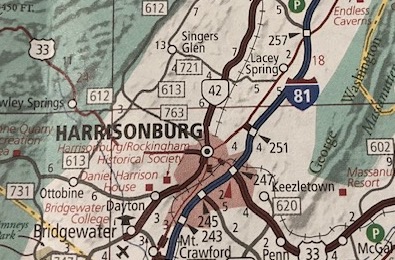
From June 17-20, Methodist from across Virginia hunkered down at the Atlantic Union Bank Center for the 244th Annual Conference in Harrisonburg, Virginia.
Methodist are pretty tame. I doubt if they needed extra security at the Atlantic Union Bank Center.
Occasionally, Methodist do get riled up on a social issue.
Related to Methodist clergy to be able to perform same sex marriages, it felt like the Methodist church took a million years to make a decision.
Even when common ground was found and changes were made, some congregations weren’t happy and left the denomination.
At this year’s annual conference, Bishop Sue Haupert Johnson will preside. Bishop Sue has a tough job.
Her job is not much different from being the superintendent of schools for a large school system. On some days, no matter what a bishop or superintendent tries, they can’t please everyone.
As a life long Methodist, I’ve attended a few annual conferences. The agenda for the gathering is grounded in reports, voting related to conference business, worship services, and opportunities to learn from fellow Methodist across Virginia.
Worrier that I am, I worry that we Methodists are still too resistant to change. At times, I sense we are trapped in the “that’s the way we’ve always done it’ mindset.
Hanging on to that mentality in the future won’t be helpful to Methodist churches.
In the Winter 2026 issue of the William and Mary alumni magazine, I read an interesting article about Will Payne, a 2001 graduate of the school. (Article written by Jeremy Norman)
The article covers many things that Mr. Payne has been involved since graduating.
At this stage of his life, Mr. Payne is heading up Squabble State Hard Cider and Spirits in Bristol, Virginia. This is a 68 acre agritourism destination.
At the core of Mr. Payne’s work are two dedications—“a drive to build things that matter and an unwavering belief in the potential of people.”
Those two givens are not dissimilar to church thinking—build opportunities for people to participate in programs that matter and utilizing the untapped potential of people.
For years, church attendance and participation has been in decline. Mr. Payne’s investments in southwest Virginia, an area that has struggled economically caused him to rethink what was before him. He did not focus on that “decline.” Instead, he shifted his thinking to “opportunity” and believing that the region could be “reimagined.”
The keys to “reimagining” were linked to building relationships, understanding the region’s “undervalued assets” and wrestling with how “outdated perceptions limited the region’s potential.”
Reimagining churches could pivot off this template too. Developing new relationships, identifying a church’s “undervalued assets,” and understanding how “perceptions” of a church can limit its future are essential for church leaders and their congregations to consider.
Mr. Payne also learned quite a bit in the reimagining of the farm that was purchased and redeveloped. He stated that “farming teaches humility, weather, pests, disease. If it can go sideways, it will.”
Churches know about humility too. But I wonder if we truly understand humility?
How much of churches going “sideways” was caused by our inability to embrace Mr. Payne’s thinking—“honoring a region’s past and building its future are not opposing ideas.” Going forward can churches find a compatible balance between the two?
In his pursuit to make Squabble State a regional destination, Mr. Payne believes this—“Give people more than a reason to stop. Give them a reason to come back. That’s how you become a destination.”
For churches this means if a new family stops in on a Sunday morning for a visit, then what the church offers that Sunday morning must be compelling enough to make them want to come back. For a church staff and its congregation, that means from the pulpit to the last pew everyone must be at their very best every Sunday— not occasionally.
I hope annual conference went well.
And as clergy and their congregations begin another church year maybe some of these observations about Will Payne from his peers can be put to use toward reimagining our churches:
“Will is a problem solver, a uniter, and a natural servant leader.”
“Will has been successful mainly because he listens. Most people talk more frequently than they listen, and they believe they can persuade people to agree. Will approaches things differently. He allows people the space to express themselves, and then finds common ground.”
If the Methodist church in Virginia expects to impact the future of the communities it serves, the church will need to think differently.
Maybe E. B. White said it best: “The only sense that is common in the long run, is the sense of change – and we all instinctively avoid it.”
The sound I could hear coming from the Trinity Hall Mechanical Room wasn’t a happy one.
For sure, circulating pumps make noise when they are working. But these sounds were beyond the normal whirring of a motor that was working properly.
I could hear metal vibrating and bearings that were thinking to themselves—“I’ve grown weary of this same predictable redundancy day after day, I’m ready to check out.”
Eventually, the I’m not happy sound was annoying staff members who could hear something, but they weren’t quite sure what that sound was.
Our associate pastor asked, “What is that sound?”
I responded, “A pump in need of its last rites.”
So, I asked our HVAC company to stop by to offer an assessment of the ailing pump.
Their assessment was bleak.
The pump needed to be placed in mechanical hospice.
This highly reliable and well-built pump had been circulating chilled water during the often brutal Richmond summers since July 1987. The pump kept people in the Trinity Hall wing of the building from melting on those unbearable summer days.
The estimated cost for the pump’s funeral was close to $13,800. The pump alone was nearly $8,000.
I protested the high cost of that funeral to the estimator. I asked him to sharpen his pencil. He obliged this request. The price reduced almost a thousand dollars.
There was no way that our current budget could afford the funeral cost for a new pump. The harsh winter had been rough on our HVAC systems and budget.
I pushed back.
I thought to myself.
I appreciate the almost forty years of loyalty from this pump.
In this fast-paced, every changing world, I sense that loyalty is becoming a scarce commodity.
I asked if the loyal pump could be rebuilt?
Our lead HVAC technician said that was a possibility.
So with a bit more investigation, we determined that we could shutdown the pump and still keep that section of the building cool.
Late on Thursday afternoon, I pulled down on the arm of the singular circuit for that pump. In a matter of seconds the pump was quiet.
On Friday morning, another technician stopped by to remove the pump. This was no easy task. The pump is bulky, heavy, and in a tight location. Eventually, the technician won.
The pump was transported to Roy’s Electric. For over seventy five years, Roy’s has developed a reliable reputation for assessing old pumps and determining if they are salvageable and able to be rebuilt. This $90.00 assessment will hopefully give us a positive answer to rebuild the pump.
If the pump can be rebuilt with new parts and quality hands on assembly, the cost to bring it back to life is $3,000.
My fingers are crossed that the pump can be rebuilt. Our church budget will appreciate the difference in price.
Keeping an eye on the daily workings of a church is not much different from keeping a daily eye on the workings of our own bodies. Just as mechanical rooms are complicated—so are our human bodies.
We never know when our bodies might opt to have a difficult conversation with us.
I’m sure God and Jesus hear difficult prayers everyday from people around the world.
These people are reaching out because a loved one might be nearing the end.
Clearly, human beings are a lot different from mechanical room HVAC pumps. A pump can be replaced, or maybe rebuilt.
That’s not always the case for human beings. Sometimes, doctors with lots of dignity, grace, and respect must tell families— I’m sorry, but we have no other options.
If I’m lucky before the end of June, I’ll turn seventy-three.
I think how fortunate I’ve been. I wonder how many more birthdays I might have in me?
Despite my efforts to take care of myself, I wonder when will my luck run out?
Today at church, I had a long conversation with a friend who had lost his wife to cancer. Despite this devastating loss, he found comfort in a recent research breakthrough for the type of cancer she battled. That breakthrough was a ray of hope for the future.
Isaiah 41:10 states: “Don’t be afraid, for I am with you. Don’t be discouraged, for I am your God. I will strengthen you and help you. I will hold you up with My victorious right hand.”
In her book, “The Wings of Hope: Survivor,” Lailah Gifty Akita wrote: “Hope is hanging on to the promises of God.”
Doesn’t matter if you’re dealing with a weary old HVAC pump, or the frailty of human life, sometimes, the only hope we have is “hanging on to the promises of God.”
Before, I start, how about this weather. Since Thursday, we’ve had spectacular weather.
I was told to keep this short, no goofy humor, no preachiness, and above all don’t embarrass us.
Nice try.
I’d like to start by thanking everyone for being here this evening.
Over the last few days, we had family and friends arrive from London, England, Hawaii, California, Texas, Tennessee, Illinois, Georgia, Massachusetts, New York, Maryland, North Carolina, and Virginia.
We are honored to have you with us.
But in truth, my most heartfelt thanks goes to those who opted not to attend—bless your hearts.
We are deeply appreciative of our friends, Bill and Cabell Longan for helping Elizabeth and Jackson reserve the Commonwealth Club.
Thanks for every staff member at the Commonwealth Club and our wedding coordinators.
Appreciate the staff and volunteers at Trinity United Methodist Church for their help too.
Thanks to those “dangerous” steel magnolias who hosted bridal showers in North Carolina and Virginia, and the bridal luncheon yesterday.
We also want to thank the Cates and Phipps families for their gracious hospitality at the rehearsal dinner.
The whole evening was delightful—delicious food, connecting conversations, and heartfelt toasts to honor Jackson and Elizabeth.
We look forward to being with you at more family gatherings in the future.
That thanks goes also to some special heavenly guests Ken and Liz, Bill and Louise, Susan and Larry, and two of my uncles Harry and Ralph who adored Elizabeth.
I’ve been thinking about this day for a long time.
I have determined that weddings are not about fathers.
Weddings are all about the mother of the bride or groom.
Our family has been exceptionally lucky to have my wife to be our leader for these events.
Her command center was the kitchen table. All of the lists, notes, and orders were developed there.
Betsy, I love and thank you for all of this.
The words—“Just Chill William” are engrained in what remains of my gnat size brain.
Perhaps that might make a good two-sided t-shirt. On the front “Just Chill William” and on the back a rendering of William in a block of ice with the words “William Is Frozen.”
For a wedding, fathers lose their “Miranda” rights.
George Banks played by Steve Martin in the remake of the movie Father of the Bride showed us that.
I will spare you my George Banks inspired “flipping out” grievances.
Relatives and friends offered me advice related to the wedding.
My sister-in-law, Abby, told me to stock up my basement office with survival supplies and stay down there until a couple days before the wedding.
At one point, I told my college pal, Dan Callow, I’d like to pull a Forrest Gump, and start running away. But in true Dan wisdom, he told me that would be too easy.
So, Jackson, every father prays that his daughter will not end up with Mr. Wrong.
I guess the good Lord was listening, because I think for Elizabeth you are Mr. Right.
I say that for lots of reasons. But over these last couple of years, I’ve seen and admired your quiet endurance and resilience.
And in the ups and downs of that endurance and resilience, I’ve witnessed your love and respect for Elizabeth.
Jackson, we love you and welcome you to our family.
Elizabeth, where do I start?
Quite honestly, I thought at one point during your senior year of high school that I would be faced with two options.
At that time, you and your mother “loved” each other so much that I thought I’d be visiting one of you in prison and the other at the cemetery.
I’m thankful that eventually “love” intervened and persevered.
Jackson, I’m sorry, but the shopping gene that Elizabeth possesses is from the Cloud side of the family.
That is countered by her stubbornness which has long been linked to an unmuted gene from the Pike family.
Elizabeth, I want you to know that I love your endurance and resilience too. I’ve seen that at work in your personal and professional life, and I’ve seen this with your love and respect for Jackson.
The March 2026 issue of Southern Living Magazine has an article titled “She’s Got Game.” The article focuses on six Southern women who have impacted women’s basketball “both on and off the court.”
One of those women is Kara Lawson. She is the coach of Duke University women’s team.
A 2022 video of Coach Lawson talking to her Duke players gained much attention through social media.
Here is part of what Coach Lawson said to her players:
“We all wait in life for things to get easier. Most people think that it’s going to get easier. Life is gonna get easier, basketball’s gonna get easier, school is gonna get easier—it never gets easier. What happens is you become someone that handles hard stuff better.”
Elizabeth and Jackson, I know you know that marriage isn’t easy, but through your experiences with each other you will learn to handle the hard stuff better.
Handling that hard stuff better is grounded in what might be a dying word—loyalty.
Your love and loyalty to each other won’t make life easier.
But your love and loyalty for each other can carry a marriage for a long, long, long time.
Years ago, at Lakeside Elementary School, one of the young teachers on our faculty was engaged.
From her wedding invitation, I cut out and saved these words from the Song of Solomon Chapter 3 verse 4: “I found the one who loves my soul.”
To Elizabeth and Jackson, it is clear to me and everyone here that you “found and love each others souls.”
We pray that love will sustain you and your souls for forever.
All the best!
Note from the author: A few minutes after 4:30 p.m. on Saturday, May 30, 2026, I had the honor and privilege of walking our youngest daughter down the church aisle and to the altar for the wedding ceremony. On behalf of her mother and me, I handed her over to Jackson. Long may they endure.
Perhaps, we’ll learn a little bit more about each other over the next hour.
That’s right.
I was told to fill up an hour.
Just kidding. I don’t want you to be late for dinner.
Let’s see if I can do better with the humor.
Perhaps, you recall the comedian, Red Skelton.
I can remember watching his show on television.
Here is some humor from Mr. Skelton:
All men make mistakes, but married men find out about them sooner.
There are three signs of old age—loss of memory—I forget the other two.
I put on a lot of weight. I was only six and half pounds when I was born.
I married Miss Right. I just didn’t know her first name was Always.
I asked my wife where she wanted to go for our anniversary. She said, “Somewhere I haven’t been in a long time.” I suggested the kitchen.
There is nothing like a bit of humor to distract us from the challenges that might be whirling around us.
During his career, Red Skelton knew it was important for him to help people to laugh.
Mr. Skelton said this: “I personally believe that each of us was put here for a purpose — to build not to destroy. If I can make people smile, then I have served my purpose for God.”
Do you ever wonder what God was thinking when he brought his son, Jesus, into the world?
What was God’s purpose for sending us Jesus?
Was it to frighten us?
Teach us?
Make us think?
Was it to nudge us to understand our purpose in this challenging and complicated world?
Maybe you are familiar with John Chapter 2 verses 1-12.
This is the wedding in Galilee where Jesus changes water into wine. Let’s read through that scripture passage.
Jesus Changes Water Into Wine
On the third day a wedding took place at Cana in Galilee. Jesus’ mother was there. Jesus and his disciples had also been invited to the wedding.
When the wine was gone, Jesus’ mother said to him, “They have no more wine.”
“Woman, why do you involve me?” Jesus replied. “My hour has not yet come.”
His mother said to the servants, “Do whatever he tells you.”
Nearby stood six stone water jars, the kind used by the Jews for ceremonial washing, each holding from twenty to thirty gallons.
Jesus said to the servants, “Fill the jars with water”; so they filled them to the brim.
Then he told them, “Now draw some out and take it to the master of the banquet.”
They did so, and the master of the banquet tasted the water that had been turned into wine.
He did not realize where it had come from, though the servants who had drawn the water knew.
Then he called the bridegroom aside and said, “Everyone brings out the choice wine first and then the cheaper wine after the guests have had too much to drink; but you have saved the best till now.”
What Jesus did here in Cana of Galilee was the first of the signs through which he revealed his glory; and his disciples believed in him.
After this he went down to Capernaum with his mother and brothers and his disciples. There they stayed for a few days.
In this setting where we are today, I always have a disclaimer, I’m no Biblical scholar or theologian. I’m just a below average knucklehead who is still trying to figure out why the good Lord put me here.
So with water to wine story, I’m drawn immediately to the presence of Jesus’ mother, Mary.
She notes that the wedding has a little challenge—they have run out of wine.
I wonder if Mary is thinking to herself— I know how to resolve this dilemma, I’ll get my son to work some of his magic.
Maybe it’s just me, but I sense a bit of terseness in Jesus’ response to Mary—“Woman, why do you involve me?” Jesus replied. “My hour has not yet come.”
Despite that response, Mary says to the servants— “Do whatever he tells you.”
For me, Mary’s response is an indication that she knows that Jesus will not let his mother down.
This past weekend, I was invited to a wedding.
The wedding was for our youngest daughter.
Perhaps, you have watched the remake of the movie, Father of the Bride. This movie starring Steve Martin as George Banks, the father of the bride, clearly illustrates that for a wedding fathers have no rights—their “Miranda” rights are removed.
There is a scene in the movie where George Banks experiences a meltdown—a humorous meltdown. George’s meltdown is grounded in his minimal input for his daughter’s wedding.
Planning for our daughter’s wedding took almost a year.
During that time frame, I could identify with George Banks.
For example, I still do not understand why an invitation to our daughter’s wedding was mailed to our house. I knew she was getting married.
Why did we waste a whopping 78 cents to officially notify us? I filed it with my long list of “fathers have no wedding rights grievances.”
Subsequently, any attempted whine from me about the planning of our daughter’s wedding was met with this frequent rebuttal from my wife: “just chill William.”
Indirectly, “just chill William” is similar to Mary’s instructions to the servants—“do whatever he tells you.”
In the end, for our daughter’s wedding, I did what I was told to do.
Mary says to the servants “do whatever he tells you.”
In my almost seventy three years of living, I wonder if I’ve complied with those words.
Have I been able to do whatever Jesus tells me to do?
When you look back at your lives, have you been able to do whatever Jesus has told you to do?
A few years ago, I began the process to become a local licensed pastor in the Virginia Conference for the United Methodist Church.
At the time, I received exceptional support from Trinity’s senior pastor, Larry Lenow, and my mentor, Katie Gooch, the director of the Pace Center on the campus of Virginia Commonwealth University.
That initial support nudged me along, but I became frustrated with the process. I became mired in attempting to understand and respond to the multiple layers of work ahead of me.
So, I bailed out. I quit. I did not do what I felt like Jesus had told me to do.
What might have happened at that wedding in Galilee if the servants had not responded to “do whatever he tells you to do?”
I don’t think Jesus is looking for us to turn water into wine. However, there are times in our daily living when he needs us to do our part and help people.
At Trinity, we attempt to do our part by helping people through our mission work. Goochland Cares, the Tuckahoe YMCA, the Park at Oak Grove-Bellemeade, the food pantries at Belmont, Sherbourne, and Welborne, the recent United Women In Faith collection for UMCOR care kits, an upcoming youth mission trip to serve people in need in western North Carolina, and the upcoming Joy Circle are examples of “do whatever he tells you to do.”
In case, we didn’t notice, there is another important part of the “water to wine” scripture.
This is the first time that his disciples encounter Jesus performing a miracle. With this conversion of liquids, their journey as believers and followers truly begins.
Being a believer, a follower isn’t always easy.
Sometimes, believers and followers of Jesus are faced with making difficult decisions.
Even Jesus, and his mother, Mary, had to make difficult decisions in their lives.
“Do whatever he tells you to do” impacted them.
How difficult it must have been for Mary to “believe” and trust God with her unexpected pregnancy.
How difficult it must have been for Jesus to “believe” and trust God knowing that Jesus was to die on the cross.
Every month, a copy of Southern Living magazine is delivered to our house. My first read in the magazine is the Rick Bragg column. I look forward to Mr. Bragg’s writing because he usually makes me laugh. At one time during his career, Mr. Bragg was an accomplished newspaper reporter. In 1996, Mr. Bragg earned a Pulitzer Prize for his work at the New York Times.
Mr. Bragg’s book “Somebody Told Me” is a collection of newspaper articles he has written.
In late October 1994, Mr. Bragg wrote a series of articles about Susan Smith. You might recall that Mrs. Smith was the mother who claimed that her car had been hijacked with her two sons remaining in the car as the hijacker stole the car and drove off.
Howard Wells was the sheriff in Union, South Carolina. In the end, it was Sheriff Wells who was able to get Susan Smith to confess. There was no hijacker and stealing of her boys. Mrs. Smith with her boys in the car drove her car into a local lake where they drowned.
Suspicious of Mrs. Smith from the start, Sheriff Wells who describes himself as “I’m not a smart fellow” was smart enough to know that he had to build a rapport, a trust with Mrs. Smith.
Sheriff Wells’ patience and understanding in working with Mrs. Smith allowed him to tell a lie to catch her.
Sheriff Wells admits “I had a problem telling the lie, but if that’s what it takes, I’d do it again.”(Bragg)
I wonder how Jesus would respond to Sheriff Wells’ “lie?”
How does “do whatever he tells you to do” apply in this set of circumstances?
At the wedding Jesus responded to a plea for help from his mother.
Even though, Jesus might have expressed some initial reluctance to his Mother’s request— he followed through and converted the water to wine.
And yes, Sheriff Wells didn’t like telling the “lie”, but deep inside his soul he knew he had to try this tactic for the sake of those two drowned boys. Sheriff Wells did what his soul, his conscience told him to do to solve a horrible, horrible tragedy.
Remember, Red Skelton stated that he believes each of us was “put here for a purpose.”
The real question for you, me, we, us is will we have the courage “to do whatever he tells us to do” when we are called to help someone?
Let us pray: Father of us all, help us to be better “ to do whatever you tell us to do” to help the people we encounter in our complicated world. Amen
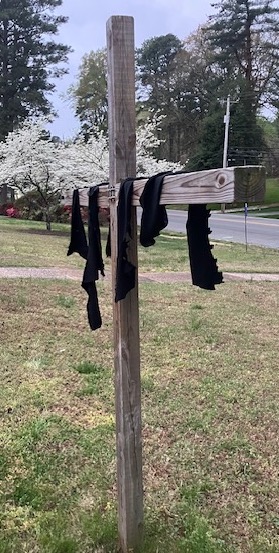
Early on Friday morning, April 3, 2026, I removed the purple cloth from the cross on the front lawn of our church.
I replaced the purple with four torn pieces of black cloth.
(Photo Bill Pike)
The black represents the somber, solemn remembrance of the death of Jesus Christ on the cross.
As you well know, I’m no theologian. Good Friday seems an odd label for naming the day that Jesus was crucified on the cross. I struggle to find the goodness with a good person like Jesus dying this way.
Additionally, you are probably thinking, Bill isn’t much of a Christian if he doesn’t understand this sacrifice as an atonement for sins, thus a win, a victory over sins and death.
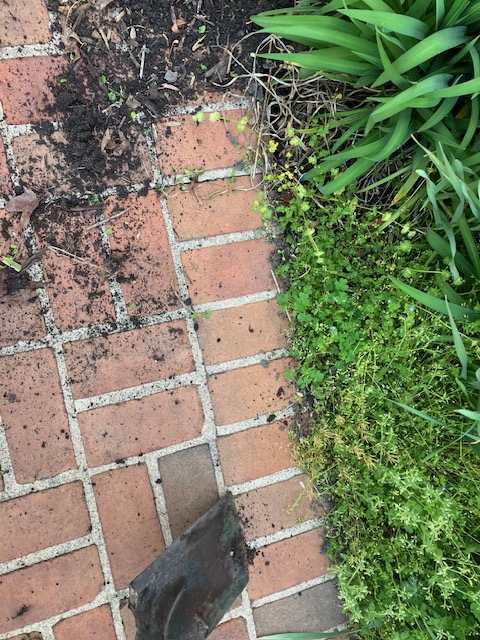
Today, I spent my time on the grounds of our church. I was trying to make the place look pretty for Easter Sunday. I had help from a contracted grounds crew, but not every square inch of our property is covered in the contract.
Most of my time, I was in combat with the weeds. Weeds in borders, weeds in sidewalk cracks, weeds in the mulch surrounding the base of trees, weeds in the fissures of asphalt—weeds, weeds everywhere.
In one border, the weeds were so thick that I knew a huge spider, or a slippery snake were going to have a bit of fun with me. Thankfully, that didn’t happen.
By late afternoon, I was tired of the weeds, and the weeds were tired of me.
Weeding offers solitude.
Weeding can be a time to ponder.
I have an early morning routine that starts my day with the devotional magazine the Upper Room, a well-worn script for prayers, and a computer stop at Bible Gateway.
At Bible Gateway, I always read the Verse of the Day.
One day this week, the featured verse was from Psalm 14 verse one (New International Version of the Bible): “The fool says in his heart, ‘there is no God.’ They are corrupt, their deeds are vile; there is no one who does good.”
I’ve thought about this verse quite a bit during the week.
I’m sorry, but at my age, I’m having quite a few of those fool days—‘there is no God.’
Easter is such a contrast to Christmas.
At Christmas, we celebrate the birth of Jesus Christ, and even with this story there is tension. But like a Hollywood script, the early part of Jesus’ life worked out.
With Easter, the contrast is obvious. Now, we are talking about the end of his life, his death on a cross. There is a tension in this story too.
Lots happened in the days following the birth of Jesus. I like the verse of scripture from Luke Chapter 2 verse 19: “But Mary treasured up all these things and pondered them in her heart.”
In John Chapter 19, we learn that Mary was near the cross watching her son. His simple words to her were: “Woman, here is your son.” I wonder what Mary pondered in her heart following the death Jesus?
I wonder if she thought, yes, you are my son, and you shouldn’t be dying this way.
Did Mary think—God where are you?
You turned the lives of Joseph and me upside down with his birth, and now he is being crucified on a cross.
What kind of deal is this?
A good man, who did good things in your name, crucified on a cross, right in front of me.
Perhaps, you recall the movie—Steel Magnolias.
Oh no, Bill is going Hollywood on us again. Doesn’t he know that Hollywood isn’t real life?
Yes, I know Hollywood isn’t real life. Yet, a good scriptwriter can make words come to life. Robert Harling, the writer of Steel Magnolias, accomplishes this in a a powerful scene in the cemetery following Shelby’s funeral.
Shelby’s mother, M’Lynn is joined by four of her closest friends. The women are there in support of M’Lynn.
M’Lynn responds to her friend, Annelle, “And it’s a real good idea. Shelby wouldn’t want us to get down mired down and wallow in this. We should handle it the best way we know how and get on with it. That’s what my mind says. I wish someone would explain it to my heart.”
Returning back to Psalm 14 and my struggle with Easter. Maybe you disagree, but I don’t see my heart as corrupt, vile, or incapable of doing good.
The fool in my heart wants to understand why.
Wanting to understand the why is human.
Doesn’t matter if it is M’Lynn in the loss of her daughter in Steel Magnolias, Mary in the loss of Jesus on the cross, or any parent who has suffered the premature loss of a child.
We want to understand why, and we want to know where was God?
I hope you and your loved ones have a good Easter.
Maybe before next Easter, I’ll spend more time pondering with my friends the weeds the death of Jesus.
(Photo Bill Pike)
And maybe, the fool in my decrepit heart, who argues with God about a lot of things, will finally hear God’s heart.






 might be baloney