During the first four months of 2026, the reporters and editors of the Richmond Times-Dispatch have provided a variety of stories and opinion pieces about affordable housing.
These reports have covered legislative efforts, involvement from local governments, and St. Elizabeth’s Catholic Church breaking ground for a new affordable housing project.
It is my hope that we can continue to nudge affordable housing initiatives forward.
As a retired public-school educator, I’ve seen the impact that housing instability has on families with school-age children. Additionally, I’ve seen that same uncertainty for families who seek financial assistance related to housing at the church where I work.
For the past three years, I’ve had the privilege of volunteering on the Faith Council for the Richmond Metropolitan Habitat for Humanity. The Faith Council works to seek the involvement of houses of worship in Habitat’s work to provide affordable housing.
Habitat for Humanity has a long history of working to provide affordable housing at the national and international levels.
In fact, 2026 marks the 40th year of the Richmond branch in building and rehabbing homes. During May, the Richmond Habitat staff and volunteers expect to complete construction on their 400th home. This is a significant accomplishment.
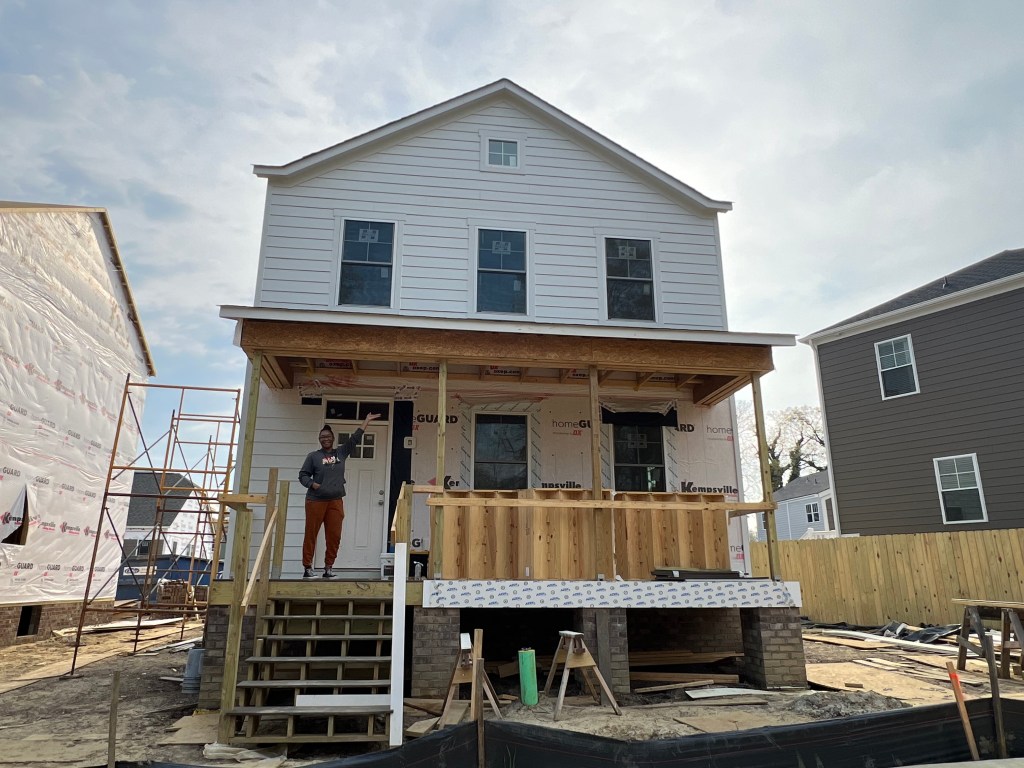
The owner and the 400th Habitat home in Richmond, Virginia (Photo Courtesy of Richmond Metropolitan Habitat For Humanity)
I’ve had the privilege of volunteering on Habitat projects in North Carolina, South Carolina and Richmond. On those sites, I have been impressed by the efficiency of the house designs, the quality of the work completed by Habitat staff and volunteers, and the support of local building suppliers who provide materials.
Yet I always walk away wondering how much more might Habitat accomplish if additional collaborations and partnerships could be brokered?
What happens if Habitat and similar affordable housing non-profits pool resources? Will that allow more houses to be built or rehabbed?
How can our local governments partner with Habitat? Could land donations, financial incentives and opportunities for employees to volunteer on Habitat projects happen in the near future?
With houses of worship, how might their financial resources and volunteers be committed to building a house?
Look at our Richmond neighborhoods and the proximity of churches to each other. Does that geographical closeness lend itself toward building relationships and partnerships for developing more affordable housing projects?
Another consideration with houses of worship is how many empty church buildings are there in Richmond? Can these empty buildings be renovated into housing? If the building can’t be salvaged, can the building be torn down and the land donated for an affordable housing project?
In continuing to explore resources for affordable housing, what is the involvement of our community colleges, Virginia Union University, Virginia Commonwealth University, Virginia State University and the University of Richmond in these initiatives? Are students and professors currently involved? If not, how do we secure their involvement?
Pushing further into our education communities, is there a way for high school students who are enrolled in construction-related Career and Technical Education programs to work on Habitat building and rehab sites?
Clearly, we have lots to consider in the push to support efforts for affordable housing throughout Richmond. Pushing beyond the predictable to find creative and practical ways to sustain Habitat’s work is important.
With my small role on Habitat’s Faith Council, I sense the leadership for Richmond Metropolitan Habitat for Humanity has positioned itself for the long run into the future of our communities.
When the Richmond Habitat office opened in 1986, I wonder if those determined leaders could have predicted the construction of 400 homes in 40 years?
This is a remarkable accomplishment and one worth celebrating.
And yet, I wonder how many more affordable homes Habitat could build in its next 40 years with the development of new relationships and partnerships across Richmond.
We need to find out.
Bill Pike is the director of operations at Trinity United Methodist Church. He can be reached at wapike1@gmail.com.
Note from author: I was honored to have this guest column in the Richmond Times-Dispatch on Wednesday, April 29, 2026. To learn more about Richmond Metropolitan Habitat For Humanity and their forty years go to: https://richmondhabitat.org/
On March 19, the Virginia Commonwealth University Rams (VCU) upset the North Carolina Tarheels (UNC) in the NCAA men’s basketball tournament.
This was in the first round of the tournament. VCU was seeded eleventh and UNC was a six seed.
VCU overcame a 19 point second half lead, and then beat the Tarheels in overtime 82 to 78.
Ten days later on March 29, the Duke University Blue Devils joined their arch rivals, the Tarheels, as Duke also blew a 19 point lead. Duke lost to the University of Connecticut Huskies (UCONN).
Following a Duke turnover, UCONN beat Duke on a last second shot 73 to 72. Duke and UCONN were playing in the Elite Eight for a berth in the Final Four. Duke was a number one seed, and UCONN was a number two seed.
Before going any further, let me tell you that I have always cheered for Duke in the Atlantic Coast Conference. Perhaps some of that grounding came from my parents who thought I might end up going to Duke Divinity School to become a Methodist pastor. The good Lord is thankful that didn’t happen.
I am no expert on college basketball.
I loved the Atlantic Coast Conference (ACC) that I grew up with as a kid. In my opinion, because of money and illogical geographical expansions the ACC has been destroyed.
Also, because of money, including Name Image and Likeness (NIL), the Transfer Portal, one and done players, I worry that the NCAA could fall further into disarray.
I do not watch Duke basketball games. I follow the season from a safe distance. I’m too chicken to put my life in the hands of 18 and 19 year olds with a round ball that has a mind of its own.
Watching missed foul shots and mindless turnovers at critical times during a game would cause me to lose what little real time sanity I have left.
When Duke plays, I check in on line, read the post game analysis, and look carefully at the boxscores.
I’ve watched enough basketball games to know that big leads in the second half are always a concern. Big leads can be tough to sustain. Look no further than the games that UNC and Duke loss.
If UNC took VCU lightly, they shouldn’t have. In 2007, VCU upset Duke 79 to 77 in the men’s NCAA tournament. True that was nineteen years ago, but Duke didn’t expect to lose to VCU either. I guarantee you the Duke players on that team still remember that loss.
If a team has a big lead in the second half with lots of time left, at some point, the basketball gods switch the momentum. Suddenly, everything starts to work for the team playing catch up, and everything starts going wrong for the team with the big lead.
Living here in Richmond where VCU is located, I’ve heard that the UNC players talked trash to the VCU players. Whether that is true or not, I can’t confirm.
But, I know this— trash talking with a big lead isn’t a good idea. If your going to trash talk a team, your talk best be in a really obscure foreign language that no one, not even a student manager on the opposing team can translate. Trash talking your opponent ensures trouble.
And speaking of talking, a reliable friend of mine, a lifelong UNC fan and graduate, noticed that neither Hubert Davis nor Jon Scheyer congratulated the winning coaches and their players in the post-game press conferences.
Perhaps, Coaches Davis and Scheyer were too shellshocked from losing. I understand these were excruciatingly painful losses. However, these coaches have been around basketball all of their lives. They know better—you congratulate the winning coach and his team.
Another source of frustration for me is the coaching carousel. Again, money is the ruler.
Quite often, I think to myself I went into the wrong profession. I should have been a men’s college basketball coach.
I could coach somewhere, turn a losing program around, lead my team into the NCAA tournament, sign an extension contract for millions of dollars, and then fail to continue to win and make it into the NCAA tournament.
Even with this lousy downturn, and the end of my coaching career at this school, it is likely that I a mediocre coach will walk away a millionaire. I can thank my wise agent and attorney for negotiating this sweet deal.
These ridiculous coaching contracts are all about the desire not just to have a winning season every year, but to win conference championships and potentially the national championship.
Alumni with deep pockets are willing to support these coaching contracts while also providing funds to bring in the best players.
Gone are the days when a player is loyal to his school and he plays there for all four years.
Loyalty is a dying word.
The same lack of loyalty can apply to coaches too.
N.C. State’s Athletic Director, Boo Corrigan learned about the lack of loyalty when he hired former LSU coach Will Wade.
Will Wade coached at N.C. State this year. Coach Wade bolted at the end of this season. He agreed to return to LSU where he had been a mediocre coach. Down in Tigerland, Coach Wade will continue to play second fiddle as football is still king of the campus there.
I imagine Boo Corrigan wishes he had never hired or ever heard of Will Wade.
And in truth, I feel bad for Hubert Davis. He might not be a great coach, but he was loyal to UNC.
Seems that the UNC decision makers forgot that Coach Davis’ teams beat the despised Dookies at two critical times in 2022.
First, at Mike Krzyzewski’s final home game at Cameron Indoor Stadium, and then again in the Final Four that year which turned out to be Coach Krzyzewski’s last game.
And with all of the foolishness involved in the speculation of who gets fired and hired as college basketball coaches, it is too bad that the athletic directors at N.C. State and UNC didn’t put out a perfect April Fool’s press release.
They could have announced that N.C. State had hired Hubert Davis and that UNC had offered a contract to former Duke star, Bobby Hurley. On March 11, Coach Hurley and Arizona State parted ways.
College basketball coaches, preachers, and public school superintendents have something in common—pressure.
These individuals are supposed to succeed. Doesn’t matter that it is impossible for them to make everyone happy in their environments.
They must win every game, hit a grand slam every Sunday with their sermon, and survive every school year without controversy. Impossible.
Go take a good look at Hubert Davis’ face in the post VCU press conference. On May 17, 2026, Coach Davis will turn 56. Weariness, the wear and tear of coaching is all over Coach Davis’ face. He looks much older than 56.
The pain of joining Club 19 will linger for some like losing a member of their family in the worse possible way.
If Club 19 is like that for you, I suggest you ponder life a bit deeper, deeper than UNC and Duke’s basketball seasons. Clearly, there are many things in daily living that have a greater urgency.
The real question for Dookies is what do you, me, we, us, the players and coaches learn from blowing a nineteen point lead?
I have a handful of books about college basketball. I’ve enjoyed reading each book. But, it is no secret that my favorite book about college basketball is Pat Conroy’s My Losing Season. If you are a college basketball lover, you must read this book.
In the Epilogue of the book, Mr. Conroy writes: “There is no downside to winning. It feels forever fabulous.But there is no teacher more discriminating or transforming than loss. The great secret of athletics is that you can learn more from losing than winning.” (Conroy pages 394-395, My Losing Season)
I think Mr. Conroy is correct about learning from losing.
Monday, November 2, 2026 will be here in a blink. That is the date set by the NCAA when men’s college basketball games can officially start.
With that date, all of this madness starts again.
My old feeble mind hopes that some common sense might return to the college game.
I’ll hold out for hope, but I think we’re too deep into the allure of money to turn things around.
Of course that enticement could be slowed if multiple college athletic departments continue to run at a deficit. The optics for running in the red will not be favorable.
Long after I’m gone, someone might stumble upon The Andy Griffith Show. The “Mayberry Goes Hollywood” episode illustrates how the charm of the town of Mayberry is turned upside down by its citizens.
A Hollywood movie producer comes to Mayberry to scout the town for the shooting of a movie. The producer likes what he finds with the town and its people.
When Mayberry is chosen as the site for the filming, its citizens turn Mayberry into an unattractive Hollywood themed town.
It takes a gentle chastising from the producer to get the citizens and Mayberry back to normal.
As Mayberry finds itself again, Mayor Pike looks at Sheriff Taylor and says to him: “We tried to tell them didn’t we Andy?” Andy who never fell into the Hollywood trap replies to the Mayor, “We sure did, Mayor.”
Maybe, someday, someone will look back at the current state of men’s college basketball and say, “we tried to tell them.”
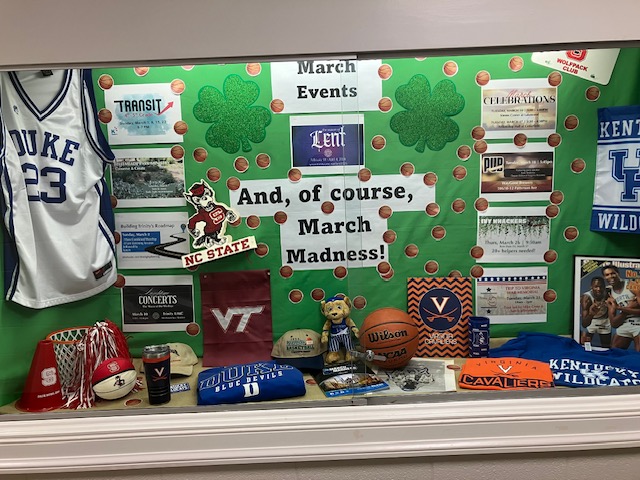
Even March Madness appears in a church display case during Lent (Photo Bill Pike)
On the morning of July 10, 2025, the Fairbanks International Airport reported overcast skies, 53 degree temperature, calm winds, 93% humidity, 51 degree dew point, and ten mile visibility.
Back home in Richmond before I go for a run, I always check the same data at the Richmond airport. Every morning is different, but there is usually one constant—visibility—ten miles.
This morning, I was determined to add Alaska to the places where I have run in my life. So, I left the Westmark Hotel, went down Noble Street, and found the River Walk.
Fairbanks was still waking up. A few raindrops were coming down. The sidewalks and streets were damp from the rain.
The river walk is not dissimilar to other river walks in different cities and states across America. Water no matter if it is an ocean, lake, or river seems to capture our attention.
This morning, the Chena River is calm. It’s quiet, steady current is occasionally broken by a hyper seagull. Maybe this seagull is trying to wake up Fairbanks.
Along my route, I come across a pretty fountain, an assortment of statues, and a couple of American standards—graffiti and a homeless encampment under a bridge.
Retracing my steps, I work my way back to the hotel with a time of 33:41. I might have completed three slow miles.
We had another early riser in our group, Dan, who would be taking a lesson on a float plane with a local pilot.
This would be a busy day for us. We wanted to explore Fairbanks, but we also had to prepare our bags for our return flights to our homes.
By late morning, we were circled up and ready to walk around Fairbanks.
We noted information about the Chena River flood that took place on August 15, 1967.
Here we also learned about the Gould Cabin one of the first of the mining camp cabins. The cabin dates back to 1910.
It features the use of milled lumber and logs available in that time frame. The Gould Cabin’s construction is notable for its ability survive the tough Alaska environment.
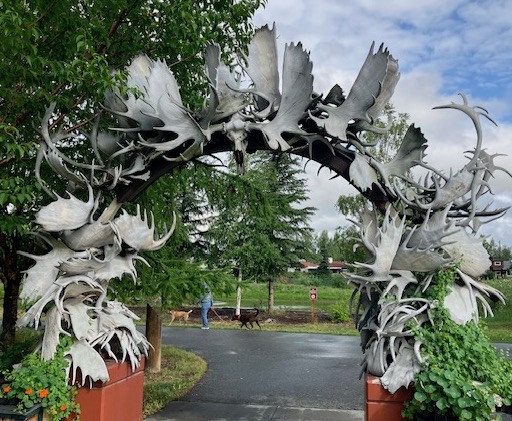
Close by, we came across the Interior Alaska Antler Arch.
The antler arch (Photo Bill Pike)
The antlers were donated by hunters and collectors from around Alaska. Over 100 moose and caribou antlers were donated.
This display was woven together by Fairbanks artist, Sandy Jamieson. For Jamieson, the arch might also be called “an arch of stories.” As each set of antlers is attached to a person who experienced the wilderness of Alaska.
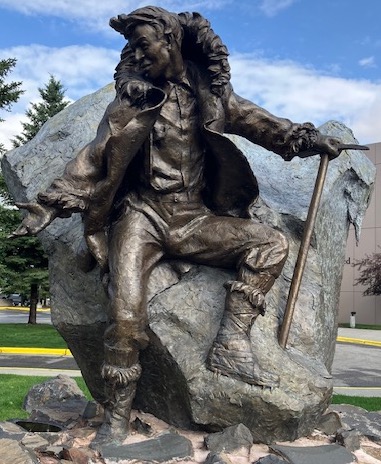
Next we came across a display about the 1913 Pioneer Ascent of Denali. The display clearly captured this historic event, but the focus is on one of the climbers—Walter Harper.
Next to the display is a marvelous statue capturing the essence of Harper on the climb and his outstretched “hand up.” Harper’s possessed the all-around skills for the climb, but he also possessed the essential human skills for his willingness to always extend his hand to help.
Walter Harper and his outstretched hand (Photo Bill Pike)
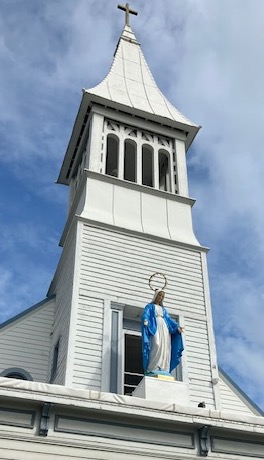
It is a short walk over to the Immaculate Conception Catholic Parish. Established in 1904, this is a pretty white framed building. The church overlooking the Chena River has quite a history. In 1976, the church was named to the Register of Historical sites.
The pretty church (Photo Bill Pike)
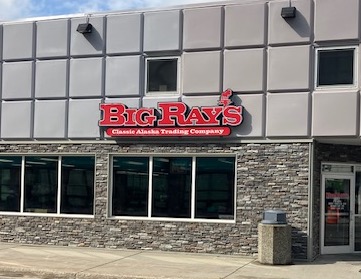
From there, we ambled into downtown Fairbanks. My favorite stop was at Big Ray’s Classic Alaska Trading Company.
A really nice store (Photo Bill Pike)
For lunch, we stopped at a local favorite, The Crepery. The food was good, and it matched the owner’s dream for the restaurant—“to serve good and quality food to the community.”
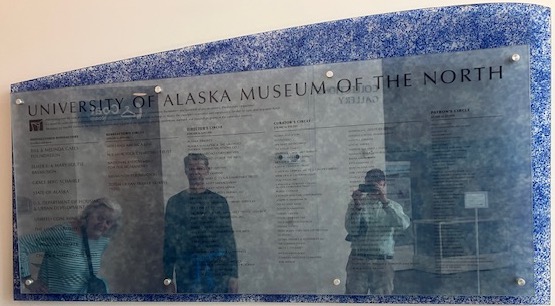
After lunch, Betsy, Dan, and I caught a ride to the University of Alaska Museum Of The North. If you are in Fairbanks, and you have the time, this museum is worth the stop.
(Photo Bill Pike)
From the museum’s website, please note “this is the only research and teaching museum in Alaska.” The museum is home to 2.5 million artifacts. These artifacts are broken down into ten disciplines of study. The museum also captures the northern culture and its history.
On this trip, we have learned how precious Alaska and its resources are. That’s why the museum serves as a valuable resource for research on climate change, genetics, contaminants, and other issues facing Alaska and the circumpolar North.
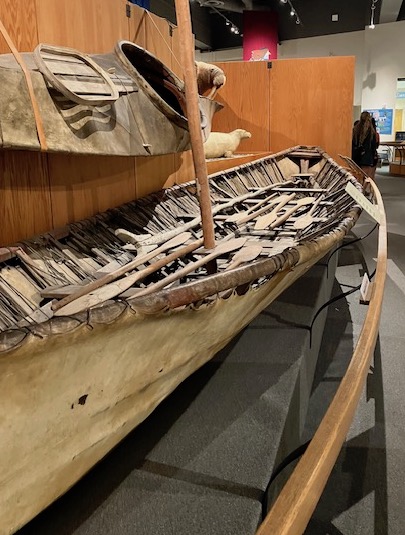
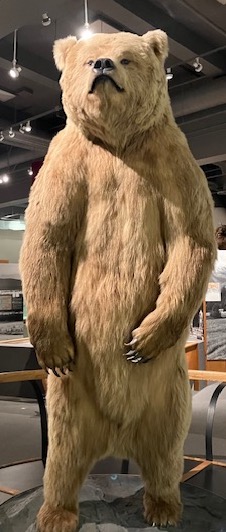
I enjoyed the exhibits about the Brown Bear, Pacific Halibut, Permafrost, and Alaskan Kayaks.
Kayaks (Photo Bill Pike)
At some point, we made our way back to the hotel. Once there, we turned our attention to making sure our luggage was ready for the ride out to the airport.
Checking in at the airport went smoothly. We figured out ordering our dinner, and then we waited for our boarding call.
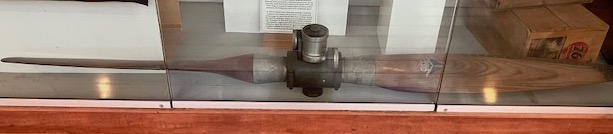
I roamed around the airport’s interior as much as I could. There are some nicely done photos in different places, and I even came across a historical display about aviation with an old wooden propeller.
A well-made propeller (Photo Bill Pike)
Shortly before 10 p.m., we started boarding the Delta B73-900ER for our flight to Minneapolis.
We had said our goodbyes to Dan and Judy as they were on a different flight back into Baltimore. The Pikes and the Sherrills were on this flight that would after the connection in Minneapolis would take us back to Raleigh.
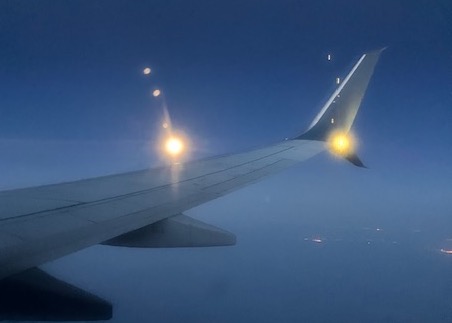
All I can tell you about the flight into Minneapolis is I don’t recall sleeping much. I watched the movie Oppenheimer. I recall looking out of my window several times, and I’m not sure that I ever saw total darkness.
A 1:30 a.m. wing view (Photo Bill Pike)
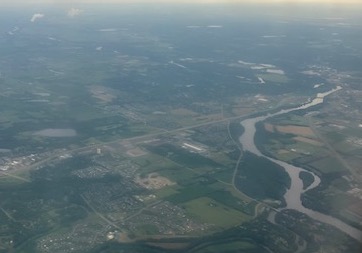
At 6:40 a.m. on the approach coming into the airport, I’m almost certain that we flew over the Mississippi River.
Approach into Minneapolis (Photo Bill Pike)
We landed, and I immediately went into beer search mode. That’s correct— beer search mode.
As it turns out, the beer gods were working in my favor related to time.
Unfortunately, in Fairbanks, our red-eye flight was delayed. A passenger became ill before we departed the runway. The pilot had to taxi the plane back to the terminal so the passenger could be assisted.
Then when we landed in Minneapolis, we learned that our flight back to Raleigh was delayed.
These delays gave me the extra time needed to track down an August Schell beer. Located in New Ulm, Minnesota, August Schell is one of the oldest breweries in America.
My pre-trip research led me to Scott Hislop, the Senior Distributor Sales Manager, for the August Schell Brewing Company.
Scott informed me that in Terminal One of this massive airport was an establishment named the Stone Arch. Stone Arch had an August Schell light beer on tap.
At some point, in the middle of a corridor, I look into the distance and I saw the words Stone Arch. Being sleep deprived, I hope this wasn’t a mirage.
Stone Arch employees were busy with breakfast customers. It took a few minutes for me to flag down one of their employees who handled beverages.
Finally, a nice young man paused as I flagged him down. His hurried steps came to a halt. I explained what I was trying to accomplish. He could not have been nicer.
First, he confirmed that Schell’s Light an American lager was on tap. Additionally, he showed me two sixteen ounce cans that were available, but I opted for the draft.
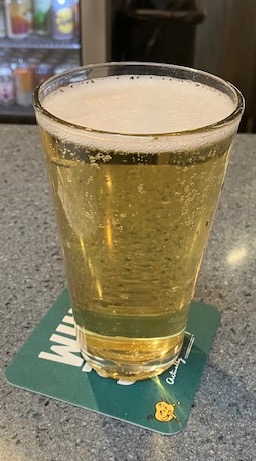
A couple of minutes later, he returned with a perfectly poured glass of Schell Light. This clear, pale lager, was full of carbonation bubbles and a thin head of foam.
My August Schell light beer (Photo Bill Pike)
While I’m not a fan of light beers, this one hit the spot at 7:20 a.m. on Friday, July 11.
I was reminded of the song “Roadhouse Blues” from the Doors’ album Morrison Hotel: “Well, I woke up this morning and I got myself a beer, the future’s uncertain and the end is always near.”
At my old age, I have never purposely abused my affection for beer. Out of respect for the beverage, I’ve worked to be doggedly rigid in my self-control when consuming beer, I’m basically—‘one and done.’
But, I will admit that for a long, long time lurking in the back of my mind were the lyrics from “Roadhouse Blues.”
So now, I can mark the drinking of an early morning beer off an unimportant bucket list.
Yet, there is a more important point, and that is Scott Hislop.
In our fast paced, impatient world, Scott took the time to respond to my original email. To me that is admirable.
After finishing my beer, we found our terminal and waited for the call to board our final flight into Raleigh.
At 8:06 a.m., we were on a Delta A320(OW) bound for Raleigh.
I think I dozed a bit on this flight.
Soon, we were on the ground in Raleigh.
We said our goodbyes to Butch and Marian. One of their daughters was picking them up from Greensboro.
Our future son-in-law picked us up.
He navigated exiting the airport. It wasn’t long before we were back at the condo where our car had been resting for the last fifteen days.
We took a few minutes to regroup at the condo with our daughter and her fiancé. Then we transferred to luggage into our car, said goodbye, and started our ride home to Richmond.
When I was growing up in North Carolina, I don’t recall dreaming about traveling. This trip from Vancouver into Alaska was one that will stay with me for a long, long time.
In Vancouver, Lynn Canyon Park was my favorite. And in Alaska, the color of the ice in the glaciers will never leave me. It is stunning.
I am so lucky to be able to travel with my wife and our dear friends.
Vancouver and Alaska offered us so much. Each place is precious and priceless with their uniqueness. I can only begin to imagine what the first settlers felt like as the embraced the wonder of these environments.
In closing, I simply say to you—if you have the opportunity— go.
You will not regret making the trip.
This little fellow agrees, you will not regret making the trip (Photo Bill Pike)
The invitation came to read a book to Mrs. Cotterill’s second grade class on February 23, 2026.
We agreed on Friday, March 20 at 1 p.m. as the date to read.
The invitation excited me, but there was some selfishness too. Our grandson is a student in Mrs. Cotterill’s class at Summerfield Elementary School in the Guilford County school system.
Friday, March 20, my wife and I drove from Richmond, Virginia to Summerfield Elementary School. Our drive was uneventful. We arrived with time to spare.
We were warmly greeted by the office staff. Additionally, we met the principal and assistant principal.
My wife and I know a bit about schools. We spent our careers working with students, parents, and teachers in Virginia’s public schools.
I grew up in Burlington, North Carolina. Little did I know that I would become part of the 4 R’s saying: ‘reedin’, ‘riting’, ‘rithmetic’, and the ‘road to Richmond’.
My success in Virginia as a teacher and administrator was always connected to my teachers in the Alamance-Burlington School System and the professors who instructed me at Greensboro College.
I had read books to elementary students in Virginia, but this reading made me nervous. I didn’t want to embarrass our grandson.
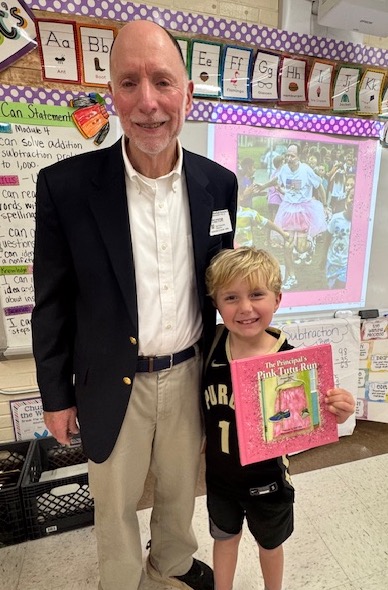
With our grandson after reading the book (Photo Lauren Reinking)
The walk to the classroom took a couple of minutes, but I could feel the pulse of the school. Some classes were outside for recess or physical education. The school has nice outside learning stations. Every classroom we passed, students and their teachers were hard at work.
In prepping to read, Mrs. Cotterill and I planned to use technology to project the book on to a monitor. This allowed all students to follow along while getting a full view of the book’s illustrations.
We tested the technology, and luckily, the technology gods were playing nice this afternoon.
Mrs. Cotterill gave me a kind introduction. I spent a few quick minutes telling the students a bit more about me and the book we would be reading—“The Principal’s Pink Tutu Run.” Full disclosure, I’m the author of the book.
I wrote it about a real experience I had working as an elementary school principal. As we started, my pace was anxious and rushed, but I settled down. I was impressed with the students. They were attentive and quiet. As I read, I appreciated their chuckles. Before I knew it, we were on the final page.
We had a few minutes for questions. The students asked some good ones. I took great pleasure in letting the students know that everyone has the ability to write a book. Writing a book is really about will power and continuously pushing yourself.
I will never forget my time with this class. That is because of the work of their teacher, Mrs. Cotterill, her students, and their parents. Students have a better chance to find success in school when teachers, students, and parents work together.
Working in schools, I felt from the time a child comes into this world until his/her first day in kindergarten are the critical formative years. Family stability, parameters in place for the child, and taking the time to read to this child are vital to their finding success.
Tacked on to those essentials are helping parents understand how important they are in working to support and build relationships with their sons and daughters teachers.
I was lucky— my family was stable, my parents were supportive of my teachers and me, and my grandmother always read to me when she visited.
It’s a tough world out there.
However, I left Summerfield Elementary School feeling hopeful about those clear-eyed, good listening, and inquisitive second grade students.
That’s why it is so important for all of us to work together to make sure these students and thousands like them across North Carolina have every opportunity to find success in their schools and communities.
Author’s note: I submitted this as an op-ed piece to the Greensboro News and Record on March 23, 2026. The word count was 772. On March 24, I received an email from the editor stating that he would like to use the piece. He asked that I shrink the word count to 650. I did that. I sent the piece back at 647 words. He confirmed receiving it. I reached back out to the editor on April 4, asking if he had been able to run the piece. Here we are on April 17, and to the best of my knowledge the piece never ran in the Greensboro News and Record. Disappointing, but that’s ok. That Friday afternoon with our grandson’s class is one I will never forget. Bill Pike
On the morning of Wednesday, July 9, 2025, we picked up a breakfast snack, rechecked our rooms again, and loaded on to the bus.
The drive to Fairbanks was in the two and half hour range. However, this could be extended as there was a wildfire along one section of the highway that had been a nuisance.
According to our bus driver, it was possible that our traffic flow could be disrupted. Firefighting officials might shutdown the highway with a one lane traffic feed that alternated travel in either direction.
As we approached this stretch of the highway, we knew instantly when we were within range of the fire. That familiar campfire aroma seeped into the interior of the bus. Soon we came upon charred forest with occasional plumes of lingering smoke.
We passed staging areas for the fire crews. We could see where bulldozers had plowed access roads and fire breaks. One fire truck was parked on the shoulder of the highway with its firehose stretched into the wilderness.
At some point, my old bladder needed a restroom break.
I was warned by the people sitting in the back of the bus near the restroom that the door didn’t latch properly.
Needless to say, this potty break was going to be an experience.
Securing the door, trying to keep my balance, and my aim on the target was challenging. Thankfully, the potty gods were kind to me—no errors with the door or hitting the target occurred.
In hindsight, I simply should have sat down on the toilet.
Despite a slight delay from the fire, we were ahead of schedule arriving into Fairbanks.
This meant the Holland America personnel had to do some quick thinking. So, we made an unscheduled stop at the visitors center.
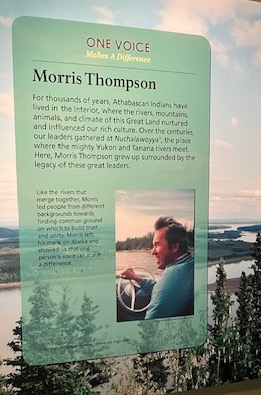
The Morris Thompson Cultural Visitors Center isn’t your typical visitors center. Yes, employees can provide helpful information to travelers, but there is a nice store, an information center for national and state parks, a theater, and lots of cultural and historical displays about Fairbanks and the surrounding area.
We were greeted with this information at the visitors center (Photo Betsy Pike)
Morris Thompson was a prominent leader in Alaska.
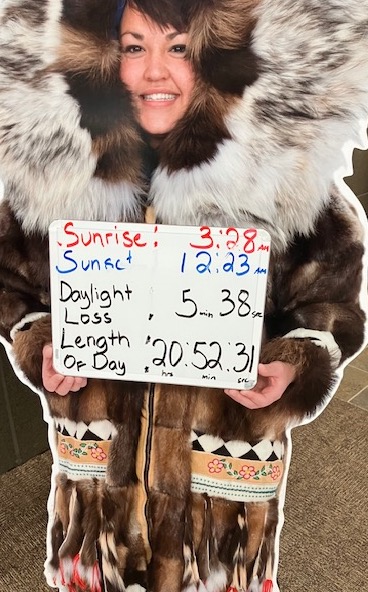
From one of the center’s displays (Photo Bill Pike)
His work focused on matters related to Alaskan Natives. A businessman and a political appointee, Mr. Thompson was best known for his leadership and work at the Bureau of Indian Affairs. Sadly, Mr. Morris, his wife, and daughter were killed in the crash of Alaskan Airline Flight 261. (Multiple Sources)
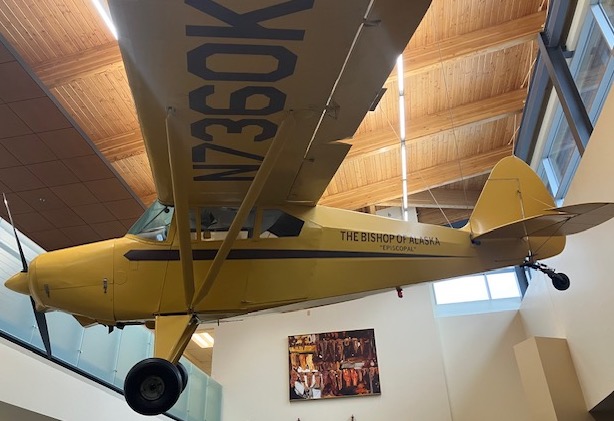
Another fixture in the community was Episcopal Bishop William J. Gordon, Jr. Bishop Gordon at the very young age of 29 was elected as the Third Episcopal Bishop of Alaska.
In 1948 with his family in tow, he settled in Fairbanks. Realizing that riverboat travel limited his summer access to visiting clergy and their churches, Bishop Gordon learned to fly. A replica of the Piper PA-22 that he flew is on display at the museum.
Replica of the Bishop’s plane (Photo Bill Pike)
That’s one thing we learned about Alaska was how useful airplanes were in remote areas.
From the visitor’s center, we re-boarded the bus with our destination to Riverboat Discovery.
Once on site, we were directed to a large dining facility, where we enjoyed a family style lunch.
After lunch, we boarded the riverboat for a tour along the Chena River. Our guide was full of local information about the river, Fairbanks, and the entire surrounding area.
Despite seeing the devastation from the wildfire, I was amazed at how lush and green the landscape was along the banks of the river.
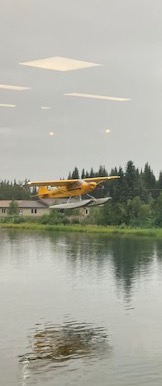
One of the highlights of the cruise for me, and probably for our friend, Dan, was the interaction with a bush pilot who landed his float plane on the river. The Captain of the riverboat and the pilot of the plane shared a lively conversation broadcast to the passengers.
Our special float plane guest (Photo Bill Pike)
Interestingly, our Dan, who also has his private pilot’s license had booked a training flight on a float plane. Turns out that Dan’s training flight was going to be in the same plane with the same pilot who was a part of the riverboat tour. In fact on Thursday, Dan landed with the pilot on the river with the riverboat’s first cruise of the morning.
After the plane, we learned about Trail Breaker Kennel and everything related to sled dogs and four time Iditarod champion, Susan Butcher. This facility is located along the river.
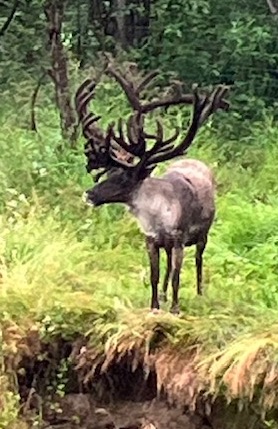
Another treat was seeing caribou on the shoreline.
A curious caribou checking out the riverboat (Photo Betsy Pike)
Before heading back to the dock, we had one last stop at Chena Village to learn more about the early lives of the Athabascan people.
Back at the dock, we unloaded for one last swoop through the shops at the center.
From there, we took the bus back into Fairbanks to our hotel for the evening.
In closing out this day, I’m drawn to the size of Alaska—it is massive. I’m privileged to see this snapshot in places where tourist typically tread.
Yet, I imagine there are many precious places throughout Alaska where tourist rarely venture. I hope those spaces can be quietly preserved, and that includes the stunning state and national parks that are currently protected. We can never let go of this cherished land.
Tomorrow, we would hustle to explore Fairbanks.
And then late on Thursday, we would be heading back home.
As a flawed human and American, I’ve recently been thinking about the Preamble to our Constitution. I’ve been drawn to these words: “in Order to form a more perfect Union.”
Today, when I ponder those words, it appears to me that America’s leaders are doing their best “to form a more imperfect Union.”
Does Mike Johnson, Speaker of the House of Representatives, understand empathy after he recently denied a request for the late Reverend Jesse Jackson, Sr. to lie in honor at the United States Capitol?
Is Secretary of Defense, Pete Hegseth’s vanity more important to him than the integrity of his work after his staff complained about “unflattering” photos taken of him by press photographers?
Some congressional leaders have made anti-Muslim statements. Don’t they understand their comments only create more tension?
In an NBC news interview with President Trump, he commented about US airstrikes on Iran’s Kharg Island. He stated: “but we may hit it a few more times just for fun.” Mr. President—no military pilot’s family thinks a bombing run is “just for fun.”
Federal Communications Commission Chair, Brendan Carr, has threatened to remove broadcast licenses over President Trump’s criticism of the media’s coverage of the war with Iran. Chairman Carr have you read the First Amendment recently?
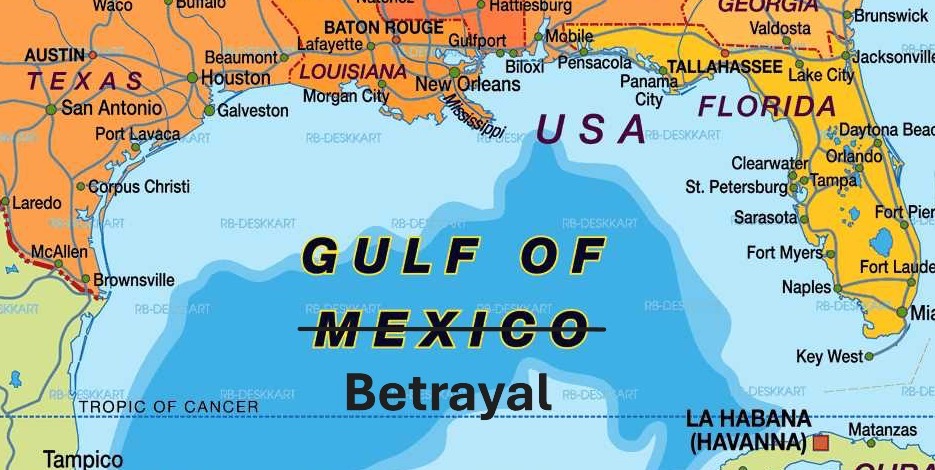
Unfortunately, we are experiencing a betrayal of America.
It is an appalling betrayal like Judas Iscariot’s disloyalty to Jesus Christ.
This is a sickening betrayal of America as our leaders have selfishly lost their hearts, their compassion, and their souls.
Alexis De Tocqueville wrote: “The greatness of America lies not in being more enlightened than any other nation, but rather in her ability to repair her faults.”
America, if we don’t wake up, the faults of our “imperfect union” will be our end.
Submitted to the Richmond Times-Dispatch on 3/16/2026 for consideration as a letter to the editor. The letter was not accepted. Bill Pike
Graphic design courtesy of Blue Hydrangea Studios (PLE)
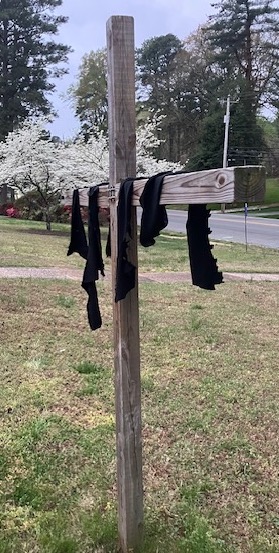
Early on Friday morning, April 3, 2026, I removed the purple cloth from the cross on the front lawn of our church.
I replaced the purple with four torn pieces of black cloth.
(Photo Bill Pike)
The black represents the somber, solemn remembrance of the death of Jesus Christ on the cross.
As you well know, I’m no theologian. Good Friday seems an odd label for naming the day that Jesus was crucified on the cross. I struggle to find the goodness with a good person like Jesus dying this way.
Additionally, you are probably thinking, Bill isn’t much of a Christian if he doesn’t understand this sacrifice as an atonement for sins, thus a win, a victory over sins and death.
Today, I spent my time on the grounds of our church. I was trying to make the place look pretty for Easter Sunday. I had help from a contracted grounds crew, but not every square inch of our property is covered in the contract.
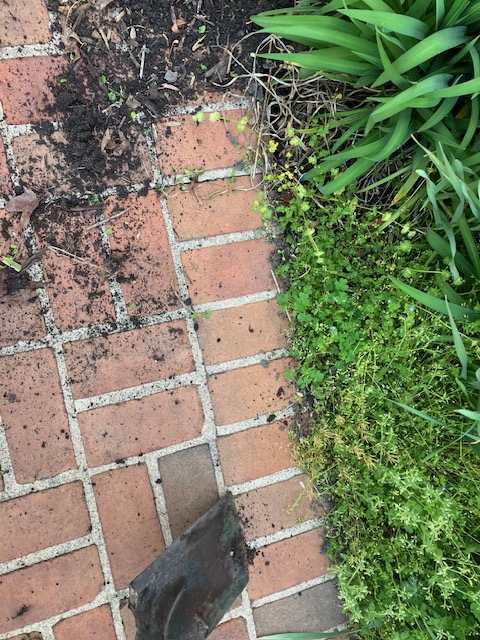
Most of my time, I was in combat with the weeds. Weeds in borders, weeds in sidewalk cracks, weeds in the mulch surrounding the base of trees, weeds in the fissures of asphalt—weeds, weeds everywhere.
In one border, the weeds were so thick that I knew a huge spider, or a slippery snake were going to have a bit of fun with me. Thankfully, that didn’t happen.
By late afternoon, I was tired of the weeds, and the weeds were tired of me.
Weeding offers solitude.
Weeding can be a time to ponder.
I have an early morning routine that starts my day with the devotional magazine the Upper Room, a well-worn script for prayers, and a computer stop at Bible Gateway.
At Bible Gateway, I always read the Verse of the Day.
One day this week, the featured verse was from Psalm 14 verse one (New International Version of the Bible): “The fool says in his heart, ‘there is no God.’ They are corrupt, their deeds are vile; there is no one who does good.”
I’ve thought about this verse quite a bit during the week.
I’m sorry, but at my age, I’m having quite a few of those fool days—‘there is no God.’
Easter is such a contrast to Christmas.
At Christmas, we celebrate the birth of Jesus Christ, and even with this story there is tension. But like a Hollywood script, the early part of Jesus’ life worked out.
With Easter, the contrast is obvious. Now, we are talking about the end of his life, his death on a cross. There is a tension in this story too.
Lots happened in the days following the birth of Jesus. I like the verse of scripture from Luke Chapter 2 verse 19: “But Mary treasured up all these things and pondered them in her heart.”
In John Chapter 19, we learn that Mary was near the cross watching her son. His simple words to her were: “Woman, here is your son.” I wonder what Mary pondered in her heart following the death Jesus?
I wonder if she thought, yes, you are my son, and you shouldn’t be dying this way.
Did Mary think—God where are you?
You turned the lives of Joseph and me upside down with his birth, and now he is being crucified on a cross.
What kind of deal is this?
A good man, who did good things in your name, crucified on a cross, right in front of me.
Perhaps, you recall the movie—Steel Magnolias.
Oh no, Bill is going Hollywood on us again. Doesn’t he know that Hollywood isn’t real life?
Yes, I know Hollywood isn’t real life. Yet, a good scriptwriter can make words come to life. Robert Harling, the writer of Steel Magnolias, accomplishes this in a a powerful scene in the cemetery following Shelby’s funeral.
Shelby’s mother, M’Lynn is joined by four of her closest friends. The women are there in support of M’Lynn.
M’Lynn responds to her friend, Annelle, “And it’s a real good idea. Shelby wouldn’t want us to get down mired down and wallow in this. We should handle it the best way we know how and get on with it. That’s what my mind says. I wish someone would explain it to my heart.”
Returning back to Psalm 14 and my struggle with Easter. Maybe you disagree, but I don’t see my heart as corrupt, vile, or incapable of doing good.
The fool in my heart wants to understand why.
Wanting to understand the why is human.
Doesn’t matter if it is M’Lynn in the loss of her daughter in Steel Magnolias, Mary in the loss of Jesus on the cross, or any parent who has suffered the premature loss of a child.
We want to understand why, and we want to know where was God?
I hope you and your loved ones have a good Easter.
Maybe before next Easter, I’ll spend more time pondering with my friends the weeds the death of Jesus.
(Photo Bill Pike)
And maybe, the fool in my decrepit heart, who argues with God about a lot of things, will finally hear God’s heart.
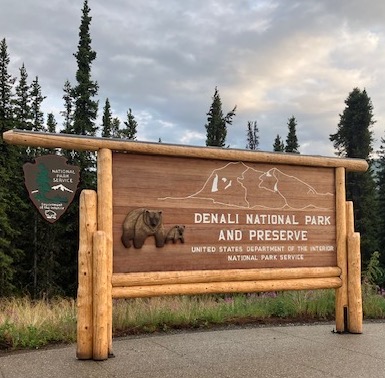
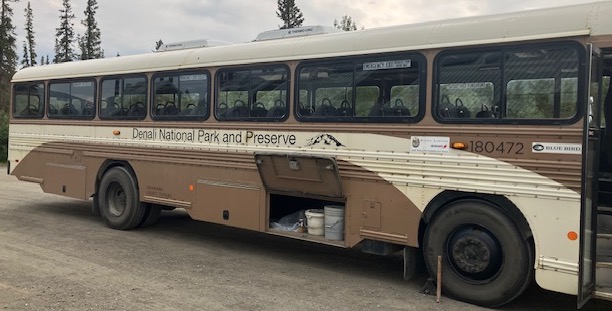
Probably a miracle, but every member of our group was on the Denali bus at 5:30 a.m.
(Photo Bill Pike)
Our driver gave us lots of information about park rules and regulations including how we were to handle ourselves on the bus.
The driver/guide was in constant chatter. This was mostly scripted, but with occasional personal comments.
Our bus (Photo Bill Pike)
The bus was equipped with a camera that allowed the driver to zoom in on wildlife sightings. Flip down monitors were scattered throughout the bus.
These monitors allowed riders to see the wildlife that had been alertly spotted by a fellow passenger.
If a passenger shouted out animal, the bus came to a halt.
The passenger who made the sighting then described what he/she spotted and every eyeball on the bus focused on that speck of white. In this case it was a Dall sheep.
Binoculars and cameras with expensive lens were used to increase the chances of finding a moose having his antlers manicured at a Denali spa.
In truth, the bus’s exterior camera was excellent in picking a few of the finds made by passengers.
For me, the sightings of wildlife both real and doubtful became tiresome. Alaska has done a good job of marketing the state’s wildlife.
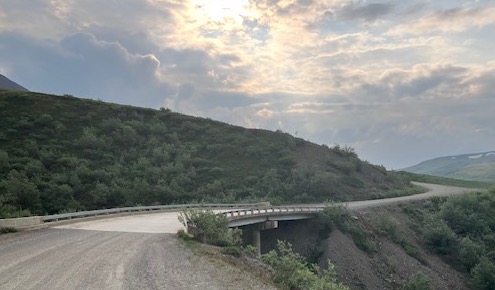
The well maintained road gave us clear views. (Photo Bill Pike)
However, the wildlife are coy about when and if they will make an appearance. One source I spoke with on the condition of anonymity stated that the wildlife aren’t pleased with their current contract.
Our five hour tour tallied no moose, one possible sighting of a bear—maybe a brown boulder, red squirrels, a hare, the state bird— the willow ptarmigan.
While on this tour, we received water, a box of snacks, and a nice booklet with excellent photos about Alaska.
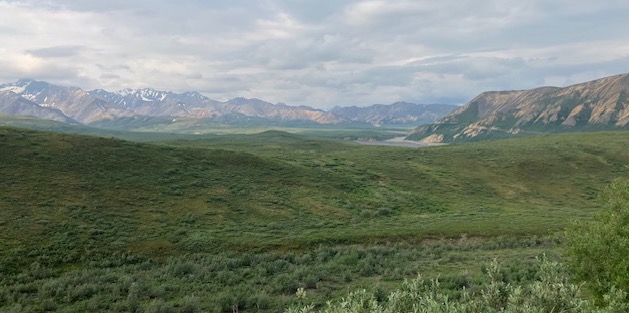
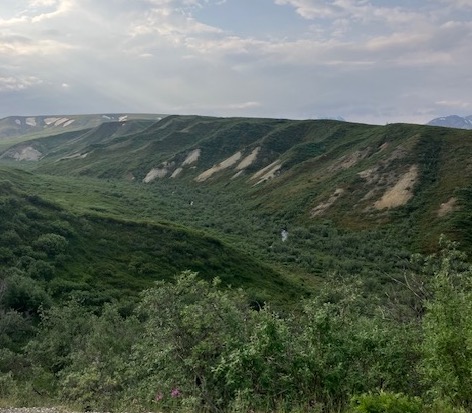
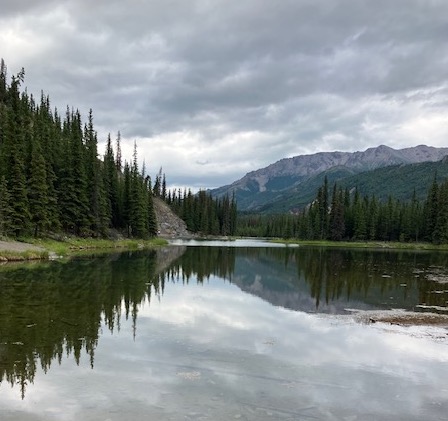
Again, the scarcity of wildlife sightings drew me more to the landscape. During our drive—permafrost, mountains, vast meadows, isolated ponds, a river, and rugged rock formations were all around us.
One of those clear views (Photo Bill Pike)
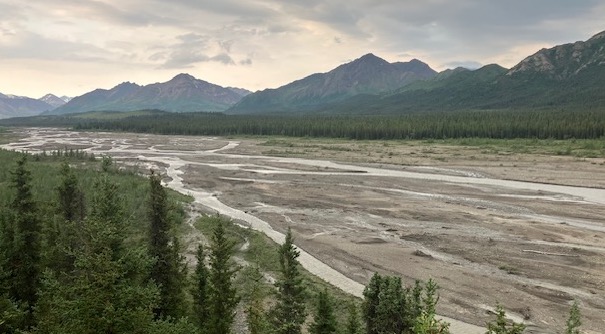
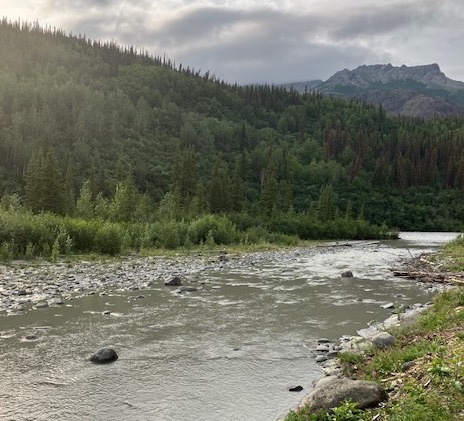
The Denali Park road crosses the Teklanika River. According to several sources, the Teklanika is a 91 mile long tributary of the Nenana River. Additionally, this section of the park features a popular campground with 53 sites for camping. The National Park Service manages the campground.
Teklanika River (Photo Bill Pike)
As far as the famous peak, Denali, the mountain was as bashful as the wildlife. Lots of clouds kept us from seeing Denali. Once again, a source I spoke with on the condition of anonymity stated that there is a tension between the cloud cover union representatives and the advisors representing the peak.
No matter the direction, the landscape was special. (Photo Bill Pike)
Overall, it was a good ride. However, I wonder if the five hours could have been compacted.
Our competent driver and guide deposited us safely back at the lobby. We took a break in our rooms, and then regrouped for lunch. Somehow, that ride had made us hungry.
After lunch, we check out a few shops.
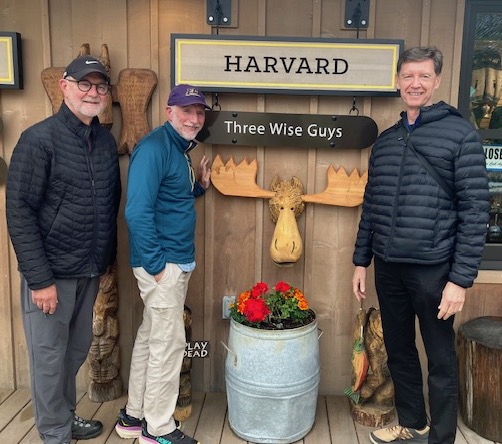
My two wise friends (Photo Betsy Pike)
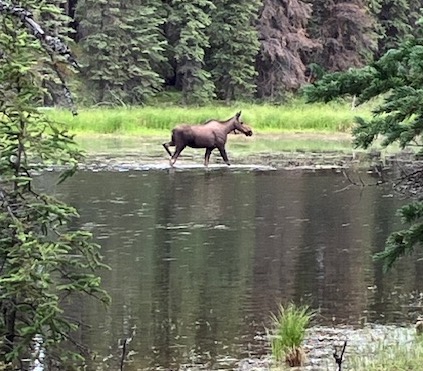
Then Betsy, Dan, and I took the free shuttle to the Horseshoe Lake Trail. It was here that we were rewarded—we saw a moose, a female moose, grazing in the shallows of the lake.
Our first moose sighting (Photo Betsy Pike)
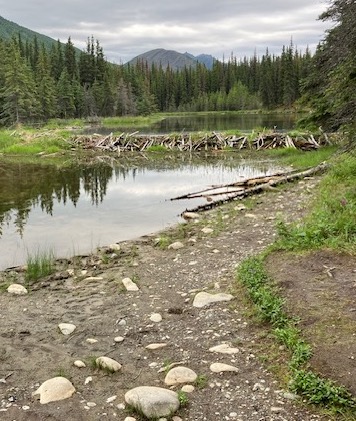
Luckily for us this moose, seemed to sense that she was a photo op for tourists. She stayed around munching for longer than tourists anxious for a real moose sighting deserved. Again, the trail and all that surrounded it are quite pretty including several beaver dams along the way.
Beaver dam (Photo Bill Pike)
From there, we caught the shuttle back to the Denali Visitors Center. This was a good spot for all information related to Denali. The place was packed.
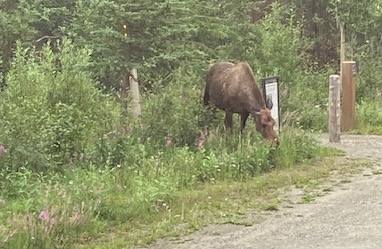
Just as our shuttle was leaving to take us back to the hotel, our alert driver spotted a moose casually munching on some weeds around one of the parking lots.
Our second moose (Photo Bill Pike)
Back at the hotel, we made a reservation for dinner and headed back to our rooms.
The Commander had picked up an annoying head cold. We weren’t surprised at this intrusion. No matter if we were on the ship, train, or bus we heard an assortment of coughs and sneezes.
In preparing for dinner, I was hoping to take a hot shower. Instead, I took a shower with a lousy temperature. At some point, Holland America must make some upgrades to this facility. It is starting to look a little weary.
After dinner, we took two walks. First, a river walk behind the hotel that took in a variety of landscape plantings and the rapids of the river rushing by in the background. On two occasions, we saw rafters rolling by quickly.
River behind the hotel (Photo Bill Pike)
Our second walk, took us across the highway, and we walked the boardwalk of restaurants and shops that wanted our wallets. We obliged by purchasing some ice cream.
On the walk back across the highway, we figured out our departure plans for Wednesday morning.
We had to roll out early on Wednesday, but not at 5:30.
I’ve enjoyed this stop in Denali.
While it is true that the viewing of wildlife wasn’t as grand as advertised, and despite never having a clear view of the famous peak, Denali, I would not trade this stop for anything else.
I’m sorry to be redundant, but the beauty of the land and the water makes up the difference.
Clearly, the good Lord’s angels were at their best when this precious land was carved out.