Acorns, soccer, and a light fixture

On the afternoon of Friday, October 9, 2026, our yard needed to be mowed.

Before I could start mowing the front yard, I needed to remove about ten million acorns.

In truth, I can’t believe we have so many acorns. I thought the summer’s excessive heat and timid rainfall might curtail the acorns this year. I was wrong.

The acorns have been falling from a stately oak tree that lives in the corner of our neighbor’s yard.

This majestic oak has quite a canopy. The spread of this canopy intrudes into our yard.

There are so many acorns that even squirrels are disinterested. Wacky as squirrels are, they might regret their indifference this winter.

Our flower border along the fence line and a mulched section under the dogwood tree have some of those ten million acorns.

The acorns thud when they hit the ground. They bounce off the asphalt. The acorns pop loudly when they careen off the roof of my parked car or its windshield.

Driving over the acorns, sounds like ice cracking on a road surface on a frozen winter morning.

After I had finished raking as many as I could out of the yard, a neighbor who was walking by looked at my pile. She commented, “Wow, that’s a lot of acorns.”

She is correct. I expect after the acorns stop falling that between both yards we will conservatively estimate close to twenty million.
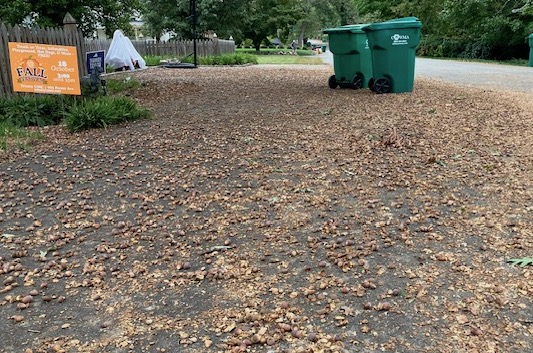
Acorns to be shipped to you (Photo Bill Pike)

Perhaps you remember from the movie, Forrest Gump, this introduction from Forrest’s new best friend: “My name is Benjamin Buford Blue, people call me Bubba.”

You might recall that young Bubba was all about starting his own shrimping business after the Vietnam war. Bubba could reel off all the possibilities for preparing and selling their harvested shrimp.

Based upon Bubba’s list, I’m beginning to wonder if there might be a market for acorns. According to several sources, some reliable, and some probably unreliable, acorns can be eaten.

If I believed more in the reliable, I could like Bubba name multiple culinary possibilities for the acorns—acorn pancakes, acorn ice cream, acorn muffins, spiced acorn cider, lightly salted acorns, acorn brittle, acorn upside down cake, emulsified acorn soup, acorn slurpy, acorn pudding. You get the idea.

Perhaps, it might be worth calling the Rose Bowl Parade. I’ll bet those clever float makers could find a place for the acorns on their floats.

Seriously, I’m thinking about reaching out to the Virginia Department of Forestry. They might take a million of the higher quality acorns off my hands for potential seedlings.

I know next spring at least half of our front yard will be sprouting oak leaves from the buried acorns.

Meanwhile if you live in a part of America where there are no oak trees producing acorns, for $29.95, I will gladly ship you a pound of acorns.

Before heading out to the Richmond Folk Festival on the afternoon of Saturday, October 10, we had grandparent soccer duty.

The Commander Supreme drove west to the Shady Grove YMCA facilities to watch our third grade granddaughter, Josie, play soccer.

The Commander left early so that she could survey the sale at Tweed. Tweed is one of the most dangerous retailers in Richmond for wives to visit. Husbands cringe when their wives say I’m going to Tweed.

I made no stop at a retailer on my way to Tuckahoe Middle School where our first grader, Ellie, would be playing her game. Both Josie and Ellie play in leagues coordinated through the Tuckahoe YMCA. Ellie’s team holds their weekly practice before the start of the game.

I think the Tuckahoe YMCA does a good job with this program. I particularly like the wording found on the back of the t-shirts worn by the coaches. It reads: COACH CARING, HONESTY, RESPECT, RESPONSIBILITY.
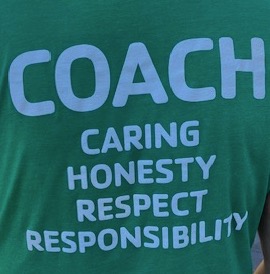
Tuckahoe YMCA t-shirt (Photo Bill Pike)

Despite efforts from my friend, Robb Spotts, who played collegiate soccer, coached at the high school level, and still officiates local soccer games, I do not understand the rules of soccer. Perhaps our granddaughters can assist my soccer mentor, Coach Spotts, in my tutelage.

Despite my soccer denseness, I do appreciate with lots of patience from their coaches how these young ladies improve their soccer skills.

I know grandparents are not supposed to brag about their grandchildren, but I’m going to break that rule.

The Commander Supreme reported to me that Josie has improved her skills. Josie scored a goal, and she had multiple saves when playing goalie.

At one point during the game on Saturday morning, I saw that improvement in Ellie’s soccer skills. I have no photographic proof, but here is what I saw.


The other team had the ball. One of their players was pushing the ball down the sideline on the side opposite from where Ellie was positioned. The player had an open field down that sideline.

Ellie from the other side of midfield saw this player breaking away. She ran with the grace of a yearling who had just discovered its stride. Ellie turned on her afterburners, caught up with the player, steered the ball away from her, took the ball back up field, and with some soccer gods’ luck kicked in a goal.

I wanted to see a replay. I wanted to hear a commentator compliment Ellie on her field of vision, her foot speed, and her pivot to work the ball back down field to score a goal.

Until I croak, I will replay Ellie’s play in my mind forever.

The remnants of Hurricane Isaias came to Richmond with a much needed, gentle rain on Sunday morning.

In opening up our church, Trinity Methodist, I was greeted with a text message from our Kids Director, Jen. A slow rotting pumpkin had slimmed a carpet tile in a classroom.

And, I remembered that I needed to replace a burned out light in the mini-kitchen in the Welcome Center.

I popped up the carpet tile, replaced it with a substitute, and disposed of the rotting pumpkin. With warm soapy water, I scrubbed the stained carpet tile, rinsed it, and placed the soggy tile in the Trinity Hall mechanical room to dry.

Next, I worked my way to replacing the burned out light.

Someday, I would like to have a long conversation with the designer of the light fixtures that grace our Welcome Center. That conversation would also include the architect who thought it would be a good idea to install these fixtures in the Welcome Center.

My battles with these fixtures are not pretty.
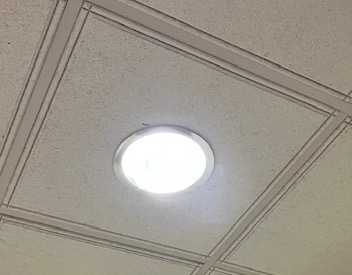
Troublesome light fixture (Photo Bill Pike)

God’s ears burn when the confrontation with the dead bulb starts. Any slim chance that I had for even seeing the pearly gates of heaven slip further and further away when wrestling with replacing these lights.

This Sunday morning was to be no different.

Armed with a ladder, a Phillips head screwdriver, a pencil, gloves, and a new bulb, I started.

The first challenge is to remove the bulb from the socket without it breaking. Just so you know these bulbs are not your standard screw in type. With a gloved hand, I gently try to remove the bulb. Step one failed.

Eventually, I was able to coax the bulb to release. With its cracks, I placed the bulb, into a small cardboard box.

Next, I used the screwdriver to unscrew two screws holding the metal canister in place in the ceiling tile opening.

Quickly, with the pencil, I attempted to push in the new light bulb. The pencil is just the right length, and with the eraser I can apply pressure to push in the bulb. Rushing, I failed again. I did not have the new bulb snug in its four sided opening. The bulb landed hard and cracked on the countertop.

More muttering of unacceptable language spewed.

So, I regrouped. Went down into Eaton Hall to grab a new bulb. Came back into the Welcome Center, repositioned the ladder, and started over.

This time the bulb was snug. I put the bulb back into the cone, realigned and tightened the two screws and shoved the fixture back into the ceiling. Unfortunately, the base of the fixture was not flush with the ceiling tile.

Now, I had an unacceptable gap. I removed another ceiling tile, shoved my head into that space, and saw the problem.

To hold the fixture in place on the metal grids where the ceiling tiles lie are two adjustable metal bars. These two bars were not positioned properly. With the assist of more rotten language, I finally found the correct position for the bars. Now the base of the light canister was flush with the ceiling tile.

If you’re still reading this baloney, you are either laughing hysterically, crying for my incompetence, or wondering why, why does God and this church keep this old guy around?

I can’t answer that question.

But, I do think about the words on the back of that YMCA t-shirt worn by their coaches.

Where have caring, honesty, respect, and responsibility gone in our world?

Have they become lost in the chaos of our headlines?

What do acorns, a soccer game, and a light fixture have to do with those words?

The over productive oak tree is simply being responsible to the rules of nature that it has followed since its birth.

Luckily for our granddaughters, the YMCA is still an organization that values caring, honesty, respect, and responsibility. Just imagine the impact we could have on each other and the world if we thoughtfully applied these words.

As for me and that light fixture, despite all of the heartburn it gave me, I do respect the light it provides.

And continuing on the as for me, my wife will tell you that at times I care too much.

I had a school leader tell me one time that I was “honest to a fault.”

And as for responsibility, it is in my DNA.

Where are caring, honesty, respect, and responsibility in our collective DNA?

Maybe acorns pinging off our noggins, the innocent hope of children on a soccer field, and the stubborn collision between an old grump and a light fixture will remind us that we need caring, honesty, respect, and responsibility more that ever.

You, me, we, us need to reconnect with these words.

They are in our DNA.

Winston Churchill said, “Words are the only things which last forever.”

You, me, we, us need to make sure that caring, honesty, respect, and responsibility last forever.
When life goes sideways

Late on the afternoon of Friday, August 21, 2026, long time Trinity member, Ken Hart, showed up at church.

Ken arrived with his leaf blower. The crepe myrtles in the Bicentennial Garden drop their pretty pink blossoms on the brick paver sidewalk.

Those blossoms track into the building. This is especially true after a passing summer thunderstorm.

When I saw Ken on Sunday morning, I thanked him for his work.

I also told him that the sidewalk was covered again this morning with those pretty pink blossoms.

Somedays, sidewalks go sideways.

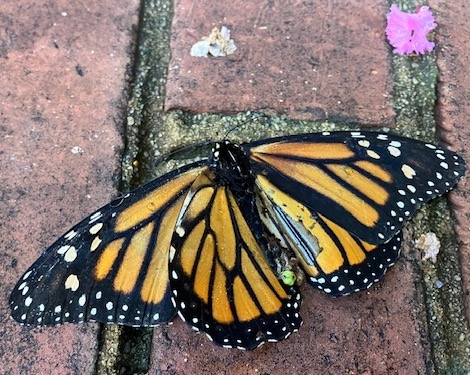
Early on that same Sunday morning, I used a couple of brooms to clear the sidewalk again. As I was sweeping those pink blossoms, I looked down into the pile where I saw a motionless butterfly.

I picked it up and placed it on the top of one of the brick columns. The butterfly was a monarch. Stunning in its color, its patterns were perfectly designed and sequenced, a flawless example of an angel on earth.

(Photo by Bill Pike)

I felt bad for the butterfly. I thought back to all of the times Eric Carle’s “The Very Hungry Caterpillar” had been read to our children before bedtime.

Somedays, life goes sideways for butterflies.

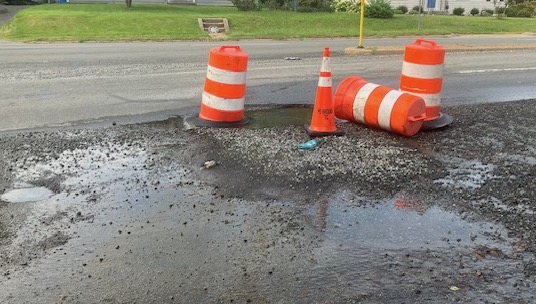
Out on Patterson Avenue, Virginia Route 6, where Normandy Drive empties on to Patterson there is a water line leak. Water has been bubbling for over two weeks now.


That bubbling created a large pot hole. The pot hole was large enough to be a hindrance for drivers. Despite shutting that travel lane down, and using orange traffic cones and gravel as a band-aid repair, none of that has kept right front tires from slamming into the hole.

(Photo by Bill Pike)

One morning, I watched a county school bus make a very awkward turn on to the open lane on Patterson. I don’t think the bus driver enjoyed making that turn.

Somedays, life goes sideways for water lines.

This week, thousands of miles from Richmond, Virginia, life went sideways in Nepal. I have never seen such immediate and catastrophic flood destruction. There was no blink. Didn’t matter if you were a human being or a man made structure, you were gone.

Somedays, life can unexpectedly go sideways.

A few weeks ago, life went sideways for our new senior pastor, and her husband, who is also a pastor. He was diagnosed with a very rare, but dangerous oral cancer. His second round of surgery was yesterday.

Cancer always makes life go sideways.

Somewhere in America there is a small business owner who is feverishly attempting to figure out how to make payroll for this week. The business owner understands loyalty and sacrifice. Deep inside, the owner wonders how much longer loyalty and sacrifice will last.

Making payroll makes life go sideways.

My sister and I always remember August 31, 1992 and September 1, 2002. Those were the days when we lost our parents.


Losing a loved one makes life go sideways.

Up in heaven, I wonder if life goes sideways for God and Jesus?

My guess is life goes sideways every day in heaven.

Twenty-four seven, there is no down time. There is always a crisis.

For people like me, who try to be good, who try to understand and apply the teachings in the Bible to my daily living, my belief in what I have held on to for all these years can go sideways too.

I want to know why life goes sideways?

Yes, this is a reoccuring whining theme for me.

But, the truth be told, this is a reoccuring, whining question for you too. You want to know why life goes sideways.

Quite honestly, God and Jesus are tired of me and my why.

And all my whys are grounded in the New Testament of the Bible—the miracles. Why was sight restored to someone? Why were demons cast out of a young man? Why were lepers cured? Why did a judge finally cave in and rule in favor of the woman who had consistently pestered him? Why, why, why, why, why?

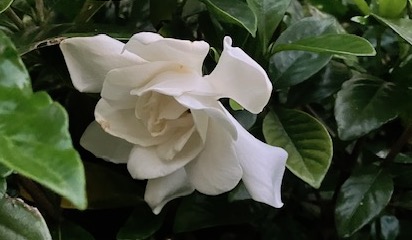
Every August, I keep an eye on a gardenia shrub. The gardenia is located on the west side of our home. It is in a narrow border beside our trash cans and recycling container.

That gardenia blooms in the late spring. Sometimes in August, the gardenia surprises me with a few fragrant singular blooms.

This August, the gardenia didn’t disappoint me. I caught a whiff of its fragrance when taking out some recycling. I searched the shrub and found the single white bloom buried among waxy green leaves.

(Photo by Bill Pike)

That gardenia always circles me back to my parents. They had prolific green thumbs. For this gardenia, its roots are linked back to my parent’s yard. It’s blooming in August always makes me think of our mother and father.

There have been years, when life had gone sideways for the gardenia. Challenging winters with coatings of ice and harsh northwest winds have on several occasions burned its green foliage.

Despite the bitter winter, the gardenia finds a way to persevere.

When life went sideways for our parents, I think their perseverance came from their faith.

Clearly, there is no stopping of life going sideways.

Perhaps when sideways arrives, I need to think more deeply about this quote from Helen Keller: “Although the world is full of suffering, it is full also of the overcoming of it.”


Instead of me constantly whining why about sideways, I need to commit to help those who are still here with the “overcoming it.”

It will be difficult for me to overcome my whining why.

But, I’m going to work on it.

How about you?

Wedding Day Saturday, May 30, 2026: A Toast

(Photo Bill Pike)

Before, I start, how about this weather. Since Thursday, we’ve had spectacular weather.

I was told to keep this short, no goofy humor, no preachiness, and above all don’t embarrass us.

Nice try.

I’d like to start by thanking everyone for being here this evening.

Over the last few days, we had family and friends arrive from London, England, Hawaii, California, Texas, Tennessee, Illinois, Georgia, Massachusetts, New York, Maryland, North Carolina, and Virginia.

We are honored to have you with us.

But in truth, my most heartfelt thanks goes to those who opted not to attend—bless your hearts.

We are deeply appreciative of our friends, Bill and Cabell Longan for helping Elizabeth and Jackson reserve the Commonwealth Club.

Thanks for every staff member at the Commonwealth Club and our wedding coordinators.

Appreciate the staff and volunteers at Trinity United Methodist Church for their help too.

Thanks to those “dangerous” steel magnolias who hosted bridal showers in North Carolina and Virginia, and the bridal luncheon yesterday.

We also want to thank the Cates and Phipps families for their gracious hospitality at the rehearsal dinner.

The whole evening was delightful—delicious food, connecting conversations, and heartfelt toasts to honor Jackson and Elizabeth.

We look forward to being with you at more family gatherings in the future.

That thanks goes also to some special heavenly guests Ken and Liz, Bill and Louise, Susan and Larry, and two of my uncles Harry and Ralph who adored Elizabeth.

I’ve been thinking about this day for a long time.

I have determined that weddings are not about fathers.

Weddings are all about the mother of the bride or groom.

Our family has been exceptionally lucky to have my wife to be our leader for these events.

Her command center was the kitchen table. All of the lists, notes, and orders were developed there.

Betsy, I love and thank you for all of this.

The words—“Just Chill William” are engrained in what remains of my gnat size brain.

Perhaps that might make a good two-sided t-shirt. On the front “Just Chill William” and on the back a rendering of William in a block of ice with the words “William Is Frozen.”

For a wedding, fathers lose their “Miranda” rights.

George Banks played by Steve Martin in the remake of the movie Father of the Bride showed us that.

I will spare you my George Banks inspired “flipping out” grievances.

Relatives and friends offered me advice related to the wedding.

My sister-in-law, Abby, told me to stock up my basement office with survival supplies and stay down there until a couple days before the wedding.

At one point, I told my college pal, Dan Callow, I’d like to pull a Forrest Gump, and start running away. But in true Dan wisdom, he told me that would be too easy.

So, Jackson, every father prays that his daughter will not end up with Mr. Wrong.

I guess the good Lord was listening, because I think for Elizabeth you are Mr. Right.

I say that for lots of reasons. But over these last couple of years, I’ve seen and admired your quiet endurance and resilience.

And in the ups and downs of that endurance and resilience, I’ve witnessed your love and respect for Elizabeth.

Jackson, we love you and welcome you to our family.

Elizabeth, where do I start?

Quite honestly, I thought at one point during your senior year of high school that I would be faced with two options.

At that time, you and your mother “loved” each other so much that I thought I’d be visiting one of you in prison and the other at the cemetery.

I’m thankful that eventually “love” intervened and persevered.

Jackson, I’m sorry, but the shopping gene that Elizabeth possesses is from the Cloud side of the family.

That is countered by her stubbornness which has long been linked to an unmuted gene from the Pike family.

Elizabeth, I want you to know that I love your endurance and resilience too. I’ve seen that at work in your personal and professional life, and I’ve seen this with your love and respect for Jackson.

The March 2026 issue of Southern Living Magazine has an article titled “She’s Got Game.” The article focuses on six Southern women who have impacted women’s basketball “both on and off the court.”

One of those women is Kara Lawson. She is the coach of Duke University women’s team.

A 2022 video of Coach Lawson talking to her Duke players gained much attention through social media.

Here is part of what Coach Lawson said to her players:

“We all wait in life for things to get easier. Most people think that it’s going to get easier. Life is gonna get easier, basketball’s gonna get easier, school is gonna get easier—it never gets easier. What happens is you become someone that handles hard stuff better.”

Elizabeth and Jackson, I know you know that marriage isn’t easy, but through your experiences with each other you will learn to handle the hard stuff better.

Handling that hard stuff better is grounded in what might be a dying word—loyalty.

Your love and loyalty to each other won’t make life easier.

But your love and loyalty for each other can carry a marriage for a long, long, long time.

Years ago, at Lakeside Elementary School, one of the young teachers on our faculty was engaged.

From her wedding invitation, I cut out and saved these words from the Song of Solomon Chapter 3 verse 4: “I found the one who loves my soul.”

To Elizabeth and Jackson, it is clear to me and everyone here that you “found and love each others souls.”

We pray that love will sustain you and your souls for forever.

All the best!

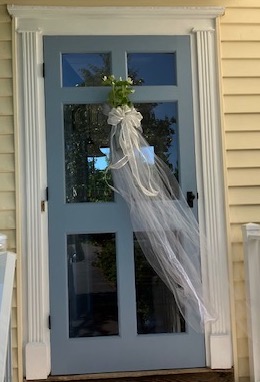
Note from the author: A few minutes after 4:30 p.m. on Saturday, May 30, 2026, I had the honor and privilege of walking our youngest daughter down the church aisle and to the altar for the wedding ceremony. On behalf of her mother and me, I handed her over to Jackson. Long may they endure.

Tightening A Loose Screw

In the Eaton Hall mechanical room, there are two boilers. A hot water heater. A couple of air handlers. All kinds of electrical panels—some dead, some living.

There are pumps, pipes, conduits where phone and communication lines merge and disperse.

We even have a tunnel.

A crawl space that connects the Eaton Hall mechanical room to a small mechanical room in the basement of the Preschool.

Maybe, the youth should forget about selling pumpkins in the Fall. Consideration should be given to transitioning to a haunted bowels of the basement tour at Trinity during Halloween.

Who knows Chip and Flip could make cameo appearances as the sump pump mudmumblers or the boiler buzzards with a guaranteed admission discount slashed from $39.95 to $19.95.

Mechanical rooms in this old church building make me weary.

Financial disaster, in the form of a piece of equipment failing is always lurking in a mechanical room. Its the law of the darkness— where deep inside a pump a worn coupler shreds, fails. The pump squawks and shrieks in its mechanized death until the power is cut.

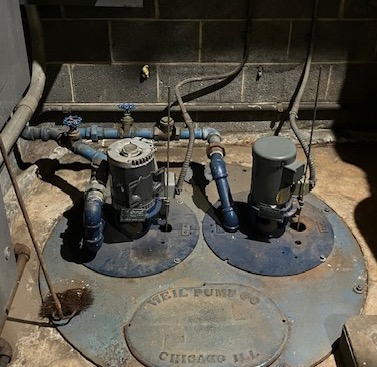
For months, we’ve been carefully monitoring two sump pumps in a well deep in the concrete floor. These pumps perform a critical function—they remove intruding ground water.

On Tuesday, a skilled technician who is familiar with cantankerous sump pumps came back to install a new switch for a supposedly faulty one.

In preparing for this installation, the technician discovered a loose screw. This screw was impacting the proper operation of that pump.

The technician simply tightened down the screw. Following this reconnection, he adjusted a float mechanism, and turned back on the electricity. In a matter of seconds, the pump was engaged and working properly.

When the technician reported his findings, I was relieved to hear this good news, and yet, I wondered why can’t the complications of daily living be so simple?

How different this world might be if it simply came down to finding and tightening a loose screw.

James Taylor is a gifted songwriter, singer, and musician.

He is also a survivor.

At some point in his career, Mr. Taylor had to tighten the screws of his lifestyle in order to make it to another day.

In the third stanza of his song “Fire and Rain,” Mr. Taylor wrote:
“Won’t you look down upon me, Jesus?
You’ve got to help me make a stand.
You’ve just got to see me through another day.
My body’s aching and my time is at hand,
And I won’t make it any other way.”

In this chaotic world, at this very moment, there is a human being who is hoping that Jesus is looking down upon them. That person no matter his/her circumstances needs help in making a stand.

What does it take to be seen through another day when no other options seem possible?

What are the chances that the right person with the right screwdriver will arrive and tighten down the loose screw for the person in need?

Might that screw tightener be you, me, we, us?

The other day, I stumbled upon this line of scripture: “Let me alone, for my days are a breath.”

Those words came from Job chapter 7 verse 16.

“For my days are a breath” reminds me of how quick time moves.

For that person who needs a screw tightened his/her time “is at hand.”

How will I respond if it is up to me to help that person to “make a stand?”

Making a stand is a “breath.”

So is tightening a screw.

My sump pump pals (Photo Bill Pike)

Thank you Anthony Romanello

When I served as an assistant principal at Hermitage High School in Henrico County, Anthony Romanello was one of our students.

By the time Anthony was a senior, the faculty, staff, and his peers knew there was something special about him.

They also sensed no matter where Anthony’s future took him that he was going to have an impact in a positive way.

In 2025, Anthony announced that he would be leaving his job as Henrico County’s leader for economic development.

Truthfully, I was a bit sad by this announcement. I thought Anthony might become county manager in Henrico some day.

No matter the cities and counties where Anthony has served in Virginia, he has made a difference.

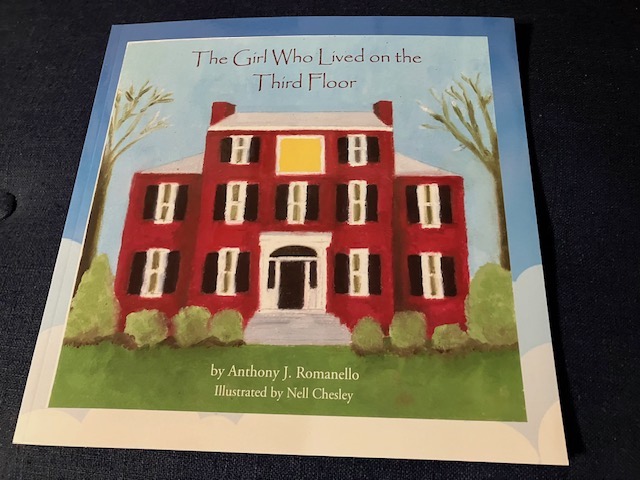
In his two books, “Random Thoughts: Reflections of Public Service, Fatherhood, and Middle Age” and “The Girl Who Lived on the Third Floor,” we learn about Anthony’s most reliable asset—his heart.

Starting with “Random Thoughts: Reflections on Public Service, Fatherhood, and Middle Age,” readers experience an up close look at Anthony’s leadership heart in action.

His heart reveals the importance of building relationships, listening, visioning, hard work, teamwork, empathy, loyalty, and two simple words—thank you.

With “The Girl Who Lived on the Third Floor,” the focus shifts to Anthony’s daily interactions with his wife, Diane, and their children. This book is based upon the commitment Anthony and Diane made as foster parents.

(Photo Bill Pike)

In 2016, with four of their own children, Anthony and Diane made a decision to adopt an eleven day old baby girl into their family.

From this adoption, we see Anthony’s heart from a different angle— an angle that reveals how his successful management skills can be impactful in a family setting too.

I believe those attributes and his compassion for people will continue to allow Anthony to grow in his new role as a managing partner for a local consulting firm.

But what I really hope is no matter how difficult the decisions might be that local leaders make, it is important for them to listen to their hearts.

When leaders disregard their hearts in making decisions, the people they serve lose.

Luckily for the people in the communities where Anthony Romanello has served, he has humbly listened to his heart.

Long may his heartfelt service endure.

Thankful For Fifty

Original photo Deford Dechert (West Hartford, CT)

On behalf of the Pike and Reinking families, we are honored to have you with us for Thanksgiving.

Back in October, our world was flipped over when Betsy’s left shoulder took one last clunk on the sidewalk at the corner of Rock Creek and Forest.

In a blink, plans for her seventieth birthday and our fiftieth wedding anniversary changed.

That’s when family and friends took over and planned this Thanksgiving Day gathering.

Without this support and your willingness to pitch in, we’d be eating Jimmy John’s turkey subs this afternoon.

A special thanks to Lauren and Doug, Andrew and Kathryn, Elizabeth and Jackson, Ken and Adrienne, Norman and Jo, and Jay and David for their assistance.

Tucked in there too are the nieces and nephews—George, Lydia, and Sarah, Nana’s heroes, her grands—Caroline, Josie, Ellie, and Hudson, and we can’t forget Jay’s daughter, our Olympic swim coach, Katie, who is with us this afternoon. Katie, we could have used some of your deep breathing techniques when the turkey caused some kitchen tension earlier this afternoon.

Fifty years ago today (11-27-75), we were in Milton, Massachusetts for Thanksgiving at the home of Bertha Avery Crosby.

That was Betsy’s grandmother. Everyone called her Nammer.

We had quite a feast with the Crosby and Cloud families.

Two days later (11-29-75), Betsy and I were married in West Hartford, Connecticut.

There are many reasons why marriages fail and work.

For Betsy and me, I think we had good role models in our parents— Ken and Liz and Bill and Louise.

They weren’t perfect, but their loyalty, support, sacrifice, and teamwork were hard to beat. I think these qualities rubbed off on us.

On the night that I finally mustered the courage to ask Betsy’s father for her hand, I used two words that Betsy’s oldest sister, Susan, told Betsy that I must use—love and respect.

I can still hear my quivering voice—“Mr. Cloud, I love and respect your daughter.”

Despite all of the things I do that drive her absolutely bonkers, Betsy, I still love and respect you as much as I did on that night fifty years ago.

In 2020, a German advertising company created a holiday commercial for the European pharmaceutical company, Doc Morris.

This heartfelt commercial ends with these words—“So you can take care of what matters in life.”

Betsy, for these fifty years, thanks for taking care of what matters in our lives. Here’s to Betsy.

Original photo Deford Dechert(West Hartford, CT)

Thanksgiving: “I don’t get no respect.”

Rodney Dangerfield was a gifted comedian.

His self-deprecating humor made me laugh.

In his rapid fire delivery of jokes, he always found a way to work in what became his identifying line—“I don’t get no respect.”

For lots of reasons, that’s how I’ve come to feel about Thanksgiving.

Over the last several years, it appears to me that our respect for Thanksgiving is eroding.

Retailers know this.

For example, the National Retail Federation expects Christmas sales in 2025 to “exceed a trillion dollars.”

Forecasters predicted that Halloween sales for 2025 would be in the range of twelve billion.

Thanksgiving is projected to be in the four to five billion range.

Growing up in North Carolina, Thanksgiving was always a drive on U.S. 70 to my grandmother’s home in Greensboro.

Sometimes, there was a stop on this twenty minute drive at Mt. Pleasant United Methodist Church for a morning Thanksgiving service.

The spread of home cooked food for our lunch time gathering was amazing. As an overweight kid, I was in heaven.

And yes, I like pumpkin pie. However, my favorite Thanksgiving dessert was persimmon pudding. I think my Aunt Evelyn always made sure we had persimmon pudding.

The other thing that I remember about those gatherings was being huddled in a small den with a television that projected a black and white picture of the Detroit Lions and Green Bay Packers playing their traditional Thanksgiving Day game. At the time, that was the only game broadcast or played.

Money has changed that. From Thursday through Sunday, football games at the collegiate and professional level are non-stop.

In November 1975, I spent my first Thanksgiving away from home. I was in Milton, Massachusetts, a pretty New England town just south of Boston.

I was with my future wife’s family. Two days later, that beautiful lady and I were married in West Hartford, Connecticut.

Lots has transpired in those fifty years.

And even though, Thanksgiving is squashed between the billions and trillions of Halloween and Christmas, it continues to survive.

We must never take the survival of Thanksgiving for granted.

The survival of Thanksgiving depends upon you, me, we, us.

We can’t let Thanksgiving die.

If Thanksgiving dies, so will we.

Maya Angelo said it better: “If we lose love and self-respect for each other, this is how we finally die.”

For Thanksgiving to continue to have a life, we must ensure that our children and grandchildren understand why it is so important to be thankful.

Being thankful can’t be taken for granted.

In the fall of my sophomore year at Greensboro College, biology professor, Dr. Kemper Callahan, put that into perspective for me.

This is what I have come to Dr. Callahan’s Thanksgiving Lecture. He simply told our class that we should never take Thanksgiving for granted. That included appreciating all of the people who make Thanksgiving happen. Dr. Callahan put a strong emphasis on farmers—no farmers, no Thanksgiving.

Successful Farming reported in July of 2025: “More farms nationwide filed for bankruptcy in the first three months of the year this year than across the entirety of 2024.”

What will the continuing struggles of our farmers mean for future Thanksgivings?

While I love the Thanksgiving food, Thanksgiving is also about family.

How lucky I have been to have been nurtured by a family every day of my life. That is a luxury not available to everyone.

As crazy as families can be, even an ounce of stability can make all the difference in a person’s life.

I see that generational stability in our Thanksgiving gatherings. Internally I ask—how different would my life have been without that stability?


I also ponder how much better America could be if that stability was present for all of our families. We might be surprised at how lives could improve by solving those generational cycles of instability.

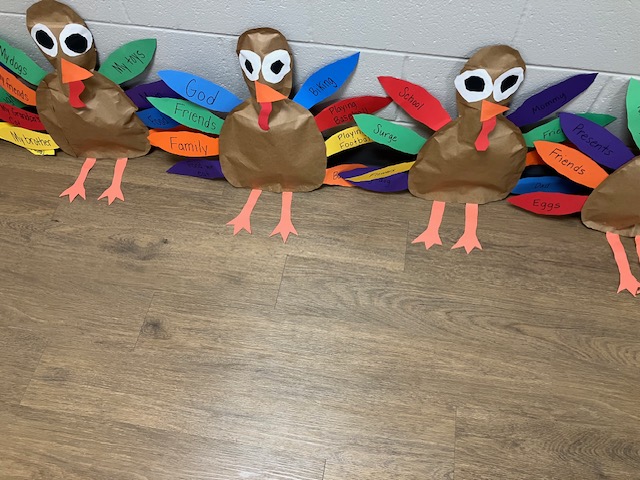
In my work at Trinity United Methodist Church, I see hope for Thanksgiving. That hope comes through the art work of the children in the preschool.

(Photo by Bill Pike)

I love walking through the hallways in the days before Thanksgiving. I get to see the Thanksgiving artwork gracefully resting on the floor or gently hanging from a wall mounted hook. These masterpieces are in their curing stage with glue and paint drying before they are transported home.

(Photo by Bill Pike)

Who knows maybe these heartfelt creations will be cherished and preserved for future Thanksgiving celebrations.

Isn’t that part of what makes up respect—preserving what we value?

Rodney Dangerfield figured that out.

Mr. Dangerfield learned that his audiences anticipated and valued his famous line—“I don’t get no respect.”

I can hear him now.

Thanksgiving is coming. I gotta tell you, when I was a kid Thanksgiving got a lot of respect. Not now. Thanksgiving is like a panini sandwich flatten on a press by Halloween pumpkins and retailers overstuffing our Christmas stockings.

I hope you and your families have a good Thanksgiving.

And remember to endure, Thanksgiving needs our respect, our hope, and our thankful hearts.

A Mrs. Schmidt production (Photo Bill Pike)

Yes, I know it’s November: “be still”

My old body knows when I fail to exercise.

My body talks to me, “Bill, its been ten days since you have been for a run. What’s wrong with you?

I respond, “I’ve been busy. Life gets in the way.”

My body counters, “No doubt. That’s an easy excuse. I don’t like excuses. Go for a run. Now. Not tomorrow. Now. Go!”

On the morning of Friday, November 14, I went for that run.

I have a route that runs a neighborhood 5K course in reverse. The distance might be a bit more than a 5K, but I’m usually back at the house in 35 or 36 minutes.

This morning, I was inspired by our next door neighbor, Al Lockerman. As I was heading out to open up Trinity, Al was leaving for his morning run.

Al is a big guy. Yet, he runs like fast moving freight train. He goes all out on his runs. I admire his stamina.

When I return from opening up Trinity, I ready myself for my run. At the end of the driveway, I encounter Al again. With a cup of coffee in hand, Al is returning from walking their dog, Bambi.

I tell Al he inspired me to go for a run. He commented about the temperature. It is hovering at 33 degrees. That is about his limit with enduring cold weather runs.

Old man that I am, I have dressed in light layers for this run. That includes some worn knitted gloves and a stocking cap.

Al hopes I have a good run, and with that I’m off.

I note frost on the windshields of cars. This is the first real frost of the season.

Light frost on windshield (Photo Bill Pike)

Heading down Stuart Hall Road hill, at the intersection of Baldwin Road, the county is in the process of repaving.

The company doing the work has a massive asphalt eating machine. This contraption is called a cold milling machine or cold planer. The steel carbide tipped teeth of the milling machine peels back the top layer of the asphalt.

A good thing about the milling process is that the old asphalt surface is recycled. That planing of the top layer in some places reveals the foundation of the road— our pale orange Piedmont clay.

Milling machine’s work (Photo Bill Pike)

As I head up the hill, I turn left on to the front driveway at Trinity. On the front lawn, the pumpkins are gone. We conduct this annual sale to raise money for our youth group.

I admire the people who purchase our pumpkins. They are what I call heart buyers. These consumers could easily buy their pumpkins at a big box store at a much lower price.

At the bridge over the creek on Rock Creek Road, I wish I had a camera with me. Floating on the still creek surface is a pretty pattern of colorful fallen leaves. Also perfectly captured on that mirrored tranquil surface is blue sky with scattered clouds.

With the milling work on Baldwin, the road surface is uneven. The footing can be tricky, but I’m watching where my feet are taking me.

Occasionally, I see leftover signs from the November 4 election. I’m sure the mute button on the remote control for our television is thankful that campaign ads have stopped running.

The nonstop pace of those ads have now been replaced by incessant ads for Christmas. Of course, the big box retailers started telling me it was Christmas in September.

As I chug along, some front lawns still have Halloween decor. Others have rapidly transitioned to their Christmas theme.

Skeletons dominated many Halloween displays this year. I wonder if there will be a new big selling hero for Christmas on lawns this season?

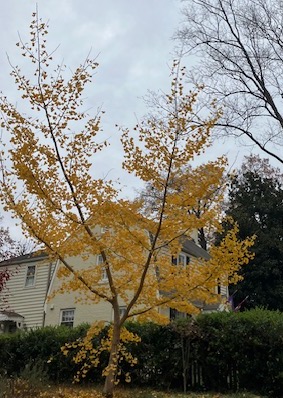
Thankfully, I can block out those commercialized distractions with the brilliance of leaf colors along the way. The last few days, the trees seemed to have hit their peak.

Golden leaves from a Gingko tree (Photo Bill Pike)

At the corner of Horsepen and Devon, I come upon four young fathers who have finished up monitoring their sons and daughters at the bus stop.

I interrupt their discussion by gently shouting out, “Let me know when you guys figure it out.”

They laugh, and one of them replies, “We’ll be here a long time.”

I chuckle and keep trudging toward Westham Parkway.

My mind keeps reminding me this is November.

I know you know this is November.

However, just in case you haven’t noticed— when we hit November, the pace of the year accelerates.

That acceleration is like a pilot of a jet fighter plane hitting the afterburners. We are thrust, blasted, and hurled into a supersonic march.

From now until December 31, we are in blinding blitz. The G forces of the season pull, contort, and rush every fiber of our bodies.

Seasonal to do lists rush us. Retailers rush us to early Black Friday sales. Our overbooked calendars rush us to holiday events. And perhaps the most demanding, the pursuit of seasonal perfection rushes us.

We are overly consumed by this pursuit of seasonal perfection. And while we can deny the seasonal pursuit of perfection, truthfully, that relentless pursuit is our downfall.

In all of the hustle and bustle, I wonder if that pace results in an increase of pacemaker surgeries related to how this seasonal rush impacts our hearts?

At the stop sign on the east end of Rock Creek Road, I’m about to turn left on to Sweetbriar Road. That final straight stretch on Sweetbriar will bring me back to where I started.

In the whirlwind pace of November into December, I wonder how this season might be different if my human layers were stripped back and revealed by a human cold milling machine?

What would that human cold milling machine find in me?

Part of me thinks it would reveal that I need the first two words from Psalm 46:10: “Be still.”

With the reminding roar of November that zooms us into December’s blitzing sprint, at some point your body’s internal voice will remind you to “be still.”

Don’t ignore that voice.

Listen.

Take the time and “be still.”

re· ject· ed

Another School Shooting

Sadly, on August 27, 2025, the Washington Post reported on another school shooting. This one at Annunciation Catholic School in Minneapolis, Minnesota killed two students and injured seventeen.

Everyday across America, families send their daughters and sons to school. Those families trust that their cherished daughters and sons will come back home.

Too frequently in America, that trust is violated. Children aren’t supposed to come home in a body bag.

There is something wrong with a country whose innocent school students continue to be murdered in alleged safe settings.

No matter our legislation, school rules, intruder drills, and school security officers, we are unsuccessful in preventing school shootings.

I spent over thirty-one years working in education. In my career, I had experience working in public, private, and department of correction schools.

As different as those school environments were, none were immune from disruptive behaviors from students. In those unique school settings, I kept coming back to a recurring concern—the erosion of our families.

In 2019, the Pew Research Center reported that “America has the world’s highest rate of children living in single-parent households.”

A 2022 report by the Annie E. Casey Foundation found that more than 23 million children live in single-parent homes in America.

To be clear in my career, I worked with many competent single parents.

Yet, I believe for too many years, we have failed to understand the impact on students in our school environments when the parent or family is dysfunctional in providing the support a child needs in school.

That instability makes me wonder how many of our school shooters came from unstable homes? Regrettably, I wonder how many more might come from those stressful settings?

In James H. Cone’s book, The Cross And The Lynching Tree, he quotes Dr. Martin Luther King, and a comment he made after the assassination of John F. Kennedy. Dr. King told his wife: “This is what is going to happen to me also. I keep telling you this is such a sick society.”

Dr. King was correct—we are a sick society.

Our mental sickness has left its blood stains on every school shooting that America has endured.

America is overdue to cure our sickness.

This is urgent.

Failing to solve guarantees more school shootings.

Haven’t we had enough?

Written by Bill Pike submitted to the Washington Post on August 28, 2025.

Dismissal of Virginia Tech Football Coach

I have no allegiance to Virginia Tech football. Our oldest daughter is a Hokie. From this connection, I have quietly pulled for the Hokies. In life or death losses, the extreme pain of Hokie friends has eluded me.

Contrary to some Atlantic Coast Conference(ACC) fans I was not opposed to the expansion that brought Virginia Tech into the ACC. Academically and geographically, this invitation made sense to me.

In today’s college athletics, not much makes sense. The transfer portal and Name, Image, and Likeness (NIL) have completely changed how conferences and coaches function.

I’ve never met Brent Pry who was relieved of his coaching duties at Virginia Tech on Sunday afternoon. Yet, I have no idea why anyone wants to coach college football.

The internal and external pressure to win is relentless. Getting those wins means a coach puts his life in the hands of young men who are 18-21 years old.

Recruitment of players can be ruthless. Despite a coach putting his heart and soul into signing a player that doesn’t mean the player will be loyal and play all four years for that coach.

Loyalty and patience are dead in college athletics. Money is the sole driver.

With Virginia Tech’s three losses, no one from Tech’s President, the Athletic Director, or alumni were willing to be patient— might Coach Pry turn the season around?

The humiliating loss to ODU on Saturday night in Lane Stadium was too disgraceful. Impatience exploded.

In President Sands announcement to the Hokie Nation, he has essentially given his blessing to a task force that in short order must: “develop a financial, organizational, and leadership plan that will rapidly position the Virginia Tech football program to be competitive with the best in the ACC.”

Too bad the charge for those Virginia Tech leaders can’t be to return common sense to college athletics, with an emphasis on financial saneness, and a realistic strategic plan that molds an athletic department into an equitable portion of the university— not an isolated empire.

Written by Bill Pike submitted to the Roanoke Times on September 17, 2025.

Author’s note: No matter how passionate the writer, submitting letters to the editor of a newspaper is never a guaranteed acceptance. Yet, I think I will continue my writing whine until my last breath.

October finger-tippers

Even though I know that the dew covering the windows on my car will soon become frost, October, I’m glad you’re back.

(Photo Bill Pike)

You are my favorite month.

I don’t want you to leave.

I know when you depart, November moves me one step closer to winter.

Mentally, I fight winter.

While I still respect winter, I’ve lost my constant school boy hope and prayer for snow.

At 72, my old brain doesn’t revere snow anymore. That wish for snow is for our grandchildren and school teachers.

So October, I’m going to cherish you.

The last few days the harvest moon has been like a spotlight in the predawn western sky. Its brightness teasing as it hovers by church steeples and plays hide and seek descending behind tree lines.

(Photo Bill Pike)

To my west, cold fronts hurtle their northwest winds over the Blue Ridge Mountains. Rushing east toward Richmond, these winds paint your sky with the clearest, bluest blue my eyes have ever seen. I want to daydream into that blue forever.

Although I dread my annual battle with your fallen leaves, I adore the palette of colors found in the bright sun against that blue sky backdrop.

Even though, my affection for today’s baseball is gone, October brings the world series. I remember sneaking my transistor radio and earplug into Miss Avery’s sixth grade class at Hillcrest Elementary School. She figured out that I was trying to listen to the world series. For some reason, she didn’t kill me.

And just to be fair, I can grumble about October too.

I whine about the retailers who thrust Christmas on us way too early. I couldn’t believe that even our neighborhood hardware store had a Christmas Sale display today.

(Photo Bill Pike)

And to continue the fairness, I will confess that I do not understand our increased fondness for Halloween. Yards throughout our neighborhood are transformed with all kinds of displays. I’m surprised someone hasn’t come up with a tacky Halloween tour like we have for tacky Christmas lights.


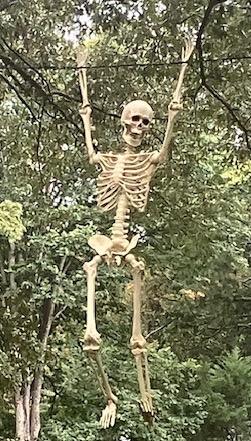
On a recent morning run, I turned off Horsepen Road and made a right on Devon. A few yards down the street two houses across from each other are decked out in Halloween gear. What caught my attention were the skeletons.

Each yard has an array of skeletons. Yet, my eyes were drawn to the high wire that stretches across the street from a tree in each yard. Skeletons in a variety of positions dangle from that high wire.

In particular, there is one skeleton that I really focused on. High above the yard, this skeleton is hanging by its fingertips. I wonder how many people I encounter on a daily basis who are hanging on by his or her fingertips?

(Photo Bill Pike)

I worry about those finger-tippers.

Unless we are completely oblivious, day to day living in this challenging world is tough.There is a tension that makes people more fragile, more vulnerable.

What really worries me about those finger-tippers is I might never know how close they are to letting go.

The constant barrage of discouraging news headlines makes me a pessimist at heart. I wonder when are we going to wake up? Perhaps that’s what keeps a bit of optimism—a bit of hope in my old heart. Hope that we will find our hearts again.

Maybe those finger-tippers can find some hope in October.

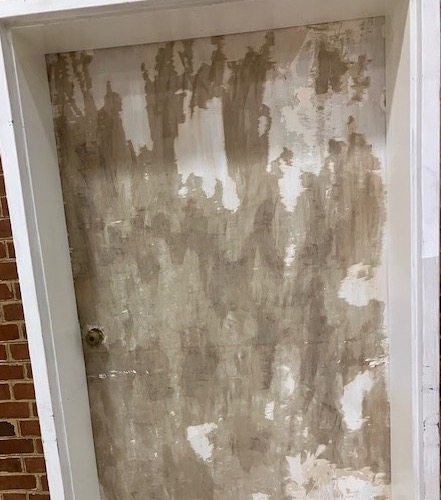
Maybe finding hope requires us to strip away the layers of hurt in our hearts like stripping layers of paint off on an old battered door.

(Photo Bill Pike)

Maybe that hope is in the October bloom of a camellia shrub.

(Photo Bill Pike)

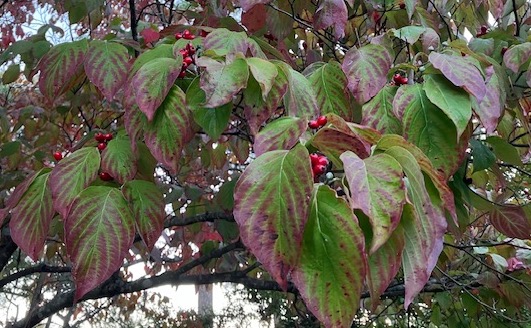
Maybe that hope is the shiny red berries from a dogwood tree.

(Photo Bill Pike)

Maybe that hope is early morning sunlight coming through window shutters as it cast a pattern of light against a sanctuary wall.

(Photo Bill Pike)

Maybe that hope is you, me, we, us realizing that a finger-tipper is in close proximity.

Maybe that hope is you, me, we, us starting a conversation with the finger-tipper.

Bruce Springsteen said: “At the end of every hard day, people find some reason to believe.”

Maybe for finger-tippers, you, me, we, us, and October can become a reason to believe at the end of their hard day.

After all, 1 Thessalonians 4:18 states: “Therefore, encourage one another with these words.”