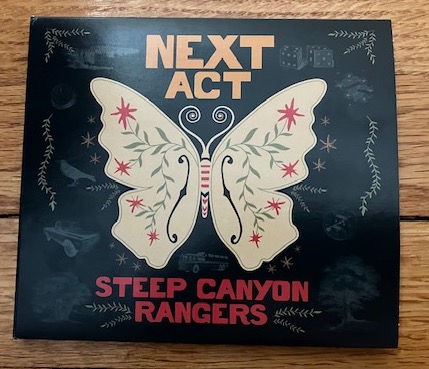
The new Steep Canyon Rangers’ album, Next Act: “we can order it for you.”

(Photo taken of album cover by Bill Pike)

Dear Steep Canyon Rangers,

Sadly, I was not able to attend your May 28 and 29 concerts at the Sierra Nevada Brewing Company Amphitheater in Mill River, North Carolina.

I had a tiny distraction to deal with here in Richmond, Virginia. Our youngest daughter’s wedding was scheduled for Saturday, May 30.

No matter what I tried, neither my wife nor daughter could be persuaded to let me attend either show. Even though, I was just the lowly father of the bride, I guess from a distance or up close the optics didn’t look good for such an escape. Maybe next year.

Congratulations on the release of your new album—Next Act.

I’m one of those old guys who hasn’t returned to vinyl. I prefer having a CD in my hands as opposed to all that digital downloading stuff.

I made a short drive into Richmond to my usually reliable independent record store to purchase Next Act.

Sadly, they did not even have a bin divider with Steep Canyon Rangers printed on it.

In the bin labeled S, much to my dismay they did not have a copy of your new album. They did have a copy of your excellent live album—Live At Greenfield Lake. I already own a copy of this album.

I made another check through the S bin, and rechecked the latest releases section at the front of the store, but no Next Act was present. I questioned an employee about the album, and he simply said, “we can order it for you.”

The Eddie Haskel in me, or maybe that should be the Ernest T. Bass in me wanted to say: “ I can order it too, but I was trying to support your store, you know my local independent record store.”

So, I thought I would try our local Barnes and Noble. They have a small section featuring recordings.

At Barnes and Noble, a nice young lady checked to see if Next Act was in the store, and of course, it wasn’t. And she too said, “we can order it for you.” By that time, the Eddie Haskell and Ernest T. Bass had died in me—no snarky comment.

A few days later, I ordered the CD from The Steep Canyon Rangers’ website. It arrived in the US Mail on Thursday, June 11.

At our church on Friday, June 12, while setting up Trinity Hall for a Saturday evening event, I listened to Next Act.


In some of the preliminary reading I did about the album, I read that instrumentally the recording marked a return to the band’s bluegrass roots. No drum set for Mike Ashworth, and no banjo-caster for Graham Sharp on this recording.

This back to the basics has happened with other bands too.

While mostly overlooked, the Beach Boys attempted to move away from the complexities of Pet Sounds and Smile with their Wild Honey album.

The Beatles made a similar push with the Get Back sessions. This was a significant step away from the legendary Sgt. Pepper’s Lonely Hearts Club Band and to some extent The White Album. However, the shelved Get Back sessions did eventually birth the magnificent Abbey Road.

For the Steep Canyon Rangers, I think Next Act is a winner. There are no clunker songs on the album. I know this because the songs from this recording stuck what’s left of my memory bank.

This album pivots off of the the band’s multiple strengths.

No doubt they are gifted players, masters of their instruments. Their playing can be fiery hot, or deftly simple and pretty.

Mandolin player and harmony singer, Mike Guggino, is an example of this. At times on these recordings, his fingers sear the fretboard of his mandolin.

I’ve always loved their harmonies. But a extra dimension is added to the band with four lead vocalist in Aaron, Graham, Barrett, and Mike. Barrett and Mike are at their best with “Some Days” and “Babylon Stone.”
I continue to be impressed with the band’s songwriters. Aaron Burdett and Graham Sharp are good storytellers. They have a gift for weaving the past and the present into their lyrics. Their stories reflect what feels like real people, real lives—people that you might encounter in any town in America. I like what I hear in the realness of these heartfelt words.

Edie Brickell and Steve Martin lend support on a couple songs. Both performers easily blend into the structure of each song. That’s not surprising considering Miss Brickell and Mr. Martin have histories with the band.

Perhaps not a first, but the Ranger’s gifted fiddle player, Nicky Sanders, puts in some nice piano playing on “Hard Luck Kid.”

Even though I miss his creative and well-timed drum work, Mike Ashworth contributes dobro, guitar, banjo, and some quiet percussion to the recording along with vocals. He is also credited in sharing production work with the group. This is a testament to his talent.

Despite my frustration in securing a copy of the album, my only other complaint is there is no photo of the band anywhere on the CD packaging. Perhaps, the record label, Yep Roc, was saving pennies.

I would like to see the Steep Canyon Rangers in concert again. I’m curious to see if Mike Ashworth will be set up behind a drum kit.

While bluegrass purists are probably dismayed about the drums being a part of the Steep Canyon Rangers, I think Mr. Ashworth’s drumming added a nice punch and texture to the band.

Hope your summer tour goes well.

Thanks for recording and releasing Next Act.

I know this was your fifteenth studio album, and I hope there are fifteen more in the future.

For my rapidly aging, non-musician ears, you gentlemen, the Steep Canyon Rangers, are required listening.

“Long may you run.”

Bill Pike
Richmond, Virginia
Learning about Claude Russell Bridges aka Leon Russell at the Osher Institute of Lifelong Learning at the University of Richmond

Some day, our luck at the Osher Institute Of Lifelong Learning at the University of Richmond is going to run out.

We’ll submit a proposal, a topic for teaching a class, and we’ll be rejected.

And that will be ok, as it will be part of life’s learning curve for two rapidly aging geezers.

But so far, we’ve been lucky. We just completed our ninth collaborative class.

The we is my lifelong friend, Joe Vanderford, and me.

We grew up in Burlington, North Carolina.

Our original bonding came from church, church softball teams, and in our teenage years—a love for music.

On some Sunday mornings, we’d sneak out of the balcony of the sanctuary at Davis Street United Methodist Church and go to Central News. Central News sold magazines and newspapers. We’d be searching for the latest issue of Rolling Stone, Crawdaddy, or Creem. These periodicals covered rock and roll in America.

If we knew, a favorite artist had released a new album, we’d drive down North Carolina Highway 54 to Chapel Hill. In Chapel Hill, we had two stops, the Record and Tape Center or the Record Bar. In either of those record shops, we’d find the new album we were looking to purchase.

But that love of reading about music and listening to music never left us. It is still part of our lives. Thankfully for Joe and me, our wives support our annual collaboration for developing a class.

I don’t remember the precise moment when we decided to develop our ninth class on Leon Russell, but I can tell you this—neither Joe nor I will ever, ever forget our class on Mr. Russell.

When we started working on this class, Joe and I knew the basic information about Mr. Russell. However, we had no idea, I mean no idea how wide, long, and deep his career spanned in American music.

His career was like staring forever into the the Grand Canyon. No matter where you look into the vastness of the Canyon, Leon’s career could fill it. Not only fill it, but the colors, tones, shades, shapes, and moods of his music could match those found in the Canyon too.

It seems almost inconceivable that a kid from Lawton, Oklahoma would have such an impact as a band leader, session musician, arranger, producer, multi-instrumentalist, songwriter, singer, and performer, but he did.

His family called him Russell. His mother noted that young Russell was slow to speak, but according to family stories, his first words were, “What’s the matter, little birdie, you cry?”

By the age of four, Russell had started playing piano by ear. His mother recognizing the potential talent connected him with the best piano teacher in the area.

A birth injury impacted his left hand, but Russell figured out how to compensate with his piano playing.

Later in life, he described his piano playing: “My chops have always been sort of weak, because the right side of my body was paralyzed a little bit. I have damaged nerve endings on the right side, so my piano style comes from designing stuff I can play with my right hand.” (Bill Janovitz page 7)

In our prep for a class, we have two essentials—a worthwhile book about the artist and a documentary that captures the artist at work.

For this class, we had an unbelievable book, Leon Russell The Master of Space and Time’s Journey Through Rock and Roll History. This book written by Bill Janovitz is as good as any book I’ve ever read about a musician. In a Herculean effort, Mr. Janovitz captures all of Mr. Russell’s life.

To showcase Leon at work, we had three documentaries to consider—Mad Dogs and Englishmen, The Concert For Bangla Desh, and an obscure film made in 1970s A Poem Is A Naked Person.

We opted for Mad Dogs and Englishmen.

Our two part class on April 13 and 14, 2026 opened with a late Monday afternoon screening of Mad Dogs and Englishmen.

On Tuesday, we put our hearts and souls into covering as much of the essentials of Mr. Russell’s work as we could. From his early bands in Tulsa, Oklahoma, the road to Los Angeles, session work, arranging and production work for a who’s who’s list of artist, the quiet development of his own songwriting skills, how Mad Dogs and Englishmen came together, his first solo album, and how he in a short period of time became a top concert draw.

To tell this story we used recordings, assorted videos of performances, and a wide range of interviews with other artists and Mr. Russell to capture a sampling of his work and the admiration that other musicians had for him.

Leon’s sound and piano style were unique. Plus, he didn’t limit himself to rock and roll. His recording and live performances reflect an ability to play any style of music.

And despite all of his talent and success, his lows were at times as devastating as a tornado ravaging across Oklahoma. Some substance abuse, struggles with his personal health, multiple marriages, unwise investments, and poor management choices severely countered his triumphs.

Those troublesome decisions forced him to tour out of necessity for much of his later life.

In 2010, his friend, Elton John, a long time admirer of Mr. Russell’s piano playing reconnected with him. The result was a collaborative album, The Union, and a tour to support the album.

During the 2011 induction of Mr. Russell into the Rock and Roll Hall Of Fame, he spoke these heartfelt words about Elton’s rescue: “About a year ago, Elton found me in a ditch at the side of the highway of life and took me up to the high stages with big audiences, and treated me like a king.”

That resurgence was good for Leon and Elton.

One of the best things about the Osher program is that they survey the students who attended both sessions of our class.

Joe and I learn from that feedback.

This year, our documentary choice was criticized.

Before the screening, Joe always writes an introduction about the film for the students. Joe’s instincts as a writer are to provide a broad brush stroke of opinions related to the film. This included referencing the negative review from the Washington Post critic, Tom Zito.

Mr. Zito said:
“Forget the film and try the record,” explaining, “What emerges from all this is roughly two hours of footage that looks terrible on the screen and sounds almost as bad. The film is projected in an annoying square format, except for the moments when the screen area is broken up into some poorly coordinated split-screen effects. The camerawork is often sloppy … the whole thing winds up looking and sounding like a cheap, imitation (indoor) ‘Woodstock.’”

Much of the feedback we received about the film from our students agreed with Mr. Zito’s assessment.

For the presentation that Joe and I wove together about Mr. Russell, the students were kinder. They offered good suggestions for how we could have shortened the videos we used as a way for including more content about Mr. Russell.

I’m not sure why, but for some reason, in working on this project, I was drawn to the first stanza of the Beatles’ song “Come Together”:

“Here come old flat-top, he come grooving up slowly.
He got ju-ju eyeball, he one holy roller. He got hair down to his knee, got to be a joker, he just do what he please.”

Here comes Leon Russell off of the Oklahoma “flat-top”, a slow moving, groovy musician. Whose eyes according to the women in his life could see right through them. His church music upbringing made him in some respects a “holy roller.” By 1970 his hair was heading toward his knees, a quiet joker who had just been biding his time to do what he pleased with his first solo album.

Mr. Russell’s first solo album confirmed what fellow musicians, including arrangers and producers knew about him—he was exceptionally gifted.

Perhaps, the opening song from the album “A Song For You” supports this testimony from his peers. “A Song For You” has been recorded by 200 artists.

My teaching pal, Joe, who knows much more about the intricacies and structure of music than I do believes this album is an underrated piece of Americana. A recording that should always be recognized as a classic piece of our musical heritage.

I agree.

I have no idea if we will come up with a proposal for a class in the Spring of 2027.

Leon’s life and his body of work pushed us to our limits.

But, I don’t think either of us would trade anything for how we wove the class together. Joe was at his best in developing the flow of the script.

On November 13, 2016, we lost Leon Russell. He died in his sleep.

Two memorial services were held—one in Mt. Juliet, Tennessee where he resided, and the other in Tulsa, Oklahoma where his career in music was launched.

At those memorial services, I wonder if anyone thought of those early words from young Claude Russell Bridges—“What’s the matter, little birdie, you cry?”

Clearly at both services, there were lots of “little birdies” from performers to speakers, and the audience who were in tears.

One of those speakers, Steve Ripley, fought through his tears to share this text from Leon: “The reason for connection is food, music, friendship, and tape machines. The strong stuff is just the facts of life and death; you either laugh or cry.”

I’m thankful for the friendship and connection that music has given to Joe and me. With every class we have laughed and cried.

And Joe and I are deeply thankful to the Osher members, and the Osher staff—Peggy, Nell, Romney, and Amy. Without them, there is no Osher program, and no class from us.

For days after the class, songs that we had featured from Gary Lewis and the Playboys, Delaney and Bonnie, Joe Cocker, and Bob Dylan rolled through my old brain. Mr. Russell’s unmistakable touch as a session musician, arranger, and producer were on those songs.

During his life and even today, Mr. Russell’s gift of music touched lots of “little birdies.” I for one am thankful that he shared this gift with us.

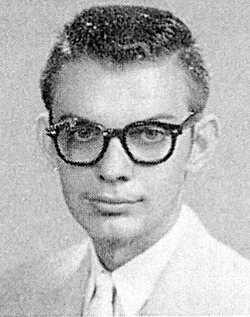
Yearbook photo of Claude Russell Bridges aka Leon Russell (multiple internet sources)

Thanks Brian Wilson

I never met Brian Wilson, but during his lifetime I met his songs, his music.

My first record purchase was a Beach Boys’ single. It was the Christmas hit “The Little Saint Nick.” On the flip side was a stunning a cappella version of “The Lord’s Prayer.”

From that first listen to that record, I was hooked.

Brian’s songwriting had a way of hooking people.

He took us to sunny California to surf the Pacific’s waves. To get to those famous west coast beaches, Brian put us in cars too— little deuce coupes and woodies. No matter if we were in one of those fast cars or watching surfers, we were surrounded by pretty California girls.

Brian was a marketer for California. He sold California to America and the world.

The lyrics showcased the lingo of surfers, hot rodders, and surfer girls.

The singable melodies locked into our instant recall. Irresistible harmonies as golden as sunshine became a trademark. Layers of instruments sometimes played with chord changes that weren’t supposed to work on paper showed the brilliance of his songwriting capabilities.

In 1961, their recordings and concerts started a legacy that lasted longer than anyone in the group could have imagined. Brian’s two younger brothers, Dennis and Carl, their cousin, Mike Love, and Brian’s high school friend, Al Jardine, formed the group.

Early on, the Wilson’s father, Murry, was the band’s manager. Despite his imperfections, Murry positioned the band for their early success as he smoozed disc jockeys, concert promoters, and dealt with the record company.

From 1962 through 1966, the band could do no wrong. Their hit songs raced up the charts. Screaming fans filled concert halls. But in 1964 while on a concert tour, Brian had a nervous breakdown.

That breakdown like a shift in a tectonic plate in the San Andreas fault broke the Beach Boys’ early formula—write songs, record, tour. Brian stopped touring. This allowed him to put his energies into writing songs and production work.

Brian worked with the gifted Los Angeles studio musicians who with great affection were named the Wrecking Crew. A new formula was born. Brian wrote the songs. He recorded the backing tracks with the Wrecking Crew. When the Beach Boys came off the road, they went into the studio and added the vocals.

This freedom to write and record allowed Brian to hone his skills as a producer. The studio became a second home. He pushed the traditional boundaries for the musicians and for his favorite recording engineer, Chuck Britz. Brian once asked Mr. Britz if he could bring a horse into the studio. Mr. Britz said no.

Brian also pushed himself to write and create beyond the band’s surfers, surfer girls, and fast cars image. From this came the legendary album Pet Sounds. Brian was twenty-three at the time. Released in 1966, initially, Pet Sounds was not a commercial success. The album’s success came from how it changed the way musicians from around the world wrote and recorded their songs.

The Beatles were listening. Brian’s work and innovations nudged them into their landmark album Sgt. Pepper’s Lonely Hearts Club Band.

Brian continued to push. The stunning single “Good Vibrations” was released. The recording was another masterpiece. The back story of the song’s recording sessions shows Brian either as a mad genius or a master of the studio.

His next project Smile continued to push the envelope. With Smile, as beautiful as we now know it was, the album crushed the Beach Boys’ successful hit making formula like a monster rogue wave from the Pacific.

His bandmates, the record company needed hit records. Smile was aborted. Brian retreated.

From 1967 until 1975, Brian quietly worked behind the scenes with the Beach Boys. He contributed songs, produced in the studio with them, but his reclusiveness begin to spin Brian out of control.

By 1975, physically, Brian was a far cry from the high school athlete he had been. His appetite was out of control, constant smoking was destroying his beautiful singing voice, and his consumption of drugs was impacting his personal well being.

Brian’s first wife, Marilyn, sought an intervention. She brought in a controversial psycho-therapist, Dr. Eugene Landy. Despite the good and bad from Dr. Landy, no one can deny that his interventions saved Brian’s life twice.

Brian’s second wife, Melinda Ledbetter, was the spark for launching Brian’s career as a solo artist. Contributing to this redemption was another group of young Los Angeles based musicians, the Wondermints. This group with other gifted musicians formed what became known as Brian’s band.

This band was fearless. No matter the concert set lists they hit every note with their instrumental chops and vocal dexterity. For example, the entire complex Pet Sounds album was played in concerts note for note.

Dead in a studio vault for almost forty years, the Smile album was resurrected. It was re-recorded, released, and met with high critical acclaim. Again, the musical gifts of Brian’s band drove this redemption of Smile.

In 2012, the living members of the Beach Boys reunited for a fiftieth anniversary tour. Brian had lots of songs to contribute to a new studio album.

After this success, for Brian recordings and concert appearance continued. But then in a summer co-headling tour with Chicago in 2022, his demeanor on stage changed. Brian became less and less engaged with the audience. By the tour’s final date, it was clear Brian’s concert performances were over.

Part of me believes that Brian’s work with the gifted musicians in his band and those concert performances added to the quality of his life, and maybe even extended his life.
However, on January 30, 2024, we learned how much the quality of Brian’s life depended upon his wife, Melinda. Married for twenty-nine years, she had been his rock. Her passing was a devastating loss.

The impact of this loss came to reality in May of 2024. That’s when Brian’s family formally placed him in a conservatorship. Dementia was to be his end.

After all that he endured, I’m amazed that Brian made it to 82. He outlived his brothers, Dennis and Carl.

It always seemed to me that his heart was music, that music was his rescuer, his redemption, a lifeline.

And in its own unique way, I believe Brian’s music was a rescuer, a redeemer, a lifeline for people who needed something to hang on to when life challenges us.

I will miss Brian Wilson.

Despite all of life’s ups and downs that Brian endured, I’m thankful for my first record purchase. That purchase started a lifelong journey with Brian and the Beach Boys.

I have thought about citing a favorite song to close out this piece. But, I can’t. There are too many.

Just as Brian was relentless in his songwriting and studio production, I encourage you to be relentless in discovering the music Brian made beyond the hit songs. Your ears, heart, and soul will not regret this pursuit.

So, I leave you with these words from Brian’s youngest brother, Carl. These comments came from the Beach Boys boxed set Made In California.

Carl Wilson: “I asked Brian one time, I guess we were just having a long conversation talking about life and some of the stuff we had gone through, and I said: “Why do you think we succeeded in such a big way?” He said: “I think the music celebrated the joy of life in a real simple way, a real direct experience of joyfulness.”

I think Brian was right.

His music brought a joy into the world.

A joyfulness that will live forever.

Brian Wilson in his home recording studio, circa 1971. (Photo Bob Jenkins)

Author’s note: On the afternoon of Wednesday, June 11, my dear college friend, Steve Hodge, who is also an accomplished musician, and long time fan of the Beach Boys, let me know that Brian Wilson had passed. In all of our road trips to see the Beach Boys in concert, I can only remember one show when Brian performed with the group. That was in the spring of 1979 at the Greensboro Coliseum. Additionally, my childhood friend, Joe Vanderford, another follower of Brian and the Beach Boys, has kept me in the loop with references to articles and podcasts related to Brian’s passing. Today, Friday, June 20 is Brian’s birthday. He would have turned 83. His website: https://www.brianwilson.com/ has posted a nice tribute to Brian.