Dear Steep Canyon Rangers,
Sadly, I was not able to attend your May 28 and 29 concerts at the Sierra Nevada Brewing Company Amphitheater in Mill River, North Carolina.
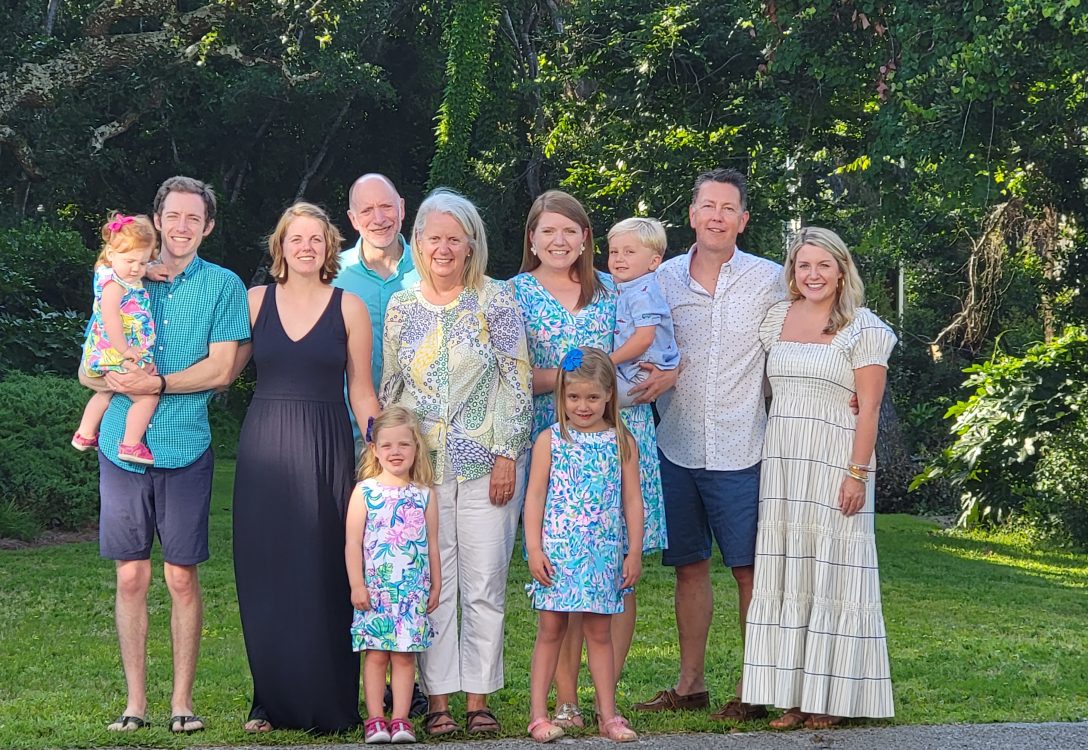
I had a tiny distraction to deal with here in Richmond, Virginia. Our youngest daughter’s wedding was scheduled for Saturday, May 30.
No matter what I tried, neither my wife nor daughter could be persuaded to let me attend either show. Even though, I was just the lowly father of the bride, I guess from a distance or up close the optics didn’t look good for such an escape. Maybe next year.
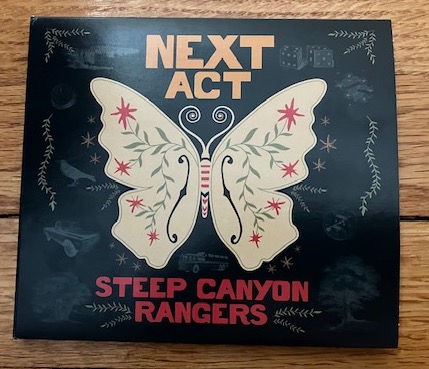
Congratulations on the release of your new album—Next Act.
I’m one of those old guys who hasn’t returned to vinyl. I prefer having a CD in my hands as opposed to all that digital downloading stuff.
I made a short drive into Richmond to my usually reliable independent record store to purchase Next Act.
Sadly, they did not even have a bin divider with Steep Canyon Rangers printed on it.
In the bin labeled S, much to my dismay they did not have a copy of your new album. They did have a copy of your excellent live album—Live At Greenfield Lake. I already own a copy of this album.
I made another check through the S bin, and rechecked the latest releases section at the front of the store, but no Next Act was present. I questioned an employee about the album, and he simply said, “we can order it for you.”
The Eddie Haskel in me, or maybe that should be the Ernest T. Bass in me wanted to say: “ I can order it too, but I was trying to support your store, you know my local independent record store.”
So, I thought I would try our local Barnes and Noble. They have a small section featuring recordings.
At Barnes and Noble, a nice young lady checked to see if Next Act was in the store, and of course, it wasn’t. And she too said, “we can order it for you.” By that time, the Eddie Haskell and Ernest T. Bass had died in me—no snarky comment.
A few days later, I ordered the CD from The Steep Canyon Rangers’ website. It arrived in the US Mail on Thursday, June 11.
At our church on Friday, June 12, while setting up Trinity Hall for a Saturday evening event, I listened to Next Act.
In some of the preliminary reading I did about the album, I read that instrumentally the recording marked a return to the band’s bluegrass roots. No drum set for Mike Ashworth, and no banjo-caster for Graham Sharp on this recording.
This back to the basics has happened with other bands too.
While mostly overlooked, the Beach Boys attempted to move away from the complexities of Pet Sounds and Smile with their Wild Honey album.
The Beatles made a similar push with the Get Back sessions. This was a significant step away from the legendary Sgt. Pepper’s Lonely Hearts Club Band and to some extent The White Album. However, the shelved Get Back sessions did eventually birth the magnificent Abbey Road.
For the Steep Canyon Rangers, I think Next Act is a winner. There are no clunker songs on the album. I know this because the songs from this recording stuck what’s left of my memory bank.
This album pivots off of the the band’s multiple strengths.
No doubt they are gifted players, masters of their instruments. Their playing can be fiery hot, or deftly simple and pretty.
Mandolin player and harmony singer, Mike Guggino, is an example of this. At times on these recordings, his fingers sear the fretboard of his mandolin.
I’ve always loved their harmonies. But a extra dimension is added to the band with four lead vocalist in Aaron, Graham, Barrett, and Mike. Barrett and Mike are at their best with “Some Days” and “Babylon Stone.”
I continue to be impressed with the band’s songwriters. Aaron Burdett and Graham Sharp are good storytellers. They have a gift for weaving the past and the present into their lyrics. Their stories reflect what feels like real people, real lives—people that you might encounter in any town in America. I like what I hear in the realness of these heartfelt words.
Edie Brickell and Steve Martin lend support on a couple songs. Both performers easily blend into the structure of each song. That’s not surprising considering Miss Brickell and Mr. Martin have histories with the band.
Perhaps not a first, but the Ranger’s gifted fiddle player, Nicky Sanders, puts in some nice piano playing on “Hard Luck Kid.”
Even though I miss his creative and well-timed drum work, Mike Ashworth contributes dobro, guitar, banjo, and some quiet percussion to the recording along with vocals. He is also credited in sharing production work with the group. This is a testament to his talent.
Despite my frustration in securing a copy of the album, my only other complaint is there is no photo of the band anywhere on the CD packaging. Perhaps, the record label, Yep Roc, was saving pennies.
I would like to see the Steep Canyon Rangers in concert again. I’m curious to see if Mike Ashworth will be set up behind a drum kit.
While bluegrass purists are probably dismayed about the drums being a part of the Steep Canyon Rangers, I think Mr. Ashworth’s drumming added a nice punch and texture to the band.
Hope your summer tour goes well.
Thanks for recording and releasing Next Act.
I know this was your fifteenth studio album, and I hope there are fifteen more in the future.
For my rapidly aging, non-musician ears, you gentlemen, the Steep Canyon Rangers, are required listening.
“Long may you run.”
Bill Pike
Richmond, Virginia