I haven’t forgotten my first visit to Virginia Tech.
In the late 1970s, on a beautiful fall afternoon, a friend, a Tech graduate, with whom I taught at Martinsville Jr. High School, took me to a football game.
Even then, I sensed there was something unique about this outstanding university. Years later, that admiration continued. Our oldest daughter is a successful graduate and diehard Hokie.
As an old North Carolina boy, I cheered when Tech entered the Atlantic Coast Conference. Academically and geographically, this was a win for the conference.
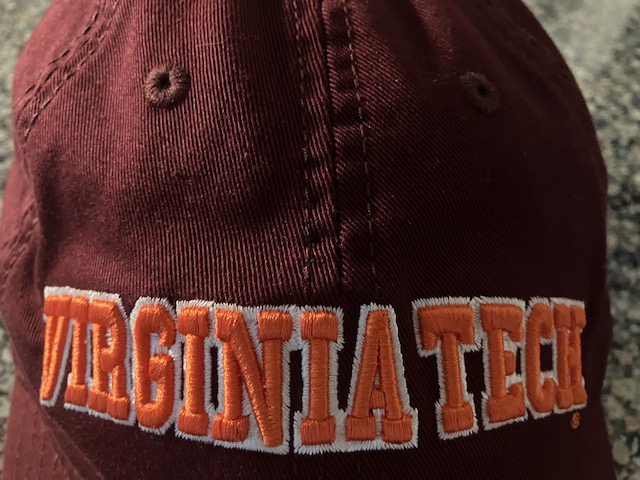
Photo of my Virginia Tech hat (Bill Pike)
Despite this affection for a university that has impacted the world beyond Blacksburg’s town limits, I do not understand the school’s relentless pursuit of becoming a dominant player in college athletics.
The recent anonymous gift of $75 million dollars to the school is an example of this quest. I appreciate the donor’s twofold focus with the gift benefiting the school’s athletic department and honors program.
However, there are no guarantees that using these millions to buy the best players, coaches, and building state of the art athletic facilities equals automatic national championships.
Founded as a “land-grant” university in 1872, I wonder how many of Virginia Tech’s “land-grant” peers are consumed by this same push for athletic prominence?
My guess is Virginia Tech’s new football coach, James Franklin, is publicly thrilled with this financial gift.
However, I can only begin to imagine the pressure he must feel to quickly develop his team into a national powerhouse.
Speaking of pressure, does the university’s leadership feel any of that stress to succeed?
If Virginia Tech’s athletic department squanders this investment, other than a coach, who will be held accountable?
Where does that accountability apply to the $95 million in debt that the athletic department already has?
The world was less complicated on my first visit to Virginia Tech.
And yet, I suspect the “lunch pail” in Lane Stadium knows this wisdom from Seneca: “It is not the man who has too little, but the man who craves more, that is poor.”
Hokies, I hope your craving works out.
Bill Pike, Richmond
Note from author: I am always honored when a piece I submit to a newspaper is published. This letter to the editor was published in the Sunday, July 19, 2026 edition of the Roanoke Times. I have many dear friends who are graduates from Virginia Tech. I apologize if the letter offends you. My goal was not to offend. The goal was to ponder one more example of how money continues to rule college sports.
On March 19, the Virginia Commonwealth University Rams (VCU) upset the North Carolina Tarheels (UNC) in the NCAA men’s basketball tournament.
This was in the first round of the tournament. VCU was seeded eleventh and UNC was a six seed.
VCU overcame a 19 point second half lead, and then beat the Tarheels in overtime 82 to 78.
Ten days later on March 29, the Duke University Blue Devils joined their arch rivals, the Tarheels, as Duke also blew a 19 point lead. Duke lost to the University of Connecticut Huskies (UCONN).
Following a Duke turnover, UCONN beat Duke on a last second shot 73 to 72. Duke and UCONN were playing in the Elite Eight for a berth in the Final Four. Duke was a number one seed, and UCONN was a number two seed.
Before going any further, let me tell you that I have always cheered for Duke in the Atlantic Coast Conference. Perhaps some of that grounding came from my parents who thought I might end up going to Duke Divinity School to become a Methodist pastor. The good Lord is thankful that didn’t happen.
I am no expert on college basketball.
I loved the Atlantic Coast Conference (ACC) that I grew up with as a kid. In my opinion, because of money and illogical geographical expansions the ACC has been destroyed.
Also, because of money, including Name Image and Likeness (NIL), the Transfer Portal, one and done players, I worry that the NCAA could fall further into disarray.
I do not watch Duke basketball games. I follow the season from a safe distance. I’m too chicken to put my life in the hands of 18 and 19 year olds with a round ball that has a mind of its own.
Watching missed foul shots and mindless turnovers at critical times during a game would cause me to lose what little real time sanity I have left.
When Duke plays, I check in on line, read the post game analysis, and look carefully at the boxscores.
I’ve watched enough basketball games to know that big leads in the second half are always a concern. Big leads can be tough to sustain. Look no further than the games that UNC and Duke loss.
If UNC took VCU lightly, they shouldn’t have. In 2007, VCU upset Duke 79 to 77 in the men’s NCAA tournament. True that was nineteen years ago, but Duke didn’t expect to lose to VCU either. I guarantee you the Duke players on that team still remember that loss.
If a team has a big lead in the second half with lots of time left, at some point, the basketball gods switch the momentum. Suddenly, everything starts to work for the team playing catch up, and everything starts going wrong for the team with the big lead.
Living here in Richmond where VCU is located, I’ve heard that the UNC players talked trash to the VCU players. Whether that is true or not, I can’t confirm.
But, I know this— trash talking with a big lead isn’t a good idea. If your going to trash talk a team, your talk best be in a really obscure foreign language that no one, not even a student manager on the opposing team can translate. Trash talking your opponent ensures trouble.
And speaking of talking, a reliable friend of mine, a lifelong UNC fan and graduate, noticed that neither Hubert Davis nor Jon Scheyer congratulated the winning coaches and their players in the post-game press conferences.
Perhaps, Coaches Davis and Scheyer were too shellshocked from losing. I understand these were excruciatingly painful losses. However, these coaches have been around basketball all of their lives. They know better—you congratulate the winning coach and his team.
Another source of frustration for me is the coaching carousel. Again, money is the ruler.
Quite often, I think to myself I went into the wrong profession. I should have been a men’s college basketball coach.
I could coach somewhere, turn a losing program around, lead my team into the NCAA tournament, sign an extension contract for millions of dollars, and then fail to continue to win and make it into the NCAA tournament.
Even with this lousy downturn, and the end of my coaching career at this school, it is likely that I a mediocre coach will walk away a millionaire. I can thank my wise agent and attorney for negotiating this sweet deal.
These ridiculous coaching contracts are all about the desire not just to have a winning season every year, but to win conference championships and potentially the national championship.
Alumni with deep pockets are willing to support these coaching contracts while also providing funds to bring in the best players.
Gone are the days when a player is loyal to his school and he plays there for all four years.
Loyalty is a dying word.
The same lack of loyalty can apply to coaches too.
N.C. State’s Athletic Director, Boo Corrigan learned about the lack of loyalty when he hired former LSU coach Will Wade.
Will Wade coached at N.C. State this year. Coach Wade bolted at the end of this season. He agreed to return to LSU where he had been a mediocre coach. Down in Tigerland, Coach Wade will continue to play second fiddle as football is still king of the campus there.
I imagine Boo Corrigan wishes he had never hired or ever heard of Will Wade.
And in truth, I feel bad for Hubert Davis. He might not be a great coach, but he was loyal to UNC.
Seems that the UNC decision makers forgot that Coach Davis’ teams beat the despised Dookies at two critical times in 2022.
First, at Mike Krzyzewski’s final home game at Cameron Indoor Stadium, and then again in the Final Four that year which turned out to be Coach Krzyzewski’s last game.
And with all of the foolishness involved in the speculation of who gets fired and hired as college basketball coaches, it is too bad that the athletic directors at N.C. State and UNC didn’t put out a perfect April Fool’s press release.
They could have announced that N.C. State had hired Hubert Davis and that UNC had offered a contract to former Duke star, Bobby Hurley. On March 11, Coach Hurley and Arizona State parted ways.
College basketball coaches, preachers, and public school superintendents have something in common—pressure.
These individuals are supposed to succeed. Doesn’t matter that it is impossible for them to make everyone happy in their environments.
They must win every game, hit a grand slam every Sunday with their sermon, and survive every school year without controversy. Impossible.
Go take a good look at Hubert Davis’ face in the post VCU press conference. On May 17, 2026, Coach Davis will turn 56. Weariness, the wear and tear of coaching is all over Coach Davis’ face. He looks much older than 56.
The pain of joining Club 19 will linger for some like losing a member of their family in the worse possible way.
If Club 19 is like that for you, I suggest you ponder life a bit deeper, deeper than UNC and Duke’s basketball seasons. Clearly, there are many things in daily living that have a greater urgency.
The real question for Dookies is what do you, me, we, us, the players and coaches learn from blowing a nineteen point lead?
I have a handful of books about college basketball. I’ve enjoyed reading each book. But, it is no secret that my favorite book about college basketball is Pat Conroy’s My Losing Season. If you are a college basketball lover, you must read this book.
In the Epilogue of the book, Mr. Conroy writes: “There is no downside to winning. It feels forever fabulous.But there is no teacher more discriminating or transforming than loss. The great secret of athletics is that you can learn more from losing than winning.” (Conroy pages 394-395, My Losing Season)
I think Mr. Conroy is correct about learning from losing.
Monday, November 2, 2026 will be here in a blink. That is the date set by the NCAA when men’s college basketball games can officially start.
With that date, all of this madness starts again.
My old feeble mind hopes that some common sense might return to the college game.
I’ll hold out for hope, but I think we’re too deep into the allure of money to turn things around.
Of course that enticement could be slowed if multiple college athletic departments continue to run at a deficit. The optics for running in the red will not be favorable.
Long after I’m gone, someone might stumble upon The Andy Griffith Show. The “Mayberry Goes Hollywood” episode illustrates how the charm of the town of Mayberry is turned upside down by its citizens.
A Hollywood movie producer comes to Mayberry to scout the town for the shooting of a movie. The producer likes what he finds with the town and its people.
When Mayberry is chosen as the site for the filming, its citizens turn Mayberry into an unattractive Hollywood themed town.
It takes a gentle chastising from the producer to get the citizens and Mayberry back to normal.
As Mayberry finds itself again, Mayor Pike looks at Sheriff Taylor and says to him: “We tried to tell them didn’t we Andy?” Andy who never fell into the Hollywood trap replies to the Mayor, “We sure did, Mayor.”
Maybe, someday, someone will look back at the current state of men’s college basketball and say, “we tried to tell them.”
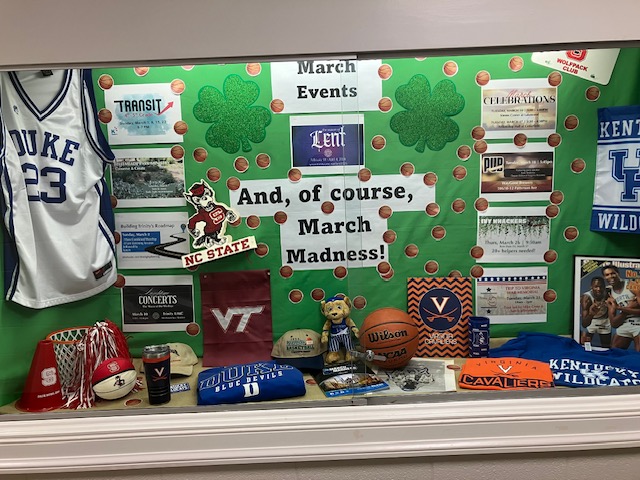
Even March Madness appears in a church display case during Lent (Photo Bill Pike)
Today, the Major League Baseball (MLB) season opens.
Seems too early to me.
Growing up, I never tried out for a baseball team in the community or at school.
Yet, baseball consumed me.
I purchased baseball cards.
Waited for the afternoon paper to arrive to check the box scores.
And at night, my AM only transistor radio could pickup the broadcast of the New York Yankee games.
I was a Yankees fan.
I listened to those games.
I could reel off with no hesitation the starting line-up for the Yankees.
Of course, Mickey Mantle was my favorite player.
At home in the backyard was my father’s large garden plot. Behind the garden was a barren field.
The kids in the neighborhood turned it into our “field of dreams.”
We played non-stop— girls and boys.
Bats were cracked, baseballs lost, and sometimes egos were bruised.
But, we always came back the next day to play.
My love of the Yankees faded.
My wife’s relatives converted me to a Red Sox fan.
When our oldest daughter lived and worked in Chicago, my allegiance shifted to the Cubs.
To tell you the truth, now that the Red Sox and the Cubs have each won a World Series, I barely pay attention to baseball.
At my age, I’m a natural born whiner.
So, I whine about the ridiculous salaries.
According to Sportico, “ the 15 highest-paid MLB players will earn an estimated $718 million overall in 2026.”
I was an English major in college, and even I know that’s a lot of money—just shy of $50 million dollars per each of those 15 players.
And with baseball still being our so-called “national pastime” I chuckle that Venezuela defeated the United States in the first ever World Baseball Classic.
Let’s get the disclaimer out here, I’m no expert about baseball. However, I sense that all players must have good eyes.
It is essential for hitting, and so many other taken for granted pieces of the game.
In David Halberstam’s book “The Summer of ’49,” I love the story about Ted Williams being called out on strikes.
Ted Williams was known for his remarkable 20/10 eyesight.
Being called out on strikes really agitated him.
For this game, the agitation continued in the dugout where teammates teased him about being called out on strikes.
In his bellowing about being called out on strikes, Williams asserted that—“home plate was out of line,” and that was the reason he was called out.
The next day, the Red Sox manager, Joe Cronin went out to measure home plate. Ted Williams was correct. Home plate was out of line.
In my aging, I have become more aware and sensitive about my vision. Cataract removals and two corneal transplants have made me more protective of my vision.
For sure these medical improvements have helped my eyesight, but I wonder have they helped me to truly see the world in front of me.
In the movie about baseball titled “Moneyball,” I appreciate the conversation between Peter Brand, the Assistant General Manager for the Oakland Athletics, and General Manager for the team, Billy Beane.
Using player data and computer analytics, Peter Brand is charged with finding value in players “that no one else can see.”
Mr. Brand states that “people are overlooked for a variety of biased reasons and perceived flaws—age, appearance, personality.”
How many times in my life have I failed to find value in people because of my “biased reasons” and their “perceived flaws?”
How about this place called church? How many times has the church failed people for the same reasons?
How many times have I been exactly like the person in the scripture from Luke 6:42: “How can you say to your brother, ‘Brother, let me take the speck out of your eye,’ when you yourself fail to see the plank in your own eye? You hypocrite, first take the plank out of your eye, and then you will see clearly to remove the speck from your brother’s eye.”
If good vision is essential for a baseball player, it is also essential in the real world too.
As a confessed whiner, I’m also skilled at worrying.
I worry about my country.
I love my country, but at this very moment— I don’t understand my country.
Yes, I am worried.
I think about this quote from Helen Keller: “Better to be blind and see with your heart, than to have two good eyes and see nothing.”
In the time I have left in this weary old world, I can no longer afford to see nothing.
I need to become better in finding the value in people that “no one else can see.”
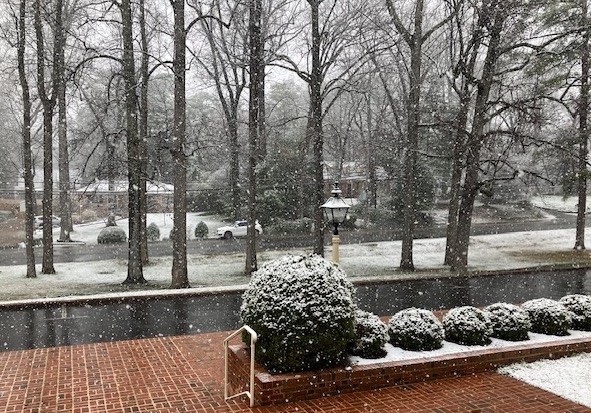
On the afternoon of Wednesday, March 11, a record high temperature of 89 degrees was set in Richmond, Virginia.
In Richmond, the next day, the afternoon temperature dropped to 39 degrees, and cold rain switched over to snow.
For two hours, heavy wet snow flakes fell turning trees and the grass white.
That mad March snow (Photo Bill Pike)
March is mad.
Beyond its weather madness, March is mad for another reason—college basketball.
March is the time of the year when the regular season comes to an end. Conference tournaments are held.
Then on Selection Sunday, this year, March 15, college teams across America wait to see if their season’s accomplishments merit being selected to participate in the sixty six team tournament.
For teams selected, there is a feeling of exhilaration.
For the teams who were not selected, heart crushing disappointment hits them and their fans.
When the tournament opens on Thursday, March 19, America is captured. A disruption occurs. Lives are consumed. Everything pivots off the games.
My introduction to basketball came in the fourth grade.
On a spring afternoon, two of my classmates, Johnny Huffman and Tommy Hinson, from Hillcrest Elementary School in Burlington, North Carolina walked to my house. They invited me to play basketball at the Huffman’s house.
We walked back to the Huffman’s house. For the remainder of the afternoon, I attempted to play basketball for the first time.
I could not have lived in a better location for basketball.
I lived in the heart of the Atlantic Coast Conference. Four of the conference’s founding teams—Duke, North Carolina, N.C. State, and Wake Forest were in close proximity.
I followed these teams by reading the boxscores in the Burlington Daily Times News. Listened to radio broadcast of games on an AM radio, and watched a weekly televised game on Saturdays broadcast in black and white.
I didn’t possess the skills needed to make teams at school, but I enjoyed playing in the neighborhood and on our church team at the YMCA.
Those days are long gone.
While I still love basketball, I no longer let the game consume me.
I follow the game from a distance.
That way I don’t torture my rapidly aging body with mental and physical stress. It isn’t good for an old man to shout foul, fiery language at an unresponsive television screen.
In 2009, our church started a program centered around Upward basketball and cheerleading. From January through February our fellowship hall is converted into two basketball courts. During the week teams have late afternoon practices. Saturday is game day.
I think the original intent was maybe, just maybe, this basketball and cheerleading offering might help our church to pick up new members. I sense that hasn’t been a win for the church.
On the afternoon of Saturday, February 21, 2026, I found myself sitting in the lobby outside our church office. I was waiting for the last Upward basketball game to end.
Earlier in the day, our lead building caretaker had been admitted to the hospital. I was there to get the building ready for Sunday.
While waiting, I noted a piece of paper on a table top. I went over to checkout the paper.
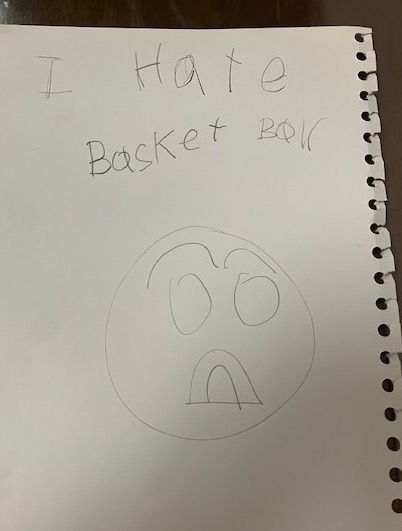
In the script of a young child, I read these penciled words: “I hate basketball.” Under that statement was a drawing of an unhappy face.
The heartfelt note (Photo Bill Pike)
I showed the note and drawing to our Director of Kids and Family Ministries. She had noticed a young girl sitting in the lobby working on that piece of paper.
Immediately, I was curious about the young lady’s reasoning.
Was she unhappy because her parents were requiring her to play basketball, or was she disgruntled because she was required to watch a sibling participate?
By the time I finished getting Trinity Hall its restrooms, hallways, and classrooms back in shape after being used by 400 people—I too could feel a bit of disdain toward basketball.
When I think about the game of college basketball that I grew up admiring compared to today’s game, quite honestly, I’m disgusted and disappointed.
That disgust and disappointment is all grounded in money.
That money has birthed:
Geographically Illogical expansions of college athletic conferences
NIL (name, image, likeness generates money for players)
The transfer portal has destroyed loyalty to a team
Players who play for one year and then bolt to play professionally
In my humble and non-expert opinion, each of these have hurt college basketball.
That hurting of college basketball is linked to the following questions:
At this very moment, how many college athletic departments are running in a financial deficit?
How many college presidents and board of visitors lack the spine and courage to say to alumni with deep pockets—we don’t want your millions to buy college athletes and potential national championships?
How many collegiate athletes who fail to earn their academic degrees, but secure large professional contracts end up filing for bankruptcy?
How many more investigations are lurking out there about coaches who can’t play by the NCAA rules related to recruiting and running their basketball programs?
The same question can be asked about student athletes and gambling. How many more investigations will uncover gambling with professional gamblers to fix a game?
In doing a bit of reading about this college basketball season, I sadly learned about how Anthony Grant, coach for the mens’ team at the University of Dayton has been treated this year.
Coach Grant and his players were the target of unhappy fans and gamblers after losing a game. These hateful messages were addressed by Coach Grant and the school’s Athletic Director.
Later in the season, some Dayton fans wore t-shirts suggesting that Coach Grant be fired.
Without question, college coaches and their players are always under pressure to win. I’m not sure all fans, including alumni, understand how challenging it is to secure a winning season and the potential championships that go with it every year.
This year, March Madness is a bit more mad for another reason—since February 28, the United States has been involved in a war with Iran.
For sixteen days, American service members have been attacking Iranian installations. I wonder what the families of the thirteen service members who have been killed in this war think about this madness?
That madness of losing a loved one will never leave those families—never.
Part of me would like to meet the young lady who left us the “I hate basketball” message.
I appreciate how she shared what was on her heart.
Maybe, she wanted to get the adults who run the program and her family to think deeper about her needs.
Maybe, she wanted our church, the church who sponsors the program, to think deeper about what we were offering.
In Pat Conroy’s book, My Losing Season, he thinks deeply about his senior year of playing college basketball at The Citadel.
Chapter 16 is titled Christmas Break. In this chapter, Mr. Conroy writes about eight days of practice that started on the afternoon of Christmas Day and ended on New Year’s Day.
He regarded those practices as “the worse time of my life as a ballplayer.”
I worry that our young note writer might feel the same way about her Upward basketball experience.
I hope that will not be the case for her.
Despite March and its madness, the month does have some good traits— St. Patrick’s Day, Spring officially arrives, and baseball season is around the corner.
With the March basketball madness, I wish you, your bracket, and your favorite team the best of luck.
Just remember, someone you encounter during this basketball madness might not be as steadfast as you are about keeping tabs on an orange ball.
This person might be having “the worst time” of his/her life.
And chances are that difficulty can’t be attributed to the madness of how a basketball bounces.
My connection to Chicago comes from my wife’s family and our oldest daughter. She lived and worked in Chicago for 14 years. We always enjoyed our visits to Chicago to see our daughter.
I never had the privilege of attending a game at Soldier Field, but I have a question for Chicago: After the electrifying win over the Packers on Saturday evening, why would anyone in their right mind even consider leaving this cherished stadium for another site?
Watching the game at home on television, I could feel the electricity of the crowd surging through the screen. That intensity was powerful. The stadium’s design, location and loyalty of its fans are legendary.
Ponder these questions about other similar athletic venues.
Do you think the Red Sox will leave Fenway, the Dodgers Chavez Ravine or the Cubs Wrigley? No.
Will Butler University leave Hinkle Fieldhouse or Duke leave Cameron Indoor Stadium? No.
Will the Packers leave Lambeau? No.
Soldier Field, just like these venues, is a classic. Da Bears deserve to play in no other stadium.
A move to another location in Chicago would be an insult. That could cause Carl Sandburg’s “City of the Big Shoulders” to shrink. We can’t have that.
Soldier Field has been loyal to the Chicago Bears. Now, the Chicago Bears and Chicago must be loyal to Soldier Field.
Put on your thinking caps and figure this out. Take all options minus one off the planning table.
The only viable option worthy of consideration — Da Bears play at Soldier Field forever.
— Bill Pike, Richmond, Virginia
Note from author: I was honored to have this Letter To The Editor published in the Wednesday, January 14, 2026 edition of the Chicago Tribune.
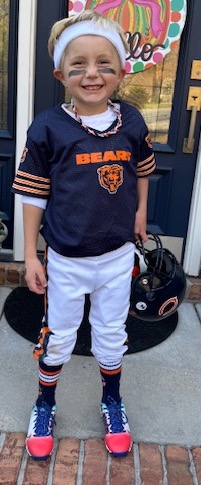
Our grandson in his Chicago Bears uniform (Photo courtesy of his mom)
Isolated in the back parking lot of our church is a dumpster. This dumpster is clearly marked for recycling materials.
Despite our attempt to be good neighbors, the dumpster was periodically contaminated by people who loaded it with items that can’t be recycled. As a result, we had to add padlocks on both sliding doors.
I don’t understand how a person can misunderstand the purpose of this dumpster.
Late on the afternoon of Friday, January 3, I walked across the parking lot with some cardboard to recycle.
When I unlocked a padlock on one of the sliding doors, I noted on the floor of the dumpster a small, tied off plastic bag. It was loaded with dog poop.
Disgusted, I asked myself how could a person do this?
Growing up in Burlington, North Carolina, I will always cherish playing baseball, basketball, and football with neighbors, friends, and cousins.
An empty field behind two houses became our “field of dreams” where we played baseball.
Out front, two lawns merged together nicely to form our football field.
And of course, whether dirt, concrete, or an asphalt court even on the coldest of winter days, we played basketball.
That love of sports made it easy to follow the basketball and football teams from the Atlantic Coast Conference(ACC).
Four of the founding schools, the University of North Carolina, N. C. State, Wake Forest, and Duke were in close proximity to Burlington.
I read newspaper accounts, listened to radio broadcasts, or watched on television games with the ACC teams.
Founded in 1953, the original conference has been destroyed by an expansion that completely disregarded geography, but was entirely grounded in a full court press for money.
That fixation on money has trickled down into the athletes too.
Now Name, Image, and Likeness—NIL allows college athletes to profit not only from their skills, but by marketing and promoting themselves.
Additionally, a transfer portal allows athletes to freely shop their skills. Loyalty to the school that originally wooed the gifted athlete is no longer a consideration.
Just before Christmas, several media outlets reported that Duke University’s athletic department will be paying Darian Mensah, a redshirt, transfer quarterback from Tulane University eight million dollars to play at Duke for two years.
I guess a degree from Tulane or Duke means nothing when stacked against eight millions dollars.
I wonder what Duke University employees who work behind the scenes for the football program think about this eight million dollar deal.
And I also wonder if those program sustaining employees ever see any extra pennies in their paychecks from the payout when the football team plays in a post season bowl game?
While we’re talking about paying millions for a college football quarterback to play for a couple of years, a school might opt to spend several million dollars to build a team in hopes of winning a national championship.
Again, media outlets have reported that the current edition of the Ohio State University Buckeyes football team came from twenty million dollars raised by “the school’s collectives.”
With these millions floating around in the pursuit of gifted players and national championships, I find it interesting that at these two prestigious universities, both schools have food pantries for their students who are food insecure.
Back on December 28, 2024, the football teams from East Carolina University and N.C. State University played each other in the Go Bowling Military Bowl.
An exciting hard played game was marred by a brawl as the last seconds of the fourth quarter were ticking away.
Players involved in this fray were out of control. It took too much effort and time for the coaching staffs and game officials to get the players on both teams under control.
One of the referees was injured as he tried to help settle down the players from both teams.
Watching this melee on television, I was disappointed by the lack of self-control from individual players, and their disrespect for the coaching staffs and officials who tried to quell the disorder.
In this madness, sportsmanship was dead. I kept hoping that the referee would stop the game, and send both teams to their locker rooms.
When order was finally restored, a few players from both team were ejected. The final seconds of the game were completed. Then the teams were directed toward their respective locker rooms.
I’m heartbreakingly disgusted with bagged dog poop in a recycling dumpster, money driving collegiate athletic conferences and their student athletes, and a college football bowl game marred by players in a brawl.
Disgusted as I might be, I should not be surprised. We’ve been losing our minds for a long, long, long time.
Yes, what’s left of my old brain shows that I’m losing my mind too, but losing my mind is grounded in worry.
December of 2024 brought us more to worry about than bagged dog poop and athletic madness.
The CEO of United Health Care was brazenly murdered in New York City.
At the Abundant Life Christian School in Madison Wisconsin two students were murdered by one of their classmates.
And just as the New Year started more innocent people were murdered by a traitorous driver who plowed his vehicle into the streets of New Orleans, Louisiana.
Yes, we continue to break hearts, we continue to be disgusted, and we continue to be paralyzed to solve our madness.
At this point, you must be thinking, Bill, with these blog posts, all you do is whine, whine, whine, whine. Is your whining ever going to stop?
Fair question, and I don’t disagree with your assessment.
Maybe my whining is grounded in these questions for myself from Isaiah Chapter 1 verse 17: “when am I going to become better at helping to cease evil, when am I going to become better at doing good, when am I going to become better at seeking justice, and when am I going to become better at rescuing the oppressed?”
Perhaps, the answer can be found in Fritz Knapp’s book— The Book of Sports Virtues.
In one chapter, Knapp writes about Branch Rickey. Early in the 1940s, Branch Rickey was the general manager for the Brooklyn Dodgers baseball team. Mr. Rickey helped to break the color barrier in major league baseball when he signed Jackie Robinson to be the first African American player to play major league baseball.
Mr. Rickey’s motto was “Education Never Stops.”
If I want to stop my heartbreakingly disgusted whining, then I must not let my education stop.
That learning is the only chance I have to become better at working toward ceasing evil, doing more good, seeking justice, and rescuing the oppressed.
In the time I have left in this wobbling old world, I will be heartbreakingly disgusted with myself if I don’t use my learning and my voice to keep poking at those challenges.
How about you?
Maybe your answer can be found in these words from Stephen Hawking: “Quiet people have the loudest minds.”
Thanks for putting up with me, love, Bill
Bagged dog poop inside recycling dumpster (Photo Bill Pike)