Every Memorial Day, I think about the uncle I never met—Charlie Boyd Pike, Jr.
Boyd was the oldest of the eleven children in the Pike family.
According to family records, Boyd enlisted in the United States Navy on October 9,1941. Seven months later, on May 7, 1942, Boyd was declared missing in action. Boyd was a Fireman Third Class on the Navy destroyer the USS Simms. The Simms was attacked by Japanese war planes and sunk in the Coral Sea.
Despite this notification, the family held out hope that Boyd might have survived. Sadly, his body was never recovered.
Out on the Burlington Road in Greensboro at the cemetery for Mt. Pleasant United Methodist Church, there is a gravestone for Boyd.
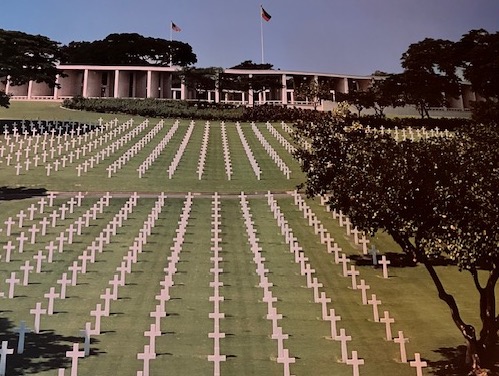
Additionally, Boyd’s name is inscribed on the Tablets of the Missing at the Manila American Cemetery and Memorial in the Philippines.
Manila American Cemetery and Memorial Fort Bonifacio, Philippines (Photo taken from an original print provided by WA Pike, Sr. )
According to United States military records, there are 36,280 missing in action names commemorated at the Philippines cemetery. That’s about the equivalent of the population of Salisbury, North Carolina (35,825) suddenly disappearing.
I can’t begin to imagine what Boyd’s loss was like for my grandparents and his brothers and sisters.
Subsequently, four of Boyd’s brothers served our country. Perhaps, it was luck or the grace of God, but they served without permanent injury or death.
Since our founding, America knows how horrible war is.
Our historical accounts and the trauma for families who experienced these too many losses confirm these horrors.
And despite this awfulness, at the end of every war, we hold on to a false hope that this one might just really be the last war of our lifetimes.
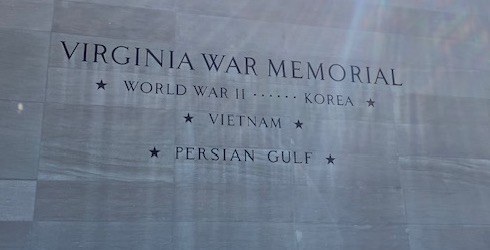
On a recent outing to the Virginia War Memorial, I came across these words: “Tell all who enjoy freedom of the deeds and sacrifices required for freedom to flourish.”
Every Memorial Day, I worry a little bit more that America is slipping away from understanding those “deeds and sacrifices required for freedom to flourish.”
I don’t think my Uncle Boyd, nor the thousands like him want that to happen.
From the author: I wrote this post on Sunday, May 17, 2026. On Monday, May 18, I sent the piece to the editor of the Greensboro News and Record. I gambled that the editor might take the piece and run it for Memorial Day because of the Greensboro connection. That didn’t happen, and I’m fine with the editor’s decision not to use it.
My friend, Mike Cross, is a United States Marine Corps veteran.
Sgt. Cross served America during the Vietnam War.
Sgt. Cross rarely speaks about his tour of duty in Vietnam. As you might well know, all wars are tough, disquieting duty.
Sgt. Cross is also a docent at the Virginia War Memorial—an excellent docent.
In the Spring of 2025, I learned from Sgt. Cross about a new program that the Virginia War Memorial was initiating for Memorial Day. The program is called “Say Their Names.”
“Say Their Names” is simply a reading of the names of “Virginia’s fallen heroes” from America’s wars. The reading of the names “ensures that their names and memories will not be forgotten.”
I was able to sign up on-line for two slots.
On Memorial Day afternoon in 2025, I drove to the Virginia War Memorial. Readers were asked to arrive thirty minutes prior to their designated start time.
Arriving early gave me the chance to read through my list of names. In that silent practice, War Memorial staff were available to answer any questions about pronunciation. Additionally, the staff made sure that your pacing for the reading of the names would not be too quick or too slow.
My first slot was at 4:09 p.m. My next one was at 4:12 p.m.
As the reading time approaches, War Memorial staff lead the readers outside into the Shrine Of Memory.
Readers also receive simple instructions about the cue for approaching the podium. There is no sprint to the podium, but no second is lost in keeping to the scripted timing.
Luckily for both of my assigned time slots, my pace was good, and most importantly, I did not mispronounce the names.
While waiting, I sat and listened to the reader at the podium saying the names from their list.
In the background, the whirring of car tires could be heard from out on Belvidere Street and an occasional gentle toot of a train horn from a freight train ambling along the tracks by the James River would roll up from the bluffs below.
But nothing disrupted the quiet, respectful dignity of the cadence of the names being read as that singular voice at the podium filled the Shrine of Memory.
Of course, these “fallen heroes” deserved every second of that solemnity.
I can only begin to imagine the harshness of the environments in which many of them perished.
During my first four years of teaching, I was hired as a Title VII Remedial Reading teacher at the Martinsville Junior High School in Martinsville, Virginia. Martinsville is located in Henry County, Virginia.
Some of the names I read were from Henry County. As I read, I recalled a few familiar last names that came from the last names of former students. I wondered if the hero might be a relative.
One thing is clear, we have lost too many Americans in our wars. In the Shrine of Memory, there are close to 12,000 names inscribed on the glass and stone walls.
These sacrifices in combat start with World War II and include every war and conflict where America has deployed our troops since then.
If this inaugural “Say Their Names” event is offered next year, I will attempt to sign up again as a reader.
Today, part of me feels that America is more interested in Memorial Day as a holiday weekend and the retail sales events that are linked to this unofficial start of summer.
Taking Memorial Day for granted isn’t good thinking.
In the last chapter of Tom Brokaw’s book, The Greatest Generation, he describes a Memorial Day in South Dakota. Mr. Brokaw was visiting his father’s brother, John, a World War II veteran.
On this Memorial Day, his uncle asked Mr. Brokaw to go with him to the Bristol cemetery. For years, John Brokaw had been the person who placed a small American flag on the graves of veterans.
John Brokaw had handed off this responsibility to a veteran from the Korean War, but John worried that his friend might not know the exact location of the graves of the veterans. So, on this day, he was still helping out and guiding his friend.
Watching these two veterans placing the flags on the appropriate graves, Tom Brokaw wrote: “It was a ceremony of honor, remembrance, and renewal played out in countless other cemeteries across the land by members of a generation that gave so much and asked so little in return.”
When it comes to Memorial Day, America and its citizens can’t afford to be distracted by a three day weekend and massive retail sales.
We need to be remembering those women and men “who gave so much and asked so little in return.”
After all, their sacrifices are the reason America continues to exist.
As we move into the future, we can never fail to honor and remember those “who gave so much.”
It is the least we can do for their now silent, humble hearts as they “asked so little in return” from us.