My friend rejection: Florida Keys, Miami, Greensboro, Charlotte, Washington, New York

Let’s get the truthful apology out early. To my wife and family, I know I spend too much time at my laptop writing.

Whether I’m good or lousy at writing, I couldn’t tell you. At this point in my old life, the writing is more about spouting out what is in my old heart.

And that spouting is grounded in this fact, I’ll be 72 in June. I don’t have much time left to put you into nap mode with my words.

If a person writes with the goal to be published, then that person must know that rejection is part of the territory.

I try to learn from rejection.

I once took the aggravation from a rejected submission and used that frustration to create another piece that was accepted for publication.
That made me feel better.

So for this post, I’m releasing some recent rejections.

I’ll provide a footnote giving background as to why I wrote each piece.

If you choose to continue your reading, ponder this. My whining about words being rejected is nothing compared to the rejection people experience in their day to day living.

What’s remaining of my old brain can still recall those moments when I hurt people by rejecting them. If those moments are still within me, they must still be within the person I rejected. That’s not good.

In the Hulu series Only Murders In The Building, the three main characters know rejection in their lives and careers.
Their rejection experiences also equal loneliness, a quiet killer in our chaotic world.

Moving forward in what is rapidly becoming an inconsiderate world, I need to be more aware of the rejection and loneliness that are around me everyday.

My heart needs to care more.

I need be more attentive to the green wristband I wear that simply states: “Be Kind.”

Kindness can counter rejection.

That wrist band means nothing if I don’t live it.

Letter To The Editor

From January 20 – January 31, my wife and I, and two couples from our college days had the pleasure of visiting the Florida Keys. Marathon was our base.

Let’s start with the confession. Since we arrived from Maryland, North Carolina, and Virginia, I think we were responsible for the unseasonably cool, cloudy, and windy weather that annoyed the Keys for a few days.

We adapted, and fortunately, no frozen iguanas fell from a tree and clunked our noggins.

In truth, I wanted to thank the people of the Keys for their hospitality. From Key Largo to Key West, we dined, snorkeled, fished, biked, walked, jogged, and learned. No matter where we visited, the people who greeted and assisted us were patient, considerate, and knowledgeable.

I don’t think any of us were prepared for the volume of traffic that the Overseas Highway handles. This main route never rests. Vehicles of every size and shape keep moving even in the dicey sections where the throughway narrows.

In that traffic mix are school buses. As a retired public schools educator, I want to compliment the Monroe County school bus drivers. While we were in Marathon, I marveled at the skills of these drivers.

School bus drivers are required to multi-task. They monitor their priceless cargo while managing the challenges of heavy traffic and the often deficient judgment of clueless drivers.

If we have the privilege of visiting the Keys again, we’ll work not to bring winter air with us. I think the iguanas would be appreciative.

Keep up the good work.

Bill Pike
Richmond, Virginia

Submitted to the Florida Keys Weekly Newspapers 2/5/25. Two ideas, thanks for the hospitality, and many thanks to the bus drivers in this school system. They need a pat on the back.

Letter To The Editor

On Friday, January 31, 2025, I was in the Miami International Airport. I was headed home to Richmond, Virginia. My last visit to Miami was in 1978.

Over those 47 years, Miami, Florida, and America have experienced the ups and downs of change.

Knowing I had a long wait for my flight, I wanted to purchase the Friday edition of the Miami Herald.

When I entered an airport variety store, I was pleasantly surprised to find your paper in stock. In a flying trip last May, neither the Richmond nor Atlanta newspapers were available for sale in their airports.

After paying for my copy, I was shocked by the paper’s appearance. It was thin, lightweight, and totaled 24 pages.

The paper reminded me of how a friend looked after experiencing the trauma of cancer surgery and post-operative treatments.

I imagine the painful gutting of your personnel to save pennies was similar to what our journalist experienced in Richmond and hundreds of other newspapers across America.

If I return to Miami, I hope I will be able to buy a Herald.

Those 24 Pulitzers mean something.

Miami, Florida, and America need your paper.

Don’t die.


Submitted to the Miami Herald on Sunday, February 2, 2025. Long after I am dead, I truly believe that someone will figure out that one of the reasons newspapers died in America was grounded in the inability to report about their internal struggles to their subscribers. To date no newspaper has an accepted a letter to the editor or an op-ed submission from me that pushes the newspaper to report their struggles.

Letter To The Editor


The men’s Atlantic Coast Conference(ACC) Basketball Tournament opens in Charlotte on March 11. I assume that ACC commissioner Jim Phillips and his employees have adjusted to moving the conference office from Greensboro to Charlotte. But, with relocations and college basketball, one should never make assumptions.

For example, how can it be possible that the Southeastern Conference (SEC), a conference known for its college football accomplishments, has more of its basketball teams ranked in the Top 25 than the ACC?

Maybe, this is an embarrassing single year anomaly. Commissioner Phillips and conference leaders can only hope this is true.

While this SEC dominance is concerning, what I find more alarming is an article from the January/February edition of the Carolina Alumni Review.

The UNC athletic department “faces a $17 million shortfall this year.” Additionally, Board of Trustees member Jennifer Lloyd stated in May 2024 “that the athletics department is projected to have a $100 million cumulative deficit in the coming years.”

If UNC is running at a deficit, how many of the athletic departments for the other seventeen ACC schools are in similar situations?

I wonder if the flawed geographic configuration of the ACC, the economic challenges of Name, Image, and Likeness, the relentless pursuit of power, and unrealistic athletic goals will doom this once treasured conference?

I hope not.

I hope a conference leader, who has courage and wisdom, will stand up and state— this isn’t working, we need to fix it— now.

Submitted to the Greensboro News and Record 3/6/25
I care too much about the legacy of the Atlantic Coast Conference. In my opinion, one of the best college athletic conferences in America has been destroyed. Greensboro News and Record allows 250 words.

Letter To The Editor

The men’s Atlantic Coast Conference(ACC) Basketball Tournament opens in Charlotte on March 11.

For Commissioner Phillips and his employees, I hope the tournament goes well.

Clearly, they have more to worry about than the tournament.

For example, how is it possible that the Southeastern Conference, a conference known for its college football, has more of its basketball teams ranked in the Top 25 than the ACC?

Perhaps, this is an embarrassing single year anomaly.

Yet, more concerning is an article in Jan/Feb edition of the Carolina Alumni Review that states: “the UNC athletic department faces a $17 million dollar shortfall this year.”

Do the other seventeen ACC schools face a similar deficit?

I wonder will the flawed geography of the ACC, the burden of paying players, and unrealistic athletic pursuits implode the conference?

I hope not.

I hope conference leaders find their backbones.

This template isn’t sustainable.

Submitted to the Charlotte Observer 3/6/25 Taking the frame from the Greensboro letter and sending it to the Charlotte paper. Word count is important to editors, every newspaper is different. If you don’t meet the word count, your letter will not be published. Charlotte News and Observer allows 150 words.

Letter To The Editor


I’m not surprised by this Washington Post headline from March 14: Virginia’s top school leader, Lisa Coons, abruptly resigns.


Hiring Coons was a mistake by Virginia Governor Glenn Youngkin. Perhaps, the Governor believed that Coons would bring change to Virginia’s Department of Education while also embracing his education agenda.


This is the second botched education hire by the Governor. The former Superintendent of Public Instruction, Jillian Balow, also resigned. Neither Balow or Coons were able to deliver recommended changes to public schools related to new history standards.


Communications Director, Rob Damschen, announced that Deputy Superintendent of Education, Emily Anne Gullickson, will be the interim State Superintendent of Public Instruction. Interestingly, Gullickson came to Virginia from Arizona. In 2014, she founded A For Arizona.


Maybe the Governor needs a refresher course in American geography and human resources. Coons, Balow, and Gullickson hailed from Tennessee, Wyoming, and Arizona. Where were candidates from Virginia in those searches?


Having spent thirty plus years working in the public schools of Virginia, I know that our state has many gifted and qualified superintendent candidates. Perhaps, none of these leaders merited consideration by Governor Youngkin because they can’t embrace his agenda.


When it comes to public education, it is discouraging and disappointing that politics obstructs the capacity to do what is right for students, parents, and teachers. Frequent bickering over divisive political allegiances, fails to provide the support that students, parents, and teachers need in their schools everyday.

As I read the headlines about Virginia’s declining student performance on state and national tests, rarely do educational leaders and politicians take a deeper dive into why those results continue to plummet.


We must have vast amounts of data about students, their schools and communities. Shouldn’t we be using this data to improve our schools? Are we afraid of revealing the truth about decades of generational neglect related to substandard housing, deficient mental/physical health care, safety, family erosion, and disheartened morale in communities and schools. Housing, health care, safety, family stability, and morale all impact school instruction and performance.


As a former collegiate athlete, Governor Youngkin, knows the difference between talking the game and playing the game.


At this point, he must play the game.


That means hiring a State Superintendent of Public Instruction who is from Virginia.


Nothing else is acceptable for students, parents, and teachers.


Submitted to the Washington Post in March 2025. Surprisingly, the Post has raised their word count for letters to 400. Poking at the Virginia governor for not finding talent within our state.

Letter To The Editor


For over thirty years, I had the privilege of teaching in the public schools of Virginia. Those first four years, I was a Title VII remedial reading teacher. Each year, my position was dependent upon funding from Congress. Luckily, the federal funding continued. This allowed struggling students to grasp an essential life skill—reading.

On March 20, with his signature President Trump dismantled the Department of Education. It will be interesting to learn how many students will be devastated by the President’s negligent decision.

Could the Department of Education be more effective and efficient? Maybe.

Is there a better way to make needed changes? Yes.

In 1964, the St. Louis Cardinals defeated the New York Yankees in the World Series.

After the final game, reporters asked Cardinals, manager Johnny Keane, why he remained with starting pitcher, Bob Gibson, to finish the game?

Mr. Keane responded, “I had a commitment to his heart.”

Demolishing the Department of Education was easy for this President. Mr. Trump has no commitment to any American heart other than his own selfish, uncaring one.

Submitted to the NY Times 3/24/25 New York Times allows 150 to 200 words. This letter took a poke at the dismantling of the Department of Education.

Graphic design courtesy of ELP at Independent Lab Productions

“You can resume normal activities.”

I wasn’t looking forward to Monday, February 17, 2025. I knew what was coming.

For the next 48 hours, I was to be flat on my back. The only exceptions—restroom and meals.

I knew this drill because in December of 2023, I had surgery on my left eye to address Fuchs Dystrophy and cataracts.

To put it simply, Fuchs Dystrophy is when a person’s cornea begins to misbehave. My eye doctor had been tracking this behavior for a few years. After an exam, the comment was always the same—“you’re not ready yet.”

When you’re ready, the surgeon makes arrangements to secure a healthy cornea from a donation bank, and then the surgeon works his magic.

This morning, the plan was the same, but the focus would be my right eye.

I had completed the pre-surgery prep. A laser is used to zap a small entry point into my right eye. This is followed by a regimen of eye drops to prep the eye for the surgery.

The Commander Supreme and I had an uneventful drive to the surgery center. We parked and walked into the large waiting room.

The room was packed. I’m certain this facility is a cash cow.

Since, I had already signed my life away, the check-in process wasn’t very cumbersome. On a monitor, we could see my name, and track its positioning with the other patients. It wasn’t too long before a nurse came into the lobby, and called my name.

She gave a few instructions to the Commander, and then I was on my way.

The nurse and I chatted to the staging area. She asked many questions to ensure that I had followed the required protocols.

I had one last shot at bladder relief before stretching out on the gurney. A preheated blanket greeted my feet, and the magic touch of the nurse properly positioned my old sack of bones. My right eye was marked to alleviate whacking out the wrong part of my body.

My vitals were cooperating, and soon the knockout doctor appeared. Again more questions, and a short while later I was out.

When I awoke, I slowly noticed I had a dull throbbing pain in my left eye. It seemed like forever before anyone stopped again to check on me. I let them know about the eye pain, and they were perplexed.

I continued to wait. The longer I waited the more anxious I became. I didn’t remember waiting this long the last time.

Another check on me, I asked how much longer? I guess I was like a kid on a long road trip with his family—are we there yet?

Soon, the knockout doctor returned. Something was removed from the left side of my face, and the pain around my left eye immediately disappeared. He asked me if I was ready for some more sleepy juice, and I said yes.

I couldn’t feel anything, but I do recall the doctor working on my right eye.

I don’t remember the ride, but the gurney was wheeled back to the spot where I started. And it wasn’t long before my left eye could see the Commander Supreme.

At some point, we learned that the surgery went well. The patch over my eye could be removed for the drops, and we had a chart for recording the dispensing of the drops.

My post-surgery appointment on Tuesday morning would reveal more.

I was alert now, alert enough to know I needed a pit stop. I was transitioned to a wheelchair and wheeled to the restroom.

Back in the wheel chair, a nice nurse pushed me out to the departure circle. The Commander was waiting for us.

With the seat reclined, I entered the car, connected the seatbelt, and we headed for home.

I’m a very lucky person. My back rarely causes me any stress, but my back doesn’t like being flat for 48 hours.

The last time I had this surgery, my back was the challenge, and unfortunately, this time, my back again chose to bother me.

No matter how pillows were used in support of my legs and feet, my back tightened and cramped. I had permission to take Ibuprofen and Extra Strength Tylenol. They dulled the pain, but the aching never totally disappeared.

That first night, I’m certain Alexa was just as happy as I when morning arrived. I kept making requests, and Alexa kept playing the music.

A bit after eight, we started the drive to the doctor’s office. It is a different passenger experience being reclined in a moving car.

With my eye still covered with its patch, we made our way into the waiting area. I was a bit uneasy.

When I was called back, the first nurse to assess me learned quickly that I had barely any vision in my right eye. I don’t remember this from the previous surgery, but this time the absence of vision was alarming to me.

My eye picked up light, but that was all. It was like there was a film covering my eye.

She didn’t seemed too concern.

Next the doctor came in. He took a look through the fancy machine, and he liked what he saw. The four sutures were in place, and the inserted bubble in my eye was still helping to hold the needed pressure.

The doctor showed the Commander how to monitor the bubble. If everything worked properly, the bubble gradually disappears.

We didn’t pepper him with too many questions, and before leaving we set up the appointment to have the sutures removed in a week.

During the remainder of Tuesday, somehow, my back and I tolerated each other. Waiting for dawn the second night seemed longer. Once again, Alexa honored my music requests.

On Wednesday, I continued to go for flat time. I didn’t want anything to go wrong with the surgery. Late on Wednesday afternoon, I took a shower. There is nothing like a shower for a weary soul.

By late Saturday afternoon, Betsy had good news—the bubble was gone.

On Thursday, February 27, I drove myself to the appointment. When the nurse started checking my right eye vision, she was pleased. This morning, I could read letters to her from large to very small.

When the doctor came in, he was pleased with what he saw too. Some drops were applied to numb the right eye, and now he was ready to remove the four sutures.

Once the sutures were out, I was given some different instructions for the eyedrops, and then I heard the best news from the doctor: “Your post-operative progress is ahead of schedule, you can resume normal activities.”

I was elated.

I thanked him and the nurse, and I made an appointment to come back in a month. I hope my progress continues.

This whole process amazes me.

According to the National Library of Medicine, the first corneal transplant dates back to 1905. An Austrian, Dr. Eduard Zim, used his ophthalmologist skills to perform that surgery in what is now known as the Czech Republic.

Since that surgery, countless doctors have been involved in improving and refining the process. I can’t begin to imagine figuring out the need for a tissue bank, the special tools needed to suture inside an eye, developing the eye drops, and how to use a laser to form an opening for the surgery to take place.

Why can we figure out this complicated surgical procedure, but we can’t figure out how to bring a lasting peace to every corner of the world? What is wrong with us? What have we to fear from a lasting peace?

In this process, I’m thankful for the care provided to me by the Commander Supreme, the meals from neighbors and friends, and heartfelt prayers.

And in both surgeries, I’m appreciative of the skills from the doctors, nurses, and support staffs.

But more importantly, I’m deeply appreciative of the family who made the decision to donated the cornea to the tissue bank.

How can I be so lucky and others are not?

I wonder how the good Lord might answer that question?
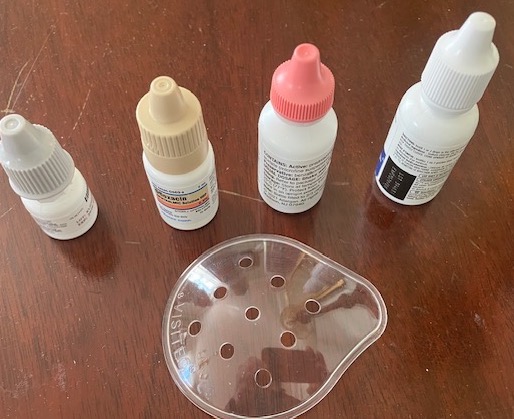
Eye drops and eye shield. (Photo Bill Pike)

Author’s post surgery note: Today, March 27, I had my one month appointment with the eye surgeon. Everything looks good, and he has released me. Again, I’m so thankful.

Pat Conroy learning from losing

March 4, 2016 was a sad day for me. On that date, I learned that my favorite author, Pat Conroy, had died.

Mr. Conroy was seventy years old. In January of 2016, he announced that he was being treated for pancreatic cancer. To me, all cancer is evil. But, pancreatic seems to be extremely cruel.

At times, the world might have been extremely cruel to Mr. Conroy. Yet, he always seemed to persevere. His luck ran out with the destructive pancreatic.

Here are some instructions for my children, grandchildren, and beyond, my Pat Conroy books are not to ever leave the family. Sorry to dump that on you, but Mr. Conroy’s books touched my soul. They might just touch yours too.

When I see old book tour itineraries, when Mr. Conroy was close to Richmond, I still curse myself for not making the trip.

Only one book is missing from my collection and that is The Boo. I’ll read it before I croak.

Out of all if his books, I keep coming back to My Losing Season. That book is about his senior year of playing college basketball at The Citadel. My Losing Season is my favorite book to pickup for the purpose of re-reading a page or two or three. Sometimes, I can’t put the book back down.

With this book, Mr. Conroy’s gifts as a writer made me laugh, cry, and ponder.

I laughed at the room checks on road trips as the coaches checked for females in the rooms of players.

I cried when I read about Mr. Conroy’s teammates, Al Kroboth and Joe Eubanks, as they served America during the Vietnam War.

And I pondered, the difficult decisions that Mr. Conroy and his classmates had to make while serving on the Honor Court at The Citadel.

Woven into the book are the ups and downs of the season, the psychology of dealing with Mr. Conroy’s difficult father, and a demanding coach.

We learn about his teammates in the real time of the season, but we also learn about their post Citadel lives as Mr. Conroy finds and interviews each one of them.

I love the self-talk Mr. Conroy has with himself after a rare but exhilarating win:

“I needed time to memorize what happiness felt like because I had experienced so little of it. Looking up into the night sky, I saw the Milky Way. I instantly thought of God and how I was afraid I was losing my faith in him and the immensity of the fear and cowardice I felt when I thought of facing the world without Him.

I was receiving the Eucharist every day of my life and fighting this war with faithlessness with every cell of my body, but I could feel the withdrawal taking place without my consent.

On the causeway to Lady’s Island I prayed out loud, ‘O Lord, please hear me. I thank you for this year. I thank you from my heart. I needed to be a decent basketball player in college, Lord. I don’t know why. But, I needed it. We both know I’m no good, but we sure are fooling some people. Aren’t we, Lord?’(Pages 275-276)

I love the honesty of that passage.

I love it because I have been there.

I have felt and experienced that same tidal undertow of my faithlessness to God being pulled away too.

And I’ll carry that faithlessness further, it is still alive in me today when the discouraging headlines in the news overwhelm me. My fearful soul cries out—God where are you?

Like many scriptures found in the Bible, Mr. Conroy references being afraid with fear at the prospect of attempting to live his life without God’s presence. I know that fear too. It is with me everyday.

But there is another honest lesson about acknowledging life’s disappointments in the epilogue for My Losing Season.

Mr. Conroy writes: “There is no downside to winning. It feels forever fabulous. But there is no teacher more discriminating or transforming than loss. The great secret of athletics is that you can learn more from losing than winning.”

He continues: “The word “loser” follows you, bird-dogs you, sniffs you out of whatever fields you hide in because you have to face things clearly and you cannot turn away from what is true. My team won eight games and lost seven-teen—losers by any measure. Then we went out and led our lives, and our losing season inspired every one of us to strive for complete and successful lives.” (Pages 394-395)

Pat Conroy’s final game as a player for The Citadel was in the 1967 Southern Conference Tournament. They lost to the University of Richmond in overtime 100 to 98.


The next morning in the Charleston, South Carolina newspaper, The News and Courier, Citadel coach Mel Thompson said this about Mr. Conroy’s play: “Pat Conroy gave another great performance. That kid gets more mileage out of his talent than any player I have ever coached.” (Pages 340-341)

Those unexpected words of praise from Mel Thompson were used by Pat Conroy to inspire and shape the rest of his life.

I don’t think my old heart can ever let go of Pat Conroy’s books.

Maybe this is why my soul will always hang on to him and his words: “It was the year I learned to accept loss as part of natural law. My team taught me there could be courage and dignity and humanity in loss. They taught me how to pull myself up, to hold my head high, and to soldier on.” (Page 400 Epilogue My Losing Season)

That is a powerful lesson.

No matter how bleak, frustrating, and uncertain this world can be, you, me, we, us must soldier on by pulling ourselves up with courage, dignity, and humanity.

God bless and rest your soul Pat Conroy.

(Photo Bill Pike)