A long time ago when I was a public school student in Burlington, North Carolina, I prayed for snow. Now as a rapidly aging, grumpy, geezer, snow has lost my affection. That endearment to snow has been shifted to our four school age grandchildren.
Even with my 31 years of work in public education, I watched faculty and staff members do their chants, dances, and prayers for a snow day. There is something about a snow day that is good for morale and a weary teacher’s mental health.
The challenge with snow is that it disrupts our regular routines. For parents with school age children that means being able to adjust those routines so that the daily needs of the children are met. Not every family has the built-in luxury of having grandparents who can pinch-hit when a snowstorm upsets those routines.
For school superintendents closing school due to inclement weather is never an easy decision. No matter the choice made by the superintendent that decision is always under the scrutiny of the public.
Thus far in the Richmond area, two storms have disrupted the routine for local school systems. It is easy to second guess those decisions.
For example, I wonder if the mild winter storm that closed schools in the Richmond area on December 5 could have merited a delayed opening?
With the December 8 storm, the snowflakes really didn’t start to accumulate on road surfaces until late morning. Could schools have opened and then closed early in the afternoon?
I know superintendents and their staffs do not take weather related closings of school lightly. In making that decision they carefully review the forecast, consult with local police and road departments about street conditions, and depend upon personnel in pupil transportation to make real time assessments.
Despite every effort to carefully make the right decision, a superintendent can’t please everyone.
I experienced this when I served as an assistant principal at Hermitage High School. Several days after a significant winter storm schools reopened.
With that reopening, a phone call came in from an upset mother. While driving to school that morning, her son had been involved in an accident. She was angry at the school system for reopening. Nothing I said calmed the mother’s fury.
Honestly, at the heart of closing a school system for winter weather, you will find an attorney. Attorneys are thinking about safety from multiple angles. They ask lots of questions all related to reducing the potential for liability:
Can school system maintenance personnel properly clear parking lots and sidewalks?
Can bus drivers safely maneuver their buses through less traveled neighborhood streets?
Can faculty and staffs, student drivers, and parents who are responsible for transporting their children arrive at school safely?
No one associated with the school system wants any injuries from slippery sidewalks, fender benders in high school parking lots, or a school bus accident.
Perhaps, the greatest pressure is on school bus drivers. Driving a school bus under normal conditions is challenging enough. Mix in frozen winter precipitation with impatient civilian drivers who believe they are invincible with their all wheel drive vehicles, and the potential for accidents rises.
Recently, another phenomena has occurred in the decision to close schools related to winter weather. More frequently, superintendents are closing schools before the first snowflake has fallen.
I suppose this early announcement helps families to better implement their alternative plans for a snow day. However, I can only imagine what a superintendent will endure if that forecast fails to materialize.
As difficult as it is to close schools, making the decision to reopen can be challenging too. Depending how much instructional time has been missed, superintendents must also figure out how to recoup the missed time.
Perhaps, these questions are worth reviewing:
Do superintendents know of alternatives beyond the traditional make up days or extending the hours of the school day for regaining instructional time?
Might developing a year round school calendar reduce winter weather interruptions?
Could attorneys find a year round school calendar more compatible for reducing potential liability?
Do superintendents solicit post-winter storm feedback from students, parents, teachers, bus drivers, and maintenance personnel as a means for helping to shape future weather closing decisions?
And of course, there is always the insights of our friends and neighbors from other parts of America who rarely close their schools for winter weather. What might Southern superintendents learn from these “no fear of snow” superintendents?
As we waddle our way through the remainder of winter, maybe the weather gods will be kind to us with no more snow days. While that might disappoint students, superintendents will sleep better.
Note from the author: This rejected Op-Ed piece was sent to the Richmond Times-Dispatch in response to December 2025 school system closures from wintry weather. Bill Pike Richmond, Virginia
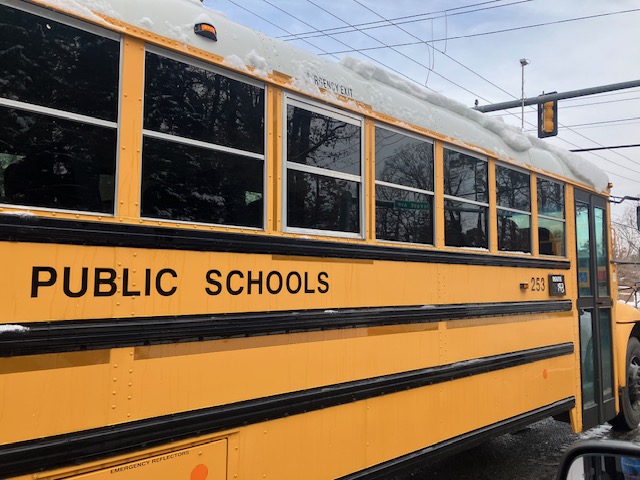
School bus with snow along its roof line (Photo Bill Pike)
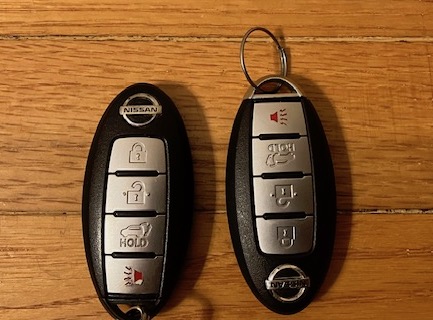
I’ve got the Monday morning key fob blues, that old key fob has made me weary right down to the soles of my shoes. Like a vengeful woman on Sunday night, that key fob battery has made my revengeful Monday morning a sorrowful plight.
On the morning of Monday, December 1, I had a plan.
Step one—drop off a letter that had been incorrectly delivered to our home to a US Postal service mailbox at a neighborhood shopping center.
Step two— open up Trinity United Methodist Church.
Step three—return home and work out on my old exercise bike.
Just before 6:30, I started my plan.
I drove to the shopping center.
I did not park in a parking space. I looped my car around parallel to the building with the car pointing in the direction I needed to go to exit the parking lot.
Turned off the car, walked a few steps to the postal box, and dropped in the letter.
Walked the few steps back to my car and attempted to start the car.
The car would not start.
A message flashed on the panel in front of me: Key ID incorrect.
No matter what I tried. The car would not start. The message remained the same—Key ID incorrect.
How in the world could the Key ID be incorrect? I wondered if the key fob had been overtaken by some outer space alien who wanted to disrupt my Monday.
A young man from a local construction company pulled in a parking space in front of the 7-11. I politely interrupted his entry and asked if he had any ideas?
He didn’t, but we had a good conversation about his company who had replaced the steeple at our church a few years ago.
With that I started a walk home. I was worried that my improper parking might get the car towed before I could get home and return with the backup key fob.
The Mobil service station was open. I stopped in and asked Jeff, the attendant, if he had any ideas. He suspected the key fob’s battery, but was perplexed by the message. I thanked him and returned to my walk back home.
At the corner of Rock Creek Road and Forest Avenue, the young man from the construction company pulled over and offered me a ride to my house. I gladly accepted. Turns out two of his four children attend Trinity’s preschool.
I thanked him profusely, and rushed in the house to get the second key fob.
With that key, I started my walk back to the shopping center.
I decided to stop at Trinity on the way back to open up the building.
Once that was done, I started a slow, sprint back to my car.
It was cold and my fingers were frozen. When I arrived at the car, those frigid fingers had a hard time working the second fob.
Unfortunately, the key fob gods were not in my favor on this Monday. The second fob greeted me with the same message— key ID incorrect.
Good thing I didn’t have a hammer.
I noted that my friend, James, was working in the 7-11. James also works part-time at the Mobil station. I walked in and explained to James my Monday morning key fob blues.
James walked outside and tested the fobs for opening the car’s doors. Neither fob responded—both fob batteries were dead.
As James walked back into the 7-11, Jeff from the Mobil station pulled up in his truck. Jeff had done an internet check. He discovered that by holding the fob directly against the ignition button that the car should start.
I got back in the car. My still icy fingers struggled to make the proper connection.
I tried a couple of times with no luck.
With Jeff’s insistence, he suggested that I align the fob again, and for whatever quirky reason—the car started.
Again, I thanked Jeff for his diligence.
Back home, I explained to my Commander Supreme what had transpired. She couldn’t believe it. I felt drained.
But, my Monday morning key fob blues were not as draining as this headline: 4 dead and 10 wounded in shooting at banquet hall in Stockton, California.
Among the dead were three children ages 8, 9, and 14. This event was a birthday celebration for a child.
Regrettably, this event only reconfirms what we already know about America—the trigger puller had no respect for his/her life, nor the respect for the lives of the people attending the birthday party.
San Joaquin County, Sheriff Patrick Withrow, made this statement: “I am confident in our team and with the work that we have done so far that we will find these animals that did this and bring them justice, but we still need the public’s help.”
“Animals”
Is this what America has sadly become?
I’ve got the Monday morning Stockton, California birthday party blues, with broken hearts that never heal as senseless shootings continue no matter the venue in a disrespectful America with a dying red, white, and blue.
On behalf of the Pike and Reinking families, we are honored to have you with us for Thanksgiving.
Back in October, our world was flipped over when Betsy’s left shoulder took one last clunk on the sidewalk at the corner of Rock Creek and Forest.
In a blink, plans for her seventieth birthday and our fiftieth wedding anniversary changed.
That’s when family and friends took over and planned this Thanksgiving Day gathering.
Without this support and your willingness to pitch in, we’d be eating Jimmy John’s turkey subs this afternoon.
A special thanks to Lauren and Doug, Andrew and Kathryn, Elizabeth and Jackson, Ken and Adrienne, Norman and Jo, and Jay and David for their assistance.
Tucked in there too are the nieces and nephews—George, Lydia, and Sarah, Nana’s heroes, her grands—Caroline, Josie, Ellie, and Hudson, and we can’t forget Jay’s daughter, our Olympic swim coach, Katie, who is with us this afternoon. Katie, we could have used some of your deep breathing techniques when the turkey caused some kitchen tension earlier this afternoon.
Fifty years ago today (11-27-75), we were in Milton, Massachusetts for Thanksgiving at the home of Bertha Avery Crosby.
That was Betsy’s grandmother. Everyone called her Nammer.
We had quite a feast with the Crosby and Cloud families.
Two days later (11-29-75), Betsy and I were married in West Hartford, Connecticut.
There are many reasons why marriages fail and work.
For Betsy and me, I think we had good role models in our parents— Ken and Liz and Bill and Louise.
They weren’t perfect, but their loyalty, support, sacrifice, and teamwork were hard to beat. I think these qualities rubbed off on us.
On the night that I finally mustered the courage to ask Betsy’s father for her hand, I used two words that Betsy’s oldest sister, Susan, told Betsy that I must use—love and respect.
I can still hear my quivering voice—“Mr. Cloud, I love and respect your daughter.”
Despite all of the things I do that drive her absolutely bonkers, Betsy, I still love and respect you as much as I did on that night fifty years ago.
In 2020, a German advertising company created a holiday commercial for the European pharmaceutical company, Doc Morris.
This heartfelt commercial ends with these words—“So you can take care of what matters in life.”
Betsy, for these fifty years, thanks for taking care of what matters in our lives. Here’s to Betsy.
In his rapid fire delivery of jokes, he always found a way to work in what became his identifying line—“I don’t get no respect.”
For lots of reasons, that’s how I’ve come to feel about Thanksgiving.
Over the last several years, it appears to me that our respect for Thanksgiving is eroding.
Retailers know this.
For example, the National Retail Federation expects Christmas sales in 2025 to “exceed a trillion dollars.”
Forecasters predicted that Halloween sales for 2025 would be in the range of twelve billion.
Thanksgiving is projected to be in the four to five billion range.
Growing up in North Carolina, Thanksgiving was always a drive on U.S. 70 to my grandmother’s home in Greensboro.
Sometimes, there was a stop on this twenty minute drive at Mt. Pleasant United Methodist Church for a morning Thanksgiving service.
The spread of home cooked food for our lunch time gathering was amazing. As an overweight kid, I was in heaven.
And yes, I like pumpkin pie. However, my favorite Thanksgiving dessert was persimmon pudding. I think my Aunt Evelyn always made sure we had persimmon pudding.
The other thing that I remember about those gatherings was being huddled in a small den with a television that projected a black and white picture of the Detroit Lions and Green Bay Packers playing their traditional Thanksgiving Day game. At the time, that was the only game broadcast or played.
Money has changed that. From Thursday through Sunday, football games at the collegiate and professional level are non-stop.
In November 1975, I spent my first Thanksgiving away from home. I was in Milton, Massachusetts, a pretty New England town just south of Boston.
I was with my future wife’s family. Two days later, that beautiful lady and I were married in West Hartford, Connecticut.
Lots has transpired in those fifty years.
And even though, Thanksgiving is squashed between the billions and trillions of Halloween and Christmas, it continues to survive.
We must never take the survival of Thanksgiving for granted.
The survival of Thanksgiving depends upon you, me, we, us.
We can’t let Thanksgiving die.
If Thanksgiving dies, so will we.
Maya Angelo said it better: “If we lose love and self-respect for each other, this is how we finally die.”
For Thanksgiving to continue to have a life, we must ensure that our children and grandchildren understand why it is so important to be thankful.
Being thankful can’t be taken for granted.
In the fall of my sophomore year at Greensboro College, biology professor, Dr. Kemper Callahan, put that into perspective for me.
This is what I have come to Dr. Callahan’s Thanksgiving Lecture. He simply told our class that we should never take Thanksgiving for granted. That included appreciating all of the people who make Thanksgiving happen. Dr. Callahan put a strong emphasis on farmers—no farmers, no Thanksgiving.
Successful Farming reported in July of 2025: “More farms nationwide filed for bankruptcy in the first three months of the year this year than across the entirety of 2024.”
What will the continuing struggles of our farmers mean for future Thanksgivings?
While I love the Thanksgiving food, Thanksgiving is also about family.
How lucky I have been to have been nurtured by a family every day of my life. That is a luxury not available to everyone.
As crazy as families can be, even an ounce of stability can make all the difference in a person’s life.
I see that generational stability in our Thanksgiving gatherings. Internally I ask—how different would my life have been without that stability?
I also ponder how much better America could be if that stability was present for all of our families. We might be surprised at how lives could improve by solving those generational cycles of instability.
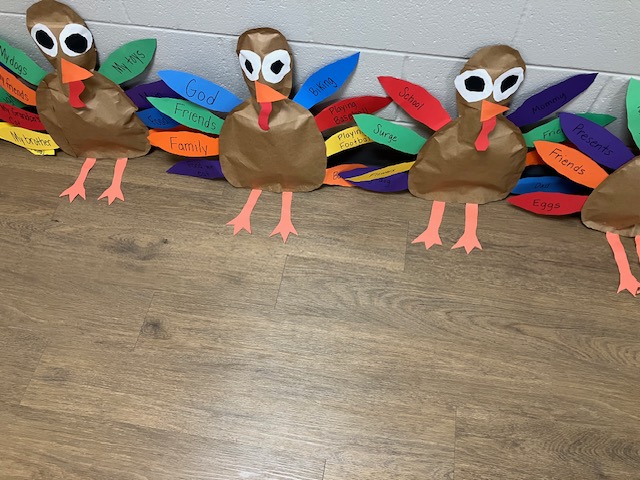
In my work at Trinity United Methodist Church, I see hope for Thanksgiving. That hope comes through the art work of the children in the preschool.
(Photo by Bill Pike)
I love walking through the hallways in the days before Thanksgiving. I get to see the Thanksgiving artwork gracefully resting on the floor or gently hanging from a wall mounted hook. These masterpieces are in their curing stage with glue and paint drying before they are transported home.
(Photo by Bill Pike)
Who knows maybe these heartfelt creations will be cherished and preserved for future Thanksgiving celebrations.
Isn’t that part of what makes up respect—preserving what we value?
Rodney Dangerfield figured that out.
Mr. Dangerfield learned that his audiences anticipated and valued his famous line—“I don’t get no respect.”
I can hear him now.
Thanksgiving is coming. I gotta tell you, when I was a kid Thanksgiving got a lot of respect. Not now. Thanksgiving is like a panini sandwich flatten on a press by Halloween pumpkins and retailers overstuffing our Christmas stockings.
I hope you and your families have a good Thanksgiving.
And remember to endure, Thanksgiving needs our respect, our hope, and our thankful hearts.
My body talks to me, “Bill, its been ten days since you have been for a run. What’s wrong with you?
I respond, “I’ve been busy. Life gets in the way.”
My body counters, “No doubt. That’s an easy excuse. I don’t like excuses. Go for a run. Now. Not tomorrow. Now. Go!”
On the morning of Friday, November 14, I went for that run.
I have a route that runs a neighborhood 5K course in reverse. The distance might be a bit more than a 5K, but I’m usually back at the house in 35 or 36 minutes.
This morning, I was inspired by our next door neighbor, Al Lockerman. As I was heading out to open up Trinity, Al was leaving for his morning run.
Al is a big guy. Yet, he runs like fast moving freight train. He goes all out on his runs. I admire his stamina.
When I return from opening up Trinity, I ready myself for my run. At the end of the driveway, I encounter Al again. With a cup of coffee in hand, Al is returning from walking their dog, Bambi.
I tell Al he inspired me to go for a run. He commented about the temperature. It is hovering at 33 degrees. That is about his limit with enduring cold weather runs.
Old man that I am, I have dressed in light layers for this run. That includes some worn knitted gloves and a stocking cap.
Al hopes I have a good run, and with that I’m off.
I note frost on the windshields of cars. This is the first real frost of the season.
Light frost on windshield (Photo Bill Pike)
Heading down Stuart Hall Road hill, at the intersection of Baldwin Road, the county is in the process of repaving.
The company doing the work has a massive asphalt eating machine. This contraption is called a cold milling machine or cold planer. The steel carbide tipped teeth of the milling machine peels back the top layer of the asphalt.
A good thing about the milling process is that the old asphalt surface is recycled. That planing of the top layer in some places reveals the foundation of the road— our pale orange Piedmont clay.
Milling machine’s work (Photo Bill Pike)
As I head up the hill, I turn left on to the front driveway at Trinity. On the front lawn, the pumpkins are gone. We conduct this annual sale to raise money for our youth group.
I admire the people who purchase our pumpkins. They are what I call heart buyers. These consumers could easily buy their pumpkins at a big box store at a much lower price.
At the bridge over the creek on Rock Creek Road, I wish I had a camera with me. Floating on the still creek surface is a pretty pattern of colorful fallen leaves. Also perfectly captured on that mirrored tranquil surface is blue sky with scattered clouds.
With the milling work on Baldwin, the road surface is uneven. The footing can be tricky, but I’m watching where my feet are taking me.
Occasionally, I see leftover signs from the November 4 election. I’m sure the mute button on the remote control for our television is thankful that campaign ads have stopped running.
The nonstop pace of those ads have now been replaced by incessant ads for Christmas. Of course, the big box retailers started telling me it was Christmas in September.
As I chug along, some front lawns still have Halloween decor. Others have rapidly transitioned to their Christmas theme.
Skeletons dominated many Halloween displays this year. I wonder if there will be a new big selling hero for Christmas on lawns this season?
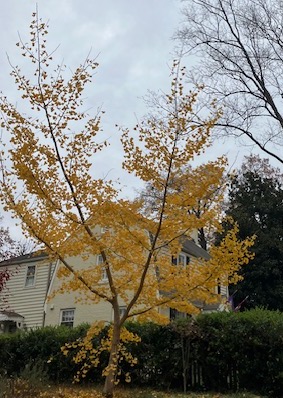
Thankfully, I can block out those commercialized distractions with the brilliance of leaf colors along the way. The last few days, the trees seemed to have hit their peak.
Golden leaves from a Gingko tree (Photo Bill Pike)
At the corner of Horsepen and Devon, I come upon four young fathers who have finished up monitoring their sons and daughters at the bus stop.
I interrupt their discussion by gently shouting out, “Let me know when you guys figure it out.”
They laugh, and one of them replies, “We’ll be here a long time.”
I chuckle and keep trudging toward Westham Parkway.
My mind keeps reminding me this is November.
I know you know this is November.
However, just in case you haven’t noticed— when we hit November, the pace of the year accelerates.
That acceleration is like a pilot of a jet fighter plane hitting the afterburners. We are thrust, blasted, and hurled into a supersonic march.
From now until December 31, we are in blinding blitz. The G forces of the season pull, contort, and rush every fiber of our bodies.
Seasonal to do lists rush us. Retailers rush us to early Black Friday sales. Our overbooked calendars rush us to holiday events. And perhaps the most demanding, the pursuit of seasonal perfection rushes us.
We are overly consumed by this pursuit of seasonal perfection. And while we can deny the seasonal pursuit of perfection, truthfully, that relentless pursuit is our downfall.
In all of the hustle and bustle, I wonder if that pace results in an increase of pacemaker surgeries related to how this seasonal rush impacts our hearts?
At the stop sign on the east end of Rock Creek Road, I’m about to turn left on to Sweetbriar Road. That final straight stretch on Sweetbriar will bring me back to where I started.
In the whirlwind pace of November into December, I wonder how this season might be different if my human layers were stripped back and revealed by a human cold milling machine?
What would that human cold milling machine find in me?
Part of me thinks it would reveal that I need the first two words from Psalm 46:10: “Be still.”
With the reminding roar of November that zooms us into December’s blitzing sprint, at some point your body’s internal voice will remind you to “be still.”
Even though I know that the dew covering the windows on my car will soon become frost, October, I’m glad you’re back.
(Photo Bill Pike)
You are my favorite month.
I don’t want you to leave.
I know when you depart, November moves me one step closer to winter.
Mentally, I fight winter.
While I still respect winter, I’ve lost my constant school boy hope and prayer for snow.
At 72, my old brain doesn’t revere snow anymore. That wish for snow is for our grandchildren and school teachers.
So October, I’m going to cherish you.
The last few days the harvest moon has been like a spotlight in the predawn western sky. Its brightness teasing as it hovers by church steeples and plays hide and seek descending behind tree lines.
(Photo Bill Pike)
To my west, cold fronts hurtle their northwest winds over the Blue Ridge Mountains. Rushing east toward Richmond, these winds paint your sky with the clearest, bluest blue my eyes have ever seen. I want to daydream into that blue forever.
Although I dread my annual battle with your fallen leaves, I adore the palette of colors found in the bright sun against that blue sky backdrop.
Even though, my affection for today’s baseball is gone, October brings the world series. I remember sneaking my transistor radio and earplug into Miss Avery’s sixth grade class at Hillcrest Elementary School. She figured out that I was trying to listen to the world series. For some reason, she didn’t kill me.
And just to be fair, I can grumble about October too.
I whine about the retailers who thrust Christmas on us way too early. I couldn’t believe that even our neighborhood hardware store had a Christmas Sale display today.
(Photo Bill Pike)
And to continue the fairness, I will confess that I do not understand our increased fondness for Halloween. Yards throughout our neighborhood are transformed with all kinds of displays. I’m surprised someone hasn’t come up with a tacky Halloween tour like we have for tacky Christmas lights.
On a recent morning run, I turned off Horsepen Road and made a right on Devon. A few yards down the street two houses across from each other are decked out in Halloween gear. What caught my attention were the skeletons.
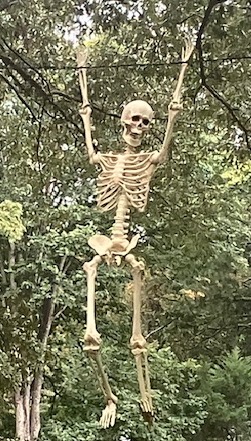
Each yard has an array of skeletons. Yet, my eyes were drawn to the high wire that stretches across the street from a tree in each yard. Skeletons in a variety of positions dangle from that high wire.
In particular, there is one skeleton that I really focused on. High above the yard, this skeleton is hanging by its fingertips. I wonder how many people I encounter on a daily basis who are hanging on by his or her fingertips?
(Photo Bill Pike)
I worry about those finger-tippers.
Unless we are completely oblivious, day to day living in this challenging world is tough.There is a tension that makes people more fragile, more vulnerable.
What really worries me about those finger-tippers is I might never know how close they are to letting go.
The constant barrage of discouraging news headlines makes me a pessimist at heart. I wonder when are we going to wake up? Perhaps that’s what keeps a bit of optimism—a bit of hope in my old heart. Hope that we will find our hearts again.
Maybe those finger-tippers can find some hope in October.
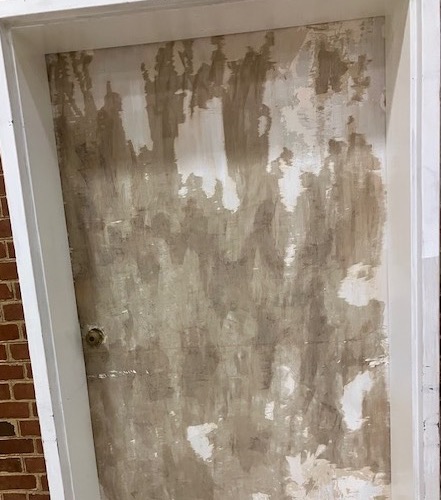
Maybe finding hope requires us to strip away the layers of hurt in our hearts like stripping layers of paint off on an old battered door.
(Photo Bill Pike)
Maybe that hope is in the October bloom of a camellia shrub.
(Photo Bill Pike)
Maybe that hope is the shiny red berries from a dogwood tree.
(Photo Bill Pike)
Maybe that hope is early morning sunlight coming through window shutters as it cast a pattern of light against a sanctuary wall.
(Photo Bill Pike)
Maybe that hope is you, me, we, us realizing that a finger-tipper is in close proximity.
Maybe that hope is you, me, we, us starting a conversation with the finger-tipper.
Bruce Springsteen said: “At the end of every hard day, people find some reason to believe.”
Maybe for finger-tippers, you, me, we, us, and October can become a reason to believe at the end of their hard day.
After all, 1 Thessalonians 4:18 states: “Therefore, encourage one another with these words.”
On the evening of Monday, September 1, 2025, my wife and I went with neighbors to the James Taylor concert at the Allianz Amphitheater At Riverfront. This new outdoor concert venue is on the banks of the James River.
A few days prior to the concert, our neighbors did a reconnaissance drive to check out parking options and the walking distance to the entrance.
Additionally, a day before the event, my wife received a courtesy email stating the concert was sold out. Arriving early was recommended.
The reconnaissance for the parking was smart. We parked in a lot within reasonable walking distance to the amphitheater. Additionally, the price for parking was acceptable.
It was a bit after six when we finished up at the parking lot and started our walk to the entrance. What we didn’t expect was the long, long line of people waiting to enter the amphitheater.
Richmond police officers did good work monitoring pedestrian and vehicle traffic at the intersection of Second and Byrd. That long, long line worked its way up a very steep hill along Byrd Street well past the Afton Chemical Corporation.
For a person with worn-out legs, challenges with their cardiovascular system, or wheelchair dependency getting up this hill was a challenge.
At some point the line started to move. The movement toward the entrance was slow, but steady. We cleared the security checkpoint, and the next challenge was finding a space on the lawn for us to sit.
We found a spot, but then we relocated. We relocated to the back of the lawn area. A fence runs the length of the lawn. We had two chairs reserved for seating. Our thinking was the fence would be like the back of a chair while sitting on blanket.
Again, the line to pickup our two chairs was long. We tolerated the wait time. Good news, the chairs were sturdy and comfortable.
When we relocated to the fence, the chair line was directly in front of us. Numerous people came to the chair line not realizing that a reservation had to be made to secure a chair. Just before the concert started, another problem surfaced. Apparently, the supply of chairs for people who had made a chair reservation was depleted.
As we settled into our spot, we learned that there are still some kindhearted souls in the world. A lady with two chairs stopped in front of our group. She offered us her chairs. Where her friends were seated on the lawn was too crowded for chairs, so she offered them to us.
Prior to the opening act, I spent thirty minutes exploring the amphitheater.
The stage is massive and it appears to be outfitted with all the latest bells and whistles for concert technology.
Seating options are varied with some unique locations, and the sight-lines seem good. This is despite at least three large light poles that can impact those sight-lines.
Large video monitors grace either sided of the stage. So, if your sight-lines are lousy, and the tall and lanky, James Taylor, looked tiny, the monitors capture all of the action on stage.
The space provided for food, beverage, and merchandise seemed to be adequate. This area was full of people, but despite some long lines people were able to move freely.
Can’t speak for the women, but there was no wait time for the mens’ restroom area. Urinals, sinks, and toilets were numerous.
No one from our group purchased any food or beverages. I’m not sure about food prices, but a variety of items were offered.
I had read about the grumbling over the pricing of alcoholic beverages, and I now understand the grumbling.
Interesting to me that pricing for all wine options was prominently posted. Wine pricing was expensive. A can of wine was $14.00. Wine by the bottle fell into three price ranges from $40.00 to one Cabernet Sauvignon topping out at $110.00.
As far as I could tell pricing for beer was not posted. It is my understanding that beers in 24 ounce cans cost from $16.50 to $23.00. I did see one beer sign advertising a Value Beer for $5.00.
(Photo Bill Pike)
When I inquired about the value beer was I shown a 12 ounce can of Busch Light. While I’m sure Busch Light has its fans, I don’t value it as a beer. Plus, a consumer can purchase a 30 can case of Busch Light in a local grocery store for $27.99. With that pricing, each can of beer in that case cost about 93 cents a can. Even for a value beer, that’s a significant mark up, but nothing like the mark up on the other beers.
The concert started on time with opening act Tiny Habits hitting the stage at 7:30. After their set, the roadies made some adjustments to the stage, and then we were treated to two solid hours of James Taylor and his very gifted band.
On September 15, 2024, my wife and I made our first trip to Wolf Trap National Park for the Performing Arts. We made this trip to see James Taylor.
Clearly, Wolf Trip has been presenting concerts much longer than the rookies at the Allianz Amphitheater. However, getting into Wolf Trap, working our way to the lawn, and picking up our reserved chairs was seamless.
Part of me wants to know if anyone involved with the development of the Allianz Amphitheater spent anytime picking the brains of the staff at Wolf Trap.
It is my hope that the management team will conduct a detailed review of this first season. That review should include receiving feedback from the people who attended the concerts, and all Allianz personnel.
The day after the concert, my wife did receive an email from Live Nation, a survey that opened with: “What did you(really) think of James Taylor? Share your review!”
That opening was followed with these question prompts: How was the event? Best ever? Room for improvement? Leave feedback on your recent concert or event, so Ticketmaster, a division of Live Nation Entertainment, can help enhance your next live experience.
I wonder how many people responded to the request for feedback? Additionally, I wonder how diligently the survey comments are discussed and studied by Live Nation and Ticketmaster?
From my perspective, here are some questions that management needs to ponder:
When a concert is sold out, how might the long line and wait time for getting into the amphitheater be reduced?
If I reserve a chair, how does management ensure that the chair will be available for me?
For consumers of alcoholic beverages, the pricing must be clearly posted for all options, and the pricing of these beverages must be restructured to be more sensible.
How might the seating in the lawn area be more balanced between blankets and chairs? Should the lawn area have a designated section only for chairs?
Hopefully, management will listen and improvements will be ready to be implemented by next summer.
At the age of 77, James Taylor enjoyed performing in this new venue. He was complimentary of the facility, the setting, and the crowd. His compliments also hinted that he would like to return next summer for another performance.
I’m 72, I anticipate returning to the Allianz Amphitheater At Riverfront for another concert. However, if I opt to return, I certainly hope that the management team will collectively work to make improvements. Improvements that will make the concert experience better for all who attend a performance in this amphitheater.
Failure to listen to feedback and institute reasonable changes based upon that constructive criticism could potentially hurt the success of the amphitheater.
At the end of this first season, I know everyone will be looking at the profit numbers. I won’t deny the importance of that data. But did concert attendees have a good experience also drives that revenue, and that can’t be overlooked.
And thinking of people, there is one more important part of our concert experience that also can’t be disregarded—the Allianz personnel. From my interactions with them, I found these employees to be patient, polite, and knowledgeable. In our impatient world those traits are important, especially in a public setting—nice work.
During Holy Week at our church, for some unknown reason, termites decided to erupt out of the wooden baseboard in the Forest Avenue foyer of the Sanctuary.
Our head building caretaker had been spiffing up the old black and white tile floor when he noticed my new best friends.
Sure enough, the termites had staged quite an invasion. They were curiously crawling around and inspecting these unfamiliar surfaces.
Maybe they were communicating to themselves, “Hey, where did the soft wood go, how did we end up here, we’re usually crunching wood in the dark, where did this light come from, who is this old guy holding a spay bottle?
Down on my knees, I probed deeper. Sometimes when we probe deeper into the outer layers more challenges are revealed. As I gently pried off the first piece of stained wood, I quickly saw that the next piece of trim work had been decimated by the termites.
No telling how long they had been silently chomping on the wood.
With a touch of agitation, I grabbed the spray bottle of Windex with ammonia in it. I started spraying. A long time ago, an exterminator told me that Windex with ammonia can temporarily help in eliminating creatures that show up at the wrong time.
I made the call to the company who has our termite contract. One of their technicians would stop by early on Thursday morning.
Not long after that encounter, a church member told me she forgot to tell me that ants had been sighted by one of the windows in the nursery on Sunday.
Sure enough, the ants were all over the window ledge and the HVAC register.
Once again, the ants met Windex.
Maybe in their defense, the ants were responding to the disruption they had experienced during our summer of 2024 building renovation project. That extensive project had peeled back all layers in one section of our building. I’m sure we intruded into the ants’ space.
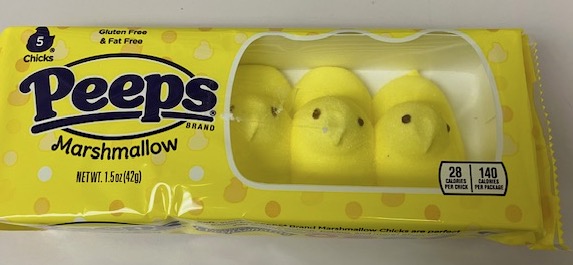
Perhaps, the ants were seeking revenge. My guess is they were on a secret mission. The ants were working their way to the office of our Kids Director, Jen Williams, and her stash of Peeps. The ants were planning to disrupt Easter.
Again, I made a call to our pest control company, and our reliable technician was scheduled to visit the ants on Friday.
In the interim, I spent time cleaning up the ant massacre. I’d learn from past encounters its about eliminating access. I found no evidence of intrusion from the outside, so I concentrated on caulking up any openings and seams around the window trim and the HVAC unit.
Early on Thursday morning, I met the termite technician. He confirmed that the visitors were termites, not flying ants. For a few minutes, he share his options for treating the damaged area. For sure, he would treat the visible wood, but he also wanted to get inside the plaster wall above the trim work.
With this, we agreed on him drilling three small holes into the plaster. This gave access for treating the inside of the wall area. In turn, I agreed to patch the three holes.
Later on Thursday afternoon, I was able to get the damaged baseboard presentable for Easter.
Over in the nursery, the caulk work from Wednesday afternoon worked. No ants were scurrying around the window or the HVAC unit.
Easter Sunday was a pretty, warm day in Richmond. We had made the switch over to the summer season with the HVAC systems in the older sections of the building. Initially, these chillers with their compressors, pumps, and air handlers fired up properly.
While that initial start up had gone well on Thursday afternoon, that wasn’t the case on Sunday morning. The chiller for the Trinity Hall wing of the building was a bad bunny. The chiller despite prompting would not fire up.
Luckily, no one croaked from heat stroke in that section of the building on Sunday. However, the news wasn’t good when the unit was checked out by our HVAC service company the following week. One of the compressors for that chiller decided—“I’m done, I’m not working another Richmond summer, find another compressor to battle that heat and humidity.”
Now, our Trustees are reviewing a quote for replacing the uncooperative compressor. The cost is not pretty.
On Friday, May 2, the call came on my cell phone at 9:28 a.m.
Our youngest daughter, Elizabeth, had started her drive to Richmond from Raleigh. She was coming to attend a dance recital for two of our granddaughters on Saturday afternoon.
But this call wasn’t about how much napping I would do during the recital. No there was a sense of urgency. I could hear concern in Elizabeth’s voice.
She explained there was a noise coming from the dashboard of her car. The noise reminded her of the type of the scratching sounds that an agitated squirrel or mouse make when they are trapped inside the wall of a house.
Elizabeth was convinced that some crazed furry creature was going to explode through the dashboard or floorboard of the car as she sped up the interstate.
When I finally was able to settle her down, we walked through a series of unscientific tests. No creature exploded out from under the hood, nor from the dashboard.
At the gas station where Elizabeth had pulled over, a nice man noticed the raised hood. Clearly, he saw this young lady going through a sequence of unusual maneuvers while holding a cell phone. Possibly, he thought she was about to lose one or all of her marbles by the actions he saw.
He decide to investigate. With me listening in on the phone, he asked if she needed help?
Calmly, Elizabeth told him about the noise and what she was attempting to do.
Upon hearing her concerns, this kind stranger suggested that leaf debris might be in her ventilation system. He talked about the “squirrel cage” for this system and how debris can become trapped and blown around.
For now, that explanation made sense.
Elizabeth thanked him for his willingness to help. She continued her drive toward Richmond.
Later on Friday afternoon, we had a father-daughter bonding session.
First, we removed all tree debris from the windshield wiper area of the car and under the hood too.
Then, per the advice of the helpful stranger, we went inside the glove box of the car to remove the air filter for the car’s HVAC system. Yes, the filter for the HVAC system is located behind the glove box.
Despite watching helpful Youtube videos on how to access the filter, this work was not profanity free.
But inside the filter and the surrounding area, we did find leaf debris particles that could have been the noisy culprit.
During this endeavor, I did as all fathers are supposed to do. I put my hand into the cylinder for the vent, and I let out a scream. A scream that conveyed a furry creature had my hand.
Of course, this tactic worked. Elizabeth’s was initially quite startled, but not impressed with her immature father.
Elizabeth led the way in getting the filter and glove box back into the proper positions. Remarkably, we didn’t break anything.
Usually, situations with ants, termites, compressors, and car creatures can be remedied. However, that is not always the case for human beings.
Right now, despite fighting with all of their strength, and the best efforts of oncologists, someone within this hour is going to lose their battle with cancer.
Today, a darkness so deep and desperate will push a person to die by suicide.
With the end of another school year in sight, a single parent with three elementary age children wonders how they will survive the summer. Her concerns are based on the gutting of funding from leaders in Washington who have no clue about the reality of real American life.
Easter is over.
For me, Easter, despite its resurrection ending, is a difficult story.
Life is a difficult story too. Disruptive challenges are always, always part of that difficulty.
But with Easter, I always come back to Thomas. That’s right Thomas.
I identify with Thomas because he is honest. Like me he doubts. He doubted that Jesus had appeared before the disciples after his death.
Thomas wanted proof.
He wanted to see the wounds Jesus had suffered during his crucifixion.
How do we confront our doubts during life’s challenging moments?
Maybe, the key is to always hold on to hope.
Even when we doubt, and our faith is fading, we must not let go of hope.
And here’s why— Romans Chapter Five verses three and four: “because we know that suffering produces perseverance; 4 perseverance, character; and character, hope.”
Remember in the post Easter story, someone you encounter needs your perseverance, your character, and your hope.
Doesn’t matter if this person is confronting ants, compressors, car critters, termites, or the true reality of real life— someone needs hope.
On those bad days in an old church building when I’m convinced that God is out to get me, maybe he’s simply reminding me, “Hey knucklehead, someone you encounter today needs to hear that hope from Romans. Don’t let them down.”
At first glance Hill, Feinstein, McWilliams, and Love sounds like a group of lawyers, accountants, or doctors. But, they aren’t.
No, these people impacted America. In their own unique way, they gave us their hearts. Recently and sadly, their time on earth ran out.
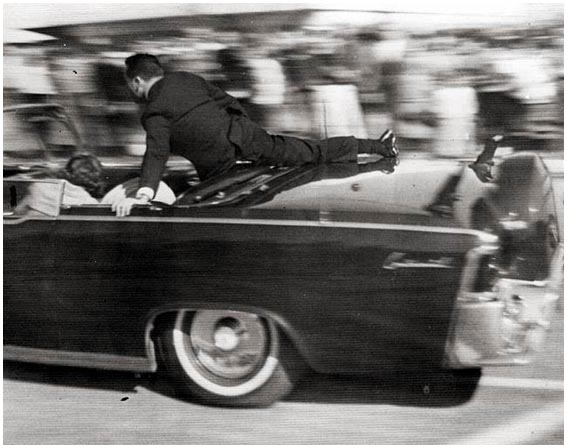
Clint Hill was a Secret Service agent. At the age of 31, Mr. Hill was the agent who jumped on to the back of the presidential limousine when President Kennedy was assassinated on November 22, 1963. When this occurred, I was in the fifth grade at Hillcrest Elementary School in Burlington, North Carolina. Our teacher, Mrs. Cline, was in tears.
Agent Hill (Photo Wikipedia)
I never knew the guilt that Agent Hill carried with him after this murder. For years, he blamed himself for not being able to react in time to save the President. Though some believe he saved the President’s wife as she attempted to help her fallen husband.
That turmoil in Dallas shadowed Agent Hill as he continued to serve three more presidents. He attempted to wash that torment away with alcohol. In 1975, Agent Hill retired from the Secret Service, and a doctor warned him, “if he didn’t stop this self-destructive behavior, he would die.”(The Week)
In the 1980s, he was able to give up alcohol.
Surprisingly, Agent Hill in 1990 made a return trip to Dallas. He visited the site of that horrible November afternoon. Perhaps, the passing of time, or the wisdom of a different angle “convinced him that he couldn’t have done anything to prevent the tragic outcome.” (The Week)
In 2024, Agent Hill was asked by an interviewer how he wanted to be remembered. He replied, “Two words, I tried.” (The Week)
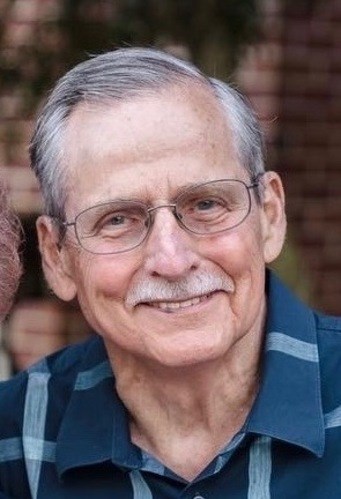
John Feinstein was a gifted writer. He found success in writing about sports. Mr. Feinstein was a sports reporter for the Washington Post and the author of over forty books. Additionally, his skills as a writer allowed him to write sports novels geared for a younger audience.
John Feinstein (Photo Wikipedia)
In my random collection of books, I have four written by Mr. Feinstein: Forever’s Team, A Season On The Brink, A March To Madness, and A Civil War.
His gifts went beyond the printed word as he was a commentator for college basketball and football games, an adjunct professor at Duke, his alma mater, and this year, a writer-in-residence at Longwood University in Virginia.
Some might view Mr. Feinstein as a nuisance. Yet, at the heart of his work was a drive and determination to find and capture the truth in the people and topics he covered.
I think this quote from a NPR report about Mr. Feinstein captures his passion.
Barry Svrluga, a Washington Post columnist who said he took Feinstein’s sports journalism course as a senior at Duke, recalled the experience Thursday:
“He got whoever he could to talk to the class — Gary Williams on a game day when Maryland was in town, Billy Packer, Bud Collins. Bob Woodward called in,” Svrluga said. “And you could just tell that part of his reporting prowess — how he got into locker rooms and front offices and onto the range and in clubhouses at PGA Tour events — is because he could really develop relationships, and people just liked to talk to him. Part of that had to be because he didn’t pander. You knew exactly where he stood. And that gained respect.”
My takeaway from this remembrance is “he could really develop relationships.” No matter where we walk in our lives building relationships is critical.
Unlike Mr. Hill, Mr. Feinstein, and Miss Love, I had the privilege of knowing Jody McWilliams. He was a member of our church. And if there was one person in this world who had a clear understanding for the importance of building relationships, it was Jody McWilliams.
Mr. McWilliams understood the importance of commitment in those relationships. His commitment, his loyalty impacted his wife, their children, and their families. Those qualities applied to his service to the United States Army, the United Methodist Church, and as the Executive Director of the William Byrd Community House in the Oregon Hill neighborhood of Richmond, Virginia.
Jody McWilliams (Photo Courtesy of the McWilliams family)
For thirty three years, he served in that role, and he once told the Richmond Times-Dispatch: “We are in business to serve the working poor, people who fall through the cracks. We serve people from birth until death, from the womb to the tomb.” During his tenure, close to 4,000 people used the services available from the William Byrd Community House on an annual basis.
With three master’s degrees, Mr. McWilliams also taught at the collegiate level. There he instructed and mentored future social workers. He gave them some very wise advice as they started their careers: “Be open to learn from those you serve.”
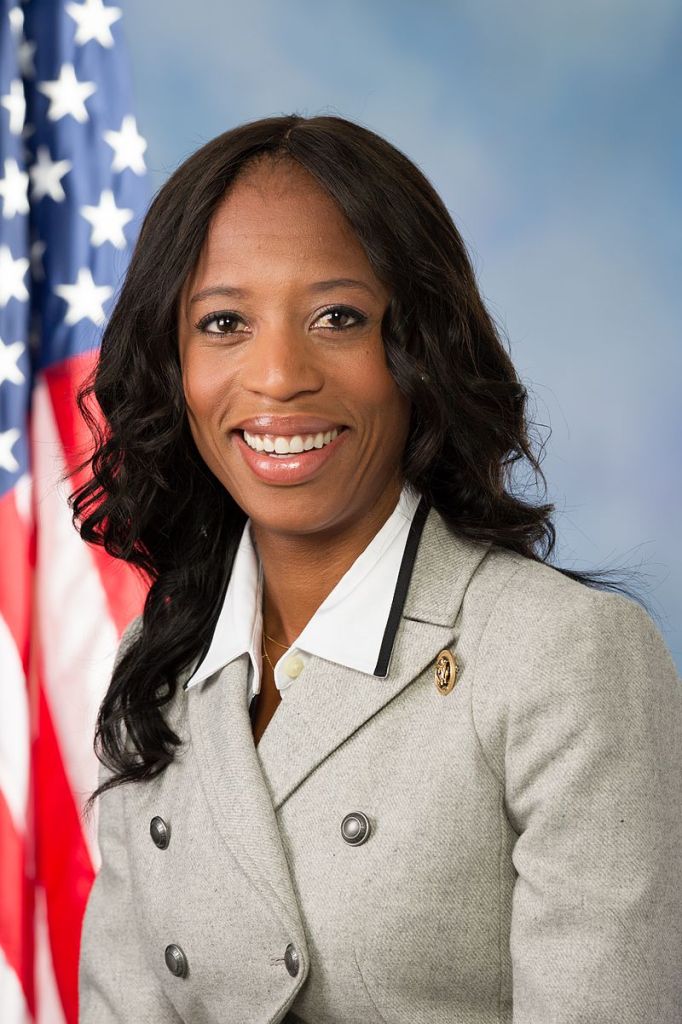
Until I read her obituary in the April 4, 2025 edition of The Week, I knew very little about Mia Love.
Mia Love was the daughter of Haitian immigrants. In 2014, Miss Love became the first black Republican elected to serve in Congress from the state of Utah.
Mia Love (Photo courtesy of United States Congress)
In The Week’s summary of her life, several items caught my attention. She was opposed to the 2016 election of Donald Trump as President of America.
At a Republican caucus meeting, she pushed back against a member of the caucus who made unflattering remarks about Haiti. Miss Love said, “If you don’t see me as an equal, you can remove me from this conference, and if we don’t see everyone as equal under God we have a bigger problem.”
In 2022, she learned that brain cancer was raging inside of her. That cancer ended her political career.
Before her death, Miss Love wrote: “I believe the American experiment is not a setting sun, but a rising sun. We must fight to keep the America we know.”
Unless you have been able to block out the turmoil and chaos coming out of Washington, “the America we know” is under attack. Piece by piece, it is being dismantled.
This disgraceful dismantling is impacting a wide range of people in America.
As Americans, we must work to counter this dismantling. We must regain Clint Hill’s courage, reclaim our voices to question like John Feinstein, recapture the unshakeable endurance of Jody McWilliams, and recommit to fight for America like Mia Love.
And in that fight for America, we need leaders in our country to embrace Mr. McWilliams’ logic: “Be open to learn from those you serve.”
While Hill, Feinstein, McWilliams, and Love might not have been a group of lawyers, doctors, or accountants, it is clear they were a group of human beings who possessed hearts that cared and who were willing “to learn” from the people they served.
At this very moment, we can’t “pander.”
We have to do more than “try.”
We must exhaust every ounce of our strength to build the “relationships” needed to save the imperfect soul of the America that “we know.”
Let’s get the truthful apology out early. To my wife and family, I know I spend too much time at my laptop writing.
Whether I’m good or lousy at writing, I couldn’t tell you. At this point in my old life, the writing is more about spouting out what is in my old heart.
And that spouting is grounded in this fact, I’ll be 72 in June. I don’t have much time left to put you into nap mode with my words.
If a person writes with the goal to be published, then that person must know that rejection is part of the territory.
I try to learn from rejection.
I once took the aggravation from a rejected submission and used that frustration to create another piece that was accepted for publication. That made me feel better.
So for this post, I’m releasing some recent rejections.
I’ll provide a footnote giving background as to why I wrote each piece.
If you choose to continue your reading, ponder this. My whining about words being rejected is nothing compared to the rejection people experience in their day to day living.
What’s remaining of my old brain can still recall those moments when I hurt people by rejecting them. If those moments are still within me, they must still be within the person I rejected. That’s not good.
In the Hulu series Only Murders In The Building, the three main characters know rejection in their lives and careers. Their rejection experiences also equal loneliness, a quiet killer in our chaotic world.
Moving forward in what is rapidly becoming an inconsiderate world, I need to be more aware of the rejection and loneliness that are around me everyday.
My heart needs to care more.
I need be more attentive to the green wristband I wear that simply states: “Be Kind.”
Kindness can counter rejection.
That wrist band means nothing if I don’t live it.
Letter To The Editor
From January 20 – January 31, my wife and I, and two couples from our college days had the pleasure of visiting the Florida Keys. Marathon was our base.
Let’s start with the confession. Since we arrived from Maryland, North Carolina, and Virginia, I think we were responsible for the unseasonably cool, cloudy, and windy weather that annoyed the Keys for a few days.
We adapted, and fortunately, no frozen iguanas fell from a tree and clunked our noggins.
In truth, I wanted to thank the people of the Keys for their hospitality. From Key Largo to Key West, we dined, snorkeled, fished, biked, walked, jogged, and learned. No matter where we visited, the people who greeted and assisted us were patient, considerate, and knowledgeable.
I don’t think any of us were prepared for the volume of traffic that the Overseas Highway handles. This main route never rests. Vehicles of every size and shape keep moving even in the dicey sections where the throughway narrows.
In that traffic mix are school buses. As a retired public schools educator, I want to compliment the Monroe County school bus drivers. While we were in Marathon, I marveled at the skills of these drivers.
School bus drivers are required to multi-task. They monitor their priceless cargo while managing the challenges of heavy traffic and the often deficient judgment of clueless drivers.
If we have the privilege of visiting the Keys again, we’ll work not to bring winter air with us. I think the iguanas would be appreciative.
Keep up the good work.
Bill Pike Richmond, Virginia
Submitted to the Florida Keys Weekly Newspapers 2/5/25. Two ideas, thanks for the hospitality, and many thanks to the bus drivers in this school system. They need a pat on the back.
Letter To The Editor
On Friday, January 31, 2025, I was in the Miami International Airport. I was headed home to Richmond, Virginia. My last visit to Miami was in 1978.
Over those 47 years, Miami, Florida, and America have experienced the ups and downs of change.
Knowing I had a long wait for my flight, I wanted to purchase the Friday edition of the Miami Herald.
When I entered an airport variety store, I was pleasantly surprised to find your paper in stock. In a flying trip last May, neither the Richmond nor Atlanta newspapers were available for sale in their airports.
After paying for my copy, I was shocked by the paper’s appearance. It was thin, lightweight, and totaled 24 pages.
The paper reminded me of how a friend looked after experiencing the trauma of cancer surgery and post-operative treatments.
I imagine the painful gutting of your personnel to save pennies was similar to what our journalist experienced in Richmond and hundreds of other newspapers across America.
If I return to Miami, I hope I will be able to buy a Herald.
Those 24 Pulitzers mean something.
Miami, Florida, and America need your paper.
Don’t die.
Submitted to the Miami Herald on Sunday, February 2, 2025. Long after I am dead, I truly believe that someone will figure out that one of the reasons newspapers died in America was grounded in the inability to report about their internal struggles to their subscribers. To date no newspaper has an accepted a letter to the editor or an op-ed submission from me that pushes the newspaper to report their struggles.
Letter To The Editor
The men’s Atlantic Coast Conference(ACC) Basketball Tournament opens in Charlotte on March 11. I assume that ACC commissioner Jim Phillips and his employees have adjusted to moving the conference office from Greensboro to Charlotte. But, with relocations and college basketball, one should never make assumptions.
For example, how can it be possible that the Southeastern Conference (SEC), a conference known for its college football accomplishments, has more of its basketball teams ranked in the Top 25 than the ACC?
Maybe, this is an embarrassing single year anomaly. Commissioner Phillips and conference leaders can only hope this is true.
While this SEC dominance is concerning, what I find more alarming is an article from the January/February edition of the Carolina Alumni Review.
The UNC athletic department “faces a $17 million shortfall this year.” Additionally, Board of Trustees member Jennifer Lloyd stated in May 2024 “that the athletics department is projected to have a $100 million cumulative deficit in the coming years.”
If UNC is running at a deficit, how many of the athletic departments for the other seventeen ACC schools are in similar situations?
I wonder if the flawed geographic configuration of the ACC, the economic challenges of Name, Image, and Likeness, the relentless pursuit of power, and unrealistic athletic goals will doom this once treasured conference?
I hope not.
I hope a conference leader, who has courage and wisdom, will stand up and state— this isn’t working, we need to fix it— now.
Submitted to the Greensboro News and Record 3/6/25 I care too much about the legacy of the Atlantic Coast Conference. In my opinion, one of the best college athletic conferences in America has been destroyed. Greensboro News and Record allows 250 words.
Letter To The Editor
The men’s Atlantic Coast Conference(ACC) Basketball Tournament opens in Charlotte on March 11.
For Commissioner Phillips and his employees, I hope the tournament goes well.
Clearly, they have more to worry about than the tournament.
For example, how is it possible that the Southeastern Conference, a conference known for its college football, has more of its basketball teams ranked in the Top 25 than the ACC?
Perhaps, this is an embarrassing single year anomaly.
Yet, more concerning is an article in Jan/Feb edition of the Carolina Alumni Review that states: “the UNC athletic department faces a $17 million dollar shortfall this year.”
Do the other seventeen ACC schools face a similar deficit?
I wonder will the flawed geography of the ACC, the burden of paying players, and unrealistic athletic pursuits implode the conference?
I hope not.
I hope conference leaders find their backbones.
This template isn’t sustainable.
Submitted to the Charlotte Observer 3/6/25 Taking the frame from the Greensboro letter and sending it to the Charlotte paper. Word count is important to editors, every newspaper is different. If you don’t meet the word count, your letter will not be published. Charlotte News and Observer allows 150 words.
Letter To The Editor
I’m not surprised by this Washington Post headline from March 14: Virginia’s top school leader, Lisa Coons, abruptly resigns.
Hiring Coons was a mistake by Virginia Governor Glenn Youngkin. Perhaps, the Governor believed that Coons would bring change to Virginia’s Department of Education while also embracing his education agenda.
This is the second botched education hire by the Governor. The former Superintendent of Public Instruction, Jillian Balow, also resigned. Neither Balow or Coons were able to deliver recommended changes to public schools related to new history standards.
Communications Director, Rob Damschen, announced that Deputy Superintendent of Education, Emily Anne Gullickson, will be the interim State Superintendent of Public Instruction. Interestingly, Gullickson came to Virginia from Arizona. In 2014, she founded A For Arizona.
Maybe the Governor needs a refresher course in American geography and human resources. Coons, Balow, and Gullickson hailed from Tennessee, Wyoming, and Arizona. Where were candidates from Virginia in those searches?
Having spent thirty plus years working in the public schools of Virginia, I know that our state has many gifted and qualified superintendent candidates. Perhaps, none of these leaders merited consideration by Governor Youngkin because they can’t embrace his agenda.
When it comes to public education, it is discouraging and disappointing that politics obstructs the capacity to do what is right for students, parents, and teachers. Frequent bickering over divisive political allegiances, fails to provide the support that students, parents, and teachers need in their schools everyday.
As I read the headlines about Virginia’s declining student performance on state and national tests, rarely do educational leaders and politicians take a deeper dive into why those results continue to plummet.
We must have vast amounts of data about students, their schools and communities. Shouldn’t we be using this data to improve our schools? Are we afraid of revealing the truth about decades of generational neglect related to substandard housing, deficient mental/physical health care, safety, family erosion, and disheartened morale in communities and schools. Housing, health care, safety, family stability, and morale all impact school instruction and performance.
As a former collegiate athlete, Governor Youngkin, knows the difference between talking the game and playing the game.
At this point, he must play the game.
That means hiring a State Superintendent of Public Instruction who is from Virginia.
Nothing else is acceptable for students, parents, and teachers.
Submitted to the Washington Post in March 2025. Surprisingly, the Post has raised their word count for letters to 400. Poking at the Virginia governor for not finding talent within our state.
Letter To The Editor
For over thirty years, I had the privilege of teaching in the public schools of Virginia. Those first four years, I was a Title VII remedial reading teacher. Each year, my position was dependent upon funding from Congress. Luckily, the federal funding continued. This allowed struggling students to grasp an essential life skill—reading.
On March 20, with his signature President Trump dismantled the Department of Education. It will be interesting to learn how many students will be devastated by the President’s negligent decision.
Could the Department of Education be more effective and efficient? Maybe.
Is there a better way to make needed changes? Yes.
In 1964, the St. Louis Cardinals defeated the New York Yankees in the World Series.
After the final game, reporters asked Cardinals, manager Johnny Keane, why he remained with starting pitcher, Bob Gibson, to finish the game?
Mr. Keane responded, “I had a commitment to his heart.”
Demolishing the Department of Education was easy for this President. Mr. Trump has no commitment to any American heart other than his own selfish, uncaring one.
Submitted to the NY Times 3/24/25 New York Times allows 150 to 200 words. This letter took a poke at the dismantling of the Department of Education.
Graphic design courtesy of ELP at Independent Lab Productions












 might be baloney