I especially like the scene when Clarence, a want to be angel, is sent back to earth to save George Bailey.
Through his diligence and understanding of human nature, Clarence redirects George Bailey to reclaim his life. With this success, Clarence finally earns his angel wings.
On the morning of Thursday, August 28, 2025 at 6:29, I came upon a sign that showed me two angels had graced our home on Sweetbriar Road.
A gardenia bush on the west side of our yard had a singular open bloom at the top.
The August 28 gardenia bloom (Photo Bill Pike)
This gardenia had previously been full of blooms earlier during the summer. While I’m no expert on gardenias, I think it is rare for a gardenia to offer up a singular bloom after its traditional full summer blossoming.
This gardenia is a special shrub. It originally came from a cutting from my parents yard in Burlington, North Carolina.
I took this cutting and planted in the yard of our first home in Richmond.
I’m sure I wasn’t supposed to do this, but when we sold that house, I dug up that gardenia and transplanted it in our yard on Sweetbriar.
Despite some challenging winters and uncomfortable summers, the gardenia has thrived.
The gardenia was a favorite flower of my parents. I believe my father really loved the sweet fragrance from its white bloom.
I’ve written about this before, but I never forget the last week of August. On August 31, 1992, we lost my mother. Ten years later on September 1, 2002, we lost my father.
For some reason, on the day of my mother’s funeral, a singular gardenia bloom blossomed on the large shrub by the front door of the home of my sister, Lisa, and her husband, Eric, on Parkview Drive in Burlington.
On August 28, when I came across that singular gardenia bloom in our yard, I immediately thought of my parents. Perhaps, a horticulturist could explain why that perfect bloom appeared.
While there might be a perfectly logical science based answer, I have my own reasoning—two angels, Louise and Bill.
I still struggle to comprehend how my parents tolerated me. At times, I was a worthless disappointment.
Fortunately, I sense some of their better qualities did rub off on me.
Part of me believes that at 72, I’m still around because they continue to keep an eye out for me.
My old brain believes the appearance of that singular gardenia bloom on August 28 was their way of reminding me that despite the heartburn and the sleep deprivation I caused for them—they still love me.
As they glide around in that blue yonder, I still cherish and love all they did for me.
And yes, my old heart continues to cherish and love them.
This time last year, there was a mad rush in one wing of our church building to complete a three floor renovation project.
The contractor was doing everything humanly possible to be substantially finished by August 31.
It wasn’t perfect, but the deadline was met. More importantly, the county’s building inspector granted permission to occupy that wing.
In the year that has passed, we’ve spent time with punch lists, uncooperative technology, ambushed water intrusions, and attempting to learn the nuances of the new HVAC system.
HVAC systems are always a challenge. Perhaps the biggest hurdle comes from monitoring our own individual human thermostats.
A few weeks ago, in the neighborhood where our church is located, a powerful late afternoon thunderstorm got our attention. This storm knocked out power to a wide section of the neighborhood.
At the church, the storm disabled two phases of electricity to our building. Full power didn’t return to us until the next afternoon. But in the long minutes when the storm was in action, the flickering ups and downs of the electrical service to our building reeked havoc on some of the components for the new HVAC system.
Because of a shortage of parts from the manufacturer, we’ve been patiently awaiting for repairs.
Recently, one of the technicians for the company was in our building to recheck the monitoring technology.
I wasn’t sure if he remembered me. So, I reintroduced myself.
As I was doing this, he responded to me, “Oh, I know who you are.”
I didn’t know how to take—“Oh, I know who you are,” but we had a good conversation about the challenges involved in getting the HVAC issues solved.
In all my years of working in public schools, we had plenty of challenging students. Students that we knew who they were because rightly or wrongly, their reputations preceded them. For a few of these students, living down their reputations was virtually impossible.
Over time and with the right support, a handful of those students figured out how to make adjustments. Their challenging behaviors became less intrusive.
And then there was a group that no matter what they tried, they just could not keep from getting attention in all the wrong ways. And of course, no matter what the school tried, we could never quite make the right connection, or build the right relationship to help the student adjust.
“Oh, I know who you are,” made me think about my own life.
How do people see me?
Does my reputation precede me?
Do my imperfections create challenges for me and the people I encounter on a daily basis?
Sometimes, I wonder if God really knows who I am?
With so many people in this world, what does God truly know about me?
My guess he knows that my morning prayer routine is too long.
He probably knows that I’m a constant, repetitive whiner.
This is especially true when life goes wrong for good people. I whine to God, “what are you thinking, where are you, how could you let this happen?”
Psalm 139 verse 13 implies that God has known me since I was knit together in my mother’s womb.
In Matthew and Luke, the scripture states that even the hairs of my head are numbered. This is another indication that God knows me down to the hairs on my head.
At this stage of my life, I’d say the hairs on my head are disappearing at such a rapid rate that an accurate inventory is useless.
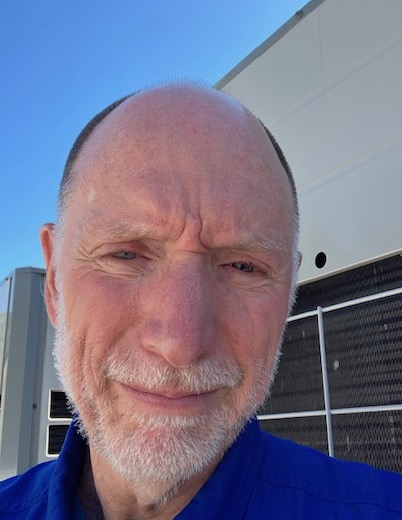
Whiny old buzzard, new HVAC system behind me (Photo Bill Pike)
I wonder if my shrinking hairline decreases my value in the eyes of the Lord? Am I still of more value than the sparrows of the field?
I have some days on my wobble through life when I think the sparrows of the field are of more value than me.
On those valueless days, I ask myself— why aren’t you doing more?
Where is your voice?
Why aren’t you finding your voice to speak out?
How can you let all of the injustice of this dismantling pass by you in silence?
Maybe God really does know me.
Maybe he knows that I’m nothing more than a whiny old buzzard with no backbone who is gripped by fear of what people will think of me when I finally assert my muted voice.
My wife and I are playing catch up with the Apple TV series—Ted Lasso. We have made it into season three.
In prepping his team, Coach Lasso shares wisdom with his soccer players. Coach Lasso has a way of blending on field wisdom into life wisdom for his players.
I was taken by these words from the script of Episode 12 in Season 2: “To quote the great UCLA college basketball coach, John Obi-Wan Gandalf, “It is our choices, gentlemen, that show what we truly are, far more than our abilities.”
Of course, Coach Lasso was referencing legendary UCLA basketball coach, John Wooden. Coach Wooden not only taught his players the essential details of playing college basketball, but attempted to equip his players about essential life skills too.
“Oh, I know who you are” really comes down to this—do I know who I am?
It is my choices that reveal if I really know who I am.
Regardless of womb knitting, counting hairs, and sparrows, God is watching my clock.
In the remaining time he has allocated for me, I must be wiser. I must find out who I really am.
Growing up in Burlington, North Carolina, every Sunday, I was in church— Sunday school, worship service, and a youth program later that evening. Illness was the only interruption.
That church, Davis Street United Methodist, is now closed. Congregation voted to shutdown. With declining attendance and financial support, staying open wasn’t logical.
To their credit church leaders did their homework. A buyer for the building was found. Over a period of time, the Davis Street congregation opted to merge with another Methodist church.
Over the last fourteen years, I’ve had the privilege of working at my church, Trinity United Methodist. During that time, I’ve learned a lot about churches.
Whether they want to admit it, churches, no matter their size or status, aren’t immune from wondering how much longer can they hang on.
No question, the pandemic had an impact on churches.
Yet, respected research organizations like Gallup and Pew have been reporting for years that churches were struggling.
Six years past the pandemic, congregations are still challenged to address declining attendance, giving, aging members, and deteriorating buildings.
In March of 2024, Gallup reported: “On any given weekend, about three in 10 U.S. adults attend religious services, down from 42% two decades ago.”
A February 2025 study from the Pew Research Center found some stabilization in their data. However, when looking toward the future, this key point was made: “younger Americans remain far less religious than older adults.”
Daniel Silliman, in Christianity Today, and Francis Wilkinson, in Bloomberg, have written about the possible impact that Donald Trump has made in contributing to the decline of church attendance.
No matter who takes the blame, I wonder how frequently church leaders point the finger of blame back at their own shortcomings?
In the baseball movie, Moneyball, there is a pivotal scene between a rookie executive, who is skilled in player analysis, and the seasoned general manager of the team.
The young executive makes a bold statement: “Baseball thinking is medieval, they are asking all the wrong questions.”
Part of me believes that “church thinking is medieval, they are they asking all the wrong questions.”
I’m no expert on churches. However, in this current environment, I think church leaders and congregations are overdue to ask tough questions. That is the only way to determine their current standing in order to determine a path forward.
Part of me believes that churches would benefit from participating in an accreditation process. That process would require churches on an annual basis to assess key evaluative criteria related to: program offerings, finances, outreach, personnel, facilities, safety, technology, and the ability to make meaningful connections.
Conducting an annual review could potentially help churches in making difficult decisions relate to budgets, personnel, facilities, and the effectiveness of their program offerings.
With a need to attract young families, I think churches often overlook the concept of “discretionary time.” Young families often over extend, they are always on the go.
So, how does a church help young families find a fit that works for them? Can churches develop flexibility in their seemingly inflexible traditional schedules for young families?
How can churches be more welcoming to those exploring churches? On a first visit, a nervous visitor doesn’t need to hear the unwelcoming: “Sorry, sonny, but your sitting in my pew.”
Finding their footing for the future means churches can’t fear change.
Churches must embrace change. The path forward will not be found in producing more predictable sameness. Congregations should consider this question—do you want the autopsy for your church to state: cause of death—stubbornly resistant to change.
And speaking of death, why must a funeral be the time to learn all about a church member? Churches must become stronger in building ‘living’ relationships within and outside the walls of the church.
That means becoming more adept in capturing and sharing significant stories within the congregation and community.
How much longer your church can hang on isn’t up to me.
Hanging on depends on your congregation and its leadership, and the willingness to take some risks.
Here are five simple risks:
Compile all essential data about your church for detailed research and review.
From this review, determine what works and what isn’t working within your church.
Resolve to tell the truth from these findings.
Write a report of findings for the congregation that clearly reveals the challenges and strengths of the church.
Use the report of findings as the pivot point for determining how to move forward.
More church closings are unavoidable.
Maybe that’s why this Og Mandino wisdom keeps coming back to me: “I have never heard anything about the resolutions of the apostles, but a good deal about their acts.”
A long time ago someone decided that churches needed to have kitchens.
At our church, we have three: in the original fellowship hall, an oddball one on the third floor of the Preschool wing, and in Trinity Hall.
And there was a mini-kitchen near the church office that we disassembled a few years ago.
I imagine those kitchens could write a book about the life of our church that took place inside those culinary walls.
Cook talk, laughter, gossip, recipes, and compliments were shared.
Back on Wednesday, August 13, my work teammate, Judy Oguich, and I met in the Trinity Hall kitchen to inventory our supplies and make plans for a church wide lunch on Sunday, August 24.
We found adequate supplies of plates, cups, napkins, and utensils.
Since the menu called for grilling hotdogs, we believed we had lots of hotdogs leftover from a community event last fall. Unfortunately, these frozen dogs had long gone past their expiration date. We had to chuck them.
Checking on the condiments that we needed to enhance the hotdogs, we again found that mustard, catsup, relish had an expired.
No matter where we looked, we found food items that were no longer safe to serve.
In truth, I’m not surprised. A few years ago, our church closed out our Wednesday night dinners. No longer could we justify the expense based upon fewer and fewer families attending.
Now, the Trinity Hall Kitchen is used sporadically. The people who use the kitchen leave extra food in the refrigerators. These kindhearted people believe that someone will eventually consume those leftovers.
This wasn’t my first experience in the Trinity Hall Kitchen throwing away outdated or spoiled food.
I had to do this when Hurricane Isabell walloped the neighborhood as electrical service was absent for over a week.
There were other times too.
Leftover food from Sunday night youth dinners were not consumed in a timely manner, and they too had to be tossed.
Perhaps the only good thing that came from disposing of this food was recycling the containers where the food had been stored.
I despise days like Wednesday, and the ones I’ve encountered in the past.
My disgust comes from revisiting Deuteronomy Chapter 15 verse 11: “There will always be poor people in the land.”
And from Matthew 26 and Mark 14: “The poor you will always have with you.”
Look, I’m no Biblical scholar, but those three verses cast an embarrassing guilt over me. In these situations, I could have done better than tossing out all this food.
If I had only been more attune to those refrigerators, we could have fed more people in our community.
I wonder why those three verses are in the Bible?
Were they written as a challenge?
Did the scripture writers think, “Hey, let’s tell the knuckleheads on earth that the poor will always be with them.”
If we tell them this, maybe, they will look at those statements and ask: “Why should we always have the poor with us?”
Why don’t we work together to wipe out poverty in our world so that we will have no poor people.
Seems like a noble idea, but unfortunately, we have been failing for centuries at eliminating poverty.
So why is it that we can explore the vastness of space, perform heart transplants, dam mighty rivers, build skyscrapers that touch the blue yonder, and yet we can’t figure out how to solve the challenges faced by the poor.
Williamsburg, Virginia native, Bruce Hornsby, has built himself quite a career as an extraordinary piano player, songwriter, and singer. His first hit single with his band The Range was a song titled “The Way It Is.”
From my first listening of the song, I was hooked.
The lyrics caught my attention too. The words are a snapshot of ongoing social challenges in America.
But it is the chorus that stuck to me: “That’s just the way it is. Some things’ll never change. That’s just the way it is. Ah, but don’t you believe them.”
Having the poor with us, “That’s just the way it is. Some things’ll never change.”
For me, the bleak affirmation of those two lines is countered with the last line: “Ah, but don’t you believe them.”
We are long overdue to believe that we can solve the vicious generational cycles of our poor.
I can barely imagine what it must have been like for the early explorers who came upon Colorado. Perhaps, they were as awestruck as I during my late July visit.
From our first lunch at the Wynkoop Brewing Company to our last lunch at Westbound and Down in Idaho Springs, our family spent seven enjoyable days in your state.
With Keystone as our base, we hiked, biked, fished, and learned about your priceless and precious land. Though altitude sickness wore on me, it didn’t keep me from admiring majestic mountains, forests thick with evergreens and aspens, wildflowers along the banks of creeks flowing with cold, clear water, and the unexpected sighting of moose.
One afternoon, we witnessed the extremes in Colorado weather. A furious hailstorm pounded on the Manitou and Pikes Peak Railway as the train crept back down the famous peak.
No matter where we ventured— steep trails, rocky creeks, pristine lakes, and assorted retailers—we were met with friendly, patient people who were always willing to answer questions and provide guidance.
On our return from Pikes Peak into Keystone, we avoided the interstates. I will never forget the grand openness and splendor of endless pasture lands that unfolded along those back roads.
Zebulon Pike once said: “May Heaven be propitious, and smile on the cause of my country.”
I hope that heaven will be propitious and continue to smile on the people of Colorado with the will to persevere and preserve their irreplaceable land.
William Avery Pike, Jr.
Richmond, Virginia
Note from author: Honored to have this letter published in the Sunday, August 10, 2025 edition of the Denver Post.
For a number of years, I’ve been given the privilege of teaching classes for the Osher Lifelong Learning Institute at the University of Richmond.
My class proposals have covered lots of topics: writing, cowboy music, the Andy Griffith Show, and book discussions.
While I have enjoyed putting those classes together, it has been my collaborations with my childhood friend, Joe Vanderford, from Burlington, North Carolina, that has brought lots of satisfaction.
Since 2016, Joe and I have developed eight classes on the following recording artists: The Beach Boys’ Pet Sounds, Carl Wilson of the Beach Boys, Brian Wilson presents Smile, George Harrison’s All Things Must Pass, The Band, The Beatles’ Abbey Road, and Stevie Wonder.
Class number eight focused on a Denny Tedesco documentary, The Immediate Family. This film is all about a gifted group of session musicians from the 1970s.
I’ve included a link to an article that I wrote for The University of Richmond Magazine about this class.
Special thanks to Editor, Matthew Dewald, for all that he and his team did to support the publishing of the article.
That thanks is also extended to Osher Director, Peggy Watson, and her staff, and the Dean of the School of Professional and Continuing Studies, Dr. Jamelle Wilson.
And finally a special thanks to the Osher students, and Joe Vanderford and Denny Tedesco.
Joe Vanderford, Denny Tedesco, and Bill Pike (Photo taken by Joe’s friend, Steve Fisher)
And one more finally, if a college or university in your area participates in the Osher Institute, I hope you will check it out.
While I will not set any speed records, my old body still allows me to go out for a run.
Since the start of 2025, I’ve had the privilege of running in the Florida Keys, North Carolina, San Francisco and Monterey, California, Vancouver, British Columbia, Fairbanks, Alaska, and almost in Keystone, Colorado.
I was all set to go for a run in Keystone, but my body talked me out of it. My body did not like the change in altitude. In Keystone, the altitude is 9,173 feet. Where I live in Richmond, Virginia the altitude is 150 feet.
We arrived in Colorado on Saturday, July 26. By Monday, my body started to feel acclimated.
I know that I was lucky, privileged to be able to go for a run in those different locations. And as fortunate as I was with that opportunity, I still enjoy taking a run in our Richmond neighborhood.
No doubt those other locations offering unique settings for a run, but as Dorothy said in The Wizard of Oz—“there’s no place like home.”
For seventy two years, I have lived in North Carolina and Virginia. The entire southeast is known for its uncomfortable summertime temperatures. When heat, dew point, and humidity conspire to create daytime heat indexes over one hundred degrees, there is nothing like it.
Air conditioners strain, pets are hesitant to go outside, and the air is as thick as pound cake batter.
The sinking of the sun offers no relief. Sure the intensity of the sun is gone, but the still night time air has no pulse. Leaves don’t rustle, and when dawn breaks the temperature will be 75 degrees, with a dew point of 74 degrees, and a humidity reading of 96%—a sauna.
And now, I will confirm for you what you have known for many years now—Bill Pike is crazy— just like Max Klinger from MASH in search of his Section 8. I’m crazy because every summer I look forward to taking an early morning simmering sinner run through my neighborhood in those unbearable conditions.
On the morning of Saturday, July 12, I took a simmering sinner run. I ran the neighborhood 5K route in reverse starting at our house instead of Trinity.
By the time, I had completed my run from head to toe my entire body was soaked in perspiration. I could wring water out of my t-shirt and shorts. When I walked inside our house, I felt like I had walked into a ice chest.
Mentally, the simmering sinner run is good for me. I feel like any meanness in my body has been removed. It has dripped out of my pores.
Following the run, here is the bad news—any removal of my meanness, worry, anxiety, and discontentment is only temporary.
You might be thinking, Bill, why is your satisfactory simmering sinner run only temporary?
Here is my explanation from Dr. George Sheehan from his book Running To Win: “Life is not logical. Life is not rational.”
I think Dr. Sheehan’s assessment is correct.
Speaking for myself, at this very moment in my life, my country, America, is not logical and not rational.
Back on July 26, 1993, using a gift certificate from a friend, I bought Dr. Sheehan’s book at a Barnes and Noble on Parham Road. That store is gone.
I have never read Dr. Sheehan’s book from beginning to end. I have read it in pieces and highlighted his wisdom and wisdom from others that he quotes.
Tonight, I came across this wisdom in the last paragraph of the Epilogue.
Dr. Sheehan wrote: “The glory of God,” wrote Ireneus, one of the early church fathers, “is man fully functioning.” Find your place to do that, and you will find the peace that passeth all understanding.
Again, speaking for myself, America is not fully functioning for the good of all Americans.
For my old brain, this is a concern.
And in that concern is our inability to find our place and understanding.
I fear if we continue down our current path, peace will never grace America again.
August 30, 1971, the Beach Boys released their album Surf’s Up. In case your curious, the album features no songs about surfing.
On side two, there is a pretty, heartfelt song from Brian Wilson titled ’Til I Die. I think about one line from that song quite a bit—“I lost my way.”
A timeline of my life will reveal that I have “lost my way” on many occasions.
And yet, some compass, some internal voice, some nudge, some whisper seems to correct my path. Isaiah 33:22 states: “For the Lord is our judge, the Lord is our lawgiver, the Lord is our king; it is he who will save us.”
America has lost its way.
I wonder if America can be saved from this dysfunction?
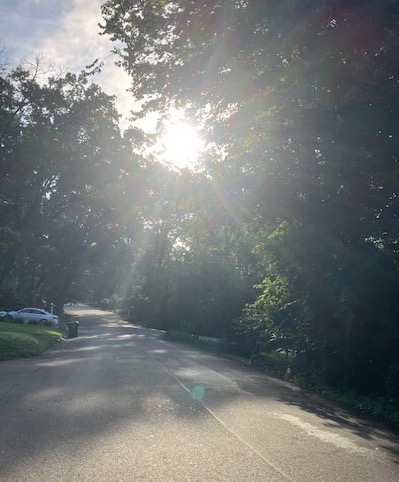
Hot summer sun rising over Rollingwood. (Photo Bill Pike)
I was up early on the morning of Tuesday, May 13. My old body told me I needed to go for a run.
I followed this internal self-talk. I ran from the hotel to Otter Point in Pacific Grove. This is a part of the Monterey Bay Coastal Trail.
The trail had been dampened by some pre-dawn rain showers. That didn’t slow me or the other walkers, joggers, and bike riders who too were up early.
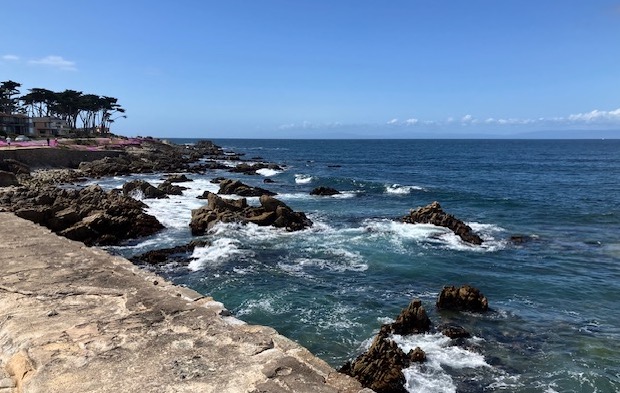
No matter where my eyes scanned, I had pretty views of the neighborhood and the bay. This run is not likely to leave my memory. The setting is too special. If I had the endurance and the time, I could have stayed on this trail all day. But another trail was calling me.
After breakfast, the Commander had us scheduled to start our exploration of the Seventeen Mile Drive. As much as I had liked the views from my run, the views for the remainder of the day would only become more incredible.
Much has been written about The Seventeen Mile Drive, I doubt I can add much to these praises. Let’s leave like this, if you are given the opportunity to make the drive, don’t turn it down.
I did not focus on the opulence of the homes or the famous golf courses. No, I focused on the determination of the Pacific Ocean, and the rugged coastline the ocean rolls into every minute of the day and night.
The Restless Sea (Photo Bill Pike)
Marker 4 on the drive is titled The Restless Sea, and here is the commentary about this section: “The Restless Sea earns its name as one of the most turbulent sections of coastline in Pebble Beach. Waves are constantly converging and crashing into each other, likely caused by submerged rocks.”
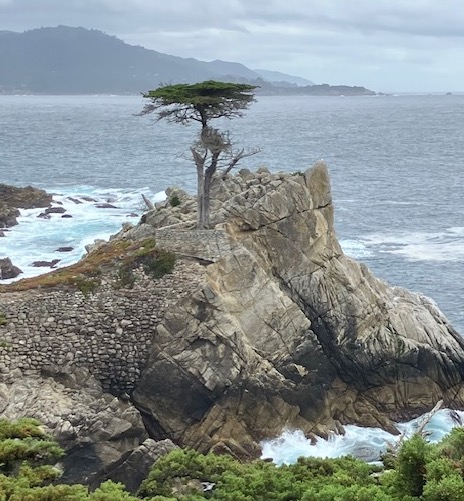
Each marker has a story to tell and a point to make. Perhaps the most famous is The Lone Cypress.
According to one marker, the Monterey cypress almost became extinct along the coast. Fortunately, it didn’t as the trees grow naturally here. The popular trees can reach heights up to seventy feet and can live up to three hundred years.
Yes, there is something special about The Lone Cypress. I admire its loyalty. No matter what nature has tossed at the tree, the cypress has remained loyal to its solitary perch.
The Lone Cypress (Photo Betsy Pike)
We made a short stop at the Pebble Beach Visitor Center. Next, we started working our way further south toward Point Lobos State Natural Reserve.
I’ll put this in the same category as The Seventeen Mile Drive—if you have the opportunity to visit Point Lobos, don’t turn the invitation down. Yes, you will walk more at Point Lobos, but those steps will reveal to you spectacular coastal scenery.
When we arrived at Point Lobos, the parking lot was full and closed. This meant we had to park along the shoulder of the highway that parallels the park.
We walked back to the entrance, took some advice from park personnel, and started our exploration. In truth, what happened was we were so enthralled by the beauty that we kept pushing ourselves further and further into the available trails.
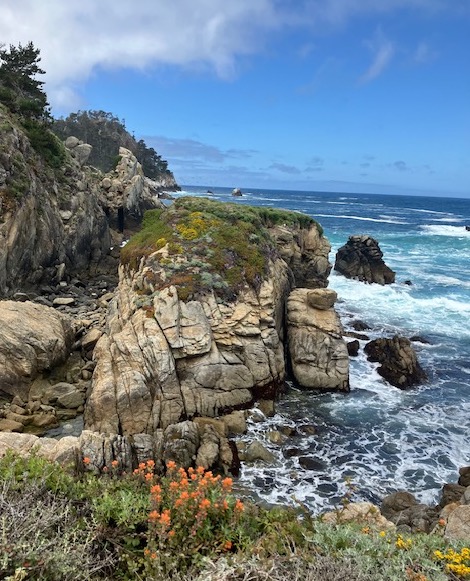
One of many pretty sights at Point Lobos (Photo Bill Pike)
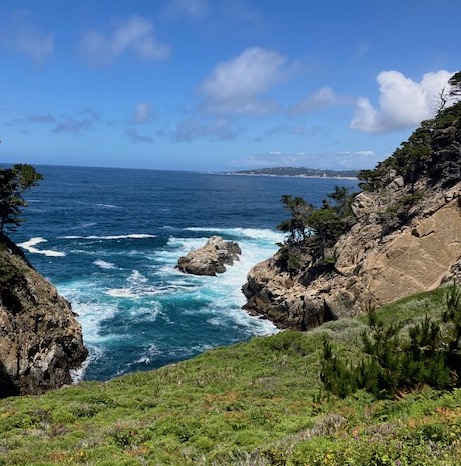
Eventually, we worked our way to a stopping point and the walk back to our car, but neither of us regrets taking the time to explore. What we saw was nature at her best.
The ocean, the rocky shoreline, the wildflowers, an occasional appearance of wildlife, and the knowledge of park personnel added to the pleasure of the hike. Neither of us will forget this visit.
Point Lobos: rocks, surf, flowers (Photo Bill Pike)
Back out on the highway, we made a stop in the parking lot of Monastery Beach and enjoyed our Pebble Beach sandwich in the car.
From there we drove back into Carmel By Sea for more exploring. The focus here was to locate some of the Storybook Houses.
Unfortunately, our interpretation of local maps was being challenged. Luckily, a patient, local resident sensed this, and he redirected our steps guiding us to our first Storybook House.
Carmel By The Sea Storybook House (Photo Betsy Pike)
We strolled through the shopping district and made our way down to see the famous beach. Even though it was May, a few beach worshippers were present on this pleasant sunny afternoon. In a few weeks, I imagine this beach will be packed.
Our walk back to the car revealed more about the character of the town.
A plaque on a fence featured these words in bold print: LIV DE LIFE with this Emerson quote behind it: “The ornament of a house is the friends who frequent it.”
Another creative sign featured precisely cut letters from assorted license plates to form this colorful expression: Happy Go Lucky.
Colorful sign (Photo Bill Pike)
From Carmel By The Sea, we re-entered The Seventeen Mile Drive from the land side. We worked our way to The Inn at Spanish Bay.
The Commander navigated us to a sunlit, stone patio where she ordered a glass of wine and I had glass of beer.
(Photo Betsy Pike)
We sat in comfort admiring the view.
Gradually, we inched our way back to the hotel.
After a respite, we walked back down to Cannery Row, and had dinner with a view of Monterey Bay at Louie Linguini.
Tonight, this trip was coming to an end.
Early tomorrow morning, we would say goodbye to this stunning California coastline and drive back to the San Francisco airport.
Thankfully, we survived the drive to the airport and the drop off of the rental car.
Inside our gate area, I stumbled upon a church friend, Susan King, who had been in San Francisco visiting a friend. Later she would get a good laugh watching me stuffing an over stuffed suitcase into an overhead bin.
Before we took off, the Captain of the plane for Breeze Airways gave what was maybe the best welcome aboard and here’s what to expect speech I’ve ever heard from a pilot.
Remnants of thundershowers were around the Richmond area as we descended into the landing pattern, but our landing was smooth.
We grabbed our bags and worked our way to the shuttle van to return us to our parked car.
The only downer of our trip unfolded between the driver of the van and an airline employee who admitted she had a lousy day.
These two individuals grumbled over where the airline employee wanted to be dropped off. The tenseness between them was disappointing.
This tiny confrontation brought me back to reality. That magnificent California coastline was far away on the other side of America.
I wonder if the personalities of the van driver and the airline employee could have been soothed by a single pretty California vista?
That’s hard to know, but I know that my old brain and soul will forever cherish what California shared with me and the Commander, the best trip planner in the world.
It might be hard to see it at times, and often we do our best to destroy it, but we still live in a beautiful world.
For that I am grateful, and I must constantly remind myself to do my part to take care of this world.
Another pretty vista from Point Lobos (Photo Bill Pike)
We wasted no time after breakfast to start our morning.
Our walk to the Monterey Bay Aquarium took us by an assortment of homes, shops, and other businesses.
Making a visit to this unique aquarium had been a goal for a long time. This is a special place. A place where imagination and ingenuity have created an environment for capturing the stories about the Pacific Ocean and its impact on these California coastal communities. And at the heart of those stories are people.
Immediately, the displays draw visitors to people.
The ‘generosity and vision’ of David and Lucile Packard sparked the development of the aquarium. Mr. Packard once said that “the ocean is the most important frontier we have.” Clearly, the aquarium gives life to his words.
Through his fiction and nonfiction writing, American author, John Steinbeck, brought to life Monterey and Cannery Row. Steinbeck wrote about the people who breathed life into economy of harvesting the bounty of the sea.
Another important person was Ed Ricketts, who is described as “an ecologist before his time.” Mr. Ricketts helped people to learn about and understand the relationships of the Pacific’s sea life and its links to the region. His early studies helped to lay the foundation for future research. Also, Mr. Ricketts was the fictional character ‘Doc’ in Steinbeck’s Cannery Row and Sweet Thursday.
Without question, visitors learn about Cannery Row. The impact of harvesting fish and bringing the catch to the cannery for processing is told from the perspective of the workers.
Here is a quote that describes what it was like: “We used to dread getting up in the morning because we worked so hard. It was cold and wet with water running under your feet the whole time—Can you imagine squeezing the guts out of fish at three or four in morning?”
Early in our visit, we learned about sea kelp and its impact on the life of this region of the Pacific.
Critical sea kelp for these California coastal waters (Photo Bill Pike)
The entire aquarium is user friendly. Displays attract all age groups, but there is a special emphasis for children.
From the brilliance of the wave machine, the interior and exterior displays of sea life, the outside vistas, the friendly and knowledgeable docents, and the use of video to present information make the aquarium uniquely qualified to help us all learn.
Stunning jellyfish (Photo Betsy Pike)
This quote from Loren Eiseley caught my attention: “If there is magic on this planet, it is contained in water.”
From our first display until our last view from an outside vista, we felt the “magic of the water” at the Monterey Bay Aquarium.
An exterior view from the aquarium (Photo Betsy Pike)
After our visit to the aquarium, we regrouped at the hotel.
We continued to explore. Our goal was to visit the Point Pinos Lighthouse.
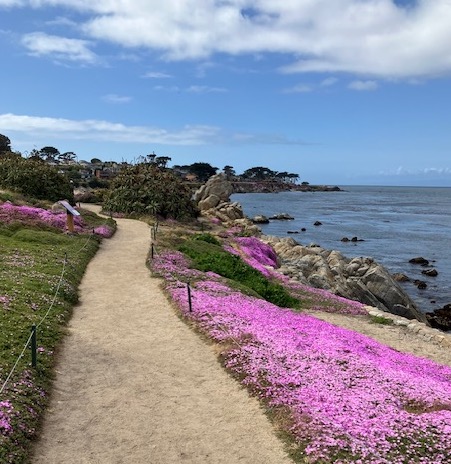
As we drove and walked along, the blue sky, beds of flowers, combined with a shoreline of scraggy rocks worn by a relentless Pacific, made for unforgettable postcard images.
Pretty path along the Pacific (Photo Bill Pike)
Occasionally, we came across a colony of at type of burrowing ground squirrel. Clearly looking for a handout from kindhearted tourists, these creatures did not rate highly with residents of Monterey.
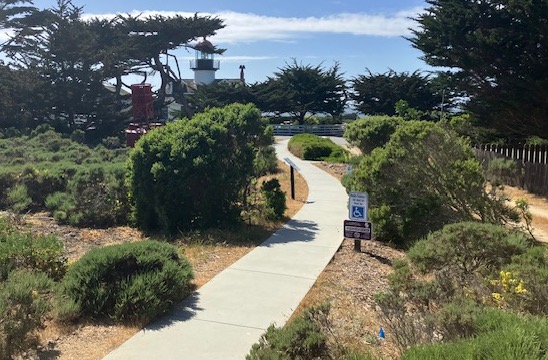
Unfortunately, the lighthouse was closed. But again, the rocky shoreline, the hues of the ocean’s water, the crashing waves, the glide of pelicans, and the steady progress of fishing boats heading into port made for a remarkable afternoon.
In the background the Point Pinos Lighthouse (Photo Bill Pike)
We drove back to the hotel, then took a short walk to a local dive—Sly McFly for dinner.
On our after dinner walk back to the hotel, we purchased some chocolate.
Then, we made a decision to drive back out to Asilomar State Beach with the hope of seeing the sun recline into the Pacific.
We found a good spot for watching the sun sink, but partly cloudy conditions and a light rain shower limited seeing the sun.
A slowly sinking sun (Photo Bill Pike)
Our drive back to the hotel wove us through the pretty coastal town, Pacific Grove.
Another non-stop day with lots of steps had us ready for rest.
The Monterey Bay Aquarium still swirled in my mind.
I thought again about how this magnificent facility for teaching and learning came together.
And my old brain has this reoccurring question—why can we collectively come together to create such a facility, and yet, we appear to be unable or unwilling to truly solve our ongoing challenges related to homelessness, health care, mental health needs, and food instability across America?
I wonder if we will ever fully see that contrast and commit to solving it?
Letter to the Editor: Grateful for Alaska’s outstretched hand
JUNEAU EMPIRE The Voice of Alaska’s Capital Since 1912 Wednesday, July 30, 2025
From June 29 to July 10, my wife, along with two couples from college, and I traveled into Alaska. Twelve days out from our indescribable trip, I’m still suffering from chowder withdrawal.
Even though Mr. Moose didn’t appear on every corner, Alaska captured us. No matter if we were on a ship, train, bus or foot, the landscape was spectacular.
Our views were enhanced from the knowledge of exceptional guides who expressed their love and respect for this cherished land. Their devotion made us appreciate even more the stories about the courage of the original settlers and their respect for their heritage.
And while Denali was shy, I had ample opportunities to appreciate other snowcapped peaks, rolling rivers, cascading falls, deep forests, and the stunning blue ice of glaciers.
In Fairbanks, from so many angles, the Museum of the North really captured the spirit of Alaska and its people. It is my hope that the people of Alaska will never lose their loyalty or will to always protect this precious and priceless land.
After an early morning run along the Chena River, some of us stopped at the statue of Walter Harper. I loved the simple beauty of his outstretched hand, a hand up ready to help no matter the person or circumstances. In the short amount of time I have left in this weary old world, I hope I will become better at following Walter Harper’s heart by outstretching my hand.
Thanks Alaska for outstretching your hands to us.
Bill Pike
Author’s note: I was honored to have my Letter to the Editor published in the July 30, 2025 edition of the Juneau Times.














 might be baloney