I wasn’t looking forward to Monday, February 17, 2025. I knew what was coming.
For the next 48 hours, I was to be flat on my back. The only exceptions—restroom and meals.
I knew this drill because in December of 2023, I had surgery on my left eye to address Fuchs Dystrophy and cataracts.
To put it simply, Fuchs Dystrophy is when a person’s cornea begins to misbehave. My eye doctor had been tracking this behavior for a few years. After an exam, the comment was always the same—“you’re not ready yet.”
When you’re ready, the surgeon makes arrangements to secure a healthy cornea from a donation bank, and then the surgeon works his magic.
This morning, the plan was the same, but the focus would be my right eye.
I had completed the pre-surgery prep. A laser is used to zap a small entry point into my right eye. This is followed by a regimen of eye drops to prep the eye for the surgery.
The Commander Supreme and I had an uneventful drive to the surgery center. We parked and walked into the large waiting room.
The room was packed. I’m certain this facility is a cash cow.
Since, I had already signed my life away, the check-in process wasn’t very cumbersome. On a monitor, we could see my name, and track its positioning with the other patients. It wasn’t too long before a nurse came into the lobby, and called my name.
She gave a few instructions to the Commander, and then I was on my way.
The nurse and I chatted to the staging area. She asked many questions to ensure that I had followed the required protocols.
I had one last shot at bladder relief before stretching out on the gurney. A preheated blanket greeted my feet, and the magic touch of the nurse properly positioned my old sack of bones. My right eye was marked to alleviate whacking out the wrong part of my body.
My vitals were cooperating, and soon the knockout doctor appeared. Again more questions, and a short while later I was out.
When I awoke, I slowly noticed I had a dull throbbing pain in my left eye. It seemed like forever before anyone stopped again to check on me. I let them know about the eye pain, and they were perplexed.
I continued to wait. The longer I waited the more anxious I became. I didn’t remember waiting this long the last time.
Another check on me, I asked how much longer? I guess I was like a kid on a long road trip with his family—are we there yet?
Soon, the knockout doctor returned. Something was removed from the left side of my face, and the pain around my left eye immediately disappeared. He asked me if I was ready for some more sleepy juice, and I said yes.
I couldn’t feel anything, but I do recall the doctor working on my right eye.
I don’t remember the ride, but the gurney was wheeled back to the spot where I started. And it wasn’t long before my left eye could see the Commander Supreme.
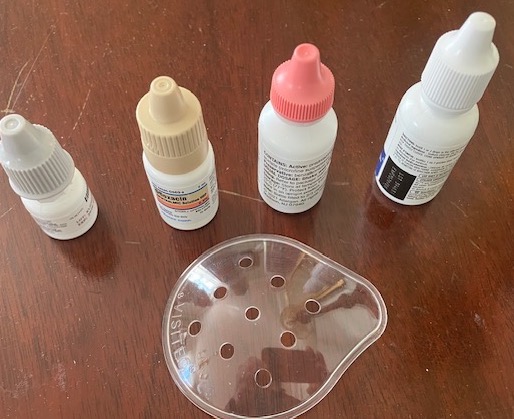
At some point, we learned that the surgery went well. The patch over my eye could be removed for the drops, and we had a chart for recording the dispensing of the drops.
My post-surgery appointment on Tuesday morning would reveal more.
I was alert now, alert enough to know I needed a pit stop. I was transitioned to a wheelchair and wheeled to the restroom.
Back in the wheel chair, a nice nurse pushed me out to the departure circle. The Commander was waiting for us.
With the seat reclined, I entered the car, connected the seatbelt, and we headed for home.
I’m a very lucky person. My back rarely causes me any stress, but my back doesn’t like being flat for 48 hours.
The last time I had this surgery, my back was the challenge, and unfortunately, this time, my back again chose to bother me.
No matter how pillows were used in support of my legs and feet, my back tightened and cramped. I had permission to take Ibuprofen and Extra Strength Tylenol. They dulled the pain, but the aching never totally disappeared.
That first night, I’m certain Alexa was just as happy as I when morning arrived. I kept making requests, and Alexa kept playing the music.
A bit after eight, we started the drive to the doctor’s office. It is a different passenger experience being reclined in a moving car.
With my eye still covered with its patch, we made our way into the waiting area. I was a bit uneasy.
When I was called back, the first nurse to assess me learned quickly that I had barely any vision in my right eye. I don’t remember this from the previous surgery, but this time the absence of vision was alarming to me.
My eye picked up light, but that was all. It was like there was a film covering my eye.
She didn’t seemed too concern.
Next the doctor came in. He took a look through the fancy machine, and he liked what he saw. The four sutures were in place, and the inserted bubble in my eye was still helping to hold the needed pressure.
The doctor showed the Commander how to monitor the bubble. If everything worked properly, the bubble gradually disappears.
We didn’t pepper him with too many questions, and before leaving we set up the appointment to have the sutures removed in a week.
During the remainder of Tuesday, somehow, my back and I tolerated each other. Waiting for dawn the second night seemed longer. Once again, Alexa honored my music requests.
On Wednesday, I continued to go for flat time. I didn’t want anything to go wrong with the surgery. Late on Wednesday afternoon, I took a shower. There is nothing like a shower for a weary soul.
By late Saturday afternoon, Betsy had good news—the bubble was gone.
On Thursday, February 27, I drove myself to the appointment. When the nurse started checking my right eye vision, she was pleased. This morning, I could read letters to her from large to very small.
When the doctor came in, he was pleased with what he saw too. Some drops were applied to numb the right eye, and now he was ready to remove the four sutures.
Once the sutures were out, I was given some different instructions for the eyedrops, and then I heard the best news from the doctor: “Your post-operative progress is ahead of schedule, you can resume normal activities.”
I was elated.
I thanked him and the nurse, and I made an appointment to come back in a month. I hope my progress continues.
This whole process amazes me.
According to the National Library of Medicine, the first corneal transplant dates back to 1905. An Austrian, Dr. Eduard Zim, used his ophthalmologist skills to perform that surgery in what is now known as the Czech Republic.
Since that surgery, countless doctors have been involved in improving and refining the process. I can’t begin to imagine figuring out the need for a tissue bank, the special tools needed to suture inside an eye, developing the eye drops, and how to use a laser to form an opening for the surgery to take place.
Why can we figure out this complicated surgical procedure, but we can’t figure out how to bring a lasting peace to every corner of the world? What is wrong with us? What have we to fear from a lasting peace?
In this process, I’m thankful for the care provided to me by the Commander Supreme, the meals from neighbors and friends, and heartfelt prayers.
And in both surgeries, I’m appreciative of the skills from the doctors, nurses, and support staffs.
But more importantly, I’m deeply appreciative of the family who made the decision to donated the cornea to the tissue bank.
How can I be so lucky and others are not?
I wonder how the good Lord might answer that question?
Author’s post surgery note: Today, March 27, I had my one month appointment with the eye surgeon. Everything looks good, and he has released me. Again, I’m so thankful.

 might be baloney