On the evening of Thursday, July 10, 2025, our red-eye flight from Fairbanks, Alaska to Minneapolis-St. Paul to Raleigh, North Carolina was delayed.
A passenger became ill, and the plane had to taxi back to the Fairbanks terminal.
Before our early morning landing in Minnesota, our airline notified us that our connecting flight to Raleigh was delayed.
That delay gave me some hope. Hope that I might be able sample an August Schell beer in the airport. Guidance for this pursuit came from Scott Hislop, the Senior Distributor Sales Manager, for the August Schell Brewing Company.
As soon we disembarked from the plane, I stopped at each bar/restaurant in the terminal. I checked the tap handles and asked friendly employees if they carried August Schell. Their kind response was “sorry, no.”
As my wife followed her crazed husband, in the distance, in the middle of the corridor of terminal one, I saw the words Stone Arch. That was the name of the one place Scott had referenced for sampling an August Schell beer.
Stone Arch employees were busy with breakfast customers. It took a few minutes for me to flag down one of their employees who handled beverages.
Finally, a nice young man paused as I flagged him down. His hurried steps came to a halt. I explained what I was trying to accomplish. He could not have been nicer.
First, he confirmed that Schell’s Light an American lager was on tap. Additionally, he showed me two sixteen ounce cans that were available, but I opted for the draft.
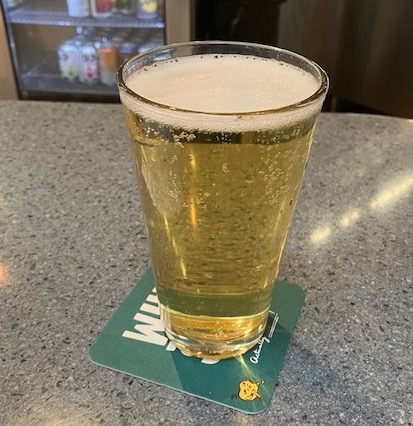
A couple of minutes later, he returned with a perfectly poured glass of Schell Light. This clear, pale lager, was full of carbonation bubbles and a thin head of foam.
While I’m not a fan of light beers, this one hit the spot at 7:20 a.m. on Friday, July 11.
I was reminded of the song “Roadhouse Blues” from the Doors’ album Morrison Hotel: “Well, I woke up this morning and I got myself a beer, the future’s uncertain and the end is always near.”
At my old age, I have never purposely abused my affection for beer. Out of respect for the beverage, I’ve worked to be doggedly rigid in my self-control when consuming beer, I’m basically—‘one and done.’
But, I will admit that for a long, long time lurking in the back of my mind were the lyrics from “Roadhouse Blues.”
So now, I can mark the drinking of an early morning beer off any unimportant bucket list.
Yet, there is a more important point, and that is Scott Hislop.
In our fast paced, impatient world, Scott took the time to respond to my original email. To me that is admirable.
I can’t tell you how many times I have sent a complimentary email to published authors. Rarely, do I receive a note of thanks back.
Scott’s response is a valuable lesson for any company small or large—that personal contact, the opportunity to build even a brief relationship with a potential consumer or customer is important.
That quick encounter with me also shows Scott’s loyalty to August Schell and its customers. No matter if they are devoted Midwestern supporters of August Schell, or a grumpy, rapidly aging geezer from Virginia passing through the Minneapolis-St. Paul airport, Scott understands the value of communication and building a relationship.
Finally, my pursuit in sampling an August Schell beer was grounded out of respect for their perseverance.
Located in New Ulm, Minnesota, August Schell is the second oldest family run brewery in America. From their beginnings, the brewery has continued to survive. In that survival, you will find risk taking combined with the ability to respect the foundation of the past with the will to adapt for the future.
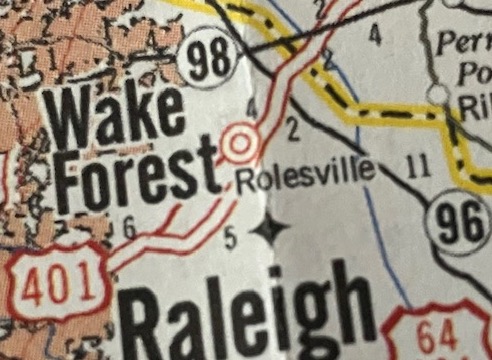
From the 2023-24 official state transportation map of North Carolina (Photo Bill Pike)
Good morning, I’m Bill Pike, and it is my honor to be with you this Sunday as the pinch hitter for Enon’s pastor, Michael Dettmer.
No matter if you are with us in the Sanctuary or watching on-line, we are glad to have you with us this morning.
Before we start, I need to share some disclaimers.
First, I’m not a Biblical scholar, nor a degreed theologian, but I do have a certification as a lay speaker from the Virginia Conference of the United Methodist Church.
My wife and I were traveling with dear friends from college when I listened to Michael’s voice mail. We had a good conversation when I called him back, but he said something dangerous to me.
Michael told me by phone and later in a follow-up email that I could preach on any topic of my liking.
That’s not a good offer to a person like me, who has what American writer, Dave Barry calls “brain sludge.” Mr. Barry defines “brain sludge” as useless information in the minds of men.
However, with Michael’s offer, my “brain sludge cells” started tossing out ideas.
Knowing that we are in Hanover County, home of the famous Hanover tomatoes, maybe, I should speak about the fruits and vegetables that are listed in the Bible.
In light of the recent water crisis that impacted the Richmond region, maybe I should talk about water. After all the Bible references water over 500 times.
Or since it is baseball season, maybe I should talk about the movie Moneyball, and offer suggestions to what churches might learn from characters Billy Beane and Peter Brand and their statistical thinking about baseball.
Or maybe, I can tell you some stories about my thirty one years of work in public schools, or my last fourteen years of work at Trinity, or maybe I should just let my heart do the talking.
Who knows, maybe I’ll be lucky, and something from my old heart might resonate with your hearts.
How about we start with a prayer: Father of us all, forgive my old heart. Amen.
The gospel reading this morning comes from Luke Chapter 10 verses 38-42. Let’s take another look at those four verses:
“As Jesus and his disciples were on their way, he came to a village where a woman named Martha opened her home to him. She had a sister called Mary, who sat at the Lord’s feet listening to what he said. But Martha was distracted by all the preparations that had to be made. She came to him and asked, “Lord, don’t you care that my sister has left me to do the work by myself? Tell her to help me!” “Martha, Martha,” the Lord answered, “you are worried and upset about many things, but few things are needed—or indeed only one. Mary has chosen what is better, and it will not be taken away from her.”
I’m sorry, but I think Martha has a point. She has opened her home to Jesus and his disciples. Including Martha and Mary, that’s at least fifteen mouths to feed.
I can see Martha scurrying around her home, prepping food, finding serving pieces, and while she is burning all this energy, it suddenly dawns on her, I need some help.
Look at my sister, she is sitting at the feet of Jesus hanging on every word that he is saying. Why isn’t she helping me?
In our own kitchens with our families, we’ve seen similar scenes play out when we have special guests in our homes. We want the meal and the fellowship to go well. For that meal and fellowship to go well, we are probably going to need some extra hands.
But, Jesus, doesn’t see it that way. I think he can see and feel Martha’s sense of urgency in this moment.
While his reply to Martha acknowledges that she is worried and upset about many things, he offers no real relief—other than basically— hey, Martha, cool your jets.
By this time, Martha might be headed toward a nuclear meltdown.
Maybe she is thinking to herself: “I’m trying to be a good host, no one is helping me, sounds like Jesus told me to trim the menu down, and that Mary has chosen more wisely than me and that her choice will not be altered. I guess, I’ll just keep plugging along.”
In the May 23 edition of the news magazine The Week, I read an obituary about Joseph Nye. Dr. Nye was a political scientist who had a distinguished career in academia and politics.
The Washington Post reported that the future Dr. Nye grew up on a farm. He attended Princeton University. It was at Princeton that “he briefly considered studying for the ministry—until he read the Bible all the way through.”
I’ll be honest with you— I have days like that with the Bible. Days when I have no earthly idea how I can understand or rationalize what is written.
And I’ll take that honesty a bit further, these four verses about Martha and Mary are difficult for me to understand.
My vision, my practical thinking sees this home visit by Jesus from Martha’s perspective. I hear and understand her plea.
But in the footnotes of the 1973 edition of the The Oxford Annotated Bible, the Revised Standard Version, I’ll give you a bit more to ponder: “With delicate ambiguity Jesus rebuked Martha’s choice of values; a simple meal (one dish) is sufficient for hospitality. Jesus approved Mary’s preference for listening to his teachings as contrasted with Martha’s unneeded acts of hospitality.”
“Unneeded acts of hospitality” sorry, but I need to think about that comment for a while, maybe longer than you want to be here this morning.
On the evening of Thursday, July 10, my wife and I were on a redeye flight from Fairbanks, Alaska to Minneapolis-St. Paul to Raleigh.
We experienced a brief delay for our flight to Raleigh, but other than that all went well.
Even though I grew up in North Carolina, I have never figured out the roads in Raleigh.
This is despite many trips to Raleigh to visit our youngest daughter.
We were on US 1 north headed out of the city into Wake County.
And I have no idea why on this Friday afternoon, my eyes were drawn to an exit sign for Rolesville.
But, my brain locked on to that name— Rolesville.
I’ve never been to Rolesville, don’t know if I will ever go to Rolesville, but the town was founded in 1837 by William H. Roles. Today, it is the second largest city in Wake County with a population of 9,745. (Wikipedia)
Luckily, my jet lag did not impact my driving, and we made it back to Richmond safely.
Yet, my old brain would not let go of Rolesville.
Late on Saturday evening, I started doing some preliminary prep for this morning, and when I consulted the lectionary for the gospel reading, Rolesville nudged me again.
And that’s when it hit me, what is my ‘role’ in this cantankerous, weary, and worn out old world?
Mary and Martha both have roles in this scripture.
What is your role in this world?
How do you impact your family, your friends, your community, your work environment, and how do you impact Enon?
What is our role, our responsibility?
How can we use our role, our responsibility to make a positive impact?
You may never visit Rolesville, but I hope you will revisit everyday what your ‘role’ is in this world. Never stop evaluating how your ‘role’ can bring about change.
A few years ago, I stumbled upon this quote from E. B. White: “The only sense that is common in the long run, is the sense of change and we all instinctively avoid it.”
How about in your ‘role’ in this life, do you “instinctively avoid change?”
When I read a book, an article in a magazine, or the daily devotional in the Upper Room, I use a highlighter. If I come upon wisdom that resonates with me I will highlight it and that includes highlighting the page number.
I recently read The Secret World Of Weather by Tristan Gooley. In the book, Mr. Gooley shares with readers how to read weather signs ‘in every cloud, breeze, hill, street, plant, animal, and dew drop.’
If you are intrigued by our daily weather, you might want to read this book.
Now, I haven’t gone back in the book and counted how may times the word ‘change’ is used by the author to make his points, but ‘change’ is used a lot.
Our seasons and their weather force us to change our routines. Yes, we might complain about the weather, but do we really ever consider how it initiates change?
These weather changes force us to adapt.
In the New Testament isn’t that Jesus’ role? Isn’t he nudging us to change?
With every interaction with every parable, isn’t he working to initiate change, to make us think, to make us uneasy, to nudge us out of our comfort zones? Doesn’t he want us to take on a different ‘role’ in the reality of our own Rolesville?
Who in your Rolesville needs you?
Is it an aging parent, a student who needs a mentor, a struggling co-worker, a church member, a stressed out neighbor, or a stranger rummaging through a dumpster in the back of a fast food restaurant?
You, me, we, us have a ‘role’ to fill in our communities.
And, I’m not sure about your thinking, but I sense God and Jesus are not much different from Martha. Maybe they don’t want to admit it, but they need us to take more of an active ‘role’ in this raging old world.
We are at a point in all of the Rolesvilles across the world where we can no longer “instinctively avoid change.”
Perhaps you are aware that in Luke Chapter 10, just before the story of Mary and Martha is the story of the Good Samaritan.
What a ‘role’ this man played in saving a stranger’s life.
The last four words that Jesus speaks in that parable are “go and do likewise.”
I wonder if I’d be able to offer the same type of assistance to a stranger today like the Good Samaritan did?
I love music.
I have a deep appreciation for musicians.
I can’t sing or play any instrument.
At home, if I were to attempt to sing in the solitary confinement of our shower, I’m certain all of the dogs in our neighborhood would howl in anguish.
The Steep Canyon Rangers are a bluegrass/Americana band from Asheville, North Carolina.
Unlike me, they are gifted songwriters, musicians, and singers.
The lyrics from their song “Down That Road Again” made me pause and think:
“Don’t let me go down that road again I know where it leads and how it ends Right now I need the kind of friend Who won’t let me go down that road again” (Written by Graham Paul Sharp of The Steep Canyon Rangers from their album Radio on Rounder Records 2015)
At this very moment, there is someone in your life who doesn’t want to go down that road again. This individual needs someone from Rolesville to be the ‘role’ of a friend ‘who won’t let them go down that road again.’
Jesus was honest in his assessment of Mary and Martha, and I’ll be honest with you.
Each of us has a ‘role’ to play in this world full of hurting people.
It is time for us to put into action the words from Jesus: ‘go and do likewise.’
Near the end of June, I turned 72.
There is a little voice inside of me that whispers, “Bill, you don’t have much time left, you need to get busy.”
That whispering voice is correct, I don’t have much time left, I need to get busy.
How about you?
In the time that you have left, how are you going to get busy?
What ‘role’ are you going to play?
Maybe you know the name Dr. Mae Jemison. Dr. Jemison was the first African American woman to travel in space. She was a mission specialist in 1992 on the space shuttle Endeavour.
This wisdom from Dr. Jemison makes me think a lot about the time I have left: “Never limit yourself because of others’ limited imagination; never limit others because of your own limited imagination.”
I told you earlier this morning—I’m not a Biblical scholar or a degreed theologian, but I’ll tell you what I think about Mary and Martha.
My old heart tells me that God and Jesus both need Mary and Martha, and we do too.
We need to hear the words from Jesus, but we also must put those words into action, and we must not think about our limitations.
Dr. Jemison never allowed limits to slow the pursuit of her goals.
Nor should we, as we position ourselves to “go and do likewise.”
Mary and Martha had limits in offering hospitality to Jesus and his disciples. But, I suspect that Mary and Martha came away from that experience a little wiser.
The Good Samaritan set no limits for himself to ensure that the robbed and injured traveler received the care he needed.
The person in the Steep Canyon Rangers’ song “Down That Road Again,” requested the help of a friend to keep them from making the same mistakes again. Tomorrow, you might be that friend who keeps a friend on the right road.
And grounded in the each of these examples is the E. B. White quote about change.
At this stage in my life, I can no longer “instinctively avoid change.”
If I avoid ‘change,’ then I will be incapable of playing the ‘role’ that Jesus charged me with— “now go and do likewise.”
Doesn’t matter if we are down in Rolesville or at Enon United Methodist Church— it is time for our hearts to “go and do likewise” in our communities.
Time isn’t on our side.
We need to get busy.
Talk to your heart.
“Go and do likewise.”
Author’s note: Today, I had the privilege of “pinch hitting” in the pulpit at Enon United Methodist Church in Hanover County, Virginia. A special thanks to the church staff and congregation for their hospitality and patience.
Ok Roanoke, this is your warning—the Methodist are coming.
From June 11-14, Methodists from across Virginia will be gathering for their Annual Conference at the Berglund Center.
I attended the annual conference as a district delegate in June 2019. That gathering is chiseled inside my body’s thermostat. Outside the Berglund Center was June perfect. Inside the building was freezing.
Maybe, conference leaders requested the frigid air to keep participants awake, or to keep emotions cooled when heated topics were debated.
Might be hard to believe, but methodical Methodist can get riled up. In case you don’t know, it took our denomination what seemed like centuries to work out differences over gay clergy and LGBTQ issues.
That grueling, hot-blooded debate caused some Methodist congregations to leave the denomination. The disaffiliation process was grounded in paperwork, property, and pennies.
I wonder if church researchers are investigating how those disaffiliated churches fared?
Trends in religion and houses of worship continue to be a source of interest for researchers.
A February 2025 study from the Pew Research Center featured this headline: “Decline of Christianity In The U.S. Has Slowed, May Have Leveled Off.” That might be encouraging news for church leaders in America, but I believe churches and the Methodists at the Berglund Center still have their work cut out for them.
The Pew report goes on to state: “But, despite these signs of recent stabilization and abiding spirituality, other indicators suggest we may see further declines in the American religious landscape in future years.” The key point made is that “younger Americans remain far less religious than older adults.”
I’m one of those older Americans. I see that trend at my church, Trinity United Methodist, in Richmond, Virginia.
If researchers reviewed the age demographics for the Methodists attending this year’s conference, I suspect they would find more older adults in attendance than younger adults.
Let’s be honest, churches were in trouble before COVID-19. Data captured by assorted researchers revealed declines in attendance, decreases in giving, aging congregations, and deteriorating buildings.
We are six years past COVID-19. Churches, including Methodist, continue to be challenged to address these on-going issues.
I sense our Bishop for the Virginia Annual Conference of the United Methodist Church, Sue Haupert-Johnson, is a very competent leader. Bishop Sue is a career switcher— business to law to theology. She has the task of leading Virginia Methodists through these challenges and whatever remaining baggage exists from the under current of our divides.
As a life long Methodist, we put ourselves into this mess, how do we pull ourselves out? Here are some thoughts.
In the baseball movie, Moneyball, there is a pivotal scene between a recently hired young executive, who is skilled in data analysis, and the seasoned general manager of the team. The young executive makes a bold statement: “Baseball thinking is medieval, they are asking all the wrong questions.”
Are conference leaders using available data about our churches and their congregations to ask the “right questions?”
For example, how many of our churches are hanging by their fingernails? What is the plan for gently closing these churches and merging their congregations into more stable churches within their communities? How might these now vacant properties be converted into affordable housing to help Virginia ease its housing crisis?
To reduce future closures, might churches benefit from participating in an accreditation process? On an annual basis, pastors and their congregations would be required to assess key components related to attendance, finances, programs, outreach, safety, leadership, technology, and property.
Over the last fourteen years, I’ve learned quite a bit about church operations. Churches can be tough places to navigate. How does morale impact the feel of the church’s emotional and physical environment for the pastor, employees, congregation, and visitors?
In looking to the future, Methodists would be wise to give serious thought to “discretionary time.” The key to attracting and sustaining young adults and young families is where does church fit in their overbooked schedules?
The theme for this year’s conference is “Movement of the Heart.” A part of that theme will focus on how Methodists can become “agents of change.”
If Methodists desire to become “agents of change,” they must avoid “medieval thinking” and asking “wrong questions.”
Pat Conroy wrote in his book My Losing Season: “Loss invites reflection and reformulating and a change of strategies.”
In plotting their future, Virginia’s Methodists ought to initiate Mr. Conroy’s wisdom.
Author’s note: On June 8, 2025, just before the start of the Annual Conference for the Virginia United Methodist Church, this op-ed piece was submitted to the Roanoke Times. The piece was not accepted by the newspaper’s editors.
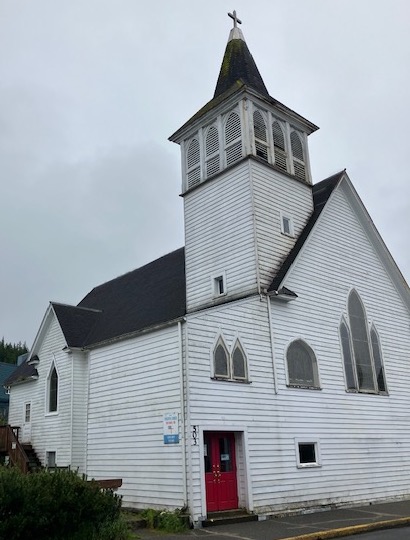
An Episcopal church in Ketchikan, Alaska (Photo Bill Pike)
Near the end of June, my wife and I travelled with college friends to Vancouver. As Americans, we appreciated your hospitality and your will to preserve precious land.
From your stunning airport terminal to our hike in Lynn Canyon, we enjoyed every footstep of our exploration. In turn, we worked to be considerate guests at every place we visited. During our visit, we saw the diversity of your city and how your community embraced a pretty June Saturday along the beaches on English Bay.
We noted similar challenges that we experience in our communities along the east coast of America — the high cost of housing, the struggles of the homeless, maintaining infrastructure, and the snarls of traffic. No community is immune from those challenges.
I will never forget my early morning run along the Stanley Park seawall. Captured forever are four herons gathered on a point, the scattered purple pieces of mussel shells on a soundless beach, magnificent trees, and the quiet exchange of “good mornings” with fellow runners and walkers.
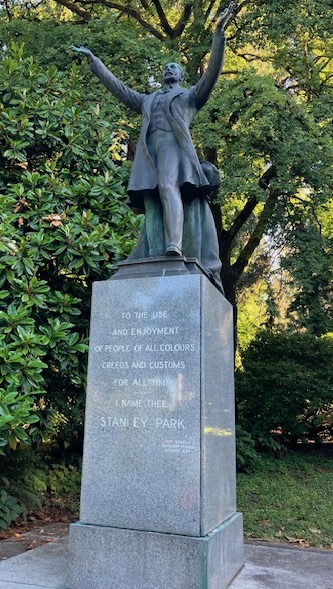
As much as I will cherish that run, my old heart will value even more a discovery we made in Stanley Park on our last morning in Vancouver. I know nothing about the qualities of Governor-General Lord Stanley, but I loved the vision of his words on his statue in the park: “To the use and enjoyment of people of all colours, creeds, and customs for all time.”
That is a powerful and visionary statement for 1889. Sadly, in the United States, that foresight continues to erode from our thinking.
In the time I have remaining in this cantankerous old world, I plan to share Lord Stanley’s wisdom as a reminder to everyone in my community that as Americans, we have an obligation to support “people of all colours, creeds, and customs for all time.”
Thanks, Vancouver, for the reminder.
Bill Pike, Richmond, Virginia
Author’s note: From June 25-July 10, 2025, my wife and I had the privilege of traveling with dear friends from college to Vancouver, Canada and Alaska. I was honored to have this letter published in the Vancouver Sun newspaper on July 8, 2025.
Over the last year, I’ve thought about 72 quite a bit.
On August 31,1992, my mother died courtesy of one the cruelest things on earth— cancer. She was 72.
I always wondered if I would make it to 72.
In June of 1972, I turned 19.
I had just finished my freshman year at Greensboro College.
It is unbelievable to me how quickly the last 53 years have passed.
Time is not on my side.
Truthfully, I don’t think time has ever been on my side.
I often reflect about how badly I have managed my time on earth. I could have been better at so many things.
I could have been more thoughtful, patient, kindhearted, and friendly.
I could have read more books, been more attentive to the needs of those around me, less judgmental, and less whiny.
Yet, I am thankful that I might just make it to 72.
This verse of the day showed up recently in my daily early morning quiet time. It’s from Psalm 121 verses 7-8: “The Lord will keep you from all harm— he will watch over your life; the Lord will watch over your coming and going both now and forevermore.”
When the news isn’t good, how in the world can a person of faith or a person who struggles with their faith believe those words?
With the bombing of Iran, the word “obliterated” was used to describe the destruction at the country’s nuclear facilities.
Obliterated applies to human beings too.
A neighbor for the second time is battling cancer. Her most recent post indicated that the cancer is obliterating her body.
Nothing that the oncologists have tried is slowing down or killing the cancer. Too bad we don’t have a 30,000 pound bomb that we can drop on her cancer.
And despite this discouraging report, our neighbor wrote, “I’m not losing hope.”
How in the world does she hang on to hope when her body has been betrayed by the words in the Psalms?
Clearly, her body hasn’t been kept from harm, and in her going and coming she must feel like she hasn’t been watched over.
On the afternoon of Sunday, June 22, I was running some errands. I was listening to a rebroadcast of a live concert from Mountain Stage.
A Kentucky duo named The Local Honeys was performing. One of The Local Honeys, Montana Hobbs, introduced a song that she had written about her grandfather.
Back stories fascinate me, and this one didn’t disappoint.
Her grandfather came from a large family. Unfortunately, his parents died early. This meant the children were shipped off to relatives to be raised.
In those challenging circumstances, Miss Hobbs’ grandfather ran off twice. Eventually, he joined the Navy and became a pilot during World War II. Somehow, her grandfather survived his plane being shot down and crashing in the Pacific.
With time, the roots of this family and their stories came together. When Miss Hobbs had the opportunity to visit her grandfather, if she asked him how he was doing, his standard reply was “better than I deserve.”
That reply from Miss Hobbs’ grandfather punched hard at my old soul.
At this point, my life has been “better than I deserve.”
And yet, I will complain until the day I die when a verse from the Bible, promises to protect, but from my downcast perspective the words fail.
In the May 23 edition of the news magazine The Week, I read an obituary about Joseph Nye. Dr. Nye was a political scientist who had a distinguished career in academia and politics.
The Washington Post reported that the future Dr. Nye grew up on a farm. He attended Princeton University. It was at Princeton that “he briefly considered studying for the ministry—until he read the Bible all the way through.”
I wonder what in the Bible changed Nye’s mind about pursuing the ministry? Was it a day when the news wasn’t good, and he knew that the hopeful words of scripture had let another person down?
If I make it to Friday, I will be thankful.
And on Friday, when I compare my life to the lives of others who are struggling to hang on, I’ll think about the words from Montana Hobbs’ grandfather “better than I deserve,” and with respect to the doubt of Thomas, I too will not lose hope.
Author’s note: I wrote this piece as a devotional for a staff meeting at our church on June 24. It was not my intention to draw attention to my birthday. The purpose is simply to remind you, me, we, us how fragile and unpredictable life can be. Love you all, Bill
Window at Trinity UMC Richmond, Virginia (Photo by Bill Pike)
RICHMOND TIMES-DISPATCH WEDNESDAY, JUNE 25, 2025 | A11
OPINION
LETTERS TO THE EDITOR
Letter: Violence is always ‘tolerated’ in America
From coast to coast, America continues to erode. The senseless shootings in Minnesota of four citizens with ties to the Democratic Party is the latest example of our decay. This resulted in two deaths, and astonishment that the other bullet-riddled victims survived.
Of even more concern is that the individual responsible for the shootings had a “hit list” of 45 officials targeted for harm.
President Donald Trump condemned the shootings in Minnesota with a social media post: “such horrific violence will not be tolerated in the United States of America.”
Sorry, Mr. President, you and your predecessors are wrong. America continues to tolerate horrific violence. Any day, a person can use a firearm to solve his/her problems. No immunity exists.
At the heart of this violence is the loss of our civility and respect. We abuse our free speech by bashing and bullying each other on every media platform with hateful, virulent, inciting language. Even more concerning is the loss of our moral conscience. With no hesitancy, we irrationally justify our vitriol.
As an imperfect human, American and Christian, I wonder if any religious influencer who has the ear of President Trump has shared with him this Bible verse from Galatians: “The fruit of the spirit is love, joy, peace, patience, kindness, generosity, faithfulness, gentleness, and self-control. There is no law against such things.”
While there is no law against these qualities, it is clear that self-control doesn’t apply to Americans who commit horrific crimes and our Washington leaders. Both are incapable of applying these values in making decisions.
Helen Keller said: “The only thing worse than being blind is having sight, but no vision.”
Will we have the courage to say enough?
Only if the spirit of our sight and vision returns.
Bill Pike Henrico
Author’s note: I’m honored that my letter to the editor about the shootings in Minnesota was published in the June 25, 2025 edition of the Richmond Times-Dispatch.
I never met Brian Wilson, but during his lifetime I met his songs, his music.
My first record purchase was a Beach Boys’ single. It was the Christmas hit “The Little Saint Nick.” On the flip side was a stunning a cappella version of “The Lord’s Prayer.”
From that first listen to that record, I was hooked.
Brian’s songwriting had a way of hooking people.
He took us to sunny California to surf the Pacific’s waves. To get to those famous west coast beaches, Brian put us in cars too— little deuce coupes and woodies. No matter if we were in one of those fast cars or watching surfers, we were surrounded by pretty California girls.
Brian was a marketer for California. He sold California to America and the world.
The lyrics showcased the lingo of surfers, hot rodders, and surfer girls.
The singable melodies locked into our instant recall. Irresistible harmonies as golden as sunshine became a trademark. Layers of instruments sometimes played with chord changes that weren’t supposed to work on paper showed the brilliance of his songwriting capabilities.
In 1961, their recordings and concerts started a legacy that lasted longer than anyone in the group could have imagined. Brian’s two younger brothers, Dennis and Carl, their cousin, Mike Love, and Brian’s high school friend, Al Jardine, formed the group.
Early on, the Wilson’s father, Murry, was the band’s manager. Despite his imperfections, Murry positioned the band for their early success as he smoozed disc jockeys, concert promoters, and dealt with the record company.
From 1962 through 1966, the band could do no wrong. Their hit songs raced up the charts. Screaming fans filled concert halls. But in 1964 while on a concert tour, Brian had a nervous breakdown.
That breakdown like a shift in a tectonic plate in the San Andreas fault broke the Beach Boys’ early formula—write songs, record, tour. Brian stopped touring. This allowed him to put his energies into writing songs and production work.
Brian worked with the gifted Los Angeles studio musicians who with great affection were named the Wrecking Crew. A new formula was born. Brian wrote the songs. He recorded the backing tracks with the Wrecking Crew. When the Beach Boys came off the road, they went into the studio and added the vocals.
This freedom to write and record allowed Brian to hone his skills as a producer. The studio became a second home. He pushed the traditional boundaries for the musicians and for his favorite recording engineer, Chuck Britz. Brian once asked Mr. Britz if he could bring a horse into the studio. Mr. Britz said no.
Brian also pushed himself to write and create beyond the band’s surfers, surfer girls, and fast cars image. From this came the legendary album Pet Sounds. Brian was twenty-three at the time. Released in 1966, initially, Pet Sounds was not a commercial success. The album’s success came from how it changed the way musicians from around the world wrote and recorded their songs.
The Beatles were listening. Brian’s work and innovations nudged them into their landmark album Sgt. Pepper’s Lonely Hearts Club Band.
Brian continued to push. The stunning single “Good Vibrations” was released. The recording was another masterpiece. The back story of the song’s recording sessions shows Brian either as a mad genius or a master of the studio.
His next project Smile continued to push the envelope. With Smile, as beautiful as we now know it was, the album crushed the Beach Boys’ successful hit making formula like a monster rogue wave from the Pacific.
His bandmates, the record company needed hit records. Smile was aborted. Brian retreated.
From 1967 until 1975, Brian quietly worked behind the scenes with the Beach Boys. He contributed songs, produced in the studio with them, but his reclusiveness begin to spin Brian out of control.
By 1975, physically, Brian was a far cry from the high school athlete he had been. His appetite was out of control, constant smoking was destroying his beautiful singing voice, and his consumption of drugs was impacting his personal well being.
Brian’s first wife, Marilyn, sought an intervention. She brought in a controversial psycho-therapist, Dr. Eugene Landy. Despite the good and bad from Dr. Landy, no one can deny that his interventions saved Brian’s life twice.
Brian’s second wife, Melinda Ledbetter, was the spark for launching Brian’s career as a solo artist. Contributing to this redemption was another group of young Los Angeles based musicians, the Wondermints. This group with other gifted musicians formed what became known as Brian’s band.
This band was fearless. No matter the concert set lists they hit every note with their instrumental chops and vocal dexterity. For example, the entire complex Pet Sounds album was played in concerts note for note.
Dead in a studio vault for almost forty years, the Smile album was resurrected. It was re-recorded, released, and met with high critical acclaim. Again, the musical gifts of Brian’s band drove this redemption of Smile.
In 2012, the living members of the Beach Boys reunited for a fiftieth anniversary tour. Brian had lots of songs to contribute to a new studio album.
After this success, for Brian recordings and concert appearance continued. But then in a summer co-headling tour with Chicago in 2022, his demeanor on stage changed. Brian became less and less engaged with the audience. By the tour’s final date, it was clear Brian’s concert performances were over.
Part of me believes that Brian’s work with the gifted musicians in his band and those concert performances added to the quality of his life, and maybe even extended his life. However, on January 30, 2024, we learned how much the quality of Brian’s life depended upon his wife, Melinda. Married for twenty-nine years, she had been his rock. Her passing was a devastating loss.
The impact of this loss came to reality in May of 2024. That’s when Brian’s family formally placed him in a conservatorship. Dementia was to be his end.
After all that he endured, I’m amazed that Brian made it to 82. He outlived his brothers, Dennis and Carl.
It always seemed to me that his heart was music, that music was his rescuer, his redemption, a lifeline.
And in its own unique way, I believe Brian’s music was a rescuer, a redeemer, a lifeline for people who needed something to hang on to when life challenges us.
I will miss Brian Wilson.
Despite all of life’s ups and downs that Brian endured, I’m thankful for my first record purchase. That purchase started a lifelong journey with Brian and the Beach Boys.
I have thought about citing a favorite song to close out this piece. But, I can’t. There are too many.
Just as Brian was relentless in his songwriting and studio production, I encourage you to be relentless in discovering the music Brian made beyond the hit songs. Your ears, heart, and soul will not regret this pursuit.
So, I leave you with these words from Brian’s youngest brother, Carl. These comments came from the Beach Boys boxed set Made In California.
Carl Wilson: “I asked Brian one time, I guess we were just having a long conversation talking about life and some of the stuff we had gone through, and I said: “Why do you think we succeeded in such a big way?” He said: “I think the music celebrated the joy of life in a real simple way, a real direct experience of joyfulness.”
I think Brian was right.
His music brought a joy into the world.
A joyfulness that will live forever.
Brian Wilson in his home recording studio, circa 1971. (Photo Bob Jenkins)
Author’s note: On the afternoon of Wednesday, June 11, my dear college friend, Steve Hodge, who is also an accomplished musician, and long time fan of the Beach Boys, let me know that Brian Wilson had passed. In all of our road trips to see the Beach Boys in concert, I can only remember one show when Brian performed with the group. That was in the spring of 1979 at the Greensboro Coliseum. Additionally, my childhood friend, Joe Vanderford, another follower of Brian and the Beach Boys, has kept me in the loop with references to articles and podcasts related to Brian’s passing. Today, Friday, June 20 is Brian’s birthday. He would have turned 83. His website: https://www.brianwilson.com/ has posted a nice tribute to Brian.
I’m Bill Pike, the director of operations for Trinity. Before starting, here are my disclaimers: I’m not a Biblical scholar, nor a degreed theologian, but I do have certification as a lay speaker.
In truth, I’m a rapidly aging, grumpy geezer who slings baloney. My monotone voice is guaranteed to put the sleep deprived in a deep sleep in a matter of minutes.
On a Sunday morning, when I pinch hit in the pulpit, the U.S. Geological Survey picks up substantial seismic shifts across Virginia graveyards. These detections are where former Methodist bishops and district superintendents are buried. They are rolling in their graves, and saying not Pike again
Despite my disclaimers, I’m honored to be with you on this Father’s Day.
Let us pray: Father of us all, forgive my old heart. Amen.
My deeply Methodist parents would be pleased to know that I have the opportunity to deliver a hellfire and damnation sermon to a bunch of heathens this morning.
Relax, I’m teasing you. I’m the heathen who needs to be saved.
Deep inside their hearts, my parents wanted me to become a Methodist minister. There was only on problem with their dream.
My brain is like this ancient cowboy insult: He is as shy of brains as a terrapin is of feathers.
Even if God had greased my entry, I had no chance at being admitted to Duke Divinity School.
Somehow, despite my many faults, my parents loved me. I think the best trait my father gave me was an understanding heart.
My father could get riled, especially if wire grass or rabbits invaded his garden, but he had a good heart. On Sundays, after church, my parents, my sister and me came home. We devoured my mother’s delicious homemade lunch, and then the only thing my father wanted was a nap.
The only thing I hoped for on Sunday afternoons was that my father took a short nap. I wanted him to pitch a baseball to me, toss a football, or shoot baskets.
My father hoped his son would allow him thirty minutes of snoring.
Hey, I seem to recall that our scripture reading for today mentions hope.
“We rejoice in our hope of sharing the glory of God. More than that, we rejoice in our sufferings, knowing that suffering produces endurance, and endurance produces character, and character produces hope, and hope does not disappoint us because God’s love has been poured into our hearts.”
I’m not sure about you, but I don’t see many people who are in a battle with cancer rejoicing.
Nor do I see a homeless person on a street corner rejoicing.
The same for the parent of a son or daughter who is fighting a substance abuse addiction.
In my thirty one years of work in public education, I remember my peers saying, “If you can teach in a middle school, you can teach anywhere.” That’s a form of endurance to survive all of the physical and emotional challenges that middle school students face in their development.
The scripture goes further to tell us that endurance produces character.
For today, let’s think about character in terms of our integrity, our moral fiber, our moral strength, our temperament, our fortitude.
How might our character—our integrity, moral fiber, moral strength, temperament, and fortitude produce hope?
Let’s take a Mayberry detour for a minute.
In this scene, Sheriff Taylor is concerned about his son, Opie. Opie is constantly chatting about a Mr. McVeebee.
Based upon Opie’s descriptions of Mr. McVeebee, Sheriff Taylor believes that Opie is making up all of this stuff. Sheriff Taylor decides to confront Opie.
Let’s play the clip now.
Parenting, no matter if it is in fictional Mayberry or here on Forest Avenue, is tough work.
There can be suffering in parenting.
Parenting can wipe out endurance.
Parenting can test our character, our judgment, our decision making.
In this scene, what is Sheriff Taylor hoping? What is Opie hoping?
Sheriff Taylor is hoping to learn the truth from Opie.
Opie is hoping his father will believe him.
How many times in our lives are we asked to believe when we have doubts?
Deep inside Sheriff Taylor, he must still have doubts about Opie’s convictions. But somehow his integrity, moral fiber, moral strength, temperament, and fortitude convince him to believe in his son.
As it turns out, Opie was telling the truth about Mr. McVeebee. He was a real person.
For a parent, there is no greater relief when your character endures the suffering and hope does not disappoint us.
Let’s travel from Mayberry to England for the first season of the Apple TV show, Ted Lasso.
In this locker room scene, Ted is talking to his team before their soccer game.
Ted says: “So I’ve been hearing this phrase y’all got over here that I ain’t too crazy about— “It’s the hope that kills you.” Y’all know that? I disagree, you know? I think it’s the lack of hope that comes and gets you. See, I believe in hope.”
I love those words from Joe Kelly, Jason Sudeikis, and Brendan Hunt.
I’ve thought quite a bit about the line: “I think it’s the lack of hope that comes and gets you.”
I’ll be honest, I have days when I lose hope.
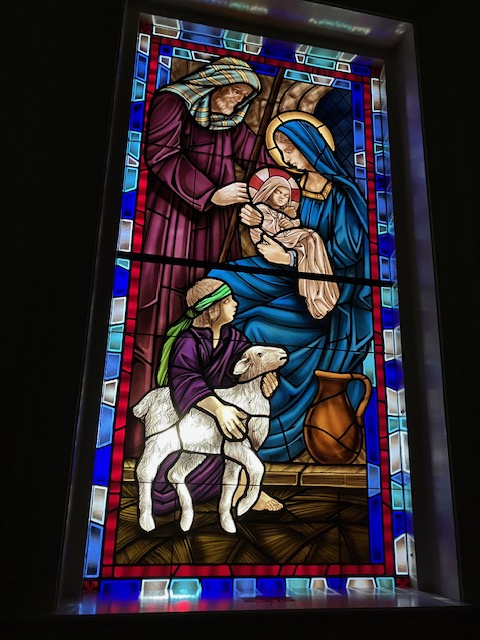
There are days that I want to walk into this sanctuary, and stare into that stained glass rendering of Jesus and shout out: “Hey, Jesus, where are you?”
People are suffering down here.
Where are your miracles from the New Testament?
1 Thessalonians 5:17 says “pray continually.”
I do pray every day. Where are you?
John 15:7 states: “If you remain in me, and my words remain in you, ask whatever you wish, and it will be done for you.”
Jesus, I’m not perfect
But, my life is in you, and your words are in me.
I’m asking for the people battling cancer, the homeless person on the corner, and those fighting addiction where are you? Their hopes, their wishes are not being fulfilled.
I can’t imagine what it is like to be God or Jesus.
Everyday whiny, cranky, grumpy old men like me rail against them.
I suspect God and Jesus want to shout back, “Hey, Bill, where are you? What are you doing to bring hope into this world?”
Ed Smylie was a NASA engineer.
On April 13, 1970, Mr. Smylie was at home. He received a phone call. An oxygen tank aboard the Apollo 13 spacecraft had exploded.
It was Ed Smylie and his team who figured out how the astronauts could build an air scrubber from the materials aboard the spacecraft.
Once Smylie and his team designed and built that air scrubber, they taught the astronauts how to build and install the air scrubber for the spacecraft.
The air scrubber removed the carbon dioxide from the spacecraft. This creative intervention kept the astronauts alive.
Smylie always downplayed his role in this “lifesaving of the astronauts.”
He had this to say about constructing the air scrubber: “If you’re a Southern boy, if it moves, and it’s not supposed to, you use duct tape.”
Does this equation work? Suffering + endurance + character+ duct tape+ love = hope. For the astronauts, their families, and the leaders at NASA, that equation worked. Smylie and his team’s solution gave hope.
On the morning of Sunday, June 1, Trinity member, Courtenay Brooks stopped by my office. She asked if had any super glue.
The heel, the sole of her shoe was separating. I handed Courtenay a roll of duct tape. She put her shoe back together.
When life looks bleak, maybe our souls are hoping that a person with endurance, character, love, and duct tape shows up.
In my thirty one years of working in public schools, I learned many student names.
At Lakeside Elementary School, we had a young lady in the third grade whose name was Hope.
I wonder where Hope is today?
Hope never knew this, but on those days when things go wrong inside a school building, Hope’s name gave me hope.
One day the school nurse came to my office. Hope was in the clinic. She was really sick. She needed to go home. When the nurse phoned Hope’s home, the line kept ringing busy.
My father’s understanding heart took over.
With the address in hand, I asked our guidance counselor to ride with me to take Hope home. When we arrived, the family dog greeted me in the yard with lots of welcoming hospitality.
A member of the household came out. I explained what was taking place.
This person was apologetic and grateful.
Sometimes hope comes from a soft heart taking a risk.
Maybe you have read Isabel Wilkerson’s book The Warmth Of Other Suns.
Then you know that Ida Mae Brandon Gladney, George Swanson Starling, and Robert Joseph Pershing Foster took risks. These were challenging risks. They left Mississippi, Florida, and Louisiana as part of the Great Migration.
Each of these individuals suffered through the injustices of the South. In their suffering, their character was developed.
Enduring the South gave them an extra layer of endurance and courage to pursue the perilous journey to new opportunities.
And in every mile to Chicago, New York City, and Los Angeles hope hovered around them like a guardian angel.
Let’s take one more cinematic look at hope.
Please play this last clip.
Hope is a good thing.
No good thing ever dies. You, me, we, us can’t let hope die.
At this very moment someone is suffering.
Might be a person in this Sanctuary, someone watching on line, a neighbor, a colleague at work, a relative, a friend, or a stranger, and no matter what is hanging over these people—they need hope.
We don’t give God and Jesus days off. In this weary world, they are overworked.
That’s why they ask, “Hey Bill, where are you? What are you doing to make this world less weary? How are you giving weary people hope?”
With our endurance, character, and the grace and love of God, in our hearts, we can be the duct tape, the hope for those who are struggling.
Even though I had lots of rotten moments, my father never lost hope that despite not becoming a Methodist minister that I might land on my feet someday.
Sheriff Taylor in a difficult moment of parenting hoped that his decision to believe in Opie was the right one.
Ted Lasso helped his team to see hope from a different angle.
Ed Smylie and his team gave the astronauts hope.
Courtenay Brooks found hope for a shoe in duct tape.
Ida Mae Brandon Gladney, George Swanson Starling, and Robert Joseph Pershing Foster never lost their hope when they took the greatest risks of their lives.
An unassuming, energetic third grade student named Hope gave a weary principal hope on lousy school days.
And in The Shawshank Redemption, Ellis Boyd “Red” Redding showed us that the endurance of friendship can redeem hope.
Remember the simple equation of words: suffering + endurance + character+ love + duct tape = hope.
Let’s rewrite that word equation: my heart + your hearts + our hearts + God’s love = hope.
God and Jesus can’t do it all.
Let your father take a nap this afternoon.
But when that nap is over, figure out how next week will be different.
It will be different because you, me, we, us are going to use our endurance, character, duct tape, God’s love, and our understanding hearts to give hope to a weary soul.
Benediction
Whether here in the Sanctuary or watching on line, thanks for putting up with me this morning.
I often wonder where our student, Hope, might be today.
I’ll tell you where Hope is today.
She is in each of your hearts.
I have one small favor.
Before Monday arrives, find the duct tape in your home. Cut off a piece of the tape and write the word hope on it. Then put that piece of tape where you can see it every day.
Now go in peace and use God’s love and your understanding hearts to give hope.
Author’s note: On Sunday, June 15, 2025, Father’s Day, I had the privilege of speaking at Trinity United Methodist Church on Forest Avenue in Henrico County, Virginia. If you want to watch the presentation go to this link: https://www.trinityumc.net/media and go to Summer Worship, you should come to a play button for Sunday, June 15. At the 26:30 mark is when I start. Thanks for your time, be safe, Bill Pike
TRUSTED BY LOCALS AND LOVED BY VISITORS SINCE 1915
Memorable trip Dear Editor,
In early May, my wife and I had the privilege of exploring California from Point Reyes to Point Lobos. No matter where our plans took us, we enjoyed our journey.
The enjoyment of our visit was grounded in the vision and will of Californians to preserve such precious land.
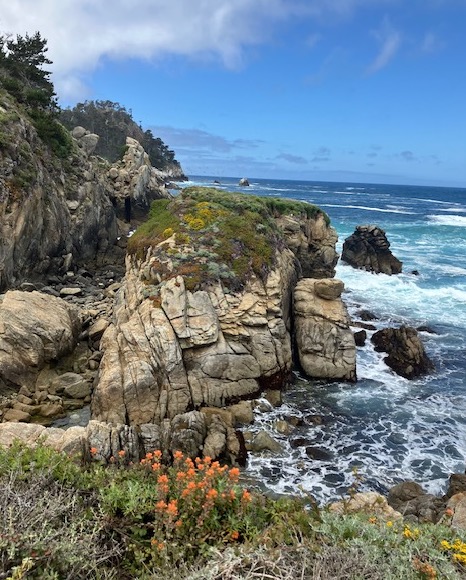
No matter the vistas in the seaside parklands or along the 17 Mile Drive, we cherished the restless Pacific, its stone masonry on the shoreline, and the pretty blooming flowers along many trails.
Our lives have been enriched by graceful redwoods, the backstories found in Alcatraz and Angel islands, the coffee-colored soil in farmland near Watsonville, and the magnificent Monterey Bay Aquarium.
Additionally, we were impressed by the patience and wisdom of employees in the state and national parks, appreciated the knowledgeable waitstaffs in every restaurant, and were thankful for an understanding man, a transplant from Austin, who sensed we were lost in locating the famous Fairytale Cottages in Carmel-By-The- Sea. This stranger might have saved our almost fifty years of marriage.
In Robinson Jeffers’ poem “The Beaks of Eagles,” he writes about the life of a mother eagle. The author notes: “The world has changed in her time,” and despite these challenging changes, the mother eagle continues to find the way to survive.
Like the mother eagle, it is my hope that California with stubborn persistence will repel any wacky Washington attempts to dismantle these priceless plots of unparalleled beauty.
Our aging hearts will hold this trip forever, thank you.
                                                               Bill Pike,
                                                       Richmond, Va.
Author’s note: Today, I was honored to have this letter to the editor published in the Carmel Pine Cone, a weekly newspaper in Carmel-By-The-Sea, California.
Coastline, Point Lobos, California (Photo Bill Pike)
From the flight across America to our first afternoon of exploring San Francisco, we were exhausted.
I slept soundly until 4:24 a.m. That’s when I heard the voice of a woman screaming profanity from the street five stories below our room.
We ate breakfast in the hotel’s restaurant. We both had a dish named overnight cold oats. This was basically cold oatmeal with fruit.
After breakfast, we hustled back to the room to get organized for our walk down Fisherman’s Wharf. We were headed to Pier 33 where we would board a ferry for Alcatraz Island.
In its heyday, I imagine every inch of Fisherman’s Wharf held a story. The Pier 43 Arch is one of those places with lots of stories. Constructed in 1914, this pier was a major hub of transportation for the bay area.
Pier 43 archway (Photo Bill Pike)
At Pier 39, California sea lions have established a colony. They make their presence known with their chit chat and their aroma.
Continuing our stroll to Pier 33, we saw street vendors setting up to sell food and other tourist items. We had a good view of the city on our right and lots water views on our left.
As we approached Pier 33, the waiting area for the ferry ride was nearly full. A large group of school kids would be on this tour. My Commander Supreme was wise in making reservations and purchasing tickets weeks before our arrival. The trips to Alcatraz frequently are sold out.
On this pretty California day, we were on time when we departed for Alcatraz. On the ride over, there were multiple stunning views of the water, the mainland, and the island.
As soon as we left the ferry, Park Service personnel greeted us and explained our options for touring the island.
We opted for a tour with one of the park’s rangers. This gentleman was good. He knew everything about Alcatraz.
Initially, Alcatraz was established by the U. S. Army as a fort for protecting San Francisco. Next, it was converted into a prison for the military. In 1934, the island became a federal prison. As a federal prison, America’s worst offenders were sent to Alcatraz.
An old sign an entrance (Photo Bill Pike)
Sustaining a presence on Alcatraz was no easy task. There is no source of water on the island. Water had to be shipped over from San Francisco.
The island had no soil. Ship loads of soil was brought over from Angel Island.
At the top of the island was the warden’s home. This was a mere twenty two room mansion.
Guards and their families lived on Alcatraz. Amenities were put in place for their families. Their children traveled by boat to San Francisco for their education. Each child carried with them a special tag. That tag allowed the children to board the boat to return to Alcatraz at the end of the school day.
With the rich soil from Angel Island, Alcatraz has many plantings on its grounds. Prisoners sent out letters around the world requesting plants. Countries responded, and sent all kinds of plantings.
Someone from the park service did good work in figuring out how to transition visitors for the self-guided audio tour inside the prison.
The line moved quickly to pick up our listening device. The audio tour is very realistic. It is a combination of seeing the prison environment up close, but is greatly enhanced by the narration.
The narration is done by former Alcatraz guards and prisoners. The back stories are perfectly matched with each section of the prison. Additionally, the audio is intensified with background sounds from cell doors closing to the sounds of inmates moving.
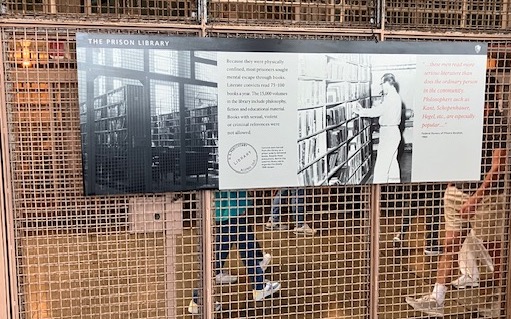
Library inside Alcatraz (Photo Bill Pike)
We saw the famous cell where in 1962 inmate, Frank Morris, initiated the carefully conceived escape from Alcatraz.
After the tour, we walked around the grounds a little more. We admired the vistas, the pretty plantings, and the preservation of this site as a national park.
Alcatraz was closed as a federal prison in 1963. Government and prison officials finally realized that the cost of sustaining Alcatraz wasn’t feasible. Closing the prison was a wise decision. Transitioning the prison into a national park was a smart move. Any attempt to return Alcatraz as a federal prison would be foolishly unwise.
Leaving Alcatraz (Photo Bill Pike)
The ferry ride back to Fisherman’s Wharf was just as pretty as our departure. Walking toward our hotel, the cool wind would occasionally send a whiff of something divine—the aroma of sourdough bread baking at the Boudin Bakery.
So, we stopped for lunch at the famous Boudin Bakery. This origin of the bakery in San Francisco dates back to 1849. The bakery’s connection to San Francisco remains strong today.
At its Pier 39 location, if you stop for lunch, you will not be disappointed. The sourdough bread is a winner, but my sourdough bread bowl filled with a corn and crab chowder was yummy.
Nice lunch (Photo Bill Pike)
After lunch, we walked back to the hotel and finalized our plans for the afternoon.
We took a Uber to the Palace of Fine Arts. This is a remaining structure from the Panama-Pacific International Exposition in 1915. The structures and its grounds are a sight to behold. I can understand why our son-in-law chose this location to propose to our oldest daughter.
Amazing construction from 1915 (Photo Bill Pike)
We spent the remainder of the afternoon walking and exploring. Our guide points along the way were the Golden Gate National Recreation Area and the San Francisco Bay Trail.
Yes, we had some missteps along the way, but the terrain, the bay, and the magnificent views made up for the modest errors. Crissy Field, Fort Point, the San Francisco National Cemetery, and the Presidio were among the areas where our feet took us.
And no matter where we trekked, another famous landmark was within sight—The Golden Gate Bridge. This afternoon, a teasing fog shrouded this striking structure.
The Golden Gate Bridge in an afternoon fog (Photo Bill Pike)
On our walk to the Presidio, we passed the humbling San Francisco National Cemetery. These nine acres of land were set aside in 1884. This was the first national cemetery on the west coast.
First west coast national cemetery (Photo Bill Pike)
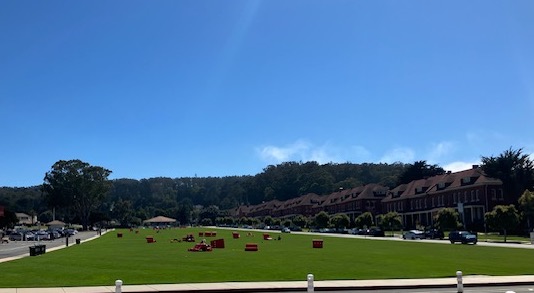
A very nice visitor’s center awaited us at the Presidio. The Presidio has a long history as a military base in America. In 1962, the facility was designated as a National Historic Landmark. In 1989, the Presidio ceased its operations as a military base, and in 1994, the buildings and grounds became part of the National Park Service.
Drill field at the Presidio (Photo Bill Pike)
The friendly park service employees at the visitor’s center helped us get our bearings. From there, we took another Uber to Ghirardelli Square where we had over priced scoops of chocolate ice cream.
On our walk back to the hotel, we passed Joseph Conrad Square, a pretty green space named in honor of the sailor and novelist who apparently never visited San Francisco.
Back in our room, we took a brief rest, and then went down into the lobby for happy hour. This afternoon the place was packed.
I found two empty chairs. I saved those while the Commander picked up a glass of wine. When she returned, I left and grabbed a beer. Two more chairs opened across from us, and a nice couple from Atlanta sat down. We had a good conversation with them.
While we were recouping before happy hour, the Commander made a reservation at an Italian restaurant.
From the hotel, we walked into the North Beach neighborhood to Trattoria Contadina. This is a small, family run restaurant with superb food and service.
Not having a meal here is a mistake. (Photo Bill Pike)
Our meals were delicious, and the tiramisu was divine. Located at 1800 Mason, if you are in San Francisco, you must make a reservation. We will never forget our dinner.
The walk back to the hotel helped to work off a few calories.
Collapsing in the room at the end of the day is becoming normal for us. I think we walked ten miles today, but they were ten good miles. Miles that continued to showcase a city that intrigues and charms visitors no matter the hardships the city has experienced during its life.








 might be baloney