Perhaps, you recall “well excuse me” becoming a catchphrase for comedian Steve Martin.
Interestingly, Mr. Martin used his gifts to find success as a scriptwriter for television, comedian, banjo player, actor, author, screenwriter, director, recording artist, playwright, producer, and art collector.
Not bad for a guy who turns 78 in August.
Mr. Martin’s talents have made me laugh, cry, and ponder.
His work with the North Carolina based bluegrass band, the Steep Canyon Rangers is impressive.
Twice, my wife and I attended the live performance of An Evening You Will Forget For The Rest of Your Life featuring you and Martin Short.
And we have completed watching the first season of Only Murders In The Building on Hulu starring Selena Gomez, Mr. Short, and yourself.
In 2013, Steve Martin and Edie Brickell released the bluegrass album Love Has Come For You.
Early in her career, Miss Brickell fronted the band—Edie Brickell and the New Bohemians. They were one hit wonders with—“What I Am.”
The album Love Has Come For You was produced by Peter Asher. In the early 60s, Mr. Asher was the Peter in the British duo—Peter and Gordon. For this album, Miss Brickell provided the song lyrics and Mr. Martin the music.
Sometimes on the internet, I stumble upon a music video with heartfelt lyrics, quality musicianship, and pretty vocals.
For me, “Love Has Come For You” is one of those songs. It features Miss Brickell singing lead vocal, Mr. Martin on banjo, and the Steep Canyon Rangers backing them.
The song is a story about a young lady who gives birth to a baby boy out of wedlock.
Her family attempts to persuade the mother to give up her new born son.
Yet holding her sweet son in her arms, she realized giving him up wasn’t a possibility.
Plus when she held him, “she could hear the quiet angels sing—love, love, love has come for you.”
Until the day she died, this mother held on to the words of the quiet angels for her son—“love, love, love has come for you.”
In this complicated, messy, weary world of ours, it is very clear that love has not come for some people.
I don’t believe love exists anywhere in Vladimir Putin’s heart.
I think the same for the heart of Adolph Hitler.
No way that Taliban leaders in Afghanistan have love in their hearts by depriving women of education and other freedoms.
With the start of a new year, Americans hold out hope that we will work to be better. But that hope is short lived.
According to a January 24, 2023 report from CNN, three weeks into the new year, the Gun Violence Archive has recorded 39 mass shootings across America.(Paul LeBlanc) I wonder if those trigger pullers ever experienced love in their hearts.
How do we bring love to people in crisis?
How do we love the unloveable?
How do we love when we feel incapable or unwilling?
Tuesday evening, February 7, 2023, the Community Conversations program at our church hosted Richmond author, Chip Jones.
Mr. Jones has written a compelling book: The Organ Thieves— The Story of the First Heart Transplant in the Segregated South.
During the hour long conversation, Mr. Jones was quite remarkable in answering questions.
A question near the end referenced a tense courtroom scene from the movie, A Few Good Men.
The prosecuting attorney with determined intensity tells the witness on the stand that “I want the truth.”
And the witness fiercely responds to the attorney with “You can’t handle the truth.”
I asked Mr. Jones if the racial divide in America is grounded in our inability to handle the truth of our shortcomings?
Part of Mr. Jones’ response was linked to a quote from Richard Rohr, a Franciscan friar, who founded the Center for Action and Contemplation: “As any good therapist will tell you, you cannot heal what you do not acknowledge, and what you do not consciously acknowledge will remain in control from within, festering, and destroying you and those around you.”(Admitting Our Wrongdoings 11-26-2015 CAC)
Love can’t heal, if we can’t acknowledge the mistakes from our past and present.
In the song “Love Has Come To You” the unwed mother acknowledged the love she felt and saw in her son.
With that confirmation, there was no turning back. The mother held for a lifetime the healing love from the quiet angels singing.
If I’m lucky, I’ll turn seventy in June.
Well excuse me, but, my heart is overdue to acknowledge my shortcomings and the shortcomings of America.
We need to acknowledge the festering inside our American hearts.
Failing to make this acknowledgement only ensures more heartbreak.
The quiet angels are nudging.
We need to let love come for us.
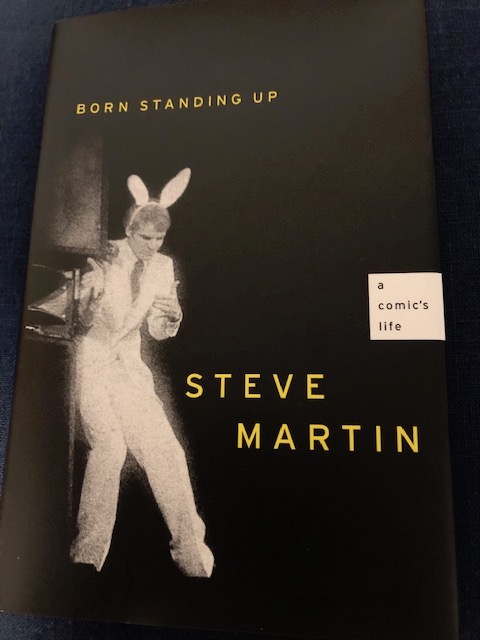
Cover of Mr. Martin’s book Born Standing Up (Photo by Bill Pike. I own a copy of the book)
Ken Simmons, Johnny Neese, Mac Abernathy, Richard Abernathy, Mary Jo Abernathy, Terry Johnston, Michael Johnston, Tommy Bennett, no hall of fame names here, just neighbor kids who sometimes found their way to the southern extension of Lambeau Field where the front yards of the Simmons and Pike families linked together to make a football field.
It wasn’t regulation size, but the graveled driveways were the end zones, sidewalks leading to the front doors of each home were out of bounds on the north side, while a drainage ditch on the south side marked out of bounds. Each yard had a couple of trees, but nothing to obstruct the main playing surface.
We played after school, any free moment on Saturdays, but I can’t remember playing on Sunday after church. No helmets, no pads, a few disagreements, no illegal hits, and never a question about whether a touchdown was really a touchdown.
I’m not sure about your perspective, but from my spider mite sized brain I’m weary of football games where the game officials must decide if a player scored a touchdown based upon whether the nose of the football broke the plane of the goal or if a player was able to graze the pylon with the football before he was shoved out of bounds.
To me this isn’t even worthy of replaying the video from a zillion different camera angles for some rule interpreting authority to make a decision. It is a simple matter of a rule change. To score a touchdown, a player must be in possession of the football, and must have his entire body in the end zone with the football securely in his possession. No exceptions, whole body, not pinky toe or finger, whole body with the football.
With this reasonable rule change, I’m sure the makers of pylons will be disappointed that their product will no longer be the focus of attention in determining the scoring of a touchdown, but I’m certain they will eventually find other sports for their product like ping-pong, gator wrestling, or large vegetable chucking which is scheduled to become a summer Olympic sport in 2020.
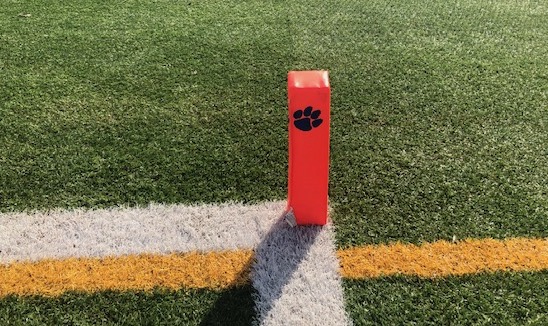
A football field pylon(Photo by Bill Pike with a special assist from Chris Rollison, Student Activities Director, Hermitage High School)
Definition research for pylon, finds a number of uses for the word, and its origin can be traced to the Greek language meaning “gateway.” Today, we associate pylon as a marker or tower, but a pylon can also be used to provide support.
Thirty-eight days ago we were celebrating Christmas, a season full of markers of support, and tomorrow is the Super Bowl, a football game that has become a national extravaganza with so much media hype that the basics of the game can be overlooked. I often wonder if the basics of Christmas are overlooked once it is over? Is the significance of Christmas still with me today, or have I tucked it away in my heart until next December?
In answering that questions, perhaps, I would be wise to consider the scripture from Jeremiah Chapter 31, verse 21: “Set up road markers for yourself, make yourself signposts; consider well the highway, the road by which you went.” I can whine about decisions related to touchdowns and pylons, but I suspect I would be better served if I push that whine energy into not forgetting the pylons of Christmas. How might I do this?
It’s a matter of redirecting my journey on the road of life by improving my focus on the markers and signposts I need to navigate the ups and downs of living. Part of that refocusing means a commitment to revisit the road by which I have traveled. To do this I must strengthen my daily devotional reading, scripture reflection, and prayer while looking for more growth opportunities at our church.
For the last several years, it has been pretty clear to me that the highway of life is more manageable with road markers and signposts from the good Lord to guide me. I’m not willing to continue my daily journey without guidance and direction from the good Lord and his Son. How about you? Have you tucked away the pylons of Christmas, and redirected your focus to less religious markers and signposts on your journey?
Author’s note: This piece “The pylons of Christmas are best not forgotten” was published as a Faith and Values column in the Richmond Times-Dispatch on Saturday, February 1, 2014. The section B Metro editor was John Hoke.
At some point after lunch on Thursday, November 2, 1972, we piled into the 1966 Chevrolet Chevelle. My Greensboro College classmate, Butch Sherrill, had somehow talked his younger brother, Robert, into loaning him the car for a road trip.
That Chevelle, painted Petty Blue, was our ride to Boone, North Carolina. In honor of Butch’s birthday, we were going to the Beach Boys concert that evening at Appalachian State University(ASU).
The we in the car were Butch, Steve Hodge, maybe his girlfriend, Gwen, who attended Guilford College, our classmate, Rita Jones, and me. Butch’s girlfriend, Marian, was a student at ASU. She would join us for the concert.
Even though we would be driving into the Blue Ridge Mountains, fall was not in the air. The temperature in Greensboro would top out at 76 degrees that day after an overnight low of 51.
We made it to Boone with no problems. We headed toward Varsity Gym where the concert would take place. My friend from Burlington, Jeff Aaron, was part of the student committee that booked concerts for ASU.
I tracked down Jeff, and he was able to sneak me backstage where the Beach Boys were rehearsing. We worked out a strategy for holding seats in the front rows, and then we waited.
Earlier in the year, with another college friend, Dan Callow, I had seen the Beach Boys in concert on March 28 at Cole Field House on the campus of the University of Maryland.
That night at Cole Field House, I sensed the Beach Boys were figuring out how to make the addition of two new bandmates work.
Seven months later at ASU, the Beach Boys had figured that out. These shows were preparation for November 23, the last concert of this tour would mark their return to Carnegie Hall for a live recording.
In 1972, the Beach Boys had been busy. Late in the spring, the band released a new album: Carl and the Passions—“So Tough.” That album featured two new members in the group, Blondie Chaplin and Ricky Fataar. Blondie and Ricky were from South Africa, a part of The Flame, a band that had recorded and released an album on the Beach Boys’ Brother Records label.
Also at some point in 1972, Bruce Johnston, who ably filled in for Brian Wilson, when Brian gave up touring had decided to leave the Beach Boys. Apparently, Bruce and Beach Boys’ manager, Jack Rieley, were unable to resolve their perspectives.
From 1970-1973, Jack Rieley helped to transform the Beach Boys. That transformation impacted their creativity in the recording studio and made the group a hot concert ticket.
By the summer of 1972, Mr. Rieley had convinced the Beach Boys to temporarily pull up their California roots, including their recording studio and families, and move to Holland.
They made this massive logistical move, and once the studio was reassembled in a barn like building in the rural farmlands near Baambrugge, the band began recording their next album to be titled—Holland.
When the Holland album was completed, the Beach Boys returned to America, and on November 1 began a tour performing at many college campuses in the South, Midwest, and Northeast.
Fast forward to December 2, 2022, Capitol Records released the box set: The Beach Boys Sail On Sailor 1972.
Box set cover, lower left Mike Love, above him Carl Wilson, middle top Brian Wilson, upper right Blondie Chaplin, center looking down Dennis Wilson, beside Dennis, Ricky Fataar, and bottom right with his eyes closed Al Jardine.
Box set is a misleading term, as fans were really treated to a 48 page hardbound book complete with photos and interviews about these recordings that include six CDs full of music. This package features the albums Carl and the Passions—“So Tough” and Holland with many unreleased outtakes from these sessions.
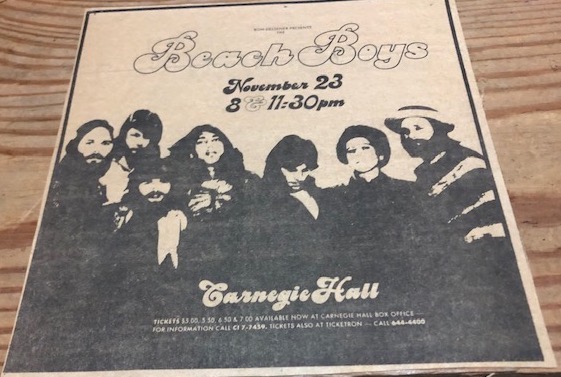
But for me, the center piece of this release is the Carnegie Hall concert from Thanksgiving night 1972. That evening, the band performed two back to back shows at 8:00 and 11:30. At this point, you should probably sit down. Tickets for that concert were $5.00, $5.50, $6.50, and $7.00.
Advertisement for the concert, from my attic archives (Photo by Bill Pike)
For fifty years, the Carnegie Hall tapes sat silently in climate controlled vaults. I sense those tapes were quietly hoping that someday they would be released. As a long time follower of the Beach Boys, I was rooting for the tapes to be converted into an album for release too.
Long after I’m gone, future music historians will revisit the legacy of the Beach Boys. No one will deny the blitz of hot hits from 1961-1966. They will discover the doldrums from 1967-1969, and when these musical sleuths uncover the recordings from 1970-1973, I think they will be stunned.
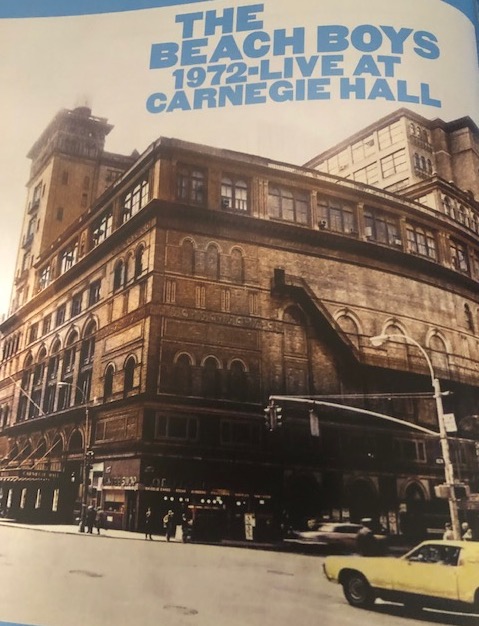
For me, that is my favorite era of the Beach Boys. I love their energy. Every band member contributes to the songwriting. The production values are high, and the recordings are deftly captured by recording engineer, Stephen Desper. Their still vibrant harmonies are beautifully present. And when the group performs live, there is an undeniable boldness in these concerts. The Beach Boys 1972-Live At Carnegie Hall captures the boldness of the songs selected to be performed that night.
Album cover
In 1972, the Beach Boys performed 101 concerts. Seventy-one of those were in America and thirty overseas.(setlist.fm) I sense when this fall tour started, the group knew, and must have been thinking internally— ok, we’ve got to use these shows prior to Carnegie Hall to make sure we are rehearsed and ready.
They arrived at Carnegie Hall ready to play and sing their hearts out. Of course, I’m biased, but my old ears believe they did play and sing their hearts out.
However, there is also a collision coming, a collision that served to foreshadow how the boldness of their concerts in the early 70s would gradually erode the Beach Boys into into an oldies band in the latter stages of their legacy. That collision is noted in the Carnegie Hall concert.
When manager Jack Rieley introduces the band, he respectfully asks the audience to hold their song requests until the end of the second set.
At some point, in the concert, singer, Mike Love, becomes annoyed with an impatient fan. Mr. Love almost uses the “f-word” in trying to keep this fan quiet. The great irony here is that Mr. Love is an ardent practitioner of Transcendental Meditation.
To confirm his convictions, during a pause between songs, Mr. Love quickly gives a personal endorsement for Transcendental Meditation encouraging the audience to check out classes in New York City.
Clearly in Mr. Love’s meltdown moment, any calmness or composure from his meditative spiritualness was tossed overboard.
For this concert, 24 songs are performed. From that 24, four songs were from the Surf’s Up and So Tough albums, and three were new songs from the Holland album that was released in January 1973. With the remaining 17 songs, 13 were hit records. Chances are the restless fan probably heard a song that he wanted to hear.
Thankfully that disruptive tension was short-lived as the beauty and power of the music seems to subdue the agitation for the remainder of the show.
Darryl Dragon, who the Beach Boys nicknamed Captain Keyboards, is on the piano, organ, and Moog synthesizer. Also, his future wife, Toni Tennille, is contributing background vocals. Mr. Dragon’s keyboard playing sparkles through the recording, but especially on “Help Me Rhonda.”
I’m not sure there is a prettier Beach Boys love song than “Only With You.” Fresh from the Holland recording sessions, here, the song is performed to heartfelt perfection.
I love the concussion of the percussion that is pounded out after the a cappella section on “Heroes and Villains.” I had never forgotten that thunder from the ASU show.
Blondie Chaplain and Ricky Faatar sound like they have been in the band for a long time rather than a few months. Blondie’s soulful vocals and guitar work add to the energy, and Ricky’s drumming is quick, steady, and creative.
Unlike the Beatles, the Beach Boys never gave up touring, and as they pushed into the early 70s, that hard work on the road made them a tight performing unit.
Even the most difficult of their songs performed live reveal their musicianship and tender care for their trademark harmonies. Lots of that concert success can be attributed to the youngest of the Wilson brothers, Carl.
During the encore with spunky confidence, Carl leads the band through “California Girls,” “Surfin’USA,” and “Fun, Fun, Fun.” Then he turns the Carnegie Hall audience on its collective ears as the Beach Boys blister through “Jumpin’ Jack Flash.” Yes, the Rolling Stones’ “Jumpin’ Jack Flash.”
I’ve never forgotten the concert at Appalachian State University. Too bad that the Carnegie Hall tapes had to wait 50 years for release.
Was the wait worth it?
Speaking solely for myself, my answer is yes.
During the listening, a handful of times, my old eyes have moistened when the timeless blending of the voices and instruments strummed my soul.
In 1972 Mike Love was 31, Al Jardine 30, Dennis Wilson 27, and Carl Wilson 26. My goodness, they were young. Yet, even in 1972, it felt like they had been around forever. Sadly, Dennis drowned in 1983, and Carl lost his battle with cancer in 1998.
Personally, I hope Capitol Records doesn’t plan anymore box set releases for the Beach Boys.
After 1975, I feel the Beach Boys suffered a “reverse storm surge.” It seemed as though all of their creative energy had been drained from the group. Never did they recapture, the beauty and brilliance of the music they created from 1970-1973. I wonder if the living members of the Beach Boys feel the same as I do about those remarkable years?
Back on November 2, 1972, I wish we could have driven that Petty Blue 1966 Chevrolet Chevelle to the back of Varsity Gym where all of the band’s equipment had been loaded in for the show.
I imagine if the car loving Dennis Wilson had been out on that loading dock and seen that beauty, he would have flagged Butch down for a ride or a drive.
I’m certain Butch would have obliged Dennis’ request. If that storybook drive had taken place, then Butch had a memory of a lifetime to share with his brother, Robert.
Perhaps, that is the beauty of a wishful daydream.
Then again, a daydream can also be a chance to recall a priceless memory, a concert that has never left me, shared with good friends, and our pals, the Beach Boys when their voices were still young, and we were too.
From my attic archives, black and white photo by John Craft, concert review by Dave Wright. (Photo by Bill Pike)
Author’s note: A belated thanks to Robert Sherrill for loaning Butch the car. Thanks to my attic archives, and a heartfelt thanks to our three children Lauren, Andrew, and Elizabeth who surprised their ancient father with this boxed set gift at Christmas 2022.
It is a reasonable question— “How was your Christmas?”
In truth, we ask lots of “how was” questions.
How was your vacation?
How was your weekend?
How was your trip to the urologist?
How was your car buying experience?
When I’m asked the Christmas question, I am very tempted to say, “I’m thankful that Christmas is over.”
I wonder what poinsettias, door wreaths made from the limbs of evergreen trees, and wrapping paper would tell us about Christmas?
In their short life span, I wonder what these traditional items might say to us as they quietly observe our Christmas ways.
Might these non-human observers say to us: these nice folks need to slow down, the pace is too hectic, perfection— forget it, keep Christmas simple, don’t over extend, if Christmas is grounded in love, shouldn’t the followers of Christmas be able to share this love everyday of the coming new year?
Here’s what I remember about Christmas 2022.
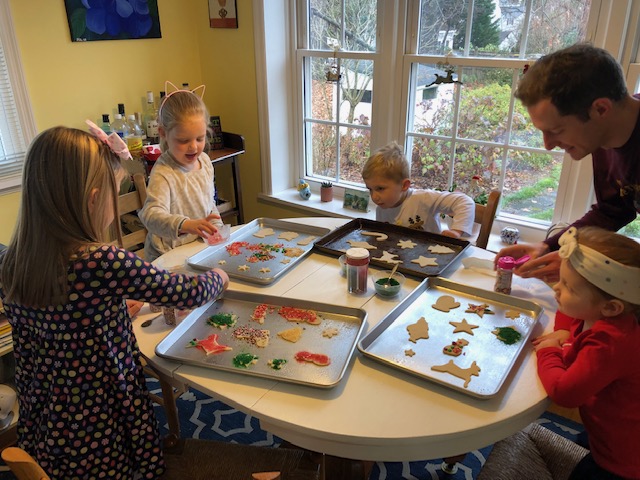
December 23, our four grandchildren gathered around the kitchen table decorating cookies.
The four grands and their cookies. Ably assisted by Uncle Andrew (Photo by Bill Pike)
Christmas Eve, the weather, the temperature was brutally and bitterly cold.
Next, I spent early Christmas morning trying to find a convenience store that sold Monterrey Jack cheese. That was the one cheese that had been forgotten in making Brad’s pasta dish. Brad is one of my wife’s nephews.
It has become a tradition in our family to feature Brad’s recipe for dinner, either on Christmas Eve or Christmas Day. I’m sure cardiologists see dollars signs with all of the rich artery clogging cheeses used to fix this dish.
At a Sheetz on West Broad Street, I found a reasonable substitute, Colby Jack.
Late on Christmas afternoon, an unwanted and unwelcome intruder arrived at our home. A stomach virus hit my 94 year old mother-in-law.
A few hours later, that trifling germ consumed our youngest daughter.
With this invasion, a tension filled our house. We all wondered who would be next? Hand scrubbing and Lysol spray became our new friends.
Our son-in-law headed back to North Carolina on Monday. That night the stomach bug welcomed Doug to the club.
That bad bug briefly messed with our son and his two daughters.
For whatever reason, this naughty nuisance really whacked my mother-in-law. Dehydration and weakness caused her to pass out and fall. Luckily, Betsy and I were there to catch her, and that prompted a 911 call.
My wife’s sister-in-law is a doctor, obgyn, she arrived before the paramedics, and found my mother-in-law’s vitals to be stable.
The paramedics with all of the latest equipment confirmed that original assessment. As I watched this team work, I thought to myself, we are lucky to live in a community with compassionate and well-trained rescue personnel.
But, we were also lucky that Betsy and I were with my mother-in-law when this collapse occurred. Her passing out could have been much worse.
Gradually, our house guests recovered and departed.
At some point, I worked my way back to Trinity. We have a 10 a.m. worship service on New Year’s Day. I needed to check on our volunteers who had been removing the seasonal Advent decorations.
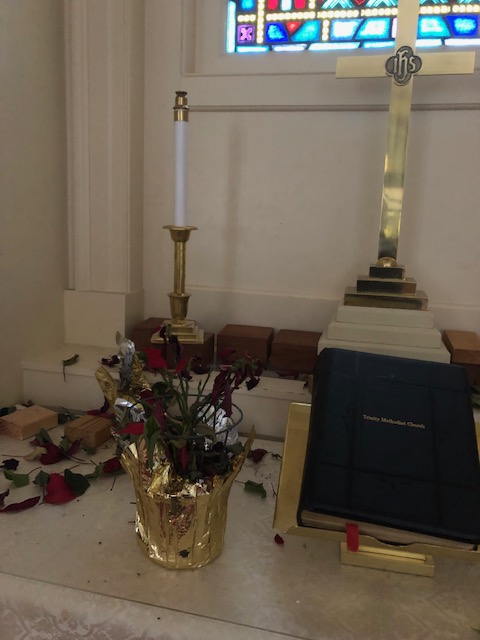
During the weeks of Advent, volunteers work to keep the poinsettias looking fresh. They water and rearrange the deep red flowers, especially, if one is looking weary.
A weary poinsettia post Christmas (Photo by Bill Pike)
The wreaths are subject to the whims of Mother Nature—sun, rain, wind, and cold can quickly fade a healthy green wreath to a brittle khaki color.
It’s tough being a real live Christmas decoration.
But, I think it is tougher being a real live human being at Christmas.
Truthfully, I have no right to whine about Christmas.
At Christmas, I’m always around family, and I’ve never missed a Christmas.
Yet, I know Christmas can be as miserable as a stomach virus for someone who is alone with no family. That lonely person might feel just as worn as a frail poinsettia or a now drab door wreath.
On Tuesday, January 3, my wife and I made one last trip to see the Christmas lights at Lewis Ginter Botanical Gardens.
I continue to be amazed at how strands of colorful lights transform this winter landscape. Others must feel the same way too. The garden’s paths begin to fill as the fading twilight gently shifts into darkness.
Colorful Christmas lights at Lewis Ginter (Photo by Bill Pike)
As we finish up our self-guided tour, we stop in the garden’s library and a meeting room.
In the meeting room, a local group of model train hobbyists have an amazing display set up featuring circus trains— including all of the matching props to fill in the landscape. This impressive exhibition makes adults and children stop in their footsteps. They stare intently at the moving trains as they weave through the countryside.
I’ve always appreciated artwork created by elementary school students. That admiration is extended to the art teachers who guide and support their students in this creative process. In the library, we were treated to a display of Christmas trees decorated by students at local elementary schools.
Instantly, I was impressed by these creations. To me the student art work reveals the pure innocence of their hearts.
One tree from Holladay Elementary School really tugged at my old heart. These fifth grade students had created “The Hope Tree.”
The Hope tree (Photo by Bill Pike)
Along with the decorations they created, each student had written his/her hope for the visitors observing this display.
For many years, my brother-in-law, Eric Henry, in Burlington, North Carolina has been a part of the team and ownership of TS Designs. Sure, I’m biased, but TS Designs makes the best t-shirts in the world. Yes, I said best in the world.
Maybe next Christmas, TS Designs can offer this long sleeved t-shirt.
On the front will be this question: How do grumpy old geezers survive Christmas?
Under the question will be the sad faces of many grumpy geezers.
But on the back of the t-shirt will be these words—They have hope.
Under “they have hope” will be quotes about hope like the following:
“Hope fills the holes of my frustration in my heart.” – Emanuel Cleaver
“To live without hope is to cease to live.” – Fyodor Dostoyevsky
“Optimism is the faith that leads to achievement. Nothing can be done without hope and confidence.” – Helen Keller
“Love recognizes no barriers. It jumps hurdles, leaps fences, penetrates walls to arrive at its destination full of hope.” – Maya Angelou
”In fact, hope is best gained after defeat and failure, because then inner strength and toughness is produced.” – Fritz Knapp
I hope that you and your families survived Christmas.
And despite my contrariness with Christmas, I hope that we all make it to the next one.
On November 20, 2022, the church I grew up in held its last worship service in the Burlington, N C building where it operated for generations.
After careful deliberations and following the protocols established in the discipline of the Methodist church, the congregation at Davis Street Methodist Church voted to shut the church doors on Davis Street near downtown and move to a new location.
Sadly, Davis Street isn’t alone in their actions. Aging congregations, tired buildings, economic instability, and the inability to attract new members are among the challenges congregations face across America.
This downward spiral is in sharp contrast to the growth churches experienced post World War II. At that time, church planters had a “if you build it, they will come,” mentality. Churches were built and people came.
Clearly, the pandemic impacted church operations and attendance. But truthfully, churches were already experiencing difficulties prior to the pandemic. Lots of data is available regarding this significant decline.
The latest Pew Research Center report from September 2022 doesn’t hold much hope for a reversal of this spiral. Churches and their congregations aren’t immune from political division, challenges to their doctrines related to sexual orientation, and a longstanding stubborn resistance to change.
Growing up at Davis Street, I don’t recall political bickering, nor conversations about sexual orientation. However, the “turf and personalities” of a church could collide if an impactful change was proposed.
During my growing up years at Davis Street, the pace of the world was slower. Sundays were quiet. Only essential businesses were open. Unless there was sickness, our family was in church every Sunday.
Today, our pace is entirely different. With many retail businesses open, Sunday is a popular day for shopping.
But there is a busyness impacting families and the choices they make over the course of a weekend. In these over-extended families, church might not be on their top five list of planned activities.
In an article in the Spring 2022 edition of the William and Mary Alumni Magazine, Brian Shallcross, General Manager of the minor league baseball team, the Bowie Baysox, talks about how his organization works to bring people to a game.
When Shallcross started his career, the focus was on “discretionary income,” the extra income a family might have to spend.
Now, Shallcross states the focus is on “discretionary time.” Marketers attempt to figure out how to persuade a family that a baseball game is the best option from the multiple options they consider during a weekend.
For churches attempting to rebuild by focusing on young families, it is critical for pastors, staffs, and congregational leaders to understand “discretionary time.” Churches who acknowledge the impact of “discretionary time” might rethink worship schedules that could be more appealing for young families.
But, I also wonder if congregations become too mired in their own church busyness? Does this church busyness and reliance upon worn practices impair congregational vision? Unfortunately, I believe the answer is yes.
If churches expect to survive this decline, their pastors, staff, and laity must be willing to take risks. Fear of taking risks, failure to implement overdue changes will only ensure more church doors closing.
With this closing of Davis Street, I imagine some significant seismic shifting came from the graves of its founders. Honestly, I admire the congregation for making this difficult decision.
If churches expect to exist beyond the dismal predictions, their leaders and congregations must make some tough decisions.
I believe churches still have a place in our communities.
But their future depends upon their ability to confront the fear of change.
Note from the author: I was honored to have this op-ed piece published in three North Carolina newspapers on Monday, January 23, 2023. The piece appeared in: The Charlotte Observer, Raleigh News & Observer, and the Durham Herald-Sun.
Late in the spring of 2022, I thought my sister-in-law, Abby, who I consider to be a brilliant woman had lost her mind.
Abby was proposing that our families take my 94 year old mother-in-law on a European river cruise. This trip would be a celebration of my mother-in-law’s upcoming birthday in February 2023, number 95.
All I could imagine was a disaster for my mother-in-law—a devastating fall, an unexpected medical emergency. Luckily, by the grace of God, none of my fears became reality.
Perhaps what is even a greater miracle is that I secured a passport in time for the trip. That’s right, my first passport.
My wife, the Commander Supreme, and our youngest daughter, Elizabeth, coached me on the nuances of saying the right words when I had my passport application interview. They were concerned that I might say something foolish, and I would be red-flagged to a no travel list.
I will be forever grateful to Abby for organizing the trip. In that gratefulness is my Commander Supreme too. I know at times during the trip she felt like she was marshaling two children, her mother and me. Yes, we had some moments of intense traveling impatience, but somehow we completed the trip intact.
Would I go again? Yes, but I need a couple of years to recover.
The flight back home was long, really, really long, and the darn flight tracker provided by the airline didn’t work. Boo technology failure.
Airplanes continue to fascinate me, but those long flights really wear on me. And it is clear as mud that airlines care more about pennies than they do about their passengers. Too bad Piedmont isn’t still in business.
Yet, I’m amazed at how many people are working behind the scenes to make all of this happen. Traveling with a 94 year old allowed us to see more of what takes place in the background.
Every place we visited was special. I can’t name a favorite, but I will give lots of credit to the weather. Aside from one rainy day, the weather was October perfect.
For sure, the cathedrals will stay with me. No matter the city, I’ve never seen anything like those cathedrals. The architecture, the art, the details, and the endurance to build them and to continue to maintain these structures is without question remarkable. But today, in their stunning opulence, I wonder how the needs of the people they serve are being met?
Another surprise for me was tobacco smoke. A lot of people in the places we visited are still smokers of cigarettes. It was so prevalent that I kept playing in my brain the Merle Travis and Tex Williams’ song—“Smoke! Smoke! Smoke!(That Cigarette).
I kept thinking about one line from the song: “Tell St. Peter at the Golden Gate, I hate to make him wait, but I just gotta have another cigarette.” I guess when their time comes to meet St. Peter, there will be lots of European smokers at the gates of those cathedrals smoking their last cigarette just before their funerals.
But adding to charm of the age of all the places our feet took us were the cobblestones.
I imagine the supplier of cobblestones from Budapest to Passau lives on a remote tropical island faraway from river cruise tourists, cathedrals, and cigarette smoke.
I loved the worn beauty of the cobblestones and their patterns in alleys and public squares. I suspect the cobblestones could tell us many stories about the ups and downs of life.
And, I would be amiss, if I didn’t compliment, Viking, the cruise line, who took care of us.
I’m sure Viking has some imperfect moments, but I can’t say enough about their personnel, the itinerary, the food, and the ship.
Let me put it this way. Viking does everything they can to spoil their guests so that the guests will want to return.
Yes, they did spoil me. And, at some point in this old life of mine, I hope the Commander Supreme and I can return.
Until that day, I will hold the Danube River cruise deep in my aging heart.
Cobblestones in Linz, Austria (Photo by Bill Pike)
Editor, Times-Dispatch: On Saturday, January 7, 2023, three front-page headlines in the Richmond Times-Dispatch were about public schools.
Sadly, six days into the new year, one of those headlines reported another school shooting.
This one did not fit what has become a predictable pattern of shooter intrusions. Unfortunately, a Newport News first-grader brought a gun to school and shot his classroom teacher.
Regrettably, I’m not surprised.
For too long in America, one of our essential assets—our families— have been quietly eroding.
In an August 2022 report issued by the Annie E. Casey Foundation, “nearly 24 million children live in a single parent family in the United States, or about “one in every three kids across America.”
That instability impacts our neighborhoods, schools, judicial systems, the human infrastructure systems created to assist families—and our future.
Continuing to neglect the erosion of our families will only ensure more tragic headlines.
We can’t legislate our way out of this mess. Nor can the Treasury print enough currency to fix it.
What can we do?
We must value time.
Valuing time means taking the time to listen and learn from our families who are in a battle everyday to survive.
Additionally, that listening must include the overloaded professionals who work in the trenches everyday to support these families.
From that listening and learning, we must commit to the challenging work of breaking the entrenchment of our ineffective systems.
Perhaps you have followed the remarkable recovery of Buffalo Bills’ defensive back Damar Hamlin. After being injured in a game with the Cincinnati Bengals, well-trained medical personnel with urgency and precision saved his life.
Our families in America are in need of the same urgent, resuscitating intervention.
With every second we lose, another heartbreaking headline is developing.
Bill Pike Henrico
Author’s note: This letter to the editor appeared in the Sunday, January 15, 2023 edition of the Richmond Times-Dispatch.
I knew Tuesday, October 18, 2022 had potential. As we gathered to start our morning tour of Passau, Germany, a beer truck was parked close by. And the person in charge of the truck had several crates of beer stacked up being prepped for delivery.
Beer truck Passau, Germany (Photo Bill Pike)
We enjoyed our tour of Passau, and that enjoyment wasn’t grounded in access to beer. Yes, beer is part of Passau’s community and culture, but the city offers much more.
Again, we had an exceptional tour guide. A young man who covered all the bases and more. He gave us tips about the twelve local breweries, shared insights about church politics, and made a perfect recommendation for the afternoon.
According to the Viking Daily, Passau is known as the “City of Three Rivers.” Swirling around Passau are the Inn, Danube, and Ilz Rivers.
Historically, salt “white gold” made Passau an important trade center. Additionally, local metal smiths gained recognition for high quality knife and sword blades that were stamped with the Passau wolf. Some warriors believed that the wolf stamped on the blade made them invulnerable.
As noted in other stops on this trip, fire had an impact. During the 17th century, the city was hit hard by destructive fires. Gradually, Passau’s Old Town was established with beautiful churches and homes. I had a tough time controlling my desire to constantly take pictures.
In Passau, the city is graced with the stunning St. Stephen’s Cathedral. This cathedral is home to the largest pipe organ outside of the United States.
But, I liked our guide’s honesty in talking a bit about the local churches.
First, like in America, church attendance is in decline. Our guide shared with us that there is a church tax in Germany, and I didn’t quite follow the purpose, but having worked in a church for twelve years I found that interesting.
Additionally, the guide indicated that not paying your church tax could impact your access to a church for a wedding, and possibly employment.
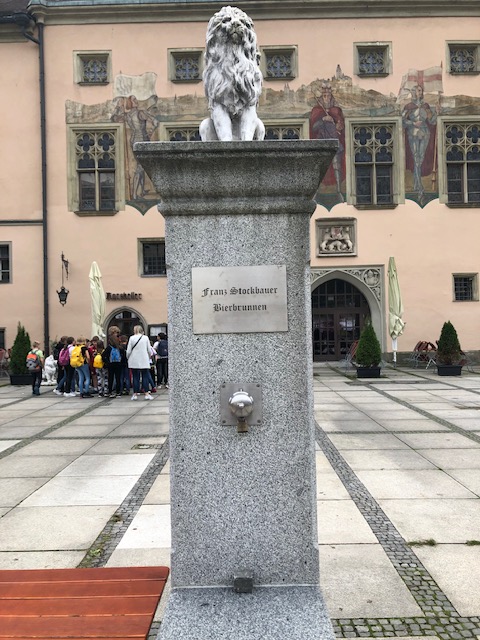
And speaking of weddings and celebrations, our guide made sure that we saw a public beer tap in the square just outside of the Old Town Hall. He told us families gather around the tap after a wedding.
Beer tap in public square Passau, Germany (Photo Bill Pike)
Also in the city is the University of Passau with about 12,000 students. Our guide conveyed that the students were quite helpful to city residents during a recent flooding of the rivers.
At some point, we said goodbye to our guide. We purchased tickets for a midday concert featuring the famous pipe organ, and prior to the performance, we simply wandered in and out of the shops in Old Town.
Some interior renovations are taking place in St. Stephen’s Cathedral, but that didn’t detract from its beauty or the magnificent performance by the organist and the 17,974 pipes, 233 stops, and four carillons.
Interior St. Stephen’s Cathedral (Photo Bill)
After the concert, we found our way back to the ship for lunch, and we made plans for the afternoon.
After lunch, more walking around Old Town took place, and we eventually made the walk across the river to begin the hike up to the Veste Oberhaus.
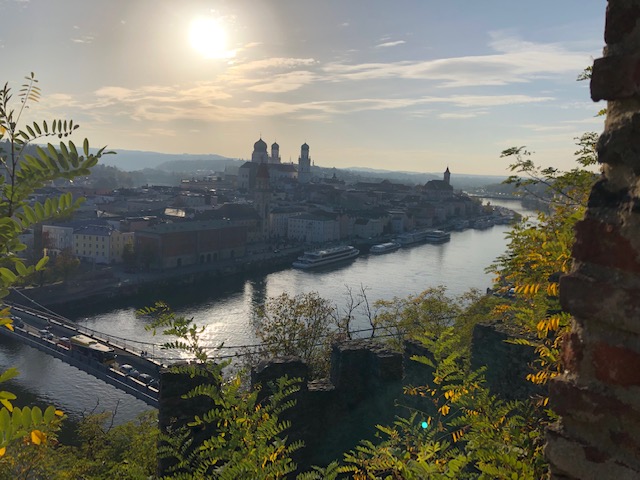
Dating back to 1219, this fortress sits on top of St. Georgsburg mountain which is only 344 feet above the valley floor. Today, the building and grounds are home to a museum, a youth hostel, and a restaurant. The views looking over the routes of the rivers and the city are spectacular. We explored a lot, and then we decided to stop in the restaurant, named the Das Oberhaus.
A view from Veste Oberhaus (Photo Bill Pike)
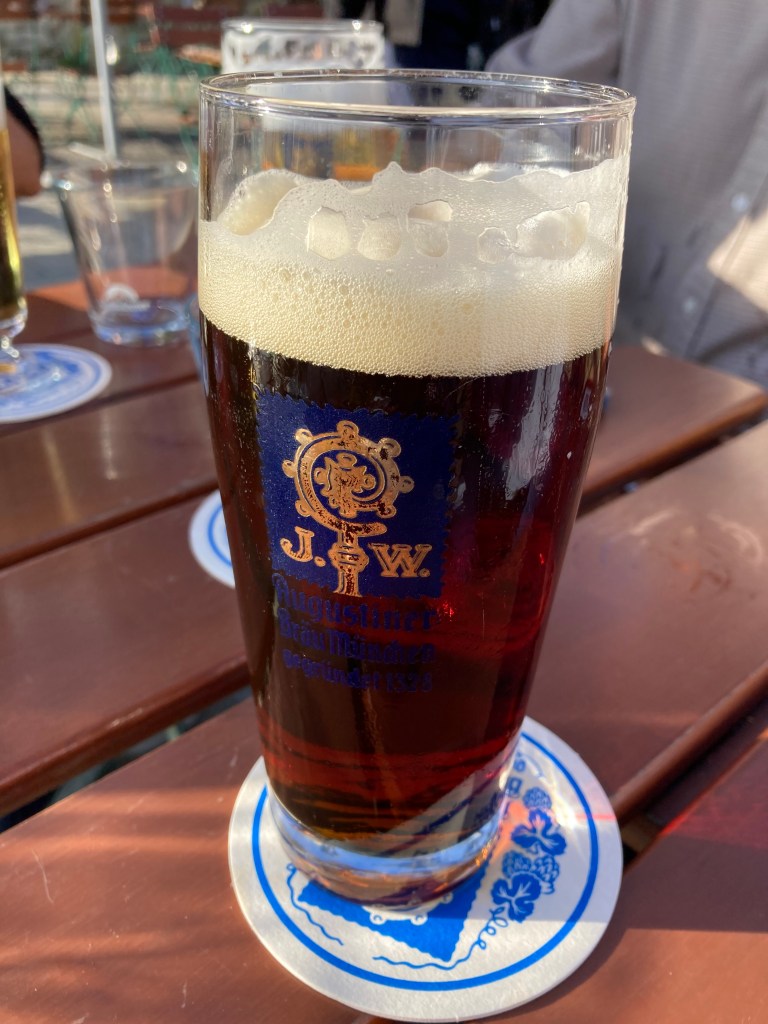
Das Oberhaus had numerous splendid views of the city from its outside seating platforms. The ladies ordered wine, and Art and I had draft beer from the famous Augustiner Brewery in Munich.
In Germany all brewers must abide by the Munich Purity Decree. The Purity Decree only allows water, hops, and malt in the brewing process. I ordered a dark lager, and it was superb.
Augustiner Beer (Photo Betsy Pike)
We made our way down from the top of St. Georgsburg, and walked back across the Luitpold Bridge.
Continuing to be charmed by the architecture and the cobblestone alley ways winding along shops and homes, we decided to make one more stop for beer. From the alley entrance we entered a restaurant that had an open air patio looking out on to the busy street and the graceful river as a backdrop.
A Passau alley (Photo Bill Pike)
The local brewery Lowenbrau was featured here.
Our server here could not have been more kind and graceful in taking our orders and answering a few questions.
From here, we made the short walk back to the ship.
We met at 6:45 in the dining room for the Captain’s farewell toast, and a final wrap up from our Program Director, Mario.
Dinner was another delicious treat, and I think we all knew we were going to be missing this elegance when we returned to the reality of our stateside homes.
Toward the end of dinner, there was a flurry of activity related to birthdays. Of course, the Viking staff knew this trip for us was in honor of Betsy’s mother and her upcoming February birthday, number 95.
Our favorite waiters with Betsy’s mom (Photo Elizabeth Pike)
It was tough to say goodbye to our favorite waiters, Mehi and Jazz. Their skills in serving us were impeccable, but speaking for myself, I loved their humor even more.
Earlier in the day, we had learned more about the system for leaving the ship in the morning. We attended to the final details of packing, and made sure our wake up times were all cued up.
Wednesday would be a long day of travel from Frankfurt, Germany back to Dulles in Northern Virginia.
On a recent Saturday morning run, I was just past the intersection of Westham Parkway and Beechwood Drive in my Richmond, Virginia neighborhood.
I noticed two potholes near the double yellow lines. Seemed unusual for potholes to be so close to the center of the road, but there they were.
I’m sure being a road surface is challenging. Vehicle weight, weather whims, and driving habits impact the asphalt.
All it takes is a tiny fissure on the blacktop, and we have the beginning of a pothole.
As I trudged along this familiar route, I thought more about those potholes. I reasoned that a tiny fissure in the life of a human being can quickly become a hollowed hole of never ending struggles.
In our communities, I sense that teachers, preachers, mental health providers, and families are in a struggle. Their morale is battered with a worn weariness that treads upon any chance of hope.
Without question, the pandemic had an impact on public schools, churches, mental health providers, and families.
Attempts to recover from the impact of COVID-19 will take a long time. That prolonged recovery is grounded in this reality: schools, churches, mental health providers, and families were already experiencing difficulties prior to the pandemic.
Personally, I’m not sure how teachers maintain their sanity. They are constantly in the sight lines of politicians who in many instances have no earthly idea of what it takes for a teacher to survive in a classroom. Yet, research bears out that the skills of the classroom teacher are often the pivot point in making a positive difference in the life of a student.
For many years, researchers have documented the decline in church attendance. The latest Pew Research Center report from September 2022 doesn’t hold much hope for a reversal of this spiral. Preachers and their congregations haven’t been immune from political division, challenges to their doctrines related to sexual orientation, and a longstanding stubborn resistance to change.
When it comes to mental health, America is in a crisis, a crisis that our country is reluctant to admit. Sadly, for many Americans, the most reliable means for solving a conflict is to pull out a gun and shoot. How many more lives are we willing to lose courtesy of this mentality? How many lives could have been saved if we were better equipped to provide mental health services to trigger pullers?
Clearly, I’m not an expert, but my career working in our public schools keeps bringing me back to a recurring concern—the erosion of our families.
In an August 2022 report issued by the Annie E. Casey Foundation, “nearly 24 million children live in a single parent family in the United States, or about one in every three kids across America.” During my career, I worked with many successful single parents, but that wasn’t always the norm.
I can only imagine the strain endured by a single parent— working multiple jobs, attempting to support children with food, clothing, health care, and education while housing the family in a rundown motel.
Repairing the two potholes on the road in my neighborhood is simple.
Repairing human potholes is complicated.
How might we start the repair process for our human potholes?
A good starting point is to understand how schools, churches, mental health providers, and nonprofits who work with families are already communicating and collaborating.
In those collaborations, it is important to identify what works, what doesn’t, including the courage to disassemble ineffective practices.
Additionally, the assessment must include a careful analysis of data and trends so that more effective templates of service can be implemented.
Assessing community real estate is essential to the process. How might blighted store fronts, empty school and church buildings be repurposed into housing and community service centers for families?
And there is another critical piece, assessing a community’s human resources. How do we utilize the skills and experiences of people who are active, but retired? How might we retool individuals who are looking for employment that will give back to families in a struggling neighborhood?
But the real question is this: do we understand that potholes are more than a seasonal challenge?
Teachers, preachers, mental health providers, and struggling families experience the reality of their pothole entrenchment everyday.
We are at a crisis point.
Continuing to ignore the needs of our human infrastructure is unacceptable.
On December 14, Virginia’s Governor announced plans for reforming mental health. This is a long overdue starting point.
Yet, I fear these proposals will fall victim to the very predictable potholes of political division on both sides of the aisle. Our political inability to play nice will only continue to hurt people. As the holiday season rushes by us, weary hearts of people in the battered potholes of life need hope.
Our politicians need to deliver.
Two potholes on Westham Parkway (Photo by Bill Pike)
What do the Romans, Mozart, and Hitler have in common? The answer, the pretty Austrian city, Linz.
Yes, a long, long time ago, the Romans started a settlement here.
Mozart wrote the “Linz” Symphony and “Linz” Sonata during a three day visit to the city. The house where he stayed and worked is still standing, but there is no tour of the home.
And quietly, our tour guide told us that Adolph Hitler’s family moved here shortly after his birth from an Austrian village near the German border. Hitler spent his childhood in the city, and he considered Linz his home.
Our tour started in Linz’s beautiful, Hauptplatz, the town square. According to the Viking Daily, the square is the largest in Austria. No matter where our tour guide directs our attention, we have lots to see and ponder.
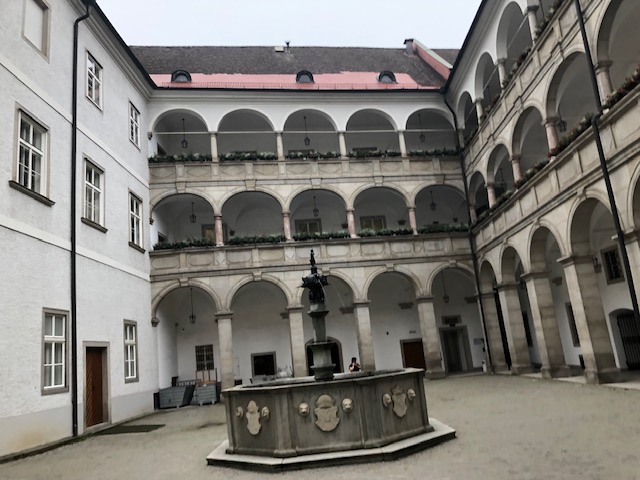
The Town Hall, stately homes, a railway line, the Trinity Column, courtyards, and the beginnings of Old Town capture my interest.
A courtyard in Old Town, Linz, Austria (Photo by Bill Pike)
The railway line is in constant use as it quietly arrives and departs in the heart of the square.
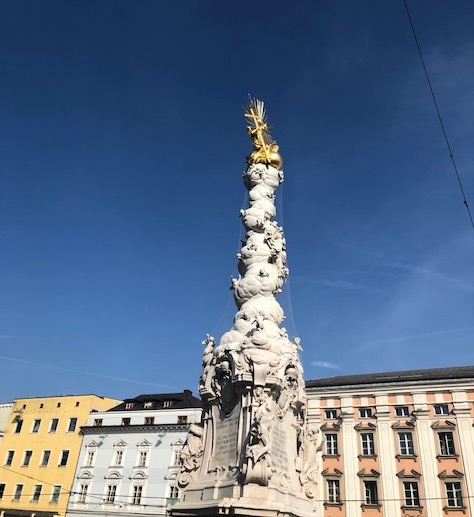
But, I’m drawn to the Trinity Column. The statue was designed and constructed to acknowledge a grateful thanks by the people of Linz for being a bit “lucky” with the challenges that surrounded them in their early history. The Column stands in at 66 feet in height, and stone masons worked with white Untersberg marble in its design.
The Trinity Column (Photo by Bill Pike)
Our tour guide kept us moving. We walked a lot, but thanks to her expertise, we took in this section of the city with great detail and a broad lens. She even took us back in time for a quick view of some Roman ruins. But more importantly, our guide, left us with a plan for the afternoon.
Roman ruins (Photo by Bill Pike)
After lunch on the ship, our plan was to revisit Old Town for more exploring, and to take the steepest mountain railway in Europe to Postlingberg hill and a pilgrimage church that dates back to the 18th century.
Railway cars in the Linz center (Photo by Betsy Pike)
Thanks to my tour guides, Betsy and Elizabeth, we figure out how to purchase tickets at the Town Hall for the railway ride. Our timing is good for catching a rail car that will take us up 1,768 feet to our destination. There is lots to see as we cross the Danube and work our way up the hill.
In 1898, someone figured out that a rail line up Postlingberg Hill to the Pilgrimage Church was a good idea. They weren’t wrong, the train ride was worth it.
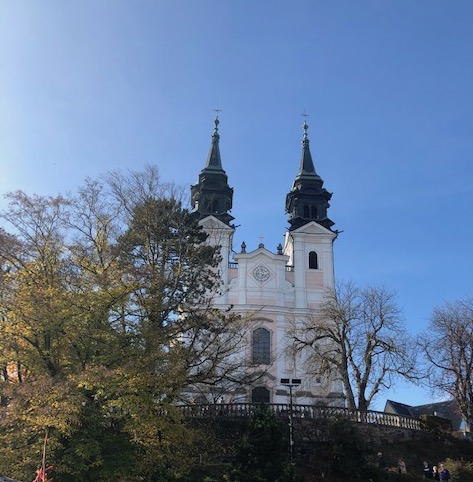
Pretty church on top of Postlingberg Hill (Photo by Bill Pike)
No question, the views looking down over Linz are as predicted— beautiful, and the church isn’t shabby either. We enjoyed our walk around the building and a quick self-guided tour inside. Locals also know the church as the Seven Sorrows of the Virgin Mary.
Gradually, we worked our way to the railway line to catch the train to take us back into Linz. Once across the Danube, we returned to the Old Town area for more exploring of the shops.
As I followed Betsy and Elizabeth around, I wondered if any of our footsteps today would have been paths that Hitler had taken during his childhood. And, I also wondered, how Hitler became such an evil monster.
Additionally, my mental meandering takes me back to World War II. My guess is we probably walked through sections of Linz today that had been heavily bombed. Linz was a constant target as the city was a major hub of activity for the Germans.
In Stephen Ambrose’s book, The Wild Blue, B-24 pilot George McGovern said this about flying over Linz: “It was terrible, hell can’t be any worse than that.”
Upon returning from one bombing mission over Linz in April of 1945, McGovern, in his plane, the Dakota Queen, counted 110 holes in plane’s fuselage and wings. He was amazed that the plane could stay in the air from being hit with all that flak.
Our day walking and exploring Linz had been tension and stress free. This was a significant contrast to what the citizens of Linz experienced during World War II.
Slowly, we made our way back to the ship. Before dinner, we had our first briefing about the upcoming disembarkation. Yes, we had one full day ahead of us before catching a plane back to America.
Dinner was delightful, and the chef and the servers continued to spoil us.
After dinner, we had an extra entertainment treat—the Salzburg Sound of Music Singers. Their performance affirmed why some acknowledge Linz as a leading cultural center in Upper Austria.