Disrupting Mothers and Fathers: 39,773


On the morning of Friday, May 10, I drove my wife to the Amtrak station on Staples Mill Road. She was taking the train to visit her 90 year old mother in Connecticut for Mother’s Day. Since the arrival of our first child in 1983, this is probably the only time when we haven’t been together for Mother’s Day, a slight disruption.

For some reason, on Sunday, May 12, I left my school board phone at home while I went through my usual assignments at Trinity United Methodist Church. When I returned home after the last service, I checked  that phone. It was full of e-mails related to Godwin High School. Overnight, the school had been significantly vandalized with hateful and threatening graffiti.

After taking care of a few things at home, I drove over to Godwin. When I arrived, I saw crews working with power washers, steel brushes, and solvents to remove those unacceptable words and symbols.

Inside the building, I was briefed by the school’s principal and assorted school board staff about what they knew at this time. Additionally, they were working on updating the Godwin community and planning for the opening of school on Monday.

Sadly, the individuals who were responsible for this mess did not think about the disruption they had created for all of the people at Godwin on a pretty afternoon Sunday afternoon. Nor had they considered the disruptions that would take place in their own lives when Henrico police would follow the evidence and tips that would lead to arrests.

Friday, May 24, my wife and I were attending a backyard celebration at a neighbor’s home for an east coast visit of one of their sons. This young man, a Navy Seal, was here with his wife and children for a few days to reunite with family and friends.

While we were enjoying this very happy occasion, unknown to my wife and I, a tragedy was taking place at a boat marina in Saguaro Lake, Arizona. The youngest son of dear college friends was shot to death. This 33 year old motivational speaker would leave behind a wife expecting their first child—more lives disrupted.

Two days later at a park in Richmond, a 9 year old girl and an 11 year old boy were shot at a community cookout and celebration. The girl died from her wounds. The young man was in serious condition—more lives disrupted.

On the afternoon of Friday, May 31, 12 people are shot and killed at a municipal building in Virginia Beach. The assailant was killed in  a shootout with the police—more lives disrupted.

Hey America, in case you haven’t noticed we are a mess. 

These senseless acts of violence bring a very predictable post incident response—media coverage for days, politicians commenting, vigils are held, the dead are honored and buried, and the indirectly unaffected go back to our normal routines.

 Those whose lives were disrupted by these events will never meet normal again. This disruption is permanent. It hangs around like a surreal, reoccuring bad dream. There is no closure, no light at the end of the tunnel. Normal is buried along with the loved one.

In 1968, the Centers for Disease Control and Prevention started recording deaths in America that were caused by people using  firearms. A December 18, 2018 article by Sarah Mervosh  in the New York Times reported that in 2017, 39,773 people died in our country from being shot with a gun. That was up a 1,000 from the previous year. Also in those numbers is another sad finding—almost two-thirds of those deaths were tied to suicides.

Think about this in regard to the 39,773. In our state, the city of Danville has a population of 41,130.

Clearly, much data exists related to gun violence in our country. But, my question is—does this data motivate us to address it? Do we want to wrestle with it, understand it, and correct it? Do we want to stop breaking hearts and disrupting lives?  Or, are we content to shrug these disturbing numbers off, and keep moving in the normal.

Each week at Trinity United Methodist Church, I have the responsibility for putting the staff meeting agenda together. Part of that agenda includes a scripture verse, a quote, and some humor. 

A few weeks ago, I came upon this quote from Clarissa Pinkola Estes:  Our own sorrows seem heavy enough, even when lifted by certain long-term joys. But watching others hurt is the breaker of most any heart.

America, we know, we have watched this breaking of hearts related to gun violence long enough.

So what is the solution?

I’m not sure we can legislate our way out of this mess. 

In the movie, The Shawshank Redemption, prisoner Ellis “Red” Redding appears  before the parole board. A member of the parole board asks Red—“Do you think you have been rehabilitated?” 

Director and screen play writer Frank Darabont, wrote these words as Red’s response:  “There’s not a day goes by I don’t feel regret. Not because I’m in here, or because you think I should. I look back on the way I was then: a young, stupid kid who committed that terrible crime. I want to talk to him. I want to try and talk some sense to him, tell him the way things are. But I can’t. That kid’s long gone and this old man is all that’s left. I got to live with that.”

Upon reflection and the disruption of their own lives, I wonder how many trigger pullers feel regret? I wonder if they wish they had chosen to respond differently? 

I’m no expert, but I sense that many factors contribute to pulling that trigger and permanently disrupting lives. Family erosion, economic instability, fear, peers, being overlooked, fragile mental health— are among pieces that come to mind.

And since, I work for a church, I wonder where is the church in working to solve this mess? After all, in Galatians 6:2, we are reminded to:  Bear one another’s burdens. 

Personally, I need to be asking myself some questions too. As an American what am I contributing in trying to solve gun violence? How am I doing in bearing the burdens of those who have lost a loved one to gun violence?

Our son sent me an article from Washington Post sports columnist Barry Svrluga. The article is about his grandfather’s D-Day journal. In one of the grandfather’s letters, he writes the following after learning that his wife had given birth to their son:

Yes, I have a great deal to live for and somehow I have a feeling that I shall come back to the both of them, but if it is God’s wish that I do not, I shall leave with a prayer, that my son shall live a better life and a safer life in his world than the life lived in the world of his father.

“That my son shall live a better life and a safer life in his world than the life lived in the world of his father,” is embedded deep in the hearts of every mother and father. Losing a daughter or a son to gun violence isn’t the type of disruption a parent expects.

Our response to these disruptive, senseless cycles of gun violence is in our hearts.

The real question is— will I use my heart to disrupt this cycle?

cemetery-51550_960_720

Tears In The Classroom

classroom-377668__340

I am sure there were multiple days during the 2018-2019 school year, when elementary school teacher, Mrs. Bridgeman, did not want to go to work. As a retired educator, there were many days in my career when I did not want to go to work too.

But for Mrs. Bridgeman, the challenge was one student. A student whose reputation preceded him. His track record as a disruptor was well known. No one was immune from the student’s ability to wreak havoc. 

His classmates, bus drivers, cafeteria personnel, librarian, art, music, physical education teachers, substitute teachers, school counselor, and principal were impacted. As a young veteran teacher, nothing in Mrs. Bridgeman’s student teaching experience prepared her for this student.

In a struggle like this, the right to learn for the student and his classmates is disrupted. Very little learning is taking place. Eventually, the parent’s life is  disrupted too. 

Mrs. Bridgeman’s repertoire of classroom management techniques was quickly emptied. She sought assistance through assorted school system supports. Again, suggestions attempted were short lived or had no influence.

There were plenty of days, when Mrs. Bridgeman went home defeated, disheartened, miserable, mentally, emotionally, and physically exhausted. On many occasions, in her mind, she wrote a carefully constructed resignation letter. Sleep was restless—like trying to nap on an airline flight tossed with turbulence.

Yet, somehow each day Mrs. Bridgeman returned to her classroom. Battle weary, she battled another day. 

Mrs. Bridgeman knew this student needed help beyond her interventions and beyond any suggestions that had been offered so far. She dug deep into her fortitude. She was not going to let this student continue to impale himself, his peers, his school, and his family.

Mrs. Bridgeman shifted tactics. Her focus became the student’s parent. In meetings, phone calls, e-mails, Mrs. Bridgeman began to build a relationship with the parent. 

As his teacher, she painted a portrait for the student’s parent. She was honest and realistic. Somehow, Mrs. Bridgeman conveyed—the potential in your son will never be uncovered unless we unravel his need to be a disruptor. 

It took time, but Mrs. Bridgeman built a trust with the parent. A relationship was being constructed. That trust evolved into the parent consenting for additional potential supports from the school system to be explored.

As these protocols were being examined, Mrs. Bridgeman continued to work with the student. Steps forward often were countered with multiple backward steps. Quite often, she was infuriated with herself—“Why do I keep trying? Why am I putting myself through this? Why do I care what happens to this student?”

Deep into the second semester of the school year, the team of professionals who had worked to assess the student was ready to report their findings. Those meetings when findings and recommendations are reported to a parent are often conducted in fragile environments.

Mrs. Bridgeman knew there were no guarantees that the parent would agree to the recommendations. But, Mrs. Bridgeman was hoping the trust she had established might be the pivot point.

Turns out that trust meant something to the parent. Loaded with lots of questions for the team that were answered, the parent agreed with the findings. 

This endorsement allowed for some critical implementations to be put in place before the end of the school year for the student.

While it took some more time for these supports to come together, they did. Though not perfect, the adjustments made on behalf of the student started to have an impact.  

In May, students across the Commonwealth of Virginia take the annual Standards of Learning (SOL) tests. These state implemented test have become an integral part of assessing student academic growth. 

Additionally, the tests are an added level of stress and pressure for principals and their faculties.  A school’s accreditation is tied to the performance of students on these tests.

On a Friday afternoon with a week of testing completed, Mrs. Bridgeman received some news. Her disruptive student who on countless occasions had put her on the brink of resigning had passed his math SOL test.

Immediately, Mrs. Bridgeman burst into tears.

As May was coming to an end and testing completed for another year, Mrs. Bridgeman was interacting with her students one afternoon. She explained to her class that she would not be returning next year. Her husband was going to pursue job opportunities in California.

Immediately, the student who had plucked every nerve in Mrs. Bridgeman’s body for an entire school year burst into tears. 

He cried the rest of the afternoon. He was like putty. He could not be consoled.

Now, here is the scary part. I have no data. But, I would wager every elementary school in America has a disruptor. Some probably have more than one.

But the real question to be asked is how are we going to respond?

And let me assure you, we can’t afford not to respond.

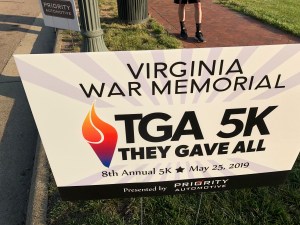
The Virginia War Memorial’s They Gave All 5K

IMG_0451

I signed up to run in the Virginia War Memorial’s They Gave All 5K on Saturday morning, May 25, 2019.

A clear blue sky and a comfortable temperature were awaiting runners and walkers at the start line. There was even a bit of a breeze at times as I waited for 8 a.m. to arrive.

The race begins in the backyard of the Virginia War Memorial. It is a well maintained piece of property. The course loops out on to Belvidere Street crosses the majestic James River, works into a slice of the Oregon Hill neighborhood, and meanders through Hollywood Cemetery before  looping back toward the War Memorial.

My goal is very simple—finish the race. I’m older and slower. Finishing the race is a reasonable goal.

The Kids Fun Run begins at 7:45. Before this race, the national anthem is sung by a young lady who works for one of the corporate sponsors. This is followed by the Pledge of Allegiance, and some reminders regarding safety while out on the course.

With the Kids Fun Run completed, participants were directed to follow the signage to three holding areas for runners, walkers, and parents who were pushing baby strollers during the race.

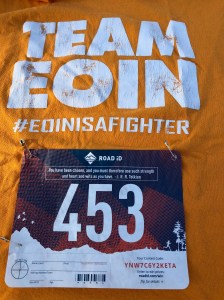
I’m ready to push the timing button on my watch. Not sure why I still do this. My bib number 453 has a timing tag on the back of it. This chip knows when I start the race and when if lucky, I finish the race.IMG_0452

Soon, we’re moving. Very slow at first, as runners scramble for foot space hoping not to trip up a fellow runner. Doesn’t take long, and I have room to maneuver. I’m stiff, but with every step, my old body limbers up a bit.

While waiting for the race to start, we were told we would run about 6,000 steps from beginning to end. And an equation had been computed linking those steps to soldiers from Virginia who had been killed serving their country.

I’m not counting my steps as we come upon the James River basking in sunlight.The bridge is named after the Civil War general, Robert E. Lee. As we run across the bridge, I wonder if the name of this bridge might be changed someday. I wonder if the James River has an opinion about that? 

I’m sure the river has endless stories in its memory.  The present, past, and future lie between the banks of the river. Like all of us, the James has good days, and not so good days. Days when it is smiling and days when tear drops fall into its churning rapids.  

Runners are quick to offer opinions about the layout of a course. Hills are quite often a concern. This course has its share of challenging hills. Overcoming a hill is mental. To conquer a hill, a runner must keep moving. The hill isn’t going to surrender.

I make a note to myself—hills in a foot race are nothing compared to military battles fought on hills and mountains. Penned down by enemy fire, explosions all around, friends dying, ammunition running low—I have no right to whine about hills on a race course.

Course marshals along the way offer encouragement and insure that we don’t make a wrong turn. 

Up ahead of me in Hollywood Cemetery, I saw one father put his elementary school age daughter on his back. She had been running pretty well. I guess she needed a break, but her free ride didn’t last too long.

Some runners where wearing a sharp looking purple t-shirt with the words In Memory printed on the back. Under that heading appeared to be a listing of names. 

Shady spots were welcomed as the sections of the course in full sun were starting to warm up. Nothing like a good sweat to get the meanness out of my rapidly aging body.

The three mile marker was good to see. I’m almost there.  Keep moving forward. A few younger runners kicked on their after burners and sprinted past me. I crossed the finish line at 29:19. Goal met—I finished.

I grabbed a bottle of water and found a bit of shade. As I was heading toward the parking lot, I saw one of those purple shirts. 

I noted from the front of the shirt it represented the Virginia National Guard. I was able to get a better look at the back of the shirt that stated In Memory. Under those words were the names of ten individuals who had lost their lives serving their country from the Virginia National Guard.

When I was a youngster, I had no real understanding of Memorial Day. As I became older, the significance of this holiday has more meaning. My father’s oldest brother, Boyd, lost his life in World War II on the destroyer the USS Simms way out in the Coral Sea.

Perhaps like me, you have read the news coverage of Ronnie Sanchez, Jr.  Sadly, Mr. Sanchez died from stab wounds he received while hiking on the Appalachian Trail in Virginia. When I learned that Mr. Sanchez was an Army veteran who had served three tours of duty in Iraq, the pain of his death touched me even more. 

Serving in Iraq had an impact on Mr. Sanchez. After he left the Army, Mr. Sanchez battled depression. He basically stayed in his house, and only went out at night when less people were around. This depression broke up his marriage. (Hernandez, Jackman, Washington Post)

An opportunity from the Department of Veterans Affairs gave Mr. Sanchez the chance to try some special programs in Oklahoma City.  An assortment of recreational programs for Veterans is available there. (Hernandez, Jackman, Washington Post)

For Sanchez, these programs were instrumental in reconnecting him with the outdoors. These recreational programs were well suited for him. He made progress against the depression. This healing was to continue on hiking the Appalachian Trail. (Hernandez, Jackman, Washington Post)

It makes no sense at all to serve three challenging tours of duty in Iraq for your country, only to lose your life while pursuing a worthy goal designed to help your recovery.

Recently, I completed reading Hampton Sides’ book Hellhound On His Trail. This book is an account of the manhunt for the killer of Dr. Martin Luther King, Jr. 

In a closing chapter, Sides makes the following observation:  “What a sordid tradition of violence we have in our country—and what an alarming record of assassinations and assassination attempts. Perhaps it’s the dark flip side of our extraordinary freedoms.”

Memorial Day is grounded in our “extraordinary freedoms”.

At times, I wonder if I truly understand those freedoms and respect them?

I need not look too far for my understanding.

Three words sum it up:  They Gave All.

On this Memorial Day, as we freely go about our normal routines, hit that pause button. 

Take several quiet minutes to think about those who gave all. 

Their lives were permanently disrupted. 

Our lives in our “extraordinary freedoms” were not.

IMG_0457

magister cor

In Robert Rodat’s screenplay for the movie Saving Private Ryan, there is a chaotic scene when Captain John Miller, portrayed by Tom Hanks, appears to be losing control of his troops. 

Captain Miller has been given the assignment to find and remove from harms way Private James Ryan. Ryan’s three brothers have been killed in the war. Military leaders do not want the Ryan family to lose their last son.

This undertaking to find Private Ryan will be a dangerous challenge. Just as soon as they start the search, one of Miller’s soldiers is killed by a German sniper. They keep moving, and the next task is a machine gun outpost. In this attack, Miller loses another soldier.

Those two losses, plus misgivings about the mission to save Ryan create a tension charged environment. One private disobeys a Miller order and threatens to desert. The private is confronted by a pistol yielding sergeant who threatens to shoot the potential deserter. Arguments are breaking out, emotions are high.

And then Captain Miller blurts out— “What’s the pool up to on me?” A pool of money has been wagered by his troops as they try to guess Captain Miller’s profession before the war. The pool is up to $300.00, and then he tells his men—“I’m a school teacher.” 

That question and the revealing of his profession, quell the emotional chaos. All ears and eyes are now trained on Captain Miller as his quiet, non-threatening voice, and rational diplomacy bring the men back into reality. Things settle down. Even with some reluctance, his men begin to understand the orders that Captain Miller has been given.

This is Teacher Appreciation week. 

Somewhere in America today, a teacher, like Captain Miller,  used his/her skills to settle down high strung emotions in a school. Somehow, in that unsettled environment, the teacher kept focused and composed. Slowly, the wisdom of the teacher reeled the students back in, order was restored.

Teaching is tough work. Yes, it can be rewarding work, but it is one of the toughest jobs on earth.

One of my favorite verses from the Bible can be found in the book of James Chapter 3 verse 1:  “Not many of you should become teachers, my brothers and sisters, for you know that we who teach will be judged with greater strictness.”

Many years ago, I shared that verse with the Lakeside Elementary School faculty. It was a beautiful spring afternoon, and I called an impromptu faculty meeting out on the playground. The pressures of SOL testing were wearing us down.  That verse has never left me.

Seems the world is even more strict today in how it judges our teachers—it is tough work.

On Tuesday afternoon, May 7, I was at Glen Allen High School for an awards program. The program was staged by our school system to recognize outstanding teachers.  Three categories focused on first year teachers, exceptional education teachers, and our teacher of the year. 

This was a humbling experience  as we learned about the finalists in each category. Students, peers, administrators, and parents painted quite a picture of the outstanding instructional and interpersonal skills each teacher possessed.

In today’s world, teachers must have quite a tool box to meet the needs of students. One size does not fit all when it comes to students. So many factors impact the shaping of a student’s life. 

Often, those factors are well beyond the control of a classroom teacher. And, yet somehow, a teacher searches for an opening in the student’s armor. Finding that opening can be the key pivot for building a relationship with the student, and in case anyone is listening—successful teachers build relationships.

I think I was probably an enigma to my teachers. I had potential, but I never ever truly applied myself. I made honor roll once in the sixth grade. I often wonder how my parents put up with my pitiful academics.

Despite my shortcomings, I am thankful for my first grade teacher, Mrs. Hughes, who taught me how to read at Elon Elementary School. At Turrentine Junior High School, Mrs. Wall taught me how to type. And at Walter Williams High School, my senior English teacher, Mrs. Barnwell, connected me to Catcher In The Rye and Black Like Me. To all of those other teachers who I let down, I apologize.

Sadly, I don’t think teaching will become any easier. In fact, finding competent teachers in the future will continue to be a challenge. 

This world we live in has lost its mind. Every year, we lose many good teachers for a variety of reasons, but our mindless world impacts those decisions to bail on a noble calling. 

When we live in a society where a college football coach can sign a contract that is worth 9 millions dollars a year for a ten year period, something is wrong.

Contrast that to the fact that for some students, their six hours at school each day are the best six hours of their 24 hour day, something is wrong.

I will stop the whining.

At some point today, I encourage you to check your memory banks for a teacher in your life. Find that moment, and ask yourself what made that teacher unique in your mind?

My hunch is your answer will be connected to that teacher’s heart. The heart of a teacher isn’t made like other hearts. 

 No, a teacher’s heart is always open, it never closes, it never stops learning, and even when defeated that heart never gives up.

Even though he was a character in a screenplay, Captain John Miller had “magister cor”—a teacher’s heart.


Your Turf Was Already In Trouble

Whether known or unknown to me, the phrase “turf and personalities” has been present in every setting where I have worked. Sometimes, success in the work place is measured by how a leader handles managing “turf and personalities.”

In my career working in schools, one of the most interesting battles was over floor space in an auxiliary gym. 

It was early spring, the weather was lousy outside. After school, the baseball coach intended to the use auxiliary gym for an instructional practice. The vocational school that was a part of our building needed the space for an early evening obedience class for dogs. 

Strong personalities clashed. Compromise and reason were missing in action.

During the last eight years, I’ve had the privilege of working in my church. Just so you know, churches are not immune from skirmishes related to “turf and personalities.” 

Even if in passing, a comment is made about repurposing a room or changing a location for a worship service—people get riled up. When church people get riled up, look out. 

Bill, you must be kidding church people get riled up?

 Yes, I’ve observed it —from the most meek, the most boisterous, and all points in between. Pluck the wrong nerve, and you have never seen such a storm.

Bill, in a church? 

Yes, I know you find that hard to believe, but church people can get riled up.

As a matter of fact, the United Methodist Church is riled up at this very moment.

For years, the church has been avoiding a collision. This collision is grounded in policies related to LGBT. Same-sex marriages and ordination of pastors who are LGBT are at the heart of this conflict. 

Some experts predict this dispute will lead to the breakup of the United Methodist Church, a breakup that could be as complicated as disassembling a Boeing 747.

I’m a lifelong Methodist. This predicted split is distressing to me. But, in truth, Methodist church turf was already in trouble. 

Other pressing challenges are on the immediate horizon too. 

These issues are just as formidable.

Like LGBT policies, Methodist congregations can’t opt to ignore— declining attendance, the “death tsunami,” financial shortfalls, tired facilities, attracting the “unchurched” and the overlooked, and what appears to be a diminishing voice for speaking out related to society’s needs.

Let me stop here, and say without any hesitation that I am not a church expert, nor am I a perfect Christian, and even though I love it, I have my moments of struggle with the Bible.

Any number of studies during the last several years have documented the decline in church attendance. Showing up on Sunday morning isn’t a priority anymore. Many factors impact those numbers. 

Some point to the dropping of blue laws. Church used to be the only game in town on Sunday mornings.  That isn’t the case anymore.

I also think people have become busier. Calendars, particularly for young families are packed. Carving out an hour or two for church isn’t a high priority. Church might not make the top five list for the weekend with a family.

When attendance drops so too can financial support. Churches have or are experiencing the “death tsunami.” 

This phrase marks the passing of the World War II generation. This generation of church members for the most part had been raised in an environment of attending church on a regular basis. That trend continued for them and their children through the 50s, 60s, and early 70s. 

Often, this generation was the real financial backbone of the church. The benefit of their labors sustained church growth. With their passing, in many instances that financial support has not been replaced with the same robustness from current church members. 

With the decline in financial support, churches are often faced with delaying or making difficult decisions related to basic maintenance needs. If strategic and financial plans are not in place, a church’s facilities can decline rapidly. A tired, worn down building is not going to attract younger members.

In the early 1950s, my church, Trinity Methodist, left its founding site in the city of Richmond.  Eventually, a new facility was built on Forest Avenue in Henrico County. I think its initial success in the new location was grounded in the surrounding neighborhoods.

At this very moment, I’m not so sure we, Trinity,  are at our best in reaching out to the “unchurched” or “overlooked” in our own backyard. If we can’t embrace these people and their needs, then I wonder if we have a future?

From September through May, I attempted to lead and teach a Disciple I Bible Study at Trinity. We carved out a meeting time on Sunday mornings after the traditional Sunday school hour and during the final worship service. Leading the class was a challenge, but one of the benefits was learning from my classmates.

One morning, a young lady asked about the voice of the church. She wondered where the leadership of the Methodist church was in regard to any number of challenges in our society? Her point was— I don’t tend to hear the church’s voice in the roar of today’s media. 

I didn’t have an answer for her. 

When we do hear the voice of the church in the media today it is often in regard to an internal scandal where people have been hurt by the church. Unfortunately, those scandals and decisions related to them don’t help how society perceives the church.

Clearly, the Methodist church has used its voice by telling its leaders and members how the LGBT issue will be handled on its turf. 

The personalities impacted by this ruling are assessing and evaluating their options. Some are delighted, some are devastated.

On Friday, May 3, I read an article in the sports section of the Richmond Times-Dispatch—“Less partying leads to more wins for UVA.” The article focused on the men’s lacrosse coach at the University of Virginia, Lars Tiffany.  Coach Tiffany came to realize that his team needed a cultural shift.

Fifth year senior Logan Greco was quoted in the article, “Something needed to change here.”

Aside from the basics of coaching, Coach Tiffany work diligently to pull from his players a heartfelt commitment to lacrosse and to each other as teammates. Coach Tiffany instituted cultural days that were grounded into the pairing of players into units like a small family. Readings were assigned, discussions held, plus there was an opportunity for players to whine about team issues. But, also embedded in this cultural shift was a means for affirming each other through the process.

I’m not suggesting that less partying will mean more wins for United Methodist churches. However, if a lacrosse coach can change the culture of his team with some new wrinkles that lead to success, why can’t United Methodists?

If we Methodist expect to find success in the future, something will need to change. Our turf has been in trouble for a long time. 

The LGBT decision is one large fragment of a troubling snapshot.

Maybe part of that trouble is within ourselves. 

Maybe we can’t see the need to change.

Doesn’t matter the angle you choose or the fragment of concern that catches your attention—our church turf is in trouble.

As I see it we can respond in two ways. 

We can follow a very predicable path of ignoring the challenges in our turf and let the church die. Or we can get riled up and chose to work collaboratively to identify how to change our path.

Maybe American author, Kathleen Norris, said it best:  

“Disconnecting from change does not recapture the past. It loses the future.”

I hope we don’t lose the future.

Unknown

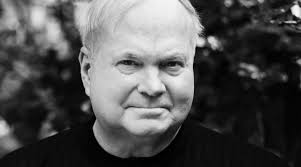
I Miss You Pat Conroy


In the fall of 1975, I started my first teaching job at the Martinsville Junior High School in Martinsville, Virginia. I was a Title VII Remedial Reading Teacher. This was a federally funded program. It was designed to captured struggling ninth grade readers before they entered high school. Yes, grades 7, 8, and 9 were housed at the school. 

I had been an English major at Greensboro College. The only college in America that would accept a pitiful student like me. God must have been watching over me. 

Did my student teaching at Aycock Junior High School in the Greensboro Public School system with Mr. Wallace Pegram. To this day, I have not forgotten some of Mr. Pegram’s wisdom—“There is a lot of psychology in teaching.” He was correct. 

To the south of Martinsville was Greensboro, North Carolina and to the north was Roanoke, Virginia. To the east was Danville and to the west the Blue Ridge Mountains. Martinsville was a furniture and textile town. Dupont, Tultex, Bassett were dominate names. These factories and many more sustained the community. 

To me there appeared to be quite an economic divide, but I guess that’s not unusual for a mill or factory town.

Anyway those struggling readers were tough. They just about drove me off as a first year teacher. Somehow with the help of two instructional assistants, I survived running the IBM based reading lab. And those challenging students, in four years helped to form my classroom management skills.

At some point in the fall of 1975, I was introduced to Pat Conroy. The movie Conrack based upon his second book The Water Is Wide showed up on my three channel black and white television  set one night. I watched it and I was hooked.

I don’t recall when I bought a copy of The Water Is Wide, but at that moment of introduction I became a fan. But, I will confess, I haven’t read or purchased every book written by Mr. Conroy— The Boo, The Pat Conroy Cookbook:  Recipes of My Life, and My Reading Life are still out there for me to conquer.

On March 4, 2016, one of the meanest forms of cancer, pancreatic, took Mr. Conroy’s life. He was 70 years old. When Mr. Conroy announced in February that he was in this battle, an address was posted for sending him a note or letter, words of support and love.

I wrote Mr. Conroy a letter, and sent him a copy of our second self-published book, Murray and the Mudmumblers: The Christmas Benefit At The Haw River Ballroom.  I named the road manager for Murray and the Mudmumblers—Conroy. Perhaps, my letter and book made it to Mr. Conroy, but I will never know.

For me, I believe Mr. Conroy’s writing was grounded in this abbreviated  quote from him:  “The most powerful words in English are ‘Tell me a story’.” 

No matter if Mr. Conroy was writing fiction or nonfiction, he was quite the storyteller. He had the ability to draw me in, to hook me, to keep my attention, and in the closing lines, I didn’t want the book to end, I wanted more.

While I’m certain, some skilled critics of literature would disagree with my assessment, Mr. Conroy’s work resonated with me. His stories stuck to my ribs. He made me laugh, and my heart had tears well up in it.

I don’t believe he was successful, but Mr. Conroy attempted to expand my vocabulary with words like dyspeptic, censorious, salient, anathema, and choler.

Quite often food was woven into the pages of his work. No matter the path chosen by a character food could be a part of the journey. My mouth watered at some of those descriptions. Once, I even ordered shrimp and gravy at a small roadside restaurant at Ocean Isle Beach in North Carolina because of Mr. Conroy.

After I retired from 31 years of work in public schools, my friend, John McGinty, offered me a part-time job teaching freshman English at Benedictine High School in the city of Richmond. Benedictine was a Catholic, military grounded school for boys. The school was also known for its prowess on the basketball court. Mr. Conroy would have fit in as student athlete at Benedictine.

When My Losing Season was published I read with interest the references to Benedictine. Mr. Conroy wrote with great enthusiasm when his high school team unexpectedly took down the mighty Benedictine Cadets in a tournament. I always shared that section of the book with my classes.

Whether he was writing from fact or fiction, Mr. Conroy bared his soul when he wrote about his family. Families are as fertile as low country soil for stories. Those people, their stories molded Mr. Conroy. Most importantly, they shaped his writing.

His relationship with his college, The Citadel, was an off and on love affair. That tussle was grounded in his book The Lords Of Discipline. But, time has a way of healing wounds, even deep wounds.

I loved that Mr. Conroy had a very brief career as a teacher. But, he never lost his appreciation for teachers across America. When he would meet teachers, he would always say, “God’s work, but not God’s pay.”

If you were to ask me my favorite Pat Conroy book, I would probably lean toward The Water Is Wide. That book started my peregrination with him. (I wonder if he would approve of my vocabulary expander in the previous sentence?)

But, in truth, I also have an affection for A Low Country Heart Reflections on a Writing Life. This is a collection of nonfiction writing from Mr. Conroy and those who knew him from an assortment of angles.

If you want all of your emotions touched, read Mr. Conroy’s graduation speech to the Corps of Cadets at The Citadel in 2001. Again, I’m no expert, but I think the core of Pat Conroy is in that speech. Heck, you can even watch this address on You Tube.

Perhaps, somewhere, at this very moment, someone is working on a biography about Mr. Conroy’s life. 

This author will pour his/her heart and soul into hours and hours of research, interviewing, writing, rewriting, late nights, early mornings, deadlines, editing, reading the manuscript over and over again, listening to an editor’s suggestions, and finally a book will be published.

I’m sure I would rush out and buy a copy.

But then, why should I?

Part of me thinks Mr. Conroy has already given us his biography.

Mr. Conroy’s life is in his books.

He told us his story.

And for that sharing, I am forever grateful.

I miss you Pat Conroy.

images-1

Church, “What time do you start?”


I had missed the Maundy Thursday program because of a school board meeting.

Early on the morning of Good Friday, I untacked the purple cloth that had graced the wooden cross on the front lawn of our church. I replaced it with torn scraps of black cloth and tacked the pieces back into the cross.

Since early in the week, the weather forecasters had everyone stirred up with predictions of severe storms for later on Friday afternoon.

 I tried to focus on the details of getting us ready for Sunday.

We were anticipating the arrival of Easter lilies for the Sanctuary at some point today. 

The warm, unsettled humid air was going to require our HVAC technicians to switch our systems from winter to summer. 

Trinity Hall needed to be put back together after the Maundy Thursday’s program.

 Before the stormy weather showed up, a few items outside needed attention. 

And at some point chairs needed to be staged in the Welcome Center as we hoped for attendance that would overfill the Sanctuary on Sunday. 

As the afternoon arrived, the skies opened up with a heavy rain shower. Severe thunderstorm and tornado watches and warnings were posted by the National Weather Service. Office staff took a number of phone calls from members wondering if we were going to cancel the Good Friday service because of the forecasts. 

We kept an eye on the radar reports and warnings, but somehow the rough weather stayed to the west and southeast of Richmond. I agreed to monitor the weather during the Tenebrae service. But aside from another drenching rain shower just prior to the start of the service, we were lucky.

The dark somberness of Tenebrae on Friday evening was sharply contrasted with a bright just about perfect spring day on Saturday. 

Chores at home on Saturday clearly wore me out, so I was dragging as I headed to Trinity a bit after 5 on Sunday morning. I had lots to do.

Cool, crisp dry air was in place—the moon was high in a clear sky. It looked to be a perfect Easter morning.

Along with the usual building rounds, the cross on the lawn needed to be transformed again. Black cloth removed, chicken wire forms put in place to hold fresh flowers.

Slowly, the behind the scene volunteers arrived. Don Boyd and Ken Hart worked in the Trinity Hall kitchen grilling fish filets for the sunrise service. Lynn Berry made final preps for communion. Associate pastor, Drew Willson, worked on staging for the Sunrise service setup, including a portable fire pit.

Three distinct aromas started to make their presence in the building. The perfume fragrance of the lilies was a sharp contrast to unmistakeable whiff of fish being cooked, and somewhere the wood smoke from the fire pit served as a median between the two. I just hoped the smoke from the fire pit didn’t set off the smoke detectors in the Welcome Center from the propped open doors.

As I was putting the finishing touches to attaching the chicken wire to the cross, a car pulled into the driveway in front of the Welcome Center. The driver put down the window and asked, “What time do you start?” 

He was inquiring about the start time for the Sunrise service. I responded 6:30. The driver must have checked his watch. Because he drove a bit further up the drive and pulled over to park. He decided to stay.

The sky was slowly beginning to show the first hints of blue in the East. I started to run back through my mental checklist, and I was pretty sure I had completed my assignments.

With one final assessment, I headed back home to get something to eat and to change my clothes.

When I arrived at the house, I picked up the  newspaper off the front sidewalk and brought it into the house. The Commander Supreme was up and ready to attend the 8 o’clock service. Our son, his wife, and their almost two year old daughter were going to attend this service with us.

My breakfast was going to be a light one, as we had been invited to brunch at our son’s home later in the morning.

As I was getting ready to sit down to eat, the Commander tossed in my direction Section B of the paper. She pointed out the following headline:  United Methodists edge toward breakup over LGBT policies.

“Nice,” I thought to myself, “couldn’t the editors of the newspaper delayed the printing of this article until Monday?”

I skimmed the article, ate quickly, and hustled upstairs to get changed.

The first hymn we sang on Easter morning was “Christ the Lord is Risen Today!” There is a line in the fourth stanza that states three words— “made like him,” meaning you, me, we were made like Jesus. 

I’m thinking if we truly were “made like him,” then why can’t we open our hearts to people like Jesus did? Why are we as Methodists so divided and willing to split up our church over these LGBT policies?  

Author Hampton Sides wrote the book, Hellhound On His Trail, an account about the eventual capturing of James Earl Ray, the assassin, who took the life of Dr. Martin Luther King, Jr.

Dr. King had been asked to come to Memphis, Tennessee in support of striking garbage workers. The first march in Memphis in support of the workers had been a disaster. Violence broke out.

In planning a return visit to Memphis to lead another protest, Dr. King was challenged by his staff. They did not think a return to Memphis was a good idea. Dr. King became so agitated with the non-supportive attitude of his staff that he walked out of this critical planning meeting. His staff was shocked. They had never experienced an explosion like this from Dr. King.

But, his abrupt departure worked. His leadership team now felt more obligated to figure out how to move forward, and they did.

Hampton Sides assessment of this pivotal meeting came down to this—“Out of dissension, a consensus had formed.”

I wonder if this current dissension in the United Methodist Church could lead us to reach an all inclusive positive consensus regarding LGBT?

While I like to hope that we could, I sense we are too stubborn— too set in our ways.

This issue has been in front of our church for many years.

I find it discouraging that we can’t find common ground or hear  the voice of reason. Church attendance is in decline. Don’t we realize that shutting our doors to clergy and people from the LGBT communities only hurts our churches?

Dietrich Bonhoeffer once stated:  “The ultimate test of a moral society is the kind of world that it leaves to its children.”

That statement poses a lot of internal questions for me.

Do I want to leave for my children a Methodist church that is unwilling to welcome and love those who are LGBT?

Does the church’s response mean that I must stop my friendships with family members, neighbors, friends, church members, and peers who are LGBT?

If as the hymn states that I you, me, we, the church are “made like him,” then why can’t I, you, me, we, the church act like him by following his lead— “You shall love your neighbor as yourself.” (Mark 12:31)

Perhaps the real question for me should be—“What time do I start?”

When do I stop thinking about myself and start thinking about the future for my children and grandchildren?

Contrary to popular belief, clocks don’t slowly tick. No, clocks spin at a maddening pace.

I hope it’s not too late for me to start to “love my neighbors.”

I think the spinning of time might slow for that journey.

I need to start. Church, how about you?

IMG_0376

Poking a tiny bit of fun at the Atlantic Coast Conference

Wednesday, April 10, 2019

The Commissioner of the Atlantic Coast Conference and his staff are to be commended. 

They have done extraordinary work. 

Expanding the number of teams in the league was pure geographical  genius. 

Growing the conference’s brand was bountifully brilliant.

 Marketing that brand exemplified exceptionally clever creativity.

Recently, two original founding members of the conference, Clemson University and the University of Virginia, won national championships in football and basketball. 

These outcomes probably sent the Commissioner and his staff reeling into a crisis mode. 

Damage control manuals and procedures were immediately opened and implemented. 

Counter measures were deployed to assure non-founding league members that their assets were safe.

The Commissioner was overheard telling his staff the famous words from an honorable North Carolina lawman, Deputy Barney Fife, “We’ve got to nip it, nip it in the bud!” We can’t allow teams from our founding members to earn any more national championships, our non-founding members might bolt— “Nip it in the bud!”

From a grumpy Alamance County native, congratulations founding members, Clemson and Virginia, you keep right on bud nipping!

Bill Pike

Richmond, Virginia

“Don’t freak out, but you’re going the wrong way.”


We were up at 4:00 a.m. Just a few minutes before 5, we had the car loaded, and ready to drive to the Richmond airport.

The predawn was dark, cloudy, and wet as we found our way to I-64. Next, we caught the brief merge to I-95, and then left I-95 for I-64 again.

We were in and out of rain. The temperature was 62. Chicago was the destination. No way that 62 would be waiting for us when we touched down at O’Hare International.

The Commander Supreme had coached me well on the game plan. Drop her off at the terminal with our two bags, then go park the car in the long term lot. Don’t forget my pack back, turn off the car lights, get the keys, and remember where the car is parked.

Somehow, I managed. The parking lot company even gave me a card with the lot letter and parking space number.

The shuttle back to the terminal was painless. I found the Commander Supreme waiting for me. She had successfully checked us in, but she gave me a warning, “Don’t freak out when TSA checks your ticket.”  For some reason, the ticket printed Pike/Pike no Bill or William. 

The Commander wasn’t sure if that hiccup might cause a concern with the TSA personnel. Fortunately, I experienced no hassle. Maybe the TSA Pre-check had helped.

Soon, we were called to start the boarding process. A Bombardier CRJ700 was the plane that would carry us to Chicago. Designed for regional flights, this one was part of American Airlines.

The CRJ700 was not engineered with passenger comfort in mind. 

My guess is a passenger might have more room in a one ounce container of Tic Tacs. 

Storage bins above the seats are compressed like a sandwich on a panini grill. I clunked my head on those low hanging bins as I scrunched my body angling toward the window seat.

Even my slight frame felt crunched and confined in the this small space. And that space shrunk even more when the passenger in front of me reclined his/her seat back into my knees.

The usual safety updates were given. Eventually, we were pushed out of the gate. The trek out to the departure runway took a long time. Let me state that again, the departure out to the runway took a long time, I mean a long time.

Just as we were starting to sprint down the runway, the first light of a gray dawn began to appear. 

We had been told by the pilot before taking off that we would experience some choppiness in the cloudy unsettled air, and this was true.

Gradually, the bumping around improved, and the last leg of the flight was smooth and tension free. Our approach into O’Hare took us out over Lake Michigan, and soon the skyline of the city was in view.

This trip was for a birthday celebration for our grandson, Hudson, who was turning one. No doubt, his first year of life had flown by for his family.

But in truth, time flies by for everyone. 

Time only has its wings clipped when we reach the end of our paths, our roads, our directions, our journeys.

I have always been intrigued with the science of flying, but always thankful when the plane safely lands at our destination.

But as we all know, journeys in life do not always end well. 

images

Sometimes in life we go in the wrong direction.

This past week, I heard an interview where a person stated, “Remember, life isn’t a straight-line.”

Tomorrow is Sunday, April 14. It is Palm Sunday. Turns out, this will be a Palm Sunday not soon to be forgotten. 

Palm Sunday in Chicago was miserably cold, gray, and wet with what could only be described as a misplaced winter snowstorm.

After attending church at St. James Lutheran, we went to brunch at the Blue Door. 

From our table, we could watch the fury of the famous windy city winds furiously tossing snowflakes. 

When brunch was over, our walk back to the car put us in the direct path of the wind’s temper and blowing snow. We were miserable. Once at the car, our three year old granddaughter, Caroline, commented, “We should have stayed at home!”

We all laughed and agreed. Leave it to a child to have the clear perspective and assessment.

Holy Week is here. I need clear perspective and assessment. 

I must confess, I’m not sure I always understand this walk, this journey, this end that Jesus is approaching. 

Part of me believes, someone should have nudged him.

 Excuse me, Jesus, but I can see the worried look deep in your eyes. I sense you are going in the wrong direction. Maybe you and your father need to talk a bit more about this straight line you are following.

I think God and Jesus did talk, but there was no wavering, no backing down, no adjustment, no compromise. 

Sadly,  the fear of not understanding Jesus fueled this uncivil environment he entered. Mankind’s irrational meanness was not absent. No matter the good in Jesus, his time had come.

In the movie, An Officer and A Gentleman, actor Richard Gere reports to Aviation Officer Candidate School. There he and his fellow recruits encounter an exceptionally tough Marine drill instructor portrayed, by actor, Louis Gossett, Jr. 

The hopeful jet pilot and the drill instructor have a turbulent relationship. 

In one pivotal scene, the drill instructor attempts to berate the candidate into resigning, giving up his chance to become a pilot. 

No matter the harsh verbal approach taken by the drill instructor, the aviation candidate stubbornly holds fast to his straight line. He will not resign.

Finally in exasperation, the drill instructor forces the resignation stating, “That’s it—your out!”

An emotional outburst comes from the aviation recruit, who strongly responds to the drill instructor:  “Don’t you do it, don’t you do it—I got nowhere else to go, I got nowhere else to go!” 

Jesus had nowhere else to go. 

The path, his road, his journey, his final destination was the cross.

Outwardly, Jesus didn’t freak out. 

I sense in his heart, Jesus knew he was going the wrong way.

I would have skipped out.

He didn’t.

Sacrifice.

Psalm 22:  “My God, my God, why have you forsaken me?”

Brushed Aside


Clearly, there are many tough jobs in our world. 

Here are a few that easily come to mind—police officer, emergency room doctor, port-a-john technician, school bus driver, and parent.

Being a parent might be the toughest one. 

While the passion of creating a child is magical, when that bundle of joy arrives, it is all hands on deck. And believe me, it takes a lot of helpful loving hands to raise a child. 

Just as parents attempt to mold and shape their children, parents are also molded and shaped by those same children.

 All kinds of things impact that molding and shaping. Some are good. Some are bad. Some are in between, and some things happen to parents and their children that just can’t be explained. 

While serving on our local school board, I have discovered there has been one constant in our monthly meetings—reviewing recommendations from the superintendent for student expulsion.

Expulsion for all practical purposes means that a student has come to the end of the line—the ride is over. 

Expulsion molds and shapes lives too. 

Sadly, the lives of some students have been unraveling since the day of their birth. For others, their lives can be torn a part in one split second with an unwise choice.

Years ago, when I served as a high school assistant principal, expulsion often meant that all educational services for a student ceased. Today, school boards and superintendents look to alternative educational opportunities for students who have been recommended for expulsion.

Sometimes after a year, a student will reapply for admission to the school system. During that year with lots of support, plus their own fortitude, a student has learned from the expulsion experience. Good things have taken place. Readmission is granted. That good molding and shaping while it might be rare makes hope a reality.

My old body still allows me to take a run through our neighborhood from time to time. Those runs can be good think time. 

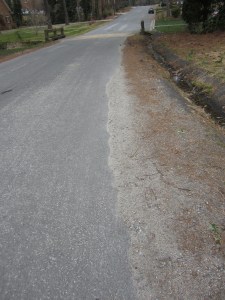
One thing I have noticed on my runs is that I can really see the surface of the road.

IMG_1882

In the winter, remaining sand and salt particles from a snow storm gradually start to accumulate on the shoulder of the road. Sometimes pine tags, broken twigs, and litter become a part of that mix as well. Friction from whirring tires, wind, and rain contribute to this brushed aside build up.

That build up makes me think about students in a school who have been brushed aside. Could be any number of  reasons, but the school system in those moments has failed a student. 

When school systems lose track of a student nothing good is going to happen. Eventually, the student will lose track as well. When the student loses track of his/her relevance, the path to making poor choices immediately expands. Once a student makes one lousy choice, too often more lousy choices are on the horizon.

My mind asks me how many students did I brush aside in my career as a public educator? How often did I fail to recognize those students who just never seemed to fit, who never quite figured school out? Where was I in their baggage? Why couldn’t I have been better at helping them figure things out? Why didn’t I intervene on their behalf?

I have no good answer, only excuses. My excuses are not acceptable.

IMG_0183

Sometimes I will run across a road surface that is full of cracks, fissures running in all directions. Sooner or later, that road surface will need to be repaired. 

Students, parents, and school systems can be full of cracks too. Those cracks allow for intrusion. Intrusions can wear us down. All of those things out there that are beyond our control begin to take over. When this happens, it is easy to lose hope.

On a daily basis, a student, a parent, and a school system can lose hope.

So, how do we regain hope?

I recently attended the National School Board Association’s annual convention in Philadelphia. My brain is still recovering from information overload.

But, there were some recurring themes.

For example, who is being overlooked in our schools?

How do schools create a sense of belonging for those who are being overlooked?

If I want to reach the brushed aside student, the student full of cracks, the overlooked student, or the student who has no sense of belonging, how do I make those needed repairs. The experts believe the answer comes down to a couple of words—building relationships.

Building relationships isn’t a simple snap of fingers. 

Building relationships takes time. 

In the ticking of those seconds, building a relationship will require endurance, endless energy, carefully chosen words, the capacity to communicate acceptance, and a resilient heart. 

I wonder how many expulsions could have been prevented by not brushing off a student or by not letting a student intrude into the cracks of the system.

Today, I often forget about a role model who didn’t brush off people during his short time on earth. No, Jesus had a skill set that allowed him to build relationships while he moved through a variety of environments. He was deliberate and precise in his teaching moments.

I wonder what it was like to be his parent? I wonder if it was a tough job? I wonder what Joseph and Mary thought about his extraordinary skills? Did they truly understand him?

 I would imagine their hearts were full of questions about their son.

I too have lots of heartfelt questions about Jesus and his work. 

 But, I also have questions about my own heart.

How can I make my heart less likely to brush aside the people I encounter who are overlooked with no sense of belonging?

I need to search my heart and find that answer. 

How about you?

Remember, it’s about building relationships.