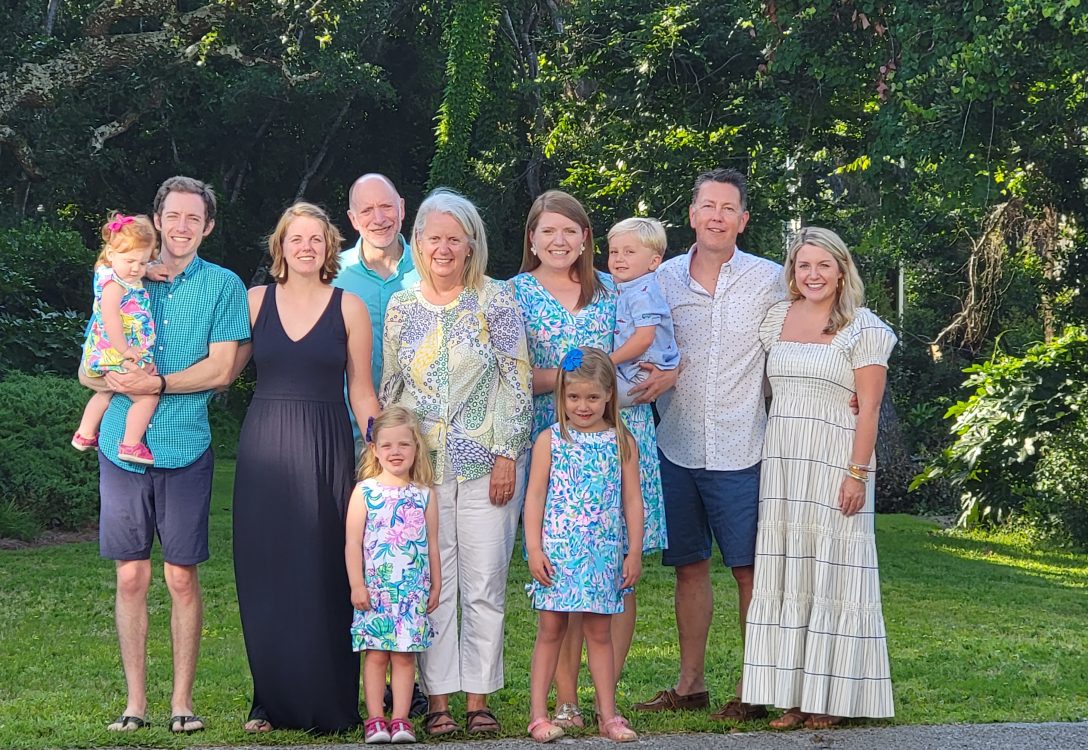
Honored to have a Faith and Values piece in the Richmond Times-Dispatch today:
Author: Bill Pike
march
On the afternoon of Sunday, June 14, I drove out to the Fairfield Library in Henrico County. Located on Laburnum Avenue, the library was to be the starting point for A March for Unity. This event was put together by the Richmond District of the United Methodist Church. The start time was 3 p.m.
For some reason, I did not find out about this march until Sunday morning. But, I determined I was going, and I went.
Before leaving the house, I covered my beyond pale legs in sunscreen, put on a long sleeved shirt, brought along a wide brimmed hat, and put in a pocket my newest friend—a handmade facial mask.
I stayed off the interstate on my drive to the library. It was a pretty June afternoon.
By the time I arrived, a small crowd was beginning to gather. With sun glasses, hats, and masks, it was tough to recognize people. But, early on, I did see a couple of friends, Ginny Willis and Elizabeth Compton, who I knew from church work and the school system. I enjoyed catching up with them for a few minutes.
People kept trickling in, and it seemed like getting started was being delayed. But, eventually our District Superintendent, Pete Moon, started to get our attention.
Pete was using a megaphone to gather us. Initially, it took a few minutes for all us chatterboxes to stop talking and listen to Pete. If nothing else, Methodist are methodical, and we eventually figured out we needed to be quiet.
Pete introduced and turned over the next few minutes to Reverend Rodney Hunter who offered prayer, march instructions, and some heartfelt thoughts about an important question: Why are we here?
Once Reverend Hunter concluded his remarks, we started the very short walk on to Laburnum Avenue. We were heading west on Laburnum. Officers from Henrico County Police had blocked the two travels lanes. We had lots of room, but this crowd of about 300 was moving slow.
Along the way, participants waved signs, sang, chanted words of encouragement, shouted out the names of African Americans who had lost their lives from racial injustice, and acknowledged horn toots and hand waves of support from drivers in the east bound lanes.
While walking, I recognized fellow Trinity member Anne Burch who was there with her husband, Bill. We listened and participated with our fellow marchers, talked, and at times were silent.
Once off Laburnum, we wound our way through neighborhood streets. Our stopping point was the home of the Worship and Praise Church. On the tree shaded front grounds of the church, we came to a stop.
Reverend Tim Kirven pastor of the church gave us leadership at this point. His wife Michelle sang a beautiful song, and then a young man from Woodlake UMC, James Lee, offered a scripture reading from Amos 5:21-24.
Before introducing the Bishop, Reverend Kirven offered some words of inspiration too.
Our Bishop for the Virginia United Methodist Conference, Sharma Lewis is a busy lady. And, I will not pretend to remember every word she stated, but I will never forget what she asked us to do.
If we were physically able, Bishop Lewis asked us to kneel on one knee for 8 minutes and 46 seconds. This was the amount of time that George Floyd was pinned down by the Minneapolis police officer.
During this 8:46, Bishop Lewis made points of emphasis related to time. Occasionally, in the stillness of the shaded grounds, a random voice called out “I can’t breathe.” A few times other voices called out “momma.” And, the strained polite request “please” was also voiced.
Finally, the last seconds ticked away. Unlike George Floyd, we were able to rise, finish the march, and go home.
Nothing I have been through in my life compares to that 8:46—nothing.
I’m glad that Pete Moon and the Richmond District organized the march. It was a good opportunity to learn. Clearly, I have lots of learning left to do.
That learning will need to go much deeper than toppling statues, changing brand names, and peaceful protest that become violent and destructive.
America is still a powder keg.
It is like when the summer heat and winds have cooked every ounce of water from the undergrowth along a parched, dusty trail out in California’s Eastern Sierra Mountains. It only takes one tiny spark to birth an out of control wildfire.
The layers of our society are just as tense as that undergrowth.
One disruptive agitation can ignite a ferocious reaction.
Somehow, we must find the path for dialogue. We must sit down, talk, and listen. And the key to this is having that conversation with people who I don’t know. Without these critical conversations, I worry that we will not be able to move forward and make long overdue improvements.
I am currently reading Osha Gray Davidson’s book The Best of Enemies— Race and Redemption in the New South. The book focuses on Durham, North Carolina and the integration of its school system. But, the author in constructing this story about Durham also includes lots of historical information about race relations in America, but particularly North Carolina.
After recounting the student led sit-ins in Greensboro and Durham, Davidson makes this point: “It is no exaggeration to say that without the church, there would have been no movement.”
I wonder if our present circumstances are the opportunity for all churches to become involved in leading their communities to the critical dialogue needed to help us move forward.
Recently, two words from John Chapter 11 verse 35 caught my attention: “Jesus wept.”
I would imagine that God and Jesus have shed quite a few tears over our current state. And, I’m pretty sure there have been times in my life when I contributed to their tears.
Stopping those tears is within our reach. It is a matter of truly embracing and putting to work the longstanding teachings of God and Jesus.
Even in the most difficult environments, we must: “Love our neighbors.”
When we find the courage to love our neighbors and put that love to work, then the words from Amos Chapter 5 will ring true: “Let justice roll on like a river, righteousness like a never-failing stream!”

Coming for Christmas 2020: The Heart Changer
Back on April 1, my wife and I were in Raleigh. We were helping our youngest daughter with a move.
Outside her home, I spoke briefly with a UPS delivery driver. I asked him if the company was busy. He grinned and replied, “It’s just like Christmas.”
The assist for his smile goes to COVID-19.
This past Tuesday in our church staff meeting via Zoom, our senior pastor ended the meeting with some seed planting. In our next gathering, he wants us to have discussion about Advent and Christmas.
Today is Thursday, June 25. In six quick months, it will be Christmas Day.
Go ahead start hurling insults at me. I deserve it for bringing up Christmas in June.
Christmas might seem a long way off, but that day will be here in a blink. I wonder what Christmas 2020 will look like?
I’ll be honest with you, I have already figured out what I want for Christmas. I want a soon to be released new gadget named a heart changer.
I don’t know about you, but I have a tendency to ignore my heart at Christmas. I become wrapped up in the annual pursuit of perfection through all of the commercial trappings.
Every Christmas, I quietly say to myself that I’m going to brush aside the madness it creates. But, in truth I never do. And the reason I never do is fear.
In the movie Home Alone, screenwriter, John Hughes develops an interesting dialogue between Kevin, an elementary aged youngster, and his elderly neighbor, Marley. The scene takes place in a church sanctuary on Christmas Eve.
Initially, for lots of untrue neighborhood rumors, Kevin is afraid of Marley. But, the polite Marley starts the conversation with “Merry Christmas.” Both Kevin and Marley open up about themselves. Marley shares the story of an old argument that he had with his son. That argument estranged the father and son.
Kevin encourages Marley to reach back out to his son. But Marley tells Kevin he is hesitant, he is afraid that his son will not talk with him.
With lots of respect, Kevin asks Marley, “Aren’t you a little old to be afraid?”
And Marley answers with this,“You can be old for a lot of things.
You’re never too old to be afraid.”
I don’t know about you, but since the middle of March, my brain has been swirling. Fear is at the center of that never ending spin.
I fear COVID-19. I fear the inability of America to solve our longstanding internal problems. I fear the November election. I fear the future for our children and their children.
Recently, I found a bit of comfort in Coach K’s comments about the turmoil in America when he said: “I have been trying to find eloquent words to explain my thoughts regarding the recent acts of injustice in our country, but I cannot be eloquent about this. I am too emotional. I am angry! I am frustrated! I am disgusted and frankly, I am scared.”
Coach K scared? I always viewed him as being tough as nails. But, here is what I love about his comments— he spoke with honesty straight from his heart.
And, I will tell you the truth, that is my biggest fear in this chaos, I am not sure that we have the desire to change our hearts.
I expect the marketing and advertising for the heart changer to start soon. It will be presented in one of those fast talking, 30 second television ads. The cost of the heart changer will be an amazing $9.99.
If someone was really clever, they would run a quiet counter to the $9.99 heart changer with a PSA (Public Service Announcement).
The PSA would simply be scrolled across the television screen:
Christmas is coming. Give America a gift—the changing of your heart. Change your heart forever. America needs it now.
In the last stanza of the Christmas carol, “In The Bleak Midwinter,” a quiet, but moving question is asked—“What can I give him?”
The response is very simple— “give my heart.”
Pulling America out of this mess will require giving and changing our hearts.
That will be tough work, but we have no options.
At the very least, that work will compel us to listen in different ways from what we have attempted in the past.
Courage, patience, and honesty will drive this listening.
Calendar is moving. Christmas is coming.
And the truth is we don’t need a gimmicky heart changer for $9.99.
No, to change our hearts, we need to stop being stubborn, let go of fear, and work until we have solutions for every injustice.
A companion for your lonely soul: Brian Wilson #78
Occasionally on the Andy Griffith Show, the Darlin family from the nearby hills would amble into the quiet town of Mayberry. Led by their father, Briscoe, he was accompanied by his daughter, Charlene, and her brothers, who in real life were actually a talented bluegrass band from Kentucky named the Dillards.
Usually in an episode when they appeared, at some point music from Briscoe and his sons would be played along with singing from Charlene. In encouraging Sheriff Taylor to pick guitar with them, Briscoe once remarked: “Got time to breathe, got time for music.”
From my perspective when I think about singer/songwriter, Brian Wilson, I’m glad that he had “time to breathe and time for music.”
Today, June 20, Brian Wilson turns 78.
It is appropriate that his birthday is today— as it marks the first day of summer. Probably no one in the history of pop music and possibly advertising did a better job of selling summer to teenagers around the world than Brian Wilson and the Beach Boys.
I’ve never met Brian Wilson, but I have met a lot of his songs. And for me, many of his songs are heart touchers.
When one considers his diverse catalog of songs, the strength of his composing, his production techniques, and his unique ability to construct precise and rich background harmonies, I think Brian Wilson stands alone.
What is even more remarkable about his success is this— Brian Wilson has virtually no hearing capacity in his right ear; all of these songs were written via his compensation for this loss of hearing.
And while we are on the topic of remarkable, as a long time fan of Brian and the music he has created with and without the Beach Boys, I find it remarkable that Brian is still alive. He has outlived his demons, and sadly his younger brothers, Dennis and Carl.
Brian is a survivor.
Brian’s challenges are well documented: starting with a difficult father, a nervous breakdown in the early stages of the Beach Boys fame, substance abuse, and nonstop pressure to constantly produce hit records. Later in his life, the collision of all these factors finally led doctors to diagnose Brian with schizoaffective disorder and mild manic depression.
And yet, Brian has written such beautiful music that brings a happiness to people.
How can a person who has suffered through all these ups and downs create such magical music?
Personally, I think music was God’s gift to Brian. And, I think that gift of music even in the most rotten times of his life, never abandoned him. Music is his heart, his soul. Music is his friend, his confidante, his safe place.
My Osher Institute teaching pal for the University of Richmond, Joe Vanderford, often reminds me of another Brian gift—his voice. Go back and listen to his early lead vocals with the Beach Boys. No one could soar like Brian.
Even if you are a marginal fan of the Beach Boys, I think it would be very easy for you to name some of their hit records. I have no desire to walk you back through those songs. I’d rather take you to August 31, 1970.
By the end of 1969, the Beach Boys were bringing closure to their contractural commitments with their original recording company Capitol Records. The late 60s were not good to the Beach Boys. The hit records literally stopped. They were a square peg in the Woodstock generation of music. And yet, somehow, they kept afloat.
Part of treading water came from their concert touring especially overseas. The British still loved them. But, something else was taking place too.
Brian’s bandmates, Al, Carl, Dennis, Mike, and Bruce had learned a few things by being around Brian in recording studios. Each of them in their own unique ways were finding their songwriting and production paths.
A new recording contract was signed with Warner Brother Records. The group would be a part of the Reprise label with the opportunity for their own Brother Records logo to be imprinted on the new label.
During the recording of their first album for Reprise, there was some special creative energy present in the studio.
Each band member contributed to the songwriting. Brian was more active in the production. Recording engineer, Stephen Desper, superbly captured the richness of the instrumentation and vocals with each song. What transpired is that the band really worked individually and collectively on this record. A harmony, a cohesiveness existed.
The album named Sunflower was released on August 31, 1970. Despite supportive promotional efforts from Warner/Reprise, the album was a commercial failure. But, the critics, like Rolling Stone magazine’s, Jim Miller, loved it. From lots of angles, Mr. Miller gave the album high marks for many valid reasons.

Sunflower turns 50 this year.
Unlike my old bag of bones, Sunflower has aged well.
If your ears have never listened to this album, you need to be brave and explore.
And what is really interesting about Sunflower is that the album in a unique way became a rejuvenation point for the Beach Boys.
The next four years charted an unexpected rediscovery by American fans that brought the band acclaim for their concert performances and their studio recordings.
I could easily walk you through every track of Sunflower, but I will leave you with this one—“Add Some Music To Your Day.”
This song is like a gentle anthem of praise to music.
And right in the middle, Carl Wilson’s lungs swell like the crest of a Big Sur wind blown wave, and he sings in his sweetest angel voice these true words: “Music when you’re alone is like a companion for your lonely soul.”
I wonder how many lonely souls found a companion in the music of Brian Wilson?
My hunch is lots of people found that companion in his songs.
But, I’m thankful that Brian’s own soul found a companion in music too.
Happy Birthday Brian Wilson!
I pray there will be many more.
And for anyone who took the time to read this post, take Brian’s advice—go add some music to your day.
It will be good for your soul.

Tough Work
Honored to have an op-ed piece in the Richmond Times-Dispatch today:
Hooray for Mrs. Berry
For many reasons, June 9 is probably a special day for lots of people.
But June 9, 2020 was a hooray day for our friend, Lynn Berry.
Mrs. Berry is a cancer survivor. This past Tuesday marked year number 15 for her being cancer free.
I don’t know about you, but I will take some good news like that in our current upside down world.
In fact, I will celebrate anyone’s proper beat down of cancer.
Of all the things human beings are asked to contend with in their lives, I despise cancer more than anything.
I will never ever, ever, ever forgive cancer for robbing the life of my mother.
My sister is a breast cancer survivor. I can still hear the pain in her voice from the afternoon she tracked me down by phone to share her rotten news.
And that’s the thing about cancer, it is rotten. Rotten to its cellular core. It has no redeeming qualities at all.
Cancer is the evil of all evils, the meanest of the meanest. Cancer respects no one, I mean no one.
Cancer doesn’t care if you are 3 or 93. Cancer doesn’t care if you are rich or poor, kind hearted, or mean spirited like cancer. Cancer has no conscience.
I still remember the e-mail from my cousin Alice when she shared the news about her three year old grandson, Eoin. He had been diagnosed with a form of childhood leukemia.
Eoin and his family were lucky. He, his parents, family, friends, and an extraordinary team of nurses and doctors beat it back.
I still wear my orange wrist band that states: Eoin is a fighter.
Think about your own personal lives. Take a minute, remember the people you know or have known who have been involved in a skirmish with cancer. The names, faces, and connections add up too quickly.
A long time ago, Chester Fritz, a legendary football coach in the Richmond area once told me this little nugget. When your team’s quarterback goes back to throw a pass only one good thing can happen. That good thing is a receiver on the quarterback’s team catches the pass.
Perhaps the same can be said about cancer. The only good thing that can come from a diagnosis is that a person is able to battle the demon out of his/her body for eternity.
For 14 months, I had the privilege of pinch hitting as the school board representative for the Tuckahoe District on the Henrico County School Board. In fact, the member I replaced resigned to devote all of her energy to battle cancer out of her body.
While serving, I had to decide if I wanted to run to fill that spot for a four year term. I thought a lot about the possibility. Discussed what would be involved with my wife and some wise friends.
I concluded two things. Even though I love public education, I am not a politician. Second, I am not a fundraiser. I could not in good conscience ask a friend for a hundred dollars toward my campaign. I would rather that donation go to a good cause, like cancer research.
Perhaps, you remember Daffy Duck from the Warner Brothers Looney Tunes cartoons. From time to time in his own unique phrasing Daffy stated: “You’re despicable.”
Now, I don’t mean to offend you, but in America what we spend to have a candidate elected as president is despicable.
According to an article written by Christopher Ingraham for the April 14, 2017 edition of the Washington Post the estimated price for the entire 2016 presidential campaign was 2.4 billion dollars. Add another 4 billion, and that would include the amount for the congressional elections for the same year.
Despicable.
Thankfully, our research dollars toward cancer are billions over that 2016 campaign total.
But that doesn’t mean we couldn’t be wiser with campaign pennies.
Wonder if a redirected campaign penny allowed a researcher in a lab to discover the cure, and in a blink, despicable cancer was gone.
But, until that day, I will be thankful for Lynn Berry’s 15 years of telling cancer to go to hell.
In that journey, I am thankful for her family, friends, nurses, and doctors that have been and will continue to be a part of her success.
And somewhere in that long, long road I am sure Lynn is thankful for all of the prayers.
Perhaps, Romans 12:12 states it best: Rejoice in hope, be patient in suffering, persevere in prayer.
Amen.
Hooray for Mrs. Berry!

Yard work is good for the soul.
I know what you are thinking.
Bill, there is something wrong with you.
At the age of 66, is it true that you still enjoy doing yard work?
Yes, I confess I do.
With yard work, there is only one thing that garners lots of non-church language—leaf raking. I despise it. If rankings were given, I suspect our Richmond neighborhood would have one of the highest ratios of fallen leaves per square inch as any place in America.
Since I was kid, I have always puttered around in yards. First, out in my parent’s yard on West Front Street in Burlington. And gradually, I had a few yards that I took care of during the summers for neighbors.
When our oldest daughter and her family lived in Chicago, I even did some landscaping on the grounds of their condo building.
Neighbors where my in-laws once lived in Farmington, Connecticut tried to steal me away for projects in their yards.
When they asked me about helping them out, my standard answer was—you can’t afford me. I have three kids in college, or we’re planning a wedding. These nice people would nod, laugh, and continue their walk with disappointment.
And continuing with a relative connection, I’ve helped out in the yards owned by my sister and her husband too. Their farm yard in Snow Camp, North Carolina is a beauty.
My wife, the Commander Supreme, and I have even done yard work in the rental houses where our youngest daughter lives in North Carolina and our son in Richmond.
Now, our son his wife and their two daughters are in their first house just across Patterson Avenue from us.
This spring, the Commander Supreme, our daughter-in-law’s father, our son, and I have blitzed their backyard. For whatever reason, this backyard had been neglected by many previous owners.
I fully expected some unclassified creature who had been hiding out in all of the debris and undergrowth since the founding of Jamestown to lurch forward and scare the living daylights out of me. Thankfully, that surprising lurch never happened.
But, all of this investment of time and energy into this yard did lead me to share the following observation with our son.
One afternoon I told him, “You know it has finally dawned on me, that your mother and I have spent more time working in your yard, than you ever spent working in our yard at home.” He just chuckled.
I’ve helped out on the grounds at three schools where I worked during my education career, and from time to time I do some trimming and weeding on the grounds of our church.
The other day a co-worker noted that I had done some work in one of the church gardens. She complimented me, and went on to recommend that taking care of people’s yards could be something I could do when I really retire.
I can see the sign on the side of a truck now:
Billy Bill’s Yard Care
( will work for beer and pound cake)
Over the last few years, the Commander Supreme has taken a keen interest in various aspects of our yard. The Commander has quite an eye. She has become a meticulous trimmer. And somedays, her assignments really wear me out.
But, I think that is one of the things I enjoy about the yard work—it is often a good work out. On those brutal humidity laden days, I believe I sweat just as much if not more than if I had gone for an early morning run.
If I happen to spend a summer day working in our yard, and helping out in the yard of our elderly neighbor across the street, then I know these words from Ecclesiastes 5:12 will hold true for me: “The sleep of a laborer is sweet.”
During this COVID-19 isolation in our bi-weekly Zoom conversations with our college friends, yard work has been a common theme. Maybe, the biggest chuckle came when we learned that one pal uses a small blow torch on weeds.
Yesterday, in our Zoom chatter, this statement surfaced—“Life is tricky.”
Over the course of the last week, we have seen that life is tricky.
Why is life tricky?
Well, there are lots of possible answers.
But, just maybe, some of those answers are tucked deep down in our souls.
I sense that we have reached a point where those tucked away items need to be brought out and carefully placed in the sunlight.
They need to become conversation, opportunities to listen, to learn, and to gently push us out of our comfort zones.
I recently read an article by Dave Hyde, a sportswriter, for the Sun Sentinel, a south Florida newspaper. Mr. Hyde was writing about the passing of legendary Miami Dolphin football coach, Don Shula.
Mr. Hyde recalled the first press conference after Coach Shula had been hired. A reporter asked if he had a plan over a three to five year span to turn the losing Dolphins around. Coach Shula’s response was very simple, “My plan is to go to work.”
And go to work he did, he turned the team around.
Right now in America, we must commit to “go to work.”
Coach Shula saw a challenge, an opportunity.
America too has a challenge, an opportunity.
In some ways for a long, long time we have neglected our challenges.
When yard work is neglected, the challenge to get the yard back in shape is more difficult.
What lies before America is hard work, but it is work that must be done.
If I really love our country, then I must “go to work” so that I can be a part of helping our country solve our challenges.
I have four good reasons to support why I need to “go to work.”
Take a look at this photo from our backyard.
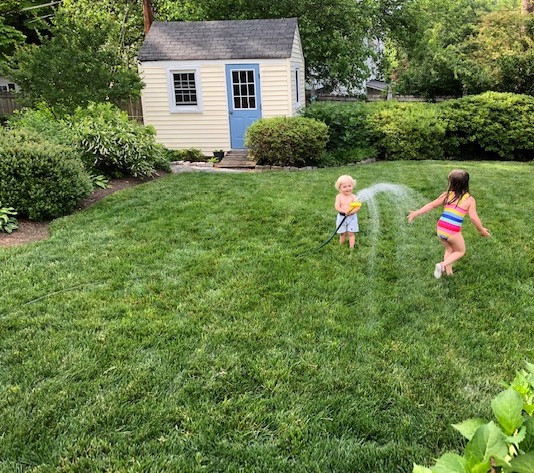
It is a classic, a younger brother spraying his older sister on a warm spring afternoon.
I owe to the future of our four grandchildren and all children in America to “go to work.”
Like my soul works in the yard, my soul needs to “go to work” for the future.
Whether you want to admit it or not, your soul needs it too.
And when we make this commitment, like the laborer in Ecclesiastes our sleep will be better.
God is disappointed in me.
On the morning of Sunday, May 31, I was bad.
I did not Zoom with our Sunday school class, nor did I tune in via uStream for our church service at 11.
Instead, I was in our son’s backyard.
Along with one of his friends, and our daughter-in-law’s father, we had been recruited to put the finishing touches of assembly on a swing set.
Just in case you don’t know, swing sets aren’t simple swing sets anymore. They are now elaborate play sets with all kinds of bells and whistles.
The assemblage requires at the very least an on call consultant who has the ability to interpret the very simple instructions and drawings in the very thick manual. In this case, our son was lucky, the consultant was his very capable wife, who at least read the manual.
I confess, I was tardy in arriving, but I did bring along the requested tools—a sledge hammer, 8 foot step ladder, and a drill.
My assignment was to figure out the linkage for the three swing options. The results were simple—I failed. But, after staring into the instruction page for 3 hours, 44 minutes, and 17 seconds I finally figured it out.
Turns out, my son, who I still love dearly, gave me the wrong pack of caliper clips for my assignment.
While I was staring into that instruction page, I took a phone call from my friend, Katie Gooch. Katie is the Director of the Pace Center for student ministries(Wesley Foundation) on the campus of Virginia Commonwealth University (VCU).
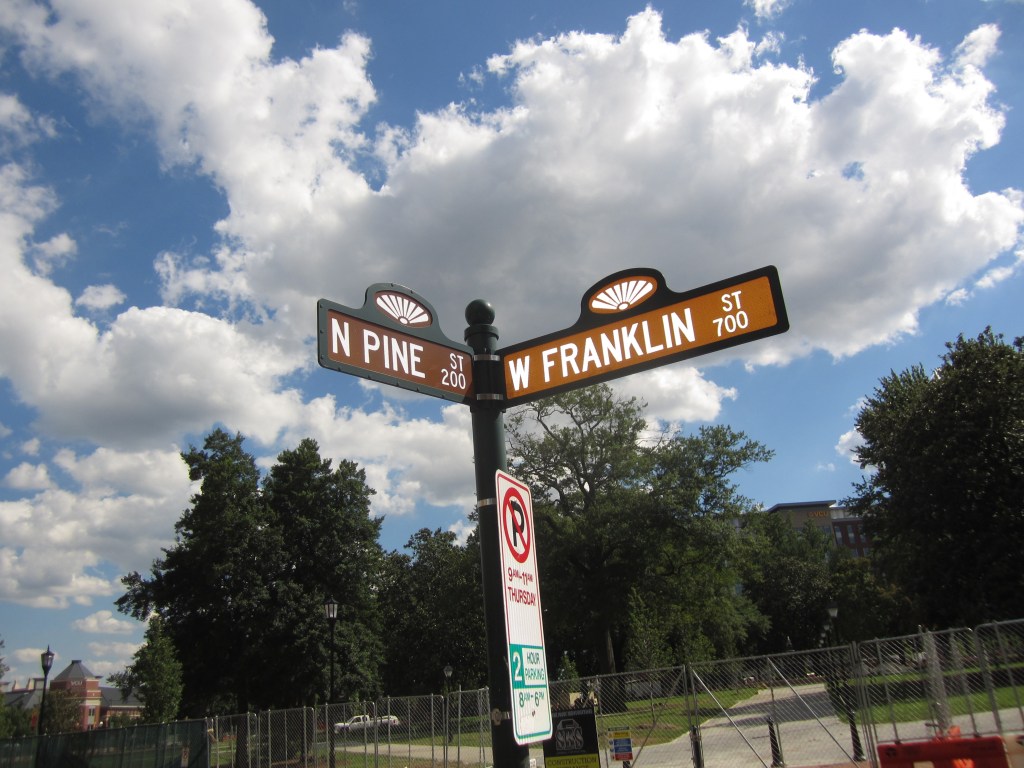
Katie’s programming is housed in the former Pace United Methodist Church at the corner of Pine and Franklin just across from Richmond’s Monroe Park. Unfortunately, Katie was calling to give me some discouraging news. Her building had been a target from the demonstrations related to the protests of George Floyd’s death.
Out of the blue, a few years ago, I was asked to serve as the property chair for the Board of Higher Education for the Virginia Conference of the United Methodist Church. I basically was given the responsibility of keeping an eye on the Wesley Foundation properties on college campuses across Virginia.
I knew the Pace building well, and I listened intently as Katie walked me through the damage. We talked, and she sketched out a game plan for securing the building. Her plan made sense, and Katie promised to follow-up as she organized her plan.
Without too many more hiccups, the play set came together. The final finishing touches were tweaked, and of course the final seal of inspection and approval came from, Josie, our soon to be three year old granddaughter.
Just as we were breaking for lunch, Katie called again to let me know that a team was assembling at Pace at 1 p.m. If I was available, she requested that I bring an extra step ladder and head down to assist.
With the play set christened by Josie, I departed for Pace.
I drove down Patterson Avenue, and then hooked a left on to Monument Avenue via North Thompson Street. It was a beautiful blue sky afternoon, perfect temperature. I saw people on the grassy medians of Monument sunbathing, some strolling with their dogs, and others just sitting in the sunshine.
The deeper I drove down Monument, the more the traffic increased. And then, as I started to encounter the Civil War monuments, I saw what was creating the stir—the monuments had been severely defaced by the actions of some of Saturday night’s protestors. I did not stop and gawk, but the messages and damage was significant.
Monument changes to Franklin after the last statue, and at a house of worship further down Franklin, I noted plywood being installed over windows. Not sure if that was a preventative measure or responding to damage.
I reached Pace and found a place to park along Pine Street. The crew was already busy cutting plywood. Twelve windows had been damaged— nine along the back alley, and three facing Pine Street. It appeared the protesters picked up anything loose and hurled that object toward the windows.
Luckily, none of the stained glass windows surrounding the Sanctuary were damaged. But, it took the volunteers quite a bit of time to gingerly remove the sharp edged shards from the old metal window frames.
There was a bit of graffiti spray painted on the alley side brick wall. I’m sure attempting to remove it will be painful.
But, maybe in some respects, the Pace building was lucky. Ask the loading dock area of the VCU high-rise dorm that sits beside Pace. The dock and lots of its receptacles for removing trash and other items was torched. I mean in some instances melted to the ground.

Katie asked one of the volunteers to paint some kind messages on the plywood. Offering Pace as a source of help and hope for the community during this tragic crisis.
A group photo was taken of the COVID-19 masked volunteers. Katie and her property manager, Jean, worked out an additional security measure for the front doors. And then, I headed back home with no intention of working my way back along Monument.
It has been a few years, but I have never forgotten this quote in the Richmond Times-Dispatch when former United States Defense Secretary, Robert Gates, spoke at the Richmond Forum. Gates told the audience: “The United States faces threats from extremists and unstable regimes around the world, but it’s the nation’s own political incivility that poses the gravest risk.”
America has been an imperfect union for too long. At this stage of my life, I would not call the state of our union sound. And, if I am truly honest with myself, our union has never been perfectly sound. There has always been something gnawing at our veneer.
We are a spiraling mess. We are a country more capable of hurling astronauts into space than we are at solving years of social injustice, unrest, and our own incivility.
I am a part of that spiraling mess.
I haven’t tried hard enough to fully comprehend and understand what is like to be an African American in our country.
And I haven’t tried hard enough to apply in my daily living the parable of the Good Samaritan.
Jesus told the questioning lawyer how to live his life. Follow the example of the Good Samaritan in caring for your neighbor—“go and do likewise.”
When have I truly gone and done likewise?
When have I truly been the one who initiated mercy in the moment of crisis?
When have I advocated for justice, mercy, and understanding?
I think God will be disappointed in my answers.
Why?
Fear.
Fear has kept me in my silo.
Fear has prevented me from going out and doing likewise.
But, fear did not prevent the Good Samaritan from showing mercy.
Why?
Because the Good Samaritan at that very moment of decision grounded his actions in these words from the Bible: “love your neighbor as yourself.”
In the movie, The Green Book, I’m not sure which screenwriter Nick Vallelonga, Brian Hayes Currie, or Peter Farrelly wrote this line: “It takes courage to change people’s hearts.”
Those words ring true to me.
God’s disappointment in me is really aimed at my heart.
And his real question for me is very simple.
In turbulent times, do I have the courage to change my heart, but also to help people change their hearts?
Heart changing isn’t easy.
Heart changing is grounded in: “Go and do likewise, love your neighbor as yourself.”
impatient
On the morning of Tuesday, May 26, my friend, Ronnie Johnson, our head custodian at Trinity United Methodist Church, was helping me load bags of groceries. We placed the groceries in the bed of the church’s pickup truck.
Collecting food for local Richmond area food banks has become a regular Friday event for our church since COVID-19 started misbehaving.
At some point, Ronnie and I realized we were going to need a second truck to load in all of the 142 bags of groceries. So Ronnie walked around to the back parking lot and drove his pickup around front for loading.
While he was gone, I witnessed something frightening on Forest Avenue in front of the church.
Forest Avenue is a busy two-lane road that carries lots of traffic from Patterson Avenue to River Road everyday.
I saw the driver of a small SUV pull out from behind the car that the driver was following. The driver drove the car across the double yellow no passing line. Pulled into the on-coming traffic lane, and accelerated well beyond the posted speed limit of 35 mph.
I couldn’t believe it.
But, I’m not surprised, myself included, we have become a very impatient society at times.
I witnessed another example of how impatient we have become on my way back from dropping off the food at Feedmore.
In the city of Richmond on Hermitage Road just past Ownby, and before Leigh Street, motorist cross a double set of railroad tracks.
As I came to this intersection, the mechanical arms were down blocking the railroad tracks, and their red warning lights were flashing. No cars on either side of Hermitage Road were moving. We were all waiting for a train to pass through.
I was in the right lane waiting patiently excited like a kid for a train to come rambling by.
I had probably been there no more than a minute when I noticed the driver of a car in the left lane started to back up. There was enough room for the driver to move the car on to the other side of Hermitage and escape.
Then the driver behind the first impatient escapee did the same.
And then a few seconds later, something hilarious happened. I laughed out loud.
The mechanical arms on both sides of Hermitage Road rose up, went to their upright positions, and their red lights stopped flashing. No train had come through the intersection nor was one in sight. I wondered how the two escapees fared after leaving this short-lived railroad crossing blockade?
On Wednesday afternoon, I rode with my wife to COSTCO, I was in search for some supplies for the church.
When we had finished our shopping, we were stopped at the intersection of West Broad and Springfield Road. Just as soon as the light turned green, an impatient beep of the horn from the car behind us annoyed our ears.
I recall a handful of times when I have been at a stoplight intersection. The light changes green. As I begin to inch out, a car comes barreling through that intersection having run the red light. I think what might have happened if I had accelerated faster into that no man’s land. I imagine there would have been a life altering kaboom.
No matter where we reside, in the 24 hours of a day, a person in a blink can have his/her life changed forever with a car accident.
Earlier in May, I read a post on Facebook about a former Lakeside Elementary School student named Ryan. With this post, there was a handsome picture of Ryan in his Coast Guard dress uniform. And then, I began to read the sad words.
Ryan who was only 24 years old had been killed in a driving accident.
I scrolled down further and learned from a friend who had spoken with Ryan’s sister what had occurred.
Ryan, somewhere in Ft. Lauderdale, Florida was riding his motorcycle. A mother was in an “I’m in a hurry mode.” She was rushing to get her daughter to a piano lesson. Her focus on arriving at that piano lesson prohibited the mother from seeing Ryan on his motorcycle.
The impact from the collision caused severe trauma to Ryan’s head and chest. He did not survive.
I am guilty of being an impatient rusher of life at times. I think we all have those moments.
But, we never know how that impatient rush might change the course of our lives and the lives of others forever.
I imagine that the driver of the car that took Ryan’s life will relive this tragedy for a long, long, long time.
And, I also assume that the driver will always, always ask these questions— why didn’t I stop the rushing, why didn’t I just slow down, why didn’t I leave earlier?
Ryan’s family will ask lots of questions too. That’s the way a sad tragedy works.
That Coast Guard photo of Ryan, shows a clear-eyed man, impeccably neat, crisply clean in his military attire, with the presence of a youthful maturity.
The passing of a loved one, no matter the circumstances, always reveals the unfairness of life when a person is so young. We all know that 24 is way to early to jump into the blue yonder.
Tex Stanton was one of the Marines who James Bradley interviewed for his book, Flags of Our Fathers. Mr. Stanton was lucky. He survived the 36 days it took to secure the Japanese island, Iwo Jima, during World War II.
That challenging survival revealed this reflection from Mr. Stanton: “Life was never regular again, we were changed from the moment we put our feet in the sand.”
Tragic automobile accidents have the same impact.
Psalm 147 verse 3 states: “He heals the brokenhearted and binds up their wounds.”
I’m not sure if time heals broken hearts and heals the wounds of a loss.
But, I do know that a handful of times in my life, I have been comforted by the words in Psalm 147.
And through those words, miraculously, people were around me in my time of need. With willing hearts, they were patiently present ready to bind me and to help me heal.
Impatient? We are all impatient.
Rush? We all rush.
Easing back, letting up, pausing, slowing down?
I fail.
Impatient?
I must improve.

Early morning quiet along Forest Avenue.
Part II: ge-og-ra-phy
Mr. and Mrs. Publix,
I didn’t expect to be reaching out to you again, but J in Customer Care has forced by hand.
Perhaps, you recall my post on Might Be Baloney titled ge-og-ra- phy back on May 12, 2020. I’m guessing since I’m hearing back from J in Customer Care that just maybe you did not take the time to read the post.
While that is a disappointment, I think I understand. Lots of normal things have been turned upside down by this pandemic.
And I’m sure you have bigger upside down things to worry about other than some wacky, screw loose, bozo whining about truth in your print ad related to ge-og-ra-phy.
However, just to quickly bring you up to speed, in the blog post I questioned the accuracy of your print ad specifically the section titled: Southern-grown produce.
I pointed out one very obvious inaccuracy on that page. The advertisement implied that pineapples were grown in the southern part of the United States.
While it is true that pineapples have long been a symbol of hospitality in the South, they are not grown in enough massive quantities in the South to supply all of your Publix stores.
In the same post, I also took a swipe at your beer pricing. It is a tad on the high side. Specifically, the pricing of Anchor Steam Beer is outrageous.
I know the concerns I reported to you were upsetting. I still recall the blubbering with your tears, nose mucus, and slobber. It took several minutes for you both to regain your composure. But, if you had read the blog post, you might have noted I diplomatically gave you an out. Here is what you missed.
First, I promised no congressional investigation. And I want you to know, I wouldn’t wish a congressional investigation on my worst enemy. But, you need to know too that J’s response from Customer Care continued to insult the dignity of my proper North Carolina education.
Second, at this time, no one from your communication or advertising staff has signed up to take Miss Helen Crump’s ge- og- ra- phy class at the unheard of price of $19.99.
This is particularly troubling news for you because that means her most acclaimed student, Dr. Ernest T. Bass, is warming up his arm down in Old Man Kelsey’s bullpen. Just be warned if summoned into action, Dr. Bass will not be hurling baseballs.
Third, here is the most curious point of interest for me. The 45 loyal followers who read every boring word from my blog site, many of them (well, at least 2) wanted to be alerted if I struck a deal with Publix on lowering the price of the Anchor Steam Beer.
What does that tell you about American consumers and my loyal followers?
I’m not sure, but I digress.
Look, Mr. and Mrs. Publix, I really, really take no pleasure in bringing you more bad news. But, I expect the next several minutes to be moments of uncontrollable blubbering with mass quantities of tears, nose mucus, and slobbering coming forth from the depths of your mission statement.
For the last two weeks, I have been carefully tracking the weekly print ad in the Richmond Times-Dispatch—specifically, inspecting the Southern-grown produce page. I really hate to do this to you, but I feel J in Customer Care left me no choice when J’s e-mail stated the following:
We appreciate you contacting us with your valued feedback. Please know that your valued feedback has been shared with the appropriate business areas.
If my “valued feedback has been shared with the appropriate business areas,” then why do the May 14 and 21 flyers raise the following red flags for me:
May 14: 15 types of produce were listed, 9 were clearly labeled as being grown in states that are certified to be in the Southeast by Dr. Bass, the strawberries, broccoli, cauliflower were labeled as California grown, Brussel sprouts labeled USA, and apples the state of Washington. Here is the best one from the ad, the red seedless grapes came from Chile. Chile is in the South, but that would be as in South America.
And to add to your steady flow of facial oriented bodily fluids, the price of Anchor Steam Beer was still $11.99.
May 21: 13 types of produce were listed, 7 were certified by Dr. Bass as being birthed in states known to be in the Southeast, however, potato inspiration potatoes, cherries, and peaches were grown in California, raspberries and mangoes Mexico, and hero gala apples from the state of Washington.
Sadly, once again, there was no drop in the price of Anchor Steam Beer.
I’d offer you my handkerchief again, but I think you are going to need a couple of boxes of facial tissue to stop the flow.
Perhaps, we should stop for a few minutes for a powder room break so that you can attempt to regain your composure.
No, you prefer to plow ahead. Well, I admire your courage. Because, you are really going to need it for the reporting of the last, but most egregious error.
Now, I’m not making this up, but the ad on May 21 contained the following at the bottom of the Southern-grown produce page, middle column: Memorial Day Bouquet In Spectacular Patriotic Colors, each $9.99.
Mr. Publix, I’m sorry, but did Mrs. Publix just pass out?
Are you certain she is ok?
What is your question?
Am I certain an ad for flowers was on your produce page?
Yes, I’m certain. Like I said in my first blog post I am a somewhat honorable person.
Again, I’m sorry for bringing this to your attention, but J really left me no choice. I’ll tell you what kind of pushed me over the edge was when J stated in the e-mail the following:
We always enjoy hearing from our customers, and we appreciate the trust you have placed in us as your grocer of choice.
Now, Mr. and Mrs. Publix if I as a consumer really trusted you would I be going through all of this? I think you know the answer. And at this stage in our relationship, I believe even Gomer and Goober could figure out that your stores are not my grocer of choice.
Perhaps, you recall the movie Cool Hand Luke, and that famous line spoken by actor Strother Martin, who portrayed the Captain, the prison warden. He spoke these words to Luke in one anguished scene: “What we’ve got here is failure to communicate.”
I’ll be honest, my first attempt to communicate with you was providing a link to my blog to your local newspaper, the Lakeland Ledger.
Since Publix is headquartered in Lakeland, it is unlikely that an editor or publisher might take a risk and post an op-ed piece from a kooky wanna be writer in Richmond, who clearly has too much time on his hands, and who pokes fun at a huge Southern company over ge-og-ra-phy.
Now, here is the thing. I don’t want J to be unemployed. I’m sure J is a nice person who has the challenge of responding to stubborn old geezers like me.
But, here is what really is making me nuts besides the disgraceful price of the Anchor Steam Beer and the dignity of my North Carolina education—it is school teachers and the students they teach throughout the Southeast.
Your Southern-grown produce advertisement isn’t helping either one of them.
Truth be told your Southern-grown produce advertisement would probably be a terrific instructional tool in the classroom. The ad is a very good example of how a company failed to properly research and vet the products they sell before they print an ad.
I’m assuming your company has no idea how challenging it is for a classroom teacher to convey to students that contrary to the Publix flyer, the pineapples your parents purchased at the local Publix were not grown in the Southeast.
The same goes for any produce in your ad that implies they were Southern grown. And I am truly sorry, but there is just no reasonable explanation for a bouquet of flowers being advertised on a produce page—unless your layout personnel were toying with me.
Please don’t toy with me. Toying with me would be like trying to remove a hungry black snake from a hen house—a bad idea.
Yes, I know that flowers and blossoms of some vegetables have been layered or folded into menus at elegant restaurants, but the typical Southern mother isn’t cooking edible flowers and vegetable blooms for breakfast, lunch, or dinner.
Even though he loves his wife to the depths of his heart, no husband is going to pull out sautéed flower petals from his lunch pail as a condiment for a center cut bologna and cheese sandwich.
Here’s the deal: with technology, a bit of common sense, and some good research with your well-established produce suppliers, Publix should be able within a reasonable period of time to improve the ge-og-ra-phy communication on your Southern-grown produce page.
Yes, Mrs. Publix, what is your question, can I define a reasonable period of time?
Well, I know in the South we sometimes move at a slug’s pace, but in truth I thought you would have corrected this tiny little nit picking detail already.
I want to be a wise guy and tell you a reasonable amount of time is 30 seconds, but just to be fair let’s say 31 days. And just to be even more kindhearted, I’ll suggest a solution for resolving this dilemma.
Here is my suggestion break the page into three sections under one heading: Fresh Produce. To be followed by:
Produce sourced from farmers in Southeastern states
Produce sourced from farmers in the USA
Produce sourced from farmers around the world
I’m sure you employ people a lot smarter than me who can figure this out. But in truth, that flower bouquet on the produce page is starting to cause me some serious doubts about their capacity to figure this out.
In closing, people who know me will tell you that I’m pretty quiet, and mild-mannered. I don’t make threats. I just diplomatically try to point out a concern.
And, while I have not carefully researched the Publix commitment to local schools in terms of monetary gifts, I know from your initial push into the Richmond grocery market that you did help some schools in neighborhoods close to your stores.
If you have the courage to financially assist schools, then you should have the courage to reasonably correct the Southern-grown produce page to the benefit of teachers and their students throughout the Southeast.
Finally, this one time offer ought to stop the blubbering.
Correct the wording of the Southern-grown produce ad for the rest of my life, and I’ll forget about your lousy price on the Anchor Steam Beer.
But, if you can’t improve the ge -og- ra -phy in that weekly flyer, expect me to continue to be just as pesky and pesty as Dr. Ernest T. Bass.
And if I bring along my pal Earl Stanley Yarville as a consultant, I can’t promise you that we won’t land on an op-ed page of a major newspaper in the Southeast.
While that might never happen, if it does, I can assure you I will try my best to highlight the errors of your ge- og- ra- phy.
While at this point, I am disappointed in your response, I realize that COVID-19 is burning lots of your energy.
I patiently await J’s next follow-up from Customer Care.
And don’t forget, Dr. Bass is impatiently warming up his throwing arm in Old Man Kelsey’s bullpen.

Rain kissed dogwood petals awaiting harvesting for a lunch pail

