Today in Virginia, a classroom teacher will meet with the school’s principal. This dedicated teacher will deliver a letter of resignation. Disrespect for the profession, poor faculty morale, and lack of support working with challenging students are among the reasons for resigning.
Also today, a school bus driver, who back in September responded to the desperate pleas by school systems for bus drivers will resign. The driver cites uncooperative students, lack of support in working with those students, and exasperating parents.
And before the day is over, a conscientious student will meet with a school counselor. The student will express to the counselor how difficult it is to concentrate in the classroom with unruly students who constantly disrupt instruction.
And, there’s more.
This is the time in the school year when human resource departments make difficult decisions. Not renewing teacher contracts, reviewing internal teacher transfer requests, and finalizing teacher projections for the upcoming school year are priorities.
Superintendents and their staffs are completing plans for high school graduations and summer programs for students. Also, they are keeping a careful eye on the annual budget process from local governments.
And those same superintendents and school boards hope their school systems can make it to that last day of school without imploding. Firearms, disruptive fights, community incidents, deteriorating buildings, non-accredited schools, lawsuits, banning books, and the undertow of low morale are among potential heartburn headlines.
For years, our public schools have become quite skilled at accumulating unfavorable headlines. No school system is immune from challenges. School systems pivot off people, and too frequently our human imperfections create problems.
During my thirty-one years and beyond of working in the public schools of Virginia, I encountered the resigning teacher and bus driver, and the frustrated student. Human resource personnel, superintendents, and school boards were in my interactions too.
No matter how many good days school personnel and students have, it’s the tough days that wear school people down. I put my heart and soul into my work as a principal. But, I felt like the lousy days drained me mentally and physically. I sensed I was less effective. That’s not good for my own morale, nor the morale of the school.
Schools were on a slippery slope before the pandemic. Those pre-pandemic challenges haven’t disappeared.
Virginia’s Department of Education must have endless amounts of data about those challenges. However, that data is worthless unless we use it to initiate reforms. How can that data be used to retain skilled teachers, reduce unacceptable student behaviors, and make the school environment effective and safe for all?
Honestly, I think the data will affirm that we can’t legislate or money our way out of school problems. But, I believe superintendents and school boards can address those problems by investing in the time to listen.
Before school ends, superintendents and school boards must implement individual and small group listening sessions. These sessions can’t be pity parties that are grounded in winless whining. The focus must be on the following: what works, what doesn’t work, and recommendations for change.
Clearly, learning from teachers who are resigning or who have requested an internal transfer should be a priority. But, I believe that opportunity to listen must include instructional assistants, secretaries, nurses, custodians, bus drivers, food services personnel, social workers, psychologists, family advocates, conscientious students, disruptive students, principals, and parents.
Yes, this is a big homework assignment. But failure to invest in this time to listen will guarantee more challenges for our schools. Honestly, we are at a point where we can’t afford more of the same.
From these sessions, I’ll be surprised if the erosion of our families and low morale fail to emerge.
Erosion of families and low morale are vicious silent cancers that fuel recurring challenges in our schools. Not only does poor morale impact school personnel, it shapes students and their families too.
To counter poor morale, superintendents and school boards must commit to unyielding support in all schools. Unyielding support means working collaboratively to find sensible solutions.
To halt the erosion of our families will require the forming of cooperative partnerships with school system personnel and community agencies. Without question, these community partners must have a track record of success in working with struggling families. That potential partnership work should be framed in practical, user friendly templates for helping families.
Yes, the last day of school is marked on the calendar.
However, for superintendents and school boards essential listening homework remains.
This is an urgent assignment, an assignment that can’t be ignored.
It requires listening with compassion and understanding.
Superintendents and school boards, that teacher, bus driver, and student need your time and ears.
Don’t miss an opportunity to initiate change, do your homework.
Author’s note: I started writing this piece back in mid-April 2023. I wrote it after a conversation with my wife. She had recently spoken with a dedicated instructional assistant at a challenging elementary school. No matter their location, if you know an educational leader, I encourage you to share this post. That loyal instructional assistant like all school system personnel deserves to be heard and supported.
Final details and assignments had been discussed, shared on Google documents, reconfirmed in Zoom calls, texts, and transcribed to mental and paper checklists.
When Monday, May 8, 2023 arrived, in Florida, Maryland, North Carolina, and Virginia, we were packed and ready to deploy, and quite possibly, we were as giddy as children on Christmas morning.
Our navigational devices contained the same information 145 Upland Shores Drive, Smith Mountain Lake, Penhook, Virginia.
Since our 1975 graduation from Greensboro College, Steve Boone, Dan Callow, Steve Hodge, Doug Kinney, Bill Pike, and Butch Sherrill have maintained a tradition of gathering once or twice a year to reconnect.
Those gatherings also included our wives and with time our children. Yes, calendar conflicts have occasionally prevented some of us from attending a reunion, but not even mechanical failures of automobiles and airplanes have disrupted our loyalty.
This morning, my wife Betsy and I left Richmond headed for the airport in Lynchburg, Virginia. If we synced our departures properly, and the travel gods cooperated, we hoped to pick up Dan and Judy in a window of time from 10 to 10:30 a.m.
Following a lifelong love of airplanes, Dan had earned his private pilot’s license. They would be flying from their home in Maryland to Lynchburg.
On Sunday, Dan had texted us a link to Flight Aware. This would allow us to know exactly when they landed at the Lynchburg Regional Airport.
Routes 6, 288, 60, 460, 24, and 29 guided us into Lynchburg. We were slowed a bit by a few big trucks on two lane roads. Even though the Callows landed ahead of us at 9:24 a.m., at 10:10 a.m. we were at the airport.
With sparse signage, I didn’t go quite far enough to reach the terminal building. But with some guidance from Dan on the phone, I soon saw his long arms waving at me.
It was a good flight to Lynchburg. We had a quick load of luggage into the back of our car. Everyone made a final check to make sure nothing was going to be left behind, and we were off for Smith Mountain Lake.
With lots of conversation, the fifty-five minute drive zipped by us. Soon, the rural landscape was transformed into the manicured grounds of the Water’s Edge Golf Course. We made familiar turns based upon the recall of our three previous visits, and within minutes, the last left turn onto Upland Shores Drive was completed.
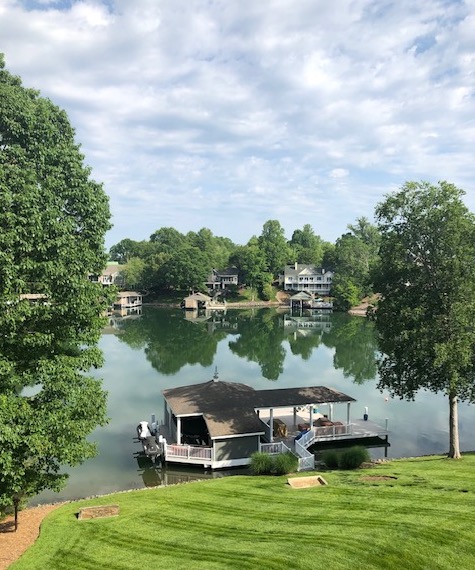
Smith Mountain Lake (Photo Bill Pike)
I always thought Upland Shores would make a good name for a craft brewery. Plenty of good images abound for an artist or a graphic designer to turn into a label for Penhook Pilsner, Lazy Lake Day Lager, or Shoreline Stout.
Butch and Marian had arrived earlier. They greeted us, helped us unload, and directed us to our rooms.
Next, Steve Boone and his wife, Kathleen arrived.
We received an update from Steve Hodge and his projected arrival time. Our friend, Doug Kinney was scheduled to arrive around midday on Tuesday. He opted to split the long drive from the east coast of Florida into two days.
For lunch turkey, pimento cheese, and egg salad sandwiches were available. We learned from Butch’s wife, Marian, a new kitchen technique for making egg salad. Marian walked us through the steps for No Peel Hard Boiled Eggs.
As the afternoon progressed, Steve Hodge arrived, and we all worked our way down to the boathouse. The boathouse sits firmly on the water with pleasing sight lines. The architect designed the space for the sun worshipper and the sun shy.
We uncovered the comfortable dock furniture, and for the next hour, reading, conversation, and some nodding off took place.
At some point, a suggestion was made that we needed snacks and beverages. Orders were taken, and in a blink, those requests were met.
We talked, laughed, and embraced the beauty of the lake and its surroundings. Whatever stress that we might have been carrying before our arrival was slipping away into the picturesque afternoon.
Even though our pace had slowed at the boathouse, at some point after five, Butch headed back toward the house to start prepping for dinner.
For years, Butch has tantalized our taste buds with his self-taught culinary skills. Tonight grilled salmon encased in a special rub, fresh asparagus, oil and sea salt rubbed baked potatoes, and homemade Key Lime pie would once again make us content.
We took a short before dessert walk through a section of the neighboring streets. The walk only made the Key Lime pie more scrumptious.
Between the travel, the soothing fresh air from the surrounding hills and lake, and the filling meal, bedtime came early.
Day Two Tuesday, May 9, 2023
On Tuesday morning, I went for a run. Even though I had run here before, I can’t tell you had good it felt to run in a different environment.
After the run, we had a healthy spread of food for breakfast. Marian reached out to Doug who had spent the night in Florence, South Carolina for an update on this arrival time.
Mid-morning, the pontoon boat that Dan had reserved for us arrived. Dan spent almost an hour going over how to operate the boat including the safety requirements with the manager of the rental company.
Prior to 12 noon, I was headed back to Richmond. At the church where I work, I was responsible for our last Community Conversations program for the year. I had some final preparations to complete that afternoon to make sure we were ready.
In my absence, Doug arrived, Dan took everyone for a ride on the pontoon boat, and the adventurous Dan and Steve Boone braved the nippy lake water and tried out their paddle board skills.
This excursion went well until the usually steady Steve Boone lost his balance and fell into the water. Unfortunately, Steve had forgotten to remove his glasses. When he hit the water, the glasses came off too. This unexpected splash happened so quickly that Steve had no chance to try and retrieve the glasses as they slowly sank toward the lake’s bottom.
Tuesday night for dinner, Doug Kinney and Steve Hodge fixed meatloaf, mashed potatoes, and a salad for dinner.
After dinner, the group gathered on the top deck of the house around a propane fed fire pit for conversation.
Back home in Richmond, Community Conversations had gone well. By nine, I was ready for some sleep.
Day Three Wednesday, May 10, 2023
I wanted to get an early start out of Richmond on Wednesday morning. I had been given a short list of items to bring back with me to Penhook. Heading out Patterson Avenue toward 288, I made a quick stop at Food Lion, and shortly after 7:30, I was on my way.
Despite following some driving directions from my high in the sky navigator that I thought were “nuts”, I arrived at the lake house by 10:30. I was just in time for a three mile walk around the neighborhood. Apparently, exercise was on the mind of everyone as Judy had just led the group through a yoga class.
By the time we completed the walk, it was almost noon, and I was treated to a meatloaf sandwich from the Tuesday night meal.
At some point after lunch, we had the urge to explore the lake some more. This time, the goal was to find what would turn out to be the Crazy Horse Marina.
Marian and my wife, Betsy, opted not to go on this trip, so eight of us loaded on to the pontoon boat with Captain Callow at the helm. The boat started properly, we shoved off without the dock coming with us, and we took off into the bright sunshine and blue skies.
No matter where we looked the shorelines were appealing, and gradually, the navigation devices pointed us toward the Crazy Horse Marina.
As the marina came into view, Captain Callow scouted a place to dock the boat. To the starboard side of the boat, he saw a series of empty docks/slips where we could off load and tie up.
The Captain was successful in his first attempt to land the boat. However, out of courtesy to the passengers, he opted to re-maneuver the boat for a smoother disembarkment.
With the boat secured, we made the short walk to the Los Amigos Bar and Grill. A polite and patient staff seated us.
Chips and salsa arrived, drink orders were placed, and Butch ordered two platters of an appetizer—Seared Ahi Tuna de la Playa.
We enjoyed our fellowship, and the kindness of Butch and Doug who covered the cost. Our old bladders told us to hit the restroom before getting back on the boat.
Back at the dock, we reloaded onto the boat, loosened the lines, and shoved off.
About a thousand yards from the marina, the boat’s motor cutoff. Without a sign of panic, Captain Callow attempted to restart the motor. For whatever reason, the motor would not cooperate.
A few minutes passed, again our Captain tried to persuade the motor to start, and again the motor responded—I’m not cooperating.
There was no panic, but a gentle humor about our situation started to surface.
Captain Callow left a phone and text message for the manager of the rental company. The manager who we trusted last year as a quick responder did not answer.
Steve Boone conducted a search of the boat for paddles, there were none. But, he did find an anchor with a long yellow rope line.
Of course, the line was all tangled and twisted. It took a few minutes to correct the entanglement, and this moment initiated more pitiful humor: “How many Greensboro College graduates does it take to untangle an anchor line?”
The anchor was secured and tossed overboard, and it did catch to prevent our further drifting.
Another attempt was made to reach the manager of the rental company, and again, we had no response.
In the interim, Captain Callow began to research how we might acquire a proper tow if we did not hear back from the manager.
Out of the Crazy Horse Marina, there was a Sea Tow operator. According to Wikipedia, Sea Tow was founded in 1983. It is based out of Southold, New York. The company provides assistance to stranded boaters around the world.
Captain Callow explained our situation to the local Sea Tow representative, and she provided us with information related to their pricing and what to expect upon Sea Tow’s arrival. We also learned that we could call off the tow if we heard back from the boat rental company manager.
Another attempt was made to reach the boat rental company, and we had no luck. At this point, we opted for Sea Tow to assist us. A return call was made to Sea Tow. Captain Callow and Butch provided all essential information including a payment via credit card. It took several minutes for this information to be properly collected.
While we were waiting for our rescue, Steve Boone’s wife, Kathleen, kept us all busy playing a game called “scar.” The concept behind “scar” is that each person shares the story of any scars the person has on his/her body from accidents or surgeries.
As our luck would have it, the manager of the boat rental company called just as the Sea Tow boat and crew arrived.
We explained our dilemma. The Sea Tow personnel could not have been nicer as we shared our decision not to use their services. And to make it even better, the Sea Tow manager opted not to charge us the full amount for calling off the tow.
We updated Marian and Betsy about our mechanical challenge, and explained how we had chosen to resolve it. Our wait time for the rental company’s boat to arrive wasn’t horrible. In the distance, we could see a fast moving boat angling toward us.
When the rescue boat arrived, both boats were parallel to each other as we carefully stepped on to the other boat.
We found our seats on the boat, and in a few seconds, our fifteen year old fully certified captain had us roaring toward home. It felt like we were riding in a supersonic jet fighter with the afterburners kicked on. We were blazing across the lake’s surface.
I was reminded of an Andy Griffith episode when Gomer talked about his cousin Goober outfitting a boat with a car motor. Gomer said, “ That thing will do 80, and on the water that’s fast.”
I felt like we were doing a 160. At any second, I expected the wash of exploding through the sound barrier just like Chuck Yeager did in 1947 to hit us.
The young man at the wheel looked like he had been doing this since he was five. He watched the water, checked his map guidance on the cell phone, and seemed oblivious to his wind blown passengers who were hanging on for dear life at a mere 37 miles per hour.
The ride back home (Photo Bill Pike)
Finally, our cove came into sight. Our captain kicked off the afterburners and slowed the engine. He confessed that he wasn’t the best at docking, but with guidance we gracefully snugged up to the dock.
We thanked him profusely. Steve Hodge and Doug tipped our young hero, and he was pleasantly surprised by their heartfelt gesture. I briefly thought about stooping down and kissing the dock when I stepped off, but my brain talked me out of that.
The fifteen year old captain made a quick loop and headed out of the cove. He had to return to the stranded pontoon boat and tow it back to its berth.
While Steve Boone and his wife Kathleen were preparing a black bean casserole for dinner, the rest of us sat on the deck giving Marian and Betsy a blow by blow account of this adventure. We laughed, and laughed, and I’m sure this excursion will bring even more laughter at our next gathering.
The black bean casserole and the accompanying accoutrements provided us with a delicious meal. After dinner, Butch quietly mixed some single shot glasses containing the oddly named Duck Fart. This layered drink contains Crown Royal, Bailey’s Irish Cream, and a tequila based coffee liqueur. Sweet and smooth, it would be easy to have more than one, but I held to a single shot.
Again the filling meal, the Duck Fart, and the afternoon excitement on the lake made me sleepy, so I headed off to bed.
Day Four Thursday, May 11, 2023
Early on Thursday morning, I took another run. It was a perfect morning for a run, a bit on the cool side with the sun rising over Penhook. I enjoyed it as much as my Tuesday morning run.
And I found my standard greeting that I use at home when I encounter a walker or runner worked here too. When people ask how I’m doing, I state: “Slower, older, and no wiser.” They chuckle, and I wish them a good day.
Thursday morning’s breakfast had been reserved for Butch’s famous oatmeal—steel cut oats, cranberries, chopped apples, and walnuts.
Breakfast, my favorite meal, was yummy every morning, and that was because Dan and Judy were the coordinators and suppliers of all the breakfast goodies.
We were hoping our pontoon boat might return, but that wasn’t happening.
Before we took off on a mid-morning walk to explore the side streets in the neighborhood, we had a treacherous task—taking a group picture.
Our intrepid boat captain, Dan, took the lead in coordinating our cooperation.
It was a tough job. He had to —stage us, set the timer on the iPhone’s camera, scurry into a predetermined spot for himself, hope that no one’s eyes were closed, that no one snarled instead of projecting a smile, and that no one was slouching.
Despite consecutive imperfect photos, we finally got the hang of it, and a couple of photos were accepted.
After the walk, Butch, Dan, and I tried fishing off the dock of the boathouse. We added canned kernels of corn to some of the casting lures, but these mountain lake fish were too smart for us city slickers. Steve Boone was hoping that we might miraculously snag his lost glasses, but that wasn’t happening with these lightweight lures.
After lunch, we gradually found our way back to the deck of the boathouse. It was a lazy afternoon. This setting was the perfect place to daydream. In any direction, at that very moment, the sky and lake had the capacity to cast us many miles from here.
Relaxing at the boathouse (Photo Bill Pike)
As the afternoon pushed on, some dozed, and at just the right time, drinks and snacks magically reappeared. In my sluggishness, I realized that unlike previous visits, we hadn’t pitched horseshoes or played corn hole. Maybe we really are getting older.
For our last dinner, Betsy and I provided grilled chicken, a pasta salad, and a marinated salad featuring green beans, peas, shoe peg corn, green peppers, and red onion. For dessert, we continued to enjoy a variety of baked chocolate treats courtesy of Betsy and Kathleen, including oatmeal raisin cookies that Doug loved.
Unfortunately, some of the dinner conversation revolved around packing up and making sure the house was back in shape before our departure.
Once the kitchen was cleaned up from dinner, I asked Steve Hodge if he would let me take a closer look at his vintage 1966 Epiphone twelve string electric guitar.
Steve and the twelve string Epiphone (Photo Bill Pike)
In the fall of 1971 during our freshman year when I first met Steve, bands and guitars were a part of his life. Even now, he regularly plays in two bands, and yes, he still has quite a collection of remarkable guitars.
Before bed, we gathered on the deck outside the kitchen for more conversation.
Day Five Friday, May 12, 2023
Of course, Friday morning arrived to soon.
After breakfast, everyone scurried around to repack suitcases and coolers.
A vacuum cleaner wailed loudly, trash cans were emptied, bathrooms tidied up.
The boathouse and house decks were rechecked.
One by one our cars filled back up.
Slowly, we said our goodbyes and started our exits up the steep curvy driveway.
Doug was first. Of course, once out of the driveway, Doug turned his car the wrong way to leave the neighborhood, and on cue, we all started waving and yelling at him. He figured out his mistake, and quickly redirected his car.
Steve Hodge made it halfway up the driveway when he started to angle off into a landscaped bed, Again, our voices rose to stop his misguided ascent.
At the base of the driveway, outside the garage, I repositioned our car. No way in hell was I going to attempt to back up this driveway.
But in defense of Doug and Steve, aside from my return to Richmond on Tuesday, none of our cars had left the neighborhood since we arrived. We were to content to stay put and relax in our friendships and the beauty of the setting.
We made it to Lynchburg safely, and dropped Dan and Judy off where we had found them on Monday.
During the afternoon, we received confirmation that our pals had returned safely to their destinations. I miss them already.
We started to get to know each other in the fall of 1971, our freshman year at Greensboro College.
And while, I’ll probably never figure out the gravitational pull that aligned these friendships for all these years, I think it might have something to do with the game that Kathleen introduced us to as we waited for a tow on the tranquil Smith Mountain Lake.
Kathleen’s game “scars” pushed us to recall the exterior scars from injuries cause by accidents and suture skirmishes with doctors.
But, I think, the longevity, the endurance of our friendships is grounded in our loyalty to each other when our hearts have been scarred by life.
No matter our hardships, regrets, shortcomings, frustrations, hurts, mistakes, and the flat out meanness of life, the loyalty in our hearts for each other has never wavered, and God willing it never will.
And there is one more piece to that loyalty, with deep respect, we know how to make each other laugh.
Love you all.
Be safe.
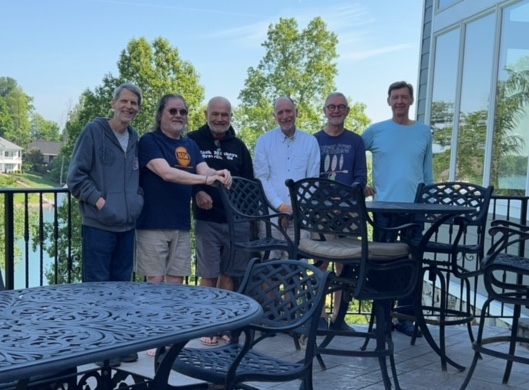
From left Steve Boone, Steve Hodge, Doug Kinney, Bill Pike, Butch Sherrill, and Dan Callow (Photo Courtesy of Dan Callow)
As Americans, we should be disgusted with this headline: Another School Shooting. Additionally, we should be angered by the predictable post-school shooting coverage: what we know about the shooter and the victims, shooter purchased guns legally, shooter’s family sought help, legislators at an impasse on firearms.
In 1975, I started my career in public education. Nothing in my undergraduate education classes, student teaching experience, orientation for my first teaching job, nor my post-graduate courses prepared me for a student bringing a gun to school.
But by the late 1980s, when I was an assistant principal at a large high school in Henrico County, Virginia we started encountering the random student who brought a firearm to school. Luckily, from those discoveries, we never had a shooting.
As school shootings began to increase, school systems and legislators scrambled to address school safety. Student codes of conduct were rewritten, schools developed safety plans, police resource officers were assigned to schools, and legislators attempted to enact laws to make schools safer.
Despite these efforts, we have failed our students, their families, and our teachers. No matter if a school shooting is on the grounds of private or public schools, this is unacceptable behavior.
School shootings are horrendous tragedies, but schools have another challenge in their environments— disruptive students. Students who violently disrupt the school day create another level of trauma for their peers, teachers, administrators, and their communities. Their outbursts create fear, impact morale, and cause injuries.
School systems in Virginia are required to report student discipline infractions and subsequent dispensations to the Virginia Department of Education. We have lots of data about our public schools, but I wonder how we are using that data to make our school environments safer and more conducive for learning.
This combination of firearms and unruly behaviors does not help the morale of teachers and staffs, nor the recruitment of new teachers. How many teachers resign at the end of each school year because of these on-going discipline challenges, and how many prospective education majors rethink their career choice for the same reasons?
Additionally, we must ask how do shootings and violent outbursts impact parent decisions as to how their children receive their education. Will these parents more carefully consider home schooling programs or private schools?
I don’t sense that we can legislate or fund our way out of these very serious recurring problems. So, what can we do?
For too long, our public schools have been asked to solve our societal problems. I’m sorry, but schools can’t solve the on-going malignant cycles related to poverty, employment, housing, nutrition, mental/physical health, and the erosion of our families.
That erosion and the instability of our families can no longer be ignored. In an August 2022 report issued by the Annie E. Casey Foundation, “nearly 24 million children live in a single parent family in the United States, or about one in every three kids across America.”
Parenting in the best of circumstances is challenging work. Yet, how many of our school shootings and aggressive disruptive behaviors can be attributed to an unstable home or ineffective parenting? The erosion of our families can also be seen from another angle in the staffing of our schools. Many schools now employ a family advocate.
Furthermore, we must ask— are our current education templates working? Can our present education models meet the extreme needs of disruptive students who have not found success in school? How can we use our unlimited data to develop more effective models of curriculum and instruction for unruly students?
As far as guns, it is very clear to me that we care more about our right to bear arms than we do about the rights of our children and teachers to be in safe schools.
A June 2021 survey conducted by the Pew Research Center found: “Four-in-ten US adults say they live in a household with a gun, including 30% who say they personally own one.” How many of those guns might find their way to a school shooting?
In a few weeks, we will forget about the tragedy in Nashville. Sadly, the families impacted will never forget. Our brains don’t have an erase button.
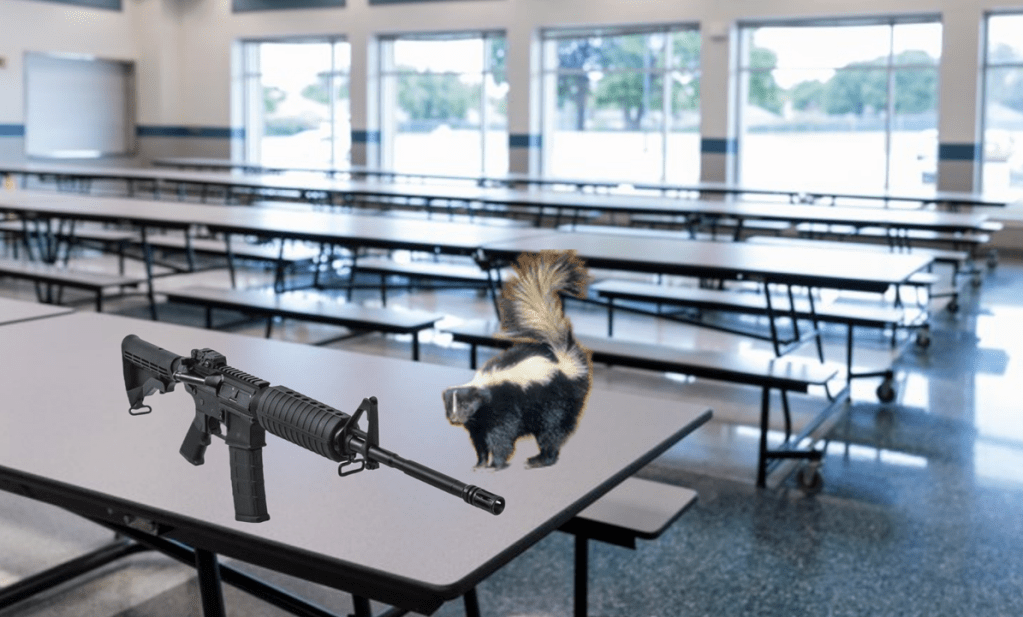
And before we know it, we’ll be reading about another school shooting catastrophe.Right now, you, me, we, us—we are all the skunk on the table.
Until we find the courage to break the silence lodged in our hearts on school safety, that skunk’s stink will continue to reek all over America. Our hearts know this silence is unacceptable.
Late on the afternoon of Sunday, April 9, the whirlwind started.
My childhood pal, Joe Vanderford, arrived from Chapel Hill, North Carolina.
For the Osher Lifelong Learning Institute at the University of Richmond, Joe and I would be presenting a two part class on The Beatles.
On Monday evening, the first part of the class was a screening of the Beatles’ film, Let It Be.
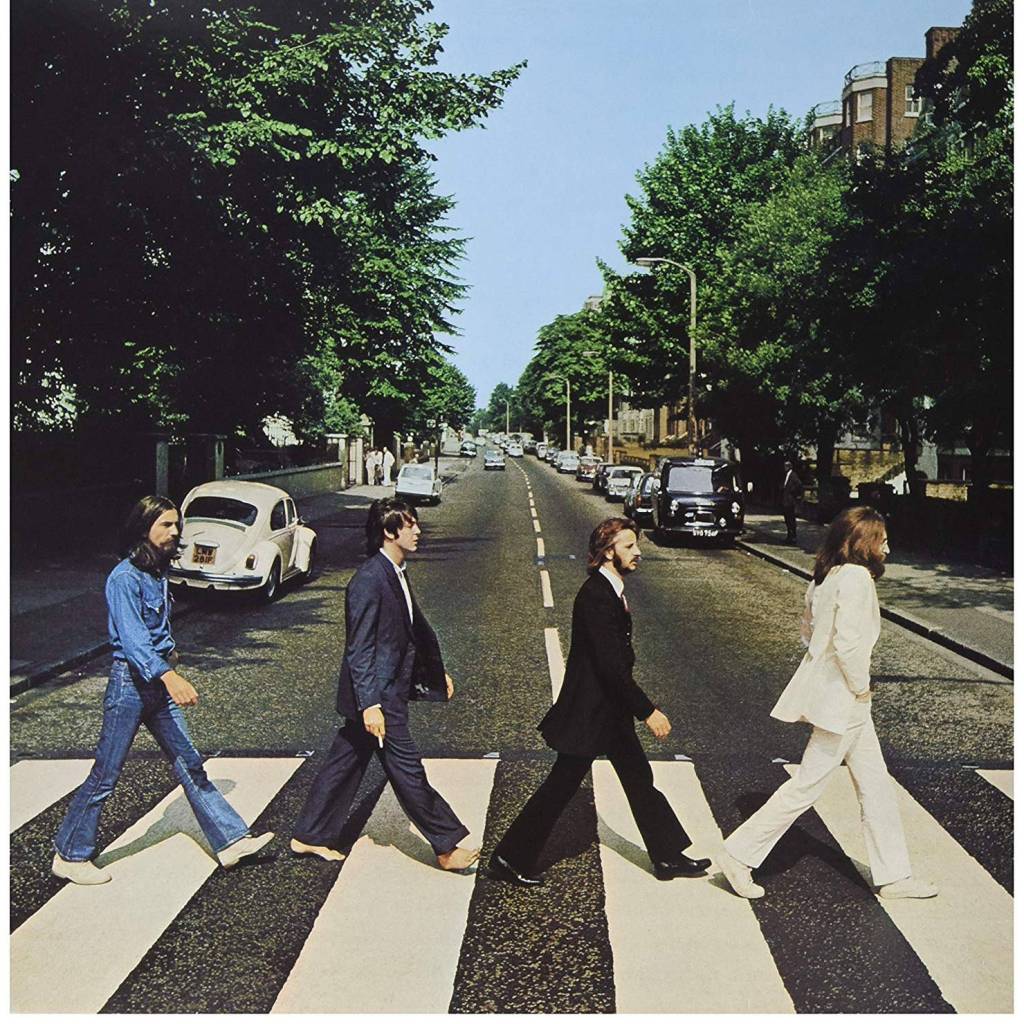
Part two of the class is focused on the Beatles’ album Abbey Road.
Joe and I started our final preparations after dinner on Sunday evening. We picked up again on Monday, and made a few last minute tweaks early on Tuesday morning to our scripts.
Our class started at 10, and by 12 noon we had completed our presentation. On the drive back to our house, we critiqued our work.
At the house, Joe prepped his belongings for an afternoon of flying. He was traveling to Toronto for a NBA game where he would be one of the camera operators.
We drove to the Richmond airport without a hitch, and later that evening Joe texted to confirm his safe arrival in Toronto.
I spent Tuesday evening in a whirlwind of packing. The Commander Supreme and I were driving to Summerfield, North Carolina on Wednesday.
We would be providing childcare for two of our grandchildren, while our oldest daughter and her husband took a trip to Napa Valley, California. This was an early birthday celebration for our daughter who was turning forty as was a dear friend from Chicago. The friend, her husband, and two other couples from Chicago were heading to Napa as a part of this birthday weekend too.
Clearly, I over-packed, but I wanted to be able to do some yard work in Summerfield. The back of the car had a few tools, some deer proof plants for an empty border in their backyard, and lots stuff purchased by the uncontrollable shopper, Nana, who is always looking for ways to spoil her grandchildren.
Since we last made this trip on March 24, the rolling landscape along the four lane highways 360, 58, and 29 had filled in nicely with assorted shades of spring green. That thickening green was now concealing the sight lines into deep forest and side roads that veered in multiple directions
By mid-afternoon, we had arrived safely in Summerfield. We unloaded the car, and started to learn the details of the calendar and the schedule we would be keeping the next four days.
Thursday morning came early for our daughter and her husband. They quietly left the house for the short drive to the Piedmont Triad International Airport.
When I was growing up in Burlington, this airport was named the Friendship Airport. In the kitchen of our house, a radio sat on a formica countertop. It was tuned to a station in Greensboro.
I recall hearing from the airport early morning broadcasts of the daily weather forecast. In the winter time, as a student, I was always hoping for a prediction of snow.
After lunch on Thursday, we drove to the Greensboro Science Center on Lawndale Drive. If you have never been to the Science Center, you must go, it is a jewel.
This was spring break week. The Science Center was packed with children and families. Assorted day cares and private school students were on the grounds too.
I saw lots of children and students wearing a wide range of matching colorful t-shirts. The variety of colors among the t-shirts reminded me of the array of spring floral colors exploding around Greensboro.
After the Science Center, we visited Ollies for ice cream. Ollies was busy too. Their staff was hustling to keep up with the steady flow of customers. I always struggle to make a selection from all of the flavors. Staring into the display cases, more bright colors from all those flavors catch my eye, and I finally settle on key lime pie.
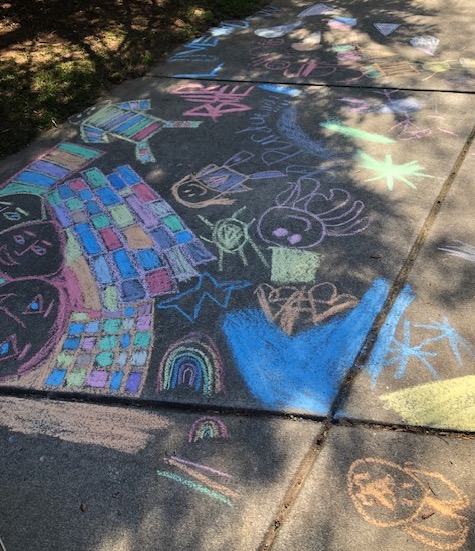
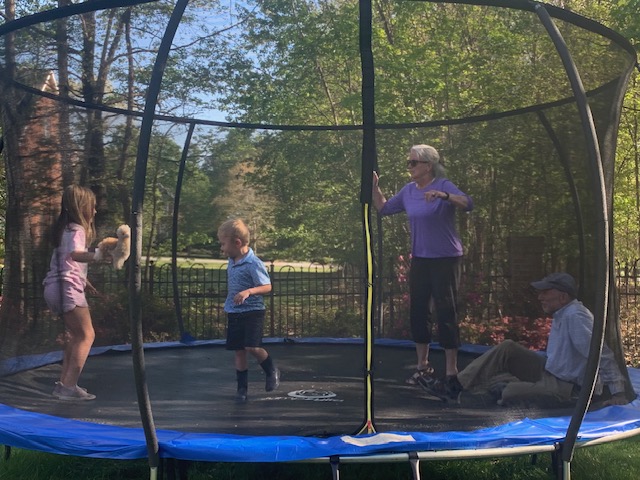
For the next three days, chalk art on the driveway, shooting hoops, puzzles, trampoline jumping, playing with neighborhood kids, quiet time, and making Nana laugh kept us busy.
Drive way chalk art (Photo by Bill Pike)
No matter the role Nana was given to portray in playing with Caroline and Hudson, I could always hear laughter from her. Sometimes, Nana laughed so hard at Caroline and Hudson’s antics and comments that she was on the verge of tears.
The return flights to Greensboro had no hitches.
Monday morning, it was back to school routines for Caroline and Hudson.
We heard how nice the trip to Napa had been, and we delivered a good report about taking care of Caroline and Hudson.
The Commander and I packed up our car, said our goodbyes, and retraced our drive to Richmond.
Taking care of grandchildren is a different kind of whirlwind.
But, neither of us would exchange anything for this opportunity to wear ourselves out burning energy with grandchildren.
And, I would never trade anything for Caroline and Hudson making their Nana laugh.
On the morning of Saturday, April 22, I had orders to be at the home of our son and his wife by 7:15. Our daughter-in-law and their five year old daughter were runners in the Monument Avenue 10K. Their daughter was a participant in the kids one mile fun run. Her mother was running the full 10K/6.2 miles.
I made it to the house by the appropriate time. Soon we were loaded into the car driving toward the start line. Our daughter-in-law squeezed into the back seat between the two car seats holding their daughters. Along the way, we searched for out of state license plates and counted overpasses on the Downtown Expressway.
Our son’s pre-race search for parking put us in a VCU lot with a reasonable fee and a tolerable walk to the start area for the kids run.
Crossing the busy intersections on the walk to Monroe Park, we encountered friendly City of Richmond police officers who were patiently directing vehicles and pedestrians. The parents of our son’s wife met us in Monroe Park. This city landmark was a mass of humanity from corner to corner.
All types of vendors were stationed in the park for the post-race celebration and a mass of blue and white port-a-johns were positioned at the end of the finish line. No matter the direction, people were in motion.
We made it to the start area for the kids run, photos were snapped, an announcer offered encouragement, and in a blink they were off. As we started our walk back to the finish line for the kids run, I ran into my friend, Jonathan Austin. You can’t have a Richmond event without Jonathan sharing his magic, juggling, and humor.
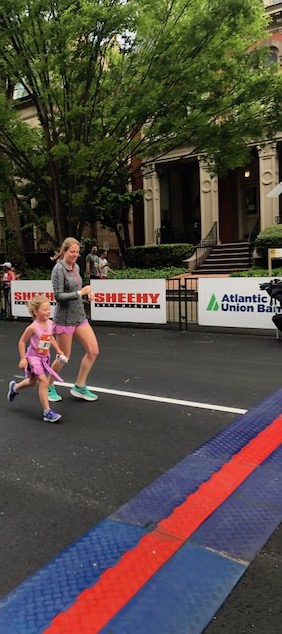
Near the finish line, we positioned ourselves with good sight lines to see the runners as they completed the run. Race organizers had wisely created companion bib labels so that parents could run with their children. Soon we saw, our twosome coming into view. Their sprint to the finish line revealed two happy faces.
Our two runners(Photo by Bill Pike)
More photos were taken of our finishers, and now the logistics shifted again. As she walked off to the start line for the 10K, her daughters wished their mother good luck.
A long time ago, I ran in the Ukrops Monument Avenue 10K. I still have the t-shirt from the race. The front of the shirt has beautiful artwork created by children and youth who had been impacted by childhood cancer. I still miss the customer friendly Ukrops grocery stores, and sadly, despite our efforts, cancer is still an unwanted demon in all age groups across America.
My old t-shirt (Photo by Bill Pike)
We worked our way to the median just passed Stuart Circle and found a good spot on the curb to wait for the lead runners. Behind us, on the the other side of Monument, spectators cheered for the runners who had just started.
I’m sure many people will disagree, but as a runner, I always felt one of the best things about a road race is this— for a few hours part of a city is shutdown. It is quite a feeling to scamper down this still beautiful avenue knowing that for a short period of time runners have no worries in the world except to make it to the finish line.
It wasn’t long until we could see the flashes of blue lights from police vehicles and the pace car in front of the lead runners. Two male runners were in a tight side by side battle for the lead. More fast paced runners began to appear, including the first woman in the group who was sprinting at a blistering pace.
All kinds of humanity rolled by us. Neon colored running shoes were quite a splash of color as they pounded across the faded gray brick pavers. Some runners showed weariness in their faces, while others looked fresh, undeterred.
Our son spotted his wife in a crowd of runners, we all cheered and waved in support. We regrouped and started the walk to the finish line.
Along the way, we admired the architecture, the variety of music being offered, and the enthusiasm of the PA announcer cheering runners across the finish line.
It isn’t easy to stage this 10K. The logistics and planning details are endless. Richmond Sports Backers, the corporate sponsors, and all of the volunteers must be commended.
This whole event pivots off people. I want to know— why are we so considerate and compliant in this setting, and at other times, we are the exact opposite.
We found our way back to the car and headed home.
Thanks Richmond for another successful Monument Avenue 10K.
And to borrow the title from a Neil Young song, “Long May You Run.”
On the afternoon of Tuesday, April 11, I was surprised that my brain was replaying songs from the Beatles’ album Abbey Road, and scenes from the movie Let It Be. That movie captures the Beatles at work in the studio recording an album also to be titled— Let It Be.
One minute, I could see and hear Paul McCartney teaching his bandmates the chord changes for the song “Maxwell’s Silver Hammer.”
Minutes later, I’d hear John Lennon playing an acoustic guitar and singing a demo for his song “Mean Mr. Mustard.”
And, I love recalling the Let It Be scene where Beatles’ drummer, Ringo Starr, introduces his song “Octopus’s Garden.” At the piano, Ringo plays a few chords and sings the early lyrics.
His bandmate, George Harrison, likes what he is hearing. George walks over to the piano with an acoustic guitar matches the chords Ringo is playing and offers suggestions for finishing the song.
And while the entire Abbey Road album is special, I’m not sure there is a better sequencing of songs starting with “You Never Give Me Your Money” and concluding with the cleverly placed twenty three seconds long—“Her Majesty.” The Beatles called this section of songs “the long one.”
For my teaching partner, Joe Vanderford, and I, our class, Let It Be, and Get Back To Abbey Road, presented for the Osher Lifelong Learning Institute at the University of Richmond was the end of another “long one” for us.
Let It Be, and Get Back To Abbey Road marked the sixth class that Joe and I have developed for Osher. Once our proposal has been accepted, we start our work. Our template for developing a class is usually linked to a documentary about the recording artist. We offer a screening of the documentary the night before our class. The following day, we present our class with a focus on significant recordings by the artist.
Our class presentation depends upon rigorous research including reading books and articles from assorted periodicals, and careful scouring of the internet for videos to help tell the story. Months before our presentation, we develop a working outline that is used to create a PowerPoint program. For us, the key to not dying by PowerPoint is to incorporate a balance of the obvious and not so obvious. A seldom scene video or a rare outtake of a song can help to engage a class.
On the evening of Monday, April 10, as the class watched Let It Be, it occurred to me that The Beatles were very skilled at disrupting lives.
January 30, 1969 was a gray, cold, windy day on the rooftop of Apple Records headquarters in the Saville Row section of London, England. But on that day, John, Paul, George, Ringo, and American keyboardist, Billy Preston, played a forty-two minute set of songs.
From that rooftop, as soon as the first chords and vocals began reverberating off the sides of buildings and the wooden plank platform where the band was playing—a disruption occurred.
People scrambled to adjacent rooftops to see and hear what this sound was. The same scurrying was happening on the street below. Necks were craning skyward trying to catch a glimpse of the famous band.
That spark of sound spread quickly, and soon the sidewalks and streets became crowded and at times impassable. And as you might expect, London’s police “the bobbies” appeared. The placement of cameras in every conceivable place by film director, Michael Lindsay-Hogg, was magnificent in capturing this disruption.
The Beatles were no strangers to disruption.
On February 9, 1964, the Beatles disruption in America started with their first appearance on the Ed Sullivan Show.
When the Beatles toured America in the summer of 1966, the tour was overshadowed with a disruption—John Lennon’s comment about the Beatles being more popular than Jesus Christ. And it was on this tour, on August 29, 1966, that the Beatles played their last concert in San Fransisco’s Candlestick Park.
The next four years proved to be a roller coaster for the Beatles.
Their much acclaimed album, Sgt. Pepper’s Lonely Hearts Club Band was released. They journeyed to India to learn about Transcendental Meditation. Apple Records was started, and a collision of substance abuse, the undertow of their personalities, and the pressure of trying to run Apple Records contributed to their breakup in 1970.
Many fans and critics blamed the 1970 breakup of the Beatles on the clash of their personalities over business matters. Some point fingers at John’s new wife, Yoko Ono, and the show business attorneys of Paul first wife, Linda Eastman.
Clearly, many factors led to the breakup of the Beatles. But, I think the passing of their manager, Brian Epstein, on August 27, 1967 is an overlooked disruption. Up until that moment, all business dealings for the band had been handled by Mr. Epstein.
In a blink, business decisions fell to the Beatles to determine. Unlike the familiarity of being in the Abbey Road recording studios, the Beatles were blindly thrust into interactions with accountants, prospective business managers, and attorneys.
For Joe and me, April 10 and 11 arrived quickly. We both engaged in a flurry of last minute activities to ensure that our planning had a chance for success.
Finding that success hinges on three key pieces—weaving our research into a competent Powerpoint, our individual skills in delivering the content, and Joe’s introductions to the movie screening and the class. Joe is a master at writing the introductions. His extensive research provides the framework.
Luckily, I received good, practical help from the students at the university’s Technology Learning Center. These students were very patient in reteaching an aging geezer how to download videos into our PowerPoint.
Also, the leadership for the Osher Lifelong Learning Institute consisting of Peggy Watson, Nell Smith, Catherine Taylor, and Amy Edwards is exceptional. Joe and I valued their attention to detail, technology skills, and ability to schedule our class in the delightful Ukrop Auditorium.
And there is another benefit from teaching these classes—the Osher students. In every class, Joe and I enjoy the interaction with our generational peers. In those exchanges, we learn more about the subject matter in a variety of ways. That learning might come from the different angle of an insightful question, or some deep thinking that sheds new light on a much discussed point.
Many times in our pre-class preparation, Joe and I reflect about growing up in Burlington, North Carolina. We were lucky. Thanks to our parents, we experienced few disruptions.
I’m glad that our mutual love of music disrupted our lives. I feel very fortunate that music for a few months each year still disrupts the normal flow of life for Joe and me through the Osher Lifelong Learning Institute.
Gradually, the snippets of song and film fragments from Let It Be, and Get Back To Abbey Road will subside in my brain.
And yet, I wonder if George Harrison and John Lennon had lived if the Beatles would have reunited in the studio or on a concert stage?
Life is full of “what if” questions.
And here is another one to ponder.
In our constantly chaotic world, what would it be like if we had followed the Beatles advice as they closed out the “long one” on Abbey Road? Remember these lyrics: “And in the end, the love you take is equal to the love you make.”
Doesn’t our world deserve to be disrupted with love?
After all, the Beatles reminded us a long time ago— “all we need is love.”
Author’s note: Joe and I thank our wives for supporting this annual journey, and a special thanks to our youngest daughter, Elizabeth Pike, who at the last minute figured out how to load in a stubborn video.
At the church where I work, the staff has been forming Holy Week plans for months. A lot has been considered.
We’ve discussed the merits of banners on the front lawn to advertise our Easter services. Personally, I think you could display a banner upside down, and no one would notice.
Cars out on Forest Avenue are zipping by our church at speeds ranging from 35 to 45 mph. At those speeds, I don’t think drivers nor their passengers are paying much attention to a church banner. But, I’m sure the companies who make the banners love the blurred vision of churches.
For the sunrise service, we talk about hospitality. Chairs become part of the discussion. Should we have chairs for this outdoor service or should we go chairless? My guess is no chairs were around at the base of the cross or at the tomb where Jesus rose from the dead. But, we decided to have chairs available, just in case someone has a need.
In the life of the church, Lent and Easter, like Advent and Christmas are significant.
As a lifelong whiner, I wish Easter was on a standard date— like the first Sunday in April.
But of course, I’m assuming that long established ancient church formulas are used for calculating Lent and Easter dates. Clearly, there is no chance of changing a template that has been chiseled into a stone tablet for centuries.
My biggest concern for Sunday’s indoor Easter services are the whims of erratic human thermostats. God and his weather pals in heaven are not making this easy. For example, tonight, Wednesday, April 5, the low in Richmond is forecast to be 67 degrees, Saturday night 39 degrees.
Unlike Christmas, Easter is a tough sell.
Christmas has the joyfulness of the birth of Jesus, and Easter the heart-rending death of Jesus. These are two challenging extremes for pastors to wrestle with in prepping their sermons.
And yet, I wonder if a pastor has ever stood before a congregation at Christmas or Easter, and said, “Hey folks, I have three degrees in theology, I’m 50 years old, and I’ve been preaching the birth and death of Jesus for over twenty years, and in my heart, I’m not sure I really understand these scriptures.”
In truth, at this stage in my so called Christian life, I would find that honesty from a pastor’s heart refreshing, because I’m not sure that I understand either story, especially the death of Jesus.
From Matthew 27:46, I struggle with these words spoken by a disgraced Jesus on the cross: “My God, my God, why have you forsaken me?”
I think Jesus is asking a fair question.
Right now, somewhere in this world a person is asking the same question of God.
This week, an oncologist told a husband that his wife of a lifetime has three to six months to live. The husband wants to know why God has forsaken this loving couple.
Families in Nashville, Tennessee want to know where God was when their loved ones were gunned down in a school building.
The homeless person asking for assistance at the intersection of Broad and Parham must in some ways feel forsaken. The greater question is— why have I forsaken this person at the intersection?
I wonder how God felt when he heard Jesus ask: “My God, my God, why have you forsaken me?”
I imagine those words penetrated God’s soul just like the harshness of the wounds on the body of Jesus.
And you know what else is troubling to me about the death of Jesus is the mentality of his crimeless conviction.
Today, no matter where we look our world is a mess. Our division, our hatred, our fears driven by the quest for power, and the lack of love are troubling.
Despite this messy world, I do find the occasional smidgen of hope when I sense that prayer has worked.
I love the story from a neighbor who tells me how her teenage daughter has found her way as a high school freshman.
At a family gathering, I see the slightest shift in the heart of a frustrated father and his youngest daughter.
I love the servant heart of Ray at a local food pantry. Clearly, life has tested Ray. But on Thursdays when I drop off food, Ray’s energy, compassion, and dedication are inspiring.
Yes, my heart will continued to be troubled by—“My God, my God, why have you forsaken me?”
But maybe I can counter the sting of those words, and the injustice of the cross by never letting go of the hope found in love and prayer.
This Easter, Bill, the grumpiest of whiners, prays that you and your family find hope and love.
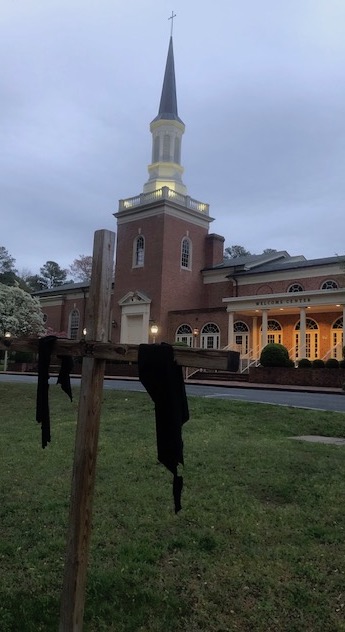
The morning of Good Friday, April 7, 2023 (Photo by Bill Pike)
By 7:23 on the morning of Friday, March 24, we were on our way to Summerfield, North Carolina.
My wife, the Commander Supreme, was driving. We were heading to the home of our oldest daughter and her family. It was a yard work weekend. A huge load of pine bark mulch was waiting for us.
To make this trip, we go the back way, no interstate intensity, just four lane US highways. I love riding this time of the year with winter saying goodbye and spring arriving. I can still peer into the woods as the kudzu, honeysuckle, briar vines, and the underbrush of scruffy pines and stubborn hardwoods haven’t fully sprouted into their seasonal attire.
Sadly, the road’s shoulder reveals the faults of litterbugs. I wonder how long a wind blown plastic retail bag has been dangling from the bare limb of a tree?
Deep off the road bed, I occasionally spot a collapsed building with a toppled, rusted roof still trying to protect its contents.
Sporadically, weather beaten cars and trucks appear on someone’s homestead. It appears time and the rightful owners have forgotten them.
As they roll by me, there is a weariness in these landscapes. Failed business, shuttered restaurants, and side roads that meander off into the distance. I wonder if they lead to more portraits of hardships?
Somewhere on 360 in Amelia County, we come upon a succession of school buses. To me the students who ride those schools buses can be a counterpoint to a dismal landscape. Those students might just be the hope a family and a community need to bring about change.
In Danville, we make the turn off US 58 to US 29, the Commander Supreme points out to me a location that is etched in her mind forever. On the afternoon of Sunday, January 22, she sat on the roadside for four hours with a flat tire waiting for AAA to respond.
We cross into North Carolina, and eventually, we reached our destination. True to his word, our son-in-law has a mountain of pine bark mulch waiting for us at the back of the concrete driveway.
After hugs and unloading, we start work prepping the borders in the backyard for the mulch. Our afternoon of work was productive, and we were more than ready for some perfectly grilled cheeseburgers for dinner.
During dinner, we learned the logistics for opening day at the Summerfield Little League. For our grandson, Hudson, this was his second year of playing with the four and five year olds.
On Saturday morning, we were greeted with gray skies that quickly dropped steady rain showers and some rumbles of thunder. Check of the radar revealed this was a quick moving disturbance. League officials canceled the first game of the morning, but Hudson’s game was still on for ten.
We arrived at the fields and parked. Armed with a ground tarp, a blanket, two chairs, umbrellas, and two small coolers holding snacks for the team, we set up our space near the Pirates’ dugout.
Each team had a different approach for warming up their players, and soon both coaches indicated the desire to start the game.
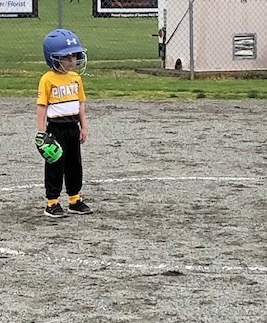
This year, Hudson is a Pirate. He and his teammates were decked out in black and gold just like the Pittsburgh Pirates in the National League. A bonus this season is that each player on Hudson’s team had their last name printed on the back of their jerseys.
For this age group, these practices and games are really an introduction to baseball. No score is kept, no outs recorded, no errors marked on a score card, and players with all kinds of personalities and a wide range of skills play.
The coaches pitch to each of their players. Players have an opportunity to try to hit four slow pitches. If they fail to connect, the player then hits from a tee.
When a batter makes contact with the ball, the batter runs to first base.
An infielder who traps the ball with his glove throws toward first base.
No matter if the fielder’s throw by a miracle makes it to first base ahead of the runner, the runner is safe.
In fact all hitters will eventually fill the bases and all will gradually make it to home plate after the team has batted around twice.
And while the game might be grueling anguish for anxiety filled parents, for an old grump like me I loved the stress free, humble openness of the players on the field.
The mild collision between two fielders going for the baseball as the ball rolls freely between them is pure slapstick comedy.
I respect the daydreamer at shortstop, and I wonder how far away his mind is when his teammates alert him about the slow roller coming his way.
I love the patience of the coaches who work with the hitters no matter if they chop at the ball, swing early or late, or struggle with their stance.
I can’t tell you how many times I chuckled at the purity of both team’s unblemished antics. Silently, I thank them for making me laugh.
We didn’t stay for Hudson’s second game. Our daughter and son-in-law gave us a pass so that we could pick up new plants for a border that was going to receive a new look.
Earlier, when we were walking toward the Pirates’ dugout, I watched a parent pitching to his son in a batting cage. Before each pitch, the father said to his son—“relax.”
Oh, to be able to relax.
What might this old world be like if you, me, we, us for a few minutes could relax?
Stress, tension, pressure, hardships, worries, division could not frazzle us into our normal useless frenzy.
Clearly, I’m daydreaming like that five year old playing shortstop.
And yet, I think it is ok for a grumpy, rapidly aging geezer like me to daydream like a five year old.
Because buried in my daydream is this reminder from Romans 12:12: “Be joyful in hope, patient in affliction, faithful in prayer.”
On Sunday morning, March 12, I was talking with my long time educator friend, Bruce Watson. We were in the Welcome Center at our church catching up for a few minutes.
Bruce asked me if I remembered Pearl Clark. Pearl had been an assistant principal at Hermitage High School where I also served as an assistant principal. Prior to coming to Hermitage, Pearl had been an exceptional English teacher at Douglas Freeman High School.
Sadly, Bruce told me that Pearl had passed away on March 3. A visitation had been held on Friday, March 10, and a funeral service on March 11 at Good Shepherd Baptist Church.
I was floored at this news.
I couldn’t believe that I had missed Pearl’s obituary in the Richmond Times-Dispatch. The announcement had been in the paper on Thursday, March 9, and yet somehow, I skimmed right over the on-line listing in the paper. I was really angry at my carelessness.
As an assistant principal at Hermitage, we could not have had a better teammate. Pearl was everything that an assistant principal was supposed to be. She was fair, consistent, a good listener, diplomatic, gracefully supportive, a hard worker, a professional.
Additionally, Pearl was respected in the community—a role model, a person who always cared for the well-being of all.
In her fifty three years of marriage to her husband, Shady, they made a good pair. Shady’s work with the Virginia Department of Education and his leadership as a pastor for a local church complemented their giving personalities.
Pearl loved their daughter, Shanetia. She was always humbly proud of Shanetia’s academic accomplishments, earning a PhD, and becoming a tenured university professor.
One summer, I remember catching a ride with Pearl to a staff development program. It was quite a nice ride in Pearl’s four door Mercedes sedan.
When I left Hermitage to accept an appointment as principal at Lakeside Elementary School, if our students met their reading goal for the year, I always tried to do something wacky on the last day of school.
One year, Pearl, and Hermitage’s Director of Guidance, Casey Berry, showed up to watch my attempt to be a ballet dancer in a pink tutu. I was horrible up on that auditorium stage, but the students roared in laughter at my pitiful performance. That’s a good way to end a school year with laughter, better readers, and two loyal friends watching my foolishness.
As I began to tinker more with words, our first book, The Last Pumpkin, was developed. I asked Pearl if she would be willing to provide me an endorsement that would be featured on the back cover.
I was honored that Pearl accepted, and she wrote these perfect gentle words: “A timely autumnal reminder for all of us to acknowledge the positiveness in all children; they are all keepers.”
As an educator, wife, mother, sister, and friend, Pearl was a keeper too.
Unfortunately, the cruelness of Alzheimer’s disease wore Pearl down.
In the few brain cells that I have left, it seems extremely evil and heartless for Alzheimer’s to claim an educator. The brains of educators spend their careers remembering hundreds and thousands of names of students, parents, and staff members. Because of the depth of this recall, I would argue that God should issue a pass on Alzheimer’s attacking educators.
Since Pearl was a Deacon in her church, maybe she can make an appointment in Heaven with God and discuss this suggestion.
Pearl, I’m sorry I missed your obituary. I should have done better with that whole process. And, I apologize for not attending the visitation and funeral. Again, I could have done better.
I have good days and bad days when I read the Bible. Yet, there are some verses that I continue to hold deep inside my imperfect heart.
Pearl, when I ponder John 1, verse five, I think of you: “The light shines in the darkness, and the darkness has not overcome it.”
Alzheimer’s might have made the last days of your life dark for you and your loved ones, but its meanness could never overcome the light that Pearl Clark brought into this world.
When I see the sun rising in the East, the moon sparkle off a dark silent bay, a star streak across the Western sky, and the flicker of a candle reflect off a window pane, I will think of you, and the light you brought into this world.
Thanks for being my friend, and thanks for being a light to us all.
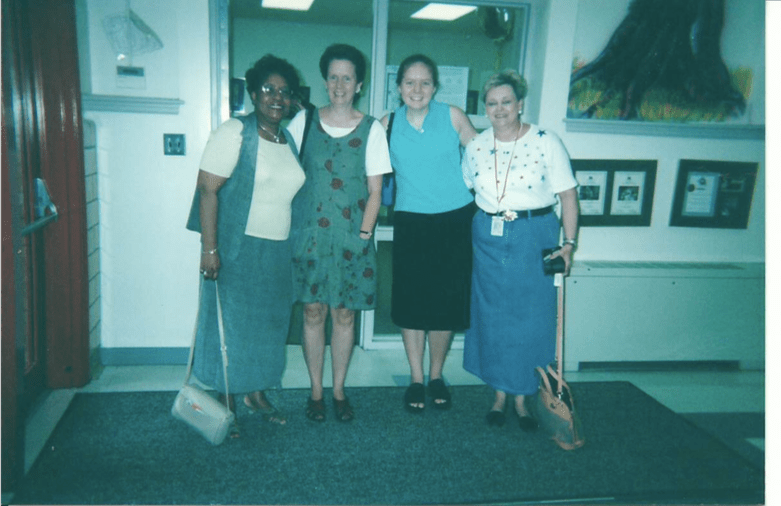
From left to right: Pearl Clark, Betsy Pike, Lauren Pike, Casey Berry.(Photo from a last day of school in the lobby of Lakeside Elementary School)
In August of 1975, I started my first teaching job at Martinsville Junior High School in Martinsville, Virginia. Nothing in my education classes, student teaching, or orientation to the school system communicated, “Look out for students who might have a gun.”
Almost fifty years later, school systems across Virginia and America are dealing with students bringing guns to school. Countless tragedies have occurred involving students and guns. No matter what we have learned from these tragedies, we still haven’t learned enough.
Shockingly, that learning continued for schools and their communities when on January 6, 2023, a first grader at Richneck Elementary School in Newport News, Virginia brought a gun to school and shot his teacher. How does this continue to happen? Are we as parents, school personnel, and citizens incapable of learning from our past tragedies?
Guns aren’t new in schools. In the late 80s and early 90s, I served as an assistant principal at a large high school in Henrico County, Virginia. Usually a tip from a caring student alerted administrators that a student had a gun on school grounds. Luckily in those discoveries, we never had a shooting.
School systems have responded to this firearm crisis with assorted tactics. Conduct codes have been revised. New local, state, and federal laws have been implemented to curb firearms on school grounds. Comprehensive safety plans are in place. Budgets support the hiring of school resource officers. Often, budgets include metal detectors for scanning students and visitors.Despite these interventions, a student can still arrive at school in possession of a gun.
Why? Simple answer: America loves guns.
A June 2021 survey of 10,606 American adults conducted by Pew Research Center found four-in-ten adults live in a household with a gun, including 30% who personally own one. That’s a lot of firearms. This doesn’t account for how many firearms are in a person’s ownership without documentation.
Compare those firearm ownership numbers to this data reported by the Annie E. Casey Foundation in August 2022: nearly 24 million children live in single-parent families in the United States, or about one in every three kids across America.
I wonder if there is a correlation in gun ownership and the erosion of American families and the parenting skills within those families? No matter a single parent, a blended family, or a traditional family, parenting is tough, demanding work. How many of the school shooting tragedies and possession of a firearm on school grounds are linked to that erosion and the challenges of parenting?
Students, parents, teachers, school system administrators and community leaders have a right to be concerned about school safety, but that safety goes beyond a student bringing a gun.
Somewhere in a school today, it’s likely that at least one student will violently disrupt the learning environment. Disruptive confrontations can include student to student, student to teacher, student to school administrator interactions. A fight involving multiple students can result in injuries to students and the school and security personnel who intervene.
No matter if a student is in possession of a firearm on school grounds or involved in violent disruptive behavior, both impact morale for non-disruptive students, parents, teachers and administrators. Additionally, that low morale factor seeps into the school’s community when these disruptions are reported in the news and social media.
Do these disruptive outbursts push parents to withdraw their children from unstable schools and switch to homeschooling programs or private schools?
The same question must be asked when a teacher resigns; was that resignation grounded in fear of violent students and personal safety concerns?
Meeting the educational needs of our children is challenging work. At this very moment, I think the tension, stress and pressure on teachers in our schools to deliver quality instruction while managing the classroom environment has become unbearable. Despite their valiant efforts, respect and support for teachers are absent.
How do we address these challenges?
Acknowledging the erosion of our families is an important step. Yes, in my career in public education, I worked with many supportive single parents. Sadly, that isn’t always the case.
Vicious generational cycles linked to poverty, inadequate housing, low employment, poor physical and mental health, insufficient nutrition and lack of safety are at the heart of this family and community instability.
In acknowledging these shortcomings, we must ask this question: are our current education templates and essential community services at local, state, and federal levels effective in meeting the needs of students and their families? If these templates are ineffective, we must have the courage to do our homework and initiate overdue changes.
Most critical is realizing that our divides, differences, incivilities and inadequate listening skills will only continue to hurt children.
Pat Conroy, the late American novelist and former educator, wrote: “I want you to know how swift time is. There is nothing as swift. A heartbeat, an eye blink, this is the way life is. It is the only great surprise in life.”
Mr. Conroy is correct; time isn’t on our side.
We are overdue to acknowledge our public education challenges, but schools cannot be the sole repairer for all that ails our country.
Diligent collaboration from every segment of our communities will be needed to improve our schools.
If we continue to align ourselves in denial, distrust, and division, we will likely destroy the schools that helped to build America.
That isn’t acceptable.
A note from the author: Friends, I was honored that my commentary: The correlation between guns, school violence and the erosion of American families was published in the Virginia Mercury today Friday, March 10, 2023. A special thanks to Commentary Editor, Samantha Willis, for her patience in working with me.