When I served as an assistant principal at Hermitage High School in Henrico County, Anthony Romanello was one of our students.
By the time Anthony was a senior, the faculty, staff, and his peers knew there was something special about him.
They also sensed no matter where Anthony’s future took him that he was going to have an impact in a positive way.
In 2025, Anthony announced that he would be leaving his job as Henrico County’s leader for economic development.
Truthfully, I was a bit sad by this announcement. I thought Anthony might become county manager in Henrico some day.
No matter the cities and counties where Anthony has served in Virginia, he has made a difference.
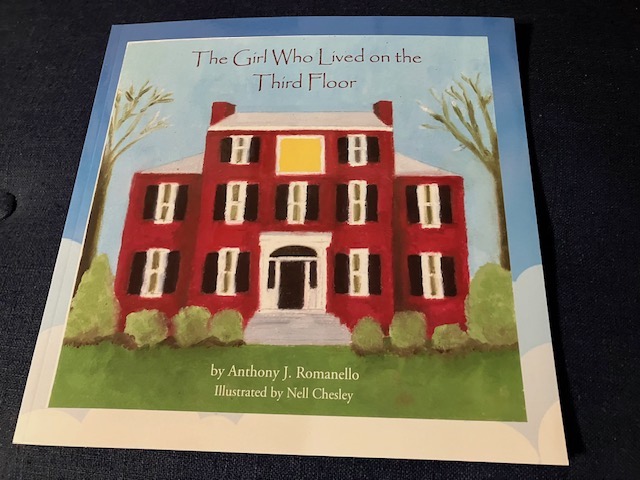
In his two books, “Random Thoughts: Reflections of Public Service, Fatherhood, and Middle Age” and “The Girl Who Lived on the Third Floor,” we learn about Anthony’s most reliable asset—his heart.
Starting with “Random Thoughts: Reflections on Public Service, Fatherhood, and Middle Age,” readers experience an up close look at Anthony’s leadership heart in action.
His heart reveals the importance of building relationships, listening, visioning, hard work, teamwork, empathy, loyalty, and two simple words—thank you.
With “The Girl Who Lived on the Third Floor,” the focus shifts to Anthony’s daily interactions with his wife, Diane, and their children. This book is based upon the commitment Anthony and Diane made as foster parents.
(Photo Bill Pike)
In 2016, with four of their own children, Anthony and Diane made a decision to adopt an eleven day old baby girl into their family.
From this adoption, we see Anthony’s heart from a different angle— an angle that reveals how his successful management skills can be impactful in a family setting too.
I believe those attributes and his compassion for people will continue to allow Anthony to grow in his new role as a managing partner for a local consulting firm.
But what I really hope is no matter how difficult the decisions might be that local leaders make, it is important for them to listen to their hearts.
When leaders disregard their hearts in making decisions, the people they serve lose.
Luckily for the people in the communities where Anthony Romanello has served, he has humbly listened to his heart.
It has been a year since wildfires devastated parts of Los Angeles, California. Recently, I have read and listened to follow-up reports about these deadly and destructive fires.
From the NPR show Fresh Air, I listened to host Tonya Moseley’s interview with journalist, Jacob Soboroff, about his new book “Firestorm: The Great Los Angeles Fires And America’s New Age Of Disaster.” Soboroff interviewed one firefighter who said, “there’s no fire season, it’s fire year.”
In truth, I feel that way about America at this time. I sense America is in a firestorm. From “sea to shining sea” and beyond our borders we are a raging hot spot.
We are burning out of control. There is no immunity. Every state and country has kindling ready to ignite.
(Photo Bill Pike)
ICE shootings in Minnesota and Oregon.
Another mass shooting in Clay County, Mississippi with six people dead. The victims range in age from 7 to 67.
A arson fire in Mississippi that burned through a historic synagogue destroying its library. In 1967, the same synagogue endured a bombing by the Ku Klux Klan.
Beyond our borders, America’s foreign policy has intense flames in Venezuela, the Ukraine-Russia war, the unrest in Iran, and the always volatile Middle East.
And despite these hot spots, the hottest, most intense fire burns in our nation’s capital.
The mentality of our leadership is fueled by greed, disrespect, incivility, selfishness, abusive power, vindictiveness, and a complete disregard for the truth.
As badly as we might want 2026 to be a better year, it is already “a fire year.”
In 1962, James Baldwin wrote in an essay for the New York Times: “Not everything that is faced can be changed; but nothing can be changed until it is faced.”
America we are overdue to face ourselves.
Author’s note: This piece was submitted to the Richmond Times-Dispatch as a letter to the editor on January 13, 2026. To the best of my knowledge, it was rejected.
I’m not sure about where you live, but here in Richmond, Virginia since Sunday, January 18, the pending winter storm has been pounding incessantly through all forms of media.
The relentless, repeating blabber is as bad as back to school and political ads.
Even my wife, my commander supreme, from the jabbering of a local television weather forecaster has asked me where the shutoff valve is for our water line.
Grocery and hardware stores are elated.
Milk, eggs, bread, snow shovels, snow melt, and batteries are gone. Gleeful managers admire their empty shelves as they scramble to restock before the monster storm arrives.
The state’s highway department is already treating road surfaces with a spray concoction of chemicals designed to melt snow, sleet, and freezing rain. The road surfaces are left streaked with wobbly white lines of the drying chemicals.
Power companies are monitoring the developing storm with deep concern as forecasts shift from snow to sleet to the most dreaded—freezing rain.
Parents with school age children are trying to figure out how they will survive if this demon storm shuts down school systems for multiple days.
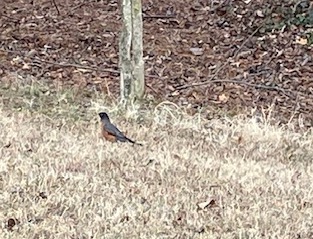
And then we have the robins.
A robin on frost bitten grass on a January afternoon. (Photo Bill Pike)
Long thought of as a sign of the return of spring, I’ve seen robins darting around our neighborhood since early January. Sorry, but there is no spring in this predicted winter storm. I hope the robins survive.
Speaking of survival, I wonder how the homeless will survive? The predicted low temperature for Monday night, January 26 is 3 degrees. That doesn’t include wind chill.
If we are the greatest country in the world, why are we unable to permanently solve this longstanding problem?
My love for winter precipitation is gone. I’m too old. That love for a snowflake has been passed on to our four grandchildren.
I hope we all survive the ferocity of this predicted winter storm.
As mighty as man pretends to be in out smarting the weather gods, I’m not sure we will ever out think a riled up mother nature.
In the post-storm days, there will be lines at car washes. Auto body shops will be giving non-stop estimates for repairs, and the noise of chainsaws and wood chippers will cascade in neighborhoods where trees have taken a tumble.
Those responsible for clearing parking lots will build mountains of snow that are piled high in out of the way corners of the lot. Like school children, these snow clearers quietly pray for another winter storm to help their seasonal bank accounts.
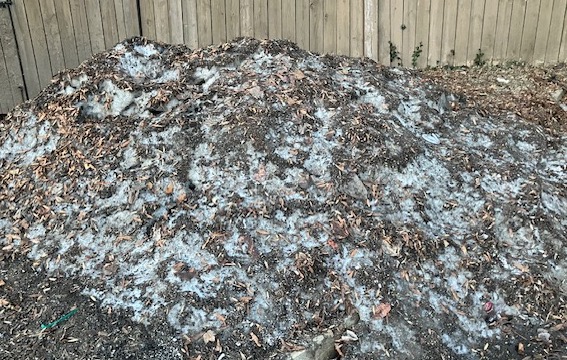
In the back parking lot of the Village Shopping Center, I’ve been keeping my eye on a shrinking mountain of snow. Tucked away in the back corner of the lot, this mound is leftover from our two December 2025 snowstorms.
The pure white color of the snow is gone. Its icy surface is now a dark charcoal gray with a layer of fallen leaves on top. I wonder what that graying, the darkening of the snow really tells us about ourselves and how we treat our world.
Polluted snow mound (Photo Bill Pike)
This time last year, we were in Marathon Key, Florida. If we had opted to return this January, we would have missed this winter madness.
And despite my curmudgeon whine against winter weather, I do find beauty in this season.
I love how the still water in the creek bed frames the reflection of the sky and the surrounding vegetation.
When driving on a country road, I admire how winter opens up the landscape. My eyes can peer deeply into roadside farms and stands of bare trees.
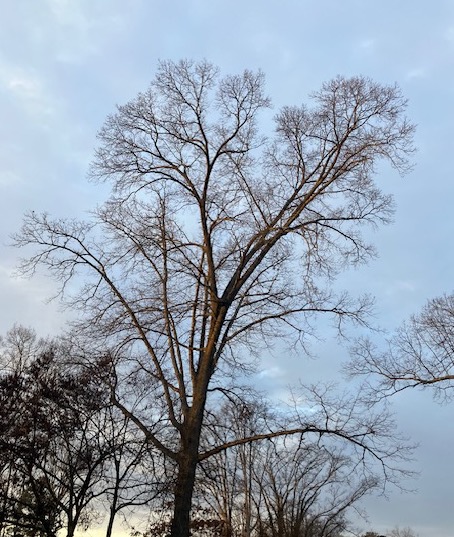
The stark bareness of those trees, lets me see the sculpting of their limbs contrast against an early morning sky.
Bare tree towers against the sky (Photo Bill Pike)
I appreciate the tenacity of a youngster shooting hoops on a nippy winter afternoon.
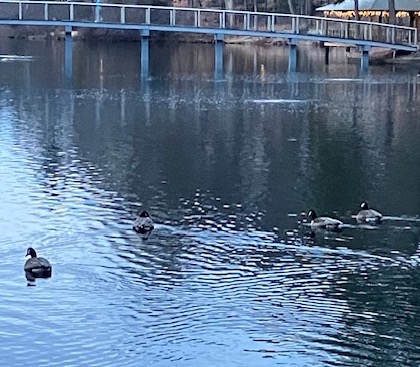
On the campus of the University of Richmond, in the Westhampton Lake, brazen ducks go for an early morning swim in water too frigid for me.
Brave ducks (Photo Bill Pike)
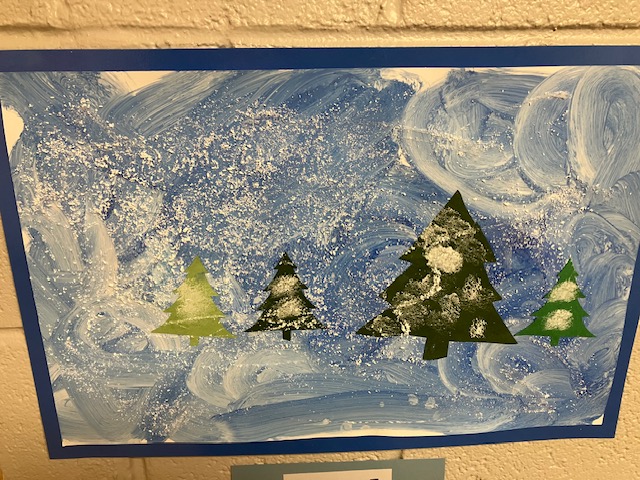
At the Trinity UMC Preschool, I’m captured by the wintry artwork of the students.
Student art work Trinity UMC Preschool (Photo Bill Pike)
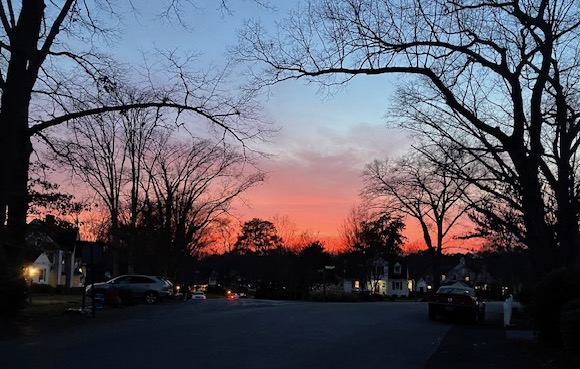
And late in the afternoon, there is nothing like the colors found in a sunset as the sun closes out another winter day.
Colors of a winter sunset (Photo Bill Pike)
Perhaps in your boo to the harshness of winter, you too can find a bit of its beauty.
And who knows, maybe that will help you endure this latest round of winter weather.
My connection to Chicago comes from my wife’s family and our oldest daughter. She lived and worked in Chicago for 14 years. We always enjoyed our visits to Chicago to see our daughter.
I never had the privilege of attending a game at Soldier Field, but I have a question for Chicago: After the electrifying win over the Packers on Saturday evening, why would anyone in their right mind even consider leaving this cherished stadium for another site?
Watching the game at home on television, I could feel the electricity of the crowd surging through the screen. That intensity was powerful. The stadium’s design, location and loyalty of its fans are legendary.
Ponder these questions about other similar athletic venues.
Do you think the Red Sox will leave Fenway, the Dodgers Chavez Ravine or the Cubs Wrigley? No.
Will Butler University leave Hinkle Fieldhouse or Duke leave Cameron Indoor Stadium? No.
Will the Packers leave Lambeau? No.
Soldier Field, just like these venues, is a classic. Da Bears deserve to play in no other stadium.
A move to another location in Chicago would be an insult. That could cause Carl Sandburg’s “City of the Big Shoulders” to shrink. We can’t have that.
Soldier Field has been loyal to the Chicago Bears. Now, the Chicago Bears and Chicago must be loyal to Soldier Field.
Put on your thinking caps and figure this out. Take all options minus one off the planning table.
The only viable option worthy of consideration — Da Bears play at Soldier Field forever.
— Bill Pike, Richmond, Virginia
Note from author: I was honored to have this Letter To The Editor published in the Wednesday, January 14, 2026 edition of the Chicago Tribune.
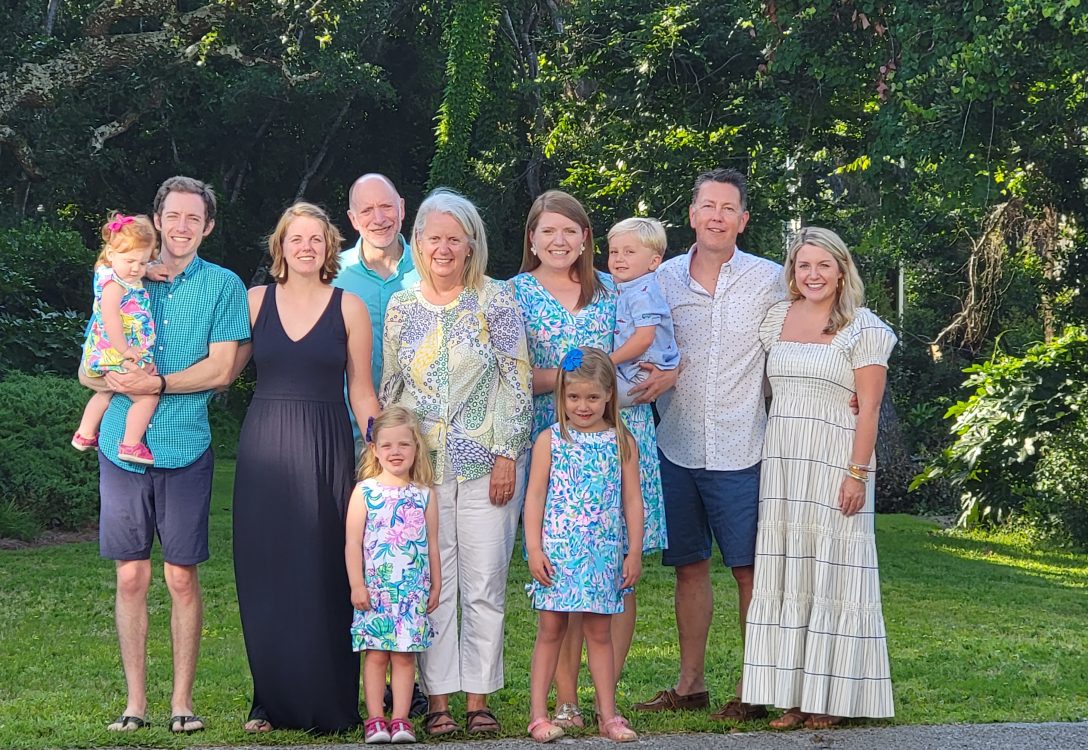
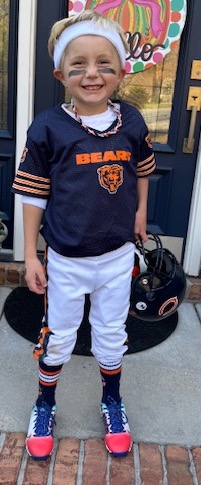
Our grandson in his Chicago Bears uniform (Photo courtesy of his mom)
The sanctuary of our church looks different today.
The same volunteers who in late November decorated it for Christmas have removed and packed away those decorations.
Window candles, garland, the Advent wreath, the Chrismon tree, live poinsettias, and what were once living branches from evergreen trees that formed pretty wreaths are gone.
To me, the poinsettias and the wreaths are the saddest departure.
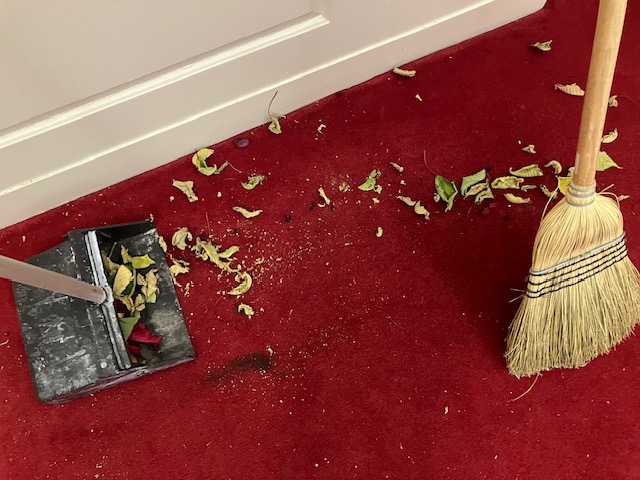
Even though they are patiently watered, the poinsettias take a beating from interior temperature fluctuations. Their pretty red and green leaves dry out. They crumple just like the fallen brown leaves on church grounds.
The most brutal change is the drying evergreen wreaths. Snug in their metal circular frames, those woven branches become brittle. Hundreds of needles fall when they are removed from lighting fixtures.
I wonder what I have learned from my seventy second Christmas?
I wonder what I will carry with me into 2026?
What in this timeworn Christmas story will stay with me?
What will flicker inside of me as the pace of a new year picks up?
To tell you the truth, I’m not sure.
No matter where my faltering eyes peer, this weary world is in turbulent turmoil.
I fear this turmoil is our end.
Yet, I continue to grasp what might be the Bible’s best scripture— “The light shines in the darkness, and the darkness has not overcome it.”
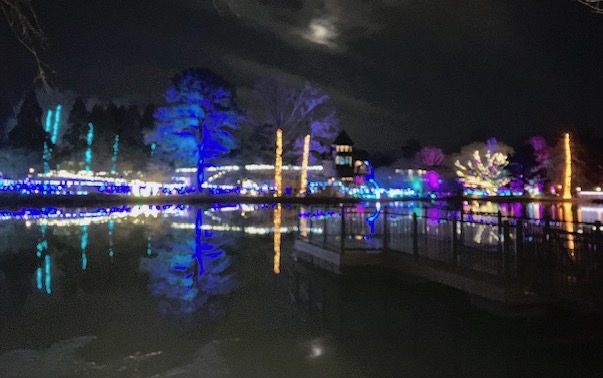
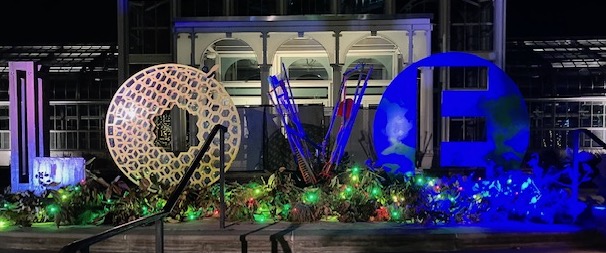
On the evening of Friday, January 2, 2026, my wife and I visited the Lewis Ginter Botanical Garden.
Our purpose for this trip was to view the Dominion Energy GardenFest of Lights.
This annual trek didn’t disappoint.
No matter where our footsteps took us, we like children were captured by the colorful and creative displays of lights.
GardenFest at Lewis Ginter Botanical Garden (Photo Bill Pike)
If you are a follower or occasional reader of my blog, Might Be Baloney, you know by now that I’m a pretty good whiner.
I try to whine for what I believe to be good reasons. I’ll let you figure out if the whines are on target.
Rightly or wrongly, I sometimes send a Letter To The Editor to newspapers across America. Quite often, my letters are rejected.
Though I’m disappointed from the rejections, I also try to see these rejections as an opportunity to learn. And no matter if a letter is accepted or rejected, our voices need to be heard.
I recently sent letters to the Chicago Tribune and the Washington Post.
I’m sharing these letters with you today.
As you will see, the frame of both letters is identical.
The letters were changed to meet word count requirements. All newspapers have word count requirements for a Letter To The Editor. Those word counts can range from 150 to 400.
Either way, the point in both letters is this— if we truly want to change our world, we must figure out how to love.
That love must be more than a pretty sign.
I leave you with both letters, and a hope and prayer that 2026 will be a gentle year for you and your loved ones.
Be safe, love, Bill Pike
Sent to the Chicago Tribune December 17, 2025
In the song “The Christmas Waltz” written by Sammy Kahn and Jule Styne is this lyric: “It’s that time of year when the world falls in love.”
While that optimism might be true for individuals who find the right person to fall in love with, it appears to me that our world is incapable of loving one another.
Where is our love for each other in these headlines:
Stockton, California at a birthday party, four people shot, killed, three of those were children, and thirteen injured.
In Palmyra, Syria, two U.S. military personnel and a civilian working as an interpreter were ambushed, killed, three others injured.
At Brown University in Rhode Island, two killed and nine injured at a shooting.
Sydney, Australia at Bondi Beach at least fifteen killed at a Hanukkah gathering.
Commenting after the attack on the U.S. military personnel in Syria, President Trump stated there will be: “a very serious retaliation.”
As an imperfect American who loves my country, but who doesn’t always understand my country, I want to know when are we going to take “a very serious retaliation” against ourselves.
By retaliation, I mean when will we fully commit to unraveling our mental illness and our dependency for solving any personal problem by shooting people.
It is disgraceful that we are politically unwilling to find the middle ground and backbone to discover a practical solution.
Why do we constantly fail to see what we are doing to ourselves?
Isn’t the carnage in schools, houses of worship, shopping centers, and other public settings enough?
How many more lives must we lose in America and other countries to violence from firearms?
Will our disrespect of our hard fought and blood stained freedoms bring America to our demise?
No matter the magnificence of America’s accomplishments, those achievements mean nothing if we can’t resolve the on-going erosion of our human infrastructure.
That erosion has emptied our hearts of compassion and courage.
Incivility, selfishness, division, and disregard for the truth have refilled our hearts.
What kind of America have we become to allow our leaders and ourselves to showcase such contempt?
Blink, and December 2026 arrives.
In that blink, we must embrace this wisdom from Martin Luther King, Jr. : “I know that love is ultimately the only answer to mankind’s problems.”
If we hope to change our headlines, we must love.
Sent to the Washington Post December 17, 2025
As reported by the Washington Post, Stockton, California, Palmyra, Syria, Brown University, and Sydney, Australia have unfortunately joined an elite club—communities where mass shooting have occurred.
This time of year, holiday songs like the “Christmas Waltz” suggest—“it’s that time of year when the world falls in love.”
In those heartbreaking headlines, no world is falling in love.
After the attack on U.S. military personnel in Syria, President Trump stated there will be: “a very serious retaliation.”
As an imperfect American who loves my country, I want to know are we ever going to take “a very serious retaliation” against ourselves?
By retaliation, I mean unraveling the source of our mental illness to understand our dependency to solve personal problems by shooting people.
It is a disgrace that our political backbones are unwilling to work cooperatively to solve this sickness.
Why do we constantly fail to see our shortcomings?
Isn’t the slaughter in schools, houses of worship, shopping centers, and other public settings enough?
How many more lives must we lose to firearms?
Our earned freedoms were hard fought and blood stained. Will our disrespect of these rights be America’s demise?
No matter the magnificence of America’s accomplishments, those achievements mean nothing if we can’t resolve the on-going erosion of our human infrastructure.
That erosion has emptied our hearts of compassion.
Incivility, selfishness, division, and disregard for the truth have refilled those hearts.
What kind of America have we become to allow our leaders and ourselves to showcase such contempt?
Blink, and December 2026 arrives.
In that blink, we must act upon this wisdom from Martin Luther King, Jr. : “I know that love is ultimately the only answer to mankind’s problems.”
Any hope to change those headlines means we must learn to love.
Pretty sign from GardenFest at Lewis Ginter Botanical Garden (Photo Bill Pike)
 might be baloney