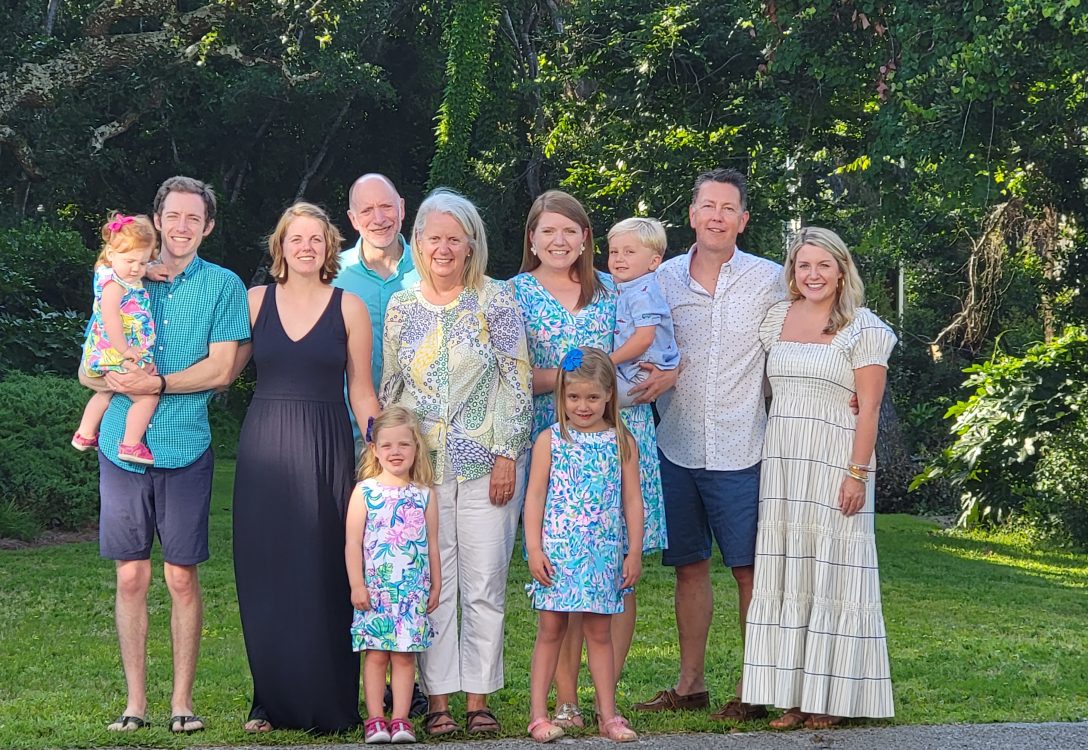
On behalf of the Pike and Reinking families, we are honored to have you with us for Thanksgiving.
Back in October, our world was flipped over when Betsy’s left shoulder took one last clunk on the sidewalk at the corner of Rock Creek and Forest.
In a blink, plans for her seventieth birthday and our fiftieth wedding anniversary changed.
That’s when family and friends took over and planned this Thanksgiving Day gathering.
Without this support and your willingness to pitch in, we’d be eating Jimmy John’s turkey subs this afternoon.
A special thanks to Lauren and Doug, Andrew and Kathryn, Elizabeth and Jackson, Ken and Adrienne, Norman and Jo, and Jay and David for their assistance.
Tucked in there too are the nieces and nephews—George, Lydia, and Sarah, Nana’s heroes, her grands—Caroline, Josie, Ellie, and Hudson, and we can’t forget Jay’s daughter, our Olympic swim coach, Katie, who is with us this afternoon. Katie, we could have used some of your deep breathing techniques when the turkey caused some kitchen tension earlier this afternoon.
Fifty years ago today (11-27-75), we were in Milton, Massachusetts for Thanksgiving at the home of Bertha Avery Crosby.
That was Betsy’s grandmother. Everyone called her Nammer.
We had quite a feast with the Crosby and Cloud families.
Two days later (11-29-75), Betsy and I were married in West Hartford, Connecticut.
There are many reasons why marriages fail and work.
For Betsy and me, I think we had good role models in our parents— Ken and Liz and Bill and Louise.
They weren’t perfect, but their loyalty, support, sacrifice, and teamwork were hard to beat. I think these qualities rubbed off on us.
On the night that I finally mustered the courage to ask Betsy’s father for her hand, I used two words that Betsy’s oldest sister, Susan, told Betsy that I must use—love and respect.
I can still hear my quivering voice—“Mr. Cloud, I love and respect your daughter.”
Despite all of the things I do that drive her absolutely bonkers, Betsy, I still love and respect you as much as I did on that night fifty years ago.
In 2020, a German advertising company created a holiday commercial for the European pharmaceutical company, Doc Morris.
This heartfelt commercial ends with these words—“So you can take care of what matters in life.”
Betsy, for these fifty years, thanks for taking care of what matters in our lives. Here’s to Betsy.
In his rapid fire delivery of jokes, he always found a way to work in what became his identifying line—“I don’t get no respect.”
For lots of reasons, that’s how I’ve come to feel about Thanksgiving.
Over the last several years, it appears to me that our respect for Thanksgiving is eroding.
Retailers know this.
For example, the National Retail Federation expects Christmas sales in 2025 to “exceed a trillion dollars.”
Forecasters predicted that Halloween sales for 2025 would be in the range of twelve billion.
Thanksgiving is projected to be in the four to five billion range.
Growing up in North Carolina, Thanksgiving was always a drive on U.S. 70 to my grandmother’s home in Greensboro.
Sometimes, there was a stop on this twenty minute drive at Mt. Pleasant United Methodist Church for a morning Thanksgiving service.
The spread of home cooked food for our lunch time gathering was amazing. As an overweight kid, I was in heaven.
And yes, I like pumpkin pie. However, my favorite Thanksgiving dessert was persimmon pudding. I think my Aunt Evelyn always made sure we had persimmon pudding.
The other thing that I remember about those gatherings was being huddled in a small den with a television that projected a black and white picture of the Detroit Lions and Green Bay Packers playing their traditional Thanksgiving Day game. At the time, that was the only game broadcast or played.
Money has changed that. From Thursday through Sunday, football games at the collegiate and professional level are non-stop.
In November 1975, I spent my first Thanksgiving away from home. I was in Milton, Massachusetts, a pretty New England town just south of Boston.
I was with my future wife’s family. Two days later, that beautiful lady and I were married in West Hartford, Connecticut.
Lots has transpired in those fifty years.
And even though, Thanksgiving is squashed between the billions and trillions of Halloween and Christmas, it continues to survive.
We must never take the survival of Thanksgiving for granted.
The survival of Thanksgiving depends upon you, me, we, us.
We can’t let Thanksgiving die.
If Thanksgiving dies, so will we.
Maya Angelo said it better: “If we lose love and self-respect for each other, this is how we finally die.”
For Thanksgiving to continue to have a life, we must ensure that our children and grandchildren understand why it is so important to be thankful.
Being thankful can’t be taken for granted.
In the fall of my sophomore year at Greensboro College, biology professor, Dr. Kemper Callahan, put that into perspective for me.
This is what I have come to Dr. Callahan’s Thanksgiving Lecture. He simply told our class that we should never take Thanksgiving for granted. That included appreciating all of the people who make Thanksgiving happen. Dr. Callahan put a strong emphasis on farmers—no farmers, no Thanksgiving.
Successful Farming reported in July of 2025: “More farms nationwide filed for bankruptcy in the first three months of the year this year than across the entirety of 2024.”
What will the continuing struggles of our farmers mean for future Thanksgivings?
While I love the Thanksgiving food, Thanksgiving is also about family.
How lucky I have been to have been nurtured by a family every day of my life. That is a luxury not available to everyone.
As crazy as families can be, even an ounce of stability can make all the difference in a person’s life.
I see that generational stability in our Thanksgiving gatherings. Internally I ask—how different would my life have been without that stability?
I also ponder how much better America could be if that stability was present for all of our families. We might be surprised at how lives could improve by solving those generational cycles of instability.
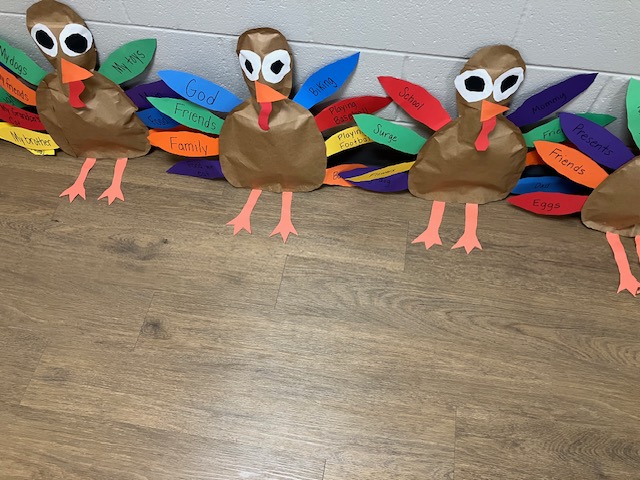
In my work at Trinity United Methodist Church, I see hope for Thanksgiving. That hope comes through the art work of the children in the preschool.
(Photo by Bill Pike)
I love walking through the hallways in the days before Thanksgiving. I get to see the Thanksgiving artwork gracefully resting on the floor or gently hanging from a wall mounted hook. These masterpieces are in their curing stage with glue and paint drying before they are transported home.
(Photo by Bill Pike)
Who knows maybe these heartfelt creations will be cherished and preserved for future Thanksgiving celebrations.
Isn’t that part of what makes up respect—preserving what we value?
Rodney Dangerfield figured that out.
Mr. Dangerfield learned that his audiences anticipated and valued his famous line—“I don’t get no respect.”
I can hear him now.
Thanksgiving is coming. I gotta tell you, when I was a kid Thanksgiving got a lot of respect. Not now. Thanksgiving is like a panini sandwich flatten on a press by Halloween pumpkins and retailers overstuffing our Christmas stockings.
I hope you and your families have a good Thanksgiving.
And remember to endure, Thanksgiving needs our respect, our hope, and our thankful hearts.
My body talks to me, “Bill, its been ten days since you have been for a run. What’s wrong with you?
I respond, “I’ve been busy. Life gets in the way.”
My body counters, “No doubt. That’s an easy excuse. I don’t like excuses. Go for a run. Now. Not tomorrow. Now. Go!”
On the morning of Friday, November 14, I went for that run.
I have a route that runs a neighborhood 5K course in reverse. The distance might be a bit more than a 5K, but I’m usually back at the house in 35 or 36 minutes.
This morning, I was inspired by our next door neighbor, Al Lockerman. As I was heading out to open up Trinity, Al was leaving for his morning run.
Al is a big guy. Yet, he runs like fast moving freight train. He goes all out on his runs. I admire his stamina.
When I return from opening up Trinity, I ready myself for my run. At the end of the driveway, I encounter Al again. With a cup of coffee in hand, Al is returning from walking their dog, Bambi.
I tell Al he inspired me to go for a run. He commented about the temperature. It is hovering at 33 degrees. That is about his limit with enduring cold weather runs.
Old man that I am, I have dressed in light layers for this run. That includes some worn knitted gloves and a stocking cap.
Al hopes I have a good run, and with that I’m off.
I note frost on the windshields of cars. This is the first real frost of the season.
Light frost on windshield (Photo Bill Pike)
Heading down Stuart Hall Road hill, at the intersection of Baldwin Road, the county is in the process of repaving.
The company doing the work has a massive asphalt eating machine. This contraption is called a cold milling machine or cold planer. The steel carbide tipped teeth of the milling machine peels back the top layer of the asphalt.
A good thing about the milling process is that the old asphalt surface is recycled. That planing of the top layer in some places reveals the foundation of the road— our pale orange Piedmont clay.
Milling machine’s work (Photo Bill Pike)
As I head up the hill, I turn left on to the front driveway at Trinity. On the front lawn, the pumpkins are gone. We conduct this annual sale to raise money for our youth group.
I admire the people who purchase our pumpkins. They are what I call heart buyers. These consumers could easily buy their pumpkins at a big box store at a much lower price.
At the bridge over the creek on Rock Creek Road, I wish I had a camera with me. Floating on the still creek surface is a pretty pattern of colorful fallen leaves. Also perfectly captured on that mirrored tranquil surface is blue sky with scattered clouds.
With the milling work on Baldwin, the road surface is uneven. The footing can be tricky, but I’m watching where my feet are taking me.
Occasionally, I see leftover signs from the November 4 election. I’m sure the mute button on the remote control for our television is thankful that campaign ads have stopped running.
The nonstop pace of those ads have now been replaced by incessant ads for Christmas. Of course, the big box retailers started telling me it was Christmas in September.
As I chug along, some front lawns still have Halloween decor. Others have rapidly transitioned to their Christmas theme.
Skeletons dominated many Halloween displays this year. I wonder if there will be a new big selling hero for Christmas on lawns this season?
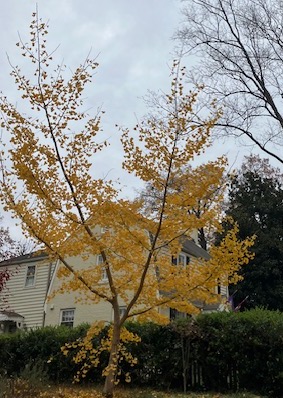
Thankfully, I can block out those commercialized distractions with the brilliance of leaf colors along the way. The last few days, the trees seemed to have hit their peak.
Golden leaves from a Gingko tree (Photo Bill Pike)
At the corner of Horsepen and Devon, I come upon four young fathers who have finished up monitoring their sons and daughters at the bus stop.
I interrupt their discussion by gently shouting out, “Let me know when you guys figure it out.”
They laugh, and one of them replies, “We’ll be here a long time.”
I chuckle and keep trudging toward Westham Parkway.
My mind keeps reminding me this is November.
I know you know this is November.
However, just in case you haven’t noticed— when we hit November, the pace of the year accelerates.
That acceleration is like a pilot of a jet fighter plane hitting the afterburners. We are thrust, blasted, and hurled into a supersonic march.
From now until December 31, we are in blinding blitz. The G forces of the season pull, contort, and rush every fiber of our bodies.
Seasonal to do lists rush us. Retailers rush us to early Black Friday sales. Our overbooked calendars rush us to holiday events. And perhaps the most demanding, the pursuit of seasonal perfection rushes us.
We are overly consumed by this pursuit of seasonal perfection. And while we can deny the seasonal pursuit of perfection, truthfully, that relentless pursuit is our downfall.
In all of the hustle and bustle, I wonder if that pace results in an increase of pacemaker surgeries related to how this seasonal rush impacts our hearts?
At the stop sign on the east end of Rock Creek Road, I’m about to turn left on to Sweetbriar Road. That final straight stretch on Sweetbriar will bring me back to where I started.
In the whirlwind pace of November into December, I wonder how this season might be different if my human layers were stripped back and revealed by a human cold milling machine?
What would that human cold milling machine find in me?
Part of me thinks it would reveal that I need the first two words from Psalm 46:10: “Be still.”
With the reminding roar of November that zooms us into December’s blitzing sprint, at some point your body’s internal voice will remind you to “be still.”
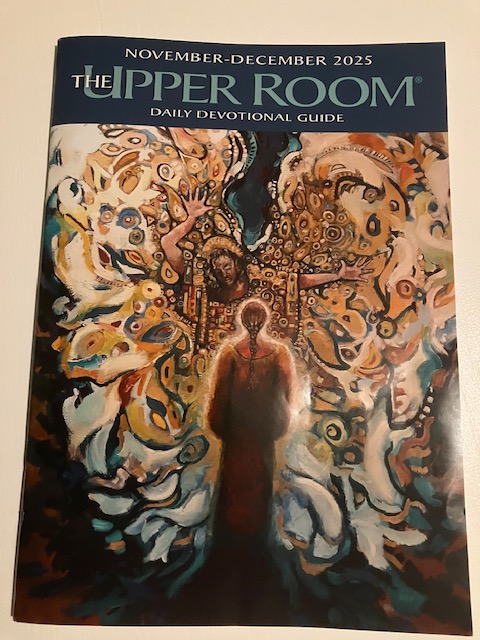
Cover from the Upper Room (Photo taken by Bill Pike)
Read Mark 10:46-52
Trust in the Lord with all your heart, and do not rely on your own insight. In all your ways acknowledge him, and he will make straight your paths. Proverbs 3:5-6 (NRSVUE)
I enjoy taking early morning runs, and before I leave the house, I check the weather conditions from the nearby airport.
One morning, the visibility at the airport was down to one mile. A thick layer of gray clouds hung above the treetops.
As I ran, I heard a plane overhead, but because of the cloud cover I couldn’t see it; I knew that the pilots couldn’t see the ground either.
Pilots must always rely on their training and sophisticated instruments to safely fly and land the plane, but this is especially true when visibility is reduced.
Sometimes I struggle to see where I need to go in life. l lose focus, and finding my way is difficult.
In those moments, I work to regain my bearings with these words from Proverbs 3:5-6— “Trust in the Lord with all your heart, and do not rely on your own insight. In all your ways acknowledge him, and he will make straight your paths.”
Trusting in God is not always easy.
Yet, that is exactly what Bartimaeus did when he asked Jesus to restore his sight; he trusted God in his heart.
On those days when the way is unclear, my heart needs to be more trusting, just like Bartimaeus.
Prayer: Faithful God, help our hearts to trust you when our vision is clouded. Guide us through your word. Amen
Thought For The Day: When the way seems unclear, I will trust God to lead me.
Bill Pike (Virginia, USA)
Note from the author: Friends I’m honored to have this piece published in the November-December edition of the Upper Room today, Tuesday, November 18, 2025. In case you are interested, I’ve also included the original piece that was submitted to the Upper Room. Thanks for your reading time, be safe, Bill Pike
Flying With God
Read Mark 10:46-52
Trust in the Lord with all your heart, and do not rely on your own insight. In all your ways acknowledge him, and he will make straight your paths. Proverbs 3:5-6 (NRSV)
I still enjoy taking an early morning run through our neighborhood.
I keep a running journal. Before I leave the house, I jot down the current weather conditions from the local airport.
Most mornings, the visibility is listed at ten miles. At the dawning of this day, the visibility at the airport was down to one mile.
In our neighborhood, a layer of thick, gray clouds hung above the treetops. As I started my run, I could hear the whine of jet engines in the cloud cover, but I couldn’t see the plane.
When visibility is reduced, pilots must rely upon their training and the use of sophisticated instruments to safely bring the plane through the clouds for a landing.
Sometimes in life, I struggle to see where I need to be landing. My vision becomes blurry. I lose focus. Finding my way is difficult.
In those moments, I work to restore my sight with these words from Proverbs 3:5-6: Trust in the Lord with all your heart, and do not rely on your own insight. In all your ways acknowledge him, and he will make straight your paths.
Trusting in God or Jesus when my vision is cloudy is not easy to do.
Yet, that is exactly what Bartimaeus did when he asked Jesus to restore his sight—his heart trusted.
On those days when my vision is reduced, my heart needs to be more trusting like Bartimaeus.
Prayer: Father of us all, help our hearts to trust you when our vision is reduced. Amen
Thought For The Day: When the clouds of life reduce our vision, trusting in the Lord can lead us to his light.
My friend, Mike Cross, a Veteran, who served his country as a Marine during the Vietnam War, invited me to the Virginia War Memorial.
On the evening of Wednesday, October 29, we would be attending Leadership In America. This is a lecture series presented by the Virginia War Memorial Foundation.
The presenter was Dr. Michael Bell, a United States Army combat veteran, who is currently the Executive Director of the World War II Museum’s Institute for the Study of War and Democracy.
Dr. Bell’s topic for the lecture was—America Returns: The 81st Anniversary of the Battles of Leyte and Leyte Gulf. These battles were in the Philippines during World War II.
According to Dr. Bell and other historians, in October of 1944, the Battle of Leyte Gulf became the largest Naval battle ever fought. (World War II Museum)
These battles were also punctuated by the leadership of General Douglas MacArthur.
In March of 1942, General MacArthur had been ordered to leave the Philippines to escape the Japanese invasion. This is when MacArthur made his famous promise: “I shall return.”
MacArthur fulfilled that promise on October 20, 1944.
On that date, he waded ashore on the Philippine Island of Leyte, and in a radio communication stated: “People of the Philippines I have returned! By the grace of Almighty God, our forces stand again on Philippine soil—soil consecrated in the blood of our two peoples.”
MacArthur’s reference to blood in the battles of Leyte and Leyte Gulf would be significant for America and Japan. Thousands and thousands of sailors and soldiers were killed in these battles.
Yet, historians are in agreement that the battles for Leyte and the Gulf of Leyte were pivotal for the war in the Pacific. America’s victory in these battles crippled for the remainder of the war the Japanese Navy. Japan lost 26 ships of war in this battle. More importantly, Japan’s supply lines had been disrupted.
Additionally, the battle of the Gulf of Leyte marked the first kamikaze attack of the war. A Japanese pilot with desperation and purpose dove his plane into the deck of the USS St Lo, an escort carrier. Sadly, this suicide attack wasn’t the last in the Pacific for American sailors to endure.
The world remains pocked with the physical and emotional scars of war. There is no escaping this toll.
With war, there has been and always will be a toll. Perhaps, the most difficult part of that suffering is our failure to learn from these conflicts. Peace remains elusive.
I wonder in Dr. Bell’s role at the World War II Museum if they have ever conducted an in depth study as to why peace remains elusive in the world?
Clearly from Dr. Bell’s comments in that packed lecture hall, we have learned a great deal from the study of the Battles of Leyte and Leyte Gulf. Yet, in all of that research do those accomplished historians ever ask why didn’t the peace at the end of World War II last?
As we were driving back to our homes, Mike and I talked for awhile about the Medal of Honor.
The Medal of Honor is the United States Armed Forces’ highest military decoration and is awarded to recognize American soldiers, sailors, marines, airmen, guardians, and coast guardsmen who have distinguished themselves by acts of valor. (Department of Defense 2017)
I learned from Mike that the Medal of Honor design for the Army and Air Force has the word valor displayed. The Navy’s design features an anchor.
I am not a Veteran.
I can only begin to imagine the acts of valor that came from the recipients of the Medal of Honor.
In James Bradley and Ron Powers’ book Flags Of Our Fathers, I read about two Medal of Honor recipients from World War II.
Jacklyn Lucas threw his body onto two Japanese grenades. His body was blown into the air. Neither his fellow soldiers, nor the doctors on the hospital ship, Samaritan, could believe he lived through the explosions. When the authors asked Mr. Lucas why he had thrown himself on those grenades, he answered: “To save my buddies.” (Page 175)
Corpsman George Whalen refused to come off the battle field despite suffering three serious wounds. Again, the authors asked Mr. Whalen—why did he continue to render aid ignoring his own dire physical condition? He responded: “Because I cared for my buddies.” (Page 234)
Valor.
On Sunday, November 9, 2025 our church held the twenty-fourth Veterans Pancake Breakfast.
Our special guest speakers for the event were David L. Robbins, an accomplished American author, and Phil Trezza, an Army combat medic who served in Operation Iraqi Freedom.
Mr. Robbins founded the Mighty Pen Project. He works through the Virginia War Memorial in offering a writing class to Veterans who want to capture their stories from when they served our country.
Mr. Trezza has been a participant in the Mighty Pen Project.
Both Mr. Robbins and Mr. Trezza gave us heartfelt snapshots about the Mighty Pen project and its impact on Veterans.
Near the conclusion of our Veterans Pancake Breakfast, we always call the names of the Veterans from our church who passed away during the year. On Sunday morning, we called three names. This is immediately followed by the live playing of taps, and a prayer.
Valor.
And the final act of the program, we ask all of our Veterans to gather for a group photograph. When I look into the aging faces of our Veterans, I see valor.
Trinity United Methodist Church and our Veterans. Joined by David L. Robbins far left second row and Phil Trezza first row far right. (Photo Bill Pike 11/9/25)
If you have followed my blog, you know that over the years, l have confessed that I am a worrier. There is no valor in worrying.
While lots of things cause me worry, right now, I constantly worry about America.
I want to know if America understands valor.
I want to know how we rediscover our valor, not just in our service men and women, but in every American citizen.
I want to know if we comprehend how important valor is to our democracy.
On Veterans Day or any day for that matter, if you encounter a Veteran please take a minute to thank them for their service and their valor.
And while you are thanking them, remember the words from Jacklyn Lucas and George Whalen about saving and caring for their “buddies” in the brutal harshness of the battlefield. Their valor saved you, me, we, us back home in America too.
By the grace of God, we must never forget the valor of our Veterans.





 might be baloney