March is mad.
I can prove it.
On the afternoon of Wednesday, March 11, a record high temperature of 89 degrees was set in Richmond, Virginia.
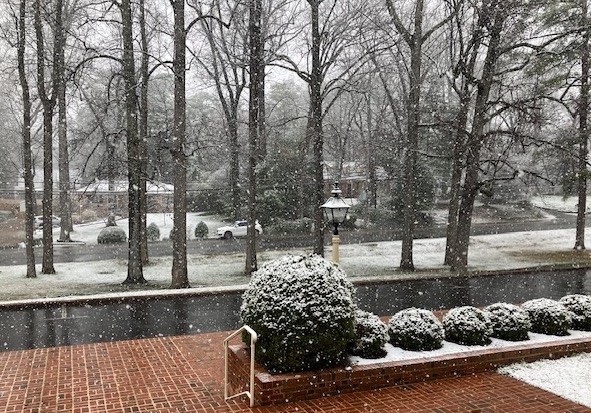
In Richmond, the next day, the afternoon temperature dropped to 39 degrees, and cold rain switched over to snow.
For two hours, heavy wet snow flakes fell turning trees and the grass white.
March is mad.
Beyond its weather madness, March is mad for another reason—college basketball.
March is the time of the year when the regular season comes to an end. Conference tournaments are held.
Then on Selection Sunday, this year, March 15, college teams across America wait to see if their season’s accomplishments merit being selected to participate in the sixty six team tournament.
For teams selected, there is a feeling of exhilaration.
For the teams who were not selected, heart crushing disappointment hits them and their fans.
When the tournament opens on Thursday, March 19, America is captured. A disruption occurs. Lives are consumed. Everything pivots off the games.
My introduction to basketball came in the fourth grade.
On a spring afternoon, two of my classmates, Johnny Huffman and Tommy Hinson, from Hillcrest Elementary School in Burlington, North Carolina walked to my house. They invited me to play basketball at the Huffman’s house.
We walked back to the Huffman’s house. For the remainder of the afternoon, I attempted to play basketball for the first time.
I could not have lived in a better location for basketball.
I lived in the heart of the Atlantic Coast Conference. Four of the conference’s founding teams—Duke, North Carolina, N.C. State, and Wake Forest were in close proximity.
I followed these teams by reading the boxscores in the Burlington Daily Times News. Listened to radio broadcast of games on an AM radio, and watched a weekly televised game on Saturdays broadcast in black and white.
I didn’t possess the skills needed to make teams at school, but I enjoyed playing in the neighborhood and on our church team at the YMCA.
Those days are long gone.
While I still love basketball, I no longer let the game consume me.
I follow the game from a distance.
That way I don’t torture my rapidly aging body with mental and physical stress. It isn’t good for an old man to shout foul, fiery language at an unresponsive television screen.
In 2009, our church started a program centered around Upward basketball and cheerleading. From January through February our fellowship hall is converted into two basketball courts. During the week teams have late afternoon practices. Saturday is game day.
I think the original intent was maybe, just maybe, this basketball and cheerleading offering might help our church to pick up new members. I sense that hasn’t been a win for the church.
On the afternoon of Saturday, February 21, 2026, I found myself sitting in the lobby outside our church office. I was waiting for the last Upward basketball game to end.
Earlier in the day, our lead building caretaker had been admitted to the hospital. I was there to get the building ready for Sunday.
While waiting, I noted a piece of paper on a table top. I went over to checkout the paper.
In the script of a young child, I read these penciled words: “I hate basketball.” Under that statement was a drawing of an unhappy face.
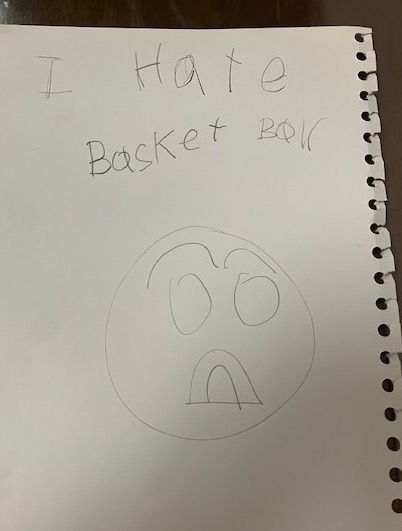
I showed the note and drawing to our Director of Kids and Family Ministries. She had noticed a young girl sitting in the lobby working on that piece of paper.
Immediately, I was curious about the young lady’s reasoning.
Was she unhappy because her parents were requiring her to play basketball, or was she disgruntled because she was required to watch a sibling participate?
By the time I finished getting Trinity Hall its restrooms, hallways, and classrooms back in shape after being used by 400 people—I too could feel a bit of disdain toward basketball.
When I think about the game of college basketball that I grew up admiring compared to today’s game, quite honestly, I’m disgusted and disappointed.
That disgust and disappointment is all grounded in money.
That money has birthed:
Geographically Illogical expansions of college athletic conferences
NIL (name, image, likeness generates money for players)
The transfer portal has destroyed loyalty to a team
Players who play for one year and then bolt to play professionally
In my humble and non-expert opinion, each of these have hurt college basketball.
That hurting of college basketball is linked to the following questions:
At this very moment, how many college athletic departments are running in a financial deficit?
How many college presidents and board of visitors lack the spine and courage to say to alumni with deep pockets—we don’t want your millions to buy college athletes and potential national championships?
How many collegiate athletes who fail to earn their academic degrees, but secure large professional contracts end up filing for bankruptcy?
How many more investigations are lurking out there about coaches who can’t play by the NCAA rules related to recruiting and running their basketball programs?
The same question can be asked about student athletes and gambling. How many more investigations will uncover gambling with professional gamblers to fix a game?
In doing a bit of reading about this college basketball season, I sadly learned about how Anthony Grant, coach for the mens’ team at the University of Dayton has been treated this year.
Coach Grant and his players were the target of unhappy fans and gamblers after losing a game. These hateful messages were addressed by Coach Grant and the school’s Athletic Director.
Later in the season, some Dayton fans wore t-shirts suggesting that Coach Grant be fired.
Without question, college coaches and their players are always under pressure to win. I’m not sure all fans, including alumni, understand how challenging it is to secure a winning season and the potential championships that go with it every year.
This year, March Madness is a bit more mad for another reason—since February 28, the United States has been involved in a war with Iran.
For sixteen days, American service members have been attacking Iranian installations. I wonder what the families of the thirteen service members who have been killed in this war think about this madness?
That madness of losing a loved one will never leave those families—never.
Part of me would like to meet the young lady who left us the “I hate basketball” message.
I appreciate how she shared what was on her heart.
Maybe, she wanted to get the adults who run the program and her family to think deeper about her needs.
Maybe, she wanted our church, the church who sponsors the program, to think deeper about what we were offering.
In Pat Conroy’s book, My Losing Season, he thinks deeply about his senior year of playing college basketball at The Citadel.
Chapter 16 is titled Christmas Break. In this chapter, Mr. Conroy writes about eight days of practice that started on the afternoon of Christmas Day and ended on New Year’s Day.
He regarded those practices as “the worse time of my life as a ballplayer.”
I worry that our young note writer might feel the same way about her Upward basketball experience.
I hope that will not be the case for her.
Despite March and its madness, the month does have some good traits— St. Patrick’s Day, Spring officially arrives, and baseball season is around the corner.
With the March basketball madness, I wish you, your bracket, and your favorite team the best of luck.
Just remember, someone you encounter during this basketball madness might not be as steadfast as you are about keeping tabs on an orange ball.
This person might be having “the worst time” of his/her life.
And chances are that difficulty can’t be attributed to the madness of how a basketball bounces.
 might be baloney