For most of you, I will guess that you do not receive a weekly email from one of the local craft breweries where you live.
But here in Richmond, Virginia, I receive an email from Ardent Craft Ales every Thursday.
The email tells me about new beer releases and special events at the brewery.
Ardent is located in the Scotts Addition section of Richmond.
Over the last several years, this neighborhood has undergone a rebirth. With old commercial buildings being transformed into housing, restaurants, and breweries.
Unfortunately, adequate parking didn’t match the explosive growth.
When our church first started our Pub Theology program, Ardent Craft Ales was our most gracious host.
This time of the year, I’m hopeful to receive an Ardent email announcing the release of The Wind That Shakes The Barley.
On Thursday, February 26, 2026, the email arrived that confirmed The Wind That Shakes The Barely would be available on draft in the taproom.
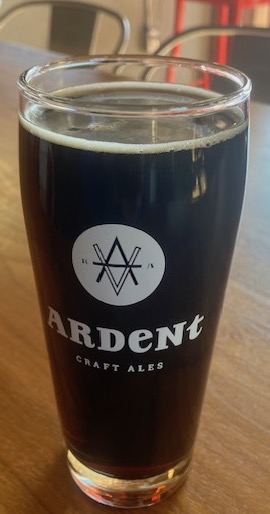
This Irish oatmeal stout has become a favorite beer of mine.
Last year on the afternoon of its release, I convinced my wife to go with me to Ardent so I could have a pint. She had a glass of wine and we split an hors d’oeuvres.
This year, I missed the opening afternoon, but I was able to have our son tag along with me on Saturday afternoon.
On this last day of February that felt like a spring day, Ardent was busy. Inside the taproom, customers formed two lines. To the credit of the cashiers, the lines moved quickly.
By the time we received our stouts, most seating on the outside deck and inside the taproom were taken. But, we found a couple of chairs at a table and sat down.
A teasing pre-Spring sun came through the window, and it was a perfect afternoon to enjoy a classic Irish brew.
This year’s version of The Wind That Shakes The Barley didn’t disappoint. The brewers made a quality beer.
I don’t possess a sophisticated beer tasting palette so notes of “baker’s chocolate and caramel” don’t register with me. However, I do agree this is a “light-bodied” stout, not has heavy as some stouts might be.
So, I must confess. I love, love the name of this beer. I think The Wind That Shakes The Barley is a perfect name for a beer.
I can imagine the golden field of barley that an Irish farmer has put his heart and soul into with a gentle wind rustling through the thickly planted grain.
According to several sources, The Wind That Shakes The Barley has quite a history in Ireland.
In 2006, this was the title of a successful film about two brothers who join the Irish Republican Army to fight for Ireland’s independence from England. The plot takes an interesting twist as the brothers are on opposing sides during the Irish Civil War.
But the title of the film, actually comes from the song written by Robert Dwyer Joyce. The song is tied to the 1798 rebellion in Ireland.
Mr. Joyce wrote this Irish ballad as a poet and English professor. I listened to several recordings of the song. Each rendering captures the heartfelt passion of the history and the young man and woman portrayed in the tune.
I checked to see if barley is referenced in the Bible, and yes, it has quite a presence. I like this citing from Deuteronomy 8:8: “a land with wheat and barley, vines and fig trees, pomegranates, olive oil and honey;”
So barley has been providing for us for a long, long time.
I hope the wind will continue to shake the barley in the fields of farmers around the world.
And, I hope the brewers at Ardent Craft Ales will brew this favorite beer of mine in 2027.
In fact, I hope they never stop brewing this annual beer.
And, I hope, I’m around to enjoy another pint next year.
I know nothing about the planning for the June of 1958 road trip to New Orleans.
My father was a member of the Civitan Club. The Civitans were having a convention in that famous city.
Founded in 1917, the Civitans are an international organization “of volunteer service clubs, dedicated to helping people in their own communities.”
This convention was the reason for the road trip. By car, we traveled with another couple from Burlington, Melvin and Tula Wilson. The Wilsons were a delightful older couple who also were a part of the congregation of Davis Street Methodist Church where my parents attended.
As far as the road trip, I remember a stop somewhere on a beach along the Gulf of Mexico. I also recall a long ride over a bridge. I assume this was across Lake Pontchartrain.
Once in New Orleans, there was a bus tour of the city. The tour guide referenced a swimming pool we passed. He said it was filled with muddy water from the Mississippi River.
Another memory was a cafeteria that had fresh watermelon on the serving line.
My mother tracked down her father who deserted her mother and her siblings early in their Mississippi lives.
For some reason, we took the train back to North Carolina. I recall a kind porter who made me a ham sandwich. I think one of my father’s brothers picked us up at the train station in Greensboro and drove us home to Burlington.
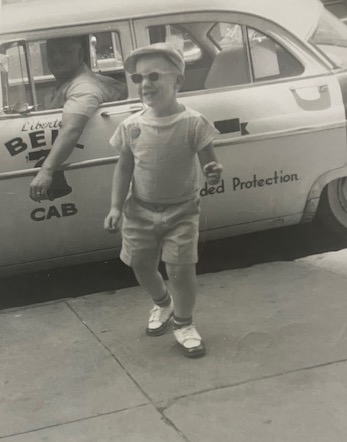
And thanks to my parents, I was decked out as a five year old tourist.
What a sport (Photo courtesy of the Pike family)
Now 66 years later, on Wednesday, May 8, 2024, my wife and I are traveling back to New Orleans. This isn’t a road trip to a Civitan convention. No, my main purpose is to visit the National World War II Museum.
Luckily for me, I benefit from the detailed trip planning from my wife, the Commander Supreme. No one is better at trip planning.
We left Richmond on a Boeing 757-200(HD) with a stop in Atlanta. On this first leg, I continued my reading of Isabel Wilkerson’s book The Warmth of Other Suns. From Atlanta to Richmond, there was lots of cloud cover. I watched part of a documentary about Jimmy Carter.
As we approached New Orleans, the visibility improved, and I saw lots of brown water.
Once we landed, the driver of the jetway had a tough time connecting to the front exit door of the plane. Eventually, the mechanical gods cooperated. This was followed by the rush of passengers exiting the plane.
New Orleans has a very nice airport.
Through our son’s in-laws, we had a driver ready to pick us up. The driver drove us into the business district and dropped us at the Magnolia Hotel. This hotel gave us good access to the places we wanted to visit in the city. With the exception of a street car ride, we walked everywhere.
Our feet wasted no time in immersing us into the city.
In the French Quarter, we enjoyed lunch at Landry’s Seafood.
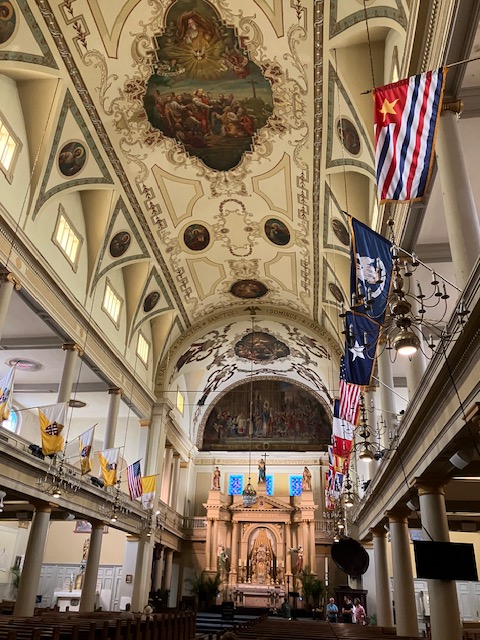
We walked into Jackson Square. We were immediately taken by the St. Louis Cathedral.
(Photo Bill Pike)
With its ties to the King of France, this stunning building dates back to 1720. Lots of adjectives have been used to recount the exterior and interior beauty of the building.
(Photo Bill Pike)
From Jackson Square, we were able to catch our first views of the mighty Mississippi River. With an assist from Mark Twain, the Mississippi might reveal the soul of America.
(Photo Bill Pike)
We made the predictable tourist stops at the Cafe Du Monde and Pat O’Brien’s. For some reason, the famous Hurricane drink reminded me of drinking Kool-Aid as a kid.
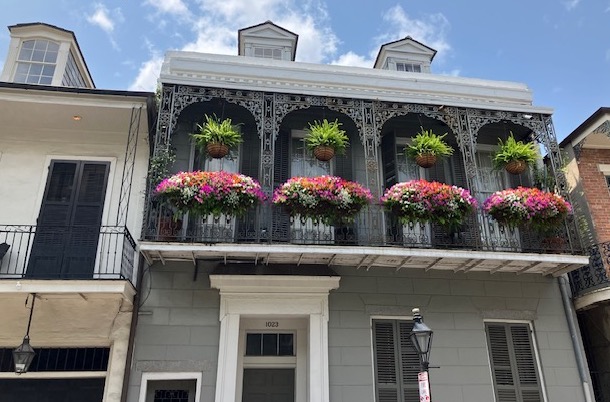
As we worked our way back to the hotel, no matter where our eyes scanned, the architecture of the buildings and homes held us captive. Brick work, wrought iron, flowers, and a palette of just right paint shades were in every direction.
(Photo Bill Pike)
After a quick refresh at the hotel, we mapped out our walk to our dinner restaurant—Herbsaint. Located on St. Charles Avenue, we enjoyed our exceptional food and service at an outside table on this pretty May evening.
From our early start in Richmond, our day had been long, but our first afternoon in New Orleans was enjoyable.
Despite the treasured prettiness of New Orleans, I noted that the city isn’t immune from what I see back home.
Struggles that are small and large—missing street signs, sidewalks in need of repair, impatient beeps, a mix of aromas some pleasant, some unpleasant, and the homeless.
No matter these challenges, New Orleans has a soul. A soul that still draws people to it. A soul that continues to survive no matter what comes its way.
With a good night of rest, I hope to learn more about the city’s perseverance on Thursday.
On the evening of Monday, September 1, 2025, my wife and I went with neighbors to the James Taylor concert at the Allianz Amphitheater At Riverfront. This new outdoor concert venue is on the banks of the James River.
A few days prior to the concert, our neighbors did a reconnaissance drive to check out parking options and the walking distance to the entrance.
Additionally, a day before the event, my wife received a courtesy email stating the concert was sold out. Arriving early was recommended.
The reconnaissance for the parking was smart. We parked in a lot within reasonable walking distance to the amphitheater. Additionally, the price for parking was acceptable.
It was a bit after six when we finished up at the parking lot and started our walk to the entrance. What we didn’t expect was the long, long line of people waiting to enter the amphitheater.
Richmond police officers did good work monitoring pedestrian and vehicle traffic at the intersection of Second and Byrd. That long, long line worked its way up a very steep hill along Byrd Street well past the Afton Chemical Corporation.
For a person with worn-out legs, challenges with their cardiovascular system, or wheelchair dependency getting up this hill was a challenge.
At some point the line started to move. The movement toward the entrance was slow, but steady. We cleared the security checkpoint, and the next challenge was finding a space on the lawn for us to sit.
We found a spot, but then we relocated. We relocated to the back of the lawn area. A fence runs the length of the lawn. We had two chairs reserved for seating. Our thinking was the fence would be like the back of a chair while sitting on blanket.
Again, the line to pickup our two chairs was long. We tolerated the wait time. Good news, the chairs were sturdy and comfortable.
When we relocated to the fence, the chair line was directly in front of us. Numerous people came to the chair line not realizing that a reservation had to be made to secure a chair. Just before the concert started, another problem surfaced. Apparently, the supply of chairs for people who had made a chair reservation was depleted.
As we settled into our spot, we learned that there are still some kindhearted souls in the world. A lady with two chairs stopped in front of our group. She offered us her chairs. Where her friends were seated on the lawn was too crowded for chairs, so she offered them to us.
Prior to the opening act, I spent thirty minutes exploring the amphitheater.
The stage is massive and it appears to be outfitted with all the latest bells and whistles for concert technology.
Seating options are varied with some unique locations, and the sight-lines seem good. This is despite at least three large light poles that can impact those sight-lines.
Large video monitors grace either sided of the stage. So, if your sight-lines are lousy, and the tall and lanky, James Taylor, looked tiny, the monitors capture all of the action on stage.
The space provided for food, beverage, and merchandise seemed to be adequate. This area was full of people, but despite some long lines people were able to move freely.
Can’t speak for the women, but there was no wait time for the mens’ restroom area. Urinals, sinks, and toilets were numerous.
No one from our group purchased any food or beverages. I’m not sure about food prices, but a variety of items were offered.
I had read about the grumbling over the pricing of alcoholic beverages, and I now understand the grumbling.
Interesting to me that pricing for all wine options was prominently posted. Wine pricing was expensive. A can of wine was $14.00. Wine by the bottle fell into three price ranges from $40.00 to one Cabernet Sauvignon topping out at $110.00.
As far as I could tell pricing for beer was not posted. It is my understanding that beers in 24 ounce cans cost from $16.50 to $23.00. I did see one beer sign advertising a Value Beer for $5.00.
(Photo Bill Pike)
When I inquired about the value beer was I shown a 12 ounce can of Busch Light. While I’m sure Busch Light has its fans, I don’t value it as a beer. Plus, a consumer can purchase a 30 can case of Busch Light in a local grocery store for $27.99. With that pricing, each can of beer in that case cost about 93 cents a can. Even for a value beer, that’s a significant mark up, but nothing like the mark up on the other beers.
The concert started on time with opening act Tiny Habits hitting the stage at 7:30. After their set, the roadies made some adjustments to the stage, and then we were treated to two solid hours of James Taylor and his very gifted band.
On September 15, 2024, my wife and I made our first trip to Wolf Trap National Park for the Performing Arts. We made this trip to see James Taylor.
Clearly, Wolf Trip has been presenting concerts much longer than the rookies at the Allianz Amphitheater. However, getting into Wolf Trap, working our way to the lawn, and picking up our reserved chairs was seamless.
Part of me wants to know if anyone involved with the development of the Allianz Amphitheater spent anytime picking the brains of the staff at Wolf Trap.
It is my hope that the management team will conduct a detailed review of this first season. That review should include receiving feedback from the people who attended the concerts, and all Allianz personnel.
The day after the concert, my wife did receive an email from Live Nation, a survey that opened with: “What did you(really) think of James Taylor? Share your review!”
That opening was followed with these question prompts: How was the event? Best ever? Room for improvement? Leave feedback on your recent concert or event, so Ticketmaster, a division of Live Nation Entertainment, can help enhance your next live experience.
I wonder how many people responded to the request for feedback? Additionally, I wonder how diligently the survey comments are discussed and studied by Live Nation and Ticketmaster?
From my perspective, here are some questions that management needs to ponder:
When a concert is sold out, how might the long line and wait time for getting into the amphitheater be reduced?
If I reserve a chair, how does management ensure that the chair will be available for me?
For consumers of alcoholic beverages, the pricing must be clearly posted for all options, and the pricing of these beverages must be restructured to be more sensible.
How might the seating in the lawn area be more balanced between blankets and chairs? Should the lawn area have a designated section only for chairs?
Hopefully, management will listen and improvements will be ready to be implemented by next summer.
At the age of 77, James Taylor enjoyed performing in this new venue. He was complimentary of the facility, the setting, and the crowd. His compliments also hinted that he would like to return next summer for another performance.
I’m 72, I anticipate returning to the Allianz Amphitheater At Riverfront for another concert. However, if I opt to return, I certainly hope that the management team will collectively work to make improvements. Improvements that will make the concert experience better for all who attend a performance in this amphitheater.
Failure to listen to feedback and institute reasonable changes based upon that constructive criticism could potentially hurt the success of the amphitheater.
At the end of this first season, I know everyone will be looking at the profit numbers. I won’t deny the importance of that data. But did concert attendees have a good experience also drives that revenue, and that can’t be overlooked.
And thinking of people, there is one more important part of our concert experience that also can’t be disregarded—the Allianz personnel. From my interactions with them, I found these employees to be patient, polite, and knowledgeable. In our impatient world those traits are important, especially in a public setting—nice work.
A long time ago someone decided that churches needed to have kitchens.
At our church, we have three: in the original fellowship hall, an oddball one on the third floor of the Preschool wing, and in Trinity Hall.
And there was a mini-kitchen near the church office that we disassembled a few years ago.
I imagine those kitchens could write a book about the life of our church that took place inside those culinary walls.
Cook talk, laughter, gossip, recipes, and compliments were shared.
Back on Wednesday, August 13, my work teammate, Judy Oguich, and I met in the Trinity Hall kitchen to inventory our supplies and make plans for a church wide lunch on Sunday, August 24.
We found adequate supplies of plates, cups, napkins, and utensils.
Since the menu called for grilling hotdogs, we believed we had lots of hotdogs leftover from a community event last fall. Unfortunately, these frozen dogs had long gone past their expiration date. We had to chuck them.
Checking on the condiments that we needed to enhance the hotdogs, we again found that mustard, catsup, relish had an expired.
No matter where we looked, we found food items that were no longer safe to serve.
In truth, I’m not surprised. A few years ago, our church closed out our Wednesday night dinners. No longer could we justify the expense based upon fewer and fewer families attending.
Now, the Trinity Hall Kitchen is used sporadically. The people who use the kitchen leave extra food in the refrigerators. These kindhearted people believe that someone will eventually consume those leftovers.
This wasn’t my first experience in the Trinity Hall Kitchen throwing away outdated or spoiled food.
I had to do this when Hurricane Isabell walloped the neighborhood as electrical service was absent for over a week.
There were other times too.
Leftover food from Sunday night youth dinners were not consumed in a timely manner, and they too had to be tossed.
Perhaps the only good thing that came from disposing of this food was recycling the containers where the food had been stored.
I despise days like Wednesday, and the ones I’ve encountered in the past.
My disgust comes from revisiting Deuteronomy Chapter 15 verse 11: “There will always be poor people in the land.”
And from Matthew 26 and Mark 14: “The poor you will always have with you.”
Look, I’m no Biblical scholar, but those three verses cast an embarrassing guilt over me. In these situations, I could have done better than tossing out all this food.
If I had only been more attune to those refrigerators, we could have fed more people in our community.
I wonder why those three verses are in the Bible?
Were they written as a challenge?
Did the scripture writers think, “Hey, let’s tell the knuckleheads on earth that the poor will always be with them.”
If we tell them this, maybe, they will look at those statements and ask: “Why should we always have the poor with us?”
Why don’t we work together to wipe out poverty in our world so that we will have no poor people.
Seems like a noble idea, but unfortunately, we have been failing for centuries at eliminating poverty.
So why is it that we can explore the vastness of space, perform heart transplants, dam mighty rivers, build skyscrapers that touch the blue yonder, and yet we can’t figure out how to solve the challenges faced by the poor.
Williamsburg, Virginia native, Bruce Hornsby, has built himself quite a career as an extraordinary piano player, songwriter, and singer. His first hit single with his band The Range was a song titled “The Way It Is.”
From my first listening of the song, I was hooked.
The lyrics caught my attention too. The words are a snapshot of ongoing social challenges in America.
But it is the chorus that stuck to me: “That’s just the way it is. Some things’ll never change. That’s just the way it is. Ah, but don’t you believe them.”
Having the poor with us, “That’s just the way it is. Some things’ll never change.”
For me, the bleak affirmation of those two lines is countered with the last line: “Ah, but don’t you believe them.”
We are long overdue to believe that we can solve the vicious generational cycles of our poor.
On the evening of Thursday, July 10, 2025, our red-eye flight from Fairbanks, Alaska to Minneapolis-St. Paul to Raleigh, North Carolina was delayed.
A passenger became ill, and the plane had to taxi back to the Fairbanks terminal.
Before our early morning landing in Minnesota, our airline notified us that our connecting flight to Raleigh was delayed.
That delay gave me some hope. Hope that I might be able sample an August Schell beer in the airport. Guidance for this pursuit came from Scott Hislop, the Senior Distributor Sales Manager, for the August Schell Brewing Company.
As soon we disembarked from the plane, I stopped at each bar/restaurant in the terminal. I checked the tap handles and asked friendly employees if they carried August Schell. Their kind response was “sorry, no.”
As my wife followed her crazed husband, in the distance, in the middle of the corridor of terminal one, I saw the words Stone Arch. That was the name of the one place Scott had referenced for sampling an August Schell beer.
Stone Arch employees were busy with breakfast customers. It took a few minutes for me to flag down one of their employees who handled beverages.
Finally, a nice young man paused as I flagged him down. His hurried steps came to a halt. I explained what I was trying to accomplish. He could not have been nicer.
First, he confirmed that Schell’s Light an American lager was on tap. Additionally, he showed me two sixteen ounce cans that were available, but I opted for the draft.
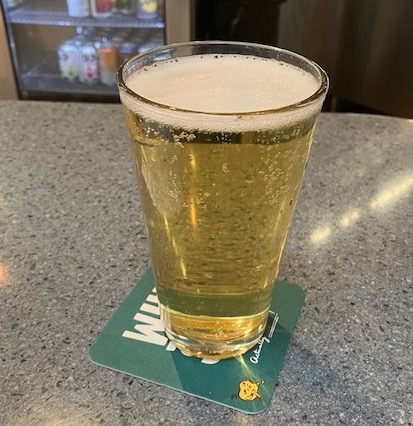
A couple of minutes later, he returned with a perfectly poured glass of Schell Light. This clear, pale lager, was full of carbonation bubbles and a thin head of foam.
While I’m not a fan of light beers, this one hit the spot at 7:20 a.m. on Friday, July 11.
I was reminded of the song “Roadhouse Blues” from the Doors’ album Morrison Hotel: “Well, I woke up this morning and I got myself a beer, the future’s uncertain and the end is always near.”
At my old age, I have never purposely abused my affection for beer. Out of respect for the beverage, I’ve worked to be doggedly rigid in my self-control when consuming beer, I’m basically—‘one and done.’
But, I will admit that for a long, long time lurking in the back of my mind were the lyrics from “Roadhouse Blues.”
So now, I can mark the drinking of an early morning beer off any unimportant bucket list.
Yet, there is a more important point, and that is Scott Hislop.
In our fast paced, impatient world, Scott took the time to respond to my original email. To me that is admirable.
I can’t tell you how many times I have sent a complimentary email to published authors. Rarely, do I receive a note of thanks back.
Scott’s response is a valuable lesson for any company small or large—that personal contact, the opportunity to build even a brief relationship with a potential consumer or customer is important.
That quick encounter with me also shows Scott’s loyalty to August Schell and its customers. No matter if they are devoted Midwestern supporters of August Schell, or a grumpy, rapidly aging geezer from Virginia passing through the Minneapolis-St. Paul airport, Scott understands the value of communication and building a relationship.
Finally, my pursuit in sampling an August Schell beer was grounded out of respect for their perseverance.
Located in New Ulm, Minnesota, August Schell is the second oldest family run brewery in America. From their beginnings, the brewery has continued to survive. In that survival, you will find risk taking combined with the ability to respect the foundation of the past with the will to adapt for the future.
If on the morning of Saturday, January 25, I went out to fish, I don’t remember it. Maybe that is because there was a distraction—the sun was back.
When I went for my morning run the temperature was 54 degrees, wind was whipping out of the north at 12 mph, with gusts up to 28. But the sun was out against a clear blue backdrop.
For this run, I ran north along the highway on the left side facing the traffic. The road’s shoulder was a combination of sidewalks and driveway entrances into parking lots for businesses.
I ended up running past Crane Point Hammock. Then, I turned around and retraced my steps to Tranquility Bay. I clocked my time at 40:59. A good workout into a stiff breeze.
Along the way, there were a few early risers. At some point, from the other side of the highway, I heard these words: “get off the road.” I spun around to see if those words were meant for me.
I determined the words came from a passing vehicle on the other side of the road. Probably some driver with a car racked out with the technology to annoy old men on a singular Saturday morning run.
I imagine the driver had quite a laugh when he/she saw me whip around searching to find the culprit.
Back at Tranquility Bay, we were in motion. We were gathering ourselves for a short walk to The Stuffed Pig for breakfast.
Bundled up for the wind, we made the walk to the restaurant. Inside seats were already taken. So, we were directed to an outside seating area in back of the restaurant.
My pals at The Stuffed Pig (Photo Bill Pike)
Yes, the air was a bit brisk, but we settled into our table, and placed our orders. When the delicious food arrived, the chilled air was forgotten.
I can only describe our orders as this—a cardiologist would see dollars signs. I’m sure my arteries, heart chambers, and veins enjoyed every bite of my homemade biscuits smothered in warm sausage gravy. For the next six days, I was powerfully tempted to return to The Stuffed Pig to up my cholesterol, but I resisted.
Along with the delightful breakfast, the staff at this restaurant is most impressive—they are polite, hardworking hustlers.
With this cool air, we had read a notice from weather forecasters to be on the outlook for iguanas falling out of trees. This cool air impacts their metabolism.
Iguanas crawl into trees to sleep. Being cold blooded, in these cool temperatures iguanas can lose their grip on the tree limbs.
When the grip goes, the iguana falls. If an iguana had clunked down on me after breakfast at The Stuffed Pig any health problems related to cholesterol, bladder, and bowel would have been instantly cleared.
But we did see a green iguana poking his head up out of shrubbery. It was if the iguana was seeking the warmth of the sun. Perhaps, this iguana was silently saying to the sun—thank the good Lord you are back this morning.
An iguana catching some sun (Photo courtesy of Betsy Pike)
Past breakfast, Saturday was quiet. The abundant sunshine kept us in motion.
My Richmond friend, Mike Cross, had alerted me before heading to the Keys that an alignment of planets would take place while we were there.
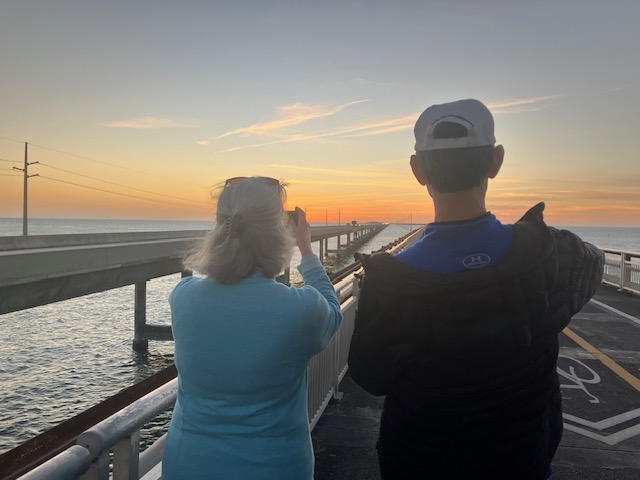
So prior to sundown, Betsy, Dan, and I made the trek to Seven Mile Bridge. Butch, Marian, and Judy would follow later in the car.
Our location looked to be a perfect for watching the sun set and planet searching.
Betsy and Dan capturing the sunset (Photo Bill Pike)
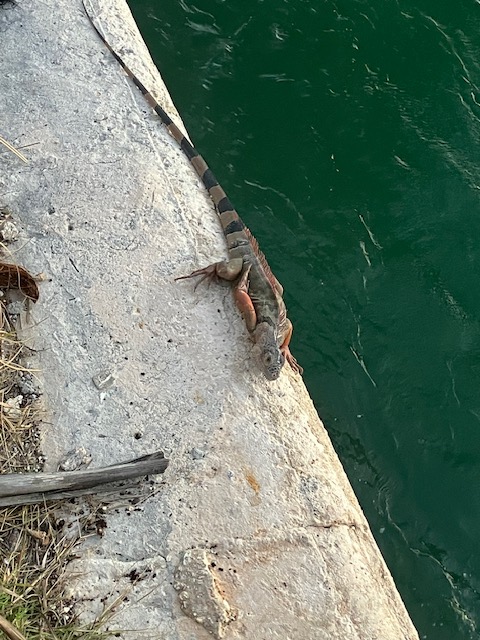
Prior to the sunset and planet search, we walked around. We noticed an iguana on a concrete ledge. Our guess was that earlier in the afternoon, the iguana had been reheating his body from the warm concrete.
Another iguana warming before nightfall (Photo Bill Pike)
Gradually, darkness began to arrive. The shades of color in the sky dimmed. Our first glimpses of sparkles in the heavens began to appear.
For the next half hour, our necks craned toward the dark yonder. Anything with some size and brightness caught our attention.
I’m no expert on the twinkling stars at night. I can find the dippers, but that’s about it.
Consulting the internet and a variety of apps, Dan and Betsy started to piece together the appearance of the planets.
Here is what our pals at NASA had to say about our search for this alignment of planets:
“In the first couple of hours after dark, you’ll find Venus and Saturn in the southwest, Jupiter high overhead, and Mars in the east. (Uranus and Neptune are there too, but a telescope is needed to see them.) Planets always appear along a line in the sky, so the “alignment” isn’t special. What’s less common is seeing four or five bright planets at once, which doesn’t happen every year. Is it a “planet parade”? This isn’t a technical term in astronomy, so call it what you wish!”
So, we kept looking and rationalizing what our eyes were seeing. By the time the rest of our gang showed up, I’m reasonably sure that Dan and Betsy had spotted Venus, Saturn, Jupiter, and Mars.
With creaky necks and weary eyes, we piled back into the car. A shrimp dinner and another round of Marian’s charades await us.
The shrimp were delicious, and the charades always bring some surprises and laughter.
Before turning in, we talked briefly about an outing to explore Pigeon Key on Sunday morning, and a sneak peak at Key West for Monday.
What a difference the return of the sun made. Its light certainly casts us into many different directions.
And in those directions, I’m thankful for the caring light found in our dear college friends, the solitude of an early morning run, the people skills at The Stuffed Pig, any iguana that didn’t clunk my head, sunsets and aligned planets, shrimp catchers and shrimp cooks, and the heartfelt laughter in a game of charades.
If you’ve been following this blog, you know how it will start. Yes, Bill was again up early. Apparently, sleeping-in isn’t in his body’s metabolism.
Another gray, cloudy, windy, unseasonably cool day was awake and waiting for me.
Gray, overcast, cool, breezy morning (Photo Bill Pike)
This morning, I took the short trek to the boardwalk and cove to fish. A different lure dangled from the end of the line.
Overnight, the stubborn winds had pushed lots of seaweed into the cove. Occasionally, the hook on the lure would pick up pieces of this grass.
On a daily basis, the ground crew works to remove the seaweed that washes up on the shoreline. We’ve noted in exploring Marathon Key that when the seaweed clusters up in tight quarters, it can create an unpleasant stench.
If there are any fish hanging around in this cove, they are opting to ignore my efforts to attract one, and that’s ok. When my fishing is unsuccessful, I turn my attention to the surroundings from where I’m casting. Even gray mornings are pretty on this coastline.
After several more minutes no nibbles, I head back to the condo.
Now, I’m going to change into my running clothes and go for a run along U. S. 1 heading toward Seven Mile Bridge.
When I’m out of town, and I go for a run, I try to remember to write down the address for where we are staying. I put that scrap of paper with me on the run. If something were to go wrong with my health, at least the responders would know where to find my family and friends, and dump my old body.
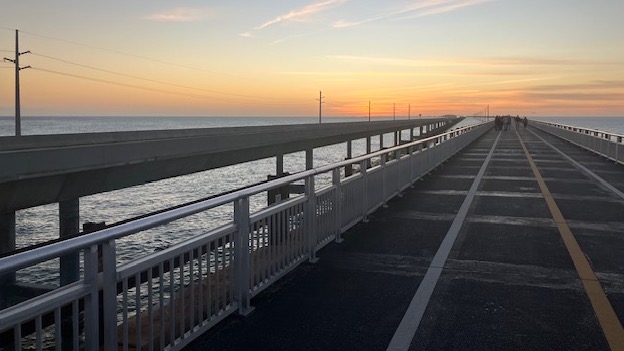
Luckily this morning, my run was uneventful. I ran to the 0.5 mile marker on the Old Seven Mile Bridge. Originally, this bridge was a part of the railroad that Henry Flagler built.
Today, the modern Seven Mile Bridge runs parallel to the old bridge. The old bridge goes for two miles. The bridge is ideal for bikers, runners, and walkers. It views are spectacular in any direction with sunset being its prime.
Overseas Highway on the left, laned pedestrian bridge opposite (Photo Bill Pike)
At the end of the two miles is Pigeon Key. At the beginning of the bridge there is a very nice connector that runs under the new Seven Mile Bridge to the Castaway restaurant.
Additionally there is a paved trail that runs parallel to U. S. 1. On the Gulf of Mexico side, this trail is a good access point for fishermen. Its small park appearance also has some picnic tables.
After my run, I have a light breakfast, shower, and get ready for our ride to Islamorada.
Dan won’t make this trip, as he has some work calls that could not be rescheduled.
According to various sources, Islamorada consists of five keys. Distance wise in the Keys, the village lies between Miami and Key West. Its name in Spanish translates to “purple island.”
For many years, former major league baseball star, Ted Williams, made his home in Islamorada. He loved the area for its fishing.
The Morada Way Arts and Cultural District is a nice shopping area in Islamorada.
Our first stop on this jaunt is the Green Turtle Inn Restaurant.
If you are in Islamorada, I would not turn down a meal at the Green Turtle Inn. I can only speak for our lunch time experience, but I would go back for The Bacon Wrapped Love Sandwich and a side of collards.
This is a meatloaf sandwich on a Brioche bun with Applewood smoked bacon, a meatloaf glaze, topped off with lettuce, tomato, and a slab of red onion.
On the menu, the restaurant notes this sandwich is a favorite of celebrity chef, Guy Fieri. After eating this sandwich, I understand his sentiment.
The collards were just as good. Tender, full of flavor, and cooked in a pot liquor that had me going for every last drop in my bowl.
And I also enjoyed from the Florida Keys Brewing Company their German styled Kolsch beer named Iguana Bait.
My college roommate, Butch, who has wonderful culinary skills, and a much more sophisticated palate, ordered the same meal and loved ever bite.
The ladies at our table enjoyed their lunch choices as well. Before we left, we ordered a whole Key Lime pie to go.
Back in the car, we drove to our next destination, Theater of the Sea.
A family owned and run business since 1946, Theater of the Sea offers a variety of demonstrations and learning opportunities featuring sea life, reptiles, and mammals. Sea lions, sea turtles, dolphins, sharks, stingrays, alligators, and parrots are among the entertainers.
Don’t relax around this lethargic looking gator (Photo Betsy Pike)
On the nicely landscaped tropical grounds, guests move to assorted locations in the park. In each space, a captive audience appreciates the trainers as they direct the stars of each show through their scripted routines. Even on this partly sunny, cool, windy afternoon, the trainers were friendly, knowledgeable, and patient.
Most impressive were the dolphins. Gentle, yet quick and powerful, the dolphins and their very agile trainer put on quite a show.
Back in the car, we made a stop at the Publix in Islamorada. Then, we drove back to Tranquility Bay.
For dinner that night, we had an assortment of light snacks, and the Key Lime Pie from the Green Turtle Inn.
The pie was delicious. We noticed the crust was different from the usual Key Lime pie crust.
After our trip, I followed up with the kind folks at the Green Turtle Inn about the crust. I learned the crust is a combination of crushed macadamia nuts and Rice Krispies cereal. Jenn who responded to my question pointed out that crust is gluten free.
Thursday showed us that our “creative flexibility” could nudge us to have fun on an imperfect day of weather.
Well, after our day of travel, we slept. Some longer than others, but we slept.
My internal alarm clock had me up by 4:30, but I did sleep.
It was a quiet start.
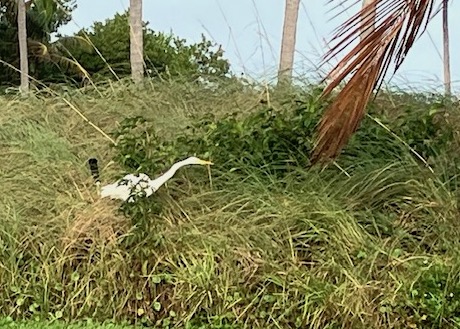
Before breakfast, Butch and I explored the grounds of Tranquility Bay. We came upon an egret in the high grass who was possibly stalking for breakfast too.
Egret in the tall grass (Photo Bill Pike)
After breakfast, we piled into the car.
We drove toward Seven Mile Bridge.
We quickly discovered that the bridge is seven miles long. Once you are on the bridge, there is no getting off until you reach the other side. I think when we reached Veteran’s Beach, we were able to turn around and head back to Marathon.
Back on Marathon Key, we were curious to check out Sandals. This was a store that we had seen constantly along U.S. 1 on our drive into Marathon.
Turns out that Sandals is a beach store. It is not unlike the Wings stores that we find on every other corner in various beach towns along the mid-Atlantic coast.
After Sandals, we made a grocery store stop at Winn-Dixie, a chain that I remember from growing up in North Carolina. They were a Florida based chain. With all of the changes and challenges in the grocery store landscape, I was surprised to see that they continues to live.
Lunch time was approaching. We decided on the Sunset Grill. This open air restaurant sits at the foot of the Seven Mile Bridge. The restaurant is properly named as it is the ideal location to watch a sunset.
I ordered conch chowder and a blackened fish sandwich. It was interesting to note the differences in the conch chowder from my similar order on Monday at High Tide in Key Largo. This version was much sweeter and featured less vegetables in the mix.
After lunch, we were in pursuit of shrimp for dinner and bait for fishing. We found both.
The clerk at the bait shop directed us to a water front seafood market where we purchased three pounds of fresh caught shrimp for our dinner. Bubba and Forrest would have been pleased.
For the remainder of the afternoon, we took advantage of the sunshine and comfortable temperatures.
At the heated, saltwater pool, Dan tried out the snorkeling gear that he brought with him. He was prepping for swims in the Gulf of Mexico and the Atlantic Ocean to view sea life.
Dan in the pool (Photo Bill Pike)
At guest services in the lobby, we picked up golf balls and putters to test our green reading ability and patience on the synthetic putting greens in the open space in front of our unit. Additionally, we reserved three bicycles for a ride back down to the Seven Mile Bridge.
After the putting practice and bike rides, I put together the fishing rods and set them up to use on Wednesday morning. My non-resident fishing license issued by the state of Florida was only good for seven days, so I wanted to try my luck and not waste my pennies.
As we pushed toward dinner with our shrimp, a few of us ambled toward the water in search of a sunset.
Toward the end of day two (Photo Bill Pike)
Thanks to gray clouds, the sinking sun was obscured, but I did capture our brides who are the braintrust for this trip.
The brains of our outfit (Photo Bill Pike)
Prepared by Butch and Marian, our shrimp dinner was delicious, and it was topped off by a Florida favorite—Key Lime Pie.
Our post-dinner entertainment was organized by Marian. We participated in an assortment of games that made us think a bit, but that also generated humorous commentary.
Soon sleep was calling, and we talked about our thoughts for Wednesday.
Turns out that cold air we left back home was going to find its way into the Florida Keys.
Whatever disappointment the gray clouds, sparse sun, and stiff winds would bring, I needed to remember it was much colder back in Richmond.
But beyond the weather, I’m also reminded to be thankful for this opportunity to get away.
And I must always keep in front of me this fact—some people from the day they are born until they make the leap to heaven never have the opportunity to get away.
And maybe there is no better way to ponder this by referencing a song written by John Lennon.
On his 1980 album, Double Fantasy, Lennon’s song, “Beautiful Boy(Darling Boy)” is about his son, Sean.
In the song, Lennon used this quote from Allen Saunders: “Life is what happens to you while you’re busy making other plans.”
I’ve never been to Chippewa Falls, but I have an appreciation for the beers brewed by Leinenkugel brewers. For me in Virginia, that appreciation never would have occurred without distribution of Leinenkugel beers initially by Miller, and more recently by Molson Coors.
Truthfully, I’m not surprised by the dumping of Leinenkugel’s original brewery by Molson Coors. Big breweries are focused on two goals — surviving and earning a profit.
When big brewers figured out that the craft-beer explosion was chipping into their sales, the big guys responded by purchasing successful craft breweries.
Not all of these acquisitions were successful.
Leinenkugel loyalists might find interest in learning the story of San Francisco’s iconic Anchor Steam Brewery. A few years after being purchased by the huge Japanese brewer, Sapporo, Anchor Steam historic brewery was closed.
Unfortunately, I don’t believe this will be the end of brewery closings in America. Investors, no matter if they are vested in a craft or behemoth brewery, desire to make a profit. For Leinenkugel, I hope there is a solution.
But what I really hope is that Molson Coors executives have learned a valuable lesson from the brewery in Chippewa Falls — loyalty still matters.
Bill Pike, Richmond, Virginia
From the author: Friends, I’m honored that my letter to the editor about the closing of the Leinenkugel Brewery was published in the Sunday, January 26, 2025 edition of the Wisconsin State Journal.











 might be baloney