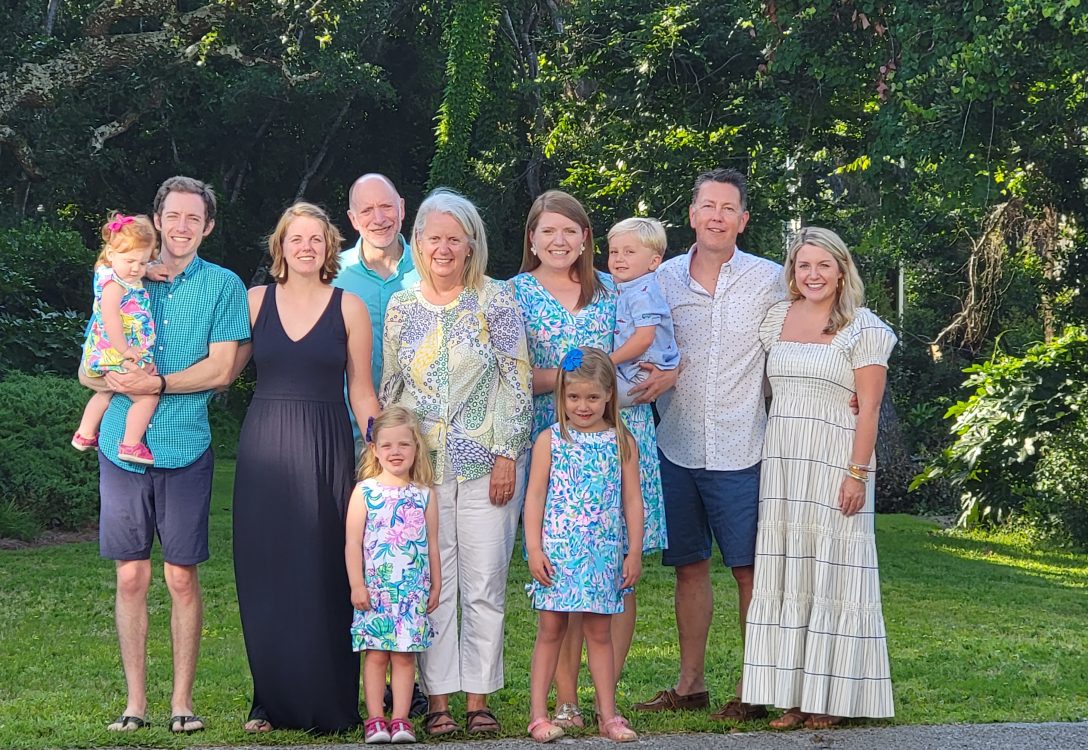
In Summerfield, North Carolina, late on the afternoon of Thursday, March 3, our grandson attended his first baseball practice. Hudson turns four in April.
When I was four, I had no idea that baseball existed. The world has changed.
We received a full report regarding Hudson’s practice. This included photographs with a brightly colored glove. Video showed him hitting the ball off the tee and scurrying down to first base. Like his grandpa and Aunt Lizzie, Hudson swings from the left side of the plate.
Growing up down the road in Burlington, I developed a love for baseball. Behind our house was an abandoned field. Our next door neighbor, Ken Simmons, transformed that field into a place for us to play. Ken had the vision.
Once we cleared out loose rocks, Ken mowed the broom straw grass and weeds. His father helped him form a rusty rectangular metal frame with chain-link fencing into a backstop. Plywood, cut with a hand saw shaped home plate.
Left and center fields had a tall stand of hardwoods and pine trees. Today, in my imagination that would remind me of Fenway’s Green Monster. No tree line in right field— a worn, narrow lake trail formed a boundary.
We had no helmets, nor batting gloves— just an odd collection of wooden bats, and a few baseballs.
Didn’t matter if you were a girl or a boy, we all played. Sometimes, friends from a few streets away would join us for a game.
We played nonstop. Of course, there were multiple delays as we searched for batted balls that had landed deep into the woods.
Way back then, the New York Yankees were my favorite team. I read short biographies about baseball players from the May Memorial Library, scoured box scores in the afternoon paper, read every printed word on the back of baseball cards, and at night listened to games on my transistor radio.
As an adult, I followed the game from a distance. I became a fan of the Boston Red Sox. Had the privilege of attending major league games in Boston, Los Angeles, Baltimore, Atlanta, and Chicago.
At some point, like a slow roller down the third base line, my interest in baseball began to subside.
I was thrilled when the Red Sox and the Cubs won the world series. However, the players strike in 1994-95, combined with the steroid challenges pushed me away.
I’ve read enough about baseball history to know that salaries, benefits, and a tug of war between owners, players, and now a player’s union have always been around.
Clearly, I’m not the brightest guy in the world, but I have no comprehension for the salary that Max Scherzer will be paid to pitch for the New York Mets this baseball season. Mr. Scherzer is scheduled to be paid $43,333,333 million. He has a three year contract valued at $130 million. I need to get on his payroll.
And that is my gripe about this most recent baseball lockout— who really is hurt by this lockout? I’ll tell you who is hurt—the fans and the people who work behind the scenes to make sure that a baseball game and its season happen.
Prior to this lockout being resolved on Thursday, March 10, both the union representing the players and the owners made nice comments about baseball’s fans. I’d call those statements shallow flattery.
Because if the owners and players really cared about the fans, no lockout would have occurred.
And if the players and owners really cared about the game, instead of raising the guaranteed annual salary of a major league player, why not significantly raise the salary of all stadium workers who do the dirty work before and after every game?
I wonder how the players and owners would feel if at some point in the future fans and stadium workers locked out owners and players at every major league stadium?
Sometimes on a perfect spring day, my mind daydreams back to that field behind our house. I hear the chatter of my friends, the unmistakable sound of a wooden bat hitting a tired baseball, and the sighs of relief when a lost ball was found. I wouldn’t trade anything for those priceless memories.
For our grandson, I hope his coaches are patient, kindhearted.
In teachable moments, I hope sportsmanship is the takeaway, not winning.
And despite baseball’s imperfections, I hope he has fun learning about a storied game.
Early one morning during the last week of February, I was sitting at my desk in the basement. Hunched over my laptop computer, I was distracted by a drip.
Sometimes a drip is a singular random drip, but then I heard it again. And just to be sure, I wasn’t hearing things, I waited to hear the drip again, and I did.
So, I got up from my chair, and moved in the direction of the drip. My ears took me to our three year old washing machine. I looked inside the silent, empty tub, and I saw the pooling of water from a steady drip.
I put a small bucket inside the tub to catch the water. I didn’t want that water to load up the drainage system.
Of course, I went to the internet to search, and in a few minutes, a diagnosis was deduced—a faulty water inlet valve.
I went further, and watched a step by step video that even an incompetent washing machine repairman like myself could do.
In her efficiency, the Commander Supreme, located the owner’s manual. It contained the essential model number and serial number for the leaking washer.
I contacted the parts department at a local retailer. I explained the drip, my amateur internet assisted diagnosis, and provided the model number to the patient clerk.
After a few minutes of his own investigation, he agreed with the diagnosis, and confirmed that he had the part in stock. I requested that he hold the part until I could pick it up.
On the afternoon of Friday, February 25, I picked up the part.
Based upon the internet video, I had the proper tools, and I was ready to start my nonprofessional surgery.
My first correct step was to unplug the machine from the electrical supply. Even with my limited skills, I know that water and electricity are not a good mix.
Next, I turned off the shutoff valves for the hot and cold water. I had placed a towel and a bucket under the stainless steel hoses where they connect to the back of the washing machine.
As I started to unscrew one of the hose connections, I took a shower. Water spewed at me like a lawn sprinkler. Clearly, an auspicious start, as molten words collided in midair with the spraying water. I retightened the shutoff valves, and the shower stopped.
After toweling off, the real surgery started. Somehow, I successfully removed the control panel. I gently leaned it on the lid of the washer.
I spied the water inlet valve. After several minutes of fumbling around, I removed this blue plastic contraption from its secure perch.
The next step was to remove the two wire harnesses that snap into the solenoids. The first one cooperated. The second one failed to cooperate. That harness was as stubborn as a child in a terrible two meltdown.
I pulled, tugged.
I used gentle words of encouragement like a horse whisperer.
I used harsh, volatile words like Coach K burning the ears of a referee.
The Commander Supreme from the top of the basement stairs asked if I was ok. I politely directed her not to come down the stairs.
I called the part supplier. He was baffled. But, he guessed that the harness had been installed too snuggly at the factory.
I decide to wrap the plastic coating of the harness in a rag. With pliers, I gripped the harness and pulled like I was in a playground tug of war, and the harness released. One side released cleanly, the other side failed to budge. I had to pry it off.
It took a few minutes, but I finally was able to get the new inlet valve in place and secured. I reattached the control panel, and screwed it back in place.
I reconnected the water hoses and tighten them to the washer. I turned on the water and I had a leak on one of the hoses. Tightened again, still dripped. It appeared that the drip was from a faulty hose.
So I turned off the water, and quit for the night.
On Saturday morning, I picked up two new hoses at Lowes. I installed them, turned on the water, and no leaks. Also, the new water inlet valve appeared to be working as no water was dripping inside the washing machine.
I know your are dying for this rubbish to end, but I’m sorry to disappoint you.
The Commander Supreme on Saturday had made an overnight trip to North Carolina for a lunch gathering of Pike related women.
After church on Sunday, I decided I would wash a load of clothes to make sure that my repair had been successful. I loaded the washer, selected the proper setting, and pushed the start button.
The control panel lit up, I could hear the tub filling with water, and inside I was quietly cheering. I went back upstairs for a few minutes, and then came back to the basement. I took a few steps toward the machine, and on the floor I saw a stream of water.
I grabbed some old towels and tossed them on the floor to stop the stream. No leaks at the hoses, but the top back corner of the washer was wet with water droplets. The tub was still filling, so I let it cycle through the complete run.
I dried everything off on the surface, and waited for the next cycle of water fill. Again no hose leaks, but water was still leaking from the machine.
When the run finished, I disassembled the control panel, and found a small pool of water where a tiny hose fit into the inlet valve. Everything look to be properly in place. With paper towels, I soaked up the water, and quit.
Part II: The Experienced Repairman
On Monday, I made arrangements for a real repairman to come out. Of course, the next appointment opening was on Tuesday, March 8. Cussing internally, I took the appointment.
I decided to call my former Hermitage High School pal, Bruce Bowen. Bruce is a savvy consumer. Maybe, he knows a repair company that can get to us sooner. Sure enough, Bruce had a name and number.
I called this company, and luckily they had a cancellation for Wednesday morning.
A few minutes before the appointed time, the repairman arrived.
As we walked to the basement, he recapped what had been reported to him about the washing machine. He acknowledged that water inlet valves had been a problem for the manufacturer of our machine.
He plugged in the washer, turned on the disassembled panel. The machine started the fill cycle, and immediately, he saw what was causing the leak.
The narrow hose going into the water inlet valve was not properly seated. He shut down the machine, and asked if I still had the faulty valve, and I did.
He looked at the old valve, and in the porthole where the hose was to properly fit, he removed a tiny “o” ring. He placed the “o” ring into the porthole, pushed the hose connection back into place, started the washer, and no water leaked.
As I beat myself up out loud for not catching the “o” ring, he stopped me.
The repairman shifted blame to the manufacturer. No new “o”ring had been included with the new valve, and the old “o” ring was the same color as the old valve making it difficult for the untrained eye to see.
With grateful thanks, I wrote the check which was also a nice surprise— he only charge us for the trip.
During the whole ordeal, a question had been burning inside of me. I asked the repairman, “Why are you so busy?”
He did not hold back. He told me—“The quality in the manufacturing of household appliances is not what it used to be.”
He further stated, “Unless you are lucky, the consumer can expect something to go wrong with an appliance during the first three years of ownership.”
I thanked him for his honest assessment.
Part III: Acts of you, me, we, us, and love
As I fumbled through the owner’s manual for our washing machine, I read with interest what is not covered in the manufacturer’s limited one year warranty. Number six read: Damage to the product caused by accident, fire, floods, or acts of God.
Interesting to me that in 2022, when as a society we appear to be more removed from God than ever before, yet “acts of God” is still part of an owner’s manual for a washing machine.
I guess that means the author of the manual, or perhaps an attorney who reviews the manual still acknowledges the unseen power, or perhaps the fear of God’s ability to cause problems.
Made me think about my own personal owner’s manual. Do I have one?
Do I have a limited warranty?
Do I have multiple pages of troubleshooting tips to guide me through difficult moments of operating through life?
How was I molded and formed on the assembly line from birth to where I am now?
And most importantly, who creates my challenges—me or God?
Yes, I know, those questions make your head spin.
But, my old noggin has come to this line of thought—you, me, we, us, our county, city, state, country, and world need an act of God.
God needs to grab us, shake us, and say to us—“Hey, you knuckleheads, this isn’t working, this has got to stop, you can’t continue like this, your stubborn hearts are not loving like I constructed them.”
In truth, we don’t need an act of God.
We need an act of our hearts.
Our hearts were constructed to love.
But, we have selfishly moved away from that love.
That inlet valve didn’t work properly without the “o” ring.
Right now, our hearts aren’t working properly.
Our “o” rings of love are missing.
Might be the most difficult challenge our hearts have experienced, but unless we figure out how to love, the messy world is not going to change.
God isn’t going to act.
He is waiting on you, me, we, and us, to change our reluctant hearts.
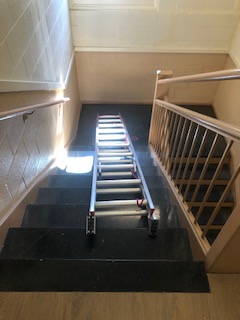
During an interview with the Oversight Committee For The Protection Of Extension Ladders, the Director of Operations at Trinity United Methodist Church, Bill Pike, admitted that he had heaved an extension ladder into a stairwell.
Fortunately, the well constructed Werner ladder sustained no injuries, nor did the rugged surface of the stairwell.
Of course, two HVAC contractors, who were with Pike in the stairwell at the time are still in a state of shock.
They were surprised that such a seemingly nice person could snap in a split second. When the contractors asked Pike if they could help him pick up the ladder, he told them: “No, I’m going to let the ladder cool off.”
This whole incident had come about because Pike had miscalculated the size of the ladder in trying to gain access to an attic hatch at the top of the stairwell. No matter which way he turned with the ladder— he clanked into walls, stair railings, and ceiling. Fortunately, he narrowly missed a collision with a sprinkler head.
For his ladder heave, the Oversight Committee For The Protection Of Extension Ladders, Pike is required to take a class on ladder trauma, audit a class on high school geometry, and is sentenced to one year of probation when using an extension ladder on church grounds. That probation requires that Pike must have another church employee or a member of the congregation with him when using the ladder.
Throughout the proceedings, Pike was remorseful. He acknowledged that the extension ladder had been a loyal friend in helping him gain access to unreachable points around the building and grounds. Pike was released to the custody of the chair of the Trustees, Jim Crowder, and Ronnie Johnson, head building caretaker.
I am ashamed to admit it, but I really did heave that extension ladder into the stairwell on the afternoon of Wednesday, February 23. I snapped. I was frustrated that I had not thought more carefully about gaining access to the attic hatch.
In truth, lots of things at church make me snap internally.
Kindhearted, well intended members ding me about lighting, speaker screen covers, chipping paint, etc.
They are correct to nag. I’m imperfect.
Some days, I suffer from tiredeyesitis. And despite tiredeyesitis, it is my job to make, or coordinate the repairs.
The pandemic years have been a challenge for our church.
Stress has impacted the staff and the congregation.
In a recent Zoom meeting of our Healthy Church Team, we worked through making a decision about relaxing the requirement to wear masks.
The meeting was long. The discussion grounded in trying to do what is in the best interest of the congregation from a health and safety perspective.
This was a challenging, but diplomatic conversation—no one snapped like the ladder heaver.
Yet, we needed a gentle reminder from our associate pastor, Hung Su Lim.
He reminded us of the following— Jesus replied: “‘Love the Lord your God with all your heart and with all your soul and with all your mind.’ This is the first and greatest commandment. And the second is like it: ‘Love your neighbor as yourself.’ Matthew 22: 37-39.
No doubt, we are weary and worn from the pandemic.
We want our friend normal to reappear in the blink of an eye.
I’m sorry, but normal isn’t coming back.
We are going to be wrestling with post pandemic trauma for a long, long time.
That wrestling is not going to be easy.
Life is never easy.
But, we do have a chance to make a change.
If you, me, we, us could embrace and live—‘love your neighbor as yourself,’ we might discover a better normal.
In the predawn silence at the kitchen table, I read the daily devotional from the Upper Room, study the recommended scripture, and then I torment God—I pray.
When my praying ends, God cheers.
Clearly, I am no theologian.
The Bible perplexes me.
Yet, some verses from the Bible give me hope in a struggling world.
Jeremiah 29:11 is one of those hopeful verses: “For I know the plans I have for you,” declares the Lord, “plans to prosper you and not to harm you, plans to give you hope and a future.”
Back on January 29, a funeral service was held at our church for one of our members, Barbara Burton. Barbara battled stage four kidney cancer for four years.
If cancer was not enough of a challenge, Barbara and her husband, Milt, lost their daughter, Alysia Basmajian, in the terrorist attack on the World Trade Center Twin Towers on September 11, 2001.
Barbara’s loss of her daughter, and her battle with cancer are a direct contradiction to Jeremiah’s scripture: “I know the plans I have for you, plans to prosper you and not to harm you, plans to give you hope and a future.”
In August of 2018, Henrico County School Board member, Lisa Marshall, announced she was resigning from the school board to focus on her battle with cancer.
After applying to fill this vacancy, in October of 2018, I was appointed to fill out Mrs. Marshall’s term.
My appointed term ended in December 2019. I’m not a politician. I opted not to run.
In that November 2019 election, Marcie Shea, an outstanding community leader, was elected to take my place.
Mrs. Shea has given great leadership to our school system in these very challenging times. Noting her skills, board members elected Mrs. Shea as the chairman in January of 2022.
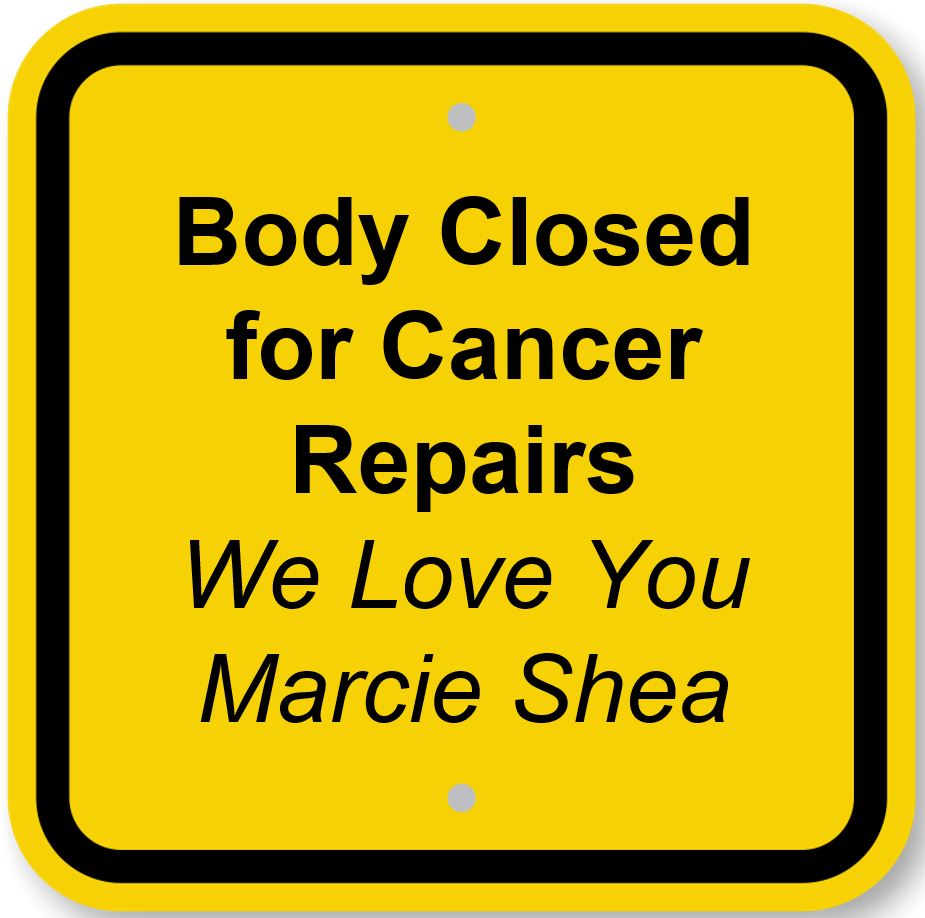
Just days before being elected chairman, Mrs. Shea made a heartbreaking public announcement. Six years into remission, breast cancer returned. This time the cancer is stage four and inoperable. True to her internal fortitude, Mrs. Shea plans to stay in office while taking the prescribed treatments.
Mrs. Shea’s announcement, is another direct contradiction to Jeremiah’s scripture: “I know the plans I have for you, plans to prosper you and not to harm you, plans to give you hope and a future.”
Since the summer of 1992, I have despised cancer.
On August 31, 1992, that stealer of life took my mother. I will never forget, nor forgive this intrusion.
When life goes wrong, I am a finger pointer.
When life does go wrong, rarely do I take the time to search deeply into my inner soul to really understand what went wrong—I’m too busy pointing that finger.
God knows that my finger points in his direction quite a bit.
I want him to intervene. I want him to right the wrongs I see.
I want God to confront the devilish cancer.
I want God to say, “Hey you pernicious pestilence, back off. Barbara and Marcie have suffered already. Enough. Leave them alone.”
Perhaps like me, you have determined that life doesn’t work that way.
Sometimes, I wonder how much of the bad in life is from our own doing.
We were given this beautiful world, but we seem intent on destroying it.
We explore Antarctica. We trash it.
We explore outer space. We trash it too.
Speaking of space, we recently launched the James Webb Telescope way out into the blue yonder. This telescope cost ten billion dollars.
Once properly positioned, this most powerful of all telescopes will allow scientist to see what our universe was like after the Big Bang. Just in case you want to know that was 200 million years ago.
Ten billion dollars to look into the past.
Is this our best thinking?
Why can’t we commit ten billion dollars to blast cancer out of this universe?
On Wednesday, February 16, the local nonprofit, Jill’s Blankets, took over the fellowship hall at our church. Jill’s Blankets makes beautiful fleece blankets for cancer patients. The blankets help to keep patients warm during and after treatments.
That day, volunteers made forty five blankets, and within twenty four hours, forty of the blankets had been delivered to patients.
For me, that is a good application of: “For I know the plans I have for you,” declares the Lord, “plans to prosper you and not to harm you, plans to give you hope and a future.”
Those volunteers gave the patients a bit of hope for the future.
Marcie Shea, and anyone else in our world who is in the trenches with cancer—hold on to this—we love you, not with harm, but with prayers of hope.
Hope that prayers of love will allow you to send that cancer straight to hell.
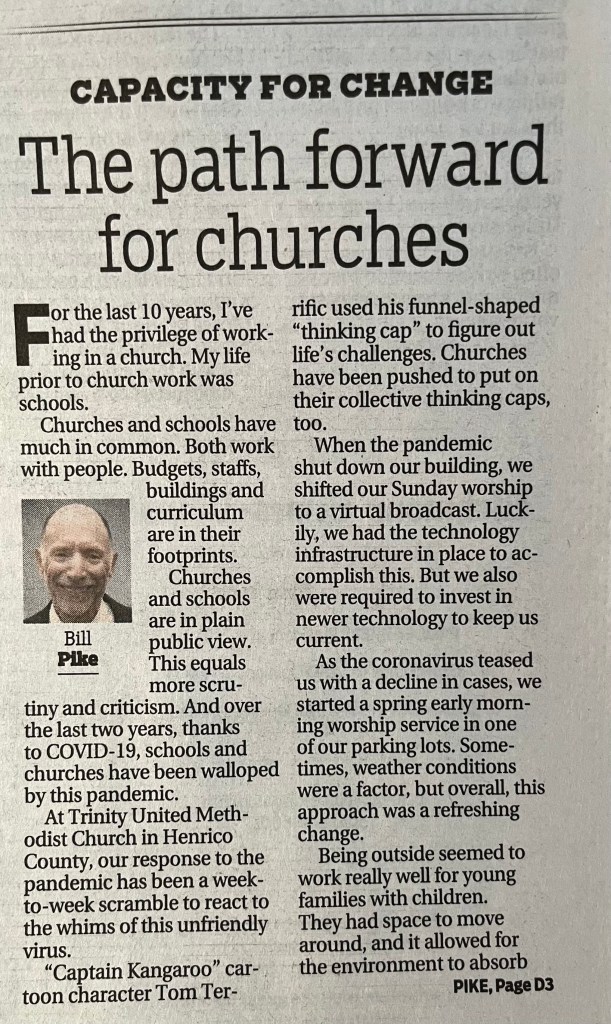
For the last ten years, I’ve had the privilege of working in our church. My life prior to church work was schools.
Churches and schools have much in common.
Both work with people.
Budgets, staffs, buildings, and curriculum are in their footprint.
Churches and schools are in plain public view. This equals more scrutiny and criticism.
And over the last two years, thanks to COVID-19, schools and churches have been walloped by this pandemic.
At our church, Trinity United Methodist, our response to the pandemic has been a week to week scramble to react to the whims of this unfriendly virus.
The Captain Kangaroo cartoon character Tom Terrific used his funnel shaped “thinking cap” to figure out life’s challenges. Churches have been pushed to put on their collective “thinking caps” too.
When the pandemic shutdown our building, we shifted our Sunday worship to a virtual broadcast. Luckily, we had the technology infrastructure in place to accomplish this. But, we were also required to invest in newer technology to keep us current.
As the virus teased us with a decline in cases, we started a spring early morning worship service in one of our parking lots. Sometimes, weather conditions were a factor, but overall this approach was a refreshing change.
Being outside, seemed to work really well for young families with children. They had space to move around. Being outside allowed the environment to absorb their chatter unlike the cramped confines of a sanctuary pew.
Our staff worked to implement other program options too. Some found traction, some didn’t.
But during this time, there was always the pandemic undertow of division. That division came from policies for dealing with the pandemic.
Initially, this was a collaborative effort from the Virginia United Methodist Conference and our local district. One requirement was for our church to develop our own healthy church team. This team consisting of staff and congregation members was charged with monitoring the pandemic and developing our response.
No matter how hard this team worked to keep people healthy and safe, no decision completely satisfied every member of our congregation.
In turn, we lost members who became frustrated with our policies when compared to other churches in the area.
Clearly, those departures had an impact. And they served to reaffirm that no matter the team’s decisions—wins were few in this environment.
But, in truth, churches were not in a winning position before the pandemic either.
Back on December 14, 2021, the latest Pew Research Center findings revealed: “That about three-in-ten American adults are now religiously unaffiliated. Self-identified Christians make up 63% of the U.S. population in 2021, down from 75% a decade ago.”
The Pew data continues to validate what churches have known for several years—finding the path to bring people back into church is a challenge.
In Tony Morgan’s book The Unstuck Church, the author uses a bell curve diagram to chart the life stages of a church. Mr. Morgan starts with the exciting launch, and sadly, concludes with the church being on life support.
From my work in a church, I sense churches really struggle with attempts to change.
The capacity to change is grounded in the ability of church staffs and their congregations to form honest relationships. Staffs and congregations must be able to talk, listen, and acknowledge differences.
Despite being in a weary and worn COVID-19 environment, churches must insure that these challenging conversations take place. Failure to talk and ponder the future will only continue to reduce the ability of churches to pull out from this downward spiral.
In Ecclesiastes Chapter 3, the point is made that there is a time and season for everything. The word “time” is cited twenty-nine times in those eight verses.
Time might be a critical piece for churches to consider in figuring out their futures. How do churches reinvent themselves with compelling offerings that will make the “religiously unaffiliated” curious enough to give of their time to check out church?
No matter whether a person is “religiously unaffiliated” or a longstanding member, churches are vying to capture time on either person’s calendar.
One thing is very clear to me—churches can’t continue to rely upon their past successes to sustain them in the future. Why? We are in a different world.
With urgent diligence, churches must invest in time to find a path forward.
Otherwise, “Due to lack of interest, church is closed” will become a dismal reality.
Author’s note: Sunday Morning Quarterbacking: Due to lack of interest, church is closed was submitted to the Richmond Times-Dispatch for consideration as an op-ed piece. On Sunday, February 20, 2022, the piece ran in the commentary section of the newspaper. I am honored when a piece of my writing is published beyond this blog site.
On the morning of Saturday, February 12, my neighborhood run started late. The keyboard on my laptop had a hold on me. It wouldn’t let go as I searched for words in what’s left of my old brain.
When I did leave the house around 7:30, the temperature was forty five degrees. Not bad for a February morning, but there was a brisk breeze out of the south, so I wasn’t running in shorts and a t-shirt.
Since Wednesday, spring had been teasing us. Afternoon temperatures had been in the sixties, with lots of blue sky and sunshine. Later on this pretty Saturday, we could hit seventy degrees.
But don’t get excited, on Sunday our projected high temperature is thirty nine degrees, with a cold rain changing over to snow.
I took my 3/28/11 route through the neighborhood. When I came to my right turn off Baldwin Road on to Westham Parkway, I saw something unusual—a pack of runners, with a longer strand of runners behind them.
Usually, I’m about the only fool out here. I slugged across Westham Parkway, so that I would be facing traffic as I ran. The runners were polite, young, and of course, many were attired in shorts and t-shirts.
One asked how I was doing, and I responded, “old.”
What I really wanted to say was slow down. Take a good look at me. This might be you in a few years as that spry heart zipped by me.
Up where Westham splits, in the median was a water stop. Several of the runners paused for some hydration.
The polite passing continued up Westham.
Some were involved in road chatter. Others were silent. It was a diverse group of men and women. All ages. Shapes and sizes. Fast, slow, and in between. I admired their commitment of time and investment in their health.
And somewhere in that investment, there is an appreciative shoe company, and maybe an orthopedic surgeon dreaming of a faster car or a bigger beach house.
On my loop back down Westham, I was curious. At the water station, I asked the gentleman in charge about the training targets for this group. He told me the runners were a mix of half and full marathoners, and some were prepping for the Boston Marathon.
Back on January 31, I bought a new pair of running shoes. By expert standards, I was long overdue.
The young man who waited on me was impressed when I removed the insole from my old pair of shoes, and I showed him the neatly printed date of my last shoe purchase.
The salesperson listened to my whines about my current shoe, and I could see he was contemplating his inventory. I learned he was in graduate school, a physics major, with a goal to eventually earn his doctorate in physics. I told him I was impressed with his brains.
I informed him that I had a budget, and of course the two pairs of shoes he brought out for me to try were not in my budget.
I asked him if he was married, his was answer was no. Then I suggested to him, if I purchased either of your recommendations, in couple of days, you’ll be reading my obituary. He laughed.
But, I made the out of budget purchase. The salesperson had properly fitted my old feet. The shoes felt right.
During my post-purchase days, my conscience was really working on me. But, that came to an end.
My wife and our youngest daughter countered my second guessing with this wisdom—you supported a local business, and at your old, old age your feet deserved it.
And then I reasoned to myself, if I were to croak while out for a run, at least my feet died happy.
On that Saturday morning run, I noticed the back of a t-shirt on one of the runners who whizzed by me. Printed on the back of the shirt was the word—“pacer.” In that particular road race, this gentleman gave of his running expertise to help pace a group of runners.
Life is a race.
Yet, as I race through life, I rarely think about my pace.
My guess is you probably don’t think of your life pace either.
Out of all our seasons, our slog from winter to spring might be the most challenging. Maybe getting through winter is about pace— our ability to adapt.
I never was one to get caught up in the hoopla over Groundhog Day.
Winter is winter. Winter knows its pace.
But, I love that scene in the movie Groundhog Day, when Phil portrayed by Bill Murray, tells the groundhog driving in a stolen pickup truck, “don’t drive angry, don’t drive angry.”
That is good advice to the groundhog, and for me too.
In our two plus years of dealing with this pandemic, we have attempted to pace ourselves with its ups and downs. But, one thing is clear to me—we are still driving angry.
Despite my quibbles with winter, I admire one of its peaceful traits.
Winter allows us to see the whole tree free of its foliage.
Winter allows us to peer deep into the landscape of a stand of silent trees along a Virginia byway.
Winter wetlands, along the banks of the James River/Huguenot Bridge Richmond, Virginia photo Bill Pike
I wonder if winter is trying to tell us something about our vision, our sight, and our capacity to see.
Is winter reaching out to a worn and weary country?
Is winter nudging us to look beyond our own stark, bareness, and to peer deeper into our hearts?
I’m not sure.
But, I do know this—we can’t continue to drive angry.
Somewhere out there, Spring is pacing its arrival.
With or without us, Spring will show up.
But, I think Spring is hoping that our pace, our driving through life is less angry with each other.
And that makes me wonder, why is it so hard for me to live the wisdom in 1 John Chapter 4 verses 19-21:
We love because he first loved us. Whoever claims to love God yet hates a brother or sister is a liar. For whoever does not love their brother and sister, whom they have seen, cannot love God, whom they have not seen. And he has given us this command: Anyone who loves God must also love their brother and sister.
Perhaps, my difficulty to follow this wisdom is grounded in my inability to consistently follow the real Pacer in life.
On the afternoon of Thursday, January 20, a cold, gray winter rain was changing to snow. I crossed the James River via the Huguenot Bridge headed toward the Woody Funeral Home in Chesterfield County. Seemed like the snow was falling harder south of the James.
Faye Bokkon, an outstanding Social Studies teacher, that I had worked with at Hermitage High School had lost her husband, Billy. A visitation for family and friends was taking place this afternoon. My schedule would not allow me to attend Billy’s funeral on Friday.
Billy was a good man. He was our insurance agent. He held our lives in paper policies.
Billy reminded me of my father who also sold insurance. They shared a common trait—honesty.
In our interactions with Billy, my wife and I found him to be honest, always thinking, always looking ahead, and we trusted his experience, his wisdom.
For the last few years, Billy’s health had been declining. On January 10, his body granted him the peace that he deserved.
At the visitation, I was able to speak with Faye for a few minutes. She was emotional. This was a tough loss. Her moist eyes and shaky voice affirmed her sadness.
But, I believe in Faye. She is a survivor. People like Faye, who dedicate their lives to classrooms with high school students packed in it, know how to work through life’s challenging moments.
Billy’s obituary cited his passions—family, the University of Virginia, and the village of Midlothian.
Billy was an avid sport fans. His love for the teams at the University of Virginia was unsurpassed.
Through a family connection Billy and Faye attended lots of football and basketball games, and the annual ACC mens basketball tournament.
When they attended the ACC tournament, I would ask Faye to pick up a copy of the tournament’s program for our son, Andrew. Andrew loved going through that packed magazine full of league history and lots of statistics.
Thanks to my brainwashing, Andrew and I cheered for the ACC team that wore the darker shade of blue. Billy knew this, and a couple of times he gave us his game tickets to watch Duke and Virginia play in Charlottesville. Andrew loved it.
In 2004, Faye and Billy attended the ACC tournament in Greensboro. Billy told me he would call if Virginia lost in the quarterfinals. A loss would mean there would be some extra tickets around from friends.
I think it was after midnight when he called saying he had two tickets for us to attend the semifinals and the finals.
Early on Saturday morning, Andrew and I drove to Greensboro. We met Billy in the lobby of the hotel, paid for the tickets, and worked our way to the Greensboro Coliseum. The seats were spectacular. We had a blast. Duke won their game, and they would be facing Maryland on Sunday in the finals.
The ride back to Richmond after the game on Sunday was long and painful—Duke lost to Maryland. But, in truth, there was a win in this. Thanks to Billy and Faye, we attended the best college basketball tournament in America.
A lot has changed in the world of college basketball in the eighteen years since we attended the tournament.
In 2019, Virginia won the mens college basketball championship. Their coach, Tony Bennett, is a class act. Virginia deserved to win the tournament that year. They were truly a united team, and the players never backed down in games when the outcome looked bleak.
I’m sure Billy enjoyed every minute of that championship season.
And I’m certain on Monday, February 7, 2022 from the comfort of courtside seats in heaven, Billy loved Virginia’s upset of seventh ranked Duke at Cameron Indoor Stadium.
Duke’s bluechip, one and done recruits were outplayed by a Virginia team who performed with a committed toughness and heart.
When I think about Billy, I keep coming back to his heart.
He had a heart for people.
Everything he did in life linked his good, kind, and generous heart to people.
I know our son, Andrew, will never forget Billy’s generous heart.
On that cold, snowy January afternoon, I will never forget Billy’s coffin draped in our American flag for his four years of service in the United States Air Force during the Vietnam War.
Nor will I forget the family and friends who filled the parlor space to pay their respects to Billy, Faye, and their daughter, Allison, and her family.
It was an opportunity for our hearts to give back to Billy for all that he meant to us.
Billy, up in the wild blue yonder, I know you are still smiling from that win over Duke.
Right now somewhere close by, or far, far away a person is crying.
Soft tears are rolling down a cheek. Hard tears are heaving up a chest. This is no fun.
No matter the type of tears, they are courtesy of a common human ailment—a broken heart.
I remember my first one—Alice Buffalo. I met her at a week long Methodist youth fellowship retreat at North Carolina Wesleyan College in Rocky Mount.
This relationship had no chance. Alice was from Rocky Mount. I lived in Burlington. But, we must have thought anything was possible because I remember writing letters. Of course, there were some faint hearted plans for Alice to come to Burlington for a weekend, but that never happened.
My father knew something about broken hearts. At some point during his World War II service in the Navy, his first marriage ended. Apparently, while he was away, my sweet, kindhearted father was dumped for an officer. I never talked with him about his broken heart. I sense my mother, his second wife, must have helped his heart to heal.
I don’t think we can be immune from a broken heart. To my knowledge scientists haven’t created a vaccine.
Poets, authors, screenwriters, and songwriters have written quite a bit about broken hearts.
Since November, I’ve been keeping track of friends whose hearts have been broken.
I think the worst type of broken heart is the blindside.
Ending a relationship by blindsiding the unsuspecting receiver is cruel.
With this news, the receiver’s heart and mind accelerate into a mad chaos.
The tears are horrid. Chest convulsions are like seismic shifts. Gasping lungs want to breathe. The heart is thrust into overdrive with an out of control propulsion of beats.
The blindside isn’t pretty. It deeply wounds a heart.
As a father, I know this blindsided heart.
We have a dear friend who survived a challenging divorce. I think our friend is a gentleman. No matter the difficulties created from the divorce, he has put his heart into maintaining his relationships with his daughters.
Despite his efforts, one daughter didn’t see it that way. She would not allow him to attend her wedding and give her away. Our friend’s heart is crushed. Mentally, he keeps questioning his heart, racking his brain asking himself over and over again—what did I do wrong?
There is never a good time for a broken heart, but Christmas is a bad choice.
Another friend was on his way to spend Christmas Day with his grown children, a former wife, and the wife’s family. Yes, I’m sure there would have been some awkward moments, but our friend’s children were really looking forward to seeing him.
As our friend was driving to this gathering, he received a phone call from his very distraught daughter. She was calling to tell him that he had been uninvited to this Christmas Day event. That phone call broke the heart of our friend and his two children.
Shortly after the start of the New Year, I received a call from a former elderly neighbor. I was hesitant to take the call, but my brainless heart talked me into it.
For a variety of reasons, our former neighbor is basically estranged from his children. That was the purpose of his call to complain about his children and everything related to his current living arrangements.
All I could do was listen. His mind, his stubborn heart would not budge on his assessment and opinions. Nothing I could say would persuade him that his brokenhearted children would be willing to talk with his unbending heart.
Warren Zevon was a very gifted songwriter, musician, and singer. You might remember his songs “Werewolves of London” and “Excitable Boy.” Additionally, Mr. Zevon’s songs were recorded by other singers most notably—Linda Ronstadt.
Sadly, Mr. Zevon died in 2003 from cancer. When diagnosed with cancer, he committed to recording a new album titled The Wind. The last song on the album “Keep Me In Your Heart” is a pretty, but sad tune about the end Mr. Zevon is facing.
He ask listeners to “keep me in your heart for a while.”
Amazon’s Alexa sits on the marble top of an old piece of furniture in our kitchen. If I were to shout out, “Alexa how do you repair a broken heart,” I wonder how she might respond?
Sometimes, I catch myself in a daydream going back to life’s bad moments when I know my words, my actions— hurt hearts. If I could only reclaim, retract that meanness.
Doesn’t matter whose heart has been broken, what that person needs to know from me and you comes from Mr. Zevon—“keep me in your heart for a while.”
Maybe that’s how broken hearts are repaired.
We keep those loved ones, those friends in our heart for a while, or for as long as they need us.
Graphic design created by a gifted artist, Elizabeth Loring Pike
In truth, I was dreading Wednesday, December 29, 2021. That was the day I would be driving my mother-in-law back to West Hartford, Connecticut. The dread wasn’t my mother-in-law. On this drive that I have made many times with her, she is a good co-pilot. The dread is the drive.
If you are lucky, the drive from Richmond to West Hartford is in the eight hour range. Of course, if you are unlucky, that ride becomes even more challenging.
Despite me botching up getting around/through our nation’s capital, we had a pretty good ride. Yes, we hit some pockets where we slowed down, and at times we questioned the sanity of our fellow drivers, but we made it.
When we arrived at Liz’s retirement community, we learned that the COVID-19 variant, Omicron, had temporarily closed the dining room. That meant after unloading the car, we would be going out for dinner.
Fortunately, West Hartford has many good restaurants. This evening, we would ride over to Effie’s Family Place. I’ve never had a bad meal at Effie’s, and tonight was no different— especially the warmed piece of blueberry pie with vanilla ice cream.
Best co-pilot and mother-in-law at Effie’s in West Hartford photo Bill Pike
After we returned from dinner, I organized my junk for an early morning departure. Liz prepped me a snack bag, and gave me a few pointers for breakfast.
Thursday morning, December 30 came quick. A little after six, I was walking with my stuff to the car.
I put my stuff in the back and transitioned to the driver’s seat. I put my foot on the brake pedal, touched the ignition button, and the car would not start. Very bad words spewed into the cold dark, dampness.
Grabbed my wallet, found my AAA card, and placed a call.
Within about twenty minutes, a nice young man arrived. I gave him some background, and let him know the battery was only six months old.
He saw no problems with the battery, and he hooked the car up for a jump. On his signal, I poked the ignition switch and the car started.
I thanked him, and I followed his instructions to let the car keep running.
In about 15 minutes, I decided to drive toward the interstate. I wasn’t going back down that east coast corridor of madness. This morning, I would take I-84 west to connect with I-81 south. Though this route is a tad bit longer, it seems less stressful.
It is a damp morning. No winter weather is in the forecast for the ride into New York and Pennsylvania. But, a collision of warm and cold air currents could create some pockets of fog.
Soon Connecticut is behind me. I crossed the Hudson River, and I’m clipping along not too far from the Pennsylvania line. Then I receive a message from my bladder—it needs some relief.
I pullover at the Wallkill rest stop. The state of New York is renovating the restrooms, so I’ll be using a port-a-john.
I make my bladder happy, get back in the car, foot on the brake pedal, push the ignition, and the car won’t start. Try again, no luck, no bad language, too angry.
A couple spaces down is a gentlemen in a pickup truck. I politely ask if he has jumper cables—sorry no is his reply.
Now, I’m back on the phone with AAA. They are trying to figure my location. Of course, I’m too much of a numbskull to walk back and see the sign for Wallkill.
Wallkill rest stop Photo Bill Pike
Finally, the dispatcher figures it out, and assigns a tow company to assist me.
I keep getting arrival time estimates, and then I receive a call from the tow company. I go through the whole location piece again, and I mention the port-a-johns out front. The driver says, “I know exactly where you are, but that’s not our territory.”
So, I’m calling AAA back explaining this new challenge. This dispatcher goes through the script again, and after several minutes he locates the correct rest stop.
The wait isn’t going to be horrible. Luckily, it is chilly, but not frigid temperatures.
I wait. I keep an eye on my phone for updates. Looking around the car, I realize I left the snack bag back in West Hartford.
I have the hood open on the car to help the AAA driver.
Patiently awaiting help Photo Bill Pike
An older model suburban pulls down several spaces from me.
A burly young man, with a massive beard, and a hoodie pulled tight over him gets my attention.
I open the door slightly, and he begins to tell me how he had trouble starting his car this morning too.
I’m not sure what he is holding in his hand with dangling wires. But, he tells me he used this contraption to start his car earlier today.
I give him permission to try, and I also tell him I don’t want you to get hurt. He assures me he will not.
So, he makes some connections to the battery. Once he is ready, he tells me to try to start the car. I do, nothing happens.
All I can imagine is this guy is going to end up frying himself like an inmate in The Green Mile, or he will be zapped while turning all shades of blue, white, and silver like a ghost in Ghostbusters.
He rattles his connection again, and I think one of his hands gets a little jolt. That’s when I tell him thanks, but I don’t want you to be hurt. He agrees and regroups to restart his drive back to Kentucky.
More long minutes pass, and then I receive a call. It is the tow truck driver. Now, I know the name of the rest stop, and I tell him Wallkill. He is only minutes away.
When he arrives, I am immediately relieved. This guy reminds me of Bill Murray.
I expect him to start talking to me like Carl Spackler, the greenskeeper in Caddyshack. I imagine Bill Murray’s next movie—The Tow Truck Guy.
But none of that happens, I explain the problem. He jump starts the car, but he advises me don’t turn the engine off when I make a stop.
He drives off. I work my way back on to I-84.
Back on the interstate, the car does some goofy things. Dashboard lights flash on/off. There is an unexplained jolt. So, I’m thinking as I cross the Pennsylvania line—something isn’t right. Instead of pushing ahead, I’m going to leave I-84 at Milford, Pennsylvania.
I stop at an Exxon for gas. As I’m pulling into a pump, the car feels like its lost the power steering. I leave the car running, I fill it up, and then park it out of the way.
I walk in to speak with the attendant. Turns out she is a pleasant young lady.
As I explain my dilemma, I’m looking at her carefully, and I see a face with a makeup covered black eye. I’m sure she tried her best to make the makeup work, but it didn’t.
My heart hurt for her as she guided me to Kost Tire and Auto Service. She told me Milford only has one stoplight, and I was to turn left at the light. It was a short drive to Kost after the turn. I thanked her and returned to my still running car.
I found Kost Tire and Auto. I parked and entered the service desk reception area.
A young man greeted me, and he patiently listened to my story. He told me to give him a few minutes. Today, Kost was busy.
I found a seat and waited.
After about a half hour, he asked me for the keys.
More wait time, and then, I was called back to the counter.
My non-mechanic brain had reasoned out that it couldn’t be the battery as the battery had been put in new in June. I was expecting to be told the car needed a new alternator. If it was an alternator, I’d been surprised if they had one in town. So, I’m preparing mentally to spend the night in Milford.
In talking with the service technician and the mechanic, I learned the computer’s electrical assessment of the car’s systems said I needed a new battery—the battery had a bad cell. Their analysis deduced the car had been running off of the alternator—too much car talk for my uneducated brain.
A new battery was installed. The mechanic wrapped the uncooperative battery in plastic for the ride back to Richmond. That way I could return it to my local mechanic.
And just to confirm that it is a small world, the mechanic has a daughter who lives in Mechanicsville, in Hanover County, Virginia. That is a twenty minute drive from our house in Henrico County.
I thanked them for letting me interrupt their day.
At some point after two, I was driving back through Milford toward I-84. And just so you know, Milford is a pretty little town, a town worth a stop for exploring.
With new confidence, I made the drive to Scranton, connected to I-81, and headed south.
The further south I drove into the mountains of Pennsylvania, another nemesis arrived—fog.
During the morning, that collision of air had not burned off. At times, the fog was so thick I could not make out the brake lights that were supposed to be in front of me. These conditions lingered for many, many miles, and of course, I reduced my speed for safety.
I don’t remember where, but gradually the fog dissipated. I was looking forward to crossing into Maryland followed quickly by West Virginia, and then Virginia. When I reached Virginia, I really wanted to exit the interstate and travel the backroads, but I opted to stay with the interstate.
Somehow during the drive, I stayed awake, and somehow much to my relief, I made it to our house before ten p.m. The normal eight hour drive had been stretched to sixteen. I would not wish that tension filled drive on my worst enemy.
But, I am thankful for one thing. I’m glad I was the driver, not my loving wife, the Commander Supreme.
When our kids attended Trinity preschool at our church, I loved attending programs and hearing the enthusiastic harmony of the voices of children singing out these words—“All night, all day, angels watching over me my Lord.”
I think Thursday, December 30 was an “angels watching over me” day.
Every person who rendered me assistance was patient, kind, an angel.
As I recall their faces, I will never forget the young lady at the service station with the makeup covered black eye.
I hope in her future that angels will be watching over her.
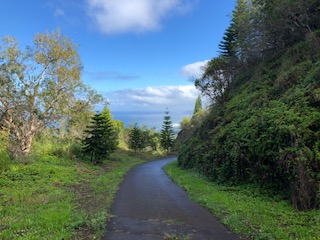
On Wednesday, December 15, we were going to hike up to Peacock Flats, a part of the Mokuleia Forest Reserve. For this hike, we followed an asphalt service road.
The beginning is a tease, straight and flat. But soon, your legs start to feel the rise in the grades with an ample supply of curves to keep you honest. There is an advantage to the upward push. As we climb, the views back to the coastline improve.
Both sides of the road are thick with greenery and splotches of color. Bike riders strain as they creep up the hills, but they come screaming down those same hills on the return loop.
Out on the trail Photo Bill Pike
Occasionally, we hear birds. In one section, a bird sounds like he/she is cackling in laughter at us as we trudge up another hill.
We do take some stops and look back at the blue sky with puffy clouds hanging above the Pacific. Once again, not a bad view.
A view looking back from the trail Photo Bill Pike
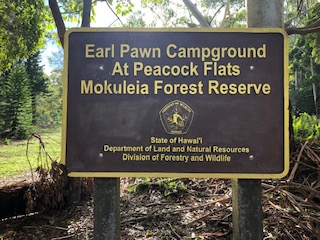
Then we recommit to keep pushing upward, and we do reach the Earl Pawn Campground at Peacock Flats.
Peacock Flats photo Bill Pike
The campground has a nice grass meadow surrounded by a variety of tall trees. Up here the asphalt trail disappears.
After a bit of exploring, we decide to start the walk back down.
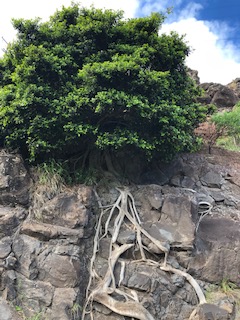
At one point, I take note of a shrub growing above a rock line with its exposed roots coming down the face of the rocks below. Somehow, this good sized shrub has figured out how to survive.
Roots of survival Photo Bill Pike
In the flatland of the valley we can see the runways for the Dillingham Airfield. I ask Art about gliders out here and almost instantly he notes a tow plane pulling a glider up into the sky.
I still have a kid’s fascination with airplanes. As we continue to watch the sky we received an unexpected treat.
In that clear blue, a glider that had been towed up and released earlier came gliding over us. Now that plane was hundreds of feet up in the sky. Yet, the quietness of our location allowed us to hear the wind wisping over its wings. Art commented—“For a glider pilot that is truly touching the face of God.”
Somewhere down below us is that flapjack flat surface where we started. Eventually we get there and follow this straight shot back to the car.
Art thought it would be a good idea to head into town to the food truck CrispyGrindz for an acai bowl.
In Haleiwa, there is a section in town where either side of the main road has two large parcels of land dedicated to food trucks. The acai bowl was as promised—delicious.
Thursday, December 16, 2021
This morning, Art drove us back in Honolulu. Our first stop is the Bishop Museum.
If in Honolulu, you must visit this museum. Even if you have a short window of time, you must make this stop.
Entrance Bishop Museum Photo Bill Pike
Yes, the meticulous displays seem endless. But, endless is to be expected for a museum that started in 1889. And the curators use these displays to tell the story of the people of Hawaii. Those stories are told with documents, photographs, and artifacts. Every aspect of life is captured.
Also, the museum incorporates the culture and history of other Pacific island cultures.
Beyond these traditional museum showcases, leaders at the Bishop bring in special exhibitions. On our visit, we took in Tatau: Marks of Polynesia. Also, the complex includes a state of the art planetarium that offers a variety of programming.
Again, if I’m lucky enough to return to Hawaii someday, I would like to spend more time exploring the Bishop Museum.
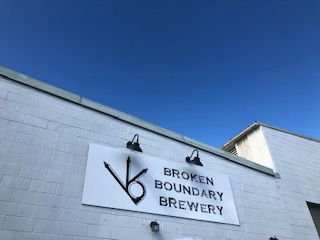
From the Bishop, we found our way to the Broken Boundary Brewery. This craft brewery also opened at the beginning of the pandemic, and somehow they have survived.
Simple signage at Broken Boundary Photo Bill Pike
The location for Broken Boundary is in a warehouse/industrial section of the city. But, the owners have taken this large interior space and given it a practical layout.
The brewery is in full view so visitors can watch as brewers attend to the various stages of brewing.
My bacon jam smash burger was delicious, and I enjoyed my Red Irish Ale named Ginger Ginger. Once back at the house, we regrouped and headed to the beach.
At some point, we took a nice leisurely walk heading west toward what Abby with great affection calls Parker’s beach. Just a few blocks away by car, Abby and Art’s son, Parker and his new bride reside in a condo.
On that walk, in the clear shallows next to the shoreline, we observe sea turtles. From time to time, the turtles will poke up their heads gulp some air and look around a bit.
I hope we can continue to protect these turtles and the environment they need to survive.
Friday, December 17, 2021
I knew this day would arrive, but I tried not to think about it.
Early that morning, we took the short drive over to the Haleiwa Harbor.
Haleiwa Harbor photo Bill Pike
That is where Art and Parker keep their boat. No fishing this morning, just a short cruise offshore. This is a good way to take a look at the land and the shoreline from a different angle.
The morning was postcard pretty. From the dock, we step on board as Art prepared the boat for departure. Other boats are in motion too, some going out, some heading in.
With a bright sun glistening off the Pacific, our views in every direction are pleasing. In fact, just about all of our views since November 30 are sure to stay with us for a long, long time. I’m not looking forward to the ride to the airport late this afternoon.
Just offshore Photo Bill Pike
While out on the boat, we have an unexpected treat. A few flying fish break the surface of the unsteady ocean and quickly skim by us. And then, just as quick, a singular spinner dolphin leaps and teases with its spin before disappearing again in the deep water.
Back in the harbor, Art tidy ups the boat, and Abby drives Betsy and I to Longs Drugs. Longs has a great selection of gifts for family and friends back home.
After Longs, we pick up Art, and head back to the house for the least favorite chore—packing up.
Amazingly, the packing goes well, so we head to the beach.
Later in the afternoon, we drive into Haleiwa for some food at Uncle Bo’s. I ordered Uncle Bo’s Kalua Pig Fried Rice with spinach. The dish was filling and tasty, just what I needed for the long redeye flight from Honolulu to Dallas/Ft. Worth.
We drove back to the house to make one more sweep for any potential stowaways who didn’t want to leave.
As we walked our luggage down the front steps, I took one last look at the pretty blooms of the plumeria tree. No blooms will greet us back in Richmond, and that’s ok. After all, the season of winter begins in four days on December 21.
With the bags loaded, we piled in the car, and Art started the drive back into Honolulu.
Goodbye Waialua, the Commander Supreme and I hope to return someday.