Reflecting Back With Doe-Wah-Jack 1971

I didn’t deserve the diploma I was handed from the faculty and staff of Walter Williams High School in Burlington, North Carolina on a spring evening in 1971. Academically, I never applied myself, socially except for attending football and basketball games I wasn’t there, and I was a complete zero in terms of being part of giving back to the community.

Yet, 50 years later from that evening, some how, some way, I landed on my feet and found a path forward.

On the afternoon of Wednesday, August 18, 2021, my wife confirmed that our high school and college yearbooks were neatly tucked away in a plastic storage box on a shelf in our basement. I found the the Navy blue 1971 Doe-Wah-Jack with its musty scent, and I walked into the next room, sat at my desk, and thumbed through it.

From the 1971 yearbook

Immediately, I was taken back into that sturdy building, a fortress, constructed from real durable materials, by craftsmen who understood the importance of applying their skills with a respect for quality. 

If only the building could talk. I’m certain every piece of that imposing structure and its grounds has a journal of stories. Stories about people because that is what school buildings are grounded in— people. 

I know a bit about school buildings and the people in them. For 31 years, I served the public schools in Virginia as a teacher, coach, administrative aide, assistant principal, and principal. During my career, I had the good fortune of serving in a high school, middle school, and elementary school. And no matter where I was assigned, any success I found came not from my abilities, but by the people who surrounded me.

In the yearbook, I looked into the seven faces of the school board  members. No women on that board, and one African American. I can only begin to imagine the discussions they had when the courts ordered the school system to integrate. 

But, that is a significant part of the history of the Class of 1971. Closing the historically black high school, Jordan Sellars, and sending the school’s students to Walter Williams and the new Cummings High School was quite a bold move. Once again, people thinking, putting together the logistics of a challenging puzzle.

Athletics aside, I was amazed at the number of extracurricular clubs that were available for students. We even had a Bible Club. But, back to athletics, I saw no sports for girls—only cheerleading and PE classes.

There was another interesting photo—the school system hired students to drive school buses. What an amazing trust the hiring adults had in those students.

The faculty at Walter Williams was a wide range of characters, but for sure the yearbook dedication in 1971 was perfect—Coach Barry Hodge. He was all heart. Every school has a teacher and coach like him. Those all heart teachers and coaches have the rare ability to reach the hearts of unreachable students. Teachers who reach the hearts of students hold a special place in heaven.

In my 50 years since graduating, I attended only one reunion— the fifth year. Yet, I have sort of followed Burlington from a distance as my sister, Lisa, and her husband, Eric Henry, still reside in Alamance County.

Thanks to the internet and Facebook, I have reconnected a bit with the class. Celia Touloupas, Denise Guthrie, and Marie Coble stumbled upon an op-ed I wrote that appeared in the Burlington newspaper a couple of years ago. Tinkering with words is one of my favorite things to do. When I make a post on my Word Press blog site named—Might Be Baloney, sometimes Celia, Denise, and Marie read the post and comment.

A few years ago, I worked on a lighting project at our church with another member of the Class of 71—David “Daisy” Coleman. At the time, David lived and worked in Richmond, Virginia. He still looked like the three sport athlete that he was in high school.

 Richmond, specifically, Henrico County is where my wife and I settled in the summer of 1979 to start our family and eventually raise three children.

From the Class of 71, I have kept in touch with my life long friend, John Huffman. That friendship started in the fourth grade at Hillcrest Elementary School. John, his parents, and siblings were like a second family to me as we grew up. I will always admire John’s sense of humor and his ability to make people laugh. Lord knows a good laugh is good for our souls especially in this challenging world.

Even though Burlington like all cities had and still has its imperfections, I would not trade anything for growing up there. My parents, God bless them, never stopped loving me or believing in me no matter how boneheaded I was. I know they were thankful when that undeserved diploma was firmly in my hand.

For any classmates in the Class of 1971, if I offended or disappointed you  with my words, actions, or inactions I apologize. I know I could be snarky like Eddie Haskell to my teachers at times. But, somehow I avoided being sent to the office.

Looking through the yearbook is an opportunity to reflect, and I know for sure that I could have been better in lots of different ways, and I guess that is what living now is about for me. How can I attempt to make this old world better before my time comes?

I thank Mrs. Barnwell, my senior year English teacher, for exposing me to different literature. I have never forgotten Catcher In The Rye or Black Like Me. Maybe that is what put me on the path to majoring in English during college.

A long time ago, when I first thumbed through my crisp, clean copy of the Doe-Wah-Jack, I was surprised to find in the early pages the lyrics to the Beatles’ song “In My Life.” Perhaps no truer words have ever been crafted by a songwriter, and yes, I was a diehard fan of all things Beatles. A special thanks to the staff for including those heartfelt lyrics.

In looking through the posts on the Class of 71’s Facebook page on Wednesday afternoon, I was saddened to read the names of classmates who have jumped into the wild blue yonder. Good, good people who made an impact no matter where they landed.

Despite the pandemic, I hope all goes well on Saturday evening for the 50th reunion. I appreciate the leadership of the organizers. That’s tough work.

I’ll leave you with these words from my favorite writer, Pat Conroy. Sadly, Mr. Conroy is also up in the wild blue yonder. 

At the age of 68, I think about these words quite a bit. 

Who knows maybe you will too.

  “I want you to know how swift time is, and there is nothing as swift—a heartbeat, an eye blink. This is the way life is. It is the only great surprise in life.” From Pat Conroy’s commencement speech at The Citadel May 12, 2001

Class of 1971, be safe, God bless, 

Bill Pike Richmond, Virginia

Photo courtesy of the Henrico County School Board

The State of Our Hearts Is Not Sound

On Tuesday mornings, groceries collected at our church are delivered to the Sherbourne Food Pantry. Each week, we take the same route passing a large hospital. On a banner unfurled from the building’s facade, I read these words:  “We heal the most hearts.”

I don’t know if this hospital leads Richmond hospitals in medically healing hearts. But as a rapidly aging, grumpy, geezer, I will assert that I worry about the non-medical state of our American hearts. 

Our Presidents proclaim in the State of the Union Address that our Union in these United States is sound. I’m sorry, but I beg to differ. I do not believe the state of our country to be sound, nor do I think our hearts are sound.

It seems logical to me that if our Union and our hearts were sound, then by now, we would have solved many of the societal challenges that continue to garner headlines every day in every state. 

We continue to shoot and kill each other. According to Gun Violence Archives as of August 16, 2021–12,779 Americans have died from being shot. 

 Our mental health needs exceed our capacity to help. Sadly, in some instances seeing no mental health solution to the strain of living suicide becomes a remedy. In 2021, data from Gun Violence Archives reveals that 15,048 Americans have died from suicide by using a firearm.

People continue to die from drug overdoses. In 2020, the Centers for Disease Control and Prevention stated that more than 93,000 people died in America from drug overdoses. Sadly, this is a new record.

An expanding economic divide continues to create challenges with housing, employment, education, health, food, and equity.

Toss in division, incivility, impatience, injustice, mistrust, selfishness, and fear, and America is a mess.

Former United States Secretary of Defense, Robert Gates, speaking at the Richmond Forum in January 2012 stated: “The United States faces threats from extremists and unstable regimes around the world, but it’s the nation’s own political incivility that poses the gravest risk.” 

Almost ten years later, Mr. Gates’ words have come true.

Why?

Well, there are many possible answers.

But, let’s start with fear. Fear drives us more than we might realize. Fear has the capacity to frazzle a weary nation. This is especially true when we can’t agree on the truth.

I sense that neglect is another part of our risks. Despite good intentions, we never truly solve the issues that have nagged us for years. Band aiding our long standing neglect isn’t a solution.

Something has happened to our internal wiring linking our brains and our hearts. A selfish, stubbornness grounds our thinking.We tend to pivot more for our individual selves than we do for the collective good of the cause. Vaccinating and wearing masks for COVID-19 is only one example. 

Perhaps most concerning in all of this is our hearts. 

Have our hearts lost the capacity to love our neighbors?

At times, I wonder if my heart is capable of loving my neighbors. 

How do I love the individual who openly spews a profanity laced phone call in public, the driver who dangerously ignores the rules of the road, or a long time friend who vehemently disagrees with my thinking?

In those real life encounters, if I form my impulsive response without listening to my heart, then I only add to the negativity of the moment. 

Earl Swift’s book Chesapeake Requiem accurately captures how over time islands in the Chesapeake Bay have disappeared. Often, these islands contained flourishing communities.  A variety of factors contributed to their vanishing into the bay’s waters. 

But deep inside my heart, I worry that a similar erosion, a comparable wearing down of America is taking place right in front of us. Leading this deterioration is our division. Whether we like it or not, we must solve this disunion.

No one can deny the remarkable medical advancements made in repairing hearts. Yet, despite these improvements, we struggle to transform our hearts in non-medical settings.

Recently, my wife and I spent time trying to keep up with two of our grandchildren. One day, our three year old grandson, showed me a tiny car. In a matter of seconds, with quick twists of his wrists, he transformed the car into a different vehicle.

That interaction made me think about our hearts—why does it take us so long to transform our human hearts? Why can’t we with a couple of quick twists and clicks make the proper adjustments to change our hearts?

Perhaps, the answer is very simple—we are too stubborn. 

Our hearts are impaired by our inability, our unwillingness to talk, listen, compromise.

While my heart is discouraged, I will hold out for hope.

Hope that we can find the courage within us to change by understanding the incivility of division is not good for our Union or our hearts.

Photo Bill Pike

It’s more than fishing

When a trip to coastal waters is planned, I always have an internal debate. 

The debate centers on these questions—do I want to secure a saltwater fishing license from the appropriate state, do I want to haul all of the necessary equipment with me, can I withstand the teasing taunts of the fish who like skilled acrobats jump within feet of me, but who elude being caught?

So far, my answer has been— yes. 

But, I know there is a trip in the future, where my brain will say to me—forget it you old fool. You can’t do this any more. You’ll do something unwise. My brain will advise—park yourself in a chair on the beach. Nap and occasionally chuckle at the fishermen and their attempts to catch fish.

 After all, that’s what people did while watching your attempts to catch fish. But, they didn’t quietly chuckle. They laughed so hard that they cried watching your incompetence.

From July 3-10, 2021, our family was going to be on Topsail Island, North Carolina. This would be our first trip to Topsail in the summer. Years ago, my wife and I attended a winter wedding. That weekend was beautiful and unseasonably warm on Topsail.

Topsail is one of the many barrier islands along the spectacular North Carolina coast. These islands were really intended to be barriers to help protect the mainland’s shoreline. 

But, a long time ago, a curious soul left the mainland in a boat and came ashore on a barrier island.  Clearly, this person thought what a place to get away.

That was the beginning. 

It started simple with a seasonal fishing or hunting shack, then a wood framed cottage, more cottages, relators/developers/legislators conspired, infrastructure expanded, swing/draw bridges from the mainland were replaced with towering multilane bridges, high rise condos sprouted, and pretty soon what was once a tranquil, pretty creation of mother nature is now a cookie cutter beach town. 

Topsail is a long island almost 26 miles in length, and we were going to be in the town of Surf City. 

Our house faced the main road with the beach and the Atlantic Ocean across the street. Thanks to the developers of this section of houses, we also had easy access to the sound behind us. For a fisherman, this is heaven—two options for casting a line— ocean or sound.

I secured and printed my North Carolina saltwater fishing license on-line. I properly used scissors to clip the license and placed it in a small, sealable sandwich bag. The license could now travel safely in my shirt or shorts pockets. In all my years of saltwater fishing, I only have been asked to show my license once.

For this trip, I brought two light, spinning rods, and my fly rod. My level of comfort is with the spinning rods. Tying a lure or using cut bait with a hook and a weight is a set up I can handle.

With the fly rod, I am still a novice. No expertise at all. I bring the fly rod just on the chance that I can practice using it on a wide open space along the sound.

I picked up some frozen shrimp at the longstanding IGA grocery store that is easy access when you come off the Surf City bridge.

While we were on Topsail, I fished the ocean and the sound, but I had more fun on the sound. Plus, I actually caught two tiny fish—a pinfish and a croaker. The croaker true to form actually croaked when he landed on the grass turf, and the pinfish’s delicate coloring sparkled in afternoon sun rays. 

The sound access was ideal. The creators of this development had an inlet cut between two sections of houses. The inlet was wide enough for docks to be built on either side, and they also at the east end constructed a ramp for seasonal loading in or out of boats.

One morning after fishing on the sound side, I decided to go for a run on the beach. The tide was still out, so the packed sand was perfect for an old goat to lift his legs. 

I headed north, lathered in sunscreen and wearing a hat. Shell searchers, walkers, and a few fishermen were out. When I passed fishermen, I carefully studied their set ups, but I was also being careful to stay behind their berths.

This was quite a change from my neighborhood runs in Richmond. I was enjoying the whims of the Atlantic beside me while also scanning the houses on my left. I noted that milepost markers were staked out along the sand dunes. At some point, I decided it was time to turn around. The sun, the humidity, and the dew point were conspiring. So I made a u-turn to head back.

On that way back, I came upon two fishermen that I had earlier passed. My brain was somewhere else. I uncharacteristically started to run under their taut lines.

Suddenly, they saw my approach, and with lots of urgency they shouted and waved me off.

I quickly navigated behind them while at the same time apologizing for my blunder. 

I was just a few steps passed them when I heard a kaboom. I looked back to see that the fishermen had fired a homemade cannon. This straight piped cannon was loaded with a baited hook, a weight,  and enough line to traject it out way beyond the breakers.

I marveled at their ingenuity and wondered if I might had been wounded by stinky bait, a weight,  and a gnarly hook if they hadn’t shooed me off.

In David Halberstam’s book The Teammates A Portrait of a Friendship, he describes the internal debate he has within himself before sitting down to conduct his first interview with Ted Williams. Not only was Ted Williams a very gifted hitter of baseballs, but he was an accomplished fisherman too.  

Halberstam grades his own fishing skills, and rates himself about a C+ with a fly rod. Knowing that Ted Williams prefers fishing with a fly rod, the author decides not to bring up fishing. He reasons that the purpose of the interview could be lost to a different Williams’ passion.

At the end of the interview, Halberstam quietly confides to Williams that he enjoys fishing. Of course Ted Williams chastises him for not speaking up. Williams asserts—“we could have spent the day fishing, and done the interview tomorrow.”

At that moment, David Halberstam was thankful he had listened to the wisdom of his internal voice and focused on the interview. Because he listened to his inner reasoning, Halberstam assessed his day with Ted Williams as “magical.” He felt like he had witnessed Ted Williams’ “joyousness and zest for life.” 

If I were to grade myself as a saltwater fishermen, I would give myself an A+ for letting fish and smart crabs steal my bait. Yet, in the end that’s ok—because there is something more magical than bait bandits going on here.

From this tiny point of land that gently juts into the waters of the sound, I without distractions see the sun inching up in the East.  In that solitude, I wonder why the sun wants to rise on such a troubled world?

 In that quiet morning light, I witness undisturbed water, flat like a  mirror reflecting a still calmness, and I want to know why we struggle to still our souls with kindness in our interactions with each other.

And in a blink of my eyes that reflective surface is broken by the energetic leap of a fish. I want to know do have the energy and courage deep inside my soul to change not for myself, but for the good of the people I encounter.

Back at the beach house, four little cherubs are probably up by now.

Upon my reentry to the house, I will offer them a sweaty, stinky shrimp bait hug. 

They will shout “no papa” and scurry away.

In a blink, those little angels will be grown.

I pray I don’t let them down.

All photos Bill Pike Topsail Island, North Carolina July 2021

God knows, “Life is life.”

Robert had never heard his SUV make this unrecognizable sound. He was close to his home, but Robert could not coax any more forward movement out of the vehicle.

The SUV had been a loyal friend for Robert. A 2003 model, it now had over 352,000 miles on the odometer. In the back of Robert’s mind, he was thinking this is the end, something is seriously wrong with this old tank.

For a couple of days, he let the tired vehicle sit. Then, he found a repair shop that could run a complete diagnostic test, and Robert had the SUV towed to this garage.

Expecting the worse, but hoping for the best, Robert waited for the results of the test. While he waited, Robert tried to figure out what he would do if the SUV was unrepairable. Robert could not imagine trying to replace his reliable friend.

Sometimes like vehicles, we receive bad news regarding the  internal workings of our bodies. 

A few weeks ago, an older, but still spry member of our church received some lousy news—that demon cancer had decided to invade her body. 

Mrs. S’s doctor told her to think about living for another 39 months. No one wants to hear news like this. Especially, with a frail husband, and a grandson that she wants to see graduate from high school.

For another church family, summer means an annual trek to Cape May, New Jersey. Shortly after arriving with her husband at this cherished location, excruciating abdominal pain overtook Pat. 

Taken to a mainland hospital, a tumor was discovered. 

Eventually, Pat was flown back to Richmond. Further testing was done only to reveal that the tumor’s location prohibited surgery. Doctors deemed it was too risky to try to remove the attacker. In a blink, this sweet lady who is always full of life and giving for others is now in hospice.

This past Thursday, I spent a pretty summer afternoon with former faculty members from Lakeside Elementary School. We had lots of catching up to do. And while we might still look like spring chickens, some of our quiet conversations centered on our aging health skirmishes or the health of loved ones.

One teacher shared the recent diagnosis of her sister, Robyn, who is in a battle with stage 4 colon cancer. That hateful cancer has spread to her liver too. The prognosis is bleak, but Robyn is tolerating the treatments, and there is this word—hope.

Shortly after turning three, my cousin, Alice’s grandson, Eoin, was diagnosed with leukemia. Three years later in November of 2019, Eoin finished his treatments. A tough, long battle, but Eoin won.

This past June, Eoin and his family learned he has a rare heart defect—pulmonary artery sling. Turns out Eoin has been living with this for his eight years of life.

When Eoin was informed about his condition, this was his comment—“Life is life.”

No crying, no tantrum, no making faces at the doctor—“Life is life.”

And you know, Eoin is right. 

Everyday, life comes after us. 

Some days are good. Some days are not so good. 

And whether life is good or bad, why is out there. 

We want to know why life is either good or bad.

We want to know where God is in the good and bad.

When life is really bad, we want to know—hey God where are you in this?

I think God is there in the good and the bad. We just want God to be around more when life is bad.

My friend Robert can tell you about the good and bad of life. 

The good—his SUV has new life. The bad— Robert is always wondering if his body can keep fighting off multiple health challenges.

The SUV with new life. Photo Bill Pike

Robert, Mrs. S, Pat, Robyn, Eoin and their families in their own unique and personal ways want to know—why?

I can’t tell you why. 

But thanks to Eoin, I can tell you—“Life is life.”

And even though it is difficult to trust when life challenges us, somehow we have to trust that God— in these grim situations has surrounded us. 

Because God also knows and understands—“Life is life.”

Author’s note: On the afternoon of Sunday, August 8, the inoperable tumor took Pat’s last breath. Prayers.

Jesus Come Soon To Dismal Hollow Road

This was not a typical Sunday for our family.  The Commander Supreme had been on top of the logistics for this one all summer.  There was no run for me on this Sunday morning.  No sir,  I had my orders, and I was ready to move out

First, we were driving Andrew to northern Virginia to participate in the Greater Richmond Aquatics League Champs Competition.  After Champs, we were back in the van with a destination of Goshen, Virginia to drop Andrew off at Boy Scout camp for the week.

While we were driving to Champs, our two daughters, Lauren and Elizabeth, were supposed to be making their final preps for a youth mission trip to Philadelphia.  

From a family dynamics perspective, this was an interesting pairing for a mission trip.  Betsy and I debated all week as to whether we should warn Forrest(youth director) about these two.  

Since Philadelphia is known as the “City of Brotherly Love”, we decided to gamble with the concept that maybe after the trip Philadelphia might be known as the “City of Sisterly Love”. 

Well, we all awoke at our appointed times.  Even our sleepyhead, Elizabeth, much to Lauren’s relief was up and making her final preps for departure.  The Commander Supreme made last minute checks of everyone’s list of orders, then we said our goodbyes, and phase one of the operation was off to Champs.

While driving to Champs the Commander Supreme worried out loud.  Would the girls make it to church without trading verbal insults?  I hope they are not too disappointed that we aren’t there for their send off.  Do you think we should have called Forrest, and then the cell phone rang.  

If we’d had a tension meter in the van it would have gone off the scale.  It was Lauren, not the Henrico County police.  They needed some large trash bags to finish off the packing.  Whew! what a relief, they only needed trash bags, and as usual like all great leaders, the Commander had this covered.

We made it to Champs at George Mason University’s beautiful Aquatics Center.  This sure beat being in the intense July heat and humidity, swatting mosquitoes, tramping around in mud, and dodging lightning bolts which had happened at past Champs events.  Even though the event managed to get off schedule, by late afternoon, Andrew was finished, and we departed ready to find Goshen.

Our exit out of the Aquatics Center put us on the connector that would take us to Interstate 66 which would eventually hook us up to Interstate 81.  

It had been those before kids years since Betsy and I had traveled through this part of the state.  As we pushed on to 66, the landscape became more appealing, and we could make out hazy ridges of mountains as we traveled farther west.

It was somewhere along Interstate 66 that I saw the name of a road that caught my attention.  Against the road sign’s standard green background, I read the white lettering of words— Dismal Hollow Road.  I wondered what the story was behind its naming?  

The road’s name might make a great title for a country song. I can imagine the lyrics—“ and that’s where she broke my heart, and my life fell apart, down on Dismal Hollow Road,” or  “ that’s where the revenuers broke my will and found my still, down on Dismal Hollow Road.”

That street name stuck with me as we connected with 81 headed south for Staunton.  The miles were clicking off, as we rolled up and down the hills taking in the appealing scenery of the world’s best artist. 

And somewhere along this route, I saw another sign that caught my eye.  It was homemade, staked into the ground, a white paint background with these handprinted words scrawled across the board— Jesus Come Soon.

Now, we really had the making for a country song—“Jesus Come Soon To Dismal Hollow Road.”  However,  my daydreaming was quickly drawn back into reality by the Commander Supreme as we approached the first exit.  

Remember, when your on a  road trip, in uncharted territory, with daylight a premium, it is critical to devote all of your attentional skills to the directions given by the Commander Supreme. Believe me I did, and thankfully, I made no turning errors.

We finally found Goshen.  

 Tucked back off Virginia Route 42, it took  bouncing on dusty gravel road beds,  driving across a lake dam, and marveling at the occasional deer before we made it to the base camp.  

Once there, Andrew was greeted by of all things—  a young lady.  She was a Boy Scout employee who helped him check in and then asked him if he was ready for the long hike to his troop’s camp site.  We said our goodbyes to Andrew, and left him with the ticks, chiggers, poison oak, and other creatures that might find him as fair game during the week.

Even though it was getting late, we decided to make the drive back to Richmond.  Thankfully, I managed to stay awake.  Partly because the words on those signs kept bouncing in my brain.

Lately, it feels like our world might be a  Dismal Hollow . The ever present reminders of 9-11, suicide bombers, excessive greed and forgotten integrity in our corporate boardrooms, child abductors, not to mention drought and wildfires. 

 With those concerns, I understand the urgency with the scribbled road sign words, “Jesus Come Soon.”  It’s like an SOS message, Jesus hurry up, get down here, and fix this mess on Dismal Hollow Road.

Truth be told, Jesus cruises by those signs everyday.  

He’s already down here. 

He is in our hearts. 

 Our challenge is to find him in our hearts.

The sooner we make this discovery the better.

Dismal Hollow Roads are not going anywhere, unless we commit our hearts to their repair.

Road sign in Warren County, Virginia photo not provided by Bill Pike

Author’s note: This piece was originally written on or about July 31, 2002. I recently revisited the piece and made a few tweaks. In a slightly different format, this was used as a devotional for the Outreach Sunday school class at Trinity UMC in Richmond, Virginia probably in August 2002.

Some, never get away

We were making good time.

The interstate was behind us.

Now, the car hugged two-lane state roads.

Our youngest daughter, Elizabeth, was at the wheel. She has the same heavy foot gene as her mother, my beloved wife, the Commander Supreme.

From the single back seat with all kinds of deemed necessary vacation junk crammed around me, I hold on tight. 

I take in the landscape of the North Carolina coastal plain as we barrel toward Surf City located on Topsail Island.

Following orders, I had scrawled with my award winning chicken scratch the capital letters NC in my calendar notebook for July 3-10.

It is always nice to get away. But, I will confess that I struggle with the packing of the car and the rooftop carrier. 

Without question, my Methodist upbringing is severely compromised as I shove in the car and the carrier stuff that by the end of the week we will never use.

The Commander Supreme had planned, plotted, negotiated, and reserved a house for the two of us, our three children, their spouses, a significant friend, and grandchildren to enjoy.

The further east we push, the closer we come to the Surf City Bridge.

To access the bridge, drivers must negotiate a traffic circle, a rotary. This requires alertness, patience, and obeying one of the most abused road signs in America—the yield sign.

The bridge spans, high over the intracoastal waterway and a patchwork of inlets, sandbars, and isolated spits of green come into view. These fragments of green remind me of pieces of a puzzle—dislocated from either the mainland or the barrier island itself. 

They are fragile, held together by marsh grasses, wind scrubbed trees, and the muck of the marshland. Their fragility is grounded in a restless pulse from season to season never knowing when tides, winds, and storms will conspire to steal more of their turf.

On the island side, as we exit the bridge, another traffic circle and properly placed yield signs await Elizabeth’s navigation.

As soon as we are on the main island road, my white knuckled grip on the door handle relaxes, the tension in my shoulders slumps, and my eyes start scanning both sides of the flat road. 

With few exceptions, the road is lined with beach houses. This place is dense with houses. No opportunity to build has been lost. A mixture of new, old, and lots of in between is in place.

We can’t check in the house until 4. So, we are headed to the Beach Shop and Grill for a late lunch.

Now, I’m going to pause and fast forward. 

We had a good week. 

What makes a good week at the beach?

Lots of ingredients in a good week at the beach, but the obvious key is the weather. 

We only lost one day thanks to Tropical Storm Elsa. Luckily, Elsa brought a bit of rain and wind to Topsail, and the storm moved quickly up the coast. 

But, the ocean was all churned up while Elsa sailed by. Wind driven white caps prevailed. Waves and undertow pounded the beach.

The wind blew sand covering beach access stairwells. But, when the wind finally subsided, some surfaces of sand were rippled and ridged like a snow bank blown against the foundation of a house.

And speaking of wind, I am thankful on those sunny days at the beach when the wind blew the shibumi. 

The shibumi is my new best friend. Its ingenious design provides shade for grumpy old geezers like me who don’t want to help my dermatologist purchase another beach house. If you are like me—sun shy, then you should get to know shibumi.

The grandkids were good. Nuclear meltdowns were few, and if one unraveled, Aunt Kathryn’s diplomacy saved the day.

Plus, the grandkids individually and collectively made their Nana laugh. That’s a good thing when Nana laughs. I will always cherish the beautiful innocence of the fleeting humor found in grandchildren.

Maybe at some point, I will write about my three runs, my fishing, and our Friday afternoon boat ride with our son-in-law’s sister, Pam, and her family. That ride showed us Topsail from an entirely different angle—its backside from the intracoastal and along the sound.

Our Saturday morning departure brings the same repacking dread for me. Except this time, we have less, and by the grace of God, we are not using the rooftop carrier. That will make God happy. My profanity is significantly reduced.

Of course, it is a postcard perfect morning as we leave Katelyn Drive. 

Soon, we are backed up in traffic approaching the rotary to cross the Surf City Bridge.

The Commander Supreme is behind the wheel. I expect we might set a new land speed record in getting back to Richmond. But, then I remember this is summer, it is Saturday, lots of traffic.

Following the directional prompts on her phone, we travel the backroads of the coastal plain.

I see forests thick with trees and undergrowth. 

Then in a few more miles, another vast expanse of acreage will appear. But, this time, the trees are gone.

Occasionally, we whirl by large parcels of land whose signage indicates they are used by the Marine Corps for training.

Towns are few. Intersections might have a gas station. 

Farming still exist—fields of corn and soybeans dominate the landscape at certain points. There must be something special about coastal plain soil.

As we zoom toward the interstate, I peer into yards and the homes on those plots. 

In some instances, I wonder how people live in these weather beaten, unkept trailers and wood framed houses. These homes appears so fragile that I imagine the wash from the fluttering wings of a gnat could topple them.

My brain talks to me. 

My brain says, you know, Bill, I imagine the people who live in these weary looking homes never get away. 

A vacation is never on their radar. They are simply trying to survive another day, another challenge.

My brain continues to drift. 

These people trying to survive, trying to breathe for another day, must be curious about the license plates they see. Out of staters whizzing by heading toward their get aways in beach mansions.

Maybe, these survivors dream when they see license plates from Virginia, Pennsylvania, South Carolina, Ohio. But, that’s probably the extent of it— a dream.

The next time you are able to get away, take more than a moment to appreciate your blessings. Don’t take those blessings for granted. For we all know—in a blink life can change.

And also take a moment to be mindful of the people in those frail homes along your route—some will never get away. 

Sand covered beach stairs from Tropical Storm Elsa on Topsail Island, North Carolina photo Bill Pike

So church, how is your Flemish bond?

Monday, March 8 proved to be an interesting day at Trinity, a large United Methodist Church, located just outside of Richmond, Virginia.

The day started with an unhappy fire alarm panel projecting a high pitched warning sound. This was followed by the discovery of a leaking hot water heater, a boiler in alarm, and a back up battery for the church’s internet server failing. 

As songwriter, John Phillips, wrote in his ode to Monday—“Monday, Monday can’t trust that day.”

Monday usually gets a bad rap, but if you are the caretaker for a sprawling church building, things can go wrong any day of the week.

To top those little building challenges off, I had to prepare for our monthly Trustees meeting to be held via Zoom later in the day. I’ll give our Trustees credit, they have embraced the Zoom technology. This has allowed us to keep tabs on our building and grounds during the pandemic.

Made up of volunteers from the congregation, Trustees bring a wide range of experiences and expertise to the table. In all my years of working with Trustees, we have worked through a variety of challenges and requests. While reaching consensus isn’t always easy, the discussions and the lens used to assess situations is vital to that process.

For this meeting, a number of standard items were on the agenda. But, our senior pastor tossed into that mix some questions related to COVID-19— how were we positioned for a much anticipated reopening?

As important as those questions were, this group of Trustees had two critical decisions in front of them: approving the final phase of our exterior signage project and whether to go a step further in considering a renovation project to help our kids ministry.

The Trustees were coming off a successful renovation project. This project had carved out from existing space a new center for our middle and high school age youth.  

Sometimes, in my role as Director of Operations for the church, I gently nudge the curiosity of the Trustees. In this case, could that successful energy from the youth center be harvested to renovate an existing space for our kids ministry?

While our wing for children has served us well, it is showing its age. It looks tired, worn, weary, and dated. A fresh coat of paint is not the answer. 

That wing suffers from what I call “congregational tired eyes.” Tired eyes simply means that a congregation has become too complacent about how a section of the building looks including its functionality. Tired eyes are not healthy for a church—they limit growth.

Our Trustees had a good discussion about the merits of renovating a section of the building to help our kids ministry. This discussion was pushed along by a  written summary report from our Kids Director. She and her team of parents had recently completed a listening and dreaming session with the same architect we had used in designing the youth center.

With an understanding of the urgency of the need for creating this space, the Trustees approved allowing the architect to develop a very basic scope of work that could be shared with a commercial builder. This would give the Trustees an estimate of the cost of the project.

For a couple of years, our Trustees have been inching toward the finish line for completing an interior and exterior signage project. This need came from work with a consultant and assorted church leadership teams. Our building is cumbersome for a first time guest, and even members can have trouble navigating.

During the pandemic, we were able to remove all of the old interior signage and have all of the new signs installed. The new signs are a significant improvement, and they also include way finding signs at key entry points and intersections.

Preliminary renderings of exterior signs from the signage company had been submitted to the Trustees to review. From that first examination, some tweaks were made, and now the Trustees had the final proofs to review and approve.

The vice-chair for the Trustees led this discussion. She had been involved with the project from the beginning. Her leadership and diligence had kept the project moving.

As noted earlier, Trustees bring a wide range of backgrounds, experiences, and expertise to the group. And the discussion about the exterior signs was going well until a Trustee brought the words—Flemish bond into the discussion.

The Trustee was referencing the brick pattern used on every square inch of our building’s exterior. Flemish bond is a very traditional brick pattern and an expensive one to install. 

For this Trustee, he was concerned that the shape of the proposed exterior signs were nontraditional—the signs were not square or rectangular in shape. He believed the proposed different shape of the new signs would be a distinct and significant contrast to the traditional Flemish bond pattern.

As you might imagine, this observation created quite a discussion. Our co-chair diplomatically countered the Flemish bond assertion with some insights from the designer of the signs.

And having been a part of the signage project since the beginning, I was asked to offer an opinion too.

My response tried to focus on what seemed obvious to me—how many members of our church or even a first time guest would recognize the brick pattern as Flemish bond?

 I think most guests are going to say what an attractive building, but only a handful might say it is attractive because of the brick pattern selected by the architect.

Additionally, I stated that only a few people might say—“the shape of those exterior signs is in contrast to the traditional Flemish bond brick work.”

More comments and discussion took place, and finally a motion was made for a vote.

The non-traditional shaped signs were approved. 

Even though the traditional shaped signs were not approved, the Flemish bond observation did offer valuable insights about vision, perspective, experiences, and tradition.

Churches are steeped in traditions. 

But sometimes, I sense that churches can become too anchored to those traditions. In some instances, traditions can become an inflexible paralysis for a church. If this happens, churches can become very one dimensional in everything that the church offers.

Some church members are like that—one dimensional. They only participate in one aspect of the church. That is their only interaction in the life of the church. This in turn can limit their vision and understanding of the church.

Ideally, Trustees need to be able to see and understand the church they serve from a variety of angles and lens. A one dimensional mind set from the Trustees could prove to be debilitating for a church. 

Flemish bond, traditional shaped signs, non-traditional shaped signs was a good learning experience for the Trustees.

But is there a deeper lesson here for churches?

I think the answer is yes. 

COVID-19 turned the world upside down. Churches are and were a part of that flip.

Perhaps, this pandemic has given churches an opportunity to rethink, re-examine, and  maybe recast their futures.

What can churches learn from the traditional Flemish bond as they contemplate the patterns of their pasts?

 Could this be a time to appreciate that our well-established patterns have sustained us for years, while also asking will these predictable templates continue to sustain us into the future? 

More importantly, isn’t this the moment to ask—if we are going to continue to connect with people and build relationships with them are those time honored traditions going to connect with people who have never had a church life or church to call home?

While important, my hunch is those traditional Flemish bonds, the predictable programs, the worn-out facilities in a church need to be gently jolted like a seismic shift in tectonic plates.

A one dimensional vision, grounded in the past is not going to sustain a church in this post-pandemic world.

After that 90 minute Trustee meeting, I was ready to go home—ready to put a challenging Monday behind me.

But, I was also appreciative of what Monday had given me—Flemish bond— a lesson in vision from the past and the future.

The Flemish bond brick pattern at Trinity UMC photo Bill Pike

Buying groceries, food insecurity

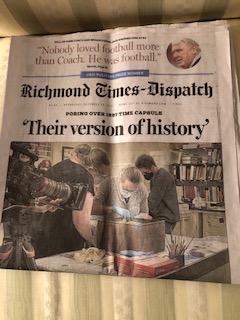
Friends in the Monday, July 5, 2021 edition of the Richmond Times-Dispatch, I am honored to have an op-ed piece. I wrote about food insecurity. Maybe, you have some of the same concerns in your community.  Here is the link:  https://richmond.com/opinion/columnists/bill-pike-column-buying-groceries-in-richmond/article_f97bf48c-5d92-56cb-9519-b8b1cecd6070.html

Load of groceries on the way to the Sherbourne Food Pantry photo Bill Pike

Not a good use of time

A long time ago, I can remember making a rest stop on Interstate 85. A snack and drink were also needed. But, I quickly learned putting some coins in the vending machine I had chosen was not going to happen. 

A really thoughtful person made the decision to break into the vending machine. Busted glass, bent metal were in abundance. As a result, no one was able to use this machine.

Disappointed, the road trip started again. 

As I drove, I thought—too bad the machine wasn’t equipped with mechanical arms. 

Whenever a vending machine is being tampered with for unlawful personal gain, these arms with large mechanical hands would quietly deploy from each side of the machine. The arms and hands would work collaboratively and bear hug the intruder. This unwise person would now be held until law enforcement could arrive.

Who knows, maybe the person who attacked the vending machine was desperate for food or money. Regardless of the person’s motivation, the decision to vandalize triggers a series of interruptions in routines for other people to respond to the mess. 

Maintenance personnel clean up the debris.   Management at the rest stop file a police report. A police officer inspects the site, adds to the report, and looks for clues. The company who owns the machine assesses the damage and determines if repairs can be made or if the machine is a total loss. And probably either the vending machine owner or the management of the rest site will be contacting their insurance company.

That’s a lot of post-incident disruption for one vending machine. But, the perpetrator wasn’t thinking about who would be impacted for the damage to the vending machine. 

During the weekend of June 4, 2021, at Trinity United Methodist Church, we had our own encounter with an intruder. 

For close to two years, we’ve had banners displayed on our grounds along Forest Avenue that proclaimed two statements:

  • No matter where you are from, we’re glad you’re our neighbor.
  • All are children of God.

Someone, took exception to the “All are children of God” banner. This person took a can of red spray paint and painted over those words.

Damaged sign photo by Bill Pike

I took a photo, filed a report with our community officer from the police department, removed the damaged sign, checked the grounds for a tossed can of spray paint, and asked our communication specialist to order a new sign.

Again, I wish the limbs of the trees where the signs were displayed had been able to swoop down and grab the unskilled artist.

Sadly, vandalism like this takes place somewhere every day. I would wager the chances of our spray painter being apprehended are slim. 

Still, I am curious about who would take out his/her frustration on what seems to me to be a harmless wording on a banner.

I have written this before, but there is something about the cover of darkness that gives a person an ounce more of courage.Too bad the prankster’s temporary courage could not be converted into a good use of time—something productive instead of  property damage.

And yet, sometimes, something good can come from an unwanted intrusion.

A couple of days after this disappointment, our senior pastor shared an e-mail with me from one of our church neighbors. She and her daughter had noted the defaced banner. The neighbor went on to state how the words on both banners really resonated with each of them.

The neighbor was asking for permission not to replace the banner, but to place on the church lawn near the banner a parcel of miniature rainbow flags.

We accepted her offer of support. 

Within a week, her shipment of flags arrived. Our neighbor and her daughter put the flags in place. The flags look good on the lawn. They are a reassurance that kind hearts can still make a difference in a world with lots of challenges.

Flags from the mother and daughter photo by Bill Pike

I wonder what pushes a person to invest his/her time into busting up a vending machine or defacing a banner? I wonder if this person ever stops to think—hey, I’m not using my time wisely, or this isn’t my best thinking, something might go wrong, and I’ll be caught.

I know the answer. 

This isn’t because I have busted up a vending machine or defaced a banner.

It is because, my memory will not let me forget the stupidity of the moments in my life when I used time unproductively or was not thinking clearly. 

In those instances, I put myself and those who loved and cared for me on a dangerously slippery slope. For whatever reason, the good Lord, guardian angels, or parental prayers kept me safe.

We ordered a new banner. Thanks to the expertise of a church member, the banner is back in place.

And for the person who created this disruption, keep this in mind—sometimes the luck found in the courage of darkness runs out. 

And, I’ll take that a step further—this wasn’t a good use of your time, and if you’re interested in a career as an artist or painter, you might want to rethink that path.

But, this is my real hope for you. 

My hope is that some arms will gently embrace your heart, your soul, and help you to understand:  All, including yourself, are children of God.

Happy Trails Coach K

I would not trade anything for growing up in Burlington, North Carolina. I was lucky, blessed, fortunate. Burlington was sandwiched between Winston-Salem and Raleigh. 

In that stretch of miles through the Piedmont of the Old North State were the four universities that made up the heart of the Atlantic Coast Conference(ACC)—Wake Forest, N.C. State, North Carolina, and Duke. Slowly, this conference would develop into one of America’s hotbeds for men’s college basketball.

Nicknamed Tobacco Row, the stories of the players, coaches, and fans became legendary in the intensity of their rivalries. Perhaps, he didn’t know it on March 18, 1980, but Michael William Krzyzewski, Coach K, in his own unique way was going to add to those stories and rivalries when he was hired to coach the men’s basketball team at Duke University.

It took a while for the young man from Chicago, who played college basketball for Bobby Knight at Army, to find his footing at Duke and the ACC. At the end of his first four years, the impatient Duke alumni wanted Coach K’s head.

Despite the demands of alumni, Athletic Director, Tom Butters, did something remarkable. 

Instead of firing Coach K, Butters tore up his existing contract, and gave him an extension. That brazen decision changed the course of basketball at Duke for forever.

But, we all know that forever, doesn’t last forever. On June 2, 2021, we learned that Coach K planned to retire upon the conclusion of the 2021-22 basketball season.

Since the fourth grade, I have followed Duke basketball. 

That allegiance came courtesy of my fourth grade friend, John Huffman, whose father was a Duke graduate. I remember tagging along with the Huffman family for football and basketball games at Duke.

My parents were Duke fans too. As Methodists, they liked the strong affiliation the denomination had with the Duke Divinity School. Perhaps in their parental dreams, they held out hope that I might find the path to becoming a preacher. They could see me attending graduate school at Duke. Somehow, I sense God is relieved that didn’t happen.

As a young Duke fan, I was a poor sport. I would cry if they lost. I would really cry angrily if they lost to that team based in Chapel Hill. And yet somehow, in those furious tears, my father did teach me about sportsmanship.

Later, my wife, the Commander Supreme, had to revisit those sportsmanship lessons. No doubt this was needed. Especially,  when I attempted to watch a Duke basketball game on television with our children. Our son’s young genes were very similar to his father’s after a tough Duke loss.

In truth over the last several years, I have watched very few Duke games on television—even championship games. I don’t want to put myself through the anguish. I’m still capable of “chastising a the screen of an unresponsive television too vehemently.”

When Coach K’s retirement was officially announced much was written. During this upcoming season, even more words will be put in print. And, I’m sure, win or lose, this last season will be chronicled for a book or even a documentary.

Coach K would not know me from Adam. 

Yet, displayed on our basement wall, where I spend time writing are the following: a piece of hardwood floor from Cameron Indoor Stadium, a picture of Coach K, our son, and me from when our son attended basketball camp at Duke, and two framed letters from the coach. 

I have a third letter from him in my desk drawer. That letter deserves to be framed too.  After all he said: “Your letter was terrific.”

As much as I admire him and respect what he has accomplished, if given the opportunity, I would have told him to retire earlier.

I have no understanding of why he insisted on chasing the one and done players. Personally, I believe his desire to win betrayed his judgment.

Quietly, I thought to myself, why couldn’t he see this? 

From my inexperienced perspective, Coach K’s success had come from his ability to develop players over time. This was because his knowledge of the game and his ability to teach the game were unsurpassed.

Additionally, I also wondered why highly recruited players sometimes ended up transferring after a couple of years? I guess they wanted more playing time. But, were there other reasons?Does loyalty receive any consideration in these decisions?

And, I questioned his stubbornness. It appeared Coach K relied upon the same rotation of players even when that configuration didn’t seem to be working in games.

In truth, I too am loaded with stubborn imperfections. My flaws are questioned. I guess this is part of being human.

And to show you how little I know about basketball, I figured Johnny Dawkins or Tommy Amaker would be announced as the new head coach— not Jon Scheyer.

But, I think this handpicked selection of Scheyer by Coach K is another example of Coach K’s ability to think and analyze deeply.  He has exceptional psychological insights. Coach K contemplates all angles like a puzzle maker analyzing shapes for a precise, perfect fit.  

Personally, I like the selection of Scheyer. To me he holds something special. In 2010, he captained the Duke team that won the national championship. 

At the beginning of that season, not many experts or fans would have given this team much of a chance at winning a championship. But, they did.

 Who knows, someday, tactical historians of the game might conclude— that season, that team was Coach K at his absolute best.  Experience, hard work,  and a cohesive bonding of the player’s personalities had something to do with that team’s run—no one and done mentality was present.

I guess the Duke haters in the world are momentarily satisfied. Their venom will be resupplied once the new season begins in November. 

Oddsmakers in Las Vegas are probably already contemplating this team chances of winning the national championship.

But, in a blink, a layer of pressure was instantly installed over this team. I’m sure Coach K is already thinking about how to deflect this distraction. My hunch is he will tell them to go out and play and have fun. We all know that will be easier said than done.

But, at the end of the day, I think that is what Coach K did during his career as a player and coach. 

He played. 

He coached.

He had fun. 

He led with his heart. 

And most importantly in all his success, his heart had the capacity to build relationships.

Hard fought and heartfelt victories come from the building of relationships.

Coach K, thanks for sharing your heart with basketball.

But, I also think your heart gave us lessons beyond basketball. 

And, at the end of the trail that might be worth more than you will ever know. 

Author’s note:  This piece is dedicated to my father William Avery Pike, Sr. He was a good son, brother, husband, father, son-in-law, brother-in-law, grandfather, father-in-law, cousin, friend, and neighbor. His goodness came from his big, gentle, caring heart. I was lucky to have that heart for my father.

My father always there for me.