Buried In The Credits: Wolfgang, Matt, Mr. Casey, Jeffrey, John, and Emerson

About mid-morning on Tuesday, August 30, the invasion started. By late Wednesday afternoon, the occupation was complete.

Trinity Hall had been transformed into a dining room, complete with check-in stations, a row of make-up tables with mirrors and lights, and the stage held individual dressing rooms. Blue tents with rounded tops.

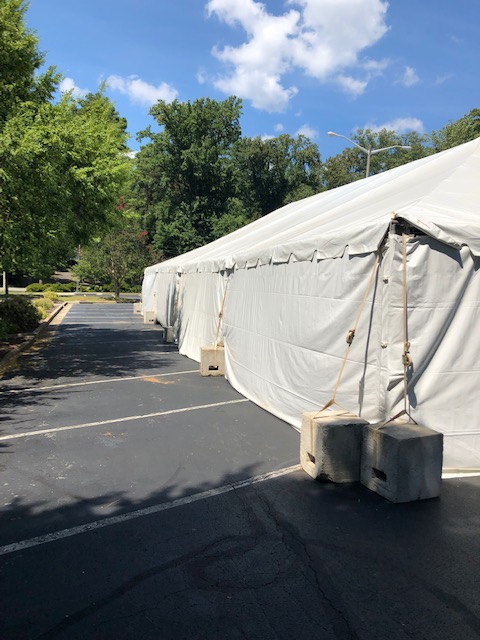
The parking lots had security guards, an air conditioned tent for overflow diners, food trucks, portable grills, tractor trailers, box trucks, port-a-johns, at least ten trailers used as offices and rehearsal rooms, trucks for fuel and maintenance, and vans for shuttling personnel.

The most impressive vehicle was the eighteen wheeler that held a noiseless generator. One of the technicians asked me if I could hear it running, and I didn’t hear a peep coming from this beast.

So, why this encampment?

Our church was one of the logistical sites hosting the second season of filming the AppleTV show—Swagger. This series is about Kevin Durant, a professional basketball player in the National Basketball Association(NBA).

For three days, August 31- September 2, our grounds and Trinity Hall would hold all this equipment and at assorted times lots of people. This would allow the production staff and the actresses and actors to complete night filming for a party scene at a house off Ridge Road a few blocks away from the church.

During my eleven years of working at the church, location scouts had come by to see our facilities, take photographs, and ask about available dates. But, with the Swagger production, this is the first time that we have actually been a part of a show.

This time it happened that our calendar and our facilities matched their needs.

My initial contact and work was with two young guys, Wolfgang, key assistant location manager, and Matt, location scout. They both coordinate getting everything in place. Their work is non-stop. Night filming made their work even more rigorous.
Matt told me he clocks in about ten miles of footwork everyday, with eighteen miles being his one day record.

They both will be with Swagger until the filming ends in late November. Then they will rest up, and use their industry contacts to secure a job with a new television or movie production company.

Late on Wednesday afternoon, I was walking the grounds checking noise levels. We had hand delivered a letter to the homeowners on Stuart Hall and Rock Creek roads letting them know what was taking place.

As I approached a security check point, I heard one of the security guards say out loud: “I see a familiar face, I know this guy.”

Turns out the security guard had been a parent at Lakeside Elementary School where I had served as principal. Mr. Casey quickly pulled me over, and he started to tell me about his boys who are now grown men. He shared some pictures, and I could not believe how old I suddenly felt.

During the three days, I kept my eyes open for the son of one of our college friends. Jeffrey has been in the production business a long time. He was worked on an assortment of television shows and movies in the mid-Atlantic as a grip. Jeffrey and the team he works with are responsible for all of the rigging and set up for the camera crew, and this includes working with the electrical department in coordinating the lighting of the set.

I knew it would be a long shot to see Jeffrey because his night filming did not match up with my church work hours. But on Saturday morning just before seven, as I was pulling into the parking lot, Jeffrey was exiting the parking lot.

Drained from three nights of filming, Jeffrey was heading to the hotel to sleep before driving back home near Frederick, Maryland to be with his wife and two young children. We chatted for a few minutes, and I commented to Jeffrey how I couldn’t believe all the trucks and equipment. His response to me—“this is a small production.”

After saying goodbye, I walked into Trinity Hall to assess the cleanup. I was amazed at how quickly Trinity Hall and our parking lots had been cleared of everything that had been here since Wednesday.
I wiped down the table tops to prep them for cart loading. One of the extras for the show, a young man named John was waiting for a ride to arrive. So, John pitched in to help with putting the folding chairs back on the carts.

We talked quite a bit. In a short period of time, I learned a lot about John. When he was growing up, his parents were both in the military. John spent quite a bit of his early life overseas. He is a young father with two children in elementary school, and another child on the way.

John is stringing together jobs related to two of his passions boxing and dancing. In talking with him, I learned the importance of footwork to boxing and dancing. John described how a foot injury—the dislocation of one of his big toes, taught him about balance. He has never forgotten how critical our toes are in providing us balance.

Once the chairs were finished, John used his travel bag as a pillow, and the next thing I knew he was asleep. Being an extra for three days will throw off your normal sleep routines. The instant sleep meant John was exhausted.

As promised, around ten the tent crew returned to take down the tent. That went well, but they were not the same vendor for the portable air conditioning unit. From Saturday morning until late Tuesday afternoon, a schedule was developed by the security company to post a security guard to watch the air conditioning unit. They guarded that portable unit like it was Fort Knox.

On Sunday morning, that’s when I met Emerson. He had been there all night watching over the air conditioning unit. We had a good talk, and Emerson shared with me that it had been a rough week for him and his car. He misjudged a turn and caused significant damage to his car. With this car bill looming over him, Emerson had asked for extra hours of work.

In 1977, singer/songwriter Jackson Browne released a live album, Running On Empty. The set of songs captures what life is like on the road for the musicians and everyone who supports them in the production of a concert.

During the three days that the extra actors and actresses and all of the production crew were at Trinity, we caught a glimpse of what it takes to make a successful television show or movie. There are lots of moving pieces in the background that we never see or think about as we watch the show or movie.

When my wife and I go to see a movie, I have a bad habit. I stay until the last credit for the film is cast on to the screen. To me, all those people who worked behind the scenes are just as important as the actors and actresses who are in the spotlight.

Wolfgang, Matt, Mr. Casey, Jeffrey, John, and Emerson might be buried in those scrolling credits, but here is what I can’t forget—these are real human beings, with real stories, and who are working to keep their balance in the ups and downs of life too.

Sometimes, in our daily walk through life we are also buried in the credits.

But, we never know in that scrolling of life when we might be called upon to help someone regain their footing and balance.

In those unexpected moments, I hope I will not remain buried in the credits.

I hope reluctance will not seize me.

I hope I will offer assistance. How about you?

Author’s note, all photos by Bill Pike

The Monday after vacation: Sell the church

On Monday, July 25, I returned to work at Trinity United Methodist Church. Our week at Topsail Island, North Carolina is now packed away.

The office staff told me the church was quiet while I was gone.

Apparently that was true except for the morning a HVAC motor in a closet overheated and smoked up the first floor of the children’s wing. Five fire trucks responded along with a few other official vehicles. So much for silence.

Monday marked the beginning of Kids Camp(vacation Bible school). I had a role as a presenter talking about how our church helps to support three local food pantries.

A week away means a pileup of computer emails and paper in my mailbox in the church office.

I made it through the morning, but early in the afternoon the building began to conspire to fully welcome me back.

A technician confirmed what I had expected—two controllers for our outdoor sprinkler system were dead. They had to be replaced.

The elevator for the Welcome Center and Eaton Hall was next. The door would open and close, but the elevator did not respond to the command to take the short ride down to Eaton Hall. Turns out a module had failed. A part would need to be ordered.

But the best challenge was last.

Working in the Preschool office, our fearless leaders Katie Swartz and Mary Jones could hear a trickle of water. When they opened the door for a small mechanical room, a stream of spraying water from a pipe greeted them.

At first glance, I mistakenly thought the leak was coming from our fire protection sprinkler system. But as I looked further at the configuration of piping, I could see that the steady stream of water was coming from a large HVAC condensation pipe.

Fortunately in the mechanical room there was a floor drain, so the spewing water wasn’t going to create another problem. But, the water was also dripping into equipment used to chemically treat the water in the HVAC system.

It was late in the afternoon when I put in the call to the company who services our HVAC systems. They dispatched a technician. When he arrived, he had to deal with water to get into our building as an intense afternoon thunderstorm was dumping gallons of water in the neighborhood surrounding our church.

Soaked, he made it into the building, and I walked him to the mechanical room.

Within a few seconds of assessing the leak, he groaned. Where the leaked had spouted would require the skills of a plumber to properly remove and replace the failed pipe.

He made a quick call to his company’s office to describe the challenges of the failed pipe. After the call, he returned to his truck. He was going to use a special tape to slow the spew of the leak.

I jokingly asked him if he thought I should line up members of the congregation to serve hourly shifts to plug the leak with their fingers. He laughed, and hoped that his tape wrapping would slow the the escaping water. Luckily, this bandaid repair worked, and the air conditioning system could still run until the real repair could be scheduled.

I can’t tell you how many days like this I’ve had over the last eleven years. I cherish this building with its Flemish bond brick pattern and aesthetically pleasing architecture. The building and its grounds as Gomer Pyle would say, “Is a sight to behold.” However, there is always something going on behind that pleasing appearance.

During the last year, my sister has kept me informed about Davis Street United Methodist Church in Burlington, North Carolina. We grew up in that church, and like Trinity I cherished the building and the people.

But, back in the spring, the congregation decided it was time to close the church doors. They followed all of the required protocols from that famous Methodist Book of Discipline and sold the building and grounds “as is” to a company who works with families who have autistic children.

The closing of the building followed what has become a predictable pattern for many churches. Membership down, attendance down, giving down, new programming marginally successful, building needs in terms of repairs and maintenance up significantly, and the funding to repair and maintain the building not always available.

Translation—building and congregation on life support, the end is near.

In truth, I love the response by the Davis Street congregation and their leadership. They figured out the future was bleak, so they sought a remedy.

Was everyone completely happy?

No.

But their plan still has life for the building and the neighborhood. The work the new owners will do with children and their families in a unique way still correlates to one of the missions of the church—helping people.

Yes, there are days, like that Monday, when I say to the Trustees let’s sell this place.

They might chuckle for a second, and say Bill, “You’ve lost your mind.”

But, you can only chuckle for so long.

Because behind that Flemish bond facade some part of the building is conspiring.

When a building with age starts to conspire— congregation beware.

Leaking HVAC pipe Photo by Bill Pike

Goodbye beach

Life moves too fast.

How do I know?

Just ask the beach vacation.

We arrived on Saturday, July 16 on Topsail Island, North Carolina.

Seven days later, we are packed, and departing.

When he was younger, our son, Andrew, would always tear up on the departure day.

Maybe, his tears are silent now. At least I didn’t see any when his family and their packed car headed back to Richmond. I’ll have to ask his wife, Kathryn, if any tears formed once they were out of sight.

My church friend, Elaine Peele, talks about the beach being her happy place. I think the same holds true for my wife, our Commander Supreme, the beach is her happy place.

I sense the beach is a happy place for dermatologists too. Perhaps, these essential doctors feel like a kid on Christmas morning when they view a beach full of scantily clad sun worshippers.

Even though I have a deep appreciation for my dermatologist, I have vowed not to make additional financial contributions to his retirement, summer home, or fancy car.

At the beach, I wear a hat that covers my entire head. If needed, I keep a head gaiter in the pocket of the long sleeved shirt that I wear while on the sandy shore.

Any bare spot on my old body is covered in 50 weight sunscreen, and I spend a lot of time camped out in a chair with an awning under the shade from our wind blown shibumi. Yes, I could be the poster child for grumpy old geezers who avoid the sun.

Despite my overabundance of sun caution, I am drawn to the beach.

I love watching our grandchildren as they learn the beach’s lessons.

I laugh at the haul of required beach cargo brought down from the house each day.

My ears and eyes delight in the sight of a low flying military helicopter scurrying down the coast line.

I respect the pull of the undertow in the ceaseless choreography of the waves.

People watching makes me wonder what beachcombers think when they see me?

I wonder if replenished sand dunes and rows of freshly planted sea oats will still be in place next summer?

I find reassurance when the sun inches up out of the ocean breaching the horizon line and signaling the start of a new day.

I appreciate the aroma of the salt marsh at low tide as it blows over me from a warm summer breeze.

And when life is pushing down on my shoulders, I’ll recall the graceful glide of pelicans skirting in formation in the trough between two cresting waves.

Now, my daydreaming is over.

The beach house is empty.

We have followed the required protocols so that the cleaning crew can make the home ready for the next renters.

The car is packed. In theory, we should have less junk on the drive back, but I’m not sure this is true.

As we pull out of the driveway on to the main road, it is my hope, my prayer that we can come back again next summer.

Goodbye beach, be smart and safe.

Sun rising Topsail Island, North Carolina photo Bill Pike

Confront societal ills

Letters to the Editor for August 28, 2022


Confront societal ills


Editor, Times-Dispatch:


We live in an impatient world.


Our team isn’t winning — fire the coach. In the sermon on Sunday, the preacher plucked my political nerves — fire the preacher. Students in our school system continue to perform poorly on the state’s Standards of Learning tests — fire the superintendent.


Try as they might, it is impossible for coaches, preachers and superintendents to fully satisfy the people they serve.


I have not carefully followed the tenure of Richmond Public Schools Superintendent Jason Kamras. During my career in public education, I worked for six superintendents, and I know this — being a superintendent is tough work, no matter the community.


Unless a law has been broken, school boards should not consider firing a superintendent before the opening of a new school year.


Additionally, school boards should not extend a superintendent’s contract for multiple years. Teachers do not have multiyear contracts. Why should superintendents?


Depending on the terms of the contract, firing a superintendent can be expensive, and so can hiring a new superintendent. Despite these facts, if a school board is determined to fire a superintendent, it will.


Why can’t school board members put their energy and willpower into understanding how our failure to solve our ongoing challenges with families, poverty, mental health, housing, safety and equity impact the performance of the students they were elected to serve?


If we want to fix schools, then school boards must commit to confronting the malignancy of our societal ills. Firing a superintendent doesn’t solve those problems.


Bill Pike.
Henrico.

Author’s note: This letter to the editor appeared in the Sunday, August 28, 2022 edition of the Richmond Times-Dispatch. I am always honored when a newspaper accepts a submission that I have written.

Life’s storms, why?

With ample hot summer sun, warm ocean and sound side water, and tropical like breezes, the coastal plain of North Carolina is a perfect place for meteorological collisions to develop. Those collisions can often produce quick hitting, powerful afternoon thunderstorms.

During our July visit to Topsail Island, we experienced a few of those storms.

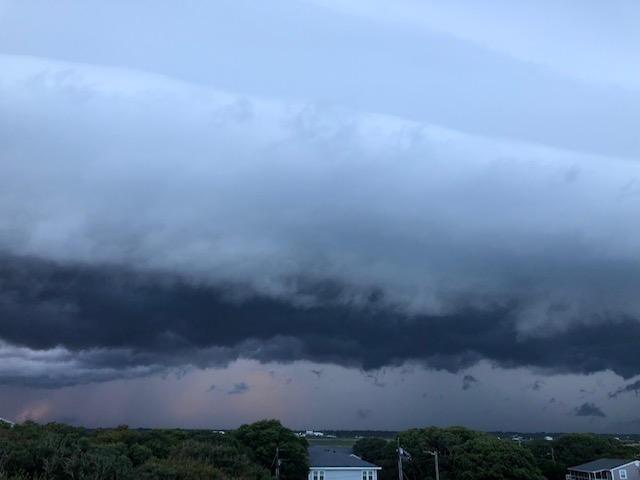
We could see the storms coming. The sun disappeared. Dark clouds formed in layered hues of deep blue, gray, and irate inky black.

Winds kicked up, thunder rumbled, and heavy rain drops pounded and ricocheted off hard surfaces. For several intense minutes the fury of the tempest consumed us. Gradually, the storm would guide itself out over the ocean, and the sun would slowly reappear.

One storm raised our anxiety as a single blast of lightning or a misguided gust of wind knocked out the electricity for the house. Our fear was short lived. In less than an hour, the local power company had the neighborhood back on line.

Life, our daily living can present us storms too. Quite often, we are blindsided by these life storms. Unfortunately, these storms aren’t always quick hitters—they linger.

Sometimes, a person will encounter a series of storms.

Our family friend, Larry, in California has been walloped by life’s storms. He has endured losing two wives—one to suicide, one to cancer. A successful, determined business owner, his worn out heart almost took him away on two occasions. Now, he has another battle— cancer.

A cousin from my mother’s family has with her father watched the steady health decline of her mother. This once vibrant educator’s mind has been scrambled with dementia. Even with care, that irrational mind has contributed to two falls breaking the same hip twice.

At church, a wife, who has been battling cancer, was recently told by administrators at the facility where her husband had been residing the following: “He can’t come back here.”

Recently, one of my wife’s uncles and his wife had traveled to Texas to visit their daughter. On their first day, they met the daughter for dinner. During dinner, they reaffirmed their plans for the visit. The next morning their daughter failed to show up as scheduled. Sadly and unexpectedly, their daughter had died in her sleep.

My sister was very proud of a new car deal she had negotiated by using her well maintained, low mileage car as the pivot point. Last week, her husband was driving the car. While stopped in traffic, the car traveling behind him slammed into the rear of my sister’s car. Because of the damage, it is quite possible that my sister’s car will be totaled—new car deal over.

Try as we might to insulate ourselves, life’s storms are unavoidable. Those intrusions, disruptions are going to happen.

And because we are human, we are guaranteed to ask a one word question—why?

Why has been around a long, long, long time.

Sometimes, why can be answered and explained.

But quite often, why can’t be answered.

The day after my sister’s car was wrecked, I spent the morning with her. We had scheduled a visit with one of our mother’s nieces, Martha, and her husband, John. Now in her eighties, we had a bit of catching up to do with Martha.

On the ride to Martha and John’s home, my sister talked about the accident.

Luckily, neither her husband, Eric, nor the other driver had serious injuries. The driver at fault was driving an older model car. Damage from the wreck totaled her car. It was not drivable.

Lisa wondered how this person might be impacted by the loss of her car? Lisa and her husband had other vehicle options. Though inconvenienced from the accident, my sister was attempting to weigh the impact from a different lens. Thinking this out further, Lisa reasoned that the economic challenges for the other driver could be more difficult.

We enjoyed our visit with Martha and John. At 86, Martha’s mind is still sharp. Physically, she is cautiously nimble. But, we also witnessed the contrast in aging. Martha’s husband, John has some challenges with his physical mobility, and dementia has started its intrusion.

Another example of life’s storms—healthy wife, husband’s health deteriorating, and another why?

In Luke Chapter 8, Jesus is with his disciples in a boat crossing a lake. During this journey, Jesus falls asleep. As the trip progresses, the boat encounters a significant storm. The disciples are fearful that the boat can’t withstand the waves and wind.

In a panic, they wake up Jesus.

Quickly, Jesus rebukes the waves and wind. The storm dissipates on his command and calm returns. But he also directly questions his disciples by asking—“Where is your faith?”

Astounded by the resulting calm, the disciples have questions too. They want to know what kind of person is Jesus who can in an instant calm a storm.

And, that is the same question I have, and in truth you have it too. If Jesus can calm a storm on a lake why can’t he in an instant calm the storms in our lives?

This is made more difficult because I know that Larry, my church friend, my cousin and her father, my wife’s uncle, my sister and her husband, and Martha and John are people of faith. So, Jesus, where is the calm intervention in their lives?

Oh, how I wish I had an answer for you.

Just as it takes a series of atmospheric conditions to brew a summer afternoon thunderstorm, perhaps it takes the right human atmospheric interventions to help the people around us who are in the turmoil and turbulence of a life storm.

Unlike Jesus, we are not able to combat a life storm for a family member or friend with an instant command to cease. But, we can vow to be gentle warriors for those in a life storm.

My sister attempted to understand the impact of the accident from the other driver’s perspective. I admire her reasoning.

Maybe, Jesus needs me to try and see a life storm for a friend or relative from a different lens or angle.

Maybe, I’m no different than the disciples— maybe he is asking— “Bill, where is your faith?”

But, in all honesty, that is a tough ask. Especially with the knowledge of the calmed lake storm hovering in my mind.

And that leads me back to my friend— why?

Why will bother me until I die.

And yet I wonder can the why in life’s storms be countered, pushed back, or eased with prayer?

My Walter Williams High School classmate, Randy Wall, a Methodist minister, would tell me— yes.

If I intend to be a quiet warrior during a life storm for someone, then I must commit to being a gentle presence, and I must pray.

Maybe that will temporarily silence—why.

Summer thunderstorm, Topsail Island, North Carolina Photo Bill Pike

Sunday morning quarterbacking: “We haven’t been in years.”

Have you ever been in a situation where you are introduced to a person, and as your brain scans his face, your brain is thinking—“come on now, I know this person, where have I seen or met him before?”

After a few more awkward seconds, you blurt out the name of the church you attend, and the person immediately affirms that is the connection—church, but then the person confesses—“we haven’t been in years.”

The person’s response—“we haven’t been in years” triggers a wide range of questions in my mind. With curiosity and care, churches should be asking this person:

Why haven’t you attended?

Did you stop coming before COVID-19 hit, or did the ensuing pandemic pause your church attendance?

If it wasn’t the pandemic, what caused you to stop attending church?

Was it the preacher, the sermons, the congregation, the programming?

Or was it something else?

And in my mind, the most important question that needs to be asked of inactive church members—“Did the church reach out to you during your absence?”

Attempting to rise up out of the pandemic will require churches to think differently.

Additionally, churches should be pushing their staffs and their congregations to develop a basic, very simple means for reaching out to members who were inactive during the pandemic, and even to those who were inactive prior to the pandemic.

Pastors, their staffs, and congregational leaders must reach out and follow-up with inactive members. Failure to follow-up isn’t good thinking. Not following up suggests an unwillingness to learn and listen. A reluctance to learn and listen isn’t a wise choice for struggling churches.

Reaching out to the inactive is an opportunity for a church to learn. That learning can potentially lead to growth, and the good Lord knows, churches are struggling with growth.

Even if the feedback a church receives from an inactive member is harsh and highly critical that is ok. That honest venting can help frame productive changes for a church.

Southern Living Magazine is probably not the type of monthly periodical where a reader might unearth an interesting comment about church. But, I found one in the March 2022 edition.

In an article by Tracey Minkin titled “Best Places To Retire,” this comment from Curtis Williams caught my attention. Williams was talking about moving with his wife from Charlotte to be nearer to their daughter in the Asheville area of North Carolina.

Mr. Williams states their daughter helped them to find a church. Here is what he said about the church search: “We found a church that fit us so much better in terms of acceptance, community outreach, and support.”(Southern Living page 69)

That statement by Mr. Williams should be posted with duct tape throughout a church building. And when it is posted, the following words need to be highlighted or boldly printed: fit, acceptance, outreach, and support.”

I wonder how many inactive church members might reference those same words when contacted by their church?

Will they respond with—“we never felt like we fit in at church, gaining acceptance was tough, when we participated in community outreach, we never found our comfort zone, and support was questionable.”

Look, the church business is tough work. Churches must really dig deep and hard to figure out how to meet the needs of people.

Meeting those needs isn’t just a one time shot. A church must be able to consistently meet the needs of their congregation in everything the church offers.

Churches that can’t figure out how to stay in contact with their congregation and at the same time meet their needs will continue to hear this comment: “we haven’t been in years.”

This is really pretty simple math.

To survive churches need people.

But in that struggle to regain the inactive and sustain the active, churches must listen.

In that listening, churches will find opportunities to help people fit and gain acceptance. This also means comfortably involving them in community outreach, and maybe most important being available for support when needed.

Without being overbearing, churches who can improve fit, acceptance, make community outreach comfortable, and be available for support might be a half step away from helping an inactive member to return.

Church, this is important.

Don’t let another year pass.

Go find “we haven’t been in years.”

l

Photo by Bill Pike

The Old Ballgame


On Aug. 10, my wife and I took our two North Carolina grandchildren to the noon Greensboro Grasshoppers game at First National Bank Field.
Even though it was sweltering hot, and the Grasshoppers lost to Jersey Shore, we had an enjoyable visit.

That good experience started with the ticket seller. He knew the stadium and found us seats in the shade. Parking was easy, the $2 cost even better.

This was followed by three friendly employees — the security checker, the ticket scanner and the young lady overseeing the playground. These employees were personable and patient. The same could be said for the ice cream and popcorn concessionaires.

To top it off, a foul ball landed near us. Now our grandson has a baseball souvenir story for a lifetime.


Additionally, the stadium was clean and well-maintained, and it appears to be a perfect fit for the team and the community.


Thank you, Grasshoppers and Greensboro, for a quality visit.


Perhaps, this successful template can serve as a genuine reminder to the leaders of the Atlantic Coast Conference.

Greensboro has the heart, the people and the hospitality to continue to be the home for the conference.


Bill Pike
Richmond, Va.


Author’s note: This letter to the editor appeared in the Tuesday, August 16, 2022 edition of the Greensboro News and Record.

The recovered foul ball Photo by Bill Pike

Snapped fishing line and the strain of life

A week before we departed for Topsail Island, North Carolina, I started prepping my fishing gear.

Last summer, the house where we stayed had access to the sound side of the island. It was a short walk down the side street.

On that walk, I admiringly gazed at other houses and loved a pretty stand of live oak trees. On an undeveloped point of land, I could easily cast into the early dawn stillness of the sound and watch the pastels of the sunrise forming in the eastern sky.

For this trip, I was hoping I would have a similar sound access. We were staying in a different house, and it was tough to determine from a Google map if the sound would be approachable.

I let my hopefulness to have sound access cloud my thinking. I organized three lightweight fishing rods, and my fly rod to take with me. I opted not to take a rod that was strong enough to handle the unpredictable whims of surf fishing in the ocean.

Not taking a surf rod with me turned out to be a mistake. The house where we stayed did not have access to the sound. This meant I would be relying on those lightweight fishing rods to cast into the Atlantic.

I picked up some shrimp bait at the IGA grocery store in Surf City. Two of the rods, I set up with lures for casting, and one I set up with a fish finder rig. The fish finder consists of a hook and a sinker slider that holds the weight.

On the days I fished in the ocean, there was a steady wind from the south. This wind churned up the surf. That chaotic surf would not be ideal for my lightweight rods.

A couple of times I was excited. I could feel the nibble of a fish. Once, there was a really strong tug on the line, but the tugger disappeared. And one day, a good sized crab hitched a ride up to the shore after devouring the shrimp bait.

But two times during the week, I snapped the fishing line. The light line couldn’t take the stress of the cast with the two ounce weight. Sadly, I tainted the surf with a lost hook, weight, and fishing line. I hoped that the roiling surf would bury the lost tackle so it wouldn’t hurt a swimmer or a sea creature.

In the late sixties, singer-songwriter, Jimmy Webb, had quite a run of luck with songs he wrote that were recorded by other artist.

One of my favorites, “Wichita Lineman,” was a hit for Glen Campbell.

As the title implies, the song is about a lineman who takes care of miles of telephone lines stretched from pole to pole in the flat plains of Kansas. Webb also weaves in the contemplative emotions of a relationship.

For some reason, this line from the song always catches my attention: “And if it snows that stretch down south won’t ever stand the strain.”

Growing up in the south, I’ve seen those lines snap under the strain of a heavy wet snow or from the weight of a coating of ice from an ice storm.

My fishing line couldn’t withstand the strain of my casting action and snapped.

And as sure as I am writing these words, somewhere today, someone in this world is going to snap from the strain of life.

Earlier this summer, I reached out to a painting contractor to take a look at an exterior project at the front entrance to the sanctuary of our church. I was tardy in meeting the appointment time, but the contractor was patient with me.

Once we had completed discussing the pending project, I walked him back to his car.

I had worked with this contractor on another church project, and I guess for whatever reason he felt comfortable in talking with me.

For the next several minutes, he unloaded his strain—health challenges.

A rare tick bite had totally disrupted his normal diet and digestive system. Last year, he underwent significant surgery related to his prostrate gland. And he shared that his wife had challenges with her thyroid gland.

Now, here is the challenge with the painting contractor’s unloading the strain of living—his outward appearance didn’t reveal these difficulties, and in truth neither did my snapped fishing line.

Everyday we encounter people who appear to be fine, normal, and yet, we don’t know the strain and stress that remains unseen or untold to us.

My two snapped fishing lines are nothing compared to what another person might be carrying.

I will never know why the painting contractor opened up to me.

And as I listened, I never thought about how to respond. I just listened.

Maybe that was all he needed—someone to listen.

His story has stayed with me.

I wonder if I have another encounter like this—how will I respond?

With lots of care and diligence, the Wichita lineman watched over the telephone lines.

To our left and right, in front of us, behind us, on a walk, at an intersection, in a meeting, in the aisle of a grocery store, and sitting in a church pew we have friends, neighbors, family, co-workers, and strangers who are strained, stressed, and weary.

Who is watching over them?

Could part of that answer be found in Matthew 11:28: “Come to me, all you who are weary and burdened, and I will give you rest.”

A human fishing line is going to snap today.

Someone will need you, me, we, and us.

How will you, me, we, and us respond?

Can our hearts help that person find rest from the strain?

Rain storm over the ocean at low tide Topsail Island, North Carolina Photo by Bill Pike

North Carolina’s stunning coast is something to cherish

On Saturday, July 16, we departed our home in Richmond, Virginia. Topsail Island, North Carolina was our goal.

Including a rooftop carrier, our car was overpacked. We would stop in Raleigh to pickup our youngest daughter. That meant finding more space where no space existed.

I grew up in Burlington, and I will confess, I don’t remember making many vacation trips to the North Carolina coast. Cherry Grove, now part of North Myrtle Beach in South Carolina, was our beach destination.

Having lived in Virginia since 1975, I find the state’s Eastern Shore to be more satisfying than the admired Virginia Beach.

This was our second trip to Topsail Island. Over the years, we’ve explored Duck, Atlantic Beach, and I’ve been to Ocean Isle. I’m no expert, but the North Carolina coast is a treasure.

According to author, Glenn Morris, in The New Guide to North Carolina Beaches, the coast is 326 miles in length. That shoreline no matter ocean or sound side is unique and spectacular. And yet I wonder— how much more can these fragile landscapes take from mother nature and human beings?

A delicate tug of war, a complicated give and take is always at work on the coast. For this precious coast to survive, visitors and locals must work to find a balance to cooperatively manage that give and take that never rests.

On Monday, July 18, my family and I, including our four grandchildren, experienced an example of cooperative preservation at the Karen Beasley Sea Turtle Rescue and Rehabilitation Center in Surf City.

A playful billboard at the entrance Photo by Bill Pike

Our tour of the center gave us real time educational experiences about the challenges a sea turtle faces. We also learned how humans impact the life cycle of sea turtles with irresponsible disposal of trash into ocean environments.

But, despite this negligence, I found hope in the stories about the countless volunteers who work to keep shorelines trash free, and who with kindhearted diligence walk the local beaches during the season when mother turtles trudge on shore to build a nest and lay their eggs.

After the tour, we returned to Topsail Beach. An afternoon thunderstorm delayed going back to the beach. But when the sun returned, we went for a beach walk.

I was curious to see if I could locate a turtle’s nest. A short distance down the beach, I came upon a nest complete with the marker stakes, orange tape, and notification sign.

A marked and hopefully protected sea turtle nest Topsail Island, North Carolina Photo by Bill Pike

This find was perfect for our grandchildren as they saw firsthand what the docent had shared with us during the tour.

Next year, I turn 70. I don’t have many years left.

But, I will hold out hope that we humans can find ways to cooperatively take care of this stunning coast.

This preservation should not be done for you or me, but for our children and grandchildren.

Cherish your North Carolina Coast, and treat it as gently as a grandchild.

Author’s note this piece appeared as a guest column in the Wilmington Star News today, Sunday, August 7, 2022.

Sunday morning quarterbacking: First Sunday For The New Preacher

In my career in public education, I remember the “fear” I felt with each new job I took.

When I entered the school’s parking lot, fear wanted me to turn around and drive back home. I never turned around. But, there were many days during those thirty one years when I thought to myself—“What in the world am I doing here?”

My guess is new preachers, or when a preacher starts a new appointment, he/she has “fear” as a companion. Additionally, preachers probably have the same days as educators when they ask a similar question—“God, why in the world did you send me here?”

This morning, July 3, was our first Sunday with our newly appointed preacher. If he was nervous, the preacher hid it well.

For many different reasons, churches are interesting places. Sitting in the top spot as to why churches are interesting comes down to this—people.

Preachers have the daunting task of trying to figure out their congregations. While congregations have the same challenge trying to figure out their new preacher.

Today, a congregation can go check out a new preacher by clicking the archive of sermons on a church’s website. Yes, that will give you a sample from the pulpit, but today a preacher must be more than a Bible toting, word hurler on Sunday mornings.

In our post-pandemic atmosphere, preachers must possess an assortment of skills to inspire a congregation. Congregations must also realize that a new preacher can’t be looked upon as the much needed hero who in a quick snap of his/her fingers is going to turn a church around.

Gastroenterologists, heart doctors, psychiatrist, and even God probably see an uptick in their appointments when a new preacher tries to settle into an established church.

Lots of potential collisions are on the preacher’s transitional path.

First, there is saying goodbye to the previous church and coordinating the move to the new assignment.


This is rapidly followed by greeting key leadership in the new congregation, meeting staff, learning as much as is humanly and humanely possible about the church in nanoseconds. And maybe most important, quickly determining who can help the preacher navigate the hidden cow pies in the church’s complicated internal and external landscape.

So, how does a new preacher survive?

As a person who has worked in a church for the last ten years, I believe new preachers in established churches need to consider the following:

Manage your pace. Don’t over commit your calendar.

But as you manage your pace, be sure to make time for visibility. Visibility is an opportunity to learn.

Make sure you understand in detail the pulse of the communication options that are accessible to you. Use those communication tools without abusing them. Know when you can effectively apply them with your own voice and words.

Don’t make promises. Promises can promote failure and create distrust. Neither is helpful for churches.

However, there is one promise that a new preacher should make. Make the promise to listen. This is absolutely critical in churches where listening to the congregation has been a closed loop.

Opportunities to listen to the congregation must be constructed so that all voices can be heard—the timid, the elderly, the young, and everyone in between.

Learn names. Even though your brain will resist, preachers sooner, rather than later must learn the names of their congregations. Knowing names makes a difference in building relationships.

Do not be afraid of the “c”word—change. When talking about change, help a congregation to understand that change has always been a part of their church. Ask them to reflect where their church would be now if change had not been embraced?

Planning—failure is guaranteed if collaborative, long term planning isn’t initiated. Plan boldly, but with a pinch of reality.

Show the congregation your heart. Convey your heart as a we heart, not a me heart.

Now for the congregational tips, I’m sorry, but I don’t have enough paper.

But, I do believe a congregation during a period of preacher transition needs to embrace the word patience in their hearts.

We live in a very impatient world.

At times, I’m a very impatient human being in our world.

Yet, to move, to nudge, to slightly turn a church requires patience.

And there is no better reminder of this than the words found in Colossians 3:12: “Therefore, as God’s chosen people, holy and dearly loved, clothe yourselves with compassion, kindness, humility, gentleness, and patience.”

Photo By Bill Pike