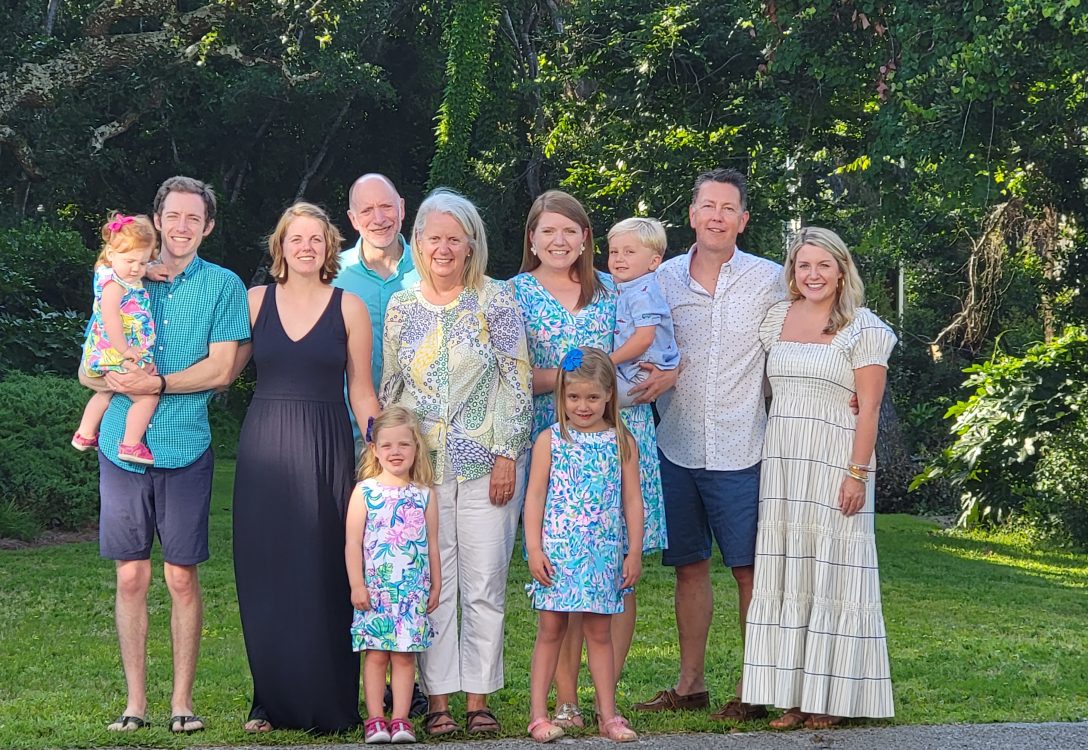
Near the end of June, my wife and I travelled with college friends to Vancouver. As Americans, we appreciated your hospitality and your will to preserve precious land.
From your stunning airport terminal to our hike in Lynn Canyon, we enjoyed every footstep of our exploration. In turn, we worked to be considerate guests at every place we visited. During our visit, we saw the diversity of your city and how your community embraced a pretty June Saturday along the beaches on English Bay.
We noted similar challenges that we experience in our communities along the east coast of America — the high cost of housing, the struggles of the homeless, maintaining infrastructure, and the snarls of traffic. No community is immune from those challenges.
I will never forget my early morning run along the Stanley Park seawall. Captured forever are four herons gathered on a point, the scattered purple pieces of mussel shells on a soundless beach, magnificent trees, and the quiet exchange of “good mornings” with fellow runners and walkers.
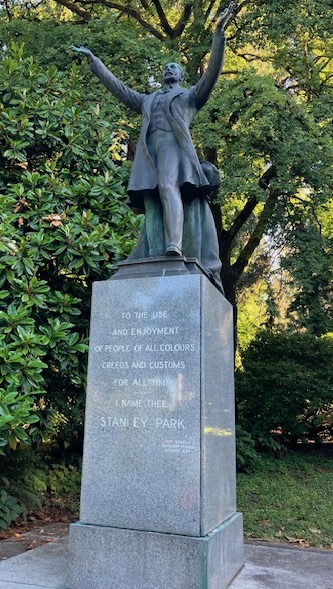
As much as I will cherish that run, my old heart will value even more a discovery we made in Stanley Park on our last morning in Vancouver. I know nothing about the qualities of Governor-General Lord Stanley, but I loved the vision of his words on his statue in the park: “To the use and enjoyment of people of all colours, creeds, and customs for all time.”
That is a powerful and visionary statement for 1889. Sadly, in the United States, that foresight continues to erode from our thinking.
In the time I have remaining in this cantankerous old world, I plan to share Lord Stanley’s wisdom as a reminder to everyone in my community that as Americans, we have an obligation to support “people of all colours, creeds, and customs for all time.”
Thanks, Vancouver, for the reminder.
Bill Pike, Richmond, Virginia
Author’s note: From June 25-July 10, 2025, my wife and I had the privilege of traveling with dear friends from college to Vancouver, Canada and Alaska. I was honored to have this letter published in the Vancouver Sun newspaper on July 8, 2025.
Over the last year, I’ve thought about 72 quite a bit.
On August 31,1992, my mother died courtesy of one the cruelest things on earth— cancer. She was 72.
I always wondered if I would make it to 72.
In June of 1972, I turned 19.
I had just finished my freshman year at Greensboro College.
It is unbelievable to me how quickly the last 53 years have passed.
Time is not on my side.
Truthfully, I don’t think time has ever been on my side.
I often reflect about how badly I have managed my time on earth. I could have been better at so many things.
I could have been more thoughtful, patient, kindhearted, and friendly.
I could have read more books, been more attentive to the needs of those around me, less judgmental, and less whiny.
Yet, I am thankful that I might just make it to 72.
This verse of the day showed up recently in my daily early morning quiet time. It’s from Psalm 121 verses 7-8: “The Lord will keep you from all harm— he will watch over your life; the Lord will watch over your coming and going both now and forevermore.”
When the news isn’t good, how in the world can a person of faith or a person who struggles with their faith believe those words?
With the bombing of Iran, the word “obliterated” was used to describe the destruction at the country’s nuclear facilities.
Obliterated applies to human beings too.
A neighbor for the second time is battling cancer. Her most recent post indicated that the cancer is obliterating her body.
Nothing that the oncologists have tried is slowing down or killing the cancer. Too bad we don’t have a 30,000 pound bomb that we can drop on her cancer.
And despite this discouraging report, our neighbor wrote, “I’m not losing hope.”
How in the world does she hang on to hope when her body has been betrayed by the words in the Psalms?
Clearly, her body hasn’t been kept from harm, and in her going and coming she must feel like she hasn’t been watched over.
On the afternoon of Sunday, June 22, I was running some errands. I was listening to a rebroadcast of a live concert from Mountain Stage.
A Kentucky duo named The Local Honeys was performing. One of The Local Honeys, Montana Hobbs, introduced a song that she had written about her grandfather.
Back stories fascinate me, and this one didn’t disappoint.
Her grandfather came from a large family. Unfortunately, his parents died early. This meant the children were shipped off to relatives to be raised.
In those challenging circumstances, Miss Hobbs’ grandfather ran off twice. Eventually, he joined the Navy and became a pilot during World War II. Somehow, her grandfather survived his plane being shot down and crashing in the Pacific.
With time, the roots of this family and their stories came together. When Miss Hobbs had the opportunity to visit her grandfather, if she asked him how he was doing, his standard reply was “better than I deserve.”
That reply from Miss Hobbs’ grandfather punched hard at my old soul.
At this point, my life has been “better than I deserve.”
And yet, I will complain until the day I die when a verse from the Bible, promises to protect, but from my downcast perspective the words fail.
In the May 23 edition of the news magazine The Week, I read an obituary about Joseph Nye. Dr. Nye was a political scientist who had a distinguished career in academia and politics.
The Washington Post reported that the future Dr. Nye grew up on a farm. He attended Princeton University. It was at Princeton that “he briefly considered studying for the ministry—until he read the Bible all the way through.”
I wonder what in the Bible changed Nye’s mind about pursuing the ministry? Was it a day when the news wasn’t good, and he knew that the hopeful words of scripture had let another person down?
If I make it to Friday, I will be thankful.
And on Friday, when I compare my life to the lives of others who are struggling to hang on, I’ll think about the words from Montana Hobbs’ grandfather “better than I deserve,” and with respect to the doubt of Thomas, I too will not lose hope.
Author’s note: I wrote this piece as a devotional for a staff meeting at our church on June 24. It was not my intention to draw attention to my birthday. The purpose is simply to remind you, me, we, us how fragile and unpredictable life can be. Love you all, Bill
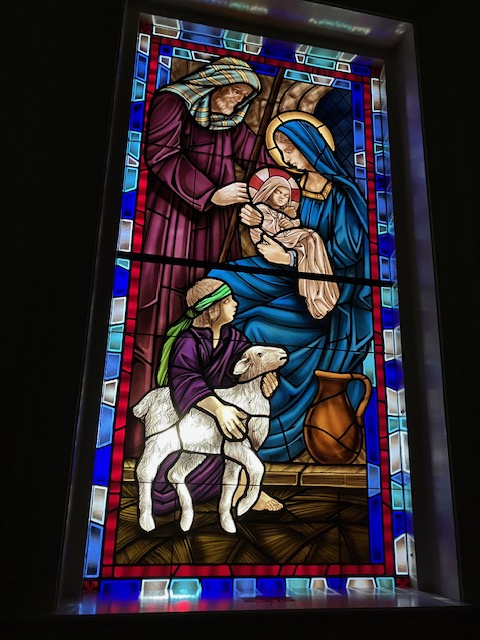
Window at Trinity UMC Richmond, Virginia (Photo by Bill Pike)
RICHMOND TIMES-DISPATCH WEDNESDAY, JUNE 25, 2025 | A11
OPINION
LETTERS TO THE EDITOR
Letter: Violence is always ‘tolerated’ in America
From coast to coast, America continues to erode. The senseless shootings in Minnesota of four citizens with ties to the Democratic Party is the latest example of our decay. This resulted in two deaths, and astonishment that the other bullet-riddled victims survived.
Of even more concern is that the individual responsible for the shootings had a “hit list” of 45 officials targeted for harm.
President Donald Trump condemned the shootings in Minnesota with a social media post: “such horrific violence will not be tolerated in the United States of America.”
Sorry, Mr. President, you and your predecessors are wrong. America continues to tolerate horrific violence. Any day, a person can use a firearm to solve his/her problems. No immunity exists.
At the heart of this violence is the loss of our civility and respect. We abuse our free speech by bashing and bullying each other on every media platform with hateful, virulent, inciting language. Even more concerning is the loss of our moral conscience. With no hesitancy, we irrationally justify our vitriol.
As an imperfect human, American and Christian, I wonder if any religious influencer who has the ear of President Trump has shared with him this Bible verse from Galatians: “The fruit of the spirit is love, joy, peace, patience, kindness, generosity, faithfulness, gentleness, and self-control. There is no law against such things.”
While there is no law against these qualities, it is clear that self-control doesn’t apply to Americans who commit horrific crimes and our Washington leaders. Both are incapable of applying these values in making decisions.
Helen Keller said: “The only thing worse than being blind is having sight, but no vision.”
Will we have the courage to say enough?
Only if the spirit of our sight and vision returns.
Bill Pike Henrico
Author’s note: I’m honored that my letter to the editor about the shootings in Minnesota was published in the June 25, 2025 edition of the Richmond Times-Dispatch.
I never met Brian Wilson, but during his lifetime I met his songs, his music.
My first record purchase was a Beach Boys’ single. It was the Christmas hit “The Little Saint Nick.” On the flip side was a stunning a cappella version of “The Lord’s Prayer.”
From that first listen to that record, I was hooked.
Brian’s songwriting had a way of hooking people.
He took us to sunny California to surf the Pacific’s waves. To get to those famous west coast beaches, Brian put us in cars too— little deuce coupes and woodies. No matter if we were in one of those fast cars or watching surfers, we were surrounded by pretty California girls.
Brian was a marketer for California. He sold California to America and the world.
The lyrics showcased the lingo of surfers, hot rodders, and surfer girls.
The singable melodies locked into our instant recall. Irresistible harmonies as golden as sunshine became a trademark. Layers of instruments sometimes played with chord changes that weren’t supposed to work on paper showed the brilliance of his songwriting capabilities.
In 1961, their recordings and concerts started a legacy that lasted longer than anyone in the group could have imagined. Brian’s two younger brothers, Dennis and Carl, their cousin, Mike Love, and Brian’s high school friend, Al Jardine, formed the group.
Early on, the Wilson’s father, Murry, was the band’s manager. Despite his imperfections, Murry positioned the band for their early success as he smoozed disc jockeys, concert promoters, and dealt with the record company.
From 1962 through 1966, the band could do no wrong. Their hit songs raced up the charts. Screaming fans filled concert halls. But in 1964 while on a concert tour, Brian had a nervous breakdown.
That breakdown like a shift in a tectonic plate in the San Andreas fault broke the Beach Boys’ early formula—write songs, record, tour. Brian stopped touring. This allowed him to put his energies into writing songs and production work.
Brian worked with the gifted Los Angeles studio musicians who with great affection were named the Wrecking Crew. A new formula was born. Brian wrote the songs. He recorded the backing tracks with the Wrecking Crew. When the Beach Boys came off the road, they went into the studio and added the vocals.
This freedom to write and record allowed Brian to hone his skills as a producer. The studio became a second home. He pushed the traditional boundaries for the musicians and for his favorite recording engineer, Chuck Britz. Brian once asked Mr. Britz if he could bring a horse into the studio. Mr. Britz said no.
Brian also pushed himself to write and create beyond the band’s surfers, surfer girls, and fast cars image. From this came the legendary album Pet Sounds. Brian was twenty-three at the time. Released in 1966, initially, Pet Sounds was not a commercial success. The album’s success came from how it changed the way musicians from around the world wrote and recorded their songs.
The Beatles were listening. Brian’s work and innovations nudged them into their landmark album Sgt. Pepper’s Lonely Hearts Club Band.
Brian continued to push. The stunning single “Good Vibrations” was released. The recording was another masterpiece. The back story of the song’s recording sessions shows Brian either as a mad genius or a master of the studio.
His next project Smile continued to push the envelope. With Smile, as beautiful as we now know it was, the album crushed the Beach Boys’ successful hit making formula like a monster rogue wave from the Pacific.
His bandmates, the record company needed hit records. Smile was aborted. Brian retreated.
From 1967 until 1975, Brian quietly worked behind the scenes with the Beach Boys. He contributed songs, produced in the studio with them, but his reclusiveness begin to spin Brian out of control.
By 1975, physically, Brian was a far cry from the high school athlete he had been. His appetite was out of control, constant smoking was destroying his beautiful singing voice, and his consumption of drugs was impacting his personal well being.
Brian’s first wife, Marilyn, sought an intervention. She brought in a controversial psycho-therapist, Dr. Eugene Landy. Despite the good and bad from Dr. Landy, no one can deny that his interventions saved Brian’s life twice.
Brian’s second wife, Melinda Ledbetter, was the spark for launching Brian’s career as a solo artist. Contributing to this redemption was another group of young Los Angeles based musicians, the Wondermints. This group with other gifted musicians formed what became known as Brian’s band.
This band was fearless. No matter the concert set lists they hit every note with their instrumental chops and vocal dexterity. For example, the entire complex Pet Sounds album was played in concerts note for note.
Dead in a studio vault for almost forty years, the Smile album was resurrected. It was re-recorded, released, and met with high critical acclaim. Again, the musical gifts of Brian’s band drove this redemption of Smile.
In 2012, the living members of the Beach Boys reunited for a fiftieth anniversary tour. Brian had lots of songs to contribute to a new studio album.
After this success, for Brian recordings and concert appearance continued. But then in a summer co-headling tour with Chicago in 2022, his demeanor on stage changed. Brian became less and less engaged with the audience. By the tour’s final date, it was clear Brian’s concert performances were over.
Part of me believes that Brian’s work with the gifted musicians in his band and those concert performances added to the quality of his life, and maybe even extended his life. However, on January 30, 2024, we learned how much the quality of Brian’s life depended upon his wife, Melinda. Married for twenty-nine years, she had been his rock. Her passing was a devastating loss.
The impact of this loss came to reality in May of 2024. That’s when Brian’s family formally placed him in a conservatorship. Dementia was to be his end.
After all that he endured, I’m amazed that Brian made it to 82. He outlived his brothers, Dennis and Carl.
It always seemed to me that his heart was music, that music was his rescuer, his redemption, a lifeline.
And in its own unique way, I believe Brian’s music was a rescuer, a redeemer, a lifeline for people who needed something to hang on to when life challenges us.
I will miss Brian Wilson.
Despite all of life’s ups and downs that Brian endured, I’m thankful for my first record purchase. That purchase started a lifelong journey with Brian and the Beach Boys.
I have thought about citing a favorite song to close out this piece. But, I can’t. There are too many.
Just as Brian was relentless in his songwriting and studio production, I encourage you to be relentless in discovering the music Brian made beyond the hit songs. Your ears, heart, and soul will not regret this pursuit.
So, I leave you with these words from Brian’s youngest brother, Carl. These comments came from the Beach Boys boxed set Made In California.
Carl Wilson: “I asked Brian one time, I guess we were just having a long conversation talking about life and some of the stuff we had gone through, and I said: “Why do you think we succeeded in such a big way?” He said: “I think the music celebrated the joy of life in a real simple way, a real direct experience of joyfulness.”
I think Brian was right.
His music brought a joy into the world.
A joyfulness that will live forever.
Brian Wilson in his home recording studio, circa 1971. (Photo Bob Jenkins)
Author’s note: On the afternoon of Wednesday, June 11, my dear college friend, Steve Hodge, who is also an accomplished musician, and long time fan of the Beach Boys, let me know that Brian Wilson had passed. In all of our road trips to see the Beach Boys in concert, I can only remember one show when Brian performed with the group. That was in the spring of 1979 at the Greensboro Coliseum. Additionally, my childhood friend, Joe Vanderford, another follower of Brian and the Beach Boys, has kept me in the loop with references to articles and podcasts related to Brian’s passing. Today, Friday, June 20 is Brian’s birthday. He would have turned 83. His website: https://www.brianwilson.com/ has posted a nice tribute to Brian.
I’m Bill Pike, the director of operations for Trinity. Before starting, here are my disclaimers: I’m not a Biblical scholar, nor a degreed theologian, but I do have certification as a lay speaker.
In truth, I’m a rapidly aging, grumpy geezer who slings baloney. My monotone voice is guaranteed to put the sleep deprived in a deep sleep in a matter of minutes.
On a Sunday morning, when I pinch hit in the pulpit, the U.S. Geological Survey picks up substantial seismic shifts across Virginia graveyards. These detections are where former Methodist bishops and district superintendents are buried. They are rolling in their graves, and saying not Pike again
Despite my disclaimers, I’m honored to be with you on this Father’s Day.
Let us pray: Father of us all, forgive my old heart. Amen.
My deeply Methodist parents would be pleased to know that I have the opportunity to deliver a hellfire and damnation sermon to a bunch of heathens this morning.
Relax, I’m teasing you. I’m the heathen who needs to be saved.
Deep inside their hearts, my parents wanted me to become a Methodist minister. There was only on problem with their dream.
My brain is like this ancient cowboy insult: He is as shy of brains as a terrapin is of feathers.
Even if God had greased my entry, I had no chance at being admitted to Duke Divinity School.
Somehow, despite my many faults, my parents loved me. I think the best trait my father gave me was an understanding heart.
My father could get riled, especially if wire grass or rabbits invaded his garden, but he had a good heart. On Sundays, after church, my parents, my sister and me came home. We devoured my mother’s delicious homemade lunch, and then the only thing my father wanted was a nap.
The only thing I hoped for on Sunday afternoons was that my father took a short nap. I wanted him to pitch a baseball to me, toss a football, or shoot baskets.
My father hoped his son would allow him thirty minutes of snoring.
Hey, I seem to recall that our scripture reading for today mentions hope.
“We rejoice in our hope of sharing the glory of God. More than that, we rejoice in our sufferings, knowing that suffering produces endurance, and endurance produces character, and character produces hope, and hope does not disappoint us because God’s love has been poured into our hearts.”
I’m not sure about you, but I don’t see many people who are in a battle with cancer rejoicing.
Nor do I see a homeless person on a street corner rejoicing.
The same for the parent of a son or daughter who is fighting a substance abuse addiction.
In my thirty one years of work in public education, I remember my peers saying, “If you can teach in a middle school, you can teach anywhere.” That’s a form of endurance to survive all of the physical and emotional challenges that middle school students face in their development.
The scripture goes further to tell us that endurance produces character.
For today, let’s think about character in terms of our integrity, our moral fiber, our moral strength, our temperament, our fortitude.
How might our character—our integrity, moral fiber, moral strength, temperament, and fortitude produce hope?
Let’s take a Mayberry detour for a minute.
In this scene, Sheriff Taylor is concerned about his son, Opie. Opie is constantly chatting about a Mr. McVeebee.
Based upon Opie’s descriptions of Mr. McVeebee, Sheriff Taylor believes that Opie is making up all of this stuff. Sheriff Taylor decides to confront Opie.
Let’s play the clip now.
Parenting, no matter if it is in fictional Mayberry or here on Forest Avenue, is tough work.
There can be suffering in parenting.
Parenting can wipe out endurance.
Parenting can test our character, our judgment, our decision making.
In this scene, what is Sheriff Taylor hoping? What is Opie hoping?
Sheriff Taylor is hoping to learn the truth from Opie.
Opie is hoping his father will believe him.
How many times in our lives are we asked to believe when we have doubts?
Deep inside Sheriff Taylor, he must still have doubts about Opie’s convictions. But somehow his integrity, moral fiber, moral strength, temperament, and fortitude convince him to believe in his son.
As it turns out, Opie was telling the truth about Mr. McVeebee. He was a real person.
For a parent, there is no greater relief when your character endures the suffering and hope does not disappoint us.
Let’s travel from Mayberry to England for the first season of the Apple TV show, Ted Lasso.
In this locker room scene, Ted is talking to his team before their soccer game.
Ted says: “So I’ve been hearing this phrase y’all got over here that I ain’t too crazy about— “It’s the hope that kills you.” Y’all know that? I disagree, you know? I think it’s the lack of hope that comes and gets you. See, I believe in hope.”
I love those words from Joe Kelly, Jason Sudeikis, and Brendan Hunt.
I’ve thought quite a bit about the line: “I think it’s the lack of hope that comes and gets you.”
I’ll be honest, I have days when I lose hope.
There are days that I want to walk into this sanctuary, and stare into that stained glass rendering of Jesus and shout out: “Hey, Jesus, where are you?”
People are suffering down here.
Where are your miracles from the New Testament?
1 Thessalonians 5:17 says “pray continually.”
I do pray every day. Where are you?
John 15:7 states: “If you remain in me, and my words remain in you, ask whatever you wish, and it will be done for you.”
Jesus, I’m not perfect
But, my life is in you, and your words are in me.
I’m asking for the people battling cancer, the homeless person on the corner, and those fighting addiction where are you? Their hopes, their wishes are not being fulfilled.
I can’t imagine what it is like to be God or Jesus.
Everyday whiny, cranky, grumpy old men like me rail against them.
I suspect God and Jesus want to shout back, “Hey, Bill, where are you? What are you doing to bring hope into this world?”
Ed Smylie was a NASA engineer.
On April 13, 1970, Mr. Smylie was at home. He received a phone call. An oxygen tank aboard the Apollo 13 spacecraft had exploded.
It was Ed Smylie and his team who figured out how the astronauts could build an air scrubber from the materials aboard the spacecraft.
Once Smylie and his team designed and built that air scrubber, they taught the astronauts how to build and install the air scrubber for the spacecraft.
The air scrubber removed the carbon dioxide from the spacecraft. This creative intervention kept the astronauts alive.
Smylie always downplayed his role in this “lifesaving of the astronauts.”
He had this to say about constructing the air scrubber: “If you’re a Southern boy, if it moves, and it’s not supposed to, you use duct tape.”
Does this equation work? Suffering + endurance + character+ duct tape+ love = hope. For the astronauts, their families, and the leaders at NASA, that equation worked. Smylie and his team’s solution gave hope.
On the morning of Sunday, June 1, Trinity member, Courtenay Brooks stopped by my office. She asked if had any super glue.
The heel, the sole of her shoe was separating. I handed Courtenay a roll of duct tape. She put her shoe back together.
When life looks bleak, maybe our souls are hoping that a person with endurance, character, love, and duct tape shows up.
In my thirty one years of working in public schools, I learned many student names.
At Lakeside Elementary School, we had a young lady in the third grade whose name was Hope.
I wonder where Hope is today?
Hope never knew this, but on those days when things go wrong inside a school building, Hope’s name gave me hope.
One day the school nurse came to my office. Hope was in the clinic. She was really sick. She needed to go home. When the nurse phoned Hope’s home, the line kept ringing busy.
My father’s understanding heart took over.
With the address in hand, I asked our guidance counselor to ride with me to take Hope home. When we arrived, the family dog greeted me in the yard with lots of welcoming hospitality.
A member of the household came out. I explained what was taking place.
This person was apologetic and grateful.
Sometimes hope comes from a soft heart taking a risk.
Maybe you have read Isabel Wilkerson’s book The Warmth Of Other Suns.
Then you know that Ida Mae Brandon Gladney, George Swanson Starling, and Robert Joseph Pershing Foster took risks. These were challenging risks. They left Mississippi, Florida, and Louisiana as part of the Great Migration.
Each of these individuals suffered through the injustices of the South. In their suffering, their character was developed.
Enduring the South gave them an extra layer of endurance and courage to pursue the perilous journey to new opportunities.
And in every mile to Chicago, New York City, and Los Angeles hope hovered around them like a guardian angel.
Let’s take one more cinematic look at hope.
Please play this last clip.
Hope is a good thing.
No good thing ever dies. You, me, we, us can’t let hope die.
At this very moment someone is suffering.
Might be a person in this Sanctuary, someone watching on line, a neighbor, a colleague at work, a relative, a friend, or a stranger, and no matter what is hanging over these people—they need hope.
We don’t give God and Jesus days off. In this weary world, they are overworked.
That’s why they ask, “Hey Bill, where are you? What are you doing to make this world less weary? How are you giving weary people hope?”
With our endurance, character, and the grace and love of God, in our hearts, we can be the duct tape, the hope for those who are struggling.
Even though I had lots of rotten moments, my father never lost hope that despite not becoming a Methodist minister that I might land on my feet someday.
Sheriff Taylor in a difficult moment of parenting hoped that his decision to believe in Opie was the right one.
Ted Lasso helped his team to see hope from a different angle.
Ed Smylie and his team gave the astronauts hope.
Courtenay Brooks found hope for a shoe in duct tape.
Ida Mae Brandon Gladney, George Swanson Starling, and Robert Joseph Pershing Foster never lost their hope when they took the greatest risks of their lives.
An unassuming, energetic third grade student named Hope gave a weary principal hope on lousy school days.
And in The Shawshank Redemption, Ellis Boyd “Red” Redding showed us that the endurance of friendship can redeem hope.
Remember the simple equation of words: suffering + endurance + character+ love + duct tape = hope.
Let’s rewrite that word equation: my heart + your hearts + our hearts + God’s love = hope.
God and Jesus can’t do it all.
Let your father take a nap this afternoon.
But when that nap is over, figure out how next week will be different.
It will be different because you, me, we, us are going to use our endurance, character, duct tape, God’s love, and our understanding hearts to give hope to a weary soul.
Benediction
Whether here in the Sanctuary or watching on line, thanks for putting up with me this morning.
I often wonder where our student, Hope, might be today.
I’ll tell you where Hope is today.
She is in each of your hearts.
I have one small favor.
Before Monday arrives, find the duct tape in your home. Cut off a piece of the tape and write the word hope on it. Then put that piece of tape where you can see it every day.
Now go in peace and use God’s love and your understanding hearts to give hope.
Author’s note: On Sunday, June 15, 2025, Father’s Day, I had the privilege of speaking at Trinity United Methodist Church on Forest Avenue in Henrico County, Virginia. If you want to watch the presentation go to this link: https://www.trinityumc.net/media and go to Summer Worship, you should come to a play button for Sunday, June 15. At the 26:30 mark is when I start. Thanks for your time, be safe, Bill Pike
TRUSTED BY LOCALS AND LOVED BY VISITORS SINCE 1915
Memorable trip Dear Editor,
In early May, my wife and I had the privilege of exploring California from Point Reyes to Point Lobos. No matter where our plans took us, we enjoyed our journey.
The enjoyment of our visit was grounded in the vision and will of Californians to preserve such precious land.
No matter the vistas in the seaside parklands or along the 17 Mile Drive, we cherished the restless Pacific, its stone masonry on the shoreline, and the pretty blooming flowers along many trails.
Our lives have been enriched by graceful redwoods, the backstories found in Alcatraz and Angel islands, the coffee-colored soil in farmland near Watsonville, and the magnificent Monterey Bay Aquarium.
Additionally, we were impressed by the patience and wisdom of employees in the state and national parks, appreciated the knowledgeable waitstaffs in every restaurant, and were thankful for an understanding man, a transplant from Austin, who sensed we were lost in locating the famous Fairytale Cottages in Carmel-By-The- Sea. This stranger might have saved our almost fifty years of marriage.
In Robinson Jeffers’ poem “The Beaks of Eagles,” he writes about the life of a mother eagle. The author notes: “The world has changed in her time,” and despite these challenging changes, the mother eagle continues to find the way to survive.
Like the mother eagle, it is my hope that California with stubborn persistence will repel any wacky Washington attempts to dismantle these priceless plots of unparalleled beauty.
Our aging hearts will hold this trip forever, thank you.
                                                               Bill Pike,
                                                       Richmond, Va.
Author’s note: Today, I was honored to have this letter to the editor published in the Carmel Pine Cone, a weekly newspaper in Carmel-By-The-Sea, California.
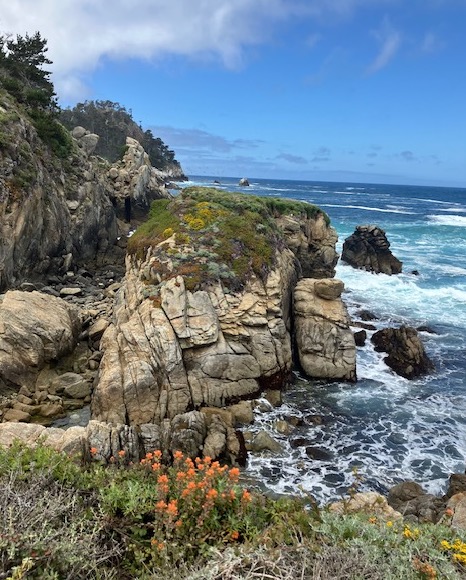
Coastline, Point Lobos, California (Photo Bill Pike)
From the flight across America to our first afternoon of exploring San Francisco, we were exhausted.
I slept soundly until 4:24 a.m. That’s when I heard the voice of a woman screaming profanity from the street five stories below our room.
We ate breakfast in the hotel’s restaurant. We both had a dish named overnight cold oats. This was basically cold oatmeal with fruit.
After breakfast, we hustled back to the room to get organized for our walk down Fisherman’s Wharf. We were headed to Pier 33 where we would board a ferry for Alcatraz Island.
In its heyday, I imagine every inch of Fisherman’s Wharf held a story. The Pier 43 Arch is one of those places with lots of stories. Constructed in 1914, this pier was a major hub of transportation for the bay area.
Pier 43 archway (Photo Bill Pike)
At Pier 39, California sea lions have established a colony. They make their presence known with their chit chat and their aroma.
Continuing our stroll to Pier 33, we saw street vendors setting up to sell food and other tourist items. We had a good view of the city on our right and lots water views on our left.
As we approached Pier 33, the waiting area for the ferry ride was nearly full. A large group of school kids would be on this tour. My Commander Supreme was wise in making reservations and purchasing tickets weeks before our arrival. The trips to Alcatraz frequently are sold out.
On this pretty California day, we were on time when we departed for Alcatraz. On the ride over, there were multiple stunning views of the water, the mainland, and the island.
As soon as we left the ferry, Park Service personnel greeted us and explained our options for touring the island.
We opted for a tour with one of the park’s rangers. This gentleman was good. He knew everything about Alcatraz.
Initially, Alcatraz was established by the U. S. Army as a fort for protecting San Francisco. Next, it was converted into a prison for the military. In 1934, the island became a federal prison. As a federal prison, America’s worst offenders were sent to Alcatraz.
An old sign an entrance (Photo Bill Pike)
Sustaining a presence on Alcatraz was no easy task. There is no source of water on the island. Water had to be shipped over from San Francisco.
The island had no soil. Ship loads of soil was brought over from Angel Island.
At the top of the island was the warden’s home. This was a mere twenty two room mansion.
Guards and their families lived on Alcatraz. Amenities were put in place for their families. Their children traveled by boat to San Francisco for their education. Each child carried with them a special tag. That tag allowed the children to board the boat to return to Alcatraz at the end of the school day.
With the rich soil from Angel Island, Alcatraz has many plantings on its grounds. Prisoners sent out letters around the world requesting plants. Countries responded, and sent all kinds of plantings.
Someone from the park service did good work in figuring out how to transition visitors for the self-guided audio tour inside the prison.
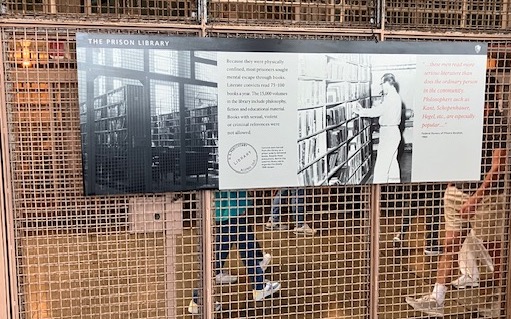
The line moved quickly to pick up our listening device. The audio tour is very realistic. It is a combination of seeing the prison environment up close, but is greatly enhanced by the narration.
The narration is done by former Alcatraz guards and prisoners. The back stories are perfectly matched with each section of the prison. Additionally, the audio is intensified with background sounds from cell doors closing to the sounds of inmates moving.
Library inside Alcatraz (Photo Bill Pike)
We saw the famous cell where in 1962 inmate, Frank Morris, initiated the carefully conceived escape from Alcatraz.
After the tour, we walked around the grounds a little more. We admired the vistas, the pretty plantings, and the preservation of this site as a national park.
Alcatraz was closed as a federal prison in 1963. Government and prison officials finally realized that the cost of sustaining Alcatraz wasn’t feasible. Closing the prison was a wise decision. Transitioning the prison into a national park was a smart move. Any attempt to return Alcatraz as a federal prison would be foolishly unwise.
Leaving Alcatraz (Photo Bill Pike)
The ferry ride back to Fisherman’s Wharf was just as pretty as our departure. Walking toward our hotel, the cool wind would occasionally send a whiff of something divine—the aroma of sourdough bread baking at the Boudin Bakery.
So, we stopped for lunch at the famous Boudin Bakery. This origin of the bakery in San Francisco dates back to 1849. The bakery’s connection to San Francisco remains strong today.
At its Pier 39 location, if you stop for lunch, you will not be disappointed. The sourdough bread is a winner, but my sourdough bread bowl filled with a corn and crab chowder was yummy.
Nice lunch (Photo Bill Pike)
After lunch, we walked back to the hotel and finalized our plans for the afternoon.
We took a Uber to the Palace of Fine Arts. This is a remaining structure from the Panama-Pacific International Exposition in 1915. The structures and its grounds are a sight to behold. I can understand why our son-in-law chose this location to propose to our oldest daughter.
Amazing construction from 1915 (Photo Bill Pike)
We spent the remainder of the afternoon walking and exploring. Our guide points along the way were the Golden Gate National Recreation Area and the San Francisco Bay Trail.
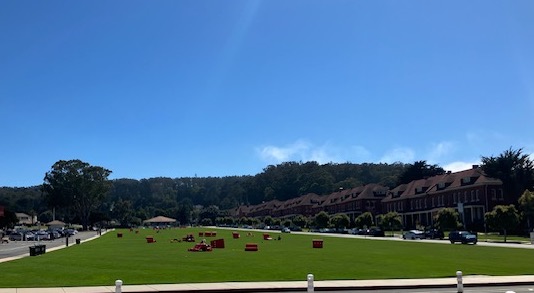
Yes, we had some missteps along the way, but the terrain, the bay, and the magnificent views made up for the modest errors. Crissy Field, Fort Point, the San Francisco National Cemetery, and the Presidio were among the areas where our feet took us.
And no matter where we trekked, another famous landmark was within sight—The Golden Gate Bridge. This afternoon, a teasing fog shrouded this striking structure.
The Golden Gate Bridge in an afternoon fog (Photo Bill Pike)
On our walk to the Presidio, we passed the humbling San Francisco National Cemetery. These nine acres of land were set aside in 1884. This was the first national cemetery on the west coast.
First west coast national cemetery (Photo Bill Pike)
A very nice visitor’s center awaited us at the Presidio. The Presidio has a long history as a military base in America. In 1962, the facility was designated as a National Historic Landmark. In 1989, the Presidio ceased its operations as a military base, and in 1994, the buildings and grounds became part of the National Park Service.
Drill field at the Presidio (Photo Bill Pike)
The friendly park service employees at the visitor’s center helped us get our bearings. From there, we took another Uber to Ghirardelli Square where we had over priced scoops of chocolate ice cream.
On our walk back to the hotel, we passed Joseph Conrad Square, a pretty green space named in honor of the sailor and novelist who apparently never visited San Francisco.
Back in our room, we took a brief rest, and then went down into the lobby for happy hour. This afternoon the place was packed.
I found two empty chairs. I saved those while the Commander picked up a glass of wine. When she returned, I left and grabbed a beer. Two more chairs opened across from us, and a nice couple from Atlanta sat down. We had a good conversation with them.
While we were recouping before happy hour, the Commander made a reservation at an Italian restaurant.
From the hotel, we walked into the North Beach neighborhood to Trattoria Contadina. This is a small, family run restaurant with superb food and service.
Not having a meal here is a mistake. (Photo Bill Pike)
Our meals were delicious, and the tiramisu was divine. Located at 1800 Mason, if you are in San Francisco, you must make a reservation. We will never forget our dinner.
The walk back to the hotel helped to work off a few calories.
Collapsing in the room at the end of the day is becoming normal for us. I think we walked ten miles today, but they were ten good miles. Miles that continued to showcase a city that intrigues and charms visitors no matter the hardships the city has experienced during its life.
My Vietnam War draft number wasn’t selected in the spring of 1972. That spring, I was finishing the second semester of my freshman year of college.
On the campus of Greensboro College, we had a few classmates who had already served in the United States military.
In Burlington, North Carolina, our across the street neighbors, the Amicks, their son, Rick, served our country during the Vietnam War.
At our church, Davis Street Methodist, the Pate family lost their oldest son, Robbie, in combat in Vietnam.
In Richmond, Virginia at our church, Trinity Methodist, we have a memorial garden that recognizes three young men from our congregation who lost their lives in Vietnam.
And for my father’s family, the oldest son, Boyd Pike, was killed in World War II. Boyd was a sailor aboard the USS Simms, a United States Navy destroyer. It was attacked and sunk by the Japanese in the Coral Sea.
I’m no history expert, no expert on any war, but I do have a respect for the men and women who have served our country in times of conflict and war.
Last May, we spent an extended weekend with college friends in Highland, Maryland. We traveled on Friday to Frederick, Maryland.
As we roamed around downtown, we walked into the local independent bookstore, the Curious Iguana.
This is a compact, but very nice bookstore with a first-class selection of books.
My college roommate, Butch Sherrill, spotted Garrett M. Graff’s book: When The Sea Came Alive An Oral History Of D-Day. As soon as Butch handed it to me, I started skimming through the pages. I was immediately hooked because of the format.
From D-Day planning until the end of the operation, Graff tells the story through the words of the men and women who were there. No matter the military personnel’s rank, no matter their country, their words, their stories, their contributions are captured in these quotes. These quotes take the readers into the bunkers, the beaches, the ships, the planes— everywhere on D-Day.
In Graff’s notes at the beginning of the book, the author ends the section with these words: “The greatest names in the pages ahead, as it turns out, are the ones you don’t know.”
My guess is you don’t know the name Waverly B. Woodson. Staff Sgt. Woodson was a Black medic on Omaha Beach on D-Day. On that day, June 6, nearly 2,000 black soldiers were a part of the D-Day attack.
Interestingly, “not a single Black soldier, sailor, airman, Marine or Coast Guard personnel was originally awarded the Medal of Honor in World War II. (Page XV Author’s Note)
“During World War II, 433 Medals of Honor were awarded. None of those medals were received by Black soldiers.”(Graff page 374)
From the moment he came ashore on Omaha Beach, Staff Sgt. Woodson was involved in assisting the wounded. He stated: “All day, we medics continued to dress many, many wounded and consoled the frightened. This went on until around 3 o’clock in the afternoon. With all of this going on I didn’t have time to see how bad I was wounded—I only wanted to help the survivors. After about 8 hours, one of the medics redressed my wounds and I continued, as I didn’t have a place to lie down.” (Graff page 374)
During 1994 in the Clinton administration, nine Black World War II Veterans received the Medal of Honor. Only one of those nine was still living. Staff Sgt. Woodson was not one of those. He died in 2005. Since his death, bills have been introduced in Congress to award Woodson the Medal of Honor. Despite support by military leaders none of these bills has passed. (Graff page 374)
Staff Sgt. Waverly B. Woodson did survive that horrible day on Omaha Beach. After the war, Woodson and his wife raised a family near Clarksburg, Maryland. He received a Purple Heart and a Bronze Star for his dedication.
For the fiftieth anniversary of D-Day the French government recognized Staff Sgt. Woodson. Woodson and two other D-Day soldiers received a weeklong all-expenses-paid trip to France, and they were awarded medals during a ceremony on Omaha Beach. Woodson could never figure out why he was chosen. But, he assumed this was the French’s way of saying, “Thanks.” (Graff page 499-500).
In the Epilogue of the book, this quote from General Dwight Eisenhower caught my attention: “These people gave us a chance and they bought time for us so that we can do better than we have before. Every time I come back to these beaches— or any day when I think about that day—I say, once more, we must find some way to work to peace, and to gain an eternal peace for this world.” (Graff page 499)
Here we are eighty years after D-Day, and the world still can’t embrace a sustainable peace.
What is wrong with us?
Why is peace unattainable?
Haven’t we learned anything from war?
Do we understand the aftermath of its carnage and destruction?
Sadly, the answer is no.
The Greek historian Herodotus wrote these words: “In peace sons bury fathers, but in war fathers bury sons.”
On this Memorial Day and those in the future, America must vow to never, never, never forget those whom we have buried from our wars.
Their sacrifices sustain America’s fragile freedom.
America must always work to find peace to stop the burials from war.
As General Eisenhower stated: “we can do better than we have done before.”
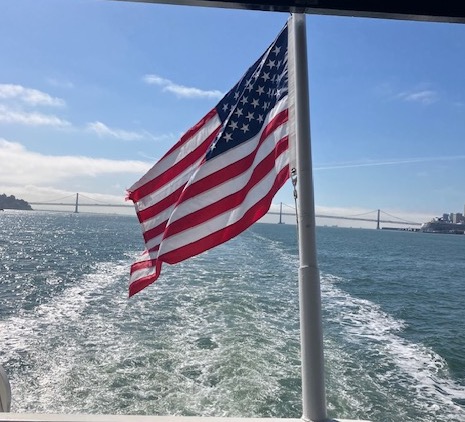
American flag, San Francisco, California May 2025 (Photo Bill Pike)
In the summer of 1980, I made my first trip to California. For the Commander Supreme and me that was a before kids trip.
A highlight of that trip was a drive up the coast from Los Angeles to San Francisco. My sister-in-law, Abby, was our tour guide.
Three years ago, we were all set to fly to San Francisco to attend the wedding of the Commander Supreme’s niece, Ashley. The day before we were scheduled to fly, thinking she had a sinus infection, the Commander tested positive for COVID-19.
Obviously, we canceled the trip, but the Commander was able to hang on to the flight for the future.
So on Wednesday, May 7, 2025, we boarded a Breeze Airways Airbus A-220 in Richmond and flew direct to San Francisco.
By 6:00 a.m. we were in the car and driving toward the Richmond airport.
Other than a van driver from the extended stay parking lot who didn’t know the details of his job, we had no challenges getting into the terminal.
We cleared all of the screening hurdles. Our walk to the gate was leisurely. Knowing that we would be sitting for a long time, I walked a lot in the terminal.
Eventually, the plane arrived from Charleston.
The boarding process went quickly.
The A220 seating configuration is three seats and two seats. The Commander booked us a two seat reservation with extra leg room. This arrangement was a nice surprise from the normal sardine box.
Even though, we boarded quickly, we sat too long on the tarmac before heading to the runway.
The captain of the plane told us to expect a few bumps as we settled in for the cross country flight.
Breeze is a no frills airline. No monitors on the back of the seats for watching movies. I had to hope I could download their wireless access correctly.
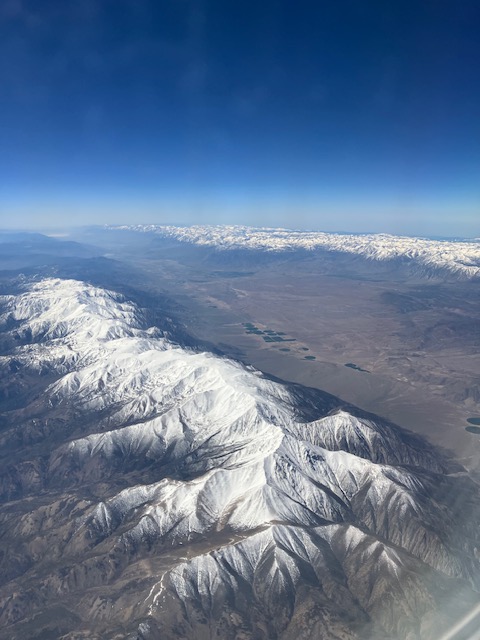
For now, I focused on the landscape out my window for a distraction. I love how the topography of America changes as we fly west. The hills, east coast mountains, the flat plains, the snow covered Rockies, wide sections of deserts, more hills, and finally the coastal plain heading into San Francisco.
Snow topped mountains flying west. (Photo Bill Pike)
Early in the flight, I nodded off for some nano naps. Read from Richmond editor and writer, Tom Allen’s second book—“Roll With It: encountering grace, grins, gridlock, and God in everyday life.” After a few chapters of Tom’s book, I switched over to Tristan Gooley’s The Secret World Of Weather: How to Read Signs in Every Cloud, Breeze, Hill, Street, Plant, Animal, and Dewdrop (Natural Navigation).
At some point, I opened up my laptop computer and started to write. For a long stretch, this was a good distraction.
The bumps, the turbulence on the flight were minimal.
Gradually, the plane slowed. We were notified that our descent into San Francisco had started.
I made sure everything was securely in my backpack. Then, I was glued to my window tracking the landscape changes.
The plane made a graceful landing. We departed the plane easily. The next hurdle was finding our way in the pretty San Francisco airport.
With adequate signage guiding us, we exited the terminal to a line of taxis. We were assigned to the first taxi in line. The driver helped us with our luggage, the Commander gave him the hotel’s address, off we went.
Our driver was very good. He skillfully maneuvered us through traffic, patiently answered questions, and never appeared rattled by wacky moves from other drivers.
He even explained Waymo to us. Waymo is the driverless Google car.
Our frequently spotted Waymo (Photo Bill Pike)
At the Alton Hotel, the driver dropped us in the perfect spot, helped with our bags, and we wished him the best.
The Commander’s detailed planning made for a seamless checkin and a surprise room upgrade.
We settled quickly into our and room, and promptly left heading to the In and Out Burger a block away from the hotel.
Until Saturday morning The Alton would be our home. Located in the Fisherman’s Wharf area of the city, the hotel still had a new construction feel to it.
We arrived just in time at In and Out. By minutes, we beat the daily lunch hour surge. The In and Out chain is a West Coast staple. If you’ve never had one of their burgers, don’t turn it down.
As soon as we finished our burgers, we hit the pavement.
One thing you quickly learn about San Francisco is the terrain. Maybe the reason Tony Bennett “left his heart in San Francisco” is that it died walking up one of its hills.
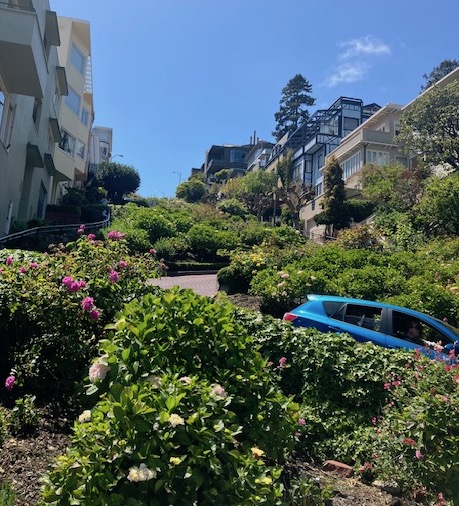
The contrast from the relative flatness at Fisherman’s Wharf to the extreme steepness of the hills on either end of Lombard Street is significant.
Our first stop was the Coit Tower. The tower sits on the top of Telegraph Hill.
The walk up to the tower is a heart thumper. But the vistas from the park at the top, and the views at the tip of the tower are worth it.
Coit Tower was built from 1932-33. It has 234 steps to the top. The tower is also graced with fresco murals.
Coit Tower (Photo Bill Pike)
From Coit Tower, we walked back toward Lombard Street. To get to the other end of Lombard Street requires another steep decent and climb.
This side of Lombard Street is known as the “Crookedest Street In The World.” It is interesting to watch cars handle the sharp turns along the well maintained lawns and gardens.
A car heading down Lombard (Photo Bill Pike)
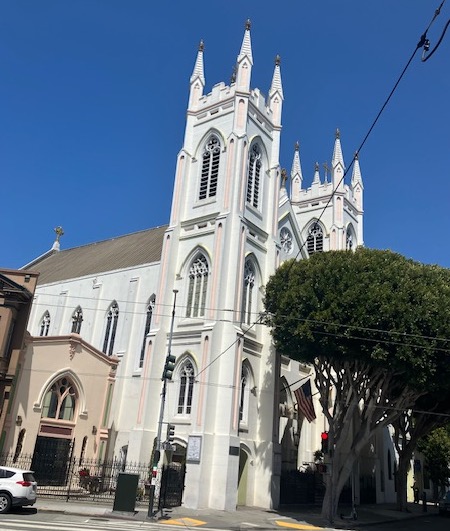
We shifted our walk into the North Beach neighborhood. Here a mix of houses and business caught our attention. Pretty cathedrals against a blue sky backdrop were hard to miss.
A pretty cathedral (Photo Bill Pike)
Even on the first day of vacation, I could not resist going into Cole Hardware. Founded in the 1920s, the store and its contents are very appealing. Maybe this motto explains the sustained success of the store: “There are no strangers here, just friends we haven’t met.” The store even has a cooler of pies from The Pie Company based out of Ripon, California.
Next, we worked our way to the famous City Lights Bookstore. Founded in 1953 by poet Lawrence Ferlinghetti and Peter D. Martin, this is one of those special independent bookstores that has managed to beat the odds. If you love books, you must stop.
The famous bookstore (Photo Bill Pike)
Then, we took a brief walk on the fringes of Chinatown. Lots of shop owner energy was present among the diverse merchandise with customers haggling for the best price. ‘
As we started our walk back to the hotel, Italian food shops tempted us with their aromas and displays, but we kept moving.
At the hotel, we collapsed, but made sure we were up and heading toward the free happy hour in the lobby at five. A nice glass of wine for the Commander and a California Blonde Ale from the Eel River Brewing Company for me helped to bring our busy day to a close.
For dinner, we made the short walk from the hotel to Cioppinos, an Italian restaurant. The food and the service were good.
After our filling dinner, we were really ready to collapse. The Commander’s “fit bit” had us over eight miles with most of those steps recorded during our afternoon trek.
At the end of the day, I’m remembering the architecture as our taxi driver drove us further into the city. No part of a plot of land is wasted. Homes and businesses are stacked up on every hillside throughout the city.
We saw lots of pretty gardens and shrubs along the way. Blooms of all shapes, sizes, and colors added to the charm and character of the neighborhoods.
Pretty blooms (Photo Bill Pike)
At the end of our first day, I’m thankful for my Commander Supreme. If the remainder of the trip is as good as the first afternoon, then we’re going to be remembering this trek for a long, long time.
During Holy Week at our church, for some unknown reason, termites decided to erupt out of the wooden baseboard in the Forest Avenue foyer of the Sanctuary.
Our head building caretaker had been spiffing up the old black and white tile floor when he noticed my new best friends.
Sure enough, the termites had staged quite an invasion. They were curiously crawling around and inspecting these unfamiliar surfaces.
Maybe they were communicating to themselves, “Hey, where did the soft wood go, how did we end up here, we’re usually crunching wood in the dark, where did this light come from, who is this old guy holding a spay bottle?
Down on my knees, I probed deeper. Sometimes when we probe deeper into the outer layers more challenges are revealed. As I gently pried off the first piece of stained wood, I quickly saw that the next piece of trim work had been decimated by the termites.
No telling how long they had been silently chomping on the wood.
With a touch of agitation, I grabbed the spray bottle of Windex with ammonia in it. I started spraying. A long time ago, an exterminator told me that Windex with ammonia can temporarily help in eliminating creatures that show up at the wrong time.
I made the call to the company who has our termite contract. One of their technicians would stop by early on Thursday morning.
Not long after that encounter, a church member told me she forgot to tell me that ants had been sighted by one of the windows in the nursery on Sunday.
Sure enough, the ants were all over the window ledge and the HVAC register.
Once again, the ants met Windex.
Maybe in their defense, the ants were responding to the disruption they had experienced during our summer of 2024 building renovation project. That extensive project had peeled back all layers in one section of our building. I’m sure we intruded into the ants’ space.
Perhaps, the ants were seeking revenge. My guess is they were on a secret mission. The ants were working their way to the office of our Kids Director, Jen Williams, and her stash of Peeps. The ants were planning to disrupt Easter.
Again, I made a call to our pest control company, and our reliable technician was scheduled to visit the ants on Friday.
In the interim, I spent time cleaning up the ant massacre. I’d learn from past encounters its about eliminating access. I found no evidence of intrusion from the outside, so I concentrated on caulking up any openings and seams around the window trim and the HVAC unit.
Early on Thursday morning, I met the termite technician. He confirmed that the visitors were termites, not flying ants. For a few minutes, he share his options for treating the damaged area. For sure, he would treat the visible wood, but he also wanted to get inside the plaster wall above the trim work.
With this, we agreed on him drilling three small holes into the plaster. This gave access for treating the inside of the wall area. In turn, I agreed to patch the three holes.
Later on Thursday afternoon, I was able to get the damaged baseboard presentable for Easter.
Over in the nursery, the caulk work from Wednesday afternoon worked. No ants were scurrying around the window or the HVAC unit.
Easter Sunday was a pretty, warm day in Richmond. We had made the switch over to the summer season with the HVAC systems in the older sections of the building. Initially, these chillers with their compressors, pumps, and air handlers fired up properly.
While that initial start up had gone well on Thursday afternoon, that wasn’t the case on Sunday morning. The chiller for the Trinity Hall wing of the building was a bad bunny. The chiller despite prompting would not fire up.
Luckily, no one croaked from heat stroke in that section of the building on Sunday. However, the news wasn’t good when the unit was checked out by our HVAC service company the following week. One of the compressors for that chiller decided—“I’m done, I’m not working another Richmond summer, find another compressor to battle that heat and humidity.”
Now, our Trustees are reviewing a quote for replacing the uncooperative compressor. The cost is not pretty.
On Friday, May 2, the call came on my cell phone at 9:28 a.m.
Our youngest daughter, Elizabeth, had started her drive to Richmond from Raleigh. She was coming to attend a dance recital for two of our granddaughters on Saturday afternoon.
But this call wasn’t about how much napping I would do during the recital. No there was a sense of urgency. I could hear concern in Elizabeth’s voice.
She explained there was a noise coming from the dashboard of her car. The noise reminded her of the type of the scratching sounds that an agitated squirrel or mouse make when they are trapped inside the wall of a house.
Elizabeth was convinced that some crazed furry creature was going to explode through the dashboard or floorboard of the car as she sped up the interstate.
When I finally was able to settle her down, we walked through a series of unscientific tests. No creature exploded out from under the hood, nor from the dashboard.
At the gas station where Elizabeth had pulled over, a nice man noticed the raised hood. Clearly, he saw this young lady going through a sequence of unusual maneuvers while holding a cell phone. Possibly, he thought she was about to lose one or all of her marbles by the actions he saw.
He decide to investigate. With me listening in on the phone, he asked if she needed help?
Calmly, Elizabeth told him about the noise and what she was attempting to do.
Upon hearing her concerns, this kind stranger suggested that leaf debris might be in her ventilation system. He talked about the “squirrel cage” for this system and how debris can become trapped and blown around.
For now, that explanation made sense.
Elizabeth thanked him for his willingness to help. She continued her drive toward Richmond.
Later on Friday afternoon, we had a father-daughter bonding session.
First, we removed all tree debris from the windshield wiper area of the car and under the hood too.
Then, per the advice of the helpful stranger, we went inside the glove box of the car to remove the air filter for the car’s HVAC system. Yes, the filter for the HVAC system is located behind the glove box.
Despite watching helpful Youtube videos on how to access the filter, this work was not profanity free.
But inside the filter and the surrounding area, we did find leaf debris particles that could have been the noisy culprit.
During this endeavor, I did as all fathers are supposed to do. I put my hand into the cylinder for the vent, and I let out a scream. A scream that conveyed a furry creature had my hand.
Of course, this tactic worked. Elizabeth’s was initially quite startled, but not impressed with her immature father.
Elizabeth led the way in getting the filter and glove box back into the proper positions. Remarkably, we didn’t break anything.
Usually, situations with ants, termites, compressors, and car creatures can be remedied. However, that is not always the case for human beings.
Right now, despite fighting with all of their strength, and the best efforts of oncologists, someone within this hour is going to lose their battle with cancer.
Today, a darkness so deep and desperate will push a person to die by suicide.
With the end of another school year in sight, a single parent with three elementary age children wonders how they will survive the summer. Her concerns are based on the gutting of funding from leaders in Washington who have no clue about the reality of real American life.
Easter is over.
For me, Easter, despite its resurrection ending, is a difficult story.
Life is a difficult story too. Disruptive challenges are always, always part of that difficulty.
But with Easter, I always come back to Thomas. That’s right Thomas.
I identify with Thomas because he is honest. Like me he doubts. He doubted that Jesus had appeared before the disciples after his death.
Thomas wanted proof.
He wanted to see the wounds Jesus had suffered during his crucifixion.
How do we confront our doubts during life’s challenging moments?
Maybe, the key is to always hold on to hope.
Even when we doubt, and our faith is fading, we must not let go of hope.
And here’s why— Romans Chapter Five verses three and four: “because we know that suffering produces perseverance; 4 perseverance, character; and character, hope.”
Remember in the post Easter story, someone you encounter needs your perseverance, your character, and your hope.
Doesn’t matter if this person is confronting ants, compressors, car critters, termites, or the true reality of real life— someone needs hope.
On those bad days in an old church building when I’m convinced that God is out to get me, maybe he’s simply reminding me, “Hey knucklehead, someone you encounter today needs to hear that hope from Romans. Don’t let them down.”