America was once

For a long time, I have been worried about America. Let me attempt to explain why.

On the afternoon of Saturday, August 23, my wife and I were driving back to Richmond, Virginia from Durham, North Carolina.

We were on I-85 still south of Petersburg when I heard a roaring sound. I was in the passing lane. I looked at my rearview mirror to find a man driving a motorcycle riding the center line between both lanes. Two things caught my attention: the speed of the motorcycle and the driver’s total disrespect for his life and the life of the drivers in the other vehicles and their passengers.

As we continued toward home, on Chippenham Parkway, we approached Forest Hill Avenue. There, three vehicles traveling at high speeds, recklessly wove in and out of the two lanes of traffic. Again, these drivers, showed no respect for their lives, nor the people in the vehicles they were passing.

Every Thursday morning, I take groceries from our congregation to the food pantry at Belmont United Methodist Church. Once off Chippenham Parkway, I take the Belmont Road exit. As this road merges with two other roads there is a traffic circle. Four yield signs are properly placed around the circle. Rarely, do drivers obey the yield signs. They opt to gun through the circle without regard to other drivers.

On the evening of Friday, September 12, my wife and I were driving to our local high school for a football game. While stopped in the left turn lane at the intersection of Forest and Three Chopt, two cars barreled through this intersection blatantly running the red light. If my wife who was driving had made her left turn quickly into the path of these two vehicles, the results would not have been pleasant.

In our neighborhood, stop signs at Stuart Hall and Rock Creek roads are frequently ignored by drivers.

Also in our neighborhood, the county has invested quite a bit to install crosswalks for pedestrians on quiet and busy streets. It is rare when drivers truly stop to allow pedestrians to cross safely.

I will confess, I’m an imperfect driver, but I do attempt to follow the rules of the road. So, Mr. Whiner, what does this have to do with your worries about America?


While seemingly minuscule, my concern is the disregard and disrespect for the rules of the road is part of the continuing erosion of America. My point is from an interstate to a neighborhood street this disregard and disrespect emboldens people to become more defiant.

We’ve seen this disregard and disrespect play out in other public settings too. From school board meetings to the Office of the President, our civility and decorum are absent.

In December 2002, Earl Scruggs, Doc Watson, and Ricky Skaggs performed a concert at the RJR auditorium in Winston-Salem, North Carolina. These gifted bluegrass musicians delighted the audience with their playing, singing, and storytelling.

During the performance, Earl Scruggs shared a story about learning to play the banjo. Mr. Scruggs had learned a part of a song, and he couldn’t wait to share this accomplishment with an older brother. When the time came to share it with his brother, the brother heard the run, and said, “Is that all you know?”

When it comes to my worries about America, that’s not all I know.

Writing in Bloomberg, journalist, Adam Minter, describes a new $62 million dollar high school football stadium in Buford, Georgia. “The stadium features 15 corporate suites, 10,000 seats, and a 3,600 square foot state-of-the art scoreboard.” As shocking as that maybe for you, here’s another jolt for you to consider: “Texas has 10 high school stadiums that cost $50 million or more.”

I wonder in Georgia and Texas how many school buildings are in disrepair?

Closer to home in Virginia, on the afternoon of Sunday, September 14, Virginia Tech fired its football coach, Brent Pry. The Hokies started their season with three consecutive losses.

We shouldn’t feel too bad for Coach Pry. Thanks to his agent/lawyer who negotiated his six year contract with Virginia Tech leaders, that agreement was worth $27.5 million dollars. It is reported that the buyout provision in Pry’s contract will require Virginia Tech to pay him $6 million over the next two years. In 2021, Virginia Tech paid former head football coach, Justin Fuente, a lump sum of $8.75 million when he was dismissed.

Somewhere in America today, a person was fired from a job. If they were fired for poor performance, I doubt there was a buyout provision. Why should a college football coach be awarded with a buyout provision for poor performance?

I wonder when college athletic directors and administrators are going to be held accountable for their poor hires and financial irresponsibility?

Doesn’t matter if it is reckless disregard for the rules of the road, an outlandish high school football stadium, or a ludicrous buyout provision for a college football coach, America from “sea to shining sea” is eroding.

Nothing signals that erosion more than our on-going loss of life from firearms. Doesn’t matter where the shooting death occurs— on a street corner, a school, house of worship, retail settings, public venues, or a university, we clearly don’t care because the bodies and broken hearts continue to pile up.

If we dared to truly care, we would work collectively and cooperatively to solve our sickness. How can we be the greatest country in world and be so negligent for so long in failing to address this issue?

In our current sickness and blindness could you, me, we, us even attempt to apply this scripture from Philippians 2:3-4 to our daily living:

“Do nothing from selfish ambition or conceit, but in humility regard others as better than yourselves. Let each of you look not to your own interests, but to the interests of others.”

When are we going to wake up and call out our “selfish ambition”?

On our visit to Durham, we took a trip to Hillsborough. We walked around the downtown and the surrounding neighborhood to admire some stunning historic homes.

In one yard was what appeared to be a homemade sign.

On top of a golden background was the American flag. At the top of the sign were the words—Never Give Up!

On the four sides of the flag printed in the golden margins were the words we should never give up: Truth, Equality, Justice, and Compassion.

If we have any chance of living through our current chaos, our voices and every ounce of strength must never give up those words.

We can’t become an America that was once grounded in truth, equality, justice, and compassion.
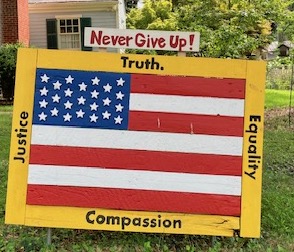
(Photo by Bill Pike)

Out at Cedarfield: Ouiser, fears, craziness, and bad moods

“I’m not crazy M’Lynn. I’ve just been in a very bad mood for forty years.”

Those words were spoken by Ouiser Boudreaux, the character portrayed by actress, Shirley MacLaine, in the movie Steel Magnolias.

In truth, Ouiser Boudreaux, reminds me of my mother’s sister, Mildred.

I loved Mildred because like Ouiser, Mildred was always honest. She never held back.

Robert Harling wrote the play, Steel Magnolias, and the screenplay that was made into a movie. The play was based upon Harling’s experience of his sister’s death.

I sense it would be fairly easy to take Ouiser’s observation about herself and apply it to our lives.
To the therapist: “I’m not crazy, Dr. Watson, I’ve just been living with my wife for the last fifty one years.”

To the superintendent of schools: “No m’am, I’m not crazy, I’ve just been trying to teach middle school students for the last thirty one years.”

To your doctor: “No sir, I’m not crazy, I know operating the television’s remote control for six hours a day isn’t a cardiovascular activity.”

I wonder if people ever felt that Jesus was crazy?

Think about Matthew Chapter 8 verses 23-27: “And when he got into the boat, his disciples followed him.  A gale arose on the lake, so great that the boat was being swamped by the waves; but he was asleep.  And they went and woke him up, saying, ‘Lord, save us! We are perishing!’  And he said to them, ‘Why are you afraid, you of little faith?’ Then he got up and rebuked the winds and the sea; and there was a dead calm.  They were amazed, saying, ‘What sort of man is this, that even the winds and the sea obey him?’”

The collective question of the disciples says it all—“What sort of man is this, that even the winds and the sea obey him?”

Maybe what they were really thinking was—“Is this man crazy?”

But in truth, the toughest question in this passage comes from Jesus: “Why are you afraid, you of little faith?”
From the disciples perspective, their fear is grounded in the intensity of the storm that is battering their boat.

Think about it— no life preservers, no flares to fire off, no cell phone, no Coast Guard helicopter in route.

Nope all they have is this crazy guy Jesus.

I’ll be truthful with you, my faith and fear are grounded in this—I still struggle to always understand this crazy guy Jesus.

I will go to my grave wondering why prayers for one friend battling cancer are answered while prayers for another friend are not.

How can a woman with a longstanding health problem in Luke Chapter 8 barely touch Jesus’ clothing and her medical condition is immediately cured?

Talk about crazy, that story drives me nuts.

All this suffering in the world, even in this beautiful facility at Cedarfield, and that touch from Jesus seems so far away.

And yet, I don’t think Jesus is far away.

No, I think the problem is that I have continued to distance myself from him.

And that distance comes from my inability to see and understand Jesus’ craziness.

I think it would be very fair for God and Jesus to say: “We’re not crazy Bill. But because of all the challenges we see on earth everyday, we’ve just been in a very bad mood for a zillion years.”

You, me, we us know that God and Jesus have lots of reasons to be in a very bad mood when they look down upon us.

No doubt, the world can put us in a very bad mood.

But, if we let that very bad mood consume us, we will lose our hope.

A few years ago I received an email from Tommy Yow. A long, long time ago, Tommy was the Associate Pastor and Youth Director at Davis Street United Methodist Church in Burlington, North Carolina.

Tommy who now is retired in Alabama read an op-ed piece I wrote about the closing of Davis Street. The piece appeared in three North Carolina newspapers. Through one of those newspapers Tommy tracked me down.

I loved reconnecting with him.


Every week Tommy forwards to me thoughtful emails from Richard Rohr, a Franciscan friar and ecumenical teacher, the retired Reverend Dr. Terry E. Walton from the North Georgia Conference, and Linda Henley at Lake Junaluska. I try to skim those writings. Occasionally, something in those posts will stick with me.

I have no idea who Jo Cato is but this quote from her was used in one of those postings: “Be brave. The unfamiliar will shape you more than the familiar ever could.”

It is tough to be brave when life becomes unfamiliar.

Yet, I think Jo Cato is correct. We have an opportunity to learn from these unfamiliar times.

I guess the real question is— are we willing to learn from these unfamiliar times?

The disciples were in unfamiliar territory with the storm pounding their boat. Fear gripped them.

For lots of different reasons, fear grips me today too.

I recently listened to an interview with Jane Fonda on the National Public Radio show Fresh Air.

Yes, I know people can still have strong feelings about Jane Fonda.

But this exchange about “fear” in the interview caught my attention.

JANE FONDA: And I wrote a book, and I lost my fear.

HOST TONYA MOSLEY: You wrote a book about aging.

JANE FONDA: Yeah. Yeah. The thing to do when you’re scared, at least for me, is I make what I’m afraid of my best friend. I learn all about it. I wrap my arms around it and squash it to death (laughter).

HOST TONYA MOSLEY: Why do you do that?

JANE FONDA: Because then I’m not afraid anymore.

There are things in life that can make us fearful, things in life that can make us crazy, and things in life that can put us in bad moods.

And in all that fear, craziness, and bad moods, and despite the impact these things have on us, God and Jesus are still hanging around.

They are ready to help us face our fears, craziness, and bad moods.

They want to help us answer Jesus’ questions: “why are you afraid, where is your faith?”

People who have known me for a long, long, long time know that I was a marginal student. I drove my parents crazy with my poor performance in school.

Yet, somehow, my parents stuck with me. They didn’t abandon me. Their deep faith anchored them in hope that some day their knucklehead of a son might land on his feet.

Though Jesus was aggravated with his disciples as the storm thrashed their boat, he did not abandon them.

At this very moment, if we have any chance of enduring this unfamiliar world, its fears, its craziness, and its bad moods, we can’t abandon the calmer of the sea.

And that requires you, me, we, us to be as honest with our hearts as Ouiser Boudreaux.

While it might be a stretch, our hearts want to say—we’re not crazy Jesus, but you know the truth.

Our hearts have been very bad at ignoring you when the unfamiliar storms of life hit us.

Don’t give up on us yet.

Toss us your life preserver of hope.

Maybe, we’ll get it right this time.

Author’s note: On the afternoon of Tuesday, September 16, 2025, I had the privilege of presenting a devotional at Cedarfield. Cedarfield is an United Methodist retirement community in Henrico County, Virginia. For eleven years, our church, Trinity United Methodist, has been presenting worship gatherings for Trinity members and Cedarfield residents. These gatherings take place four times a year.

Cedarfield (Photo Bill Pike)

The Prayer Decoy

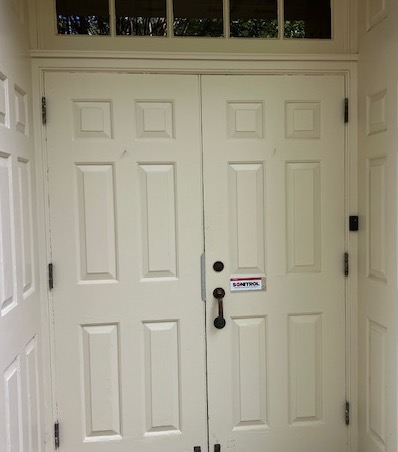
On the afternoon of Thursday, August 21, just a few minutes shy of 3 p.m., a man knocked on the door to the Stuart Hall Road entrance to our Sanctuary.

Our head building caretaker responded to the knock.

When he opened the door, this stranger said he wanted a pastor to pray for him.

Our building caretaker walked the stranger toward the church office.

Once there, our assistant pastor met with the stranger.

The request for prayer quickly shifted to a financial need to cover the cost of car insurance.

When our assistant pastor asked some basic questions about the car insurance, the stranger became belligerent and indignant. Displeased, he responded by cursing our assistant.

With this abusive language, the stranger was asked to leave the building. He was escorted out by our assistant and another staff member.

This pretense of prayer reminded me of an episode of The Andy Griffith Show titled “A Black Day For Mayberry.” The story is about a shipment of gold that is scheduled to go through Mayberry on its way to Fort Knox.

Of course, Mayberry’s biggest blabber mouth, Deputy Barney Fife, lets it slip out that a shipment of gold is on the way. This creates havoc among the citizens of Mayberry. They create an unwanted welcoming for the gold truck and its personnel.


Through a series of bungled assumptions by Deputy Fife, and his recently deputized associate bungler Gomer Pyle, we learn that the truck going through Mayberry was a decoy. The truck carrying the gold went a different route.

When Sheriff Taylor, Deputy Fife, and Deputy Pyle learn this, Deputy Pyle exclaims: “Shazam, a decoy.”

On Thursday afternoon, when I learned of our prayer seeking intruder, I felt like shouting: “Shazam, a prayer decoy.”

Yet, deep inside of me, I was angry, infuriated. Perhaps, I was just as angry as our prayer seeker when he learned that no financial assistance was to be provided because his prayer decoy plot had failed.

When I spoke further with our assistant about this stranger, turns out he wasn’t unknown to Trinity. In fact, I have his name on my prayer list.


In the past, with random infrequency, this person has shown up at Trinity seeking assistance. However, this was the first time that his interaction with church personnel was unacceptable.

One of the wristbands on my right arm says—“be kind.”

I wonder if Jesus would have been “kind” to our prayer seeker?

Might Jesus have confronted the prayer seeker by physically flipping him over like he did the tables in the temple?

Situations like this continue to erode what little Christianity I have left.

I wonder how the prayer seeker is wired?

How can a person falsely request prayer, immediately switch to ask for financial assistance, and seconds later become verbally abusive when asked reasonable, clarifying questions?

I wonder if he had worked his way down Forest Avenue stopping at each church trying the same prayer decoy?

But what I really want to know is what in the person’s lifetime put him in this position?

What is even more aggravating is I’ve been praying for this guy for years, and it appears that my prayers haven’t changed his behavior.

Maybe, I’m the problem.

Maybe, I’m a lousy prayer.

And to be even more truthful, this prayer deceit really bothered me because everyday, I’m praying for people who are in life or death situations with cancer, families who are providing care for loved ones with dementia, friends of our family who have children whose personal lives have fallen apart, and lifelong friends and co-workers whose hearts are forever crushed after tragically losing a daughter or son.

I can make this even more complicated by thinking about Hebrews 13:2: “Do not neglect to show hospitality to strangers, for by doing that some have entertained angels without knowing it.”

I’m sorry God, but I fail to see any angelic traits from the prayer decoy schemer.

I look forward to the arrival of the magazine The Week in our mail. I always read the Wit and Wisdom section. This section features quotes from a wide variety of mostly famous people.

In the September 5-12 edition, I came across this quote from American writer, James Baldwin: “The reason I will never hate anybody again is that it’s too demeaning a confession on your part if you need to hate somebody. It means you are afraid of the other thing, which is to love and be loved.”

Mr. Baldwin is correct.

I strongly dislike the method of the prayer decoy seeker.

Because of this tactic, I am afraid, unable to love the prayer decoy seeker.

Why is my heart incapable of doing this?

Stuart Hall Road doors (Photo Bill Pike)

First Visit To The Allianz Amphitheater At Riverfront

On the evening of Monday, September 1, 2025, my wife and I went with neighbors to the James Taylor concert at the Allianz Amphitheater At Riverfront. This new outdoor concert venue is on the banks of the James River.

A few days prior to the concert, our neighbors did a reconnaissance drive to check out parking options and the walking distance to the entrance.

Additionally, a day before the event, my wife received a courtesy email stating the concert was sold out. Arriving early was recommended.

The reconnaissance for the parking was smart. We parked in a lot within reasonable walking distance to the amphitheater. Additionally, the price for parking was acceptable.

It was a bit after six when we finished up at the parking lot and started our walk to the entrance. What we didn’t expect was the long, long line of people waiting to enter the amphitheater.

Richmond police officers did good work monitoring pedestrian and vehicle traffic at the intersection of Second and Byrd. That long, long line worked its way up a very steep hill along Byrd Street well past the Afton Chemical Corporation.

For a person with worn-out legs, challenges with their cardiovascular system, or wheelchair dependency getting up this hill was a challenge.

At some point the line started to move. The movement toward the entrance was slow, but steady. We cleared the security checkpoint, and the next challenge was finding a space on the lawn for us to sit.

We found a spot, but then we relocated. We relocated to the back of the lawn area. A fence runs the length of the lawn. We had two chairs reserved for seating. Our thinking was the fence would be like the back of a chair while sitting on blanket.

Again, the line to pickup our two chairs was long. We tolerated the wait time. Good news, the chairs were sturdy and comfortable.

When we relocated to the fence, the chair line was directly in front of us. Numerous people came to the chair line not realizing that a reservation had to be made to secure a chair. Just before the concert started, another problem surfaced. Apparently, the supply of chairs for people who had made a chair reservation was depleted.

As we settled into our spot, we learned that there are still some kindhearted souls in the world. A lady with two chairs stopped in front of our group. She offered us her chairs. Where her friends were seated on the lawn was too crowded for chairs, so she offered them to us.

Prior to the opening act, I spent thirty minutes exploring the amphitheater.

The stage is massive and it appears to be outfitted with all the latest bells and whistles for concert technology.

Seating options are varied with some unique locations, and the sight-lines seem good. This is despite at least three large light poles that can impact those sight-lines.

Large video monitors grace either sided of the stage. So, if your sight-lines are lousy, and the tall and lanky, James Taylor, looked tiny, the monitors capture all of the action on stage.

The space provided for food, beverage, and merchandise seemed to be adequate. This area was full of people, but despite some long lines people were able to move freely.

Can’t speak for the women, but there was no wait time for the mens’ restroom area. Urinals, sinks, and toilets were numerous.

No one from our group purchased any food or beverages. I’m not sure about food prices, but a variety of items were offered.

I had read about the grumbling over the pricing of alcoholic beverages, and I now understand the grumbling.

Interesting to me that pricing for all wine options was prominently posted. Wine pricing was expensive. A can of wine was $14.00. Wine by the bottle fell into three price ranges from $40.00 to one Cabernet Sauvignon topping out at $110.00.

As far as I could tell pricing for beer was not posted. It is my understanding that beers in 24 ounce cans cost from $16.50 to $23.00. I did see one beer sign advertising a Value Beer for $5.00.

(Photo Bill Pike)

When I inquired about the value beer was I shown a 12 ounce can of Busch Light. While I’m sure Busch Light has its fans, I don’t value it as a beer. Plus, a consumer can purchase a 30 can case of Busch Light in a local grocery store for $27.99. With that pricing, each can of beer in that case cost about 93 cents a can. Even for a value beer, that’s a significant mark up, but nothing like the mark up on the other beers.

The concert started on time with opening act Tiny Habits hitting the stage at 7:30. After their set, the roadies made some adjustments to the stage, and then we were treated to two solid hours of James Taylor and his very gifted band.

On September 15, 2024, my wife and I made our first trip to Wolf Trap National Park for the Performing Arts. We made this trip to see James Taylor.

Clearly, Wolf Trip has been presenting concerts much longer than the rookies at the Allianz Amphitheater. However, getting into Wolf Trap, working our way to the lawn, and picking up our reserved chairs was seamless.

Part of me wants to know if anyone involved with the development of the Allianz Amphitheater spent anytime picking the brains of the staff at Wolf Trap.

It is my hope that the management team will conduct a detailed review of this first season. That review should include receiving feedback from the people who attended the concerts, and all Allianz personnel.

The day after the concert, my wife did receive an email from Live Nation, a survey that opened with: “What did you(really) think of James Taylor? Share your review!”

That opening was followed with these question prompts:
How was the event? Best ever? Room for improvement? Leave feedback on your recent concert or event, so Ticketmaster, a division of Live Nation Entertainment, can help enhance your next live experience.

I wonder how many people responded to the request for feedback? Additionally, I wonder how diligently the survey comments are discussed and studied by Live Nation and Ticketmaster?

From my perspective, here are some questions that management needs to ponder:

When a concert is sold out, how might the long line and wait time for getting into the amphitheater be reduced?

If I reserve a chair, how does management ensure that the chair will be available for me?

For consumers of alcoholic beverages, the pricing must be clearly posted for all options, and the pricing of these beverages must be restructured to be more sensible.

How might the seating in the lawn area be more balanced between blankets and chairs? Should the lawn area have a designated section only for chairs?

Hopefully, management will listen and improvements will be ready to be implemented by next summer.

At the age of 77, James Taylor enjoyed performing in this new venue. He was complimentary of the facility, the setting, and the crowd. His compliments also hinted that he would like to return next summer for another performance.

I’m 72, I anticipate returning to the Allianz Amphitheater At Riverfront for another concert. However, if I opt to return, I certainly hope that the management team will collectively work to make improvements. Improvements that will make the concert experience better for all who attend a performance in this amphitheater.

Failure to listen to feedback and institute reasonable changes based upon that constructive criticism could potentially hurt the success of the amphitheater.

At the end of this first season, I know everyone will be looking at the profit numbers. I won’t deny the importance of that data. But did concert attendees have a good experience also drives that revenue, and that can’t be overlooked.

And thinking of people, there is one more important part of our concert experience that also can’t be disregarded—the Allianz personnel. From my interactions with them, I found these employees to be patient, polite, and knowledgeable. In our impatient world those traits are important, especially in a public setting—nice work.

Thank you Chris Coble

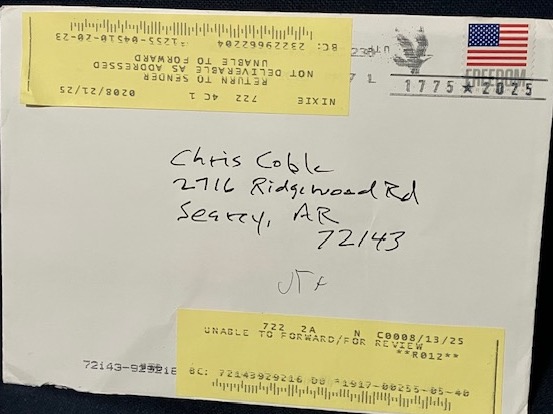
I was surprised when the envelope addressed to my friend, Chris Coble, was returned to our home.

The US Postal Service placed two yellow stickers on the front of the envelope: Return To Sender Not Deliverable As Addressed Unable To Forward.

I rechecked the address. It was correct.

I reached out to my friend, Bruce Bowen. We both had worked with Chris at Hermitage High School. Chris had been one of the secretaries in the school office. I knew Bruce had been better at keeping in touch with Chris than I had.

Sadly, Bruce told me that Chris had passed away. One of Chris’ daughters had informed Bruce. The daughter stated that declining health over the last few months wore her down.
There are many angels walking around on earth. Chris was one of them.

School offices in a large high school can be chaotic. I think Chris had a heart for understanding that human chaos. Grumpy parents, disruptive students, and struggling staff members were assisted by Mrs. Coble. Maybe they were accommodated because she understood their challenges.

Chris and I bonded over a genre of country music that had gradually lost its popularity—cowboy songs.

American singer and songwriter, Michael Martin Murphey, who had a hit record about a horse named “Wildfire” rejuvenated his career as a singer of cowboy songs.

In fact his album Cowboy Songs sparked Warner Brothers Records to form a separate recording label, Warner Western, dedicated to recording artists who wrote and sang about life west of the Mississippi River.

Chris’ sister, Carolyn, was a secretary at the musicians union in Nashville. I guess at some point Chris talked with Carolyn about these Warner Western recordings that I shared with Chris and her husband, Ron.

One day, in the Hermitage office, Chris summoned me to her desk. She told me she was going to transfer a call into my office.

I walked back into the office picked up the phone. On the line was Carolyn, she had with her Joey Miskulin. Mr. Miskulin is the accordion player for Riders In The Sky, a session musician, and a record producer in Nashville.

Riders In The Sky is a trio that performs western songs with a dose of humor. You probably have heard them performing songs from the Pixar movie Toy Story 2.

For a few minutes, I had the pleasure of speaking with a patient Mr. Miskulin. A few weeks later an autographed copy of the latest Riders In The Sky recording was handed off to me from Chris courtesy of Carolyn.

That was Chris Coble’s heart at work.

I don’t remember the timing, but at some point, Chris’ husband, Ron, made a decision to retire. Searcy, Arkansas is were they landed. I think they had some family there.

We continued to keep in touch via Christmas cards, letters, and once in awhile a phone call. Chris had beautiful handwriting. Her elementary school teachers would have been proud of the graceful elegance found in each word and sentence.

In one of my desk drawer’s, I keep an expandable folder labeled cards and notes. No doubt, I am a sentimental, softhearted pack rat. When it comes to handwritten notes from family, friends, and sometimes strangers, I have kept many.

I went through that folder today. I found eight handwritten cards and letters from Chris. I skimmed through some of them. There was always an update about her family—children and grandchildren. Her family stories and experiences whether good or challenging often gave me valuable insights as I navigated life.

Sometimes an article clipped from a magazine or newspaper was included. She sent a stellar one about cowboy poet, Baxter Clark. Occasionally, we shared book titles about World War II history that we had read. Chris recalled quite a bit about World War II.

As she continued to age, Chris never worried about the competency of her mind, but she would reference how her body was wearing out.

If you became friends with Chris while she lived in Searcy, Sunday, May 18, 2025 was a sad day. That’s when Chris flew into the wild blue yonder.

The concise obituary covered all the bases. The only surprise was that Chris requested no funeral service. I loved this sentence from the obituary: “God blessed her with gifts of a curious mind, thoughtful friendship, and the ministry of hospitality.”

From what I knew of Chris, those words truly captured her.

Years ago, I pulled out from the attic my wife’s Religion 101 Bible from her freshman year at Greensboro College. I still use that Bible today.

Inside the book of Proverbs, I have kept Chris’ handwritten note from September 26, 2001. Just under where she signed her name, Chris wrote: Proverbs 3: 5-6.

Somehow, I think Chris knew I needed those words: “Trust in the Lord with all your heart, and do not rely on your own insight. In all your ways acknowledge him,
and he will make straight your paths.”

From the way Chris led her life, I believe those words rang true to her too.

I will miss hearing from Chris, but I’m very thankful that she was an irreplaceable friend for all these years.

(Photo Bill Pike)

Part II Back To School: trust

On the morning of Monday, August 18, I took a run through our neighborhood. It was the first day of school in Henrico County. A late Sunday night thunderstorm had temporarily broken the grip of summer heat and humidity.

I thought back to 1975 when my first year as a teacher started in Martinsville, Virginia. Thirty-one years later, I hit my wall and retired.

This time of year, people who know I worked in the schools ask me— do I miss being in a school building? My answer is a swift—‘no.’

My ‘no’ is grounded in— the world has changed. I doubt I could survive in a public school today. I read the troubling headlines.

Between now, and the beginning of September, public schools in Virginia will come back to life. What the public might not realize is that schools have been breathing all summer.

Staff members are readying the building and grounds for a new year. New students are being registered. Teachers are enrolled in classes to renew their certification or to learn a new instructional strategy. Coaches prep for preseason practices for fall sports. Principals are monitoring details while nudging everyone to be ready for the first day.

When that first day arrives, nerves will be on edge. Restless sleep hassles kindergarten parents and first year teachers. Superintendents are a part of the sleep deprived too. Internally, they whisper a prayer for a quiet first day with no negative sound bytes for the local news at six.

During that first week, everyday a kindergarten student will disrupt a classroom because this student has an unstructured home life.

At lunch time, somewhere in the chaos of a middle school cafeteria, an introverted, unconfident sixth grader cringes in uneasiness.

In a large high school, an eighteen year old student who should be a senior, but who has earned enough credits to be a sophomore silently plots how to get kicked out of school.

And by the end of September, there will be a handful of teachers who are ready to submit their resignation letters. In the classroom trenches, the stress, tension, and pressure are too much.

The stress, tension, and pressure are present at home too.
The single parent of the kindergarten student dreads every text, email, or phone call from her student’s teacher.

For the parents of the introverted middle school student, they feel the uncomfortable stress too. As parents, they are hesitant to approach the school’s counselor for support. They worry that requesting assistance might create more stress for their student.

The grandparent of the unsuccessful high school student knows this troubled road. From past failed experiences, the grandparent doesn’t believe the school system can provide the proper intervention for her grandson.

These examples are only a sampling of the challenges faced by students, parents, and public school educators. Multiply that across Virginia, and one can quickly grasp—this is tough, unending work.

I often wonder what it would take to reduce the stress, tension, and pressure in our public schools. Doesn’t matter where a teacher is assigned there is no immunity from stress, tension, and pressure.

What causes these mental, physical, and emotional strains? What keeps them alive from grade level to grade level? Is it our failure to address and fix the shortcomings of our human infrastructure in our communities?

Do our most disruptive and unsuccessful students come from unstable homes? Is that instability linked to absent parents, dysfunctional parenting, trauma from abuse, unemployment, incarceration, homelessness, inadequate medical/mental health care, or food insecurity?

From grades kindergarten through twelve, a student enters a school everyday with one or more of those burdens hovering over them. How much better might life be in school for that student if those burdens were solved? Ask any classroom teacher, they know the answer.

I don’t think anyone wants to admit this or really address it, but the erosion of our families is having an impact on our schools.

A September 2023 report on The Modern American Family from the Pew Research Center stated “there is no longer one predominant family form.” Wally and Beaver, Opie and Andy are gone.

If we truly want to improve test scores in localities where they have never risen, reduce discipline problems, improve morale, and rebuild respect for teachers, then figuring out how to stop the deepening erosion of our families is urgent.

On a morning run, I thought about Pat Conroy’s book, My Lowcountry Heart. He quotes one of his high school English teachers, Gene Norris.

Mr. Norris stated: “they used to trust teachers with the kids they sent us.”

Mr. Norris was correct.

If our schools hope to move forward, we must restore our trust in teachers.

An off duty school zone sign (Photo Bill Pike)

Part I: going back to school

For weeks, retailers have been advertising back to school sales. Doesn’t matter the target— classroom supplies or clothing, they’ve been pushing hard.

Hitting hard in a different way, you will find human resource personnel in public school systems doing everything they can to fill every teacher vacancy.

Then there are old clunkers like me. I retired from the public schools nineteen years ago. Around this time of year, people who know I worked in the schools ask me— do I miss being in a school building? My answer is always a swift—‘no.’

My ‘no’ is grounded in— the world has changed. I doubt I could survive in a public school today. I read the troubling headlines.

Between now, and the beginning of September, public schools in Virginia and across America will come back to life. What the public might not know is that schools have been breathing all summer.

Staff members are readying the building and grounds for a new year. New students are being registered. Teachers are enrolled in classes to renew their certification or to learn a new instructional strategy. Coaches are getting ready for preseason practices for fall sports. Principals are planning and gently nudging everyone to be ready for the first day.

When that first day arrives, nerves will be on edge. Restless sleep hassles kindergarten parents and first year teachers. Superintendents are a part of the sleep deprived too. Internally, they whisper a prayer for a quiet first day with no negative news sound bytes for the local news at six.

During that first week, everyday a kindergarten student will disrupt a classroom because this student has an unstructured home life.

At lunch time, somewhere in the chaos of a middle school cafeteria, an introverted, unconfident sixth grader cringes in uneasiness.

In a large high school, an eighteen year old student who should be a senior, but only has earned enough credits to be a sophomore silently plots how to get kicked out of school.

And by the end of September, there will be a handful of teachers who are ready to submit their resignation letters. In the trenches, the stress, tension, and pressure are too much.

The stress, tension, and pressure are present at home too.
The single parent of the kindergarten student dreads every text message, email, or phone call from her student’s teacher.

For the parents of the introverted middle school student, they feel the uncomfortable stress too. As parents, they are hesitant to approach the school’s counselor for support. They worry that requesting assistance might create more stress for their student.

The grandparent of the unsuccessful high school student knows this troubled road. From past failed experiences, the grandparent doesn’t trust the school system to provide the proper intervention for her grandson.

These examples are only a sampling of the challenges faced by students, parents, and public school educators. Multiply that across Virginia and America, and one can quickly grasp—this is tough, unending work.

Survival in the classroom for students and teachers has become more difficult. An undertow of political and public pressure is always restless and present in our schools. From all of the data we collect, I wonder how much we really understand as to why schools have become more challenging.

Where do those challenges come from? How are they birthed? What conditions in the neighborhood and the school’s environment add to the unstable volatility?

Researchers can confirm many reasons for the challenges faced by our public schools. But for me, one of the most overlooked is the erosion of our families.

A September 2023 report on The Modern American Family from the Pew Research Center looks at key trends in marriage and family life.

Early in the report it is clear to see that American families have changed with this significant shift: “In 1970, 67% of Americans ages 25-49 were living with their spouse and one or more children younger than 18. Over the past five decades, that share has dropped to 37%.”

According to Pew researchers, this shift has created an “increase in other types of family living arrangements, like unmarried adults raising children.”

The Pew report notes numerous factors that have impacted the family structure: marrying later in life, interracial/interethnic marriages, same-sex married couples, fertility patterns, and more women are having children without being married.”

Another Pew research study from April 2018 takes a deeper look at The Changing Profile of Unmarried Women. Lots of information is captured here, but one of my take aways was this: “about one-fourth of solo parents are poor.”

Broken down further, by parent type here are the percentages living in poverty: “solo 27%, cohabiting 16%, and married 8%.” One more layer reveals that “17% of fathers and 30% of mothers” are living in poverty.

What these reports find is there is “no longer one predominant family form.”

This shift has impacted schools. From something as simple as registering students when they enter school to rethinking instructional strategies for students who have experienced trauma from the instability that can occur from these family changes.


Despite these challenges, schools, primarily teachers have the responsibility of trying to educate students who enter a school building everyday with the burden of family baggage hovering over them.

That baggage might come from these family issues: unemployment, homelessness, lack of mental and physical health care, incarceration, dysfunction, emotional trauma, and food insecurity. How many of our school shootings or severe disruptions of the school environment can be attributed to the burdens of that baggage?

And despite this baggage, for some of those students, their hours spent inside the school building are the most stable in their lives. Teachers who witness this brief stability will often silently think—if I could only take this student home with me.

Woven into the instability of our families is also the uncertainty of our politics. I can’t believe that America’s Department of Education has been dismantled. Despite our faults and imperfections, our public schools helped to build the foundation of America.

From my perspective, many of our politicians have no real understanding of what a day is like in a classroom in a public school for a student, parent, or teacher. That lack of knowledge and understanding is reflected in self-centered legislation and executive orders.

At the start of a new school year, I hope that every student, parent, and teacher will find the support they need for success.

And for you politicians out there who say you want to improve our public schools, you might want to start by focusing on the erosion of America’s families.

If you truly want to make test scores rise in localities where they have never risen, reduce discipline problems, raise morale inside a school building and their community, and rebuild respect for teachers, then figuring out how to stop the deepening erosion of our families is urgent.

Back in April 1970, NASA faced an urgent situation. That is when Apollo 13 Commander, Jim Lovell, told mission controllers in Houston those famous words: “Houston, we’ve had a problem.”

Lovell, who recently passed away, told NASA leaders the problem was the explosion of an oxygen tank inside the service module. With that explosion, the mission leaders and their team had to figure out how to get Lovell and his fellow astronauts back to earth safely.

From Jim Lovell’s perspective, this near disaster was avoided because of leadership: “What it showed was what you could do with good leadership in an organization, how good leadership fosters teamwork, and how teamwork and initiative, when you faced a problem – to use the initiative or imagination to try to solve the problem because everything doesn’t flow freely in life, and things change.”(NPR)

Quite honestly, America, we’ve had a problem with the erosion of our families for a long time.

Why is it we can explore the out limits of space, build oil wells in oceans, span bridges across canyons and waterways, construct skyscrapers, and yet we continue to struggle to solve our human infrastructure demands.

When might our teamwork, imagination, and initiative be used to solve our vicious generational cycles related to poverty, homelessness, healthcare, unemployment, nutrition, and the erosion of our families?

Not working to solve these on-going challenges, only guarantees more disconcerting days in our schools.

In the fall of 1975, I started my first teaching job in public education. I do not recall what motivated me to become a teacher. But, I would not trade anything for my thirty one years.

With the start of this new school year, I went back and re-read a section of Pat Conroy’s book A Lowcountry Heart.

During the summer of 1961, Pat Conroy had a summer job at his high school. Mr. Conroy completed landscaping tasks on campus per the direction of his principal, Bill Duffy.

Mr. Conroy wrote: “That summer, I decided to try to turn myself into a man exactly like Bill Duffy. He made me want to become a teacher, convinced me that there was no higher calling on earth, and none with richer rewards, and none more valuable in the making of a society I would be proud to be a part of.” (Conroy p. 171)

I agree there is no higher calling on earth than being a teacher, and the work teachers do in the making of our society is still valuable.

We must be supportive of them in their work.

We owe it to our teachers to figure out how to stop the erosion of our families.

This is important, and we can’t delay in finding a solution.

A resting school bus (Photo Bill Pike)