On the morning of Sunday, June 29, 2025, Betsy, Dan, and I were up early.
In a few hours, our group would be leaving the Sylvia Hotel and transitioning to a Holland America ship.
We wanted to explore Stanley Park a little more before departing.
A quiet, bright blue sky greeted us as we left the hotel.
Stanley Park opened in 1888. It is Vancouver’s “first, largest, and most beloved park.” (City of Vancouver) I can tell you there is much for residents and visitors to love about this park.
The size alone, 400 hectares, adds to this wonderment. A hectare is larger than an acre. A conversion to acres is 988.
Situated in a natural West Coast rainforest as you might expect there is lots of green to see.
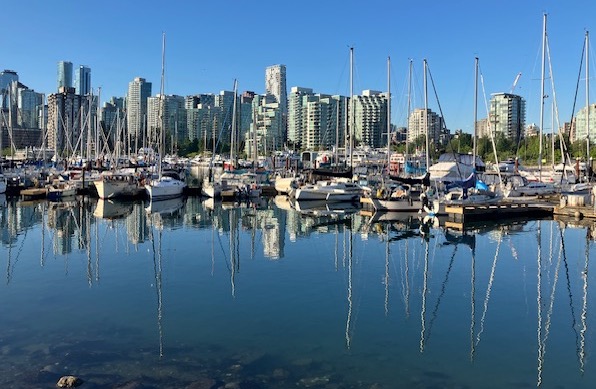
And of course there is lots of water to view too. Visitors are aided by the Seawall trail for stunning panoramas of English Bay. “This seaside greenway is the world’s longest uninterrupted waterfront path.” (City of Vancouver)
A pretty harbor off Stanley Park (Photo Bill Pike)
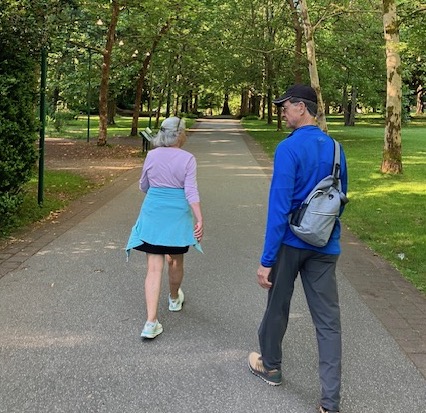
With the guidance of Betsy and Dan, we secured our bearings and started out.
Good guides (Photo Bill Pike)
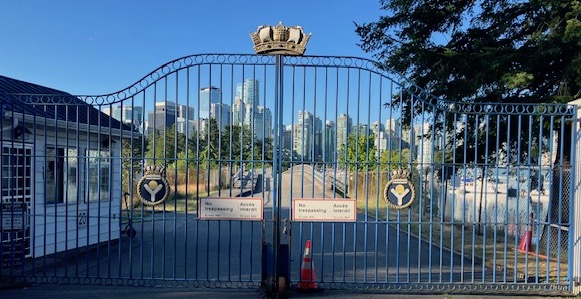
One of the first places we came across were the gates to the HMCS Discovery. Located on Deadman’s Island, this naval reserve facility also features a naval museum.
Gate entrance Deadman’s Island (Photo Bill Pike)
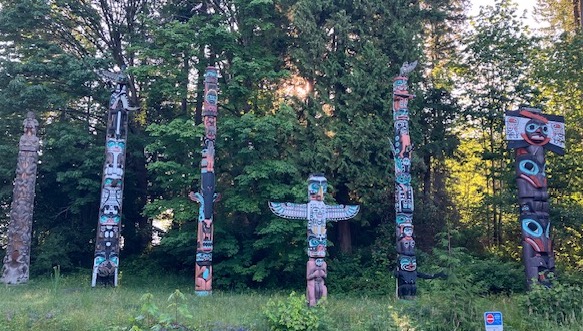
Next, we came across a section of totem poles. Some were singular others formed a group. All were unique and colorful.
Group of totem poles in Stanley Park (Photo by Bill Pike)
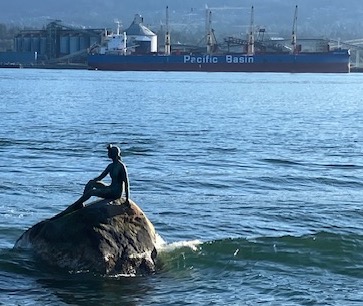
The water views capture everything from a statue of a girl in a wet suit to cargo ships passing under a suspension bridge.
Girl in the wet suit with a large ship docked in the background. (Photo Bill Pike)
Additionally, there are assorted historical memorials positioned throughout the park.
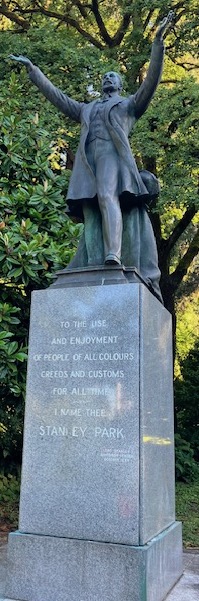
My favorite is Governor General Lord Stanley from October 1889. Inscribed at the base of the statue are these cherished words: “To the use and enjoyment of people of all colours, creeds, and customs for all time. I name thee Stanley Park.”
Lord Stanley statue (Photo Bill Pike)
With an eye on our watches, we worked our way back to hotel for breakfast.
After breakfast, we attended to the final details of our packing. This was followed by checking out and waiting for our two Uber cars to arrive.
We experienced no traffic snarls in getting to the terminal. Our check-in on the ship was trouble free too.
No time was wasted in finding our rooms. We completed the mandatory safety orientation, found our way to lunch, and started exploring the ship.
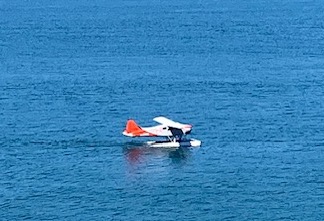
The crawl for the big ship out of the harbor was slow, but there was lots of activity with float planes and other watercraft in motion.
Float plane prepping for take off (Photo Bill Pike)
Seemed like the afternoon rolled by quickly, and we were back in a dining room for dinner.
After dinner, we took a walk on deck three for a couple of loops.
I guess we weren’t too weary as we found our way into a 60s music trivia contest. Our team tied with another team for first place, but we lost in the third tie breaker.
We shook off this setback with more exploring of the ship and stopped along the way for assorted live music.
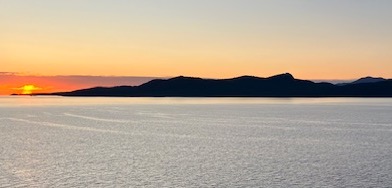
When we returned to our room, we sat out on our balcony to enjoy the sunset and some unexpected whales. Passengers who were outside cheered their brief appearance.
Nothing like a sunset on the water (Photo Bill Pike)
I wonder what tomorrow will look like.
I think to myself, how lucky I am to be here.
I wonder more about the inscription on Lord Stanley’s statue. That was in 1889. I loved his inclusion.
Why is this concept still a struggle for us today?
However, it wasn’t long before our Uber arrived to drive us out to Lynn Canyon Park.
Vancouver has many options for tourists, but while you are visiting do not turn down the opportunity to visit Lynn Canyon Park. This is one special place.
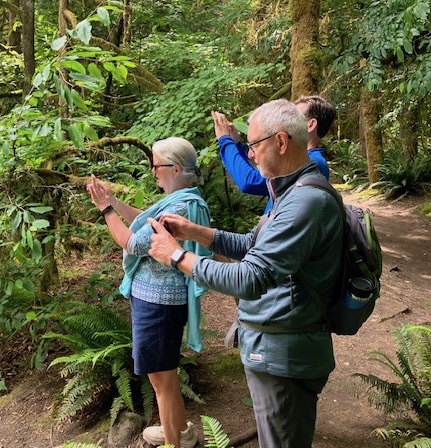
You will take lots of pictures in Lynn Canyon (Photo Bill Pike)
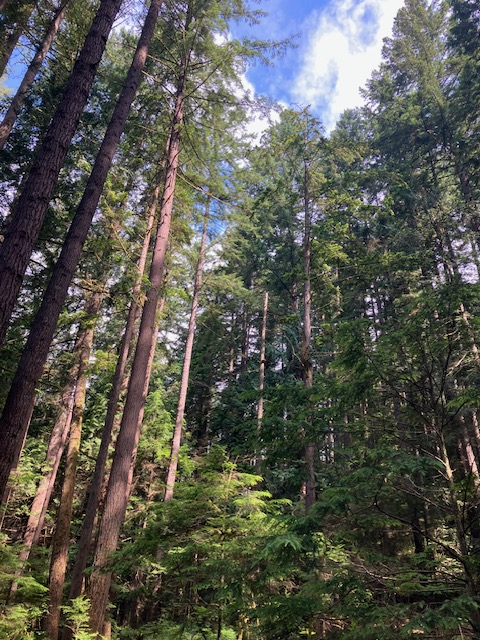
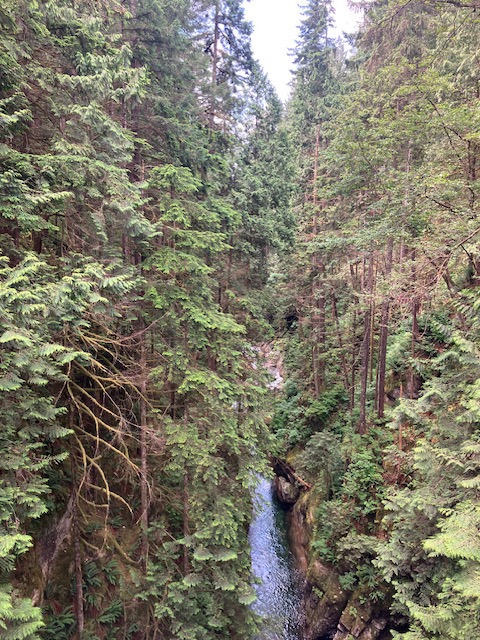
For sure the highlight of the park is the suspension bridge, but that bridge is only part of the story. The park is stunning from the tops of its massive canopy of trees to water running through creek beds—visitors are in for a treat.
Magnificent trees (Photo Bill Pike)
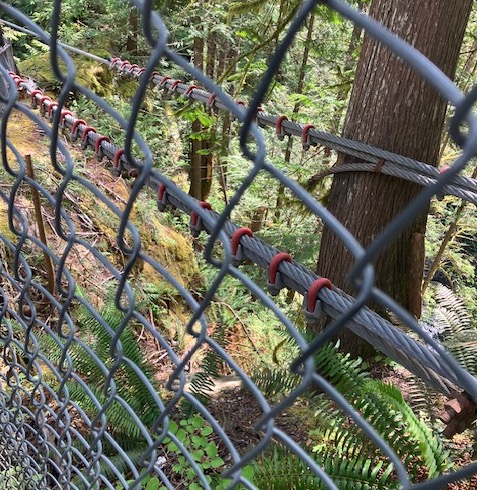
The original suspension bridge dates back to 1912. That version of the bridge featured no railings to hold on to as a person passed over Lynn Creek. Not to worry, now the bridge has all the required safety features including hand railings.
Some of the cabling for the suspension bridge (Photo Bill Pike)
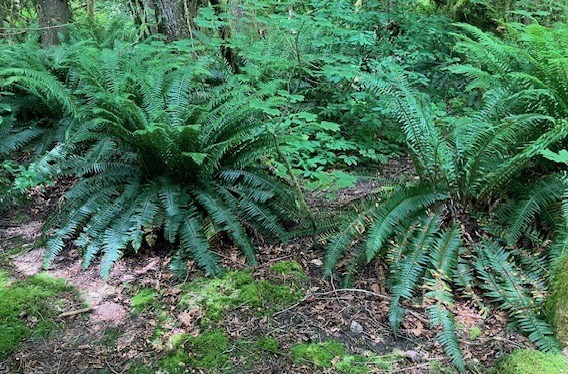
No matter where our feet took us on the well maintained trails, we saw nature at her best in this coastal temperate rain forest. A variety of trees, assorted mosses, large ferns, and unique birds make up the park.
Good growing environment for ferns (Photo Bill Pike)
At some point, the trail will bring you to the edge of a neighborhood, and you will want to make a stop at The End Of The Line General Store.
Looping back to our point of entry, the scenery did not disappoint us.
Waterfall (Photo Bill Pike)
From Lynn Canyon Park, we took a Uber to Queen Elizabeth Park.
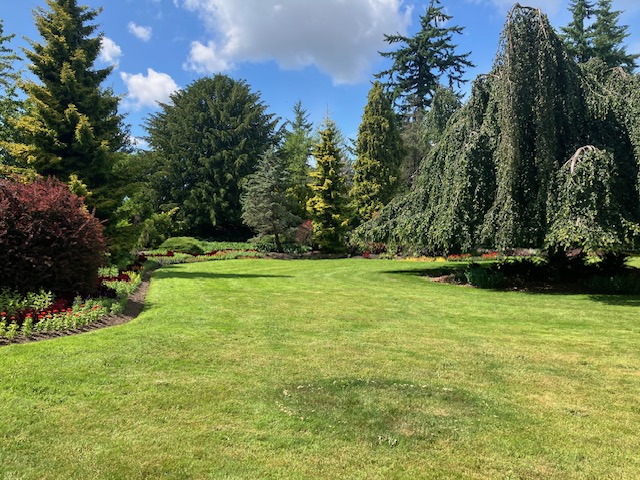
Some of the well-maintained grounds at Queen Elizabeth Park (Photo Bill Pike)
Queen Elizabeth Park is 130 acres of more beauty. The park was formally dedicated in 1939 by King George VI.
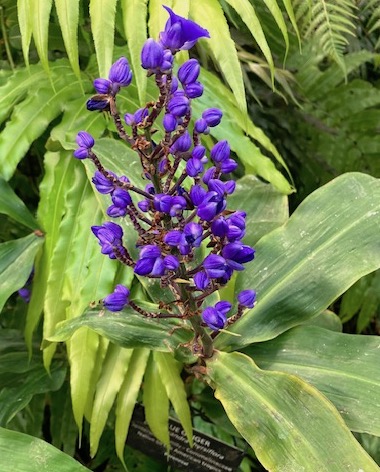
The park offers much for visitors to see from the Arboretum, the Blodel Floral Conservatory, fountains/plazas, and statues.
One of the stunning flowers (Photo Bill Pike)
On this Saturday, the park was host to multiple weddings.
Additionally, we had the good fortune of eating lunch at the Seasons In The Park restaurant.
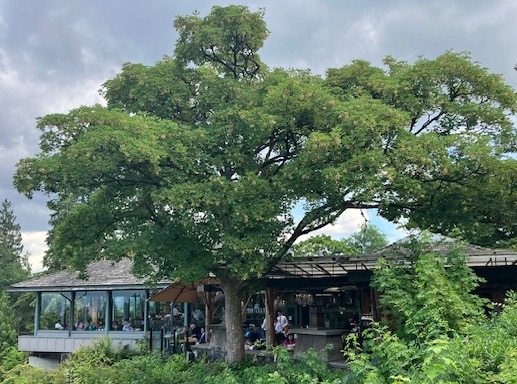
Back side of Seasons In The Park (Photo Bill Pike)
Back in April 1993, Bill Clinton and Boris Yeltsin dined here during the Vancouver Summit.
After lunch, we continued to explore the grounds. Again, no matter where we walked, we enjoyed the displays and the landscaping.
At some point, we requested an Uber.
The driver showed up in a Tesla. Nice car, but there was no way six adults were going to fit in this car comfortably.
Butch and I made the sacrifice and squeezed ourselves into the very back of the car. We were as tight in that space as vacuumed packed Vienna sausages in a can.
We laughed all the way back to the Hotel Sylvia. Maybe the laughter covered our fear. We knew if the driver made a mistake, this might be our last ride.
This was a beautiful day in Vancouver. Lots of people were out and about around the beaches and open vistas along English Bay.
We spent the remainder of the afternoon prepping for the transition to the ship on Sunday.
Before dinner at the hotel, some of us took a short walk along English Bay.
I loved my grilled halibut for dinner. Fresh and perfectly cooked, I’ll remember and miss this meal when I return to Virginia.
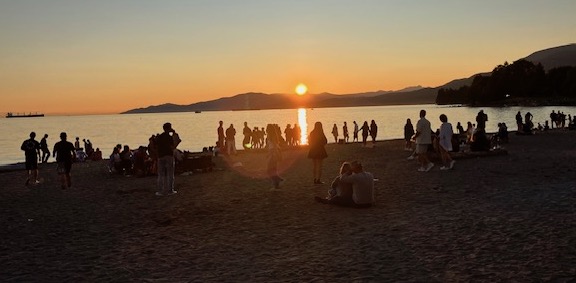
After dinner, with lots of others we were able to see a very pretty sunset.
That sunset (Photo Bill Pike)
Before drifting off, I thought about Boris Yeltsin and Bill Clinton dining at Seasons In The Park.
I wonder if the chef prepared a special dinner? Maybe Boris gifted Bill with a case of the best Russian vodka.
That was thirty two years ago.
Regrettably, America and Russia, still struggle
Too bad we can’t trust each other and become friends.
On the morning of Friday, June 27, 2025, I was up early. I planned to go for a run.
Prior to our trip, I purchased a pair of Hoka trail running shoes. As much as I love my Brooks running shoes, I wanted to have one pair of shoes that I could go for a run in and use on a variety of terrains in Alaska. Additionally, the Hokas were GoreTex to reduce possible water intrusion.
Out at the Vancouver airport the temperature was 55 degrees. It was mostly cloudy with an east southeast wind, dew point 53, humidity 96%, and visibility was at twenty miles.
I walked through the quiet lobby of the Sylvia Hotel, and headed toward a concrete base trail along English Bay. The trail was a connector into Stanley Park.
I wasn’t the only early riser. I came across four herons. One was disrupting the quiet of the morning squawking from a tree.
Some type of filming was taking place in this location as there were several production trailers lined up.
Along the edges of the trail, I noted that the water near the shoreline of English Bay was translucent. I could see the bottom in the shallows.
Around one bend, I came across a very nice municipal pool complex. Someone put quite a bit of thought into its development. Every amenity seemed to be included in the design.
The runners I encountered were friendly. Numerous good mornings were exchanged.
A cruise ship was getting an early start maneuvering through the pretty harbor.
I discovered a beach that was covered with fragments of cracked purple from the inside of mussel shells.
The trees in Stanley Park form an appealing backdrop along the trail.
And woven into that beauty are some homeless souls sleeping in sleeping bags on secluded park benches. I don’t know how lucky I am.
At some point, I turn around and retrace my steps to the hotel.
After cleaning up from the run, we gather for breakfast. I had the perfect bowl of oatmeal with a smidge of brown sugar and a variety of fruit to top it off.
Our plan for today was to take a Uber out to the University of British Columbia.
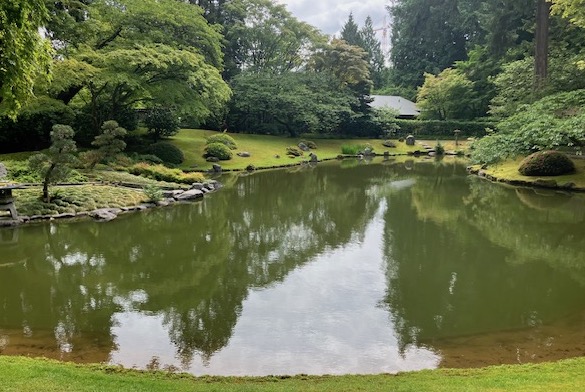
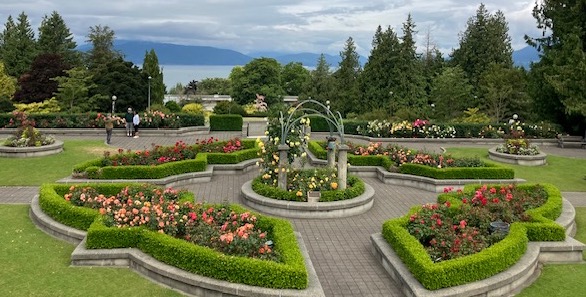
This well maintained campus kept us busy as we enjoyed a Japanese garden, a rose garden, and the stunning Museum of Anthropology.
Part of the Japanese garden at the University of British Columbia (Photo Bill Pike)
Some of the roses on display (Photo Betsy Pike)
On trips like this, I always wonder about the vision of the people who planned and put this wonderful Museum of Anthropology together.
Every display was intricate and thoughtfully designed.
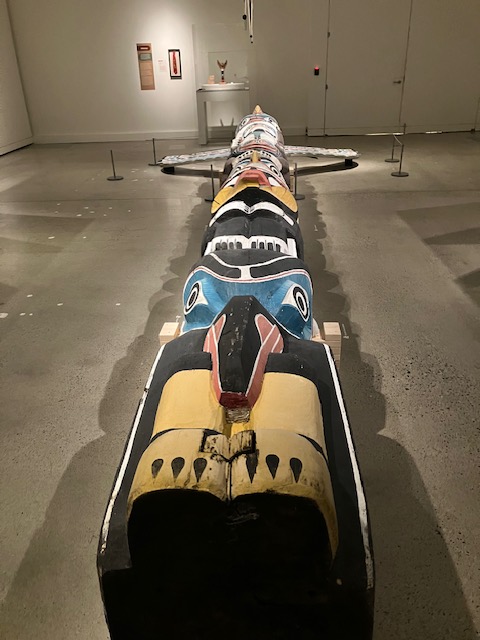
Most impressive were the totem poles. No doubt it takes a lot of skill and patience to create a totem pole. But one can feel the passion and soul from the artisans who created them.
One of the colorful totem poles inside the museum (Photo Bill Pike)
I learned that red cedar is the favorite choice for carving totem poles. Red cedar has a “straight grain and soft tissue—ideal for carving.”
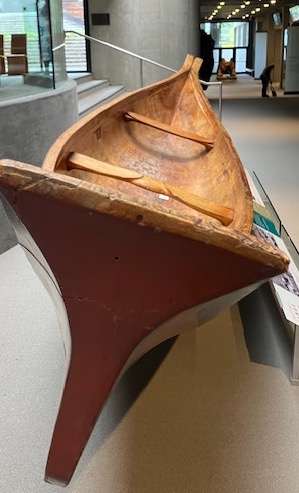
Cedar is also the choice for crafting a canoe. A massive single cedar log can be used to form a canoe.
One of the hand carved canoes on display (Photo Bill Pike)
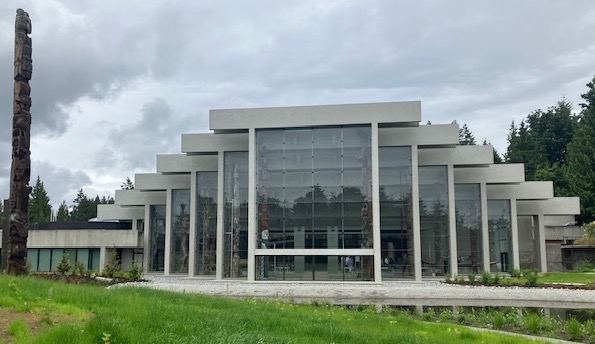
At some point, we walked outside to grounds at the back of the museum. This gave us a different look at how the architect developed the backside of the building.
Museum of Anthropology from the backside (Photo Bill Pike)
It looked like the grounds in this area had just been recently completed. Once this area is fully developed, it will add another dimension to the museum.
We had a light lunch at a Tim Hortons located at a food court on campus.
As we planned our way back to the hotel, we opted to take a Uber tour through Stanley Park. The park is massive. I understand why the park is always in motion— the people of Vancouver love it.
After the tour of Stanley Park, we stopped at Three Brits where I had a birthday beer.
From Three Brits, we walked through the shopping district near our hotel. I was amazed at the ethnicity of the restaurants and fruit stands on every block.
With my pals being nice to me, we had dinner at Craft Beer. It was an ok local spot, but it was loud inside—too loud for an old geezer like me.
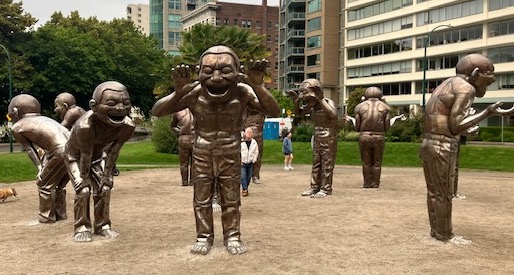
After dinner, we walked through a display of human statues that were made of metal. The exhibit is called A-Maze-Ing-Laughter. Fourteen patinated-bronze figures are featured. The statues were created by Chinese artist Yue Minjun.
Unique statues (Photo Bill Pike)
After the statues, we continued our walk to the hotel. I noticed a lady stopping at every trashcan. She was rummaging for aluminum cans.
Multiple high rise buildings make up the neighborhood. On this fading afternoon, we noticed on the rooftop of one of those buildings a large tree growing.
Back at the Sylvia Hotel, we opt for a nightcap before catching some sleep.
I’ve had a nice day, a good birthday.
My parents were really good parents.
I’m thankful that they opted to have children.
My sister and I were lucky.
I like to think that Louise and Bill would like the way we landed on our feet. This is despite the ups and downs the old world often hurls at people.
I have been so fortunate my whole life. That good fortune comes from my parents. They loved me despite my many, many faults.
That good fortune comes from my wife too and the dear friends we are traveling with on this trip.
And deep in my old soul, I know from watching the homeless sleeping on benches in Stanley Park to the lady going through every trash can this evening—one wrong move, and I could be in their shoes.
On the afternoon of Wednesday, June 25, 2025, we left Richmond driving to Raleigh.
Later that afternoon, our friends, the Sherrills, left Greensboro heading to Raleigh.
And on Thursday morning, June 26, further north in Maryland, our friends, the Callows, would be up well before dawn and drive to the Baltimore airport.
The Callows were booked on a flight from Baltimore to Chicago.
After a night of rest in a Raleigh hotel near the airport (RDU), the Pikes and Sherrills would also be early risers to catch a shuttle to the airport. We had an Air Canada direct flight into Vancouver.
When we left Richmond on Wednesday afternoon, the heat and humidity were brutal. As we worked our way down Interstate 85, just north of Henderson, North Carolina, we encountered a fairly strong thunderstorm.
The storm featured some sharp cloud to ground lightning. Plus, it was interesting to watch, the temperature take a downward plunge from the rain.
Not sure how much we slept, but we made it to the hotel lobby to catch the shuttle to RDU. We had a very good shuttle driver.
With our TSA approval, the initial check-in with Air Canada was seamless. Of course, traveling is much more complicated now. My backpack scan failed as my body lotion bottle was considered oversized.
We had a good flight to Vancouver. I was able to watch two movies, plus, we had a bonus—an empty seat between us. The Callows also had a good flight from Baltimore to Chicago. But getting out of Chicago was a challenge.
They were forced to change planes because of a hydraulic problem on the plane. Of course, this caused a delay.
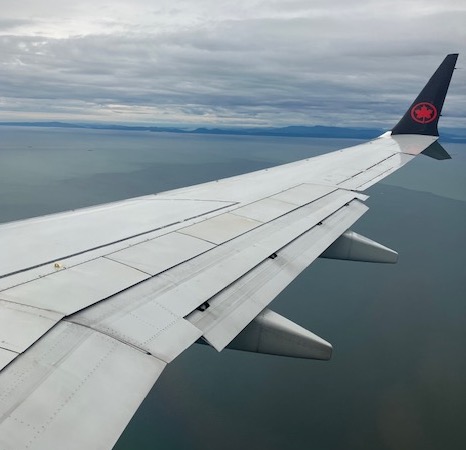
On our approach coming into Vancouver, I immediately was taken by lots of water.
Final approach into Vancouver (Photo Bill Pike)
The airport is located on Sea Island in Richmond, British Columbia.
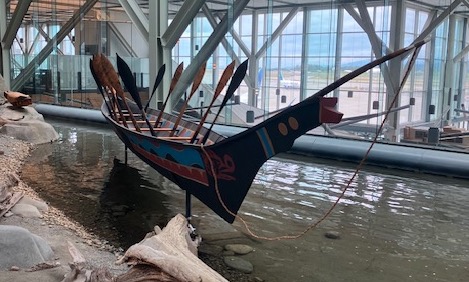
Strolling through the airport, I was taken by its open design. The architecture features water, nature, and an emphasis on the heritage of the Pacific Northwest.
Colorful canoe display (Photo Bill Pike)
I wanted to stop and look more carefully, but we needed to keep moving toward customs.
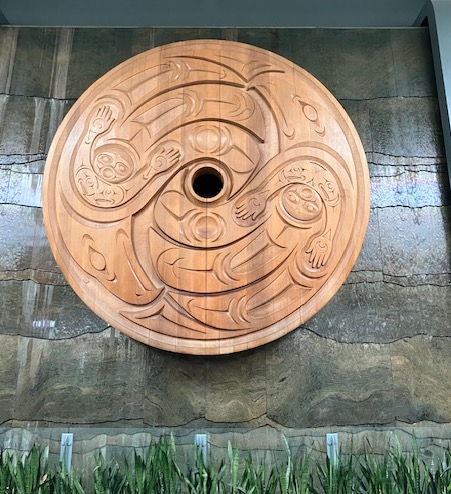
Stunning wood carving with water moving behind it. (Photo Bill Pike)
Because of enhanced technology, we cleared our entry into Canada easily.
We took an Uber to the hotel. The Uber driver was a talker. He kept yakking. He shared lots of tourist info, but ultimately he was trying to book us for a long ten hour day of driving to the sights outside of Vancouver
My ears were relieved when we arrived at the Hotel Sylvia.
We checked in, made it to our rooms, and headed to their dining room.
The Sylvia Hotel is a survivor. It is a classic old hotel with lots of charm. Our rooms featured no air conditioning, just open windows with a pleasant breeze
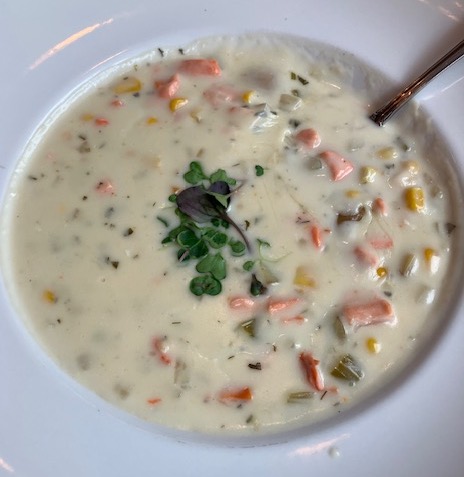
We worked our way to the dining room for lunch. Lunch was a hit with humus, seafood chowder, beet salad, and ahi salad. I loved my chowder, and I had the local Red Truck lager to sip on too.
My delicious seafood chowder (Photo Bill Pike)
It wasn’t too long before the Callows arrived, and we made plans for the afternoon.
We left the hotel and walked toward Granville Island. At some point, the braintrust figured out how to take a small ferry shuttle to the island.
Located on thirty five acres, the island is in the Fairview neighborhood of Vancouver. In its previous life, Granville was an industrial manufacturing area.
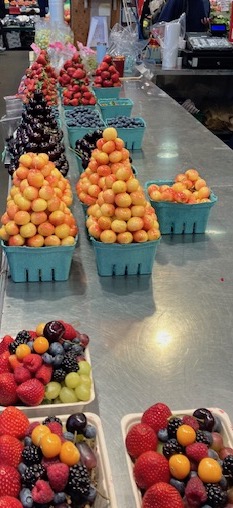
Today, its main feature is a public market. Fruits and vegetables are attractively displayed on every aisle. An amazing variety of food from local vendors weaves in and out of assorted food stalls and restaurants.
Assorted cherries further down the table top and other fruits in public market (Photo Bill Pike)
Gradually, we worked our way back to the mainland.
Light rain showers didn’t slow us down, and we had another good meal at Hook for dinner. We walked back to the hotel, had a night cap while listening to a local singer performing solo with an acoustic guitar.
By now, sleep was starting to pull on us. It had been a long day of travel.
Before snoring off, I thought about the marvels of traveling, and all of the behind the scenes stuff that takes place every day.
No doubt, the plane’s pilots and crew are important, but think about all of those people working behind the scenes to ensure that you and your friends arrive at their destination.
It is all about people. An endless stream of people doing all kinds of work. Traveling, depends upon them, and I need to be more appreciative of the critical role they play.
I’m not sure about where you live, but here in Richmond, Virginia since Sunday, January 18, the pending winter storm has been pounding incessantly through all forms of media.
The relentless, repeating blabber is as bad as back to school and political ads.
Even my wife, my commander supreme, from the jabbering of a local television weather forecaster has asked me where the shutoff valve is for our water line.
Grocery and hardware stores are elated.
Milk, eggs, bread, snow shovels, snow melt, and batteries are gone. Gleeful managers admire their empty shelves as they scramble to restock before the monster storm arrives.
The state’s highway department is already treating road surfaces with a spray concoction of chemicals designed to melt snow, sleet, and freezing rain. The road surfaces are left streaked with wobbly white lines of the drying chemicals.
Power companies are monitoring the developing storm with deep concern as forecasts shift from snow to sleet to the most dreaded—freezing rain.
Parents with school age children are trying to figure out how they will survive if this demon storm shuts down school systems for multiple days.
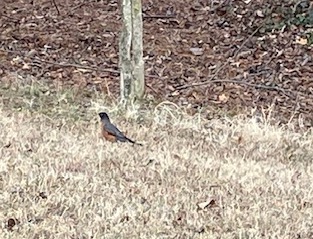
And then we have the robins.
A robin on frost bitten grass on a January afternoon. (Photo Bill Pike)
Long thought of as a sign of the return of spring, I’ve seen robins darting around our neighborhood since early January. Sorry, but there is no spring in this predicted winter storm. I hope the robins survive.
Speaking of survival, I wonder how the homeless will survive? The predicted low temperature for Monday night, January 26 is 3 degrees. That doesn’t include wind chill.
If we are the greatest country in the world, why are we unable to permanently solve this longstanding problem?
My love for winter precipitation is gone. I’m too old. That love for a snowflake has been passed on to our four grandchildren.
I hope we all survive the ferocity of this predicted winter storm.
As mighty as man pretends to be in out smarting the weather gods, I’m not sure we will ever out think a riled up mother nature.
In the post-storm days, there will be lines at car washes. Auto body shops will be giving non-stop estimates for repairs, and the noise of chainsaws and wood chippers will cascade in neighborhoods where trees have taken a tumble.
Those responsible for clearing parking lots will build mountains of snow that are piled high in out of the way corners of the lot. Like school children, these snow clearers quietly pray for another winter storm to help their seasonal bank accounts.
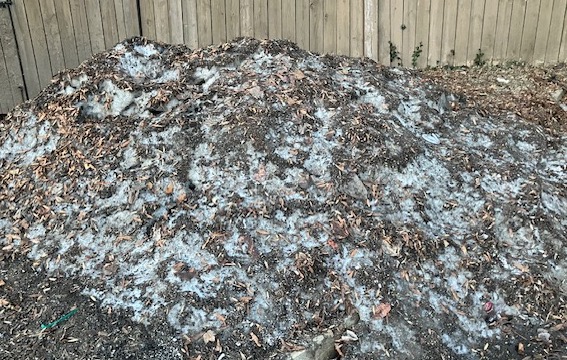
In the back parking lot of the Village Shopping Center, I’ve been keeping my eye on a shrinking mountain of snow. Tucked away in the back corner of the lot, this mound is leftover from our two December 2025 snowstorms.
The pure white color of the snow is gone. Its icy surface is now a dark charcoal gray with a layer of fallen leaves on top. I wonder what that graying, the darkening of the snow really tells us about ourselves and how we treat our world.
Polluted snow mound (Photo Bill Pike)
This time last year, we were in Marathon Key, Florida. If we had opted to return this January, we would have missed this winter madness.
And despite my curmudgeon whine against winter weather, I do find beauty in this season.
I love how the still water in the creek bed frames the reflection of the sky and the surrounding vegetation.
When driving on a country road, I admire how winter opens up the landscape. My eyes can peer deeply into roadside farms and stands of bare trees.
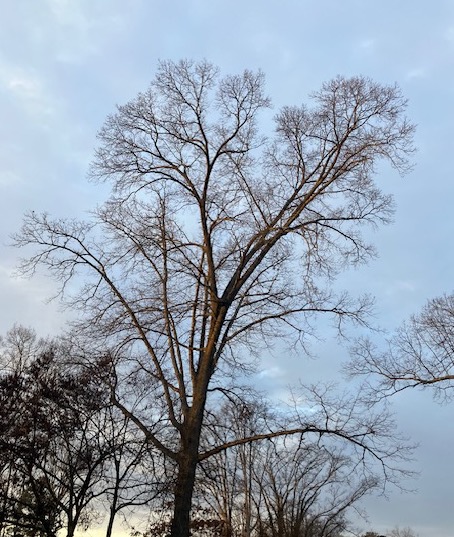
The stark bareness of those trees, lets me see the sculpting of their limbs contrast against an early morning sky.
Bare tree towers against the sky (Photo Bill Pike)
I appreciate the tenacity of a youngster shooting hoops on a nippy winter afternoon.
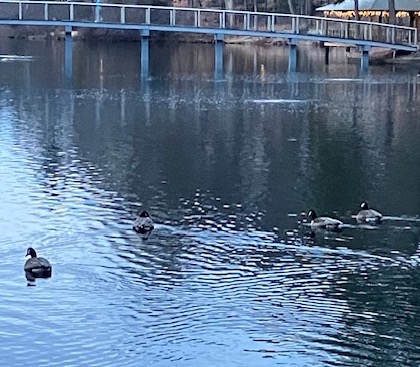
On the campus of the University of Richmond, in the Westhampton Lake, brazen ducks go for an early morning swim in water too frigid for me.
Brave ducks (Photo Bill Pike)
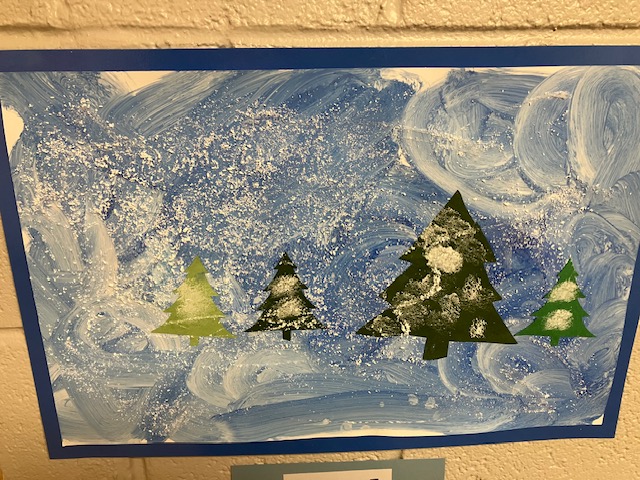
At the Trinity UMC Preschool, I’m captured by the wintry artwork of the students.
Student art work Trinity UMC Preschool (Photo Bill Pike)
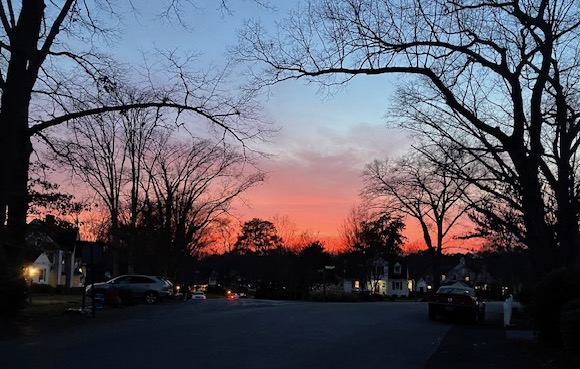
And late in the afternoon, there is nothing like the colors found in a sunset as the sun closes out another winter day.
Colors of a winter sunset (Photo Bill Pike)
Perhaps in your boo to the harshness of winter, you too can find a bit of its beauty.
And who knows, maybe that will help you endure this latest round of winter weather.
I know nothing about the planning for the June of 1958 road trip to New Orleans.
My father was a member of the Civitan Club. The Civitans were having a convention in that famous city.
Founded in 1917, the Civitans are an international organization “of volunteer service clubs, dedicated to helping people in their own communities.”
This convention was the reason for the road trip. By car, we traveled with another couple from Burlington, Melvin and Tula Wilson. The Wilsons were a delightful older couple who also were a part of the congregation of Davis Street Methodist Church where my parents attended.
As far as the road trip, I remember a stop somewhere on a beach along the Gulf of Mexico. I also recall a long ride over a bridge. I assume this was across Lake Pontchartrain.
Once in New Orleans, there was a bus tour of the city. The tour guide referenced a swimming pool we passed. He said it was filled with muddy water from the Mississippi River.
Another memory was a cafeteria that had fresh watermelon on the serving line.
My mother tracked down her father who deserted her mother and her siblings early in their Mississippi lives.
For some reason, we took the train back to North Carolina. I recall a kind porter who made me a ham sandwich. I think one of my father’s brothers picked us up at the train station in Greensboro and drove us home to Burlington.
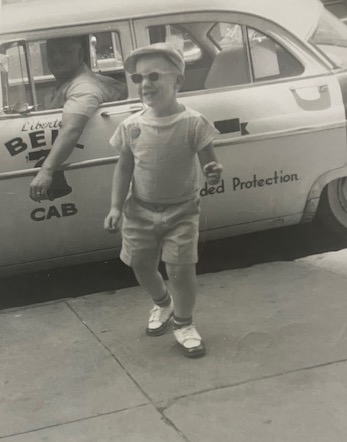
And thanks to my parents, I was decked out as a five year old tourist.
What a sport (Photo courtesy of the Pike family)
Now 66 years later, on Wednesday, May 8, 2024, my wife and I are traveling back to New Orleans. This isn’t a road trip to a Civitan convention. No, my main purpose is to visit the National World War II Museum.
Luckily for me, I benefit from the detailed trip planning from my wife, the Commander Supreme. No one is better at trip planning.
We left Richmond on a Boeing 757-200(HD) with a stop in Atlanta. On this first leg, I continued my reading of Isabel Wilkerson’s book The Warmth of Other Suns. From Atlanta to Richmond, there was lots of cloud cover. I watched part of a documentary about Jimmy Carter.
As we approached New Orleans, the visibility improved, and I saw lots of brown water.
Once we landed, the driver of the jetway had a tough time connecting to the front exit door of the plane. Eventually, the mechanical gods cooperated. This was followed by the rush of passengers exiting the plane.
New Orleans has a very nice airport.
Through our son’s in-laws, we had a driver ready to pick us up. The driver drove us into the business district and dropped us at the Magnolia Hotel. This hotel gave us good access to the places we wanted to visit in the city. With the exception of a street car ride, we walked everywhere.
Our feet wasted no time in immersing us into the city.
In the French Quarter, we enjoyed lunch at Landry’s Seafood.
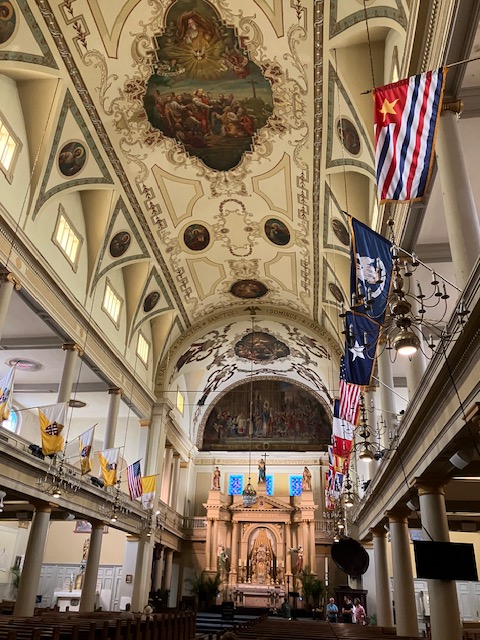
We walked into Jackson Square. We were immediately taken by the St. Louis Cathedral.
(Photo Bill Pike)
With its ties to the King of France, this stunning building dates back to 1720. Lots of adjectives have been used to recount the exterior and interior beauty of the building.
(Photo Bill Pike)
From Jackson Square, we were able to catch our first views of the mighty Mississippi River. With an assist from Mark Twain, the Mississippi might reveal the soul of America.
(Photo Bill Pike)
We made the predictable tourist stops at the Cafe Du Monde and Pat O’Brien’s. For some reason, the famous Hurricane drink reminded me of drinking Kool-Aid as a kid.
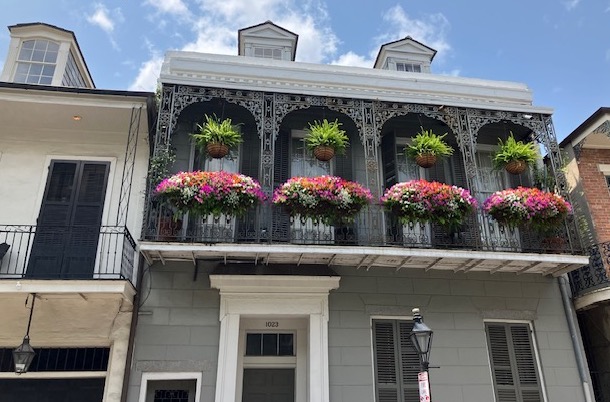
As we worked our way back to the hotel, no matter where our eyes scanned, the architecture of the buildings and homes held us captive. Brick work, wrought iron, flowers, and a palette of just right paint shades were in every direction.
(Photo Bill Pike)
After a quick refresh at the hotel, we mapped out our walk to our dinner restaurant—Herbsaint. Located on St. Charles Avenue, we enjoyed our exceptional food and service at an outside table on this pretty May evening.
From our early start in Richmond, our day had been long, but our first afternoon in New Orleans was enjoyable.
Despite the treasured prettiness of New Orleans, I noted that the city isn’t immune from what I see back home.
Struggles that are small and large—missing street signs, sidewalks in need of repair, impatient beeps, a mix of aromas some pleasant, some unpleasant, and the homeless.
No matter these challenges, New Orleans has a soul. A soul that still draws people to it. A soul that continues to survive no matter what comes its way.
With a good night of rest, I hope to learn more about the city’s perseverance on Thursday.
On the evening of Monday, September 1, 2025, my wife and I went with neighbors to the James Taylor concert at the Allianz Amphitheater At Riverfront. This new outdoor concert venue is on the banks of the James River.
A few days prior to the concert, our neighbors did a reconnaissance drive to check out parking options and the walking distance to the entrance.
Additionally, a day before the event, my wife received a courtesy email stating the concert was sold out. Arriving early was recommended.
The reconnaissance for the parking was smart. We parked in a lot within reasonable walking distance to the amphitheater. Additionally, the price for parking was acceptable.
It was a bit after six when we finished up at the parking lot and started our walk to the entrance. What we didn’t expect was the long, long line of people waiting to enter the amphitheater.
Richmond police officers did good work monitoring pedestrian and vehicle traffic at the intersection of Second and Byrd. That long, long line worked its way up a very steep hill along Byrd Street well past the Afton Chemical Corporation.
For a person with worn-out legs, challenges with their cardiovascular system, or wheelchair dependency getting up this hill was a challenge.
At some point the line started to move. The movement toward the entrance was slow, but steady. We cleared the security checkpoint, and the next challenge was finding a space on the lawn for us to sit.
We found a spot, but then we relocated. We relocated to the back of the lawn area. A fence runs the length of the lawn. We had two chairs reserved for seating. Our thinking was the fence would be like the back of a chair while sitting on blanket.
Again, the line to pickup our two chairs was long. We tolerated the wait time. Good news, the chairs were sturdy and comfortable.
When we relocated to the fence, the chair line was directly in front of us. Numerous people came to the chair line not realizing that a reservation had to be made to secure a chair. Just before the concert started, another problem surfaced. Apparently, the supply of chairs for people who had made a chair reservation was depleted.
As we settled into our spot, we learned that there are still some kindhearted souls in the world. A lady with two chairs stopped in front of our group. She offered us her chairs. Where her friends were seated on the lawn was too crowded for chairs, so she offered them to us.
Prior to the opening act, I spent thirty minutes exploring the amphitheater.
The stage is massive and it appears to be outfitted with all the latest bells and whistles for concert technology.
Seating options are varied with some unique locations, and the sight-lines seem good. This is despite at least three large light poles that can impact those sight-lines.
Large video monitors grace either sided of the stage. So, if your sight-lines are lousy, and the tall and lanky, James Taylor, looked tiny, the monitors capture all of the action on stage.
The space provided for food, beverage, and merchandise seemed to be adequate. This area was full of people, but despite some long lines people were able to move freely.
Can’t speak for the women, but there was no wait time for the mens’ restroom area. Urinals, sinks, and toilets were numerous.
No one from our group purchased any food or beverages. I’m not sure about food prices, but a variety of items were offered.
I had read about the grumbling over the pricing of alcoholic beverages, and I now understand the grumbling.
Interesting to me that pricing for all wine options was prominently posted. Wine pricing was expensive. A can of wine was $14.00. Wine by the bottle fell into three price ranges from $40.00 to one Cabernet Sauvignon topping out at $110.00.
As far as I could tell pricing for beer was not posted. It is my understanding that beers in 24 ounce cans cost from $16.50 to $23.00. I did see one beer sign advertising a Value Beer for $5.00.
(Photo Bill Pike)
When I inquired about the value beer was I shown a 12 ounce can of Busch Light. While I’m sure Busch Light has its fans, I don’t value it as a beer. Plus, a consumer can purchase a 30 can case of Busch Light in a local grocery store for $27.99. With that pricing, each can of beer in that case cost about 93 cents a can. Even for a value beer, that’s a significant mark up, but nothing like the mark up on the other beers.
The concert started on time with opening act Tiny Habits hitting the stage at 7:30. After their set, the roadies made some adjustments to the stage, and then we were treated to two solid hours of James Taylor and his very gifted band.
On September 15, 2024, my wife and I made our first trip to Wolf Trap National Park for the Performing Arts. We made this trip to see James Taylor.
Clearly, Wolf Trip has been presenting concerts much longer than the rookies at the Allianz Amphitheater. However, getting into Wolf Trap, working our way to the lawn, and picking up our reserved chairs was seamless.
Part of me wants to know if anyone involved with the development of the Allianz Amphitheater spent anytime picking the brains of the staff at Wolf Trap.
It is my hope that the management team will conduct a detailed review of this first season. That review should include receiving feedback from the people who attended the concerts, and all Allianz personnel.
The day after the concert, my wife did receive an email from Live Nation, a survey that opened with: “What did you(really) think of James Taylor? Share your review!”
That opening was followed with these question prompts: How was the event? Best ever? Room for improvement? Leave feedback on your recent concert or event, so Ticketmaster, a division of Live Nation Entertainment, can help enhance your next live experience.
I wonder how many people responded to the request for feedback? Additionally, I wonder how diligently the survey comments are discussed and studied by Live Nation and Ticketmaster?
From my perspective, here are some questions that management needs to ponder:
When a concert is sold out, how might the long line and wait time for getting into the amphitheater be reduced?
If I reserve a chair, how does management ensure that the chair will be available for me?
For consumers of alcoholic beverages, the pricing must be clearly posted for all options, and the pricing of these beverages must be restructured to be more sensible.
How might the seating in the lawn area be more balanced between blankets and chairs? Should the lawn area have a designated section only for chairs?
Hopefully, management will listen and improvements will be ready to be implemented by next summer.
At the age of 77, James Taylor enjoyed performing in this new venue. He was complimentary of the facility, the setting, and the crowd. His compliments also hinted that he would like to return next summer for another performance.
I’m 72, I anticipate returning to the Allianz Amphitheater At Riverfront for another concert. However, if I opt to return, I certainly hope that the management team will collectively work to make improvements. Improvements that will make the concert experience better for all who attend a performance in this amphitheater.
Failure to listen to feedback and institute reasonable changes based upon that constructive criticism could potentially hurt the success of the amphitheater.
At the end of this first season, I know everyone will be looking at the profit numbers. I won’t deny the importance of that data. But did concert attendees have a good experience also drives that revenue, and that can’t be overlooked.
And thinking of people, there is one more important part of our concert experience that also can’t be disregarded—the Allianz personnel. From my interactions with them, I found these employees to be patient, polite, and knowledgeable. In our impatient world those traits are important, especially in a public setting—nice work.
I was up early on the morning of Tuesday, May 13. My old body told me I needed to go for a run.
I followed this internal self-talk. I ran from the hotel to Otter Point in Pacific Grove. This is a part of the Monterey Bay Coastal Trail.
The trail had been dampened by some pre-dawn rain showers. That didn’t slow me or the other walkers, joggers, and bike riders who too were up early.
No matter where my eyes scanned, I had pretty views of the neighborhood and the bay. This run is not likely to leave my memory. The setting is too special. If I had the endurance and the time, I could have stayed on this trail all day. But another trail was calling me.
After breakfast, the Commander had us scheduled to start our exploration of the Seventeen Mile Drive. As much as I had liked the views from my run, the views for the remainder of the day would only become more incredible.
Much has been written about The Seventeen Mile Drive, I doubt I can add much to these praises. Let’s leave like this, if you are given the opportunity to make the drive, don’t turn it down.
I did not focus on the opulence of the homes or the famous golf courses. No, I focused on the determination of the Pacific Ocean, and the rugged coastline the ocean rolls into every minute of the day and night.
The Restless Sea (Photo Bill Pike)
Marker 4 on the drive is titled The Restless Sea, and here is the commentary about this section: “The Restless Sea earns its name as one of the most turbulent sections of coastline in Pebble Beach. Waves are constantly converging and crashing into each other, likely caused by submerged rocks.”
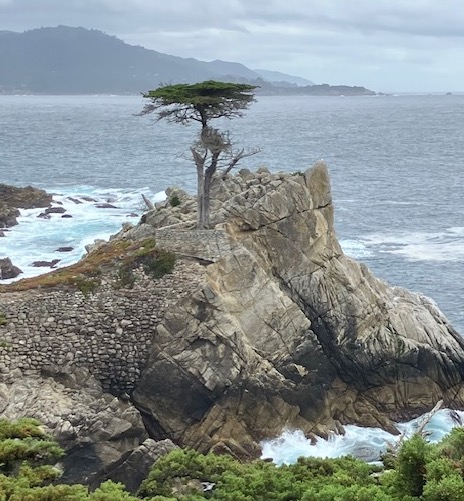
Each marker has a story to tell and a point to make. Perhaps the most famous is The Lone Cypress.
According to one marker, the Monterey cypress almost became extinct along the coast. Fortunately, it didn’t as the trees grow naturally here. The popular trees can reach heights up to seventy feet and can live up to three hundred years.
Yes, there is something special about The Lone Cypress. I admire its loyalty. No matter what nature has tossed at the tree, the cypress has remained loyal to its solitary perch.
The Lone Cypress (Photo Betsy Pike)
We made a short stop at the Pebble Beach Visitor Center. Next, we started working our way further south toward Point Lobos State Natural Reserve.
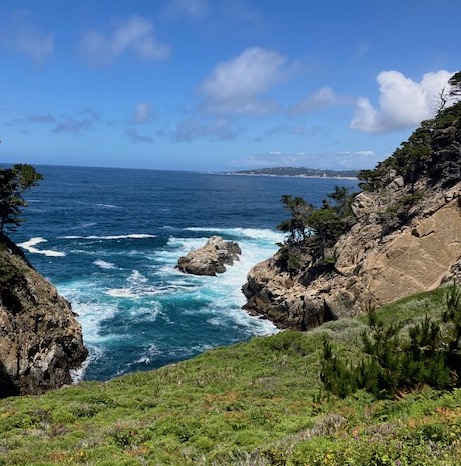
I’ll put this in the same category as The Seventeen Mile Drive—if you have the opportunity to visit Point Lobos, don’t turn the invitation down. Yes, you will walk more at Point Lobos, but those steps will reveal to you spectacular coastal scenery.
When we arrived at Point Lobos, the parking lot was full and closed. This meant we had to park along the shoulder of the highway that parallels the park.
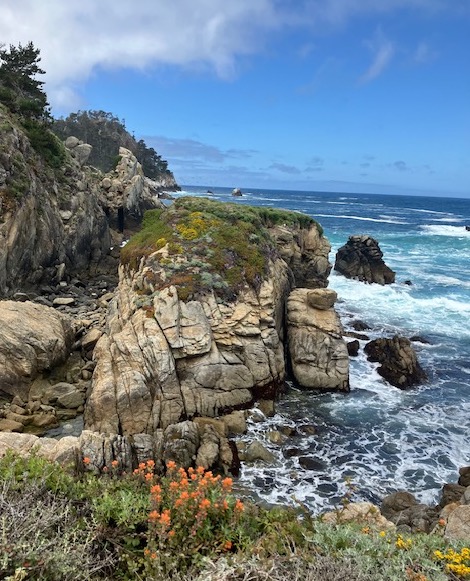
We walked back to the entrance, took some advice from park personnel, and started our exploration. In truth, what happened was we were so enthralled by the beauty that we kept pushing ourselves further and further into the available trails.
One of many pretty sights at Point Lobos (Photo Bill Pike)
Eventually, we worked our way to a stopping point and the walk back to our car, but neither of us regrets taking the time to explore. What we saw was nature at her best.
The ocean, the rocky shoreline, the wildflowers, an occasional appearance of wildlife, and the knowledge of park personnel added to the pleasure of the hike. Neither of us will forget this visit.
Point Lobos: rocks, surf, flowers (Photo Bill Pike)
Back out on the highway, we made a stop in the parking lot of Monastery Beach and enjoyed our Pebble Beach sandwich in the car.
From there we drove back into Carmel By Sea for more exploring. The focus here was to locate some of the Storybook Houses.
Unfortunately, our interpretation of local maps was being challenged. Luckily, a patient, local resident sensed this, and he redirected our steps guiding us to our first Storybook House.
Carmel By The Sea Storybook House (Photo Betsy Pike)
We strolled through the shopping district and made our way down to see the famous beach. Even though it was May, a few beach worshippers were present on this pleasant sunny afternoon. In a few weeks, I imagine this beach will be packed.
Our walk back to the car revealed more about the character of the town.
A plaque on a fence featured these words in bold print: LIV DE LIFE with this Emerson quote behind it: “The ornament of a house is the friends who frequent it.”
Another creative sign featured precisely cut letters from assorted license plates to form this colorful expression: Happy Go Lucky.
Colorful sign (Photo Bill Pike)
From Carmel By The Sea, we re-entered The Seventeen Mile Drive from the land side. We worked our way to The Inn at Spanish Bay.
The Commander navigated us to a sunlit, stone patio where she ordered a glass of wine and I had glass of beer.
(Photo Betsy Pike)
We sat in comfort admiring the view.
Gradually, we inched our way back to the hotel.
After a respite, we walked back down to Cannery Row, and had dinner with a view of Monterey Bay at Louie Linguini.
Tonight, this trip was coming to an end.
Early tomorrow morning, we would say goodbye to this stunning California coastline and drive back to the San Francisco airport.
Thankfully, we survived the drive to the airport and the drop off of the rental car.
Inside our gate area, I stumbled upon a church friend, Susan King, who had been in San Francisco visiting a friend. Later she would get a good laugh watching me stuffing an over stuffed suitcase into an overhead bin.
Before we took off, the Captain of the plane for Breeze Airways gave what was maybe the best welcome aboard and here’s what to expect speech I’ve ever heard from a pilot.
Remnants of thundershowers were around the Richmond area as we descended into the landing pattern, but our landing was smooth.
We grabbed our bags and worked our way to the shuttle van to return us to our parked car.
The only downer of our trip unfolded between the driver of the van and an airline employee who admitted she had a lousy day.
These two individuals grumbled over where the airline employee wanted to be dropped off. The tenseness between them was disappointing.
This tiny confrontation brought me back to reality. That magnificent California coastline was far away on the other side of America.
I wonder if the personalities of the van driver and the airline employee could have been soothed by a single pretty California vista?
That’s hard to know, but I know that my old brain and soul will forever cherish what California shared with me and the Commander, the best trip planner in the world.
It might be hard to see it at times, and often we do our best to destroy it, but we still live in a beautiful world.
For that I am grateful, and I must constantly remind myself to do my part to take care of this world.
Another pretty vista from Point Lobos (Photo Bill Pike)
We wasted no time after breakfast to start our morning.
Our walk to the Monterey Bay Aquarium took us by an assortment of homes, shops, and other businesses.
Making a visit to this unique aquarium had been a goal for a long time. This is a special place. A place where imagination and ingenuity have created an environment for capturing the stories about the Pacific Ocean and its impact on these California coastal communities. And at the heart of those stories are people.
Immediately, the displays draw visitors to people.
The ‘generosity and vision’ of David and Lucile Packard sparked the development of the aquarium. Mr. Packard once said that “the ocean is the most important frontier we have.” Clearly, the aquarium gives life to his words.
Through his fiction and nonfiction writing, American author, John Steinbeck, brought to life Monterey and Cannery Row. Steinbeck wrote about the people who breathed life into economy of harvesting the bounty of the sea.
Another important person was Ed Ricketts, who is described as “an ecologist before his time.” Mr. Ricketts helped people to learn about and understand the relationships of the Pacific’s sea life and its links to the region. His early studies helped to lay the foundation for future research. Also, Mr. Ricketts was the fictional character ‘Doc’ in Steinbeck’s Cannery Row and Sweet Thursday.
Without question, visitors learn about Cannery Row. The impact of harvesting fish and bringing the catch to the cannery for processing is told from the perspective of the workers.
Here is a quote that describes what it was like: “We used to dread getting up in the morning because we worked so hard. It was cold and wet with water running under your feet the whole time—Can you imagine squeezing the guts out of fish at three or four in morning?”
Early in our visit, we learned about sea kelp and its impact on the life of this region of the Pacific.
Critical sea kelp for these California coastal waters (Photo Bill Pike)
The entire aquarium is user friendly. Displays attract all age groups, but there is a special emphasis for children.
From the brilliance of the wave machine, the interior and exterior displays of sea life, the outside vistas, the friendly and knowledgeable docents, and the use of video to present information make the aquarium uniquely qualified to help us all learn.
Stunning jellyfish (Photo Betsy Pike)
This quote from Loren Eiseley caught my attention: “If there is magic on this planet, it is contained in water.”
From our first display until our last view from an outside vista, we felt the “magic of the water” at the Monterey Bay Aquarium.
An exterior view from the aquarium (Photo Betsy Pike)
After our visit to the aquarium, we regrouped at the hotel.
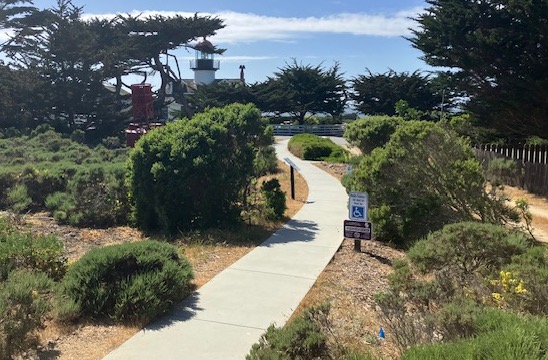
We continued to explore. Our goal was to visit the Point Pinos Lighthouse.
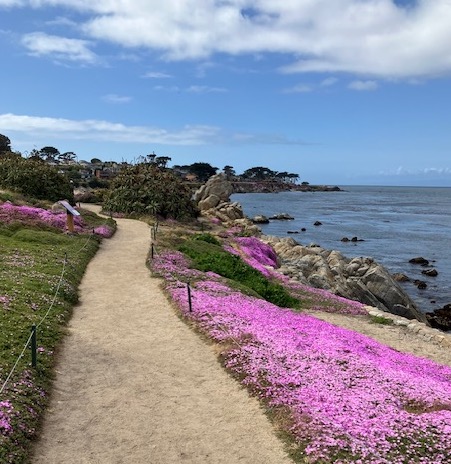
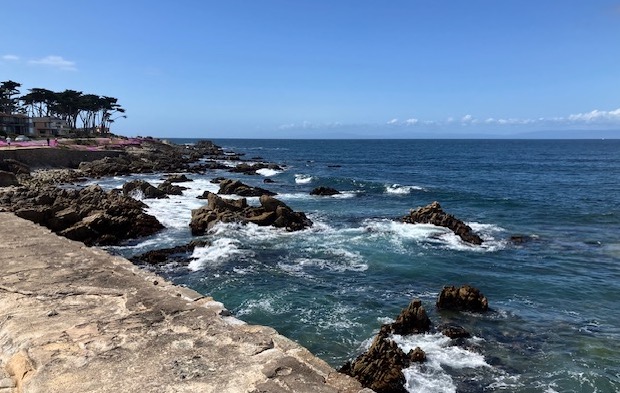
As we drove and walked along, the blue sky, beds of flowers, combined with a shoreline of scraggy rocks worn by a relentless Pacific, made for unforgettable postcard images.
Pretty path along the Pacific (Photo Bill Pike)
Occasionally, we came across a colony of at type of burrowing ground squirrel. Clearly looking for a handout from kindhearted tourists, these creatures did not rate highly with residents of Monterey.
Unfortunately, the lighthouse was closed. But again, the rocky shoreline, the hues of the ocean’s water, the crashing waves, the glide of pelicans, and the steady progress of fishing boats heading into port made for a remarkable afternoon.
In the background the Point Pinos Lighthouse (Photo Bill Pike)
We drove back to the hotel, then took a short walk to a local dive—Sly McFly for dinner.
On our after dinner walk back to the hotel, we purchased some chocolate.
Then, we made a decision to drive back out to Asilomar State Beach with the hope of seeing the sun recline into the Pacific.
We found a good spot for watching the sun sink, but partly cloudy conditions and a light rain shower limited seeing the sun.
A slowly sinking sun (Photo Bill Pike)
Our drive back to the hotel wove us through the pretty coastal town, Pacific Grove.
Another non-stop day with lots of steps had us ready for rest.
The Monterey Bay Aquarium still swirled in my mind.
I thought again about how this magnificent facility for teaching and learning came together.
And my old brain has this reoccurring question—why can we collectively come together to create such a facility, and yet, we appear to be unable or unwilling to truly solve our ongoing challenges related to homelessness, health care, mental health needs, and food instability across America?
I wonder if we will ever fully see that contrast and commit to solving it?
Letter to the Editor: Grateful for Alaska’s outstretched hand
JUNEAU EMPIRE The Voice of Alaska’s Capital Since 1912 Wednesday, July 30, 2025
From June 29 to July 10, my wife, along with two couples from college, and I traveled into Alaska. Twelve days out from our indescribable trip, I’m still suffering from chowder withdrawal.
Even though Mr. Moose didn’t appear on every corner, Alaska captured us. No matter if we were on a ship, train, bus or foot, the landscape was spectacular.
Our views were enhanced from the knowledge of exceptional guides who expressed their love and respect for this cherished land. Their devotion made us appreciate even more the stories about the courage of the original settlers and their respect for their heritage.
And while Denali was shy, I had ample opportunities to appreciate other snowcapped peaks, rolling rivers, cascading falls, deep forests, and the stunning blue ice of glaciers.
In Fairbanks, from so many angles, the Museum of the North really captured the spirit of Alaska and its people. It is my hope that the people of Alaska will never lose their loyalty or will to always protect this precious and priceless land.
After an early morning run along the Chena River, some of us stopped at the statue of Walter Harper. I loved the simple beauty of his outstretched hand, a hand up ready to help no matter the person or circumstances. In the short amount of time I have left in this weary old world, I hope I will become better at following Walter Harper’s heart by outstretching my hand.
Thanks Alaska for outstretching your hands to us.
Bill Pike
Author’s note: I was honored to have my Letter to the Editor published in the July 30, 2025 edition of the Juneau Times.











 might be baloney