Steeple at St. James’s Episcopal Church Richmond, VA (Photo Bill Pike)
Read Luke 8: 43-48
For surely I know the plans I have for you, says the Lord, plans for your welfare and not for harm, to give you a future with hope.
Jeremiah 29:11
On a pretty September afternoon, my wife and I attended the funeral for a neighbor. The sanctuary was at capacity. This celebration of her precious life was perfect. There was only one problem—I don’t think this daughter, sister, wife, mother, friend, and nurse should have died.
Our neighbor beat cancer once. I’m sorry God, but I think if a person beats cancer once, this person should have immunity from a second battle with this disrespectful disease. We need a new commandment: Thou shalt not have cancer a second time.
From Luke 8, I struggle with the instant healing of the woman who barely touched Jesus’ clothing. God, don’t you think a person battling cancer for the second time should have such a redemption? Surely, our neighbor believed just like the woman in Luke believed.
I always found comfort in Jeremiah 29:11. Yet, in real life moments like the passing of our neighbor, it is difficult to find that reassurance. She needed those hopeful plans for good welfare and no harm.
I apologize for whining God. However, I don’t think I’m a solo whiner when it comes to a recurrence of cancer. Despite my imperfections, I know you love me, but we need that new commandment.
Prayer: Father of us all give us the strength to endure when cancer pushes against us. Amen
Prayer Focus: Anyone battling cancer.
Thought For The Day: Bless those who are working to defeat cancer.
Note from author: On October 7, 2025 this devotional was submitted to the Upper Room for publication consideration. December 4, 2025, the standard email of rejection arrived. While disappointed, I understand, and I attempt to learn from every rejection. Be safe, Bill Pike
Cover from the Upper Room (Photo taken by Bill Pike)
Read Mark 10:46-52
Trust in the Lord with all your heart, and do not rely on your own insight. In all your ways acknowledge him, and he will make straight your paths. Proverbs 3:5-6 (NRSVUE)
I enjoy taking early morning runs, and before I leave the house, I check the weather conditions from the nearby airport.
One morning, the visibility at the airport was down to one mile. A thick layer of gray clouds hung above the treetops.
As I ran, I heard a plane overhead, but because of the cloud cover I couldn’t see it; I knew that the pilots couldn’t see the ground either.
Pilots must always rely on their training and sophisticated instruments to safely fly and land the plane, but this is especially true when visibility is reduced.
Sometimes I struggle to see where I need to go in life. l lose focus, and finding my way is difficult.
In those moments, I work to regain my bearings with these words from Proverbs 3:5-6— “Trust in the Lord with all your heart, and do not rely on your own insight. In all your ways acknowledge him, and he will make straight your paths.”
Trusting in God is not always easy.
Yet, that is exactly what Bartimaeus did when he asked Jesus to restore his sight; he trusted God in his heart.
On those days when the way is unclear, my heart needs to be more trusting, just like Bartimaeus.
Prayer: Faithful God, help our hearts to trust you when our vision is clouded. Guide us through your word. Amen
Thought For The Day: When the way seems unclear, I will trust God to lead me.
Bill Pike (Virginia, USA)
Note from the author: Friends I’m honored to have this piece published in the November-December edition of the Upper Room today, Tuesday, November 18, 2025. In case you are interested, I’ve also included the original piece that was submitted to the Upper Room. Thanks for your reading time, be safe, Bill Pike
Flying With God
Read Mark 10:46-52
Trust in the Lord with all your heart, and do not rely on your own insight. In all your ways acknowledge him, and he will make straight your paths. Proverbs 3:5-6 (NRSV)
I still enjoy taking an early morning run through our neighborhood.
I keep a running journal. Before I leave the house, I jot down the current weather conditions from the local airport.
Most mornings, the visibility is listed at ten miles. At the dawning of this day, the visibility at the airport was down to one mile.
In our neighborhood, a layer of thick, gray clouds hung above the treetops. As I started my run, I could hear the whine of jet engines in the cloud cover, but I couldn’t see the plane.
When visibility is reduced, pilots must rely upon their training and the use of sophisticated instruments to safely bring the plane through the clouds for a landing.
Sometimes in life, I struggle to see where I need to be landing. My vision becomes blurry. I lose focus. Finding my way is difficult.
In those moments, I work to restore my sight with these words from Proverbs 3:5-6: Trust in the Lord with all your heart, and do not rely on your own insight. In all your ways acknowledge him, and he will make straight your paths.
Trusting in God or Jesus when my vision is cloudy is not easy to do.
Yet, that is exactly what Bartimaeus did when he asked Jesus to restore his sight—his heart trusted.
On those days when my vision is reduced, my heart needs to be more trusting like Bartimaeus.
Prayer: Father of us all, help our hearts to trust you when our vision is reduced. Amen
Thought For The Day: When the clouds of life reduce our vision, trusting in the Lord can lead us to his light.
“I’m not crazy M’Lynn. I’ve just been in a very bad mood for forty years.”
Those words were spoken by Ouiser Boudreaux, the character portrayed by actress, Shirley MacLaine, in the movie Steel Magnolias.
In truth, Ouiser Boudreaux, reminds me of my mother’s sister, Mildred.
I loved Mildred because like Ouiser, Mildred was always honest. She never held back.
Robert Harling wrote the play, Steel Magnolias, and the screenplay that was made into a movie. The play was based upon Harling’s experience of his sister’s death.
I sense it would be fairly easy to take Ouiser’s observation about herself and apply it to our lives. To the therapist: “I’m not crazy, Dr. Watson, I’ve just been living with my wife for the last fifty one years.”
To the superintendent of schools: “No m’am, I’m not crazy, I’ve just been trying to teach middle school students for the last thirty one years.”
To your doctor: “No sir, I’m not crazy, I know operating the television’s remote control for six hours a day isn’t a cardiovascular activity.”
I wonder if people ever felt that Jesus was crazy?
Think about Matthew Chapter 8 verses 23-27: “And when he got into the boat, his disciples followed him. A gale arose on the lake, so great that the boat was being swamped by the waves; but he was asleep. And they went and woke him up, saying, ‘Lord, save us! We are perishing!’ And he said to them, ‘Why are you afraid, you of little faith?’ Then he got up and rebuked the winds and the sea; and there was a dead calm. They were amazed, saying, ‘What sort of man is this, that even the winds and the sea obey him?’”
The collective question of the disciples says it all—“What sort of man is this, that even the winds and the sea obey him?”
Maybe what they were really thinking was—“Is this man crazy?”
But in truth, the toughest question in this passage comes from Jesus: “Why are you afraid, you of little faith?” From the disciples perspective, their fear is grounded in the intensity of the storm that is battering their boat.
Think about it— no life preservers, no flares to fire off, no cell phone, no Coast Guard helicopter in route.
Nope all they have is this crazy guy Jesus.
I’ll be truthful with you, my faith and fear are grounded in this—I still struggle to always understand this crazy guy Jesus.
I will go to my grave wondering why prayers for one friend battling cancer are answered while prayers for another friend are not.
How can a woman with a longstanding health problem in Luke Chapter 8 barely touch Jesus’ clothing and her medical condition is immediately cured?
Talk about crazy, that story drives me nuts.
All this suffering in the world, even in this beautiful facility at Cedarfield, and that touch from Jesus seems so far away.
And yet, I don’t think Jesus is far away.
No, I think the problem is that I have continued to distance myself from him.
And that distance comes from my inability to see and understand Jesus’ craziness.
I think it would be very fair for God and Jesus to say: “We’re not crazy Bill. But because of all the challenges we see on earth everyday, we’ve just been in a very bad mood for a zillion years.”
You, me, we us know that God and Jesus have lots of reasons to be in a very bad mood when they look down upon us.
No doubt, the world can put us in a very bad mood.
But, if we let that very bad mood consume us, we will lose our hope.
A few years ago I received an email from Tommy Yow. A long, long time ago, Tommy was the Associate Pastor and Youth Director at Davis Street United Methodist Church in Burlington, North Carolina.
Tommy who now is retired in Alabama read an op-ed piece I wrote about the closing of Davis Street. The piece appeared in three North Carolina newspapers. Through one of those newspapers Tommy tracked me down.
I loved reconnecting with him.
Every week Tommy forwards to me thoughtful emails from Richard Rohr, a Franciscan friar and ecumenical teacher, the retired Reverend Dr. Terry E. Walton from the North Georgia Conference, and Linda Henley at Lake Junaluska. I try to skim those writings. Occasionally, something in those posts will stick with me.
I have no idea who Jo Cato is but this quote from her was used in one of those postings: “Be brave. The unfamiliar will shape you more than the familiar ever could.”
It is tough to be brave when life becomes unfamiliar.
Yet, I think Jo Cato is correct. We have an opportunity to learn from these unfamiliar times.
I guess the real question is— are we willing to learn from these unfamiliar times?
The disciples were in unfamiliar territory with the storm pounding their boat. Fear gripped them.
For lots of different reasons, fear grips me today too.
I recently listened to an interview with Jane Fonda on the National Public Radio show Fresh Air.
Yes, I know people can still have strong feelings about Jane Fonda.
But this exchange about “fear” in the interview caught my attention.
JANE FONDA: And I wrote a book, and I lost my fear.
HOST TONYA MOSLEY: You wrote a book about aging.
JANE FONDA: Yeah. Yeah. The thing to do when you’re scared, at least for me, is I make what I’m afraid of my best friend. I learn all about it. I wrap my arms around it and squash it to death (laughter).
HOST TONYA MOSLEY: Why do you do that?
JANE FONDA: Because then I’m not afraid anymore.
There are things in life that can make us fearful, things in life that can make us crazy, and things in life that can put us in bad moods.
And in all that fear, craziness, and bad moods, and despite the impact these things have on us, God and Jesus are still hanging around.
They are ready to help us face our fears, craziness, and bad moods.
They want to help us answer Jesus’ questions: “why are you afraid, where is your faith?”
People who have known me for a long, long, long time know that I was a marginal student. I drove my parents crazy with my poor performance in school.
Yet, somehow, my parents stuck with me. They didn’t abandon me. Their deep faith anchored them in hope that some day their knucklehead of a son might land on his feet.
Though Jesus was aggravated with his disciples as the storm thrashed their boat, he did not abandon them.
At this very moment, if we have any chance of enduring this unfamiliar world, its fears, its craziness, and its bad moods, we can’t abandon the calmer of the sea.
And that requires you, me, we, us to be as honest with our hearts as Ouiser Boudreaux.
While it might be a stretch, our hearts want to say—we’re not crazy Jesus, but you know the truth.
Our hearts have been very bad at ignoring you when the unfamiliar storms of life hit us.
Don’t give up on us yet.
Toss us your life preserver of hope.
Maybe, we’ll get it right this time.
Author’s note: On the afternoon of Tuesday, September 16, 2025, I had the privilege of presenting a devotional at Cedarfield. Cedarfield is an United Methodist retirement community in Henrico County, Virginia. For eleven years, our church, Trinity United Methodist, has been presenting worship gatherings for Trinity members and Cedarfield residents. These gatherings take place four times a year.
On the afternoon of Thursday, August 21, just a few minutes shy of 3 p.m., a man knocked on the door to the Stuart Hall Road entrance to our Sanctuary.
Our head building caretaker responded to the knock.
When he opened the door, this stranger said he wanted a pastor to pray for him.
Our building caretaker walked the stranger toward the church office.
Once there, our assistant pastor met with the stranger.
The request for prayer quickly shifted to a financial need to cover the cost of car insurance.
When our assistant pastor asked some basic questions about the car insurance, the stranger became belligerent and indignant. Displeased, he responded by cursing our assistant.
With this abusive language, the stranger was asked to leave the building. He was escorted out by our assistant and another staff member.
This pretense of prayer reminded me of an episode of The Andy Griffith Show titled “A Black Day For Mayberry.” The story is about a shipment of gold that is scheduled to go through Mayberry on its way to Fort Knox.
Of course, Mayberry’s biggest blabber mouth, Deputy Barney Fife, lets it slip out that a shipment of gold is on the way. This creates havoc among the citizens of Mayberry. They create an unwanted welcoming for the gold truck and its personnel.
Through a series of bungled assumptions by Deputy Fife, and his recently deputized associate bungler Gomer Pyle, we learn that the truck going through Mayberry was a decoy. The truck carrying the gold went a different route.
When Sheriff Taylor, Deputy Fife, and Deputy Pyle learn this, Deputy Pyle exclaims: “Shazam, a decoy.”
On Thursday afternoon, when I learned of our prayer seeking intruder, I felt like shouting: “Shazam, a prayer decoy.”
Yet, deep inside of me, I was angry, infuriated. Perhaps, I was just as angry as our prayer seeker when he learned that no financial assistance was to be provided because his prayer decoy plot had failed.
When I spoke further with our assistant about this stranger, turns out he wasn’t unknown to Trinity. In fact, I have his name on my prayer list.
In the past, with random infrequency, this person has shown up at Trinity seeking assistance. However, this was the first time that his interaction with church personnel was unacceptable.
One of the wristbands on my right arm says—“be kind.”
I wonder if Jesus would have been “kind” to our prayer seeker?
Might Jesus have confronted the prayer seeker by physically flipping him over like he did the tables in the temple?
Situations like this continue to erode what little Christianity I have left.
I wonder how the prayer seeker is wired?
How can a person falsely request prayer, immediately switch to ask for financial assistance, and seconds later become verbally abusive when asked reasonable, clarifying questions?
I wonder if he had worked his way down Forest Avenue stopping at each church trying the same prayer decoy?
But what I really want to know is what in the person’s lifetime put him in this position?
What is even more aggravating is I’ve been praying for this guy for years, and it appears that my prayers haven’t changed his behavior.
Maybe, I’m the problem.
Maybe, I’m a lousy prayer.
And to be even more truthful, this prayer deceit really bothered me because everyday, I’m praying for people who are in life or death situations with cancer, families who are providing care for loved ones with dementia, friends of our family who have children whose personal lives have fallen apart, and lifelong friends and co-workers whose hearts are forever crushed after tragically losing a daughter or son.
I can make this even more complicated by thinking about Hebrews 13:2: “Do not neglect to show hospitality to strangers, for by doing that some have entertained angels without knowing it.”
I’m sorry God, but I fail to see any angelic traits from the prayer decoy schemer.
I look forward to the arrival of the magazine The Week in our mail. I always read the Wit and Wisdom section. This section features quotes from a wide variety of mostly famous people.
In the September 5-12 edition, I came across this quote from American writer, James Baldwin: “The reason I will never hate anybody again is that it’s too demeaning a confession on your part if you need to hate somebody. It means you are afraid of the other thing, which is to love and be loved.”
Mr. Baldwin is correct.
I strongly dislike the method of the prayer decoy seeker.
Because of this tactic, I am afraid, unable to love the prayer decoy seeker.
This time last year, there was a mad rush in one wing of our church building to complete a three floor renovation project.
The contractor was doing everything humanly possible to be substantially finished by August 31.
It wasn’t perfect, but the deadline was met. More importantly, the county’s building inspector granted permission to occupy that wing.
In the year that has passed, we’ve spent time with punch lists, uncooperative technology, ambushed water intrusions, and attempting to learn the nuances of the new HVAC system.
HVAC systems are always a challenge. Perhaps the biggest hurdle comes from monitoring our own individual human thermostats.
A few weeks ago, in the neighborhood where our church is located, a powerful late afternoon thunderstorm got our attention. This storm knocked out power to a wide section of the neighborhood.
At the church, the storm disabled two phases of electricity to our building. Full power didn’t return to us until the next afternoon. But in the long minutes when the storm was in action, the flickering ups and downs of the electrical service to our building reeked havoc on some of the components for the new HVAC system.
Because of a shortage of parts from the manufacturer, we’ve been patiently awaiting for repairs.
Recently, one of the technicians for the company was in our building to recheck the monitoring technology.
I wasn’t sure if he remembered me. So, I reintroduced myself.
As I was doing this, he responded to me, “Oh, I know who you are.”
I didn’t know how to take—“Oh, I know who you are,” but we had a good conversation about the challenges involved in getting the HVAC issues solved.
In all my years of working in public schools, we had plenty of challenging students. Students that we knew who they were because rightly or wrongly, their reputations preceded them. For a few of these students, living down their reputations was virtually impossible.
Over time and with the right support, a handful of those students figured out how to make adjustments. Their challenging behaviors became less intrusive.
And then there was a group that no matter what they tried, they just could not keep from getting attention in all the wrong ways. And of course, no matter what the school tried, we could never quite make the right connection, or build the right relationship to help the student adjust.
“Oh, I know who you are,” made me think about my own life.
How do people see me?
Does my reputation precede me?
Do my imperfections create challenges for me and the people I encounter on a daily basis?
Sometimes, I wonder if God really knows who I am?
With so many people in this world, what does God truly know about me?
My guess he knows that my morning prayer routine is too long.
He probably knows that I’m a constant, repetitive whiner.
This is especially true when life goes wrong for good people. I whine to God, “what are you thinking, where are you, how could you let this happen?”
Psalm 139 verse 13 implies that God has known me since I was knit together in my mother’s womb.
In Matthew and Luke, the scripture states that even the hairs of my head are numbered. This is another indication that God knows me down to the hairs on my head.
At this stage of my life, I’d say the hairs on my head are disappearing at such a rapid rate that an accurate inventory is useless.
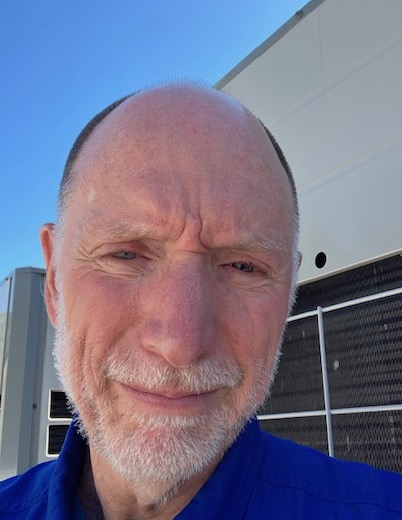
Whiny old buzzard, new HVAC system behind me (Photo Bill Pike)
I wonder if my shrinking hairline decreases my value in the eyes of the Lord? Am I still of more value than the sparrows of the field?
I have some days on my wobble through life when I think the sparrows of the field are of more value than me.
On those valueless days, I ask myself— why aren’t you doing more?
Where is your voice?
Why aren’t you finding your voice to speak out?
How can you let all of the injustice of this dismantling pass by you in silence?
Maybe God really does know me.
Maybe he knows that I’m nothing more than a whiny old buzzard with no backbone who is gripped by fear of what people will think of me when I finally assert my muted voice.
My wife and I are playing catch up with the Apple TV series—Ted Lasso. We have made it into season three.
In prepping his team, Coach Lasso shares wisdom with his soccer players. Coach Lasso has a way of blending on field wisdom into life wisdom for his players.
I was taken by these words from the script of Episode 12 in Season 2: “To quote the great UCLA college basketball coach, John Obi-Wan Gandalf, “It is our choices, gentlemen, that show what we truly are, far more than our abilities.”
Of course, Coach Lasso was referencing legendary UCLA basketball coach, John Wooden. Coach Wooden not only taught his players the essential details of playing college basketball, but attempted to equip his players about essential life skills too.
“Oh, I know who you are” really comes down to this—do I know who I am?
It is my choices that reveal if I really know who I am.
Regardless of womb knitting, counting hairs, and sparrows, God is watching my clock.
In the remaining time he has allocated for me, I must be wiser. I must find out who I really am.
Growing up in Burlington, North Carolina, every Sunday, I was in church— Sunday school, worship service, and a youth program later that evening. Illness was the only interruption.
That church, Davis Street United Methodist, is now closed. Congregation voted to shutdown. With declining attendance and financial support, staying open wasn’t logical.
To their credit church leaders did their homework. A buyer for the building was found. Over a period of time, the Davis Street congregation opted to merge with another Methodist church.
Over the last fourteen years, I’ve had the privilege of working at my church, Trinity United Methodist. During that time, I’ve learned a lot about churches.
Whether they want to admit it, churches, no matter their size or status, aren’t immune from wondering how much longer can they hang on.
No question, the pandemic had an impact on churches.
Yet, respected research organizations like Gallup and Pew have been reporting for years that churches were struggling.
Six years past the pandemic, congregations are still challenged to address declining attendance, giving, aging members, and deteriorating buildings.
In March of 2024, Gallup reported: “On any given weekend, about three in 10 U.S. adults attend religious services, down from 42% two decades ago.”
A February 2025 study from the Pew Research Center found some stabilization in their data. However, when looking toward the future, this key point was made: “younger Americans remain far less religious than older adults.”
Daniel Silliman, in Christianity Today, and Francis Wilkinson, in Bloomberg, have written about the possible impact that Donald Trump has made in contributing to the decline of church attendance.
No matter who takes the blame, I wonder how frequently church leaders point the finger of blame back at their own shortcomings?
In the baseball movie, Moneyball, there is a pivotal scene between a rookie executive, who is skilled in player analysis, and the seasoned general manager of the team.
The young executive makes a bold statement: “Baseball thinking is medieval, they are asking all the wrong questions.”
Part of me believes that “church thinking is medieval, they are they asking all the wrong questions.”
I’m no expert on churches. However, in this current environment, I think church leaders and congregations are overdue to ask tough questions. That is the only way to determine their current standing in order to determine a path forward.
Part of me believes that churches would benefit from participating in an accreditation process. That process would require churches on an annual basis to assess key evaluative criteria related to: program offerings, finances, outreach, personnel, facilities, safety, technology, and the ability to make meaningful connections.
Conducting an annual review could potentially help churches in making difficult decisions relate to budgets, personnel, facilities, and the effectiveness of their program offerings.
With a need to attract young families, I think churches often overlook the concept of “discretionary time.” Young families often over extend, they are always on the go.
So, how does a church help young families find a fit that works for them? Can churches develop flexibility in their seemingly inflexible traditional schedules for young families?
How can churches be more welcoming to those exploring churches? On a first visit, a nervous visitor doesn’t need to hear the unwelcoming: “Sorry, sonny, but your sitting in my pew.”
Finding their footing for the future means churches can’t fear change.
Churches must embrace change. The path forward will not be found in producing more predictable sameness. Congregations should consider this question—do you want the autopsy for your church to state: cause of death—stubbornly resistant to change.
And speaking of death, why must a funeral be the time to learn all about a church member? Churches must become stronger in building ‘living’ relationships within and outside the walls of the church.
That means becoming more adept in capturing and sharing significant stories within the congregation and community.
How much longer your church can hang on isn’t up to me.
Hanging on depends on your congregation and its leadership, and the willingness to take some risks.
Here are five simple risks:
Compile all essential data about your church for detailed research and review.
From this review, determine what works and what isn’t working within your church.
Resolve to tell the truth from these findings.
Write a report of findings for the congregation that clearly reveals the challenges and strengths of the church.
Use the report of findings as the pivot point for determining how to move forward.
More church closings are unavoidable.
Maybe that’s why this Og Mandino wisdom keeps coming back to me: “I have never heard anything about the resolutions of the apostles, but a good deal about their acts.”
A long time ago someone decided that churches needed to have kitchens.
At our church, we have three: in the original fellowship hall, an oddball one on the third floor of the Preschool wing, and in Trinity Hall.
And there was a mini-kitchen near the church office that we disassembled a few years ago.
I imagine those kitchens could write a book about the life of our church that took place inside those culinary walls.
Cook talk, laughter, gossip, recipes, and compliments were shared.
Back on Wednesday, August 13, my work teammate, Judy Oguich, and I met in the Trinity Hall kitchen to inventory our supplies and make plans for a church wide lunch on Sunday, August 24.
We found adequate supplies of plates, cups, napkins, and utensils.
Since the menu called for grilling hotdogs, we believed we had lots of hotdogs leftover from a community event last fall. Unfortunately, these frozen dogs had long gone past their expiration date. We had to chuck them.
Checking on the condiments that we needed to enhance the hotdogs, we again found that mustard, catsup, relish had an expired.
No matter where we looked, we found food items that were no longer safe to serve.
In truth, I’m not surprised. A few years ago, our church closed out our Wednesday night dinners. No longer could we justify the expense based upon fewer and fewer families attending.
Now, the Trinity Hall Kitchen is used sporadically. The people who use the kitchen leave extra food in the refrigerators. These kindhearted people believe that someone will eventually consume those leftovers.
This wasn’t my first experience in the Trinity Hall Kitchen throwing away outdated or spoiled food.
I had to do this when Hurricane Isabell walloped the neighborhood as electrical service was absent for over a week.
There were other times too.
Leftover food from Sunday night youth dinners were not consumed in a timely manner, and they too had to be tossed.
Perhaps the only good thing that came from disposing of this food was recycling the containers where the food had been stored.
I despise days like Wednesday, and the ones I’ve encountered in the past.
My disgust comes from revisiting Deuteronomy Chapter 15 verse 11: “There will always be poor people in the land.”
And from Matthew 26 and Mark 14: “The poor you will always have with you.”
Look, I’m no Biblical scholar, but those three verses cast an embarrassing guilt over me. In these situations, I could have done better than tossing out all this food.
If I had only been more attune to those refrigerators, we could have fed more people in our community.
I wonder why those three verses are in the Bible?
Were they written as a challenge?
Did the scripture writers think, “Hey, let’s tell the knuckleheads on earth that the poor will always be with them.”
If we tell them this, maybe, they will look at those statements and ask: “Why should we always have the poor with us?”
Why don’t we work together to wipe out poverty in our world so that we will have no poor people.
Seems like a noble idea, but unfortunately, we have been failing for centuries at eliminating poverty.
So why is it that we can explore the vastness of space, perform heart transplants, dam mighty rivers, build skyscrapers that touch the blue yonder, and yet we can’t figure out how to solve the challenges faced by the poor.
Williamsburg, Virginia native, Bruce Hornsby, has built himself quite a career as an extraordinary piano player, songwriter, and singer. His first hit single with his band The Range was a song titled “The Way It Is.”
From my first listening of the song, I was hooked.
The lyrics caught my attention too. The words are a snapshot of ongoing social challenges in America.
But it is the chorus that stuck to me: “That’s just the way it is. Some things’ll never change. That’s just the way it is. Ah, but don’t you believe them.”
Having the poor with us, “That’s just the way it is. Some things’ll never change.”
For me, the bleak affirmation of those two lines is countered with the last line: “Ah, but don’t you believe them.”
We are long overdue to believe that we can solve the vicious generational cycles of our poor.
While I will not set any speed records, my old body still allows me to go out for a run.
Since the start of 2025, I’ve had the privilege of running in the Florida Keys, North Carolina, San Francisco and Monterey, California, Vancouver, British Columbia, Fairbanks, Alaska, and almost in Keystone, Colorado.
I was all set to go for a run in Keystone, but my body talked me out of it. My body did not like the change in altitude. In Keystone, the altitude is 9,173 feet. Where I live in Richmond, Virginia the altitude is 150 feet.
We arrived in Colorado on Saturday, July 26. By Monday, my body started to feel acclimated.
I know that I was lucky, privileged to be able to go for a run in those different locations. And as fortunate as I was with that opportunity, I still enjoy taking a run in our Richmond neighborhood.
No doubt those other locations offering unique settings for a run, but as Dorothy said in The Wizard of Oz—“there’s no place like home.”
For seventy two years, I have lived in North Carolina and Virginia. The entire southeast is known for its uncomfortable summertime temperatures. When heat, dew point, and humidity conspire to create daytime heat indexes over one hundred degrees, there is nothing like it.
Air conditioners strain, pets are hesitant to go outside, and the air is as thick as pound cake batter.
The sinking of the sun offers no relief. Sure the intensity of the sun is gone, but the still night time air has no pulse. Leaves don’t rustle, and when dawn breaks the temperature will be 75 degrees, with a dew point of 74 degrees, and a humidity reading of 96%—a sauna.
And now, I will confirm for you what you have known for many years now—Bill Pike is crazy— just like Max Klinger from MASH in search of his Section 8. I’m crazy because every summer I look forward to taking an early morning simmering sinner run through my neighborhood in those unbearable conditions.
On the morning of Saturday, July 12, I took a simmering sinner run. I ran the neighborhood 5K route in reverse starting at our house instead of Trinity.
By the time, I had completed my run from head to toe my entire body was soaked in perspiration. I could wring water out of my t-shirt and shorts. When I walked inside our house, I felt like I had walked into a ice chest.
Mentally, the simmering sinner run is good for me. I feel like any meanness in my body has been removed. It has dripped out of my pores.
Following the run, here is the bad news—any removal of my meanness, worry, anxiety, and discontentment is only temporary.
You might be thinking, Bill, why is your satisfactory simmering sinner run only temporary?
Here is my explanation from Dr. George Sheehan from his book Running To Win: “Life is not logical. Life is not rational.”
I think Dr. Sheehan’s assessment is correct.
Speaking for myself, at this very moment in my life, my country, America, is not logical and not rational.
Back on July 26, 1993, using a gift certificate from a friend, I bought Dr. Sheehan’s book at a Barnes and Noble on Parham Road. That store is gone.
I have never read Dr. Sheehan’s book from beginning to end. I have read it in pieces and highlighted his wisdom and wisdom from others that he quotes.
Tonight, I came across this wisdom in the last paragraph of the Epilogue.
Dr. Sheehan wrote: “The glory of God,” wrote Ireneus, one of the early church fathers, “is man fully functioning.” Find your place to do that, and you will find the peace that passeth all understanding.
Again, speaking for myself, America is not fully functioning for the good of all Americans.
For my old brain, this is a concern.
And in that concern is our inability to find our place and understanding.
I fear if we continue down our current path, peace will never grace America again.
August 30, 1971, the Beach Boys released their album Surf’s Up. In case your curious, the album features no songs about surfing.
On side two, there is a pretty, heartfelt song from Brian Wilson titled ’Til I Die. I think about one line from that song quite a bit—“I lost my way.”
A timeline of my life will reveal that I have “lost my way” on many occasions.
And yet, some compass, some internal voice, some nudge, some whisper seems to correct my path. Isaiah 33:22 states: “For the Lord is our judge, the Lord is our lawgiver, the Lord is our king; it is he who will save us.”
America has lost its way.
I wonder if America can be saved from this dysfunction?
Hot summer sun rising over Rollingwood. (Photo Bill Pike)
From the 2023-24 official state transportation map of North Carolina (Photo Bill Pike)
Good morning, I’m Bill Pike, and it is my honor to be with you this Sunday as the pinch hitter for Enon’s pastor, Michael Dettmer.
No matter if you are with us in the Sanctuary or watching on-line, we are glad to have you with us this morning.
Before we start, I need to share some disclaimers.
First, I’m not a Biblical scholar, nor a degreed theologian, but I do have a certification as a lay speaker from the Virginia Conference of the United Methodist Church.
My wife and I were traveling with dear friends from college when I listened to Michael’s voice mail. We had a good conversation when I called him back, but he said something dangerous to me.
Michael told me by phone and later in a follow-up email that I could preach on any topic of my liking.
That’s not a good offer to a person like me, who has what American writer, Dave Barry calls “brain sludge.” Mr. Barry defines “brain sludge” as useless information in the minds of men.
However, with Michael’s offer, my “brain sludge cells” started tossing out ideas.
Knowing that we are in Hanover County, home of the famous Hanover tomatoes, maybe, I should speak about the fruits and vegetables that are listed in the Bible.
In light of the recent water crisis that impacted the Richmond region, maybe I should talk about water. After all the Bible references water over 500 times.
Or since it is baseball season, maybe I should talk about the movie Moneyball, and offer suggestions to what churches might learn from characters Billy Beane and Peter Brand and their statistical thinking about baseball.
Or maybe, I can tell you some stories about my thirty one years of work in public schools, or my last fourteen years of work at Trinity, or maybe I should just let my heart do the talking.
Who knows, maybe I’ll be lucky, and something from my old heart might resonate with your hearts.
How about we start with a prayer: Father of us all, forgive my old heart. Amen.
The gospel reading this morning comes from Luke Chapter 10 verses 38-42. Let’s take another look at those four verses:
“As Jesus and his disciples were on their way, he came to a village where a woman named Martha opened her home to him. She had a sister called Mary, who sat at the Lord’s feet listening to what he said. But Martha was distracted by all the preparations that had to be made. She came to him and asked, “Lord, don’t you care that my sister has left me to do the work by myself? Tell her to help me!” “Martha, Martha,” the Lord answered, “you are worried and upset about many things, but few things are needed—or indeed only one. Mary has chosen what is better, and it will not be taken away from her.”
I’m sorry, but I think Martha has a point. She has opened her home to Jesus and his disciples. Including Martha and Mary, that’s at least fifteen mouths to feed.
I can see Martha scurrying around her home, prepping food, finding serving pieces, and while she is burning all this energy, it suddenly dawns on her, I need some help.
Look at my sister, she is sitting at the feet of Jesus hanging on every word that he is saying. Why isn’t she helping me?
In our own kitchens with our families, we’ve seen similar scenes play out when we have special guests in our homes. We want the meal and the fellowship to go well. For that meal and fellowship to go well, we are probably going to need some extra hands.
But, Jesus, doesn’t see it that way. I think he can see and feel Martha’s sense of urgency in this moment.
While his reply to Martha acknowledges that she is worried and upset about many things, he offers no real relief—other than basically— hey, Martha, cool your jets.
By this time, Martha might be headed toward a nuclear meltdown.
Maybe she is thinking to herself: “I’m trying to be a good host, no one is helping me, sounds like Jesus told me to trim the menu down, and that Mary has chosen more wisely than me and that her choice will not be altered. I guess, I’ll just keep plugging along.”
In the May 23 edition of the news magazine The Week, I read an obituary about Joseph Nye. Dr. Nye was a political scientist who had a distinguished career in academia and politics.
The Washington Post reported that the future Dr. Nye grew up on a farm. He attended Princeton University. It was at Princeton that “he briefly considered studying for the ministry—until he read the Bible all the way through.”
I’ll be honest with you— I have days like that with the Bible. Days when I have no earthly idea how I can understand or rationalize what is written.
And I’ll take that honesty a bit further, these four verses about Martha and Mary are difficult for me to understand.
My vision, my practical thinking sees this home visit by Jesus from Martha’s perspective. I hear and understand her plea.
But in the footnotes of the 1973 edition of the The Oxford Annotated Bible, the Revised Standard Version, I’ll give you a bit more to ponder: “With delicate ambiguity Jesus rebuked Martha’s choice of values; a simple meal (one dish) is sufficient for hospitality. Jesus approved Mary’s preference for listening to his teachings as contrasted with Martha’s unneeded acts of hospitality.”
“Unneeded acts of hospitality” sorry, but I need to think about that comment for a while, maybe longer than you want to be here this morning.
On the evening of Thursday, July 10, my wife and I were on a redeye flight from Fairbanks, Alaska to Minneapolis-St. Paul to Raleigh.
We experienced a brief delay for our flight to Raleigh, but other than that all went well.
Even though I grew up in North Carolina, I have never figured out the roads in Raleigh.
This is despite many trips to Raleigh to visit our youngest daughter.
We were on US 1 north headed out of the city into Wake County.
And I have no idea why on this Friday afternoon, my eyes were drawn to an exit sign for Rolesville.
But, my brain locked on to that name— Rolesville.
I’ve never been to Rolesville, don’t know if I will ever go to Rolesville, but the town was founded in 1837 by William H. Roles. Today, it is the second largest city in Wake County with a population of 9,745. (Wikipedia)
Luckily, my jet lag did not impact my driving, and we made it back to Richmond safely.
Yet, my old brain would not let go of Rolesville.
Late on Saturday evening, I started doing some preliminary prep for this morning, and when I consulted the lectionary for the gospel reading, Rolesville nudged me again.
And that’s when it hit me, what is my ‘role’ in this cantankerous, weary, and worn out old world?
Mary and Martha both have roles in this scripture.
What is your role in this world?
How do you impact your family, your friends, your community, your work environment, and how do you impact Enon?
What is our role, our responsibility?
How can we use our role, our responsibility to make a positive impact?
You may never visit Rolesville, but I hope you will revisit everyday what your ‘role’ is in this world. Never stop evaluating how your ‘role’ can bring about change.
A few years ago, I stumbled upon this quote from E. B. White: “The only sense that is common in the long run, is the sense of change and we all instinctively avoid it.”
How about in your ‘role’ in this life, do you “instinctively avoid change?”
When I read a book, an article in a magazine, or the daily devotional in the Upper Room, I use a highlighter. If I come upon wisdom that resonates with me I will highlight it and that includes highlighting the page number.
I recently read The Secret World Of Weather by Tristan Gooley. In the book, Mr. Gooley shares with readers how to read weather signs ‘in every cloud, breeze, hill, street, plant, animal, and dew drop.’
If you are intrigued by our daily weather, you might want to read this book.
Now, I haven’t gone back in the book and counted how may times the word ‘change’ is used by the author to make his points, but ‘change’ is used a lot.
Our seasons and their weather force us to change our routines. Yes, we might complain about the weather, but do we really ever consider how it initiates change?
These weather changes force us to adapt.
In the New Testament isn’t that Jesus’ role? Isn’t he nudging us to change?
With every interaction with every parable, isn’t he working to initiate change, to make us think, to make us uneasy, to nudge us out of our comfort zones? Doesn’t he want us to take on a different ‘role’ in the reality of our own Rolesville?
Who in your Rolesville needs you?
Is it an aging parent, a student who needs a mentor, a struggling co-worker, a church member, a stressed out neighbor, or a stranger rummaging through a dumpster in the back of a fast food restaurant?
You, me, we, us have a ‘role’ to fill in our communities.
And, I’m not sure about your thinking, but I sense God and Jesus are not much different from Martha. Maybe they don’t want to admit it, but they need us to take more of an active ‘role’ in this raging old world.
We are at a point in all of the Rolesvilles across the world where we can no longer “instinctively avoid change.”
Perhaps you are aware that in Luke Chapter 10, just before the story of Mary and Martha is the story of the Good Samaritan.
What a ‘role’ this man played in saving a stranger’s life.
The last four words that Jesus speaks in that parable are “go and do likewise.”
I wonder if I’d be able to offer the same type of assistance to a stranger today like the Good Samaritan did?
I love music.
I have a deep appreciation for musicians.
I can’t sing or play any instrument.
At home, if I were to attempt to sing in the solitary confinement of our shower, I’m certain all of the dogs in our neighborhood would howl in anguish.
The Steep Canyon Rangers are a bluegrass/Americana band from Asheville, North Carolina.
Unlike me, they are gifted songwriters, musicians, and singers.
The lyrics from their song “Down That Road Again” made me pause and think:
“Don’t let me go down that road again I know where it leads and how it ends Right now I need the kind of friend Who won’t let me go down that road again” (Written by Graham Paul Sharp of The Steep Canyon Rangers from their album Radio on Rounder Records 2015)
At this very moment, there is someone in your life who doesn’t want to go down that road again. This individual needs someone from Rolesville to be the ‘role’ of a friend ‘who won’t let them go down that road again.’
Jesus was honest in his assessment of Mary and Martha, and I’ll be honest with you.
Each of us has a ‘role’ to play in this world full of hurting people.
It is time for us to put into action the words from Jesus: ‘go and do likewise.’
Near the end of June, I turned 72.
There is a little voice inside of me that whispers, “Bill, you don’t have much time left, you need to get busy.”
That whispering voice is correct, I don’t have much time left, I need to get busy.
How about you?
In the time that you have left, how are you going to get busy?
What ‘role’ are you going to play?
Maybe you know the name Dr. Mae Jemison. Dr. Jemison was the first African American woman to travel in space. She was a mission specialist in 1992 on the space shuttle Endeavour.
This wisdom from Dr. Jemison makes me think a lot about the time I have left: “Never limit yourself because of others’ limited imagination; never limit others because of your own limited imagination.”
I told you earlier this morning—I’m not a Biblical scholar or a degreed theologian, but I’ll tell you what I think about Mary and Martha.
My old heart tells me that God and Jesus both need Mary and Martha, and we do too.
We need to hear the words from Jesus, but we also must put those words into action, and we must not think about our limitations.
Dr. Jemison never allowed limits to slow the pursuit of her goals.
Nor should we, as we position ourselves to “go and do likewise.”
Mary and Martha had limits in offering hospitality to Jesus and his disciples. But, I suspect that Mary and Martha came away from that experience a little wiser.
The Good Samaritan set no limits for himself to ensure that the robbed and injured traveler received the care he needed.
The person in the Steep Canyon Rangers’ song “Down That Road Again,” requested the help of a friend to keep them from making the same mistakes again. Tomorrow, you might be that friend who keeps a friend on the right road.
And grounded in the each of these examples is the E. B. White quote about change.
At this stage in my life, I can no longer “instinctively avoid change.”
If I avoid ‘change,’ then I will be incapable of playing the ‘role’ that Jesus charged me with— “now go and do likewise.”
Doesn’t matter if we are down in Rolesville or at Enon United Methodist Church— it is time for our hearts to “go and do likewise” in our communities.
Time isn’t on our side.
We need to get busy.
Talk to your heart.
“Go and do likewise.”
Author’s note: Today, I had the privilege of “pinch hitting” in the pulpit at Enon United Methodist Church in Hanover County, Virginia. A special thanks to the church staff and congregation for their hospitality and patience.
Over the last year, I’ve thought about 72 quite a bit.
On August 31,1992, my mother died courtesy of one the cruelest things on earth— cancer. She was 72.
I always wondered if I would make it to 72.
In June of 1972, I turned 19.
I had just finished my freshman year at Greensboro College.
It is unbelievable to me how quickly the last 53 years have passed.
Time is not on my side.
Truthfully, I don’t think time has ever been on my side.
I often reflect about how badly I have managed my time on earth. I could have been better at so many things.
I could have been more thoughtful, patient, kindhearted, and friendly.
I could have read more books, been more attentive to the needs of those around me, less judgmental, and less whiny.
Yet, I am thankful that I might just make it to 72.
This verse of the day showed up recently in my daily early morning quiet time. It’s from Psalm 121 verses 7-8: “The Lord will keep you from all harm— he will watch over your life; the Lord will watch over your coming and going both now and forevermore.”
When the news isn’t good, how in the world can a person of faith or a person who struggles with their faith believe those words?
With the bombing of Iran, the word “obliterated” was used to describe the destruction at the country’s nuclear facilities.
Obliterated applies to human beings too.
A neighbor for the second time is battling cancer. Her most recent post indicated that the cancer is obliterating her body.
Nothing that the oncologists have tried is slowing down or killing the cancer. Too bad we don’t have a 30,000 pound bomb that we can drop on her cancer.
And despite this discouraging report, our neighbor wrote, “I’m not losing hope.”
How in the world does she hang on to hope when her body has been betrayed by the words in the Psalms?
Clearly, her body hasn’t been kept from harm, and in her going and coming she must feel like she hasn’t been watched over.
On the afternoon of Sunday, June 22, I was running some errands. I was listening to a rebroadcast of a live concert from Mountain Stage.
A Kentucky duo named The Local Honeys was performing. One of The Local Honeys, Montana Hobbs, introduced a song that she had written about her grandfather.
Back stories fascinate me, and this one didn’t disappoint.
Her grandfather came from a large family. Unfortunately, his parents died early. This meant the children were shipped off to relatives to be raised.
In those challenging circumstances, Miss Hobbs’ grandfather ran off twice. Eventually, he joined the Navy and became a pilot during World War II. Somehow, her grandfather survived his plane being shot down and crashing in the Pacific.
With time, the roots of this family and their stories came together. When Miss Hobbs had the opportunity to visit her grandfather, if she asked him how he was doing, his standard reply was “better than I deserve.”
That reply from Miss Hobbs’ grandfather punched hard at my old soul.
At this point, my life has been “better than I deserve.”
And yet, I will complain until the day I die when a verse from the Bible, promises to protect, but from my downcast perspective the words fail.
In the May 23 edition of the news magazine The Week, I read an obituary about Joseph Nye. Dr. Nye was a political scientist who had a distinguished career in academia and politics.
The Washington Post reported that the future Dr. Nye grew up on a farm. He attended Princeton University. It was at Princeton that “he briefly considered studying for the ministry—until he read the Bible all the way through.”
I wonder what in the Bible changed Nye’s mind about pursuing the ministry? Was it a day when the news wasn’t good, and he knew that the hopeful words of scripture had let another person down?
If I make it to Friday, I will be thankful.
And on Friday, when I compare my life to the lives of others who are struggling to hang on, I’ll think about the words from Montana Hobbs’ grandfather “better than I deserve,” and with respect to the doubt of Thomas, I too will not lose hope.
Author’s note: I wrote this piece as a devotional for a staff meeting at our church on June 24. It was not my intention to draw attention to my birthday. The purpose is simply to remind you, me, we, us how fragile and unpredictable life can be. Love you all, Bill
Window at Trinity UMC Richmond, Virginia (Photo by Bill Pike)