Part II: No beer here, goodbye Anchor Brewing, maybe

On June 13, I read discouraging news reports from California that confirmed the Anchor Brewing Company was stopping distribution of their beers outside of California, and ceasing the production of their legendary Christmas Ale.

Twenty nine days later on July 12, I received an email from my wife’s niece in San Francisco: “Looks like they are closing all together. Sorry, Bill.”

Attached to the email was a link to a report from the NBC news affiliate in San Francisco with this headline: Anchor Brewing Company in San Francisco to halt operations after 127 years.

Crushed again, I called our son. He quickly found several other similar headlines from other media outlets confirming the brewery’s closing.

Sam Singer spokesperson for the brewery cited numerous reasons for the closing, but mainly focused on declining sales in a beer market with lots of competition.

Accusatory fingers of blame will be pointed in many directions for the closing of Anchor Brewing. Most obvious will be the sale of the brewery in 2017 to Sapporo, a large brewer of beer from Japan.

I was shocked when I read about the sale of Anchor to Sapporo in 2017. I, who know nothing about the behind the scenes operation of a brewery, did not think this was a good fit.

I don’t think the Japanese culture has experienced the explosion of craft brewers like we have seen in America. I suspect Sapporo management didn’t properly understand that environment, or what had been carefully created at Anchor Brewing.

Years ago, in Richmond, Virginia, I witnessed a similar acquisition. Ukrops a very successful local, family run grocery store chain decided they were ready to sell. Apparently, they had lots of offers, but settled on Martins, a family run chain from Pennsylvania.

Martins also had ties to another large grocery store chain, Giant. In a few short years, Martins was gone. They could never match the quality and loyalty that was at the heart and soul of the Ukrops run stores. Likewise, I suspect that Sapporo never grasped the heart and soul of Anchor Brewing.

Sixty one Anchor Brewing employees lost their jobs with a “60 day notice and a separation package.” I hope those dedicated and loyal employees will quickly find comparable employment opportunities in the Bay Area without significant disruption to their lives.

I’d be curious to know who can claim and protect the beer recipes for all of the Anchor Brewing beers that have been brewed for so many years. I hope they are protected in such a way that would prohibit Sapporo from being able to cheaply mass brew the Anchor Brewing beers at the company’s large brewery in La Crosse, Wisconsin. A move like that would be shameful and disrespectful to the Anchor Brewing beers that are admired and respected by brewers and beer drinkers around the world.

Who knows, maybe there is another Fritz Maytag out there who is assessing this latest demise, and who at the last minute will make an offer that will rescue Anchor Brewing. That’s what Fritz Maytag did in 1965 when he purchased the struggling brewery. I would assume that Mr. Maytag who put his heart and soul into saving the brewery has lost some sleep over this disappointing announcement.

My wife’s brother-in-law sent me an article in the July 21 edition of the Washington Post by reporters Niha Masih and Praveena Somasundaram. Their article reported “that employees from the Anchor Brewery have submitted a proposal to Sapporo to purchase the brewery and run it as a co-op. Additionally, there are nearly two dozen bids with an interest in buying the historic brewery.”

Over the last few years, a handful of successful American craft breweries have been purchased by hefty foreign breweries. I wonder how the ledger sheets read for those acquisitions? Might there be other American craft breweries who are unstable economically and potentially facing closure?

Yes, I’m disappointed in this announcement.

But the closing of a beloved American brewery is nothing compared to other challenges in our world.

Thousands of miles from America, Ukraine continues to battle Russia and its heartless leader, Vladimir Putin.

In America, our political and economic divide continues to separate us from working together for the good of all.

Our physical and human infrastructure systems are worn and weary.

Our political system needs to be overhauled as we continue to wobble in a selfish instability.

We have become numb to the trigger pulling that is seen as the quickest and surest way to solve any problem with another American.

From sea to shining sea, we continue to experience the erosion of our dignity, patience, common sense, kindness, loyalty, and love.

And yet, I hold out hope that the current owner of Anchor Brewing, Sapporo Holdings, Ltd., will strongly consider the merit of the bid submitted by forty employees from Anchor to purchase the brewery.

And one more hope, as an imperfect human being and American, I will hold out hope that America will come to its senses and correct its challenges before America like Anchor Brewing is facing its closure.

Photo by Bill Pike

Post High School Graduation Shooting: Enough

As a parent, grandparent, and retired public school educator my heart hurts for the shooting tragedy that occurred after the Huguenot High School graduation. In a blink, lives are changed forever.

Honestly, I’m not surprised that we are processing another mass shooting.

Consider, these findings about gun violence, firearm ownership, single parent families, and the shrinking of religion.

The Johns Hopkins Center For Gun Violence Solutions has released its annual report.

The Center reported this grim data: In 2021, for the second straight year, gun deaths reached the highest number ever recorded. Nearly 49,000 people died from gun violence in the U.S. Each day, an average of 134 people died from gun violence—one death every 11 minutes.

A June 2021 survey of 10,606 American adults conducted by Pew Research Center found  four-in-ten  adults live in a household with a gun, including 30% who personally own one.

In August 2022, the Annie E. Casey Foundation reported nearly 24 million children live in single-parent families in the United States, or about one in every three kids across America.

Perhaps, you recently saw this headline: The Importance of Religion In The Lives of Americans Is Shrinking.

The Public Religion Research Institute collected data from 6,600 adults in all fifty states. The leading takeaway: “Just 16% of Americans surveyed said religion is the most important thing in their lives, that’s down from 20% a decade ago.”

Record setting deaths by gun violence, significant firearm ownership, millions of single parent families, and a country that every year slips further away from In God We Trust—forms quite a collision.

Yet, it seems perfectly clear to me that we are indifferent to the catastrophic collision revealed in this data. Additionally, we are numb to the repetitive reality found in headlines regarding another mass shooting.

If we think, we are insulated, immune, safe in our silos from being impacted by gun violence, firearm infatuation, fragile families, and crumbling churches, we are wrong.

Currently, we have a single frame of reference for solving a problem—take out a gun and shoot the problem.

In the movie, The Shawshank Redemption, actor Morgan Freeman, portrays Ellis Boyd Redding, a prisoner who has served forty years of a life sentence for committing murder.

In an appearance before the parole board, Mr. Redding is asked if he is sorry for what he did. Mr. Redding affirms that everyday he regrets his decision.

But, Mr. Redding also makes a revealing reflection about his act of violence. He states: “I look back on the way I was then— a young, stupid kid who committed that terrible crime. I want to talk to him. I want to try to talk some sense to him, tell him the way things are. But I can’t. That kid’s long gone, and this old man is all that’s left.”

No parent would turn down the opportunity to try and talk “some sense” into the raging mind of a loved one before the trigger is pulled. Regrettably, we keep missing the opportunity to talk.

As a retired educator, I know the planning that goes into a high school graduation ceremony. Years ago, safety was on the radar, but not like it is now.

After the Huguenot shooting, safety plans for graduation ceremonies are changed forever. School systems and municipalities must maintain interior security strategies that are working. But now, they will be required to design and implement a safety perimeter for the exterior of the building too.

Of course, no mass shooting is immune from comments by politicians.

Finger pointing and heated words are worthless. Instead of negligent posturing, why not commit to the hard work of building the relationships needed to solve our gun violence?

With regard to a solution, I believe these words from Anne Sullivan capture our situation: “We are afraid of ideas, of experimenting, of change. We shrink from thinking a problem through to a logical conclusion.”

This is an urgent matter.

We can no longer afford to be afraid of change. Nor can we continue to shrink from our responsibility to find logical and reasonable solutions.

Do we really want future reports from Johns Hopkins to document even more deaths per minute?

Do we want to continue to miss opportunities to “talk some sense into ourselves?”

We are overdue to set aside our differences and to commit to the hard work required to solve the mentality of pulling the trigger of a firearm as the way to fix a problem.

At this very moment, a troubled, frustrated, ready to snap human being is forming the next devastating headline.

Haven’t we had enough?

Monroe Park outside the Altria Theater where the Huguenot High School graduation shooting took place in June in Richmond, Virginia (Photo by Bill Pike)

Want to improve schools? Help families

Want to improve schools? Help families
LETTERS TO THE EDITOR
Richmond Times-Dispatch
Saturday, July 8, 2023

The headline on a recent oped written by Virginia Del. Mike Cherry caught my attention: “Want to improve schools? Start by empowering parents,” June 30.


Del. Cherry used this opportunity to bash Democrats, noting their failure to support specific education legislation in the Virginia General Assembly.

Unfortunately, our politicians spend too much time criticizing each party while accomplishing little on behalf of students, teachers and parents.


Everyone has an opinion about public education and how to fi x our schools. Those opinions cover lots of topics complete with multiple recommendations, but rarely does anyone talk about a significant challenge to every classroom: the erosion of our families.


In August 2022, The Annie E. Casey Foundation reported that nearly 24 million children live in single-parent families in the United States, or about 1 in every 3 kids across America.

Del. Cherry referenced data from the Joint Legislative Audit and Review Commission related to disruptive student behaviors in our schools. From the teachers surveyed: “56% said behavior is a ‘very serious issue,’ while 24% called it a ‘serious’ problem.”


I wonder how many of Virginia’s disruptive students come from single-parent homes?


Republicans and Democrats can talk all they want about introducing legislation to “empower teachers with the support they need to allow them to better handle discipline in their classrooms.”

Yet, those same teachers who confirmed their concerns about disruptive student behaviors can unequivocally state there will be no empowering of classroom teachers until we address the challenges our families face every day.


This is because our teachers from kindergarten through 12th grade understand: For a student, it all starts at home.

Want to improve our schools?


Then embrace what our classroom teachers have known for many years: It all starts at home.
Virginia, we are overdue to halt the erosion of our families.

Bill Pike Henrico

Author’s note: This letter to the editor was written in response to an Op-Ed piece that appeared in the Richmond Times-Dispatch on June 30, 2023. If you have a family member, relative, friends, and neighbors who teach in public schools, please consider sharing this letter with them. No pressure, thanks, Bill Pike

No beer here

Tuesday, June 13, my wife emailed me this headline: Anchor Brewing Ceases National Distribution, Discontinues Beloved Christmas Ale.

For several minutes, I kept repeating to myself—I can’t believe this. Eight days later, I can’t still believe it.

I reached out to my wife’s sister and her family in Los Angeles and San Francisco for confirmation. Later that afternoon, I had article links verifying the announcement.

Subsequently, I have told the California family— in the future, don’t come east for a visit without Anchor Brewing’s beers in your suitcase.

I remember in college, Colorado’s Coors Beer wasn’t distributed east of the Mississippi River. People found subtle and not so subtle ways to bring Coors to the East Coast. Eventually, Coors expanded east, and a brewery was built near Harrisonburg, Virginia.

Who knows, maybe clever beer enthusiasts will find the means to distribute Anchor Brewing beers beyond the California borderlines.

My first tasting of Anchor Steam Beer came in the summer of 1980. My wife and I were on a trip to California to visit her sisters and their families. We’ve never forgotten our drive up the Pacific Coast Highway from Los Angeles to San Francisco.

While in northern California, a cousin took us to Los Gatos for dinner at the Good Earth. That’s where I had my first Anchor Steam Beer. I admired the iconic label with the blue anchor, and the copper, amber color of the beer in the glass was a pretty sight.

Years later, when we visited our oldest daughter in Chicago, I always made a trip to Binny’s. Binny’s is a retailer who specializes in beer, liquor, and wine. Binny’s carried Anchor Brewing beers that would never make it to Virginia. One winter, Binny’s stocked a remarkable dark winter wheat beer from Anchor. That beer was one not to be forgotten.

But in 1965, Anchor Brewing was on the verge of being totally forgotten. The brewery was tilting toward bankruptcy, when Fritz Maytag, (yes, from the Maytag appliance manufacturer), rescued the struggling brewery.

With Mr. Maytag at the helm, the brewery regained its footing. Mr. Maytag learned about brewing from the ground up, and he corrected imperfections from the past.

He took the critical steps to improve the hygiene process in the brewing of their beers. Ensuring the integrity of the product and making required investments in new equipment were essential. Woven into those changes was a nudge toward the future. Mr. Maytag positioned the brewery to become an early innovator and leader in the craft brewing industry.

Over the years, the portfolio of beers created by the brew masters is impressive. The quality, handmade craftsmanship of their brewing did not go unnoticed. Other brewers and beer aficionados recognized that something special was taking place at Anchor Brewing.

That specialness was grounded in an appreciation for tradition, but also an untethered capacity to brew new beers beyond the traditional offerings. The brewery’s Zymaster series was an example of brewing beyond the established norms.

Since 1896, Anchor Brewing has continued to survive. Clearly, they have been a part of multiple transformations in America’s brewing history. But, I wonder if this latest decision could be the beginning of the brewery’s end?

In 2017, Anchor Brewing was purchased by Sapporo, a jumbo Japanese brewery. Sensing a potential instability, Anchor brewing employees unionized in 2019. This was followed in 2021 with a total redesigning of the brewery’s iconic labels and packaging.

When a large international brewer gobbles up a smaller brewery, at some point the purchaser is going to take a deeper look into the pennies needed to operate Anchor Brewing. The San Francisco Chronicle article quoted a company spokesman who stated that “seventy percent of the brewery’s sales come from California.”

Shipping beer from California to forty nine states isn’t inexpensive. For example, to reduce distribution costs, some West Coast brewers have built breweries on the East Coast.

Stopping the distribution of its beers outside of California is significant. However, ending the brewing of The Anchor Christmas Ale is an incompetent corporate decision direct from the Ebenezer Scrooge playbook. Not only was the beer a treat, but the label each year featured a different hand drawn tree by artist, Jim Stitt.

Writing to the San Francisco Chronicle about this decision, a former brewer at Anchor, Garrett Kelly said: “The loss of a beer as iconic as the Anchor Christmas Ale, the first American holiday beer post prohibition, is a loss for not only beer nerds like me, but anyone with an interest in preserving culture against the grinding pressure of corporate Darwinism.”

On the afternoon of June 13, I went to my local grocery store. The store had recently started to carry Anchor Steam Beer again. To counter this discouraging news, I decided to purchase a six pack.

When I reached into the cooler to grab the six pack of bottled beers, I nearly experienced a beer fatality.

In the beer industry, the cardboard packaging that carries the beer bottles in called a sleeve. As I grabbed the sleeve’s built in handle, one of the glued seams failed and separated. I almost dropped a six pack of beer on to the hard surfaced terrazzo floor.

Luckily, despite my age, my reflexes were quick enough to catch and control the six pack before it crashed to the floor.

Not wanting another Anchor loyalist to have a similar scare, I let the store’s manager know my experience.

I came home, took out a pint glass, opened the bottle, and briskly poured the beer into the glass. In appearance, my old friend looked just as fresh and healthy from my first pour in Los Gatos 43 years ago.

Since Tuesday, I’ve thought a bit more about the failure of the glued seam on the six pack sleeve.

Was that the caused by a combination of temperature changes and humidity levels, or was this a Sapporo penny pitching decision—a less sturdy grade of cardboard and a watered down adhesive?

I’ll never know that answer.

If I was a lot younger, maybe I would organize a boycott or an interception of Sapporo beers in America.

Sometimes, James Thurber’s Walter Mitty, takes over my imagination.

I imagine that I’m the leader of a squadron of F-18 pilots from the United States Air Force, and I follow orders to intercept a commercial transport airliner loaded with Sapporo beers headed for America. The squadron escorts the plane back to Japan.

Or, I’m the commander of a team of Navy SEALS, and we seize a cargo ship loaded with Sapporo Beer that was headed for the port in San Francisco. That seized Sapporo beer is shipped to gardeners in America’s southeastern states where the beer will be used to kill slugs in flower gardens.

Luckily for Sapporo, my Walter Mitty intrusions are only harmless daydreams. But if my rock slinging pal from the Andy Griffith Show, Ernest T. Bass, gets riled up over the Anchor Brewing story, then all I can say is protect your windows.

I recently came across a few single cans of Sapporo’s Premium beer in the import section of a store that specializes in the selling of beer and wine. When I picked up this 22 ounce can of beer, I was surprised to read that the beer had been brewed in the Long An Province of Vietnam.

Upon further review, I learned that Sapporo uses the former G. Heileman Brewery in La Crosse, Wisconsin to brew its beers for American consumers. Perhaps that explains why the cost of one can of Sapporo Premium Lager was only $2.99.

Additionally, brewing their flagship beer in Wisconsin, makes me question Sapporo’s loyalty to it own brand and the legacy of their brewers in Japan.

From what I can tell, media coverage of the Anchor Steam distribution has been sparse compared to the coverage given to the decline of Anheuser-Busch’s Bud Light after the company pushed its best selling beer into “a social media promotion with a trans influencer in April 2023.”(NPR)

Ok, enough whining.

At this point, I will cling to the hope that family members in California will have empathy on an old geezer and smuggle Anchor Brewing six packs in their suitcases when they fly to Virginia.

Yes, I’m disappointed in this boneheaded Sapporo decision.

But, I’m hoping the loyalty and persistence of Anchor Brewing employees, and its now California only consumers will sustain the brewery beyond Sapporo’s mindless meddling.

Failed beer sleeve, upper right corner (Photo by Bill Pike)

Churches still have reasons for hope


By BILL PIKE Thursday, June 29, 2023 Roanoke Times

It’s OK, Roanoke, the Methodists have left the Berglund Center. The 241st Session of the Virginia Annual Conference of the United Methodist Church ended around midday June 17.


Mark Twain once stated: “The coldest winter I ever spent was a summer in San Fransisco.”


For me, the coldest first day of summer I ever spent was at the Berglund Center on June 21, 2019. I was attending the annual conference as a Richmond district delegate for Trinity United Methodist, my church in Henrico County.

A family sitting behind me was wrapped in fleece throws. They looked like diehard fans in a football stadium on a blustery, cold December day.


Maybe the coldness of the Berglund Center was requested by the conference leadership to keep attendees awake during debates and sermons.


I didn’t attend the annual conference this year. I took a break. I’m hoping the younger members in our church who attended will take up this torch now.


In case you haven’t noticed, churches in America have been struggling for several years.

Perhaps you recently picked up on this headline: “The importance of religion in the lives of Americans is shrinking.” That headline came from a recent survey by the Public Religion Research Institute.


The institute collected data from 6,600 adults in all 50 states. The leading takeaway: “Just 16% of Americans surveyed said religion is the most important thing in their lives, … down from 20% a decade ago.”

The CEO for PRRI, Melissa Deckman, stated: “Americans are becoming increasingly likely to become religiously unaffiliated.”


I’m a lifetime Methodist, and I agree with Ms. Deckman’s statement.


When I consider the current state of the so called “united” Methodist church, I believe chiggers in wild blackberry vines are more united as they attack an unsuspecting blackberry picker.

Declines in attendance, shrinking financial support, our political divide, human sexuality, interpretations of Scripture related to human sexuality, the aftermath of the pandemic, and disaffiliation have impacted our Methodist “unity.”

This session of the conference was led by our newly appointed bishop, Sue Haupert-Johnson, who has already made some difficult decisions.


Back on May 6, a Special Called Annual Conference session was held. Over matters of human sexuality, 64 Virginia United Methodist Churches were approved to disaffiliate from the United Methodist Church. By session vote, 90% approved and 10% disapproved.


More recently, on June 5, a joint resolution was reached involving a Virginia United Methodist pastor who had performed a same-gender wedding in the fall of 2019. That pastor was under complaint for more than 1,300 days. My guess is both parties feel a sense of relief that a resolution was found.

Annual conferences are fairly predictable — an agenda is followed, reports made, prayers, singing and sermons fill the Berglund Center, debates occur, new clergy ordained, aging clergy retire, appointments approved, and maybe by the end on Saturday attendees are renewed with hope.


With regard to hope, the PRRI research noted the following: “[F]or people who do still attend religious services, they say they’re optimistic about the future of their house of worship.”


In this year’s Book of Reports, I did find hope and optimism. For eight years, I served on the conference’s Board of Higher Education. From the work of our Wesley Foundation campus ministers at various universities in Virginia, I leaned a lot.

Bret Gresham is the Wesley Foundation campus minister at Virginia Tech. To his credit, Bret took a different approach in writing the annual report about his work with students at Virginia Tech.
Bret’s tactic was to answer longstanding questions by conference leaders as to whether campus ministries are effective and worth the annual investment.


Bret started with: “Why is campus ministry important?” His response: “For many college students it is a matter of life and death.”


Consider this quote from a Virginia Tech student: “I was done with the Church prior to going to college, but if it weren’t for Wesley at VT, and the community within it, I would have ended my life due to events that transpired my first semester of college.” (Book of Reports, pages 69-70)

I wonder what the Virginia Annual Conference might learn about itself from this simple question and its heart-wrenching response?


If the Virginia Conference of the United Methodist Church expects to hang on and find stability, heartfelt questions combined with active listening might help the membership in regaining hope.

Anne Sullivan, the American educator best known for teaching Helen Keller, said: “We are afraid of ideas, of experimenting, of change. We shrink from thinking a problem through to a logical conclusion.”


The Virginia Annual Conference can no longer afford to fear change, nor can they shrink from thinking and working for the good of all.

Bill Pike is director of operations at Trinity United Methodist Church in Richmond.

Author’s note: I was honored to have this op-ed piece published in the Roanoke Times on Thursday, June 29, 2023. Thanks to the newspaper’s staff for the appropriate editing, and the willingness to run the piece.

70

At three in the morning on Saturday, June 27, I came into this world.

My tattered baby book has eight pounds and seven and half ounces as my entry weight.

Knowing that June can be hot and humid in North Carolina, I feel certain my mother was happy when I arrived. And somewhere in a waiting room at Alamance County Hospital, my father was probably relieved too.

Today, I turn seventy.

Luckily, I’m not alone in reaching seventy, many of my friends will also celebrate hitting seventy this year.

At different times over the last seventy years, I’ve had thoughtful conversations with my childhood friends, John Huffman and Joe Vanderford. One thing we all agree on is how lucky we were to have our parents. Any success that we’ve had through the years came from the example they set with their hard work, sacrifice, care, and unyielding love.

I think love was the key for me as my parents continued to love me when I was not at my best, and I disappointed them.

Parenting is tough, tough work. Even in good circumstances, parenting is truly never easy, and the work of a parent is never done, even when your children are grown.

I appreciate the teachers who tolerated me. I’m forever grateful to my first grade teacher, Mrs. Hughes, who taught me the life skill of reading, Mrs. Wall who taught be how to type, and Mrs. Barnwell who in my senior year of high school challenged me to read Catcher In The Rye and the Invisible Man.

Mr. Wallace Pegram my cooperating teacher during my student teaching assignment stayed with me my whole career in public education with these words: “there’s a lot psychology in teaching.”

Throughout my life, I’ve been lucky to have the support of what I call families: my relatives, church family, education family, and neighbors. When I think back, no matter where I have been, I’ve been surrounded by good people.

My sister, Lisa, and her husband, Eric, are among those good people. They have always been patient and kind to our children. And, I deeply admire their compassion for the earth. Doesn’t matter if it is about farming, chickens, horses, or t-shirts, their passion and their ability to build community relationships is unsurpassed.

Another one of those good people, Don Gumm, guided my admission into Greensboro College, and my first teaching job at Martinsville Junior High School. Don had been the Youth Minister at Davis Street United Methodist Church.

I had no business being accepted into Greensboro College. But, Don believed in me, and despite my awful academic performance in high school, Don Gumm’s belief in me was good enough for the Admissions Director.

From that admission, I met my future wife, made five friends for life, and started my thirty one year career in public schools.

This November will mark forty eight years of marriage to the love of my life, Betsy. Despite my many aggravating faults, she has stayed by my side in all the ups and downs of my wobbling through this world.

And because of her, we have three slightly above average children, and four grandchildren that provide one of the most precious gifts of life—laughter.

To our children, you need to know that time is flying, and my prayer to you in the future is this: “ I pray that I will not become a burden to you as I zip into old age.” Who knows maybe I am already a burden to you. If I do become a burden, may the ghost of Dr. Kevorkian swoop down and take me.

For our grandchildren, I’m sorry our world is such a mess. Maybe, just maybe, you’ll be part of guiding the improvements that our world needs before it’s too late.

Even though that rotten cancer took your life, I still love you Pat Conroy. Your books always hit my heart.

To all the musicians and songwriters, I love it when your music moistens my eyes. There is nothing like a good cry from the beauty of a song. Speaking of musicians, Drew Willson, if you happen upon this reflection of baloney, I hope you record your third album before I croak.

Many thanks to all the curators who put together exhibits in art museums. I apologize to all of the security guards who have politely reminded me—“Sir, your leaning a bit too close to the painting.”

Hey God, I hope you didn’t expect me to skip over you in this pondering. Somedays, I wonder if you are still vertical, and then some tiny unexpected miracle will occur, and I think to myself, yes, God is still hanging around, we haven’t run him off yet.

However, God, I want to make it perfectly clear with you, no human being should battle cancer twice during a lifetime.

I forever cherish those days when a voice from deep inside my soul whispers to me “you need to go for a run.” There is nothing like an early morning run for me. I cherish the selfish, singularity of those moments. I’m thankful for the still sleepy beauty found in the first streaks of sunlight, the “good morning chatter” of birds, and the cycles of seasonal changes.

I love who ever invented the hot shower, oatmeal raisin cookies, the camera in a cell phone, eye glasses, fifty weight sunscreen, people with patience, the fishing rod, and the readers of my baloney.

I love Wayne Dementi and Nell Chesley in the development of our four books.

I apologize to all the people I have hurt, disappointed, or let down because of my multiple imperfections. In my seventy years, there have been too many. As my wife reminds me sometimes, “William, you are too hard on yourself.” But then again, aren’t we all?

It would be easy to ramble aimlessly for a few more paragraphs.

But, I’ll close with the Andy Griffith Show.

Despite the ways critics point out the show’s shortcomings, I believe the writers, actors, and actresses gently reminded us that: listening is important, patience is essential in an impatient world, common sense, telling the truth, believing in people in difficult times, and a kind heart are virtues that were as critical to our lives when the show first aired on October 3, 1960 as they are today. Sadly, those much needed life lessons are eroding like our coastal shorelines.

Thanks for letting me interrupt you, have a quiet day, I hope to see you at 80.

Love, Bill

From my baby book. (Photographer unknown)

At Home in Henrico: An Almost Forgotten acre in the Near West End

I never thought that a photograph in the Henrico Citizen would result in a reader reaching out to me. But, after the paper ran a photo of the Ivy Whackers clearing ivy from tree trunks at Trinity United Methodist Church that’s what happened. Back in March, I took a call from Marianne Rollings.

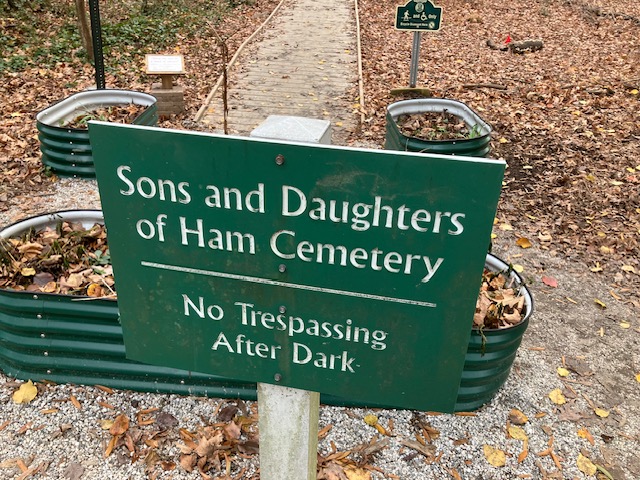
Since 2017, Mrs. Rollings has been the steady spirit for recovering and restoring The Sons and Daughters of Ham Cemetery. This historic African-American cemetery is compactly scrunched between the city of Richmond’s Bandy Field, the University of Richmond, and the beginning western edge of Henrico County.

Photo by Bill Pike

Mrs. Rollings knows every square inch of the cemetery’s history including the Revolutionary War, B.W. Green’s Huntley Plantation, Dahlgren’s Raid in the Civil War, and its founding in 1873.

After the Civil War and emancipation, members of the Bradford family, who had worked on the plantation, purchased property along Battalion Road which would later be renamed as Bandy Road. These land purchases led to the expansion of the formerly secret slave organization, the Sons of Ham. Some members of the organization built homes along Battalion Road. These land purchases also included a section designated as burial grounds for the family of Moses Bradford, Sr. and members of the Ham Council.

Seventeen years after the establishment of the Ham Council, Richmond’s Maggie Walker played a significant leadership role in helping to forge an agreement between the Independent Order of St. Luke and the Ham Council. This was seen as a consolidation of St. Luke with smaller independent societies.

For over fifty years, the Ham Council successfully oversaw the building of homes along Bandy Road, including properly maintaining the cemetery. Then in 1955, a significant intrusion occurred. The City of Richmond wanted the property to build a school. City officials imposed eminent domain. They forced the Bandy Road residents out, razed their homes, and also flattened most of the Civil War earthworks on the property.

Ironically, the school was never built, but the disrupted residents relocated to Bon Air, western Henrico, Northside, and an area around Westwood Baptist Church.

Eventually, that 1955 disruption had an impact on the cemetery. For the Ham Council families who had been forced to move, their ability to properly maintain the cemetery diminished.

That failed upkeep slowed Mrs. Rollings in her effort to locate the burial grounds. She stated, “I lived two blocks away from the cemetery, and the years of decomposing leaves and overgrown vegetation prevented me from finding the cemetery.”

In 1998, the city made an attempt to sell the property. On another front, the University of Richmond pushed an effort to acquire the Henrico County cemetery. Fortunately, efforts by the Friends of Bandy Field and members of the Bradford family prevented these potential purchases.

By 2019, Mrs. Rollings had successfully completed and filed the required paperwork so that the cemetery was incorporated as a nonprofit.

In 2021, Mrs. Rollings was filing more paperwork. This time, she was in pursuit of grant funding from the National Trust and the Virginia Outdoors Foundation. Once again, her historical knowledge of the site and her vision for what the grounds could become helped her to win grants from both organizations.

Much progress has been made in locating and cleaning up the site. But, this is on-going seasonal work that requires volunteers to maintain the property on four annual cleanup days. Friends of East End Cemetery, Henrico County employee volunteers, the University of Richmond, boy scouts, and a variety of non-profits and individuals have helped with the cleanup days.

One Boy Scout developed his Eagle Scout project to construct a much needed bridge. Also, Mrs. Rollings noted that significant interaction and help has occurred with Oliver Hill Scholars from the University of Richmond as well as the school’s archaeology department.

I asked Mrs. Rollings if there was a total for the number of grave sites on the property. Depending upon the source, she estimated that 50 to 100 souls are interred.

Yet, despite those estimates, only two grave markers remain. Sadly, from time to time vandalism has been a challenge. Yet, the two remaining markers are significant. One marker honors Private Moses Bradford, Jr., a Buffalo Soldier, and son of the founder of the Sons of the Ham Council. The other marker remembers Queenie Bradford Johnston, the granddaughter of that same founder. Queenie’s father had also toiled on the plantation.

With its founding in 1873, this year marks the sesquicentennial for the cemetery. For Mrs. Rollings, this 150 year birthday is the perfect time to recognize the history, the cleanups, the pathways, and signage improvements that have taken place since 2017.

From Mrs. Rollings’ vision there is much more to come in the future. She acknowledged the opportunity in working with an archaeologist to uncover more grave sites, the creation of a memorial garden on the site to help slow down the busyness of our lives, and an augmented reality program that will use a QR code to give visitors a deeper insight into the history of the Sons and Daughters of Ham.

When it comes to this piece of property, Marianne Rollings is a veritable history book. She has truly embraced one of her mantras in the restoration of this property: “every acre counts.”

If you or your organization would like to assist in making every acre count, you can contact Mrs. Rollings via this email: hamcemeteryrva@gmail.com

Author’s note: This piece was published in the Henrico Citizen as an At Home In Henrico column on Wednesday, June 21, 2023. A special thanks to publisher/editor, Tom Lappas, for taking the risk to run the piece in the paper.

Excommunicated with love

It is an honor to be with you this morning.

You know, there is always a back story when a person is asked to pinch hit on a Sunday morning for the clergy staff.

Back on May 9, in a staff meeting, Brian, Hung Su, Judy, and Aaron figured out that Annual Conference would be a obstacle in trying to prepare a sermon.

And they also reasoned our new associate pastor, Daniel, would have the same challenge. Plus, Daniel doesn’t officially start at Trinity until July.

And after thinking a bit further, they concluded— since old Bill wasn’t at this staff meeting, it made perfect sense for him to be assigned to bring the message on June 18.

So here I am.

Before we start, let me make a disclaimer.

My college degrees are in English and School Administration, not theology.

And before I finish this morning, it is very likely that I’ll be excommunicated from the Methodist Church.

So, you’ve been warned.

Let us pray: Father of us all, help us to know and feel your presence as we ponder the scripture. Amen.

Our Lectionary pals have selected Matthew Chapter 9 beginning at verse 35, pushing into Chapter 10.

At home, when I read my wife’s prehistoric Bible from college, I use a highlighter to mark words, phrases, or sentences that resonate with me.

I think our pew Bibles would be shocked in disbelief if we actually pulled them out, brushed off the dust and cobwebs, and used a highlighter to note words that resonate with us.

If we actually performed that highlighted reading of verses 35-38, you might be drawn to these words: teaching, proclaiming, healing, compassion, harassed, helpless, harvest, workers, few.

Jesus was always teaching and proclaiming.

He had a compassion for the harassed, the helpless, and Jesus offered healing to those in need.

Additionally, Jesus was a keen observer of people. He could sense when people were rudderless— “sheep without a shepherd.”

And he pushes that further by noting, a good harvest needs many workers, not a few.

Nudging a bit further, Jesus encourages his disciples to send out workers into the harvest field.

At this point, Jesus is thinking to himself— these disciples have been hanging around me, watching me work the crowds. They’ve seen me interact with them.

They heard my teaching of parables, and they have witnessed my ability to heal.

I think it is time for me to put them to work.

Jesus calls a staff meeting, a sales meeting, a departmental meeting, a faculty meeting, and says to his disciples: “Hey you guys, I’m giving you the authority to drive out “impure spirits, and to heal every disease and sickness.”

In further defining his orders to the disciples, he specifically tells them: “Do not go among the Gentiles or enter any town of the Samaritans. Go rather to the lost sheep of Israel.”

Again, I’m not a theologian, but in Matthew Chapter 5, Jesus advises his followers to “love your enemies,” and in Matthew Chapter 22 he tells them to “love your neighbors.”

Yet, in his orders to his disciples, his focus is not on loving your enemies or neighbors, his team of twelve is to only focus on those “lost sheep of Israel.”

You don’t want me to sort out overlooking the Gentiles and Samaritans in Jesus’ thinking.

Slackers who miss a staff meeting are only given so much time to attempt to reel in a congregation and make a couple of points.

I’m sure Jesus had very specific reasons to focus his disciples on the “lost sheep of Israel.”

But here is what I’m wondering, are you, me, we, us still like those “lost sheep of Israel”?

Here’s why I’m asking—aren’t we still conflicted in reaching out to love our enemies and our neighbors?

No matter how hard we try, or say we’re going to try to get along, we’re still a mess.

Look at our so called “united” Methodist Church.

Heck, fleas annoying a hound dog under the summer shade of a sycamore tree are more “united” than we Methodist.

Declines in attendance, shrinking financial support, our country’s political divide, human sexuality, our interpretations of the scripture related to human sexuality, the pandemic, and disaffiliation have impacted our Methodist and Trinity “unity”.

Perhaps, you recently saw this headline: The Importance of Religion In The Lives of Americans Is Shrinking. This headline came from a recent survey by the Public Religion Research Institute.

This research collected data from 6,600 adults in all fifty states.

The leading takeaway: “Just 16% of Americans surveyed said religion is the most important thing in their lives, that’s down from 20% a decade ago.”

The CEO for Public Religion Research Institute, Melissa Deckman, stated: “Americans are becoming increasingly likely to become religiously unaffiliated.”

Despite this decline, the researchers also found a strand of hope— “for people who do still attend religious services, they say they’re optimistic about the future of their house of worship.”

How about it Trinity, those of you in the Sanctuary this morning, and those who are watching at home, are you optimistic about our future?

What gave Jesus optimism when he looked into the eyes and souls of his disciples?

Maybe, Rainn Wilson has some insights about what Jesus saw in his disciples and the people they encountered.

I recently watched an interview with actor Rainn Wilson. Mr. Wilson was in the sitcom, The Office, where he portrayed Dwight Schrute.

On May 24, Mr. Wilson was being interviewed about his new book—”Soul Boom: Why We Need a Spiritual Revolution.”

From his book, the interviewer noted, Mr. Wilson writes that as a culture, we have “discounted spirituality, moved away from faith, and moved away from the sacred.”

Mmm, might Mr. Wilson be describing the “lost sheep of Israel”?

I’m not sure. But, Mr. Wilson also suggest that we need to return to those common threads found in religion.

Mr. Wilson understands why people have left religion and the church.

However, he stated the following: “But there are spiritual tools at the foundation of all of the world’s great faith traditions that we can draw from that can transform our lives, and, more importantly, that we can use to help transform our society.”

In our scripture reading this morning, isn’t that what Jesus is hoping will take place from his teachings, and the work of his disciples—the transformation of our lives and our society?

Is this what the optimistic churchgoers see in the future from the survey conducted—an opportunity to transform lives and society?

Today being Father’s Day, I wonder how much time fathers spend dreaming into the future and contemplating if their daughters and sons will have an opportunity to transform lives and society?

When I served as principal at Lakeside Elementary School, I have never forgotten the day in the cafeteria when a young man looked up at me, and stated, “my daddy is in jail.”

The sting of those words made me wonder how different my life might have been if my father had been incarcerated.

My father was a high school graduate and a Veteran. He was one of ten children in a family who worked as tenant farmers in Alamance and Guilford counties in North Carolina.

In that setting, my father learned quickly the merits of hard work and sacrifice. Those attributes allowed him to become a very successful life and health insurance salesman.

And there was something else stirring my father’s heart and soul—an unwavering faith and trust in God.

Despite losing his oldest brother in WWII, losing his job when a new opportunity failed, and losing his wife to cancer, he never lost his faith and trust.

How about Trinity, when you cast a glance at Trinity do you see opportunities in our future?

Is there a harvest, a rebound, a redemption, a comeback for this church?

What does our Senior Pastor, Brian, see when he looks at us?

If we are going to continue to move Trinity forward, we need to restore our faith and trust in God, but we also need to reestablish our faith and trust in each other.

Rightly or wrongly, Jesus trusted his disciples to go out into that field and harvest the lost sheep.

I’m sure that was a tough assignment, and it continues to be an even tougher assignment for churches today.

So how do churches, how does Trinity survive and move forward?

I’m no expert on anything. But during the last twelve years, the following thoughts keep pinging in my old noggin’:

What might we learn from Brian Shallcross, the General Manager of the Bowie Baysox about “discretionary time” and its impact on young families?

We must be aware of the “under forty barrier.” What do we offer to people at Trinity and in our community who are under forty years old?

How can Trinity become better at sharing and telling its congregational stories?

Getting to know a person’s story shouldn’t happen by reading the person’s obituary.

How do we know if our forms of communication are efficient and effective?

Are we listening and communicating with the people who watch our Sunday worship services on-line?

No matter how creatively a church staff works to develop a program or an event, the success of that event depends upon one essential element—volunteers. How do we recruit volunteers without pestering them to death?

Anne Sullivan once stated: “We are afraid of ideas, of experimenting, of change. We shrink from thinking a problem through to a logical conclusion.”

Churches must stop fearing and shrinking from our need to change.

Sam Jones in reflecting about his Boston Celtic teammate, John Havlicek, said this: “The one thing that got to me, he, Havlicek, never got tired.”

Coming out of the pandemic, Trinity can’t afford to get tired. We must nudge and inspire each other to keep moving, keep working. We can’t stop.

Long time Trinity member, Mary Ann Robins, says that our building has “good bones.” I agree.

But, to protect those “good bones,” we are obligated to take care of all interior and exterior surfaces linked to those bones.

And I’ll stop with this, Trinity to die, we must erase from our minds these words: “ Because that’s the way we have always done it.” Churches with that mentality—die.

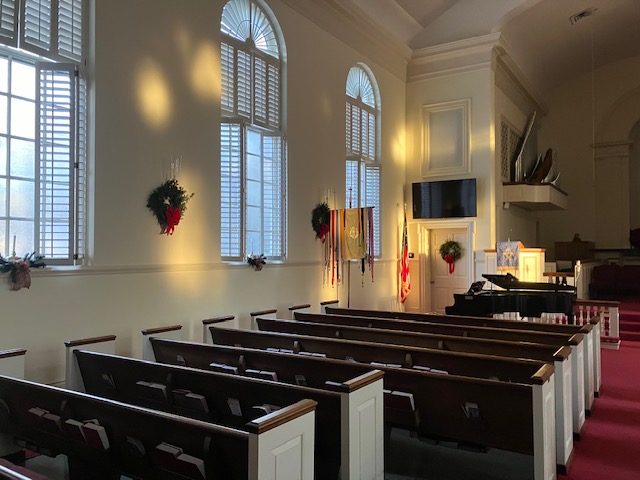
One of the best things about this Sanctuary is how sunlight filters through the shutters.

Sunlight coming through the shutters. (Photo by Bill Pike)

That sunlight makes me think about our congregation.

How many times in your lifetime has your heart been a source of light for the person sitting behind you this morning, a weary neighbor, an estranged relative, a lost stranger, and even the harassed and helpless?

In today’s scripture, I highlighted the words compassion, harassed, and helpless.

Why?

Well, it’s really pretty simple, I need to improve my compassion, my love for the harassed and helpless.

But, I also need to be better at welcoming all and judging less.

Isn’t that at the heart of what Jesus really needs from you, me, we, us?

He needs us to love.

Songwriters Graham Lyle and Terry Britten framed the right question in Tina Turner’s performance of their song—“What’s love got to do with it?”

We know the answer, love has everything to do with it.

I hope I can find the courage and the compassion of my light, my love to the harassed and helpless.

How about you?

Author’s note: Today, I had the privilege of delivering the sermon at both of our worship services at Trinity UMC in Richmond, Virginia. I appreciate the opportunity and the support.

Friday at Trinity, thanks Aunt Evelyn

On Friday, May 19, my day started early at Trinity United Methodist Church.

At some point after six that morning, I opened the building.

I made a quick sweep through the Preschool wing to open doors and turn on lights.

Next, I checked in at Trinity Hall. I wanted to make sure that we were ready for a meeting of the James River Art League.

Additionally, Friday is the day when church members can drop off food donations for three local Methodist church based food pantries.

We appeared to be in good shape for these two activities.

I grabbed the key to our 2012 step van so that I could move it to our parking lot at the corner of Rock Creek Road and Forest Avenue. By parking here, we hope to reduce the chance for some knucklehead to attempt to steal the catalytic converter for a second time.

I checked in with our head building caretaker, Ronnie Johnson, and then I went back home for breakfast.

One of my goals today was to complete overdue work on the church’s grounds.

I made it back to church for a nine o’clock meeting with a sales representative from the local company that we purchase a variety of supplies for operating the building.

This was to be followed with a meeting with a local contractor to review three door projects.

Of course, the first customer for the sales representative talked too long, so he was delayed in arriving.

Just as I was finishing up with the sales rep, the contractor arrived.

After meeting with the sales representative and the contractor, I walked down to Trinity Hall to make sure the technology for the Art League meeting was cooperating. I re-installed the charged batteries for the wireless microphones, made a slight adjustment on the volume, and this group was ready to meet.


I walked back to the church office to check in with our Office Administrator, Paula Cadden, and that’s when a visitor requested admission to the entry hall outside the church office.

A nice gentleman walked in and he wanted to talk with someone about using our building for church services. Building use is one of my responsibilities, so I invited him into the church parlor to talk.

I gave him my card, and explained my role at the church, and he begin to explain his reason for stopping by Trinity.

Professionally, this gentleman worked as a pharmacist for one of our local national chain drugstores.

A couple of years ago, he had helped to launch in Richmond with other Ethiopians—Bethel Church. They have been meeting in this gentleman’s home, but with ten to fifteen members who attend regularly, the leaders have decided they need a bigger space.

Serving as the pastor of this church, he explained how God had been nudging him to visit other churches in proximity to his home and work location in hopes of finding a place to meet.

I explained our building use process, and also, informed him that we already have a small French-Swahili congregation meeting at Trinity on Sunday afternoons.

With that said, I explained a bit further about our inability to support another small congregation.

Not wanting to discourage our passionate visitor, I walked him through some possible alternatives: meeting at a local public school, continuing to seek a meeting spot at a neighborhood church, or I could assist him in arranging a meeting with the local Superintendent for the Three Notch’d District of the Virginia Conference of United Methodist church. This district covers all of the Methodist churches from Richmond into Charlottesville. In Richmond alone, there are close to seventy churches.

Our visitor embraced the last option. I recorded his contact information, wished him luck, and within the next hour, I had sent an email to the Reverend Dr. Hyo Lee outlining the request.

As usual, time was flying, and the grounds work kept getting pushed back.

I had two burned out lights that needed to be replaced one in the connecting hallway to the Welcome Center, and one in a lamp post on the front grounds of the church. Both bulbs were a bit grouchy, but eventually they cooperated in being removed.

With the light work completed, I came back to Trinity Hall as the art group meeting was ending. We worked to get the chairs and tables back to their rightful homes without much trouble.

It was almost two o’clock, and I thought I might be able to head outside, but another failed light caught my attention.

So, I grabbed a ladder and a fluorescent tube, and pried off the plastic cover. With the cover loose, I made a mindless move. I left the plastic covering dangling on the other side from where I was stationed on the ladder. Of course, when I jostled the light tube the cover fell to the hard floor and shattered.

Sometimes, it pays to be a pack rat. In the Trinity Hall mechanical room, I had saved a couple of light covers from a previous project. I grabbed one, and reinstalled it over the light tubes.

It’s pushing three o’clock, but I’m heading outside.


At the back of Trinity Hall, there is Dominion Power easement that slopes down behind the corner of our parking lots. Penn Line cleared it a few months ago, but they failed to take saplings all the way to the ground.

This time of the year, those saplings are sprouting again. I want to keep this area clear of underbrush, so in a little over thirty minutes, I have leveled those sprouting saplings. Maybe on another day, we can reduce the short stumps to ground level.

Next, I walk over to the vacant lot. Our grounds crew keeps the lot mowed, but there are some areas around the old tool shed, under the cherry trees, and down by Rock Creek Road that need to be cleared and made neater.

I was working under the cherry trees, when one of my power tools rans out of battery life. I walked back to the church’s tool shed and grabbed a forgotten tool—a sling blade, also called a grass whip. With a good grip on the wooden handle, its double sided blade easily slices through the underbrush as I swing it back and forth.

In sprucing up this area, I notice a large trashcan that is overflowing by the tool shed. Not only is it stuffed, but it reeks of old waste.

I drag it out into the open lawn and realize the contents are too heavy for me to drag any further.

I reason I need a wheelbarrow, and I walk back toward Trinity Hall to get one. It took me a couple of trips, but I finally emptied the disgusting contents.

After dumping this grossness into the dumpster, I fill a bucket with hot water and a disinfectant and washout the inside of the trashcan. Not wanting a mess like this again, I turn the can upside down and place it on the porch of the tool shed.

Before heading in, I want to weed a mulched area under a tree at the back entrance to the Stuart Hall Road parking lot. It took a few minutes, but I was able to remove all the weeds.

With my tools put away, I took a glance at my phone. I have a text message from Paula Cadden—the sink in the Sacristy is backed up. Just what wanted to hear at five o’clock in the afternoon.

I walked to the Sacristy, and yes, the sink is a mess. My friend, Martie Parch, had used a plunger to try to unstop it, but she had no luck.

Rather than to take the pipes apart under the sink, I opted to try a shop vacuum to suck out the water and debris.

I went down into Eaton and gathered up the shop vacuum. I positioned it near the sink, put the hose over the drain, and turned it on. In a matter of seconds, the water and debris were out of the sink.

I turned on the hot water and refilled the sink, and it would not drain. Again, I vacuumed out the water, and tried the same process to clear the drain—no luck.

At this point, what is left of my feeble old brain kicked into reverse. It sped back to my father’s sister, Evelyn. Evelyn was a gem. We all loved Aunt Evelyn.

A long, long time ago, I recall Evelyn sharing wisdom from a plumber regarding a stopped up household drain. Basically, the plumber stated that hot water and bleach was a possible remedy when a plumber wasn’t available.

I went back into Eaton Hall where we have a room of custodial supplies and grabbed a jug of bleach.

Carefully, I poured bleach into the drain and filled it level with the surface of the sink. I turned out the lights, and I went home.

On Saturday morning, I was scheduled to open the building for the Choral Boosters from Freeman High School. They were holding a car wash.

After turning off the security system, I walked into the Sacristy to check the sink.

I peered into the drain and noted that the bleach was gone. I turned on the water, the drain filled. I turned off the water, and remarkably with no hesitation the drain emptied.

Again, I turned on the water and filled the drain, and for a second time, the happy gurgling drain cleared.

For good measure, I filled the drain with bleach again, and I silently cheered Aunt Evelyn’s plumber.

By now, you must be thinking, why is Bill sharing this rubbish with me?

Is he searching for a pity party?

Are the challenges of attempting to manage this cantankerous facility and its grounds starting to take its toll on him?

I recently stumbled upon this quote from Helen Keller’s teacher, Anne Sullivan: “I need a teacher quite as much as Helen. I know the education of this child will be the distinguishing event of my life, if I have the brains and perseverance to accomplish it.”

Trinity the building, its grounds, its people are quite the teacher.

My question for me and you, and for any congregation at any church is this: what are we learning from our building, our grounds, but more importantly, what might we learn from the undiscovered silence inside each of us?

Is it possible that in our undiscovered silence, we have the “brains and perseverance” to resolve our destructive differences?

Anne Sullivan did.

She used her “brains and perseverance” to transform the life of Helen Keller.

I wonder if churches have the capacity to do the same?

The Sacristy’s sink (Photo by Bill Pike)

Memorial Day: Under The Shade Of Dogwoods

On the left Joe Andrews, and on the right Mike Cross (Photo by Bill Pike 5/30/22)

The invitation was unusual.

My friend, Mike Cross, invited Joe Andrews, and me to join him at the Veterans Memorial Garden on the grounds of Trinity United Methodist Church in Henrico County, Virginia.

This quiet gathering was to take place on Monday, May 30, 2022—Memorial Day.

All Joe and I had to do was to show up. Mike provided three chairs and three cold beers.

Mike and Joe know something about Memorial Day.

During the Vietnam War, Mike served in the Marines and Joe in the Army. Both made the long journey to Vietnam. Luckily, Mike and Joe survived and returned home to their families.

That wasn’t the case for the 58,220 Americans who did not return home. Consider this perspective. Harrisonburg, Virginia has a population of 52,062. In the Vietnam war, we lost the equivalent of a Virginia city.


On this warm, but pretty May afternoon, I had the privilege of enjoying a beer with two of the finest men I’ve ever known. Under the watchful eye of a graceful American flag and the shade of quiet dogwood trees, I sat and listened.

There wasn’t a lot of chatter about the details of their assignments in Vietnam. I’ve learned enough over the years to respect a Veteran’s right to remain silent about what he might be carrying deep inside his heart.

But just a few feet away from us, sits a bronze plaque with the names George W. Jinkins III, John N. Ranson, and James Oscar Olzer, Jr. In 1974, this garden was established in memory of these three young men from Trinity. They lost their lives in the service to our country in the Vietnam War.

By November 2006, this garden was restored and rededicated as the Veterans Memorial Garden. Among the improvements were new plantings, retaining wall, gravel path, bench, flag pole with lighting, and the marker. Mike Cross and Joe Andrews were instrumental in this transformation.

All parents expect to outlive their children. I can’t imagine the apprehension that the parents of the Jinkins, Ranson, and Olzer families felt while their sons were doing their duty. I know these parents must have been crushed when they received official notification of their losses.

In Pat Conroy’s book, My Losing Season, he writes about Captain Joseph Eubank from Concord, North Carolina. When Pat Conroy played basketball for The Citadel, Captain Eubank was one of the team managers. His nickname was “Rat.”

Captain Eubank was a combat helicopter pilot in Vietnam. In his Huey helicopter, Captain Eubank lost his life coming to the aid of an Army unit that was surrounded by the enemy. Captain Eubank entered into this ferocious firefight three times. It was his third assault that his helicopter was shot down and Captain Eubank was killed.

With great embarrassment, Pat Conroy states: “Not a single member of my basketball team attended his funeral, and we can barely forgive ourselves for that indefensible fact.”

Pat Conroy’s teammate, Doug Bridges, encouraged Mr. Conroy to include Captain Eubank’s story in his book, stating, “your book will not mean anything unless you tell them about Rat. More than any of us, Rat turned out to be the real Citadel man.”

In visiting the Vietnam Veterans Memorial in Washington, D.C., Mr. Conroy carries with him a list of names. When he finds the names on the wall, he takes his fingers and traces them over the names of his fallen friends. Captain Joe Eubanks is Mr. Conroy’s last stop. At this stop, Mr. Conroy breaks down and weeps uncontrollably. (My Losing Season, Conroy, pages 301-302)

Those tears of gut wrenching loss drop all across America on our families.

This past week, at the Historic Woodland Cemetery in Henrico County, I spent a couple days with Trinity member, Ken Hart, furiously running weed eaters around tombstones and grave markers. At these gravesides, African-American families honored their loved ones with inscriptions listing rank, branch of service, and wars served: WWI, WWII, Korea, and Vietnam.

Thousands of miles and years away from the turmoil of Vietnam, I sit under the shade of dogwood trees, with two Veterans whose loved ones shed tears of joy upon their safe return to America.

I’m not a Veteran, but, like Pat Conroy’s fallen friend, Captain Joe Eubank, Mike and Joe mean the world to me.

Their decorum, honesty, perseverance, humble courage, and selfless sacrifice have shaped many hearts.

I’m truly thankful that their fortitude has touched my heart too.

For America on this Memorial Day, I wonder how many of our challenges might be solved by rededicating ourselves to decorum, honesty, perseverance, humble courage, and selfless sacrifice?

Every moment of silence and tear shed on this Memorial Day is grounded in those attributes.

And, we can’t afford to forget them.

Author’s note: Dear readers, if this post offends you because three beers were consumed on the grounds of a church, I apologize. My hope is the post might make us think more deeply about the families who lost loved ones to the horrors of war, and for us to contemplate the decorum, honesty, perseverance, courage, and sacrifice found in those losses. Finally, if this piece touches your heart, I humbly ask that you consider sharing it. Love, Bill

American flag in a brisk wind at the Veterans Memorial Garden Trinity UMC 5/25/23(Photo by Bill Pike)