Tuesday, June 13, my wife emailed me this headline: Anchor Brewing Ceases National Distribution, Discontinues Beloved Christmas Ale.
For several minutes, I kept repeating to myself—I can’t believe this. Eight days later, I can’t still believe it.
I reached out to my wife’s sister and her family in Los Angeles and San Francisco for confirmation. Later that afternoon, I had article links verifying the announcement.
Subsequently, I have told the California family— in the future, don’t come east for a visit without Anchor Brewing’s beers in your suitcase.
I remember in college, Colorado’s Coors Beer wasn’t distributed east of the Mississippi River. People found subtle and not so subtle ways to bring Coors to the East Coast. Eventually, Coors expanded east, and a brewery was built near Harrisonburg, Virginia.
Who knows, maybe clever beer enthusiasts will find the means to distribute Anchor Brewing beers beyond the California borderlines.
My first tasting of Anchor Steam Beer came in the summer of 1980. My wife and I were on a trip to California to visit her sisters and their families. We’ve never forgotten our drive up the Pacific Coast Highway from Los Angeles to San Francisco.
While in northern California, a cousin took us to Los Gatos for dinner at the Good Earth. That’s where I had my first Anchor Steam Beer. I admired the iconic label with the blue anchor, and the copper, amber color of the beer in the glass was a pretty sight.
Years later, when we visited our oldest daughter in Chicago, I always made a trip to Binny’s. Binny’s is a retailer who specializes in beer, liquor, and wine. Binny’s carried Anchor Brewing beers that would never make it to Virginia. One winter, Binny’s stocked a remarkable dark winter wheat beer from Anchor. That beer was one not to be forgotten.
But in 1965, Anchor Brewing was on the verge of being totally forgotten. The brewery was tilting toward bankruptcy, when Fritz Maytag, (yes, from the Maytag appliance manufacturer), rescued the struggling brewery.
With Mr. Maytag at the helm, the brewery regained its footing. Mr. Maytag learned about brewing from the ground up, and he corrected imperfections from the past.
He took the critical steps to improve the hygiene process in the brewing of their beers. Ensuring the integrity of the product and making required investments in new equipment were essential. Woven into those changes was a nudge toward the future. Mr. Maytag positioned the brewery to become an early innovator and leader in the craft brewing industry.
Over the years, the portfolio of beers created by the brew masters is impressive. The quality, handmade craftsmanship of their brewing did not go unnoticed. Other brewers and beer aficionados recognized that something special was taking place at Anchor Brewing.
That specialness was grounded in an appreciation for tradition, but also an untethered capacity to brew new beers beyond the traditional offerings. The brewery’s Zymaster series was an example of brewing beyond the established norms.
Since 1896, Anchor Brewing has continued to survive. Clearly, they have been a part of multiple transformations in America’s brewing history. But, I wonder if this latest decision could be the beginning of the brewery’s end?
In 2017, Anchor Brewing was purchased by Sapporo, a jumbo Japanese brewery. Sensing a potential instability, Anchor brewing employees unionized in 2019. This was followed in 2021 with a total redesigning of the brewery’s iconic labels and packaging.
When a large international brewer gobbles up a smaller brewery, at some point the purchaser is going to take a deeper look into the pennies needed to operate Anchor Brewing. The San Francisco Chronicle article quoted a company spokesman who stated that “seventy percent of the brewery’s sales come from California.”
Shipping beer from California to forty nine states isn’t inexpensive. For example, to reduce distribution costs, some West Coast brewers have built breweries on the East Coast.
Stopping the distribution of its beers outside of California is significant. However, ending the brewing of The Anchor Christmas Ale is an incompetent corporate decision direct from the Ebenezer Scrooge playbook. Not only was the beer a treat, but the label each year featured a different hand drawn tree by artist, Jim Stitt.
Writing to the San Francisco Chronicle about this decision, a former brewer at Anchor, Garrett Kelly said: “The loss of a beer as iconic as the Anchor Christmas Ale, the first American holiday beer post prohibition, is a loss for not only beer nerds like me, but anyone with an interest in preserving culture against the grinding pressure of corporate Darwinism.”
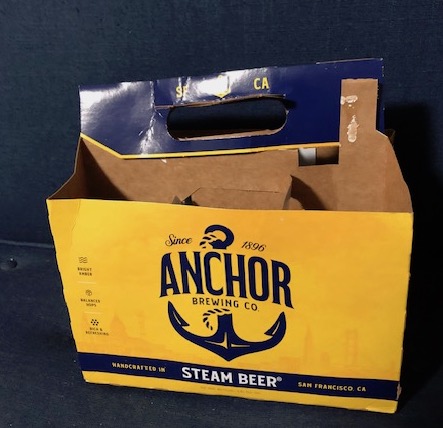
On the afternoon of June 13, I went to my local grocery store. The store had recently started to carry Anchor Steam Beer again. To counter this discouraging news, I decided to purchase a six pack.
When I reached into the cooler to grab the six pack of bottled beers, I nearly experienced a beer fatality.
In the beer industry, the cardboard packaging that carries the beer bottles in called a sleeve. As I grabbed the sleeve’s built in handle, one of the glued seams failed and separated. I almost dropped a six pack of beer on to the hard surfaced terrazzo floor.
Luckily, despite my age, my reflexes were quick enough to catch and control the six pack before it crashed to the floor.
Not wanting another Anchor loyalist to have a similar scare, I let the store’s manager know my experience.
I came home, took out a pint glass, opened the bottle, and briskly poured the beer into the glass. In appearance, my old friend looked just as fresh and healthy from my first pour in Los Gatos 43 years ago.
Since Tuesday, I’ve thought a bit more about the failure of the glued seam on the six pack sleeve.
Was that the caused by a combination of temperature changes and humidity levels, or was this a Sapporo penny pitching decision—a less sturdy grade of cardboard and a watered down adhesive?
I’ll never know that answer.
If I was a lot younger, maybe I would organize a boycott or an interception of Sapporo beers in America.
Sometimes, James Thurber’s Walter Mitty, takes over my imagination.
I imagine that I’m the leader of a squadron of F-18 pilots from the United States Air Force, and I follow orders to intercept a commercial transport airliner loaded with Sapporo beers headed for America. The squadron escorts the plane back to Japan.
Or, I’m the commander of a team of Navy SEALS, and we seize a cargo ship loaded with Sapporo Beer that was headed for the port in San Francisco. That seized Sapporo beer is shipped to gardeners in America’s southeastern states where the beer will be used to kill slugs in flower gardens.
Luckily for Sapporo, my Walter Mitty intrusions are only harmless daydreams. But if my rock slinging pal from the Andy Griffith Show, Ernest T. Bass, gets riled up over the Anchor Brewing story, then all I can say is protect your windows.
I recently came across a few single cans of Sapporo’s Premium beer in the import section of a store that specializes in the selling of beer and wine. When I picked up this 22 ounce can of beer, I was surprised to read that the beer had been brewed in the Long An Province of Vietnam.
Upon further review, I learned that Sapporo uses the former G. Heileman Brewery in La Crosse, Wisconsin to brew its beers for American consumers. Perhaps that explains why the cost of one can of Sapporo Premium Lager was only $2.99.
Additionally, brewing their flagship beer in Wisconsin, makes me question Sapporo’s loyalty to it own brand and the legacy of their brewers in Japan.
From what I can tell, media coverage of the Anchor Steam distribution has been sparse compared to the coverage given to the decline of Anheuser-Busch’s Bud Light after the company pushed its best selling beer into “a social media promotion with a trans influencer in April 2023.”(NPR)
Ok, enough whining.
At this point, I will cling to the hope that family members in California will have empathy on an old geezer and smuggle Anchor Brewing six packs in their suitcases when they fly to Virginia.
Yes, I’m disappointed in this boneheaded Sapporo decision.
But, I’m hoping the loyalty and persistence of Anchor Brewing employees, and its now California only consumers will sustain the brewery beyond Sapporo’s mindless meddling.


This is NOT baloney at all! I feel your love for beer 🙂 I had a Heineken last night to celebrate my daughter’s 32nd birthday. Cheers 🙂
LikeLike