Hawaii Day Four: acknowledging

I had been waiting for Wednesday, January 24 for thirty seven days. Back on December 18, 2023, I had two surgical procedures performed on my left eye.

Not until, January 15 did the eye surgeon grant me permission to start exercising again. Luckily for me, that first run would take place in a quiet neighborhood in Waialua, Hawaii.

Courtesy of Santa, I had packed in my suitcase a new pair of running shorts. My how the design of running shorts has changed over the years. These shorts were roomy with a liner, two standard pockets, plus an extra zippered pocket for carrying lightweight valuables.

One of my running shoes has my home address on a special tag velcroed to a shoestring. When I run out of town, I always carry with me the address of where I’m staying. That is just in case I lose my mind, a wild animal decides I’d make a suitable meal, or the driver of an eighteen wheeler dozes off and turns me into a pancake.

This morning, I’m going to revisit a familiar route. The town of Waialua has a paved two lane trail for walkers, runners, and bicycle riders. The trail empties out into a quiet neighborhood. At that point, I’m on a narrow, one lane road with multiple speed humps.

In that neighborhood, on my right will be ocean front homes that have the Pacific Ocean as their backyards. A few of these houses are historically significant to the area. On my left are small farms, green space, and standing in the background are the stunning Waianae Mountains.

I walk out to the main road, crossover to the path on the other side, and wonder if my legs will know what to do.

As I start, my gait is awkward, a bit unsteady. My mind is thinking what are you doing? Slowly, with each step, each stride, the legs start to regain a bit of confidence.

I greet other walkers, runners, and dog walkers. The trail ends, and I’m entering the neighborhood. I pause on the left side when cars fill the narrow, single lane road. A father rides by on a bike with two youngsters safely in place. One is to be dropped off at the nearby elementary school. At some point, a rooster and a couple of chickens scurry by in front of me.

Even though I did a bit of stretching before I left the house, my aging brain has already acknowledged tomorrow, Thursday—my legs will be sore.

While I am powerfully tempted to make the full neighborhood loop that I made on a previous Hawaii visit, the rational part of my brain talks me out of it. I go to the end of the street, and then start retracing my steps back to the house.

On the way back, I startled two beautiful small yellow birds out of a shrub. Their ascent is as fast as a jet fighter leaving the flight deck of an aircraft carrier. My old brain is feeling the warm, humid air. Like a kid on a long road trip, the gray matter is asking me how much further?

Back on the path that parallels the Waialua Beach Road, I see my landmark coming up for my left turn on to Kaiea Place. I stop, stop my watch, look both ways, and cross the road. My run time was 35:46.

I walked back to the house, gulped a glass of water, and quickly fixed breakfast. Our group had decided to be adventurous with a hike out to Kaena Point.

Kaena Point is a cherished park. The hike can be challenging, but at the end, hikers enter a protected nesting compound for the magnificent seabird, the albatross.

Driving out to the park entrance, we see grounds used for playing polo, an airfield that specializes in gliders, and a variety of scattered homesteads.

Once out of the van, with great energy we start the hike on the Coastal Hiking Trail. From this footpath, hikers are afforded postcard perfect views of the Pacific, and the shoreline it has created for centuries.

The Beach Boys’ drummer Dennis Wilson titled his first solo album, Pacific Ocean Blue. Today, with bright sunshine, a robust wind, and a churning surf we are treated to the blue hues of this mighty ocean.

One of the pretty views on the hike to Kaena Point. (Photo Bill Pike)

Our footing near the shore line walks us over a combination of sand and eroded lava rock. At some points, the hard-wearing wind blasts our ankles and shins with sand. Also, sporadic saltwater drops blown from the crashing waves to our right gently land on us.

But before we change the trajectory of our path, we come upon a beached seal resting in the soft sand. The seal is motionless. We wonder if the seal is alive.

Our resting seal. (Photo Bill Pike)

As Betsy, steps quickly past the seal, she is startled by a hasty snort from the seal. We interpret this exhaling as a territorial warning—I’m still alive.

Eventually, we adjust our trek toward the 4WD access trail. This adjustment improves our footing and gives us more exposure to a variety of blooming native plants.

Native plants along the trail (Photo Bill Pike)

With steady determination, we make it to the entrance to the gated and fenced protected area for the albatross. We opt not to make the full loop around this enclosure, and that’s ok.

Nesting area for albatross. (Photo Betsy Pike)

Because in the scrubby landscape, we spot a few quietly nesting albatross. And before we turn around, a couple of the albatross with their long wings like glider planes sail into the gusty wind. Wilbur and Orville Wright would admire the efficiency of their perfectly created wings.

On the way back, we made one wrong turn, but we quickly reversed our misdirection and found our bearings again. I’m certain our aging bodies silently cheered when our eyes could see the rooftops of cars in the parking lot.

Back in the van, we decided to refresh ourselves by finding nourishment at multiple parcels of food trucks along the Kamehameha Highway in Haleiwa.

With our lunches in tow, we drove back to the house, enjoyed our chosen meals, and set a departure time for the drive to the Waimea Valley for the Tao Luau.

By the time we left the house for the five o’clock performance, the rain had showed up. The raindrops didn’t dampen the spirits of our hosts when we arrived at the theater.

They moved the traditional cultural demonstrations inside. We were taught how to make our own headgear from weaving long, narrow leaves together. These leaves reminded me of the snake plant back home .

The luau is a treat. The narrative from beginning to end captures Hawaiian culture and heritage with dignity, appropriate humor, and highly skilled performers. We had a very enjoyable evening for lots of reasons, but I credit the host of the evening for setting the right tone.

The luau space is intimate without being overcrowded. The tone set is grounded in acknowledging an easy give and take from the performers to the audience. A wholesome relationship is built by incorporating very simple, but meaningful values of dignity and respect for people.

We left in good spirits.

Fire handlers at the luau (Photo Bill Pike)

We arrived back at the house and collapsed.

We needed sleep.

But before I dozed off, my brain returned to the tone of the luau. I kept thinking about how the host for the evening gracefully made a point about the importance of acknowledging.

A part of acknowledging is recognizing that respect for basic human values appears to be quickly slipping away from us in this cantankerous old world.

I wonder what impact dignity and respect might have on us in acknowledging the challenges we face?

Might dignity and respect provide us the better footing to find the path for working together to solve our challenges?

Lent: “I’ve been down this road before.”

On the morning of Saturday, December 16, 2023, I went for a run in our neighborhood. I took my 3/28/2011 route.

This route takes me thirty five to forty minutes to complete. Because of scheduled eye surgery on December 18, I would not be permitted to run during the recovery.

The surgeon knew that asking me to be inactive for over a month was going to be a challenge. Yet, I was a good patient, and followed his guidelines.

Turns out, the waiting was worth it.

On January 24, my first post-surgery run was in Waialua, a quiet town on the Hawaiian island of Oahu.

In Waialua, the temperature was in the low 70s when I started my run. I was running in shorts and a t-shirt.

Back on December 16, it was a clear, cold 33 degrees with a coating of frost that morning in Richmond. Running shorts and a t-shirt weren’t going to work on that pre-winter jog.

From our trip to Hawaii, I returned to work at our church, Trinity United Methodist on Monday, February 5. I think I’m still catching up. Time is not cutting me any breaks. We are already in the season of Lent, and March is closing fast on February.

American singer/songwriter, John Prine, passed away on April 7, 2020. Before his death, Mr. Prine recorded one last song titled “I Remember Everything.” This song is vintage Prine. It is a pretty tune with heartfelt lyrics.

The opening line—“I’ve been down this road before,” will resonate with us. As we all have been down familiar roads before.

I feel that way about Lent. I have been down this Lent road before. And to be perfectly honest with you, I’m not much of a Lenter. Truth be told, some days, I wonder if I’m much of a Christian. I might more closely align with the denier Peter, or the doubter, Thomas.

I see restless, judgmental, harmful tendencies in our world today. These tendencies are similar to what hounded Jesus during his last days on earth. For the life of me, I struggle everyday to understand— why are we so divided and unwilling to find ways to work together?

Despite our divisions, churches still attempt to reach people. On Ash Wednesday, our church offered drive thru ashes, kept the chapel open all day for anyone who wanted or needed a few minutes of solitude, and we finished the day with an Ash Wednesday service.

The internal voice in my old sack of bones often whispers to me, “Bill, you need to go for a run.” When I hear that voice, I work to carve out time for a run.

So on the morning of Ash Wednesday, I went for a run. I chose my Wood and Bryn Mawr route. These roads have steep hills.

I timed my beginning in hopes that I might enter the front drive of our church in time to receive the cross symbol of ashes on my forehead.

My timing was good. As I turned left off Stuart Hall Road onto the front drive of our church, Pastors Brian and Judy, were coming down the steps of the Welcome Center.

In the cold, bright sunlight, Pastor Brian from the container of ashes etched the cross on my forehead. He said these words: “Remember that you are dust, and to dust you shall return.”

With some acknowledgement of thanks from me, I regained my running stride and headed toward Rock Creek Road.

I really don’t remember participating in Lent activities when I was growing up. Easter yes, but Lent no.

Maybe that’s why Lent and I struggle. But, it is more likely that I struggle with Lent because I don’t understand how an innocent man could be crucified while leaders looked the other way.

Sadly, we have been down the looking the other way road before.

The Cross and The Lynching Tree by James H. Cone captures this struggle from a theological and human perspective. I wonder what might happen if The Cross and The Lynching Tree were required reading for every human being? Would you, me, we, us could become less divided, less judgmental, and kinder from reading this book?

Over the last couple of days, perhaps you read about the passing of former college basketball coach, Lefty Driesell. Even with his accomplishments, Coach Driesell encountered some difficult and disappointing human moments during his career.

In a 2017 interview with Sports Illustrated, one of Driesell’s standout players at the University of Maryland, Tom McMillen, said this about his former coach: “He was just an incredible force. He was like a dog that grabs your pant leg and won’t let go. He’s just unyielding.”

On the morning of Saturday, February 17, I arrived at Trinity to open the building for Upward basketball and cheerleading. While opening up, I received a text from two neighbors who walk our grounds early in the morning. The message was to alert me about an unknown car parked in our back parking lot.

I completed my opening chores, and then I walked out to check on the vehicle. I took an indirect route for my reconnaissance patrol. What I discovered was a woman wrapped up in a comforter on the backseat asleep.

While I couldn’t be certain, I’m almost sure this is a homeless person who sometimes parks on our grounds for quietness and safety.

Thankfully, I thought to myself being homeless is one road I haven’t been down, and yet, I asked myself where am I in working to solve the homeless issues in America?

What might happen to our country if our time, energy, and effort didn’t go into our restless, judgmental, and harmful division?

What might happen if you, me, we, us directed our energy into solving problems with the same tenacity as the unyielding dog who grabs a hold of a pant leg?

Wasn’t Jesus like that unyielding dog in his pursuit of teaching us about the requirement of love in all types of environments and human circumstances?

At this stage of my life shouldn’t I be tired of traveling down the same dead end road that is littered with unsolved problems?

Maybe it is time for you, me, we, us to ponder a lesson from the Ted Lasso playbook related to a game of darts.

What might Lent become if you, me, we, us were more curious rather than more judgmental?

What might happen to poverty, food deprivation, homelessness, addiction, racial injustice, education, mental health, physical health, and unemployment if you, me, we, us stopped underestimating our human capacity and became more curious about solving our challenges?

For me, the parable of the good Samaritan is the best road story in the Bible.

I’m curious about the Samaritan—what nudged him to stop?

Where did he learn about compassion?

Who taught him about sacrifice?

Why was he curious?

What kept him from being judgmental?

In his own humble manner, wasn’t the Samaritan unyielding like the dog who will not let go of the pant leg?

Maybe on one of those days when my internal voice suggests that I go for a run, I will finally confront myself to reason out a commitment to be more curious, more devoted, less judgmental, and unyielding.

Maybe as I travel the roads I’ve been down before I can become more like the good Samaritan.

Isn’t that exactly what Jesus needs you, me, we, us to do?

Bill Pike post-run selfie(Technical assist Andrew Pike)

Hawaii Day Three: history

I slept, but I woke up at 3:00 a.m.

I couldn’t get back to sleep. After all, back home in Richmond, it was 8:00 a.m.

So, I quietly organized myself. I tread lightly on the beautifully stained wooden stairs into the open den. From those twelve stair steps, I took the short walk to the two step stairs that lead into the kitchen.

I’m sorry, but I selfishly love the stillness of this time. I scurried through my devotional routine, scribbled barely legible handwritten notes for a weekly church video, and then opened up my old laptop.

In the predawn darkness, I heard a burst of bird chatter. My watch said 5:25 a.m. I didn’t hear the bird sounds again. I assume that a bird elder said to the early chirper, go back to sleep, your too early.
I tried that self-talk with my old body, but sleep resisted me.

At some point on Monday, I blurted out to our friends—“I can’t believe it is the middle of January, winter, and I’m sitting on a porch in shorts, with tropical breezes rustling palm tree branches, and the Pacific waving to me in the distance.”

And yet, here we are.

The birthing of this trip came from Butch’s wife, Marian, something about an early 50th wedding anniversary celebration. The years, 1975 and 1976, were our starting dates for the long road of marriage.

Soon, the talk became more serious, and in fairly short order our three commanders confirmed this plan.

This first week, we have the privilege of staying in the beautifully renovated vacation home of Betsy’s sister, Abby, and her husband, Art. The second week, we board a Norwegian Cruise Line ship for a tour of the other Hawaiian Islands.

Today, we met our 8:30 a.m. departure time. We piled in the van. With the steady Reverend Sherrill, as our driver, and essential front and back seat navigators, we were driving into Honolulu. We had two destinations—Pearl Harbor and the National Memorial Cemetery of the Pacific.

Aside from missing one exit, we made it to Pearl Harbor. At 9:50, we were scheduled to board one of the shuttle boats for the ride over to USS Arizona Memorial. We heard simple guidance from National Park Service personnel, and as we prepared to board the shuttle a quiet, stillness settled over us.

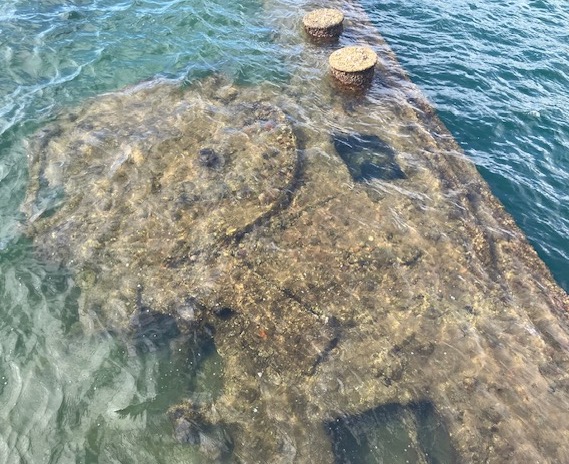
USS Arizona quietly at rest in Pearl Harbor (Photo Bill Pike)

As our friend, Dan Callow, pointed out at the end of the day—“the whole time we were at Pearl Harbor this morning, I kept thinking about what it must have been like to be in this harbor back on December 7, 1941.”

A docent in the center of the Arizona’s memorial, helps visitors understand the fury of the life ending attack. His words reinforce the horrific toll of war. This is also driven home with the exhibits and assorted media presentations at this national memorial.

Another takeaway from our visit, came from my college roommate, the Reverend Sherrill, with what he describes as “I didn’t realize moments.” A visitor could easily spend hours, or days pondering those moments.

We found our way back to the parking lot. A driver looking for a parking space was trailing us. Little did he know that it takes even young senior citizens lots of minutes to reload into a van.
With steady, efficiency, we found our way to the National Memorial Cemetery of the Pacific.

I sense this remarkable memorial is overshadowed by Pearl Harbor. I understand why. I’m no travel expert, but I would tell anyone who makes the trek to Hawaii—you must, must visit both memorials.

I often marvel at the vision of people who can look at a unique piece of land and figure out how to transform it into a hallowed space. That’s what took place on this land at the Punchbowl Crater.

Yes, in terms of documenting history, there is lots to take in with the stunning mosaic displays. But, there is something exceptional about the grounds of this memorial. Even with this second visit, my heart can feel the care that went into creating the landscaping, the magnificent vistas, and the dignity of the stone memorials to honor the fallen.

And you must make the walk to the overlook, you will never forget it. The overlook allows you to cast your eyes upon the city of Honolulu and the Pacific Ocean.

From the Punch Bowl overlook (Photo courtesy of Dan Callow)

It was approaching one, when we loaded back into the van. Now, we were going to be brave and drive back into Honolulu in search of its famous Waikiki Beach and lunch.

Once we found a parking space, we had lunch at an unlikely location— the second floor open terrace of a Tommy Bahama store.

After lunch, our curiosity overcame us to check out the local ABC store that we kept seeing frequently. Yes, they did sell liquor at the ABC store, but this was basically a modern general store for tourists. Sadly for the owners, we made no purchases.

Finding our way to the famous Waikiki was more challenging. The big hotels made access discouraging. One public access point was closed. Yet our persistence paid off. We found a sunshine covered sidewalk that took us down to see the famous shoreline.

After this glimpse, our attention turned to traveling home to Waialua. Fortunately, a collective sense of direction led us to the parking garage, and even better we found the van.

Getting back to Waialua gave us the experience of exiting Honolulu during its rush hour. Nerves of steel Sherrill brought us back to Waialua safe and sound.

At some point, we had a quiet dinner of leftovers.

Plans were sketched out for Wednesday, and we all headed off to find some sleep.

Before dozing off, I thought about how sleepy and calm Pearl Harbor had been on December 7 prior to the attack.

Honolulu has changed so much since 1941. Its previous uncluttered skyline is now dominated by high-rise hotels and all types of commercial buildings.

I’m thankful to be out in here in the country pace of Waialua away from the hardscape backdrop that frames the famous Waikiki Beach.

And as I wait for sleep to find me, I can’t erase the sacrifice that we were reminded of earlier today.

At the National Memorial Cemetery of the Pacific, these words caught my attention at the Dedication Stone:


“In these gardens are recorded the names of Americans who gave their lives in the service of their country and whose earthly resting place is known only to God.”

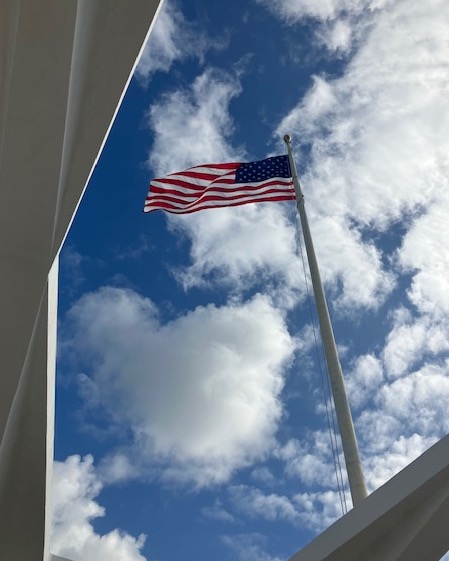
American flag from the USS Arizona Memorial (Photo Bill Pike)

On Valentine’s Day, how is your heart?

Could be today, tomorrow, or twenty years from now, but I know at some point my heart will beat for the last time.

I wonder what my heart will be thinking on that last beat?

While I’ve tried to be good to my heart, I know I had many days when worry burdened it.

I’m certain my heart could feel the stress and worry inside my soul.

That stress and worry wears on a heart.

All my years in school buildings impacted my heart.

In those school settings, I needed a balanced heart—not too soft, not too tough, and always fair no matter the circumstances. I have days when my old brain revisits challenging moments with students. Their names, and sometimes faces come back to me. Unfortunately, in most of those dealings, the student hadn’t done his/her best thinking. I wonder how life is treating them now?

My heart is still very good at worrying.

John Chapter 14, verse 27 comes to mind: “Do not let your hearts be troubled, and do not let them be afraid.”

I’ll be honest with you, when I think about our world, my heart is troubled and afraid. I don’t know how we can continue to live with such a dangerous division. Will our hearts ever be jolted to stop our perilous slide before it’s too late?

On the afternoon of Thursday, February 8, I was in a meeting that started at 1:30. The meeting was a walk through of a section of our church building that will undergo a significant renovation beginning at the end of May 2024.

The tour was helpful. And I was reminded that the success of the renovation hinges on many factors, but the real key comes down to people.

While walking in and out of classrooms, stairwells, and hallways in the Preschool wing, I caught a glimpse of two hearts. These hearts were pinned with clothes pins to a string where they had been left to dry.


I loved these hearts.

I was drawn to the hearts by the splotches of pink and purple against the white background. And on top of the splotches were lines of pink and purple going in every direction across the heart.

I imagine the students had a good time creating these vibrant, colorful hearts. Whoever is lucky enough to receive one of these pretty hearts on Valentine’s Day should immediately frame it for a lifetime. And that person should look at that beautiful rendering everyday.

Perhaps when you were growing up, you watched the movie, The Wizard of Oz. I loved the movie and the characters who told the story. And there have been many days in my life when I have questioned if I had a brain, an ounce of courage, and a heart.

You might recall what the Wizard of Oz said to the Tin Man as the movie was nearing its conclusion: “As for you, my galvanized friend, you want a heart. You don’t know how lucky you are not to have one. Hearts will never be practical until they can be made unbreakable.”

Everyday, life breaks a heart.

Even though medical advances have found ways to extend the life of a heart, those medical researchers have not found the magic to prevent breaking a heart.

But, no matter the cause, the pain, the trauma, the loneliness of a broken heart beats forever.

A long time ago, I was an overweight, shy fifth grader in Mrs. Cline’s class at Hillcrest Elementary School in Burlington, North Carolina. As Valentine’s Day approached, my mother made sure that I had cards to give to my classmates. I printed my name on the inside of each card.

For some reason, I timidly scribbled “I love you” on the back of Anne Foster’s card. She was a pretty girl, and for all I know every boy in our class scribbled the same words on the back of her card. Nothing ever came of my note, but years later, I did find the love of my life.

During Christmas break from college on a cold winter night in West Hartford, Connecticut, an apprehensive and fearful boy from North Carolina told my future father-in-law that I loved and respected his youngest daughter. I asked for permission to marry this pretty lady.

Thankfully, he didn’t say no. That was one night when the Scarecrow, Lion, and Tin Man could affirm I made one of the best decisions of my life.

Every year, Valentine’s Day comes around to remind us about our hearts and love. I’m sure florists, makers of chocolate candy, and greeting card companies appreciate the business.

And yet, somehow, I wonder why I don’t use Valentine’s Day to assess my heart with these questions:

Is my heart capable of loving beyond my family?

Can I love the unloveable?

Can I love those with whom I have the greatest divide?

Can I love those who are the exact opposite of me?

What might happen in this world instead of me scribbling “I love you” on the back of a Valentine card, if I found the courage in my heartbeats to love the unloveable, the dividers, and the opposites?

Might my heart beat with less trouble and fear if I embrace this approach?

In the time that I have left on this old earth, might the last heartbeat of my life be more content if I become better at loving the unloveable, the dividers, and the opposites like Jesus did?

How about you?

Pretty hearts, courtesy of Trinity UMC Preschool (Photo Bill Pike)

“I don’t want to go to school today.”

January 2024, the second semester of the school year has started for public schools.

Somewhere in those schools a student, teacher, instructional assistant, bus driver, assistant principal, and even a superintendent has whispered these words—“I don’t want to go to school today.”

Even though I’m retired, in my over thirty years of working in public schools, I said those same words.

Not to be forgotten in that mass of education humanity is the parent of a student in our schools who has said—“I don’t want to send my child back to that school today.”

I often ask myself how have we put our students, their parents, teachers, support staff, administrators, and superintendents in such difficult circumstances?

When I started teaching in 1975, I was scarred to death. Quickly, I figured out how to survive. I’m not sure I could endure the levels of pressure and stress that impact our students, their families, and our school personnel today.

No doubt the world has changed since 1975, but why have school environments in terms of safety become more difficult to manage?

I don’t believe this cry of despair linked to school safety will disappear. If we don’t become more solution driven on school safety, we will destroy our public schools.

Too frequently under difficult circumstances related to safety our schools make headlines.

On Thursday, January 4, the first day back to school at Perry High School near Des Moines, Iowa, we experienced another tragic school shooting.

A predictable pattern emerges following these tragedies. Multiple law enforcement officers responded quickly. Often, the shooter dies from self-inflicted wounds. And public officials politely offer condolences and prayers to the families with new broken hearts.

In the aftermath, an investigation will take place. Despite this diligence and findings, somewhere in America another school shooting will occur. How many more hearts must be broken to stop this madness?

Are we foolish to believe that we can actually legislate or metal detect our way back to maintaining safe environments in our schools?

How might those questions be answered, and our school safety improved if we worked to understand how schools are impacted by the following:

A Pew Research Center survey in June 2023 found about four-in-ten U.S. adults say they live in a household with a gun, including 32% who say they personally own one.

In August 2022, the Annie E. Casey Foundation reported nearly 24 million children live in a single-parent family in America. That is one in every three kids.

Clearly, those are impactful numbers that lead to another question—are school shooters impacted by access to guns and family instability?

Writing in Brookings January 2022, Professor Robin M. Kowalski in research conducted by herself and colleagues found: “handguns were used in over 91% of the K-12 school shootings, and almost half of the shooters stole the gun from a family member.”

Whether there is a link to family instability isn’t clear, but Kowalski’s research states: “School shooters are marginalized, rejected. With one fourteen year old shooter stating in court, “I felt like I wasn’t wanted by anyone, especially my mom.”

Additionally, other serious disruptive behaviors occur in schools without the use of weapons.

No matter weapons or other serious disruptions to the school’s environment, these incidents create their own trauma and anxiety for the students, parents, and educators who survive. Even with the fortitude to return to their classrooms, I imagine “I don’t want to go to school today” beats steadily in their shaken hearts.

So, how do we solve our crisis with school safety?

I’m sorry, but there are no simple answers. How can there be uncomplicated solutions when politicians are willing to spend millions and billions to keep professional sport franchises in Washington, DC or lure them to Virginia? What do these lucrative proposals tell us about our priorities?

For our schools and the communities they serve, I believe “I don’t want to go to school today” is genuine.

Its truth is grounded in the crushing reality of our inability to comprehend the impact of the devastating erosion of our families, and our ineffective band-aids related to generational decades of poverty, inadequate housing, unemployment, access to mental and physical health care, and justice.

I hope that “I don’t want to go to school today” rings in the ears and pierces the hearts of every school superintendent and school board member in Virginia and America.

May they be jolted into working cooperatively and tirelessly to develop and implement practical solutions


that will allow every student, parent, teacher, instructional assistant, bus driver, and assistant principal to be safe from whispering “I don’t want to go to school today.”

(Photo by Bill Pike)

Author’s note: If this piece resonated with you, please consider sharing it with a public school educator, or your local legislator.

Day Two: A slow Monday in Waialua

We all needed sleep.

Sunday had been a long, long, long day of travel.

My seventy year old body doesn’t handle eight hour airline flights well anymore.

We slept, but our internal clocks couldn’t release their east coast groundings.

I woke a bit after 3 a.m. I tried to go back to sleep, but couldn’t.

So, I dressed and came down into the kitchen.

After a day’s absence, I reconnected with my daily devotional routine. This was followed by checking emails from home and Trinity UMC.

And a bit after four, another restless sleeper, Dan Callow, came down.

We chatted and reminisced, and somewhere in the fives, Dan’s wife, Judy, joined us.

Dan noted the arrival time for sunrise. Gradually, we worked our way out to one of the decks to look for the sun.

As soon as we walked on the deck, we were taken by the chatter of the birds. They were in lively conversation with each other.

Butch, who was up now, and Dan, quickly turned to apps on their phones that can identify the calls of the birds.

It wasn’t long before we could see sunlight backlighting scattered clouds and the etchings of palm trees.

Sunrise starting in Waialua (Photo Bill Pike)

Even though I’m not a coffee drinker, the aroma of Peet’s coffee filled the kitchen.

When Betsy and Marian joined us, we started figuring out breakfast.

We decided to place a to go order at The Cafe Hale’iwa.

With a list of the orders, Butch, Dan, and I drove to the cafe. We placed our order, and then drove to Malama Market to pick up some groceries. This is a compact store with no space wasted on junky displays. As you know, Hawaii is in the middle of the Pacific Ocean, so groceries cost more here.

We found what had been requested. On the way out of the store, an individual who might have been homeless asked me about buying him some cigarettes. I politely declined.


When we arrived back at the Hale’iwa Cafe, Dan walked in, and came back out with our breakfast order packed in a box.

No wrong turns were made in getting back to the house.

Our brides, our commanders were pleased with our efforts.

No complaints surfaced about our delicious breakfast.

At mid-morning, we found the strength to amble down to the beach. We took a short walk, admired the cool Pacific, and its shades of blue.

Our neighborhood beach (Photo Bill Pike)

Gazing into the shallows, we located a couple of turtles. One popped up his head. A few small interesting pieces of coral were found, and then we took the short walk back to the house.

Once there, we collapsed on the shade covered entry porch. We enjoyed the tropical breeze, and glasses of cold ice water. The birds continued their chatter, and they blended into our drowsy conversations.

Napping dominated the early afternoon, and then Dan jostled us into a little exploring.

We piled in the van and drove over to Kaiaka Bay Beach Park with Haleʻiwa Beach Park in the adjoining parcel. Both locations offer lots in terms of recreation, camping, and picnicking. The sandy Haleʻiwa Beach shore is a favorite of local surfers.

Surf hitting lava rocks at Kaiaka Bay Beach Park (Photo Bill Pike)

Departing the parks, we drove into Hale’iwa and luckily found a parking space in the busy lot behind a section of local shops. We wandered through several shops, but we made a wise choice by stopping at Scoop of Paradise for ice cream.

We ended up at Longs Drugs Pharmacy(CVS) a good place for tourists to browse and find local favorites to take back home.

Additionally, we walked across the busy main road, the two lane Kamehameha Highway, and made our second visit to the Malama Market. This shopping spree focused us on securing a few more items for Tuesday morning’s breakfast.

With our bags from Longs and Malama, we were back in the van heading toward the house.

Out on that straight stretch of road, we made a quick stop at a local farm stand where we purchased a pineapple and a couple of papayas.

Back at the house, we unloaded, put our wares away, and five o’clock was approaching. Dan took drink orders, and I gathered some snacks.

Betsy placed an order to go for a variety of pasta dishes from Uncle Bo’s in Hale’iwa. Tonight for dinner, Betsy’s nephew, Parker, and his wife, Brandy, would be joining us.

At 5:30, I rode back into town with Butch and picked up our order.

Dinner with Brandy and Parker was fascinating. Brandy is an admissions administrator with the Kamehameha School, and Parker, a professional Honolulu firefighter. We peppered them with questions.

Brandy and Parker’s responses gave us great insight into their professions. From Brandy, we learned so much about Hawaiian culture along with the groundings and educational goals of the Kamehameha School.

And Parker didn’t let us down with a behind the scenes look at what it takes to serve a community as a firefighter. Plus, they both gave us valuable insight about navigating the rest of our week in Oahu and Honolulu.

With our time zones and sleep patterns still askew, we needed some rest for Tuesday. Our schedule had visits to Pearl Harbor and the National Memorial Cemetery of the Pacific.

On the Kamehameha School website, I was captured by this quote:

“Nurture the child and the lahui thrives.”

Hawaiians translate “lahui” as nation, people.

This quote made me think about my life.

For seventy years, I have been nurtured.

But, it is those early formative years that mold a child’s future.

Lucky for me, the nurturing wasn’t absent.

Imagine the impact on a child who doesn’t have that good fortune.

We opted not to live on the edge

For many months the three commanders had been planning this journey—a two week trip to Hawaii.

Betsy, Judy, and Marian are three resilient mothers and grandmothers. You don’t want to get in the way of of these three commanders. Yet, late on the evening of Thursday, January 18, the airline started their shenanigans.

My wife, the Commander Supreme, who is affectionately called Nana by her grandchildren noticed that our flight to Hawaii had been changed. We had been scheduled to fly out of Raleigh-Durham(RDU) on Sunday morning at 8:15 a.m. stopping in Denver before heading to Hawaii.

Now, the airline had us flying out of RDU at 6:15 a.m. with a quick stop in Houston before heading west toward the Pacific.

Gradually, we figured out the reasoning for this change in our flight reservations—we were scheduled to fly on the recently grounded Boeing 737 Max 9. You might recall that a door plug blew out of an almost new 737 Max 9 back on January 5.

This was going to create a challenge for Saturday evening. Close to twelve family members and friends had tickets to hear in concert The Steep Canyon Rangers with the Greensboro Symphony Orchestra. The concert started at 8 p.m.

Photo by Bill Pike

Our friends Dan and Judy Callow who were flying out of Baltimore for Hawaii were not impacted by the change. We quickly reached out to Butch and Marian Sherrill in Greensboro about this abrupt notice.

Lots of text messages and phone calls took place over the next hour. But before we all said goodnight, we had our seats reconfirmed, our trip insurance was back in place, and sadly, we knew there was no way we could make the concert work.

To attend the concert meant we would need to live on the edge. Go to the concert, drive to RDU after the show, stay up all night in the airport, and then board the plane in a comatose state.

I really didn’t mind the thought of a comatose state because as beautiful as Hawaii is, and even though airplanes fascinate me, I dread the long, long flight.

Wisely, we opted not to live on the edge.

We booked two hotel rooms within a mile of RDU. Just before noon on Saturday, we packed the car, and headed to Summerfield, North Carolina where our oldest daughter and her family live.

Our three hour drive to Summerfield was quiet. When we arrived, it was good to see everyone in better health. Our Christmas in Summerfield had been the Christmas of “germs.”

By 4:45 p.m., we had alerted the Sherrills that we were headed their way. Like clockwork, as soon as we pulled in the driveway, Butch walked out with the first suitcase. Because of the cold January air, we hustled the luggage into the car, and with Butch serving as navigator, we were off to Raleigh.

Traffic presented no problems, we found hotel row, checked in, and confirmed that the airport shuttle would depart at 4:15 a.m. Even though, we had a handful of restaurant recommendations, we kept it simple—The Cracker Barrel.

After dinner, it was back to the hotel, and we made our final plans for 4:15.

Sleep was sporadic, but we all acknowledged that we did sleep a little.

Before leaving for the airport, I checked the National Weather Service, and the temperature was 20 in Raleigh, 42 in Houston, and 75 in Honolulu.

One other hotel guest joined us for the early ride to the airport. Our driver knew the drill. We arrived promptly and in the correct terminal.

Somehow, we managed checking in, and we started the hike to the gate.

Of course, some things never change when boarding a big jet with wall to wall people. No matter the systems that the airlines try, boarding is organized chaos. I’ve said this before—the airlines should consult with teachers about improving their boarding process.

We found out seats. And, yes, we were scrunched tighter than a pack of tourist on a San Francisco street car.


I’m certain there is a reason for this. If our highly efficient Congress launched an investigation, they might discover something really important.

At night when passenger jets sit isolated and quiet on tarmacs, teams of mechanical engineers enter the fuselages. Using high speed tools, they unbolt every seat, reclaiming more inches not for passengers, but to add more seats that are not designed for human comfort.


In our seats, the crew and the pilot began their chatter about the flight being full. They review the safety procedures. Weather conditions and flight time are noted. And then, we start to creep out to the runway. Even with a walker, anyone’s great grandmother could beat the plane to its designated departure point.

We finally reach the assigned runway, and the pilot(The Captain) is back on the PA to tell us: “Folks, our fuelers overfilled our tanks. We’re going to need to sit here for about five minutes and burn off some fuel before we take off.” I internally groaned.

Yet, somehow I was thankful. Someone, probably a computer chip, had calculated that we were overweight. I don’t think any of us would want this big bird to land in a farmer’s field in Fuquay-Varina.

And while we were taxiing out, occasionally, I heard a clanking sound in the underbelly of the plane. I wondered if one of the loyal airline luggage loaders had been accidentally locked in a cargo bay. But, then I reasoned the clanking wasn’t urgent enough, not like a character clanking for his life in an Edgar Allan Poe short story.

At some point, enough fuel had been burned, and the A320 raced down the runway.

On the way down to Houston, I read. I’m reading Beth Macy’s book Raising Lazarus. This book is the follow-up to Dopesick.

In Raising Lazarus, she brings the reader into the post-opioid crisis. And true to the author’s previous books, she honestly captures the ups and downs of being human in really challenging environments.

It seemed like the two hour and thirty eight minute flight to Houston was quick. Just shows what a good book can do for me in moving the clock.

The captain came on to tell us we were making our descent into Houston. I’m no expert on time management, but I believe the actual flight time into Houston was thirty eight minutes with the descent taking two hours. Again, I think your great grandmother flying a single wing experimental plane propelled by a lawnmower motor could have beat the A320 to the terminal.

Cloud cover coming into Houston was thick. The clouds reminded me of bags of grayish, white cotton balls or marshmallows woven together.

Flying like a desert tortoise with wings, we gradually broke through the clouds and continued to lumber toward the landing strip.

Cloud cover heading into Houston
(Photo Bill Pike)

Finally, we touched down, and luckily the United terminal was the first one we came too. I could not imagine trying to maneuver this plane into a parking spot, but they do it. As soon as the plane stopped, people are up, opening overhead bins, and jockeying for positions toward the one open exit out of the plane.

We hustle up the jetway, get our bearings, and figure out the course to our next gate. With our feet hustling, we navigate the Texas sized corridors, and take a monorail shuttle to our terminal.

At our gate, the boarding process is already in its chaotic motion. Making sure we have each other and our belongings, when called, like good traveling soldiers, we march toward our seats.

As soon as we sit down, the Commander notes the first downer—no monitor screens on the back of the seats. I’m sorry, but at that moment, I have an internal volcanic meltdown. How in the world am I going to survive this eight hour plus flight without being able to watch a movie?

So, we are finally loaded, and we start the snail trek out to the runway. We arrive, and we sit long enough for your great grandmother with her walker to make it out to the runway to wave goodbye to us.

And as luck would have it, when the jet makes its turn to line up on the runway, the jet wash from the two massive engines on the B777-200 whisks your great grandmother up into the stratosphere.

Once we have reached our cruising altitude of 34,000, the head of the attendants gets on the PA to give us some more surprisingly bad technology news—there is no access to the streaming system. This system would allow you to use your phone or laptop to watch a movie. No one was happy with this cheerful announcement.

As the flight progresses, I have no idea where we are. My window seat looks out over this massive wing, and the cloud cover is preventing me from seeing the ground. I’m hoping we are out over Pacific heading to Honolulu.

I’m excited for our return to Hawaii. To share this experience with Butch and Dan and their wives is very special. We became friends in the fall of 1971 when we were beginning our freshman year at Greensboro College. Included in that friendship are three other gentlemen from our four years in Greensboro—Steve Boone, Steve Hodge, and Doug Kinney.

Since 1975, those loyal friendships have withstood the roller coaster of life. In those forty nine years of companionship, we have managed to gather once or twice a year.

Just as I’m about to stand up on my seat and scream out: “I can’t take this anymore,” the Captain finally makes an announcement: “Folks, we are about 163 miles from Honolulu, in about twenty eight minutes, we should be on the ground.”

Suddenly, I had renewed hope, that is until I looked out my window. I saw your great grandmother. Using her walker as a steering wheel, she roared by us like Jan and Dean’s “Little Old Lady From Pasadena.”

After going full throttle across the Pacific, suddenly the plane felt like it had stopped moving forward. How was this big bird’s frame covered in riveted pieces of perfectly planed sheets of aluminum defying gravity?

The massive plane came down through the layers of clouds. Eventually, the oversized tires found the runway. The plane slowed. We ambled toward the terminal. Inside the terminal, I thought about kissing the floor, but my bladder urgently called.

We found our baggage. Marian and Betsy waited while Butch and I walked across the street to secure the rental car. The line was long, but the employees were polite and efficient.

Butch and I walked back to the terminal. We waited patiently for the arrival of our friends, Dan and Judy, from Maryland.

The wait wasn’t long. They arrived, along with their luggage, and we piled into the rental van and headed toward  Waialua. On the way, Betsy placed an order to go from Jerry’s Pizza.

We made it the house where were staying for week number one.

Pizza, salad, wine and beer hit the spot, and then we collapsed.

While we opted not to live on the edge to attend the concert, I’m thankful for the loyal collective wisdom of our longtime friends in the decision making to adjust our travel plans.

I pray our forty nine years of friendship that have been bonded with love and loyalty will not be worn weary over the next two weeks.

Beach path photo of our dear pals. (Photo by Bill Pike)

A long day, 19 miles from home: “It ain’t no problem.”

On Saturday, January 13, I was headed toward Summerfield, North Carolina. It was to be a long day.

I met my goal to be on the road by 7 a.m. Our grandson, Hudson, a kindergarten student, had a basketball game at 10 in the gym at the elementary school where he and his sister attend.

After the game, I would drive to Mt. Pleasant United Methodist Church near Mcleansville in Guilford County to attend the funeral for my Uncle Harry. The family had asked me to be one of the two speakers during the service.

From Richmond, we take what has become a familiar route for us. Patterson Avenue to 288 to US 60, then a couple of two lane state roads that lead us to US 360, followed by US 58, and finally US 29.

This is a pretty drive with the openness of winter giving clear sight to rolling hills and rivers that still carve and sculpt the land along their banks. Today, the Appomattox River is noticeably out of its banks from the heavy rains that soaked much of the Middle Atlantic states earlier in the week.

When I arrive at the gym, Hudson’s game has already started. A neighbor and our son-in-law are coaching the team, and one of the neighbor’s son is also on the team.

I find a seat with Coach Matt’s wife and our granddaughter, Caroline. Our daughter is in San Francisco attending a baby shower for her cousin, Ashley.

I love basketball. I started playing in the fourth grade. I couldn’t imagine trying to learn how to play basketball when I was in kindergarten.

There is lots of energy on the court. Both teams have girls on their teams, and it is interesting to watch the dynamics of teamwork .

There are hurried herd sprints down the court in pursuit of the ball or the player with the ball. Some players can dribble the length of the floor. Others are good at holding the ball as the opposing team smothers the ball holder like ants swarming a crumb of food at a summer picnic.

Coaches and referees are patient. A few parent spectators are a tad boisterous. I silently wonder how they will handle their child’s participation in the years ahead. And, it appears that most players enjoy the game, especially the post game snack.

I was able to get a post game photograph with Hudson, Caroline and their father, Doug. Courtesy of Nana, I handed off to them a couple of gift cards to McDonald’s. I couldn’t tell you the last time I ate at McDonald’s.

Photo courtesy of Coach Matt’s wife

We walked to our cars and said goodbye. I checked my directions and headed toward Mt. Pleasant United Methodist Church. For many years, Mt. Pleasant had been a part of the Pike family. Church services, community events, weddings, and funerals had been a part of the ups and downs of life.

Harry was our last Uncle, 84 years old. He was the final of eleven children to be born to Izetta and Charlie Pike.

The visitation and funeral were a good celebration of Harry’s life. The Sanctuary was packed with family, friends, and the congregation.

My cousins Charles, Roger, David, Stuart, Jim, Harry’s brother-in-law, James, and I were pallbearers. Luckily, the funeral home staff gave us helpful instructions and they helped with the lifting too. The walk from the back of the hearse to the grave site was tricky, but none of us stumbled.

It was a beautiful, blue sky day, but a cold, blustery wind cut through us. The preacher’s words were brief and true, and we walked back into the fellowship hall for a reception.

I’m convinced that food and fellowship following a funeral service give a family important sustenance as they prepare for challenging days ahead.

Wanting as much daylight as I could give myself on the drive back to Richmond, a bit after four, I was working my way toward US 29.

I made good time, and the sun began to fade as I worked my way up US 360.

Soon, I was at the stoplight for State Road 604/Chula Road. I made the left turn on to Chula. Chula Road is two lanes with a fair amount of local traffic. I was awake and alert, but at some point before I reached the Appomattox River Bridge I went slightly drove off the edge of the road surface.

When I did this, the right front tire went down into a worn, deep rut. Annoyed and shocked, I turned the car back up to the road’s surface. Only on the asphalt for a few feet, the tire warning message instantly appeared on the monitor. This was quickly followed by the sound of a tire that had the air knocked out of it.

Bad words spewed at my driving mistake. The injured tire crossed the Appomattox River Bridge. It groaned up a slight hill. I pulled off the side of the road just short of the entrance to the Appomattox Trace subdivision.

I put on my flashers, looked for my AAA card, checked the damaged tire, and called AAA.

I placed that call at 6:50 p.m. At some point after nine, I canceled the call for service from an incompetent and irresponsible AAA.

Not long after I had pulled over and stopped, a Powhatan County Sheriff Deputy checked on me. When I told him I had called AAA, he didn’t have much hope that they would show up.

Luckily, he gave me a card with the number for the dispatcher for the sheriff’s department. I called the dispatcher, explained my problem.


The dispatcher gave me the number for Seay’s Towing. I called Seay’s. In less than forty minutes, the owner, Willie showed up in one of his trucks. Willie quickly loaded the car. He drove me the nineteen miles back to Richmond, dropped the car at my preferred repair shop, and then drove me to our house.

After church the next day, I drove back to the site of my shortcomings. I wanted to see in the daylight where I went wrong. I found a 20 to 30 foot section along the roadway where a rut the width of a tire had worn away turf and soil. I could see from the depth, length, and condition of the road surface that I wasn’t the only person to have this encounter.

My road rut (Photo Bill Pike)

Turns out I was lucky. I only had to replace the right front tire. The damage could have been worse, and yes, if I had over corrected to my mistake I could have been injured.

And as long as I relive that long evening, I will never forget Willie’s words to me when I apologized to him for interrupting his Saturday night. He looked at me and said, “It ain’t no problem.”

I loved Willie’s attitude.

I thought about my own mentality when life hands us a long day of challenging circumstances.

Do I learn from the long day?

More importantly, when I encounter a person who is struggling with a long day, how often do I say “it ain’t no problem?”

Do I convey an attitude of compassion and support to this person?

How do I express to this worn, weary person “it ain’t no problem?”

And, I wonder, how often am I the problem because I fail to pause, listen, acknowledge, and care?

Our last uncle is gone

I wonder what Harry’s parents, Izetta and Charlie thought back on November 19, 1939 the day of his birth.

Since he was child number eleven, I imagine Izetta looked at her husband, Charlie, and said, “I’m done, no more, this is our last one.”

Maybe, Charlie stared back at her, nodded his head in agreement, and walked off to check on the rest of the crew.

I’ve also wondered what his siblings thought of Harry’s arrival.

Perhaps, his brothers pondered this from a food angle. Possibly, in their chatter they reasoned, “at least for now he is on a liquid diet, he won’t be contending with us anytime soon for second helpings.”

As for his sisters, my guess is they knew sooner or later, they would be helping to take care of him as a part of their daily chores.

In truth, I wonder what Harry thought about all of this. He was the youngest. As each day unfolded, he had quite a vantage point. I’m sure Harry learned quickly about the do’s and don’t’s with Izetta and Charlie as they managed the personalities of all their children.

I still marvel at how Izetta and Charlie managed this family. My wife and I thought we’d go crazy at times with three. I can’t imagine 11.

Yet, somehow they survived. Even Harry, the youngest, the last, survived too.

Quite simply, families like the Pikes survived because of their hearts. Their hearts loved and cared for each other. When you love and care for each other, no matter eleven children— you survive.

Deep inside our hearts today, we’ve been dreading this departure. Selfishly, we needed and wanted Harry to live forever. He was our link back to our fathers and mothers who brought us into the Pike family.

Harry was our historian. He knew the connections to Aunt Grettie, Vernell, Uncle Roy, Ruth, Everett, and Pike Johnson.

Despite being 84, Harry was always young to me. Even on Sunday afternoon in his hospital bed, he looked like a Pike napping after a huge lunch following a full morning at church.

Even though that was to be his last earthly nap, it’s ok, because we have lots to celebrate and to be thankful for Harry’s 84 years.

Everyone in this Sanctuary has a Harry story.

That’s because Harry was a people person, a talker. But Harry was more than a talker.

He was also a wise listener. Carol, Glenn and Vivian, Shannon, Davis, Tanner, family, friends, and even strangers benefited from the logic of his experiences.

Harry was genuine, nothing phony.

He could laugh with you, cry with you, and hold you up when the world was pushing you down.

And yet for me, and maybe for you, I loved Harry’s loyalty.

No matter the Pike family gathering, Harry and Carol were always present. When our father, his brother Bill, died, Harry cut short a trip out of state to come back for the funeral—that’s loyalty.

But part of me believes Harry was loyal for another reason. I think he demonstrated the importance of loyalty to say to us—“Hey! next generation! Don’t let these family gatherings die. The survival of the Pikes is now on your shoulders. Don’t let me down.”

How could any of us let Harry down?

For a long time, I have loved this line of scripture from Hebrews 12:1: “let us run with perseverance the race that is set before us,”

Harry Glenn Pike for 84 years ran with perseverance the race that was set before him.

Now with the same genuine loyalty, compassion, and love let us run with perseverance the race that Harry has set before us.

And let us be sure to laugh, cry, love, and hold up Carol, Glenn and Vivian, Shannon, Davis, and Tanner with every step they take in their race.

Rest in peace Uncle Harry, we love you.

From the author: On Saturday, January 13, 2024, I had the privilege of being one of the family speakers at the celebration of life for Harry Pike.

Uncle Harry in his youth (Photo courtesy of Alice Lee Brown)

Where am I in the light?

For the last several years, I’ve had the privilege of working at Trinity United Methodist Church in Richmond, Virginia.

My life prior to Trinity had been grounded in over thirty years of work in public education.

I would not trade anything for either experience. Churches and schools have lots in common.

Both evolve around people. In either setting, I have met and worked with quite an array of good people.

Much of the work in churches and schools is grounded in “turf and personalities.” Turf being sacred territory in a church or school building, and the caring, but sometimes slightly possessive personalities who look after that turf. Learning to manage “turf and personalities” can be an interesting journey at a church or school.


In our forty eight years of marriage, my wife has noted my own “turf and personality” traits. From her perspective, I have been overly dedicated to the schools where I have served and Trinity.

Truthfully, I can say the same about my wife. She spent her career in public education working with students who had special needs. She was diligent in meeting the academic needs of her students. That same dedication is still pushing her in volunteer work in the Richmond community.

On a fairly regular basis, what is remaining of my old brain will push me back into my educator past to revisit tough days. In some of those situations, I still anguish when I think about what I call “alligator days”—days when every living thing is snapping at you. I’ve had some alligator days at Trinity, but nothing in comparison to the school setting.

Sometimes to get through an alligator day, all I needed was a quick distraction

At Trinity, my distraction is sunlight as it enters the Sanctuary.

I love how the sun casts its light into this stately room. The rising morning light from the east and the sinking afternoon light from the west will always find a way to push through the windows and shutters.

For years, I resisted giving up my old flip phone. But when that transition took place, I was immediately taken by the ability to snap photographs in a blink. I can’t tell you how many photos I have taken of the sunlight gracefully illuminating a section of the sanctuary. In truth, I could take Sanctuary photographs everyday.

As much as I love how sunlight creates pretty images in the Sanctuary, I also think about this scripture from the first chapter of John verse five: “The light shines in the darkness and the darkness did not overtake it.”

During Advent and Christmas light is an important part of the journey. Jesus is thought of as the “light” of the world. The star in the night sky helped to guide the wisemen. Anytime a heavenly angel appears in the story of Jesus’ birth, I imagine quite a radiant, glow brightens the evening environment.

Yet, as good as the light might be, there are times when I want to question the scripture found in John. I sense in this world there are times when the light is overcome by darkness. Unfortunately, we don’t have to look to far to see this.

Consider the conflicts between Ukraine and Russia, Israel and Palestine, and all the people whose seemingly normal lives have been shattered. A darkness hovers over them with the loss of homes, employment, and for many the heartbreaking death of a loved one.

Other examples of the light being overtaken by darkness could include anytime a person in America dies from a gunshot, death by suicide, drug overdoses, and even loneliness.

Don’t get me wrong, I’m always going to be cheering for light to overcome the dark challenges that we face in this world.

However, in a world where the impact and influence of the church has shifted, how can the light of hope be presented to those who are in need?

Truthfully, I think being that light of hope for a person in the fringes of the darkness comes down to my courage, and this question—“Am I willing to be a part of helping that person find the light he/she needs?”

Spotlights of sun in the Trinity sanctuary (Photo Bill Pike)