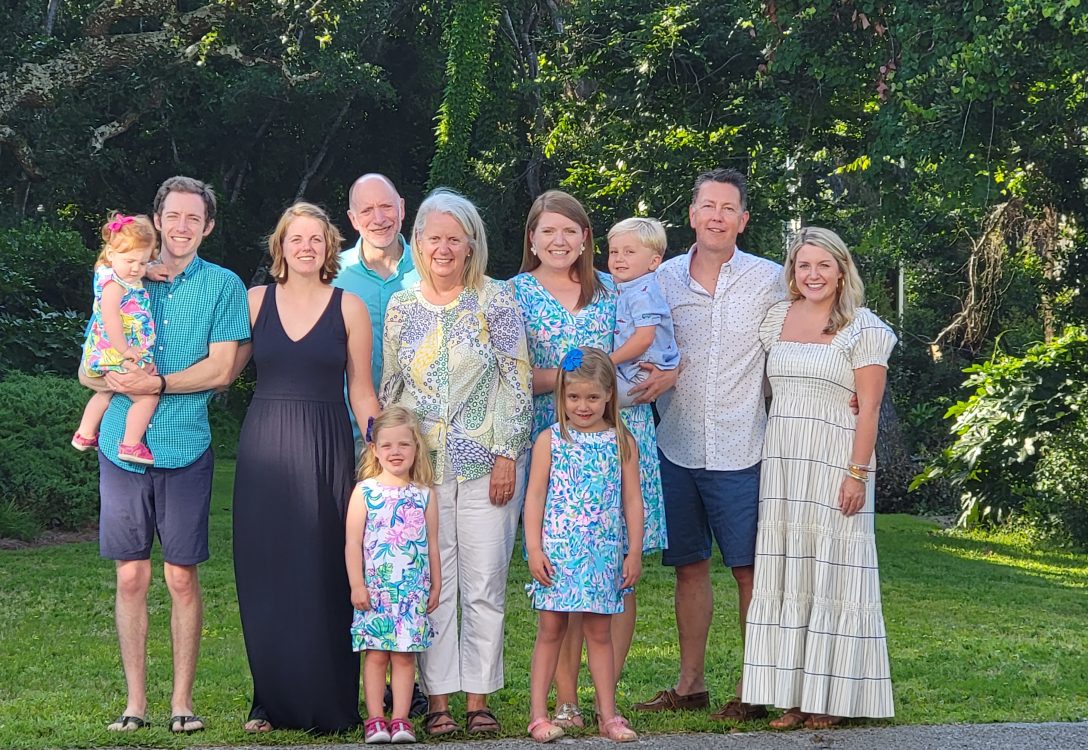
Early on Friday morning, April 3, 2026, I removed the purple cloth from the cross on the front lawn of our church.
I replaced the purple with four torn pieces of black cloth.
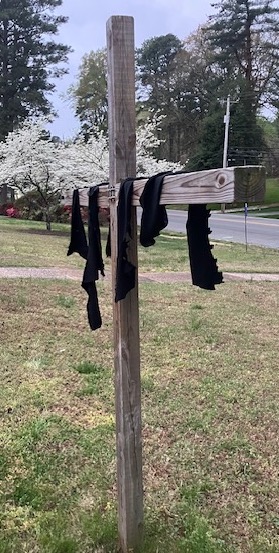
The black represents the somber, solemn remembrance of the death of Jesus Christ on the cross.
As you well know, I’m no theologian. Good Friday seems an odd label for naming the day that Jesus was crucified on the cross. I struggle to find the goodness with a good person like Jesus dying this way.
Additionally, you are probably thinking, Bill isn’t much of a Christian if he doesn’t understand this sacrifice as an atonement for sins, thus a win, a victory over sins and death.
Today, I spent my time on the grounds of our church. I was trying to make the place look pretty for Easter Sunday. I had help from a contracted grounds crew, but not every square inch of our property is covered in the contract.
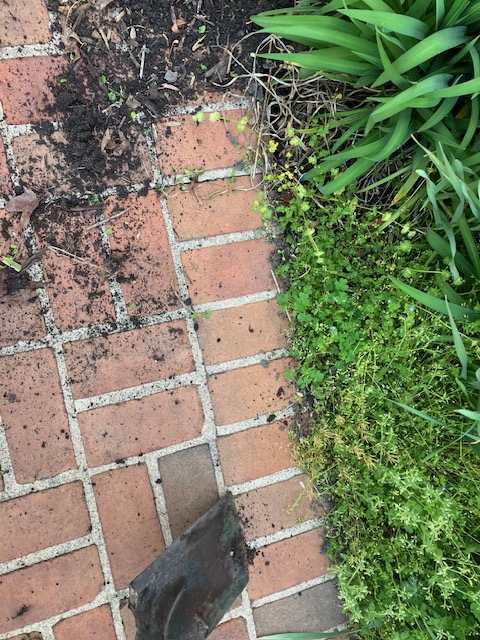
Most of my time, I was in combat with the weeds. Weeds in borders, weeds in sidewalk cracks, weeds in the mulch surrounding the base of trees, weeds in the fissures of asphalt—weeds, weeds everywhere.
In one border, the weeds were so thick that I knew a huge spider, or a slippery snake were going to have a bit of fun with me. Thankfully, that didn’t happen.
By late afternoon, I was tired of the weeds, and the weeds were tired of me.
Weeding offers solitude.
Weeding can be a time to ponder.
I have an early morning routine that starts my day with the devotional magazine the Upper Room, a well-worn script for prayers, and a computer stop at Bible Gateway.
At Bible Gateway, I always read the Verse of the Day.
One day this week, the featured verse was from Psalm 14 verse one (New International Version of the Bible): “The fool says in his heart, ‘there is no God.’ They are corrupt, their deeds are vile; there is no one who does good.”
I’ve thought about this verse quite a bit during the week.
I’m sorry, but at my age, I’m having quite a few of those fool days—‘there is no God.’
Easter is such a contrast to Christmas.
At Christmas, we celebrate the birth of Jesus Christ, and even with this story there is tension. But like a Hollywood script, the early part of Jesus’ life worked out.
With Easter, the contrast is obvious. Now, we are talking about the end of his life, his death on a cross. There is a tension in this story too.
Lots happened in the days following the birth of Jesus. I like the verse of scripture from Luke Chapter 2 verse 19: “But Mary treasured up all these things and pondered them in her heart.”
In John Chapter 19, we learn that Mary was near the cross watching her son. His simple words to her were: “Woman, here is your son.” I wonder what Mary pondered in her heart following the death Jesus?
I wonder if she thought, yes, you are my son, and you shouldn’t be dying this way.
Did Mary think—God where are you?
You turned the lives of Joseph and me upside down with his birth, and now he is being crucified on a cross.
What kind of deal is this?
A good man, who did good things in your name, crucified on a cross, right in front of me.
Perhaps, you recall the movie—Steel Magnolias.
Oh no, Bill is going Hollywood on us again. Doesn’t he know that Hollywood isn’t real life?
Yes, I know Hollywood isn’t real life. Yet, a good scriptwriter can make words come to life.
Robert Harling, the writer of Steel Magnolias, accomplishes this in a a powerful scene in the cemetery following Shelby’s funeral.
Shelby’s mother, M’Lynn is joined by four of her closest friends. The women are there in support of M’Lynn.
M’Lynn responds to her friend, Annelle, “And it’s a real good idea. Shelby wouldn’t want us to get down mired down and wallow in this. We should handle it the best way we know how and get on with it. That’s what my mind says. I wish someone would explain it to my heart.”
Returning back to Psalm 14 and my struggle with Easter. Maybe you disagree, but I don’t see my heart as corrupt, vile, or incapable of doing good.
The fool in my heart wants to understand why.
Wanting to understand the why is human.
Doesn’t matter if it is M’Lynn in the loss of her daughter in Steel Magnolias, Mary in the loss of Jesus on the cross, or any parent who has suffered the premature loss of a child.
We want to understand why, and we want to know where was God?
I hope you and your loved ones have a good Easter.
Maybe before next Easter, I’ll spend more time pondering with my friends the weeds the death of Jesus.
And maybe, the fool in my decrepit heart, who argues with God about a lot of things, will finally hear God’s heart.

 might be baloney
Bill, I share thoughts from David Jeremiah regarding Good Friday.
Good Friday…but why do we call it “good?” After all, it was a dark day filled with the suffering of our Savior.
It wouldn’t have been good without the resurrection on Sunday. Today, that’s what I want you to ponder. To fully celebrate the good news of Easter, we must fully appreciate the alternative. Let’s consider these “what ifs.”
What if it wasn’t true? What if the stone never rolled away from the tomb?
What would your life be like if Jesus didn’t defeat death and come back from the grave?
In 1 Corinthians 15, Paul describes what would be true if Christ had not been raised—and in my Easter message, we’ll examine five of those tragedies in just a few verses.
Good Friday can only be called “good” because of the hope and redemption that came through Christ’s resurrection on Easter Sunday.
Aren’t you glad to know the resurrection is true? It happened! Jesus triumphed over death, paid the penalty for your sins and mine…and offers freedom and forgiveness for all your days.
The darkness of the cross did give way to the brilliance of the empty tomb.
Praise the Lord!
You don’t have to live without hope. You have been given His promises of peace and purpose! In Christ, there is no circumstance that can defeat you…not even death.
LikeLike
Bill, not to be getting “into the weeds” (I don’t enjoy weeding either.), but I share one more thought on why we call it Good Friday,
What’s so good about Good Friday? Why isn’t the day called Bad or Sad Friday? After all, it’s meant to be a day of sorrowful reflection, not a day of celebration. Sometimes, this day takes other names, such as Holy Friday. In Germany, it’s called Karfreitag, or Sorrowful Friday. So where did we get the tradition of calling it “Good”? Some believe it may have originated from the older tradition of calling it “God’s Friday.”
No matter the origin of the name, it’s still appropriate to call the Friday on which Jesus died “good.” Out of Christ’s sacrificial love, He died for our sins. That’s why Good Friday is good. And the great news is that three days later He rose from the grave in victory.
New Testament scholar D.A. Carson wrote, “It was not nails that held Jesus to that wretched cross; it was his unqualified resolution, out of love for his Father, to do his Father’s will—and it was his love for sinners like me.” We read in 1 John 4: “This is love: not that we loved God, but that he loved us and sent his Son as an atoning sacrifice for our sins” (v. 10).
The good news of Good Friday is that God loves us and wants to have a relationship with us! Because of that love, we’re called to love others (vv. 7, 11). When we do, we show our love for Him.
By Alyson Kieda, Our Daily Bread
LikeLike
Bill, not trying to get ”into the weeds”, but I share another comment on why we call it Good Friday.
What’s so good about Good Friday? Why isn’t the day called Bad or Sad Friday? After all, it’s meant to be a day of sorrowful reflection, not a day of celebration. Sometimes, this day takes other names, such as Holy Friday. In Germany, it’s called Karfreitag, or Sorrowful Friday. So where did we get the tradition of calling it “Good”? Some believe it may have originated from the older tradition of calling it “God’s Friday.”
No matter the origin of the name, it’s still appropriate to call the Friday on which Jesus died “good.” Out of Christ’s sacrificial love, He died for our sins. That’s why Good Friday is good. And the great news is that three days later He rose from the grave in victory.
New Testament scholar D.A. Carson wrote, “It was not nails that held Jesus to that wretched cross; it was his unqualified resolution, out of love for his Father, to do his Father’s will—and it was his love for sinners like me.” We read in 1 John 4: “This is love: not that we loved God, but that he loved us and sent his Son as an atoning sacrifice for our sins” (v. 10).
The good news of Good Friday is that God loves us and wants to have a relationship with us! Because of that love, we’re called to love others (vv. 7, 11). When we do, we show our love for Him.
By Alyson Kieda, Our Daily Bread
LikeLike
Chris, as always thanks for reading the post. Your time is always appreciated. And, thanks for taking the time to provide me with three perspectives related to Good Friday. You are a good person to respond with such deep thinking. I haven’t lost hope, but this is one tough world. Have a good week, be safe, Bill
LikeLike