Pat Conroy learning from losing

March 4, 2016 was a sad day for me. On that date, I learned that my favorite author, Pat Conroy, had died.

Mr. Conroy was seventy years old. In January of 2016, he announced that he was being treated for pancreatic cancer. To me, all cancer is evil. But, pancreatic seems to be extremely cruel.

At times, the world might have been extremely cruel to Mr. Conroy. Yet, he always seemed to persevere. His luck ran out with the destructive pancreatic.

Here are some instructions for my children, grandchildren, and beyond, my Pat Conroy books are not to ever leave the family. Sorry to dump that on you, but Mr. Conroy’s books touched my soul. They might just touch yours too.

When I see old book tour itineraries, when Mr. Conroy was close to Richmond, I still curse myself for not making the trip.

Only one book is missing from my collection and that is The Boo. I’ll read it before I croak.

Out of all if his books, I keep coming back to My Losing Season. That book is about his senior year of playing college basketball at The Citadel. My Losing Season is my favorite book to pickup for the purpose of re-reading a page or two or three. Sometimes, I can’t put the book back down.

With this book, Mr. Conroy’s gifts as a writer made me laugh, cry, and ponder.

I laughed at the room checks on road trips as the coaches checked for females in the rooms of players.

I cried when I read about Mr. Conroy’s teammates, Al Kroboth and Joe Eubanks, as they served America during the Vietnam War.

And I pondered, the difficult decisions that Mr. Conroy and his classmates had to make while serving on the Honor Court at The Citadel.

Woven into the book are the ups and downs of the season, the psychology of dealing with Mr. Conroy’s difficult father, and a demanding coach.

We learn about his teammates in the real time of the season, but we also learn about their post Citadel lives as Mr. Conroy finds and interviews each one of them.

I love the self-talk Mr. Conroy has with himself after a rare but exhilarating win:

“I needed time to memorize what happiness felt like because I had experienced so little of it. Looking up into the night sky, I saw the Milky Way. I instantly thought of God and how I was afraid I was losing my faith in him and the immensity of the fear and cowardice I felt when I thought of facing the world without Him.

I was receiving the Eucharist every day of my life and fighting this war with faithlessness with every cell of my body, but I could feel the withdrawal taking place without my consent.

On the causeway to Lady’s Island I prayed out loud, ‘O Lord, please hear me. I thank you for this year. I thank you from my heart. I needed to be a decent basketball player in college, Lord. I don’t know why. But, I needed it. We both know I’m no good, but we sure are fooling some people. Aren’t we, Lord?’(Pages 275-276)

I love the honesty of that passage.

I love it because I have been there.

I have felt and experienced that same tidal undertow of my faithlessness to God being pulled away too.

And I’ll carry that faithlessness further, it is still alive in me today when the discouraging headlines in the news overwhelm me. My fearful soul cries out—God where are you?

Like many scriptures found in the Bible, Mr. Conroy references being afraid with fear at the prospect of attempting to live his life without God’s presence. I know that fear too. It is with me everyday.

But there is another honest lesson about acknowledging life’s disappointments in the epilogue for My Losing Season.

Mr. Conroy writes: “There is no downside to winning. It feels forever fabulous. But there is no teacher more discriminating or transforming than loss. The great secret of athletics is that you can learn more from losing than winning.”

He continues: “The word “loser” follows you, bird-dogs you, sniffs you out of whatever fields you hide in because you have to face things clearly and you cannot turn away from what is true. My team won eight games and lost seven-teen—losers by any measure. Then we went out and led our lives, and our losing season inspired every one of us to strive for complete and successful lives.” (Pages 394-395)

Pat Conroy’s final game as a player for The Citadel was in the 1967 Southern Conference Tournament. They lost to the University of Richmond in overtime 100 to 98.


The next morning in the Charleston, South Carolina newspaper, The News and Courier, Citadel coach Mel Thompson said this about Mr. Conroy’s play: “Pat Conroy gave another great performance. That kid gets more mileage out of his talent than any player I have ever coached.” (Pages 340-341)

Those unexpected words of praise from Mel Thompson were used by Pat Conroy to inspire and shape the rest of his life.

I don’t think my old heart can ever let go of Pat Conroy’s books.

Maybe this is why my soul will always hang on to him and his words: “It was the year I learned to accept loss as part of natural law. My team taught me there could be courage and dignity and humanity in loss. They taught me how to pull myself up, to hold my head high, and to soldier on.” (Page 400 Epilogue My Losing Season)

That is a powerful lesson.

No matter how bleak, frustrating, and uncertain this world can be, you, me, we, us must soldier on by pulling ourselves up with courage, dignity, and humanity.

God bless and rest your soul Pat Conroy.

(Photo Bill Pike)

Upstaged by Santa

On the Beatles’ Revolver album, the band’s lead guitarist, George Harrison contributes three songs. One of those songs—“Love You To” features Harrison playing the sitar backed by other musicians from India.

The opening line to the song is “Each day just goes so fast, I turn around its passed.”

Right now that’s the way I feel. I keep asking myself how did Christmas arrive so quickly this year?

As to why Christmas arrived so swiftly, the answer is very clear—it is my aging.

My days move fast. I barely recall what I did yesterday.

However, I do remember the Christmas of 2023. That Christmas will always be remembered as the one dominated by germs—stomach crud, flu, and COVID-19.


We were in Summerfield, North Carolina with our daughter, Lauren, and her family.

Before the germs attacked, I remember us sitting around the dining room table. I’m not sure what sparked this observation from our oldest granddaughter, Caroline, but I’ve been carrying her question around with me for a year—“I wonder how baby Jesus feels about being upstaged by Santa?”

At his birth, Santa was not on baby Jesus’ mind. Yet, I’d wager that Jesus might ponder Santa quite a bit today.

Back in October 2024, the National Retail Federation predicted Americans might spend “between $979.5 billion and $989 billion in total holiday shopping. This is a 2.5 to 3.5% growth from 2023.”

Santa and a few of his reindeer hanging over Devon Road in Henrico County, Virginia (Photo by Bill Pike)

Contrast that spending to these findings from the Pew Research Center. For many years, Pew researchers have been keeping track of religious trends in America.

A Pew report released on March 15, 2024 revealed the following: “80% of U.S. adults say religion’s role in American life is shrinking – a percentage that’s as high as it’s ever been in our surveys.”

In truth, I’m not surprised by this projected spending increase and the decline of religion in our lives.

It is difficult to block out the commercialization of Christmas. Retailers drum Christmas into our every waking moment. This relentless pursuit of our attention starts in October and ends when the last store closes on Christmas Eve.

For church leaders there is a pursuit, but it isn’t relentless. They don’t have the advertising pennies. Their focus is grounded upon too much reliance on tired and predictable templates.

I sense churches fear change. Perhaps, churches are like the wisemen in the Christmas story. When the angel of the Lord came upon them, “they were so afraid.”

Those wisemen moved past this initial fear. Churches must move past their initial fear of change too. No longer can change be a quiet whisper in the resistant souls of churches.

Perhaps, you recall the opening chatter of voices from the movie, It’s A Wonderful Life.

Multiple prayers from family and friends of George Bailey have sounded an alarm in heaven.

The powers that be in that blue yonder summon a wingless angel, Clarence, to become George’s guardian angel.

In briefing Clarence about George, the script reads as follows:

CLARENCE’S VOICE
You sent for me, sir?

FRANKLIN’S VOICE
Yes, Clarence. A man down on earth needs
our help.

CLARENCE’S VOICE
Splendid! Is he sick?

FRANKLIN’S VOICE
No, worse. He’s discouraged.

I don’t know about you, but in my day to day living I often feel discouraged.

My feeling discouraged is grounded in headlines: school shooting in Madison, Wisconsin, man sets fire to passenger on a New York City subway, car plows into German Christmas Market, and in my own county—17 year old found dead in backyard after shooting.

Those heartbreaking headlines are a far cry from the Christmas song written by George Wyle and Eddie Pola that emphatically sings to us “it’s the most wonderful time of the year.”

You, me, we, us know there is nothing wonderful to be found in the Madison, New York City, Germany, and Henrico County headlines.

Even these unacceptable headlines do not slow down the retail drive of Christmas.


And yet, I wonder if these tragedies push caring, kind people further away from the church? I assume they question just like I question—where were God and Jesus? Couldn’t they intervene with a miracle? Maybe in our mean old world, miracles only happen in Hollywood scripts.

In their Christmas song “Have Yourself A Merry Little Christmas” I love this line from songwriters Hugh Martin and Ralph Bane—“From now on, we’ll have to muddle through somehow.”

Perhaps that’s what people have been doing for thousands of years, finding a way “to muddle through somehow.”

I think muddling through life depends upon our hearts. I wonder if the perpetrators in these senseless killings lost their hearts?

A new year is on the horizon. As George Harrison noted in his song, our days will continue to go fast.

In a blink, Christmas 2025 will be here, and undoubtedly Caroline’s observation about Santa upstaging Jesus isn’t going to change in a year.

Despite feeling discouraged like George Bailey, I do find glimmers of hope.

On some morning runs, a flitting flash of blue with fluttering wings will dart in front of me. I find hope in bluebirds.

I find hope in medical updates from my cousin Alice in her battle with cancer. I love the hope in these words from her doctors: “the tumors are shrinking, and some have completely disappeared.”

In attending holiday themed dance recitals for two of our granddaughters, I find hope in the courage of dancers who fully embraced their roles despite not fitting the typical physical image of ballerinas.

On cold December mornings, I find hope in the light of the rising sun as it rays angle into the heart of our church building—the sanctuary. I know that light can put hope into hearts.

For some reason every Christmas, the carol “In The Bleak Midwinter” resonates with me. Something about the last three words: “give my heart.”

On the evening of December 11, I met three friends for dinner. We call ourselves the 53. That name came from our founder, Don Purkall, who figured out we were all born in 1953.

After that cheerful dinner, I was driving back home on Grove Avenue. At the corner of Grove and Wisteria, I saw a pretty, meticulously kept house.

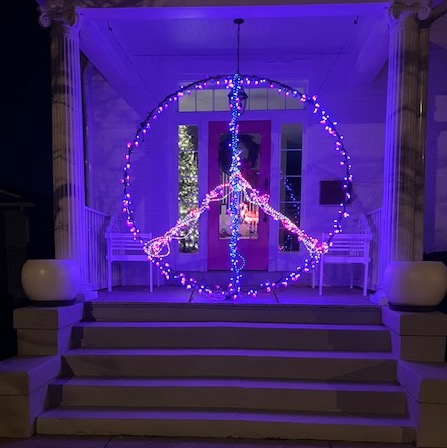
On its front porch was a huge peace symbol adorned in strings of colorful lights.

That image stayed with me.

Early in the still dark dawn of December 23, I drove back to Grove and Wisteria.

I parked my car and quietly walked to the house.

With my dependable iPhone, I took a few photos of the fully lit, but resting peace symbol.

Peace symbol on front porch in Richmond, Virginia (Photo by Bill Pike)

Silently, I returned to my car and drove off.

I wonder how discouraged the world is by the tragic headlines we create every year?

I believe our spinning, wobbly world is tired of being discouraged.

The world wants the same in its heart that you, me, we, us want in ours—peace.

Maybe the path to that elusive peace can be found in these words from Psalm 23 verse 3: “He restores my soul.”

The path to restoring our souls is our hearts.

As we muddle through the remnants of another Christmas and head into a new year, we can’t let fear upstage our hearts.