Out at Cedarfield: Ouiser, fears, craziness, and bad moods

“I’m not crazy M’Lynn. I’ve just been in a very bad mood for forty years.”

Those words were spoken by Ouiser Boudreaux, the character portrayed by actress, Shirley MacLaine, in the movie Steel Magnolias.

In truth, Ouiser Boudreaux, reminds me of my mother’s sister, Mildred.

I loved Mildred because like Ouiser, Mildred was always honest. She never held back.

Robert Harling wrote the play, Steel Magnolias, and the screenplay that was made into a movie. The play was based upon Harling’s experience of his sister’s death.

I sense it would be fairly easy to take Ouiser’s observation about herself and apply it to our lives.
To the therapist: “I’m not crazy, Dr. Watson, I’ve just been living with my wife for the last fifty one years.”

To the superintendent of schools: “No m’am, I’m not crazy, I’ve just been trying to teach middle school students for the last thirty one years.”

To your doctor: “No sir, I’m not crazy, I know operating the television’s remote control for six hours a day isn’t a cardiovascular activity.”

I wonder if people ever felt that Jesus was crazy?

Think about Matthew Chapter 8 verses 23-27: “And when he got into the boat, his disciples followed him.  A gale arose on the lake, so great that the boat was being swamped by the waves; but he was asleep.  And they went and woke him up, saying, ‘Lord, save us! We are perishing!’  And he said to them, ‘Why are you afraid, you of little faith?’ Then he got up and rebuked the winds and the sea; and there was a dead calm.  They were amazed, saying, ‘What sort of man is this, that even the winds and the sea obey him?’”

The collective question of the disciples says it all—“What sort of man is this, that even the winds and the sea obey him?”

Maybe what they were really thinking was—“Is this man crazy?”

But in truth, the toughest question in this passage comes from Jesus: “Why are you afraid, you of little faith?”
From the disciples perspective, their fear is grounded in the intensity of the storm that is battering their boat.

Think about it— no life preservers, no flares to fire off, no cell phone, no Coast Guard helicopter in route.

Nope all they have is this crazy guy Jesus.

I’ll be truthful with you, my faith and fear are grounded in this—I still struggle to always understand this crazy guy Jesus.

I will go to my grave wondering why prayers for one friend battling cancer are answered while prayers for another friend are not.

How can a woman with a longstanding health problem in Luke Chapter 8 barely touch Jesus’ clothing and her medical condition is immediately cured?

Talk about crazy, that story drives me nuts.

All this suffering in the world, even in this beautiful facility at Cedarfield, and that touch from Jesus seems so far away.

And yet, I don’t think Jesus is far away.

No, I think the problem is that I have continued to distance myself from him.

And that distance comes from my inability to see and understand Jesus’ craziness.

I think it would be very fair for God and Jesus to say: “We’re not crazy Bill. But because of all the challenges we see on earth everyday, we’ve just been in a very bad mood for a zillion years.”

You, me, we us know that God and Jesus have lots of reasons to be in a very bad mood when they look down upon us.

No doubt, the world can put us in a very bad mood.

But, if we let that very bad mood consume us, we will lose our hope.

A few years ago I received an email from Tommy Yow. A long, long time ago, Tommy was the Associate Pastor and Youth Director at Davis Street United Methodist Church in Burlington, North Carolina.

Tommy who now is retired in Alabama read an op-ed piece I wrote about the closing of Davis Street. The piece appeared in three North Carolina newspapers. Through one of those newspapers Tommy tracked me down.

I loved reconnecting with him.


Every week Tommy forwards to me thoughtful emails from Richard Rohr, a Franciscan friar and ecumenical teacher, the retired Reverend Dr. Terry E. Walton from the North Georgia Conference, and Linda Henley at Lake Junaluska. I try to skim those writings. Occasionally, something in those posts will stick with me.

I have no idea who Jo Cato is but this quote from her was used in one of those postings: “Be brave. The unfamiliar will shape you more than the familiar ever could.”

It is tough to be brave when life becomes unfamiliar.

Yet, I think Jo Cato is correct. We have an opportunity to learn from these unfamiliar times.

I guess the real question is— are we willing to learn from these unfamiliar times?

The disciples were in unfamiliar territory with the storm pounding their boat. Fear gripped them.

For lots of different reasons, fear grips me today too.

I recently listened to an interview with Jane Fonda on the National Public Radio show Fresh Air.

Yes, I know people can still have strong feelings about Jane Fonda.

But this exchange about “fear” in the interview caught my attention.

JANE FONDA: And I wrote a book, and I lost my fear.

HOST TONYA MOSLEY: You wrote a book about aging.

JANE FONDA: Yeah. Yeah. The thing to do when you’re scared, at least for me, is I make what I’m afraid of my best friend. I learn all about it. I wrap my arms around it and squash it to death (laughter).

HOST TONYA MOSLEY: Why do you do that?

JANE FONDA: Because then I’m not afraid anymore.

There are things in life that can make us fearful, things in life that can make us crazy, and things in life that can put us in bad moods.

And in all that fear, craziness, and bad moods, and despite the impact these things have on us, God and Jesus are still hanging around.

They are ready to help us face our fears, craziness, and bad moods.

They want to help us answer Jesus’ questions: “why are you afraid, where is your faith?”

People who have known me for a long, long, long time know that I was a marginal student. I drove my parents crazy with my poor performance in school.

Yet, somehow, my parents stuck with me. They didn’t abandon me. Their deep faith anchored them in hope that some day their knucklehead of a son might land on his feet.

Though Jesus was aggravated with his disciples as the storm thrashed their boat, he did not abandon them.

At this very moment, if we have any chance of enduring this unfamiliar world, its fears, its craziness, and its bad moods, we can’t abandon the calmer of the sea.

And that requires you, me, we, us to be as honest with our hearts as Ouiser Boudreaux.

While it might be a stretch, our hearts want to say—we’re not crazy Jesus, but you know the truth.

Our hearts have been very bad at ignoring you when the unfamiliar storms of life hit us.

Don’t give up on us yet.

Toss us your life preserver of hope.

Maybe, we’ll get it right this time.

Author’s note: On the afternoon of Tuesday, September 16, 2025, I had the privilege of presenting a devotional at Cedarfield. Cedarfield is an United Methodist retirement community in Henrico County, Virginia. For eleven years, our church, Trinity United Methodist, has been presenting worship gatherings for Trinity members and Cedarfield residents. These gatherings take place four times a year.

Cedarfield (Photo Bill Pike)

The Prayer Decoy

On the afternoon of Thursday, August 21, just a few minutes shy of 3 p.m., a man knocked on the door to the Stuart Hall Road entrance to our Sanctuary.

Our head building caretaker responded to the knock.

When he opened the door, this stranger said he wanted a pastor to pray for him.

Our building caretaker walked the stranger toward the church office.

Once there, our assistant pastor met with the stranger.

The request for prayer quickly shifted to a financial need to cover the cost of car insurance.

When our assistant pastor asked some basic questions about the car insurance, the stranger became belligerent and indignant. Displeased, he responded by cursing our assistant.

With this abusive language, the stranger was asked to leave the building. He was escorted out by our assistant and another staff member.

This pretense of prayer reminded me of an episode of The Andy Griffith Show titled “A Black Day For Mayberry.” The story is about a shipment of gold that is scheduled to go through Mayberry on its way to Fort Knox.

Of course, Mayberry’s biggest blabber mouth, Deputy Barney Fife, lets it slip out that a shipment of gold is on the way. This creates havoc among the citizens of Mayberry. They create an unwanted welcoming for the gold truck and its personnel.


Through a series of bungled assumptions by Deputy Fife, and his recently deputized associate bungler Gomer Pyle, we learn that the truck going through Mayberry was a decoy. The truck carrying the gold went a different route.

When Sheriff Taylor, Deputy Fife, and Deputy Pyle learn this, Deputy Pyle exclaims: “Shazam, a decoy.”

On Thursday afternoon, when I learned of our prayer seeking intruder, I felt like shouting: “Shazam, a prayer decoy.”

Yet, deep inside of me, I was angry, infuriated. Perhaps, I was just as angry as our prayer seeker when he learned that no financial assistance was to be provided because his prayer decoy plot had failed.

When I spoke further with our assistant about this stranger, turns out he wasn’t unknown to Trinity. In fact, I have his name on my prayer list.


In the past, with random infrequency, this person has shown up at Trinity seeking assistance. However, this was the first time that his interaction with church personnel was unacceptable.

One of the wristbands on my right arm says—“be kind.”

I wonder if Jesus would have been “kind” to our prayer seeker?

Might Jesus have confronted the prayer seeker by physically flipping him over like he did the tables in the temple?

Situations like this continue to erode what little Christianity I have left.

I wonder how the prayer seeker is wired?

How can a person falsely request prayer, immediately switch to ask for financial assistance, and seconds later become verbally abusive when asked reasonable, clarifying questions?

I wonder if he had worked his way down Forest Avenue stopping at each church trying the same prayer decoy?

But what I really want to know is what in the person’s lifetime put him in this position?

What is even more aggravating is I’ve been praying for this guy for years, and it appears that my prayers haven’t changed his behavior.

Maybe, I’m the problem.

Maybe, I’m a lousy prayer.

And to be even more truthful, this prayer deceit really bothered me because everyday, I’m praying for people who are in life or death situations with cancer, families who are providing care for loved ones with dementia, friends of our family who have children whose personal lives have fallen apart, and lifelong friends and co-workers whose hearts are forever crushed after tragically losing a daughter or son.

I can make this even more complicated by thinking about Hebrews 13:2: “Do not neglect to show hospitality to strangers, for by doing that some have entertained angels without knowing it.”

I’m sorry God, but I fail to see any angelic traits from the prayer decoy schemer.

I look forward to the arrival of the magazine The Week in our mail. I always read the Wit and Wisdom section. This section features quotes from a wide variety of mostly famous people.

In the September 5-12 edition, I came across this quote from American writer, James Baldwin: “The reason I will never hate anybody again is that it’s too demeaning a confession on your part if you need to hate somebody. It means you are afraid of the other thing, which is to love and be loved.”

Mr. Baldwin is correct.

I strongly dislike the method of the prayer decoy seeker.

Because of this tactic, I am afraid, unable to love the prayer decoy seeker.

Why is my heart incapable of doing this?

Stuart Hall Road doors (Photo Bill Pike)

Oh, I know who you are.

This time last year, there was a mad rush in one wing of our church building to complete a three floor renovation project.

The contractor was doing everything humanly possible to be substantially finished by August 31.

It wasn’t perfect, but the deadline was met. More importantly, the county’s building inspector granted permission to occupy that wing.

In the year that has passed, we’ve spent time with punch lists, uncooperative technology, ambushed water intrusions, and attempting to learn the nuances of the new HVAC system.

HVAC systems are always a challenge. Perhaps the biggest hurdle comes from monitoring our own individual human thermostats.

A few weeks ago, in the neighborhood where our church is located, a powerful late afternoon thunderstorm got our attention. This storm knocked out power to a wide section of the neighborhood.

At the church, the storm disabled two phases of electricity to our building. Full power didn’t return to us until the next afternoon. But in the long minutes when the storm was in action, the flickering ups and downs of the electrical service to our building reeked havoc on some of the components for the new HVAC system.

Because of a shortage of parts from the manufacturer, we’ve been patiently awaiting for repairs.

Recently, one of the technicians for the company was in our building to recheck the monitoring technology.

I wasn’t sure if he remembered me. So, I reintroduced myself.

As I was doing this, he responded to me, “Oh, I know who you are.”

I didn’t know how to take—“Oh, I know who you are,” but we had a good conversation about the challenges involved in getting the HVAC issues solved.

In all my years of working in public schools, we had plenty of challenging students. Students that we knew who they were because rightly or wrongly, their reputations preceded them. For a few of these students, living down their reputations was virtually impossible.

Over time and with the right support, a handful of those students figured out how to make adjustments. Their challenging behaviors became less intrusive.

And then there was a group that no matter what they tried, they just could not keep from getting attention in all the wrong ways. And of course, no matter what the school tried, we could never quite make the right connection, or build the right relationship to help the student adjust.

“Oh, I know who you are,” made me think about my own life.

How do people see me?

Does my reputation precede me?

Do my imperfections create challenges for me and the people I encounter on a daily basis?

Sometimes, I wonder if God really knows who I am?

With so many people in this world, what does God truly know about me?

My guess he knows that my morning prayer routine is too long.

He probably knows that I’m a constant, repetitive whiner.

This is especially true when life goes wrong for good people. I whine to God, “what are you thinking, where are you, how could you let this happen?”

Psalm 139 verse 13 implies that God has known me since I was knit together in my mother’s womb.

In Matthew and Luke, the scripture states that even the hairs of my head are numbered. This is another indication that God knows me down to the hairs on my head.


At this stage of my life, I’d say the hairs on my head are disappearing at such a rapid rate that an accurate inventory is useless.

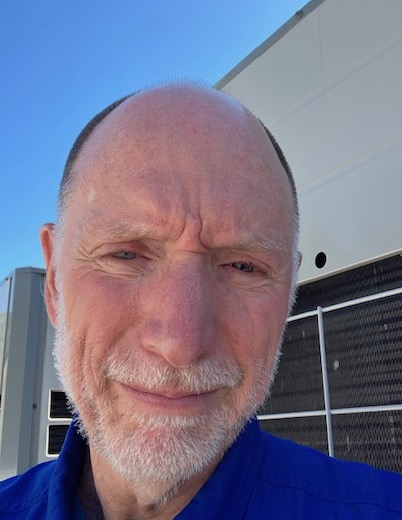
Whiny old buzzard, new HVAC system behind me (Photo Bill Pike)

I wonder if my shrinking hairline decreases my value in the eyes of the Lord? Am I still of more value than the sparrows of the field?

I have some days on my wobble through life when I think the sparrows of the field are of more value than me.

On those valueless days, I ask myself— why aren’t you doing more?

Where is your voice?

Why aren’t you finding your voice to speak out?

How can you let all of the injustice of this dismantling pass by you in silence?

Maybe God really does know me.

Maybe he knows that I’m nothing more than a whiny old buzzard with no backbone who is gripped by fear of what people will think of me when I finally assert my muted voice.

My wife and I are playing catch up with the Apple TV series—Ted Lasso. We have made it into season three.

In prepping his team, Coach Lasso shares wisdom with his soccer players. Coach Lasso has a way of blending on field wisdom into life wisdom for his players.

I was taken by these words from the script of Episode 12 in Season 2: “To quote the great UCLA college basketball coach, John Obi-Wan Gandalf, “It is our choices, gentlemen, that show what we truly are, far more than our abilities.”

Of course, Coach Lasso was referencing legendary UCLA basketball coach, John Wooden. Coach Wooden not only taught his players the essential details of playing college basketball, but attempted to equip his players about essential life skills too.

“Oh, I know who you are” really comes down to this—do I know who I am?

It is my choices that reveal if I really know who I am.

Regardless of womb knitting, counting hairs, and sparrows, God is watching my clock.

In the remaining time he has allocated for me, I must be wiser. I must find out who I really am.

How about you?

A Bad Day In The Kitchen

A long time ago someone decided that churches needed to have kitchens.

At our church, we have three: in the original fellowship hall, an oddball one on the third floor of the Preschool wing, and in Trinity Hall.

And there was a mini-kitchen near the church office that we disassembled a few years ago.

I imagine those kitchens could write a book about the life of our church that took place inside those culinary walls.

Cook talk, laughter, gossip, recipes, and compliments were shared.

Back on Wednesday, August 13, my work teammate, Judy Oguich, and I met in the Trinity Hall kitchen to inventory our supplies and make plans for a church wide lunch on Sunday, August 24.

We found adequate supplies of plates, cups, napkins, and utensils.

Since the menu called for grilling hotdogs, we believed we had lots of hotdogs leftover from a community event last fall. Unfortunately, these frozen dogs had long gone past their expiration date. We had to chuck them.

Checking on the condiments that we needed to enhance the hotdogs, we again found that mustard, catsup, relish had an expired.

No matter where we looked, we found food items that were no longer safe to serve.

In truth, I’m not surprised. A few years ago, our church closed out our Wednesday night dinners. No longer could we justify the expense based upon fewer and fewer families attending.

Now, the Trinity Hall Kitchen is used sporadically. The people who use the kitchen leave extra food in the refrigerators. These kindhearted people believe that someone will eventually consume those leftovers.

This wasn’t my first experience in the Trinity Hall Kitchen throwing away outdated or spoiled food.

I had to do this when Hurricane Isabell walloped the neighborhood as electrical service was absent for over a week.

There were other times too.

Leftover food from Sunday night youth dinners were not consumed in a timely manner, and they too had to be tossed.

Perhaps the only good thing that came from disposing of this food was recycling the containers where the food had been stored.

I despise days like Wednesday, and the ones I’ve encountered in the past.

My disgust comes from revisiting Deuteronomy Chapter 15 verse 11: “There will always be poor people in the land.”

And from Matthew 26 and Mark 14: “The poor you will always have with you.”

Look, I’m no Biblical scholar, but those three verses cast an embarrassing guilt over me. In these situations, I could have done better than tossing out all this food.

If I had only been more attune to those refrigerators, we could have fed more people in our community.

I wonder why those three verses are in the Bible?

Were they written as a challenge?

Did the scripture writers think, “Hey, let’s tell the knuckleheads on earth that the poor will always be with them.”

If we tell them this, maybe, they will look at those statements and ask: “Why should we always have the poor with us?”

Why don’t we work together to wipe out poverty in our world so that we will have no poor people.

Seems like a noble idea, but unfortunately, we have been failing for centuries at eliminating poverty.

So why is it that we can explore the vastness of space, perform heart transplants, dam mighty rivers, build skyscrapers that touch the blue yonder, and yet we can’t figure out how to solve the challenges faced by the poor.

Williamsburg, Virginia native, Bruce Hornsby, has built himself quite a career as an extraordinary piano player, songwriter, and singer. His first hit single with his band The Range was a song titled “The Way It Is.”

From my first listening of the song, I was hooked.

The lyrics caught my attention too. The words are a snapshot of ongoing social challenges in America.

But it is the chorus that stuck to me:
“That’s just the way it is.
Some things’ll never change.
That’s just the way it is.
Ah, but don’t you believe them.”

Having the poor with us, “That’s just the way it is. Some things’ll never change.”

For me, the bleak affirmation of those two lines is countered with the last line: “Ah, but don’t you believe them.”

We are long overdue to believe that we can solve the vicious generational cycles of our poor.

When are you, me, we, us going to start our work?

Trinity Hall Kitchen (Photo Bill Pike)

Easter with Warren Zevon and Jesus

Warren Zevon was a gifted songwriter, singer, and musician.

You might recall two of his songs “Excitable Boy” and “Werewolves of London.” Each garnered attention, and yes, “Werewolves of London” has become a Halloween standard.

Through his songs, Mr. Zevon was a storyteller. His characters were from all walks of life. His lyrics captured all human emotions. At times, his words were not for the faint of heart.

I chuckle when I hear these lines from “Excitable Boy”:
“Well, he went down to dinner in his Sunday best. Excitable boy, they all said. And he rubbed the pot roast all over his chest. Excitable boy, they all said. Well, he’s just an excitable boy.”

And I chuckle more with “Werewolves of London”:
“He’s the hairy-handed gent who ran amuck in Kent.
Lately, he’s been overheard in Mayfair. You better stay away from him, he’ll rip your lungs out Jim. But hey, I’d like to meet his tailor.”

But the chuckling stops with “Carmelita”:

“ I hear Mariachi static on my radio. And the tubes they glow in the dark. And I’m there with her in Ensenada, and I’m here in Echo Park. Carmelita hold me tighter. I think I’m sinking down. And I’m all strung out on heroin, on the outskirts of town.”

Singer Linda Ronstadt respected Mr. Zevon’s song “Hasten Down The Wind” so much that she recorded it and used the song as the title to one of her albums.

The song will pinch your heart and moisten your eyes:
“She tells him she thinks she needs to be free. He tells her he doesn’t understand. She takes his hand. She tells him nothing’s working out the way they planned. She’s so many women, he can’t find the one who was his friend. So he’s hanging on to half her heart. He can’t have the restless part. So he tells her to hasten down the wind.”

Even in 1978, America had challenges with lawyers, guns, and money. This song of the same title notes how risk and luck don’t always complement each other:
“I was gambling in Havana. I took a little risk. Send lawyers, guns and money, Dad, get me out of this. I’m the innocent bystander. Somehow, I got stuck, between the rock and the hard place, and I’m down on my luck.”

At times, maybe in each of us, we have a desire to be left alone, isolated from the world. In “Splendid Isolation” Mr. Zevon wrote:
“I want to live alone in the desert. I want to be like Georgia O’Keefe. I want to live on the Upper East Side, and never go down in the street. Splendid Isolation, I don’t need no one.”

Clearly, those characters envisioned in Mr. Zevon’s lyrics are thousands of miles and years away from the people Jesus encountered during his life.

Yet, I sense there might be some similarities.

How might the Demoniac compare to the “Excitable Boy” or the “Werewolves of London”?

Does the son in “Lawyers, Guns, and Money” have any connection to the Prodigal Son? Each son is looking to be saved and ultimately forgiven by their fathers.

What does the Leper have in common with the man addicted to heroin in “Carmelita”? Each is impacted by the circumstances of their health. Each needs an intervention. In their situations, both men are seen as outcasts.

In “Hasten Down The Wind” might that have been a conversation between Mary and Joseph as they tried to sort out the complications of God’s unexpected intrusion? Or, maybe this matches with the woman at the well, whose relationships with men haven’t been successful.

And for “Splendid Isolation” how many times in Jesus’ ministry did he truly need time to be alone? Did he reach his limit with the masses of followers and individuals who needed just a touch of his clothing to change the circumstances of their lives? In those moments, perhaps Jesus felt like embracing Mr. Zevon’s words: “I don’t need no one.”

By now, you must be thinking poor Bill. He has really gone off the deep end this time— comparing Warren Zevon’s characters to the people that Jesus encountered during his lifetime.

Well, maybe I have.

But, the bottom line is that both Jesus and Mr. Zevon were remarkable storytellers. More importantly, these characters, these people, no matter when or where they lived provide us an opportunity to learn from their challenges in life.

And to tell you the truth, at the age of 71, I’m not sure I’m any closer to truly understanding the challenges in the Easter story.

Maybe that’s because the world has become more complicated.

Or has the redundancy of the Easter story diminished my curiosity?

Could it be that I’m a shallow Christian, reluctant to dig deeper to break the predictability of Easter?

Maybe, I’m part of Romans 5 verse 6: “You see, at just the right time, when we were still powerless, Christ died for the ungodly.”

Yes, Jesus knows my old sack of bones. He has a file on my ungodly ways.

And, despite my “ungodly” confession, I still hold on to the hope that Easter offers. For me, that hope is tied to love.

On September 7, 2003, Warren Zevon lost his battle with inoperable lung cancer. Diagnosed in 2002, Mr. Zevon spent those miserable declining months recording his final album.

The last song on the album is titled “Keep Me In Your Heart.” Simply, this is Mr. Zevon’s way of saying goodbye to his family and friends.

Always insightful with his lyrics, here is the opening of the song:
“Shadows are falling and I’m running out of breath, keep me in your heart for awhile.
If I leave you it doesn’t mean I love you any less, keep me in your heart for awhile.
When you get up in the morning and you see that crazy sun, keep me in your heart for awhile.
There’s a train leaving nightly called when all is said and done, keep me in your heart for awhile.”

Despite the ups and downs that Mr. Zevon experienced in living his life, I think in the end his song “Keep Me In Your Heart” was his way of acknowledging the importance and value of love.

With Easter, isn’t that what our take away should be?

Isn’t that what Jesus needs from us?

That we keep him in our hearts.

That we share his love with the people we encounter everyday.

Isn’t that what Jesus did when he encountered people?

No matter their status or circumstances, he loved, he kept them in his heart.

“When all is said and done,” is that too much to ask of my heart?

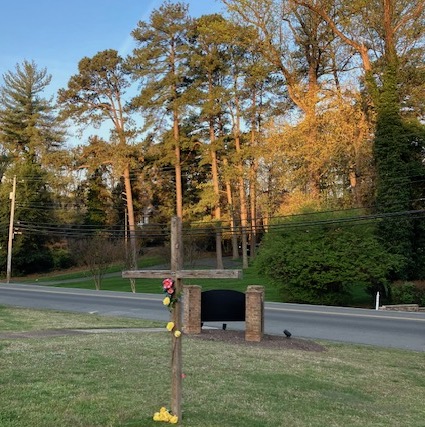
Easter 2024, the cross starting to fill with flowers. (Photo Bill Pike at Trinity UMC)

Hey God, are you anxious? If you’re not, I am.

Early in my life, I remember my parents started their day reading the daily devotional from the Upper Room at the breakfast table.

I’m not quite sure when or how, but I start my day with the Upper Room devotional too.

As an early riser, nothing else goes on in my life until I read the devotional and the recommended scripture.

Next, I pray, a prayer that I’m sure God and his angels are thankful when this detailed, prolonged plea concludes with—thanks for listening to my prayers.

On Saturday, March 29, the main scripture in the Upper Room was Philippians 4:6: “Do not be anxious about anything, but in every situation, by prayer and petition, with thanksgiving, present your requests to God.”

If you have been a loyal reader of Might Be Baloney, perhaps you have figured out that I’m a certified worrier at the local, state, national, and international levels. Worry might as well be a name for me.

Worriers are also anxious. As an imperfect Christian and American, at this stage of my life, I have never been so anxious and worried about our country, the United States of America.

I wonder if God and Jesus, and their angels are anxious and worried about America?

My reason for asking is grounded in my honesty. While I always pray for America, since January 20, I’ve been praying more for our country.

Despite my anxious and extra prayers for America, the dismantling of our country continues. Almost everyday, a new executive order is signed and issued. With that single signature, many American lives are forever altered. Quite often those changes are not for the good.

I wonder if my daily prayers are doing any good? If my prayers are having an impact, then why is our president and his staff continuing to make all of these hurtful changes?

In the movie, The Shawshank Redemption, actor Morgan Freeman, portrays inmate, Ellis Boyd “Red” Redding. Mr. Redding is serving a life sentence. The film sequences ten year intervals where Mr. Redding appears before the parole board.

At years, twenty and thirty, Mr. Redding gives the answers that he thinks the parole board wants to hear. He feels confident that his answers will result in earning his release from prison. Unfortunately, Mr. Redding’s parole requests are denied.

In his fortieth year, Mr. Redding appears before the parole board. This time his attitude isn’t hopeful or optimistic. A bitterness hovers over him, a bitterness that conveys I don’t care anymore, go ahead, and deny my parole again.

Yet, in this hearing, there is a difference.


In Mr. Redding’s previous hearings his answers to the questions come across as scripted. Being sorry for his horrible crime seems distant, an after thought.

With this hearing, Mr. Redding’s bitterness reveals what his heart is feeling.

Mr. Redding addresses the chair of the parole board with these two questions: “What do you really want to know? Am I sorry for what I did?”

The chair of the parole board asks Mr. Redding: “Well, are you?”

Here is Mr. Redding’s response: “There’s not a day goes by I don’t feel regret. Not because I’m in here, or because you think I should. I look back on the way I was then, a young, stupid kid who committed that terrible crime.

I wanna talk to him. I wanna try to talk some sense to him — tell him the way things are. But I can’t. That kid’s long gone and this old man is all that’s left. I gotta live with that.”

Screenwriter Frank Darabont’s words delivered by Mr. Redding make me think about America. I want to take that second paragraph and direct these lines to our country— “I wanna talk to America, I wanna try to talk some sense to America—tell America the way things are. But, I can’t.”

And the reason I can’t is because America’s self-talk is singularly focused on—dismantling. There is no trying to talk sense to America because our common sense has disappeared. As for the way things are, our leaders are one dimensional—this is the way things are going to be.

Where is our hard earned democracy in the decisions that are being made?

Where are our voices?

Where are the voices of our politicians in Washington?

Are they silenced by fear?

Anyone with an ounce of common sense knows that our budget deficits needed correction.

Making those corrections would not be easy. However, making those corrections wisely and with an ounce of human compassion was possible.

Unfortunately, wisdom and compassion are absent from the leaders who are making these decision.

The absence of wisdom and compassion in these cuts makes me anxious.

My friend, Anne Burch, recently sent me a link to an interview with former Duke University basketball coach, Mike Krzyzewski(Coach K). The interview was conducted by Duke University professor and author, Kate Bowler.

Early in the interview, Professor Bowler, provides Coach Krzyzewski with a small white board. The assignment is for both of them to write down a word about the pending interview. Coach K wrote on the board “hopeful.”

As I reflect about Coach K’s answer, I’m sorry to tell you this, but I’m not very “hopeful” about America’s current status.

Perhaps, you are thinking, Bill, I’m not surprised in your lack of feeling hopeful about America. You often come across as a whiny pessimist.

While I respect your honest observation, hope is something that I will always hold in my old heart.

And to tell you the truth, I think that is the problem in Washington.

The leaders in Washington who are making these decisions have no heart.

They have no concept of working for the common good of all Americans.

If God is the least bit anxious about America, his concern is about our hearts.

Our hearts have lost their way.

Maybe this quote from Aleksandr Solzhentltsyn is worth pondering: “The line separating good and evil passes not through states, not between classes, nor between political parties either—but through every human heart.”

As far as I can tell with the no hearts in Washington that line has disappeared. With no conscience, evil dominates this empty-headed thinking.

Seems to me this thoughtless Washington thinking is more aligned with Proverbs 17:24: “A man of understanding sets his face toward wisdom, but the eyes of a fool are on the ends of the earth.”

I see no understanding or wisdom in these hurtful decisions. Their eyes are set on revengeful, selfish personal gains.

Yes, I’m anxious for America.

But more anxious about the silence of our hearts.

Maybe, I’m just as vacuous as our Washington leaders.

Every morning, one of my prayers to God is that our president and vice-president find their hearts.

Light from our eat-in kitchen cast out into the predawn of our backyard. (Photo By Bill Pike)

Hey God, are you a Democrat or a Republican?

Hey God, I hope you are having a good day in the blue yonder.

As an all knowing religious leader, maybe your angel advisors have tried to keep from you that America is in turmoil.

While Americans might not want to admit it, I suspect that you know America has been heading toward upheaval for decades.

Quick to blame our political parties and their leaders for our shortcomings, rarely do we point the finger of blame back at ourselves.

Every four years, we have a presidential election.

Those elections have become flip flop events.

A newly elected Democratic president might change things championed by the preceding Republican president.

It works the other way too.

This flip flop leadership is disturbing. The common good of the people is jeopardized.

I don’t understand why our leaders take pride in these disruptive revengeful reversals.

Your son, Jesus, was quite the teacher. He was adept in using parables to teach and reteach us that we must love our neighbors.

At this moment in my life, I have a failing grade in loving my neighbors.

I don’t understand how my Republican friends can support our current president.

Those same Republican friends wonder why I’m unsupportive of their president.

So, God, I’m wondering are you a Democrat or a Republican?

Who do you support in this turmoil?

Before you answer, ponder this.

In our Pledge of Allegiance to America’s flag we purport the following beliefs: “one nation under God, indivisible, with liberty and justice for all.”

Right now, I don’t sense those words are true to our souls.

If your angels reported the latest data on religion in America from the Pew Research Center, you know we are more likely to be “religiously unaffiliated” than “one nation under God.”

You also know, we are a divided country.

And as for liberty and justice for all, ‘all’ keeps losing ground.

I repeatedly ask myself— where is the middle?

Where are those commonalities for working together?

God, I’m sure you remember Barbara Bush, maybe you see her everyday up there.

I wonder does Mrs. Bush ever bring up her wise quote: “I hate the fact that people think ‘compromise’ is a dirty word.”

When she hovers near you, does Mrs. Bush ever say: “Hey God, could you remind America about my quote?”

Regrettably, we put more energy into undermining each other instead of finding the means to work together.

I’m no theologian, but I’m curious about how these words from the Bible apply to our judgment: “The Lord does not look at the things people look at. People look at the outward appearance, but the Lord looks at the heart.”

What do you see in our hearts now?

Do you see hearts that have been misguided and overtaken by disrespect, fear, greed, hate, incivility, revenge, and selfishness?


With all the chaos in the world, I doubt if you have much quiet time for reading.

But, you might want to read—When The Sea Came Alive An Oral History Of D-Day by Garrett M. Graff. Your name appears in the book quite a bit.

In the Epilogue, I read this quote from Private Maynard Marquis: “It’s too bad we have to have wars, but I think we always will. People never change. Only the weapons change.”

Private Marquis was correct. We are stubbornly resistant to change.

As far as warfare weapons, the internet has become a psychological one.

I’m sorry God, but I owe you an apology. It is unfair of me to ask if you are a Democrat or Republican.

Everyday, people ask you heartbreaking questions—why is my grandchild battling cancer, why is my son an opioid addict, why did another Veteran die from death by suicide, why did we lose our daughter in a senseless school shooting?

Respectfully, with regard to questions, your plate is full.

However, Americans must be asking insightful, probing questions of ourselves.

In the famous “They call me Mr. Tibbs” scene from the movie In The Heat Of The Night, two piercing questions are asked: “My God what kind of people are you? What kind of place is this?”

God as you look down upon America, are those two questions roiling through your heart like they are mine?

Part of me wonders is America facing its own internal D-Day?

Will our longstanding stubborn neglect related to national debt, safety, mental health, housing, and the erosion of our families implode us?

H.L. Mencken once wrote: “The men the American people admire most extravagantly are the most daring liars; the men they detest most violently are those who try to tell the truth.”

America, what kind of people are we, what kind of place is this?

Americans, this is urgent. Our hearts must answer.

Photo by Bill Pike.

Pat Conroy learning from losing

March 4, 2016 was a sad day for me. On that date, I learned that my favorite author, Pat Conroy, had died.

Mr. Conroy was seventy years old. In January of 2016, he announced that he was being treated for pancreatic cancer. To me, all cancer is evil. But, pancreatic seems to be extremely cruel.

At times, the world might have been extremely cruel to Mr. Conroy. Yet, he always seemed to persevere. His luck ran out with the destructive pancreatic.

Here are some instructions for my children, grandchildren, and beyond, my Pat Conroy books are not to ever leave the family. Sorry to dump that on you, but Mr. Conroy’s books touched my soul. They might just touch yours too.

When I see old book tour itineraries, when Mr. Conroy was close to Richmond, I still curse myself for not making the trip.

Only one book is missing from my collection and that is The Boo. I’ll read it before I croak.

Out of all if his books, I keep coming back to My Losing Season. That book is about his senior year of playing college basketball at The Citadel. My Losing Season is my favorite book to pickup for the purpose of re-reading a page or two or three. Sometimes, I can’t put the book back down.

With this book, Mr. Conroy’s gifts as a writer made me laugh, cry, and ponder.

I laughed at the room checks on road trips as the coaches checked for females in the rooms of players.

I cried when I read about Mr. Conroy’s teammates, Al Kroboth and Joe Eubanks, as they served America during the Vietnam War.

And I pondered, the difficult decisions that Mr. Conroy and his classmates had to make while serving on the Honor Court at The Citadel.

Woven into the book are the ups and downs of the season, the psychology of dealing with Mr. Conroy’s difficult father, and a demanding coach.

We learn about his teammates in the real time of the season, but we also learn about their post Citadel lives as Mr. Conroy finds and interviews each one of them.

I love the self-talk Mr. Conroy has with himself after a rare but exhilarating win:

“I needed time to memorize what happiness felt like because I had experienced so little of it. Looking up into the night sky, I saw the Milky Way. I instantly thought of God and how I was afraid I was losing my faith in him and the immensity of the fear and cowardice I felt when I thought of facing the world without Him.

I was receiving the Eucharist every day of my life and fighting this war with faithlessness with every cell of my body, but I could feel the withdrawal taking place without my consent.

On the causeway to Lady’s Island I prayed out loud, ‘O Lord, please hear me. I thank you for this year. I thank you from my heart. I needed to be a decent basketball player in college, Lord. I don’t know why. But, I needed it. We both know I’m no good, but we sure are fooling some people. Aren’t we, Lord?’(Pages 275-276)

I love the honesty of that passage.

I love it because I have been there.

I have felt and experienced that same tidal undertow of my faithlessness to God being pulled away too.

And I’ll carry that faithlessness further, it is still alive in me today when the discouraging headlines in the news overwhelm me. My fearful soul cries out—God where are you?

Like many scriptures found in the Bible, Mr. Conroy references being afraid with fear at the prospect of attempting to live his life without God’s presence. I know that fear too. It is with me everyday.

But there is another honest lesson about acknowledging life’s disappointments in the epilogue for My Losing Season.

Mr. Conroy writes: “There is no downside to winning. It feels forever fabulous. But there is no teacher more discriminating or transforming than loss. The great secret of athletics is that you can learn more from losing than winning.”

He continues: “The word “loser” follows you, bird-dogs you, sniffs you out of whatever fields you hide in because you have to face things clearly and you cannot turn away from what is true. My team won eight games and lost seven-teen—losers by any measure. Then we went out and led our lives, and our losing season inspired every one of us to strive for complete and successful lives.” (Pages 394-395)

Pat Conroy’s final game as a player for The Citadel was in the 1967 Southern Conference Tournament. They lost to the University of Richmond in overtime 100 to 98.


The next morning in the Charleston, South Carolina newspaper, The News and Courier, Citadel coach Mel Thompson said this about Mr. Conroy’s play: “Pat Conroy gave another great performance. That kid gets more mileage out of his talent than any player I have ever coached.” (Pages 340-341)

Those unexpected words of praise from Mel Thompson were used by Pat Conroy to inspire and shape the rest of his life.

I don’t think my old heart can ever let go of Pat Conroy’s books.

Maybe this is why my soul will always hang on to him and his words: “It was the year I learned to accept loss as part of natural law. My team taught me there could be courage and dignity and humanity in loss. They taught me how to pull myself up, to hold my head high, and to soldier on.” (Page 400 Epilogue My Losing Season)

That is a powerful lesson.

No matter how bleak, frustrating, and uncertain this world can be, you, me, we, us must soldier on by pulling ourselves up with courage, dignity, and humanity.

God bless and rest your soul Pat Conroy.

(Photo Bill Pike)

Upstaged by Santa

On the Beatles’ Revolver album, the band’s lead guitarist, George Harrison contributes three songs. One of those songs—“Love You To” features Harrison playing the sitar backed by other musicians from India.

The opening line to the song is “Each day just goes so fast, I turn around its passed.”

Right now that’s the way I feel. I keep asking myself how did Christmas arrive so quickly this year?

As to why Christmas arrived so swiftly, the answer is very clear—it is my aging.

My days move fast. I barely recall what I did yesterday.

However, I do remember the Christmas of 2023. That Christmas will always be remembered as the one dominated by germs—stomach crud, flu, and COVID-19.


We were in Summerfield, North Carolina with our daughter, Lauren, and her family.

Before the germs attacked, I remember us sitting around the dining room table. I’m not sure what sparked this observation from our oldest granddaughter, Caroline, but I’ve been carrying her question around with me for a year—“I wonder how baby Jesus feels about being upstaged by Santa?”

At his birth, Santa was not on baby Jesus’ mind. Yet, I’d wager that Jesus might ponder Santa quite a bit today.

Back in October 2024, the National Retail Federation predicted Americans might spend “between $979.5 billion and $989 billion in total holiday shopping. This is a 2.5 to 3.5% growth from 2023.”

Santa and a few of his reindeer hanging over Devon Road in Henrico County, Virginia (Photo by Bill Pike)

Contrast that spending to these findings from the Pew Research Center. For many years, Pew researchers have been keeping track of religious trends in America.

A Pew report released on March 15, 2024 revealed the following: “80% of U.S. adults say religion’s role in American life is shrinking – a percentage that’s as high as it’s ever been in our surveys.”

In truth, I’m not surprised by this projected spending increase and the decline of religion in our lives.

It is difficult to block out the commercialization of Christmas. Retailers drum Christmas into our every waking moment. This relentless pursuit of our attention starts in October and ends when the last store closes on Christmas Eve.

For church leaders there is a pursuit, but it isn’t relentless. They don’t have the advertising pennies. Their focus is grounded upon too much reliance on tired and predictable templates.

I sense churches fear change. Perhaps, churches are like the wisemen in the Christmas story. When the angel of the Lord came upon them, “they were so afraid.”

Those wisemen moved past this initial fear. Churches must move past their initial fear of change too. No longer can change be a quiet whisper in the resistant souls of churches.

Perhaps, you recall the opening chatter of voices from the movie, It’s A Wonderful Life.

Multiple prayers from family and friends of George Bailey have sounded an alarm in heaven.

The powers that be in that blue yonder summon a wingless angel, Clarence, to become George’s guardian angel.

In briefing Clarence about George, the script reads as follows:

CLARENCE’S VOICE
You sent for me, sir?

FRANKLIN’S VOICE
Yes, Clarence. A man down on earth needs
our help.

CLARENCE’S VOICE
Splendid! Is he sick?

FRANKLIN’S VOICE
No, worse. He’s discouraged.

I don’t know about you, but in my day to day living I often feel discouraged.

My feeling discouraged is grounded in headlines: school shooting in Madison, Wisconsin, man sets fire to passenger on a New York City subway, car plows into German Christmas Market, and in my own county—17 year old found dead in backyard after shooting.

Those heartbreaking headlines are a far cry from the Christmas song written by George Wyle and Eddie Pola that emphatically sings to us “it’s the most wonderful time of the year.”

You, me, we, us know there is nothing wonderful to be found in the Madison, New York City, Germany, and Henrico County headlines.

Even these unacceptable headlines do not slow down the retail drive of Christmas.


And yet, I wonder if these tragedies push caring, kind people further away from the church? I assume they question just like I question—where were God and Jesus? Couldn’t they intervene with a miracle? Maybe in our mean old world, miracles only happen in Hollywood scripts.

In their Christmas song “Have Yourself A Merry Little Christmas” I love this line from songwriters Hugh Martin and Ralph Bane—“From now on, we’ll have to muddle through somehow.”

Perhaps that’s what people have been doing for thousands of years, finding a way “to muddle through somehow.”

I think muddling through life depends upon our hearts. I wonder if the perpetrators in these senseless killings lost their hearts?

A new year is on the horizon. As George Harrison noted in his song, our days will continue to go fast.

In a blink, Christmas 2025 will be here, and undoubtedly Caroline’s observation about Santa upstaging Jesus isn’t going to change in a year.

Despite feeling discouraged like George Bailey, I do find glimmers of hope.

On some morning runs, a flitting flash of blue with fluttering wings will dart in front of me. I find hope in bluebirds.

I find hope in medical updates from my cousin Alice in her battle with cancer. I love the hope in these words from her doctors: “the tumors are shrinking, and some have completely disappeared.”

In attending holiday themed dance recitals for two of our granddaughters, I find hope in the courage of dancers who fully embraced their roles despite not fitting the typical physical image of ballerinas.

On cold December mornings, I find hope in the light of the rising sun as it rays angle into the heart of our church building—the sanctuary. I know that light can put hope into hearts.

For some reason every Christmas, the carol “In The Bleak Midwinter” resonates with me. Something about the last three words: “give my heart.”

On the evening of December 11, I met three friends for dinner. We call ourselves the 53. That name came from our founder, Don Purkall, who figured out we were all born in 1953.

After that cheerful dinner, I was driving back home on Grove Avenue. At the corner of Grove and Wisteria, I saw a pretty, meticulously kept house.

On its front porch was a huge peace symbol adorned in strings of colorful lights.

That image stayed with me.

Early in the still dark dawn of December 23, I drove back to Grove and Wisteria.

I parked my car and quietly walked to the house.

With my dependable iPhone, I took a few photos of the fully lit, but resting peace symbol.

Peace symbol on front porch in Richmond, Virginia (Photo by Bill Pike)

Silently, I returned to my car and drove off.

I wonder how discouraged the world is by the tragic headlines we create every year?

I believe our spinning, wobbly world is tired of being discouraged.

The world wants the same in its heart that you, me, we, us want in ours—peace.

Maybe the path to that elusive peace can be found in these words from Psalm 23 verse 3: “He restores my soul.”

The path to restoring our souls is our hearts.

As we muddle through the remnants of another Christmas and head into a new year, we can’t let fear upstage our hearts.