The recent dismantling in Washington and the ensuing turmoil have been brewing for decades.
Failing to acknowledge our shortcomings, Americans quickly blame political parties and their leaders. Rarely, do we blame ourselves.
For example, presidential election data from the University of Florida Election Lab finds that in 2024 nearly 90 million eligible voters did not vote. At such a pivotal time in America, that is unconscionable.
Additionally, a newly elected president at the stroke of a pen can overturn decisions championed by the previous president.
I don’t understand why leaders take pride in these selfish, vengeful reversals.
In the Pledge of Allegiance to our flag, we purport these beliefs: “one nation under God, indivisible, with liberty and justice for all.” Those beliefs are eroding.
Recent data on religion in America from the Pew Research Center shows we are no longer “one nation under God.”
On a daily basis, our division is rarely absent. Even houses of worship experience disunity.
As for liberty and justice for all, “all” keeps losing ground.
In the famous “They call me Mr. Tibbs” scene from the movie “In The Heat Of The Night,” two piercing questions are asked: “My God what kind of people are you? What kind of place is this?”
Those questions roil through my heart everyday.
Part of me wonders if America is experiencing its own internal D-Day.
Will we implode because our hearts have been misguided and overtaken by disrespect, fear, greed, hate, incivility, revenge and selfishness?
H.L. Mencken wrote: “The men the American people admire most extravagantly are the most daring liars; the men they detest most violently are those who try to tell the truth.”
America, what kind of people are we, what kind of place is this?
Bill Pike.
Henrico.
Author’s note: This letter was published in the Thursday, March 20 on-line edition of the Richmond Times-Dispatch. The letter started as an 800 word op-ed piece. The editors declined the op-ed, but wondered if I could cut 500 words and make it into a 300 word letter. Somehow, I trimmed 500 words. If by chance the letter resonates with you, please share it. Thanks for your reading time be safe, Bill Pike
Our goal was to leave the condo by 6:30 a.m. That would give us time to make it to the marina by 7.
We made sure we had with us the required items. Our self-checking found us to be ready.
The only hiccup we had was the news out of Washington, D. C.
Overnight, a military helicopter collided with a commercial jet liner that was in its final approach into Reagan National. Sadly, there were no survivors.
At the marina, we parked. The row of boats we saw on Wednesday afternoon were still silent. But one boat, Size Matters, is where I located Captain Chuck. He was busily preparing the boat for our trip.
Captain Chuck asked us to give him a few minutes before we boarded.
We didn’t wait long before he welcomed us aboard. The first duty was spraying down our shoes with water. Keep the deck clean.
Once this ritual was completed, we introduced ourselves. Captain Chuck gave us a quick orientation about the boat. That included where we were heading toward and what we might expect.
The chatter continued as we learned about Captain Chuck, and we shared a bit about ourselves.
We had what my Richmond friend, Jack Berry, calls a “chamber of commerce day”—perfectly pretty.
Soon, Captain Chuck had the boat emerging from its berth at the dock. We were quietly heading out of this inlet and into a broader one.
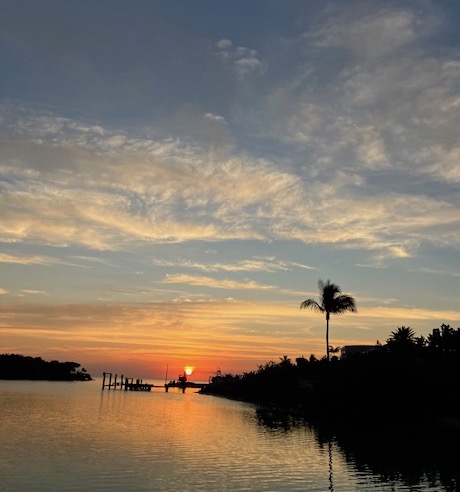
During this trip to the Keys, we had been overly focused on sunsets. This morning, we would be properly positioned to see the sun rise, and rise it did.
Sun rising Marathon Key (Photo Bill Pike)
At some point, we cleared the no wake zones, and Captain Chuck opened up the engines. Within seconds, we were scooting atop the calm surface. I wondered what the sea life below the surface thought about this roaring wakeup call.
We had one important stop to make before heading beyond the mainland—“the bait guy.”
The bait guy (Photo Bill Pike)
Anchored in a small harbor, we slowly approach his location. There are two, maybe more bait wells that capture a variety of live minnows. Charter captains arrive each morning asking for their favorite live bait.
If the bait guy can meet the captain’s request, he takes his dip net, goes into the bait well, scoops out the minnows, and transfers them into the captain’s boat well.
Cash is exchanged, the bait guy wishes the captain luck, and his attention turns to the next charter captain.
Captain Chuck makes his request. The bait is handed off to him in the dip net. He stows the bait, and the bait guy hopes we have a good morning. Next Captain Chuck positions the boat to make our run out to the Gulf of Mexico.
We cross under a bridge that handles traffic on the Over Seas highway. From Miami to Key West, I’ve read there are 42 bridges.
One of the 42 bridges in the Keys (Photo Bill Pike)
Heading out to the Gulf we are able to see multiple beautiful homes on either side of the water. Within minutes, we are out in the open Gulf.
Based upon his experience, Captain Chuck knows when we arrive in good area for catching fish. He throttles back the engines, the forward motion of the boat slows. Captain Chuck begins aligning the boat over one of his favorite spots. At the precise moment, he drops the anchor.
Then, he explains the technique to use. Next, he is baiting the hooks, and preparing to hand the rods over to us.
Dan surveying the scene (Photo Bill Pike)
On the back of the boat, attached to the exterior surface, and placed just below the waterline is a rectangular shaped cage. Designed for easy access this cage holds, a “chum block.”
A chum block is a block of frozen fish pieces. As it slowly melts, fish are attracted to this ‘gourmet’ fare.
Butch ready to start (Photo Bill Pike)
With our rods properly baited, Captain Chuck turns us loose.
I honestly don’t remember who hooked the first fish. There was a flurry of activity with each of us having our lines becoming taut. It seems as soon as Captain Chuck had removed the fish from the hook, measured its size, placed the fish in the cooler, and re-baited the hook, we had another fish on the line.
Then just as soon as this chaos started, it stopped.
Captain Chuck in the middle (Photo Bill Pike)
We pulled in the lines, and Captain Chuck repositioned the boat.
Again, Captain Chuck worked to prep our lines, and soon, we were catching fish again.
Our main catch was the Mangrove Snapper. We did manage to catch two different type of mackerel, and a couple of times the fish we caught were below the size limit, or the fish were not suitable for eating.
Captain Chuck was like an ichthyologist professor in a college lab identifying fish. No matter the fish on the end of line, Captain Chuck knew the fish on a first name basis.
Additionally, he knew if a fish posed any danger. One fish I caught, he quickly told me not to touch it. Captain Chuck told me an encounter with the fish’s fins would ruin my day.
The action slowed in this spot, and Captain Chuck pulled the anchor. He motored us quickly and skillfully to the site of an old houseboat wreck.
Once we arrived, Captain Chuck set the anchor, and baited our lines. He also coached us about how to work the wreck.
Turns out this was Dan’s lucky day. Over the wreck, Dan hooked a good size black grouper.
Dan’s grouper (Photo courtesy Butch Sherrill)
Unfortunately, grouper season starts in May. So, this pretty fish was gently put back into the Gulf of Mexico by Captain Chuck. We made a few more casts, but no nibbles.
We had a good morning. Our limit had been caught. Added to that excitement, Captain Chuck shared a wide range of stories from his experiences on the water.
With the anchor up, we started back toward Marathon Key. We made one quick stop at a bait trap that Captain Chuck maintains. With interest, we watched him pull up the trap, and carefully harvest the bait for his next charter.
The ride back to the inlet was just as pretty as the ride out to the Gulf of Mexico. Out on the water, we could see waterfront homes that might go undetected on a leisurely drive through a neighborhood.
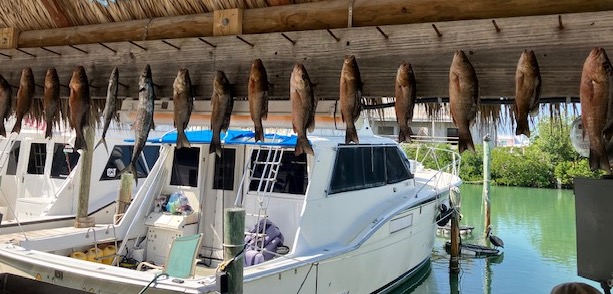
Once the boat was snug in its berth, Captain Chuck gathered the fish from the cooler. He displayed them for photos, and then Captain Chuck put his filet knife to good use.
Our catch (Photo Bill Pike)
As we watched him work his magic, another boat owner appeared. This guy was a talker.
We heard about his experiences as a commercial pilot, and his tales as a dedicated fisherman. He talked with Captain Chuck about an upcoming fishing trip. I sensed we were listening with a grain of salt.
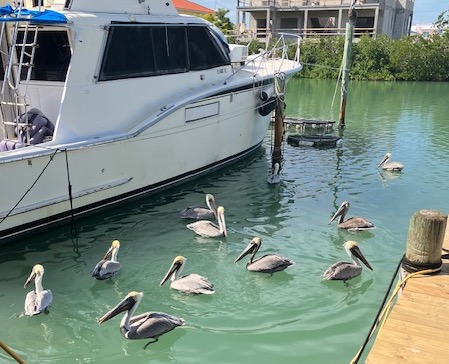
The brown pelicans had been keeping an expectant eye on Captain Chuck. I’m sure the pellies were having the same internal, self-talk— ‘I hope this Captain will share some of those non-filet scraps with us.’
Hopeful pellies (Photo Bill Pike)
The pellies were lucky. Captain Chuck made sure all the scraps hit the water. There was quite a pelican scrum in jockeying for those pieces.
Soon, the filets were ready. Captain Chuck iced them down, and we paid him for the trip and the memories.
We wished him luck with the remaining snowbird months and the upcoming grouper season. Captain Chuck told us when the grouper season is completed, he heads to Alaska to Captain fishing trips in that stunning environment.
On the drive back to Tranquility Bay, we chatted about this chapter of our trip.
Once inside the condo, we proudly showed our bosses the bag of filets caught from our morning of grueling work out in a harsh and hostile environment. These are smart ladies. They didn’t buy any of that fish baloney.
Butch took the lead in figuring out how many filets he would prepare for our dinner that night.
With the remaining filets, we opted to give them to Tranquility Bay’s support staff. I walked the bag over to the office, explained our intent, and the filets were graciously accepted.
Nothing like fresh fish for dinner. Butch seasoned and cooked the filets to perfection. The side dishes were a hit too.
Before dinner, I started my sad prep for Friday. On Friday, we would be working our way back to the Miami airport. There we would board our flights to return us to our homes and the reality of more winter.
If you have been reading this blog for the last ten days, you know I’m at best a mediocre fisherman.
Do I want to catch fish? Yes.
But, I have concluded, it is more about the opportunity to be outside in an environment that is different from home.
An environment where the solitude of the morning will overtake me in its beauty, a beauty that is different with the breaking of each new dawn.
That beauty can be seen in the shades of color as the morning rises up out of an eastern sky.
Its about the timing of the right moment to see a line of pelicans as they gracefully skim inches above the crest of a wave.
And it is appreciating stillness as a shorebird in the shallows silently stalks for minnows.
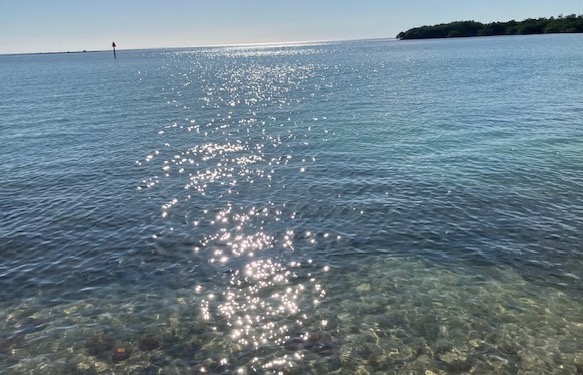
And, it is the wonder of the backlog of stories that give me the opportunity to daydream like a child staring off into the sparkling soul of seawater.
Maybe, it isn’t about the fish that are never caught.
Maybe, it is about appreciating the beauty of a weary and worn world that still has its heartbeat. A heartbeat that needs us to see it, hear it, feel it, protect it, and love it.
Hey God, I hope you are having a good day in the blue yonder.
As an all knowing religious leader, maybe your angel advisors have tried to keep from you that America is in turmoil.
While Americans might not want to admit it, I suspect that you know America has been heading toward upheaval for decades.
Quick to blame our political parties and their leaders for our shortcomings, rarely do we point the finger of blame back at ourselves.
Every four years, we have a presidential election.
Those elections have become flip flop events.
A newly elected Democratic president might change things championed by the preceding Republican president.
It works the other way too.
This flip flop leadership is disturbing. The common good of the people is jeopardized.
I don’t understand why our leaders take pride in these disruptive revengeful reversals.
Your son, Jesus, was quite the teacher. He was adept in using parables to teach and reteach us that we must love our neighbors.
At this moment in my life, I have a failing grade in loving my neighbors.
I don’t understand how my Republican friends can support our current president.
Those same Republican friends wonder why I’m unsupportive of their president.
So, God, I’m wondering are you a Democrat or a Republican?
Who do you support in this turmoil?
Before you answer, ponder this.
In our Pledge of Allegiance to America’s flag we purport the following beliefs: “one nation under God, indivisible, with liberty and justice for all.”
Right now, I don’t sense those words are true to our souls.
If your angels reported the latest data on religion in America from the Pew Research Center, you know we are more likely to be “religiously unaffiliated” than “one nation under God.”
You also know, we are a divided country.
And as for liberty and justice for all, ‘all’ keeps losing ground.
I repeatedly ask myself— where is the middle?
Where are those commonalities for working together?
God, I’m sure you remember Barbara Bush, maybe you see her everyday up there.
I wonder does Mrs. Bush ever bring up her wise quote: “I hate the fact that people think ‘compromise’ is a dirty word.”
When she hovers near you, does Mrs. Bush ever say: “Hey God, could you remind America about my quote?”
Regrettably, we put more energy into undermining each other instead of finding the means to work together.
I’m no theologian, but I’m curious about how these words from the Bible apply to our judgment: “The Lord does not look at the things people look at. People look at the outward appearance, but the Lord looks at the heart.”
What do you see in our hearts now?
Do you see hearts that have been misguided and overtaken by disrespect, fear, greed, hate, incivility, revenge, and selfishness?
With all the chaos in the world, I doubt if you have much quiet time for reading.
But, you might want to read—When The Sea Came Alive An Oral History Of D-Day by Garrett M. Graff. Your name appears in the book quite a bit.
In the Epilogue, I read this quote from Private Maynard Marquis: “It’s too bad we have to have wars, but I think we always will. People never change. Only the weapons change.”
Private Marquis was correct. We are stubbornly resistant to change.
As far as warfare weapons, the internet has become a psychological one.
I’m sorry God, but I owe you an apology. It is unfair of me to ask if you are a Democrat or Republican.
Everyday, people ask you heartbreaking questions—why is my grandchild battling cancer, why is my son an opioid addict, why did another Veteran die from death by suicide, why did we lose our daughter in a senseless school shooting?
Respectfully, with regard to questions, your plate is full.
However, Americans must be asking insightful, probing questions of ourselves.
In the famous “They call me Mr. Tibbs” scene from the movie In The Heat Of The Night, two piercing questions are asked: “My God what kind of people are you? What kind of place is this?”
God as you look down upon America, are those two questions roiling through your heart like they are mine?
Part of me wonders is America facing its own internal D-Day?
Will our longstanding stubborn neglect related to national debt, safety, mental health, housing, and the erosion of our families implode us?
H.L. Mencken once wrote: “The men the American people admire most extravagantly are the most daring liars; the men they detest most violently are those who try to tell the truth.”
America, what kind of people are we, what kind of place is this?
Americans, this is urgent. Our hearts must answer.
With my out of state fishing license expired, I didn’t go fishing this morning. My chances of being caught by a game warden from the state of Florida were probably slim. But why should I add to the glee of the fish? In my seven days of casting, I’m sure the fish were proud of shutting me out.
Actually, I’m fine with the shutout.
I’m 1,052 driving miles away from Richmond, Virginia. It’s January. It’s winter. It’s cold.
Out the back door of the condo at Tranquility Bay, I can walk less than a hundred steps, and in a blink, I’m casting a line into an isolated bight of the shoreline fed by clear water from the Gulf of Mexico. Those early morning scenes will stay with me forever, and they will push me through the remaining winter when I get back home.
So, I opted to go for a run. When I departed the condo, the temperature was 63 degrees. Back home in Richmond, the thermometer was 33 degrees.
This morning I was running north on the left side facing traffic along the Overseas Highway. I hoped to run to Sombrero Beach.
Lots of traffic on both sides of the highway this morning.
I was clipping along well. I came to the cross walk for a right turn to head toward Sombrero Beach.
With one push of a button, I was able to stop traffic on both sides of the highway. I ran across staying within the lines of the crosswalk.
Safely on the the other side, I was getting ready to cross a side entrance that feeds into the Publix parking lot. A driver in a rush was approaching this crosswalk. I sensed the driver was not going to stop, so I stopped.
When the driver realized I had stopped, she stopped. With a touch of aggravation, I motioned for her to keep moving.
I’m reminded of Rodney Dangerfield—I tell you pedestrians get no respect. I don’t know if this is because drivers don’t know that pedestrians have the right away, or if drivers selfishly don’t care, and they keep moving.
Anyway, I noticed something nice the further my old body moved me away from the highway— it became quiet.
The roar of the wheels on the always burdened asphalt disappeared. I could hear birds chirping and singing. This was a very pleasant contrast to the hustle on the Overseas Highway.
As I moved along Sombrero Beach Road, I gradually came to a well designed public education complex for the middle and high schools in Marathon Keys.
These two campuses were about to come alive with the school day beginning.
At that point, my old body told my brain, we’re not taking Baloney Bill to Sombrero Beach this morning. With that internal memo, I ran just past the school complex. I turned around and headed back toward Tranquility Bay. When I arrived at the condo, I stopped my watch. It read 56:24.
Wednesday was to be a quiet day for us. No sightseeing, just an easy pace.
Later that morning Betsy, Butch, and I walked to the 1.5 mile spot on the Seven Mile Bridge. Lots of people were in motion in both directions. The water no matter where we looked was pretty.
I wish I had brought my binoculars with me to the bridge. Off the right side, we could seen a large sand bar. In the shallows of that bar was a boat with a fisherman on it. I wanted the binoculars to see how he was doing.
The sand bar. (Photo Bill Pike)
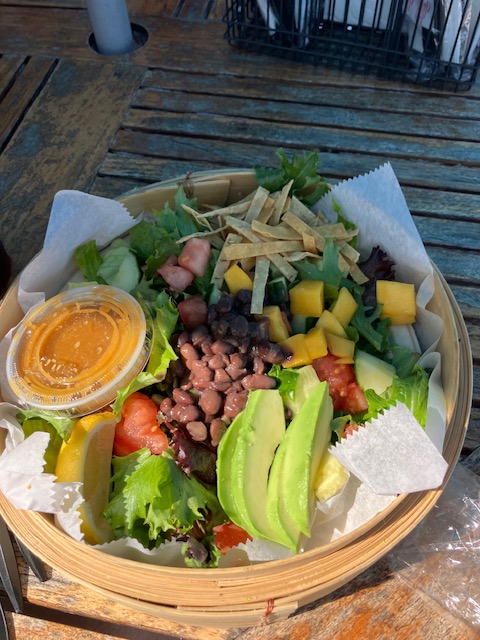
For lunch today, we opted to check out Tranquility Bay’s Tiki Bar. This pretty day was perfect for lunch under an umbrella. I enjoyed a delicious Caribbean Salad.
My salad (Photo courtesy of Betsy Pike)
Laziness ruled the afternoon. But at some point, Butch, Dan, and I decided to locate the marina where we would be meeting Captain Chuck for our fishing charter on Thursday morning.
Once off the Overseas Highway, it took us a few minutes to locate the side street where the marina was located.
Eventually, we found this finger like inlet of water. Tucked under a protected roofline that resemble a long shed was a row of silent boats.
Inside of me was a shiver of excitement. I was like a little kid anticipating Thursday morning and our half day fishing charter. Hopefully, the knowledge and skills of Captain Chuck would bring us better luck than I had fishing in the surf.
Before we knew it, we were heading out for dinner.
Tonight, we opted for the Island Fish Company. This sprawling water front restaurant was busy. We waited a bit to be seated, but the restaurant was a good choice.
After dinner, we played another challenging round of charades from the creative mind of Marian. She has a way of pushing our brain cells to be imaginative and inventive.
When charades had worn us down, we had some final chatter about the fishing charter, and there was also the dreaded yapping—preparing to fly back home on Friday.
Let’s get the predictable part of my early morning routine in Marathon Key out of the way.
Yes, I fished out front.
Yes, my incompetent skills as a fisherman continue to make headlines in The Fish Daily Times News: Local fish continue to elude angler from Virginia.
Seemed as if we had a slow start to Tuesday morning. Maybe, our Monday spent in Key West required some sleeping in today.
Ever since the drive from the Miami airport, I’ve been curious about a convenience store that we kept seeing. The store like 7-11 is named Tom Thumb.
Directly across from the entrance of Tranquility Bay sat a Tom Thumb. This morning, I made a decision that I was going to cross the always busy Overseas Highway and check out the store.
No one offered to tag along with me, so I made the short walk to the highway. Interestingly, as I was just getting ready to study the traffic, a guest from Tranquility Bay was returning from Tom Thumb. He knew what I was getting ready to do, and he said good luck.
If you’ve ever watched the movie Bowfinger, starring Steve Martin and Eddie Murphy, you might remember that harrowing scene where Eddie Murphy’s character crosses a Los Angeles Freeway on foot. I wasn’t crossing a freeway, but the volume of traffic on the Overseas Highway meant I needed to be very alert.
I safely made the crossing each way.
Simply, Tom Thumb is a convenience store. It has similarities and differences in their set up like any convenience store you have entered.
As a curious tourist, I felt obligated to make a purchase. For our wives, chocolate is always a winner, so I picked out an assortment of chocolate candies.
On the day, I stopped at the bait shop and bought shrimp for fishing, I asked the clerk about a good spot to fish. He recommended Sombrero Beach. In our travels on the Overseas Highway, we had seen the signage for the beach.
This morning, Betsy, Butch, Dan, and I made the drive to Sombrero Beach. We loaded up the car with our beach stuff, and Dan brought his snorkeling gear.
We simply followed the signage, and made the turn on to Sombrero Beach Road. I think we were pleasantly surprised when we arrived at the beach.
According to the Parks and Recreation website for Marathon Key, in 2001, the city renovated this beach front. It now features full handicap access, picnic pavilions, restrooms, showers, a volleyball court, and even a fishing pier.
Additionally, from April through October, this beach positioned on the Atlantic Ocean is a nesting site for Loggerhead Turtles. The city carefully monitors turtle nesting activities, and residents can be trained to become a turtle surveyor.
As soon as we parked, unloaded, and walked on to the beach, we were impressed. It is a gem. While not a large parcel of beach front, the white sand, the views, and the shades of color in the water caught our attention.
Sombrero Beach (Photo Betsy Pike)
We found a place to drop our belongings, and we started our recon walk. I know I’m being repetitive, but this is a special place. The city has done a nice job in maintaining everything associated with the beach.
I enjoyed walking the area. I was intrigued by the exposed limestone bedrock in a couple of places. Apparently, the coral reefs off of Sombrero Beach make for gentle waves rolling into the shoreline.
My three pals were braver than I was about checking out the water. Dan put on his snorkeling gear and did some exploring. I sensed he enjoyed the exercise, but I don’t think he came across any sea life.
After an enjoyable visit, we gathered our belongings and made the drive back to Tranquility Bay.
Once there, I rechecked my fishing license. I thought it expired on January 29, but it actually expired today.
So, my goal for the afternoon was to return to Sombrero Beach to fish. In my walk around this morning, it looked to be an ideal location for an unlucky fisherman like myself to possibly find some luck.
After nibbling on something for lunch, I got organized. I had both fishing rods, a glove, scissor forceps, hat, and sunglasses. Exposed parts of my old carcass were covered in sunscreen, and I had my license in a plastic pouch in my shirt pocket.
Dan and Judy drove me over to Sombrero. Dan helped me to get settled on a ledge of exposed limestone. Then I realized I had left the shrimp bait back at the condo. Kind friends that they are, Dan and Judy drove back to the condo to retrieve it.
There was a younger guy to my left trying his luck. Several yards to my right was the public fishing pier.
I was going to cast into Sister Creek. It was fed by the ocean. The water was pretty and clear.
My casting spot (Photo Bill Pike)
I made sure to manage my footing. If I stumbled, I knew the exposed limestone would be waiting to injure me.
Pretty limestone formation (Photo Bill Pike)
My casts were long and true with the lure. I wanted to make sure that I didn’t get hung up on any limestone rocks in the shallows.
I varied the direction of my casts each time. I kept an eye on the young man to my left. It didn’t appear that he was having any luck.
Dan returned with the bait. He had a work call coming in so he hustled back to the car.
As I was reeling in a cast, a fish hit the lure hard. That bite surprised me, and I could not react quick enough to set the hook. The distressed fish wiggled off the line.
That one hit gave me the first hope I’d had all week. I kept casting. I was getting good distance on each cast.
Once again, I had another strong hit on the lure. The fish, maybe the same one was swifter than my tardy reaction time. I missed setting the hook again.
A bit peeved at myself, I opted to switch rods and try the shrimp bait. The casts with the bait might have been shorter, but I knew the baited line had landed properly on the bottom.
I let the bait sit for several minutes. Then, I’d reel in to make sure the bait was still on the hook.
A few times, I could feel a slight twitch on the line. Felt like a small fish or a crab nibbling at the bait. But, I could never get a fish to fully take the bait.
Just shy of 4 p.m. I was ready to call it quits. I gently tossed the unused shrimp into the water. Dan helped me to collect my gear.
I had fun fishing in a pretty place. And part of my self-talk told me that I should have fished at at Sombrero Beach more. I think I would have caught a fish.
Back at the condo, we were getting ready to have dinner at the Sunset Grille and Raw Bar. The restaurant sits at the base of the Seven Mile Bridge.
We left in time to wrangle a water side table. That way, we would enjoy a good view of the sunset.
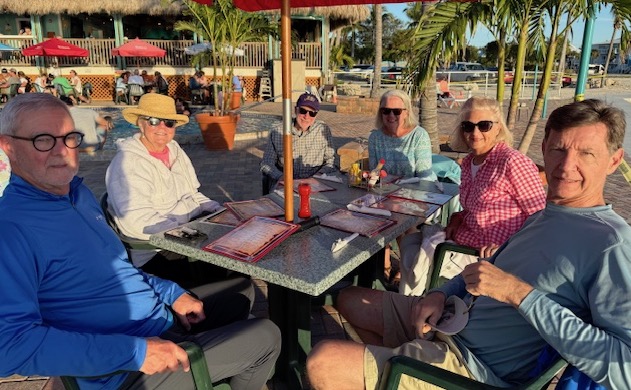
Pals (Photo taken by the waitress on someone’s phone)
We had a delightful waitress, and the sunset did not disappoint us.
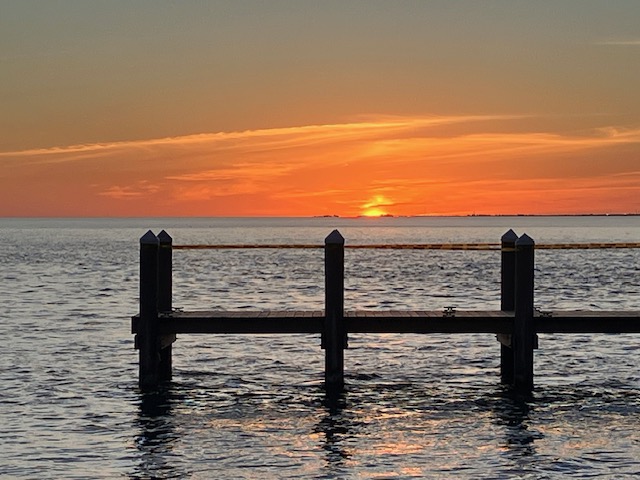
The sun settling in for the night (Photo Bill Pike)
Once we were back at Tranquility Bay, Marian had another round of charades planned out for us. After maxing out our creative brain cells, Dan had the movie, You Hurt My Feelings, ready for us to watch.
We had another busy day in Marathon Key.
The highlight for me was Sombrero Beach.
I’m thankful for the leadership in Marathon Key who believed that Sombrero Beach had potential. Clearly, their plan has made the beach a good place to visit for their residents and tourists.
And though my Richmond friend, Rohn Price, will be disappointed that a couple of fish eluded me at Sombrero Beach, my old brain will never forget the priceless beauty of casting from that shoreline.
I hope Sombrero Beach will continue to provide opportunities for people to enjoy its beauty.
And I also hope the leaders in Marathon Key will always maintain and upgrade as needed this very nice beach.
And I’ll throw one more out there. I hope we, the users of Sombrero Beach will cherish and care for this little bit of paradise for a long, long time.
I’m an early riser. Some of my best mornings are when I’m able to take a run in the predawn light of a new day. No matter the season, our neighborhood offers much to see and consider as the sun peaks through trees and crests over rooftops.
During Lent, the landscape is in the beginning of a fading winter and the arrival of spring. There is a beauty in the starkness of my surroundings before spring brings on its green paint. In the light of that starkness, my eyes see my neighborhood with a different clarity.
Those runs offer me solitude, time to reflect, and ponder. Some mornings, a feeling of “losing heart” is running with me. Yet, in those moments, I’m reminded of the “unseen.” I wonder how the good Lord, a friend, or stranger might be conspiring to bring relief to my slipping heart.
Lent can be a tough run. We know its road—hills, curves, straightaways, and blind spots.
Yet, at the end of Lent, just like the end of a morning run, I feel mentally and physically resurrected by its transforming story.
For me that resurrection and transformation are grounded in the last verse of Hebrews 12:1: “and let us run with perseverance the race that is set before us.”
Society of St. Andrew
Prayer: Father of us all, during Lent help us to persevere and not lose heart. Amen
Bill Pike Richmond, Virginia
Author’s note: I’m always humbled when a piece I have submitted to a publication is accepted. The Society of St. Andrew does good work in providing food to people. Have a quiet day, be safe, Bill Pike
March 4, 2016 was a sad day for me. On that date, I learned that my favorite author, Pat Conroy, had died.
Mr. Conroy was seventy years old. In January of 2016, he announced that he was being treated for pancreatic cancer. To me, all cancer is evil. But, pancreatic seems to be extremely cruel.
At times, the world might have been extremely cruel to Mr. Conroy. Yet, he always seemed to persevere. His luck ran out with the destructive pancreatic.
Here are some instructions for my children, grandchildren, and beyond, my Pat Conroy books are not to ever leave the family. Sorry to dump that on you, but Mr. Conroy’s books touched my soul. They might just touch yours too.
When I see old book tour itineraries, when Mr. Conroy was close to Richmond, I still curse myself for not making the trip.
Only one book is missing from my collection and that is The Boo. I’ll read it before I croak.
Out of all if his books, I keep coming back to My Losing Season. That book is about his senior year of playing college basketball at The Citadel. My Losing Season is my favorite book to pickup for the purpose of re-reading a page or two or three. Sometimes, I can’t put the book back down.
With this book, Mr. Conroy’s gifts as a writer made me laugh, cry, and ponder.
I laughed at the room checks on road trips as the coaches checked for females in the rooms of players.
I cried when I read about Mr. Conroy’s teammates, Al Kroboth and Joe Eubanks, as they served America during the Vietnam War.
And I pondered, the difficult decisions that Mr. Conroy and his classmates had to make while serving on the Honor Court at The Citadel.
Woven into the book are the ups and downs of the season, the psychology of dealing with Mr. Conroy’s difficult father, and a demanding coach.
We learn about his teammates in the real time of the season, but we also learn about their post Citadel lives as Mr. Conroy finds and interviews each one of them.
I love the self-talk Mr. Conroy has with himself after a rare but exhilarating win:
“I needed time to memorize what happiness felt like because I had experienced so little of it. Looking up into the night sky, I saw the Milky Way. I instantly thought of God and how I was afraid I was losing my faith in him and the immensity of the fear and cowardice I felt when I thought of facing the world without Him.
I was receiving the Eucharist every day of my life and fighting this war with faithlessness with every cell of my body, but I could feel the withdrawal taking place without my consent.
On the causeway to Lady’s Island I prayed out loud, ‘O Lord, please hear me. I thank you for this year. I thank you from my heart. I needed to be a decent basketball player in college, Lord. I don’t know why. But, I needed it. We both know I’m no good, but we sure are fooling some people. Aren’t we, Lord?’(Pages 275-276)
I love the honesty of that passage.
I love it because I have been there.
I have felt and experienced that same tidal undertow of my faithlessness to God being pulled away too.
And I’ll carry that faithlessness further, it is still alive in me today when the discouraging headlines in the news overwhelm me. My fearful soul cries out—God where are you?
Like many scriptures found in the Bible, Mr. Conroy references being afraid with fear at the prospect of attempting to live his life without God’s presence. I know that fear too. It is with me everyday.
But there is another honest lesson about acknowledging life’s disappointments in the epilogue for My Losing Season.
Mr. Conroy writes: “There is no downside to winning. It feels forever fabulous. But there is no teacher more discriminating or transforming than loss. The great secret of athletics is that you can learn more from losing than winning.”
He continues: “The word “loser” follows you, bird-dogs you, sniffs you out of whatever fields you hide in because you have to face things clearly and you cannot turn away from what is true. My team won eight games and lost seven-teen—losers by any measure. Then we went out and led our lives, and our losing season inspired every one of us to strive for complete and successful lives.” (Pages 394-395)
Pat Conroy’s final game as a player for The Citadel was in the 1967 Southern Conference Tournament. They lost to the University of Richmond in overtime 100 to 98.
The next morning in the Charleston, South Carolina newspaper, The News and Courier, Citadel coach Mel Thompson said this about Mr. Conroy’s play: “Pat Conroy gave another great performance. That kid gets more mileage out of his talent than any player I have ever coached.” (Pages 340-341)
Those unexpected words of praise from Mel Thompson were used by Pat Conroy to inspire and shape the rest of his life.
I don’t think my old heart can ever let go of Pat Conroy’s books.
Maybe this is why my soul will always hang on to him and his words: “It was the year I learned to accept loss as part of natural law. My team taught me there could be courage and dignity and humanity in loss. They taught me how to pull myself up, to hold my head high, and to soldier on.” (Page 400 Epilogue My Losing Season)
That is a powerful lesson.
No matter how bleak, frustrating, and uncertain this world can be, you, me, we, us must soldier on by pulling ourselves up with courage, dignity, and humanity.
But I did enjoy watching a wet blue heron land and shake his feathers.
A young father and his two sons stopped for a few minutes. Turns out this young man was a University of Richmond graduate. While its not an across the street walk, I told him we could walk to the university from our house in Richmond.
At the beach condo, breakfast was coming together as were our plans to visit Pigeon Key. We wanted to make sure our arrival allowed us to be on the first train to the key.
With our reservations confirmed, we were out the door around 9:30. It was a short drive to the staging area. We parked, made sure we had everything, checked in, and found seats on the train.
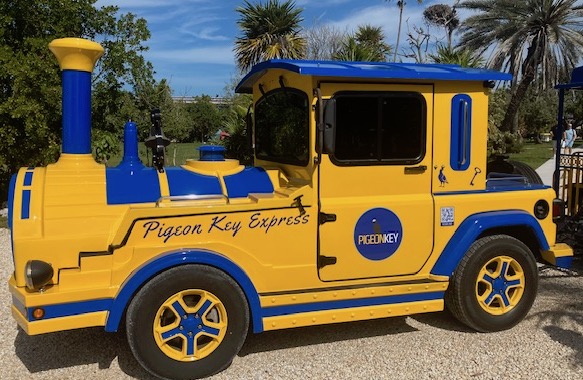
The engine that pulled us along the bridge (Photo Bill Pike)
Once everyone was seated, we received a brief orientation about our visit. There are multiple options for guests to chose from. We opted for a guided tour with time to explore the the five acre key with its eight buildings. This site is also on the National Register of Historic Places.
It is a two mile ride on the train to Pigeon Key. This was a $41 million project to repurpose and renovate the bridge for the public. This project had good results for walkers, runners, bike riders, and curious guest who want to learn more about Pigeon Key. Plus the views from the bridge in any direction are pretty.
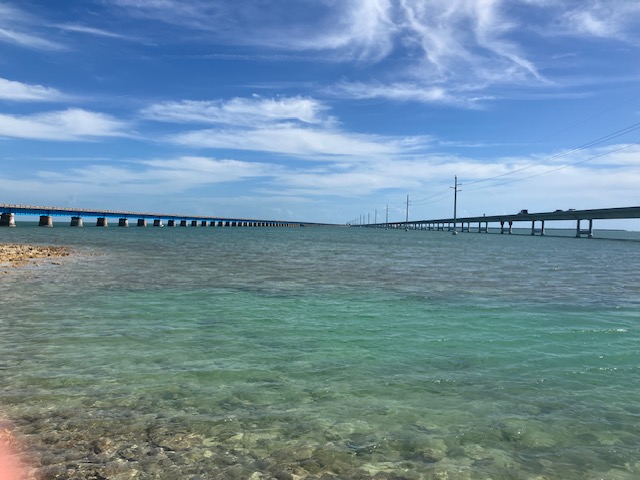
Bridge spans from Pigeon Key (Photo Bill Pike)
Our guide had given us some good insights on the ride to Pigeon Key. Once off the train, our guide organized us, and she started her historic script.
Essentially, Pigeon Key is all about Henry Flagler and his efforts to build The Florida East Coast Railway. This determined, persuasive, and successful businessman had the vision and resources to pursue this goal.
Pigeon Key was the work camp for the men who hired on to build the railway. Our guide was very knowledgeable, maybe too knowledgeable. Her wealth of information cut into our self-guided exploration.
Still we enjoyed learning about the design of the original dormitory that is now used as an education center. It still showcases the use of Dade County pine throughout the facility.
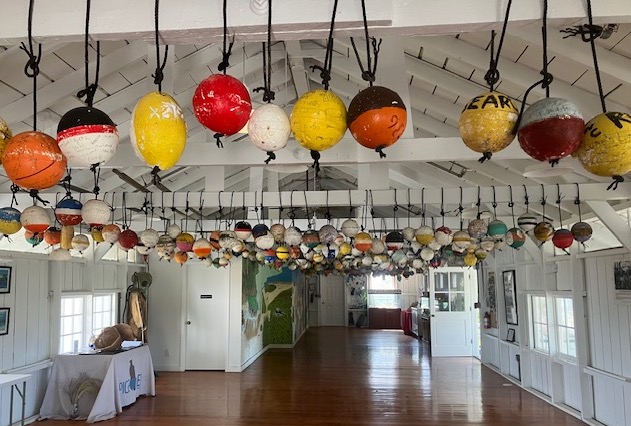
Former dormitory, now an education center, note original hardwood flooring (Photo Bill Pike)
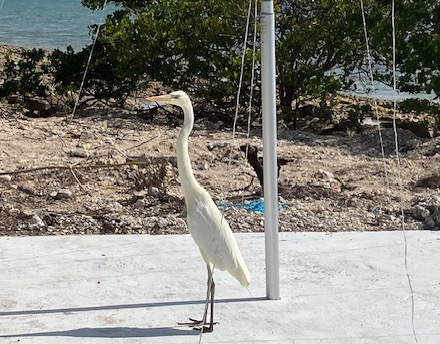
The buildings and grounds are well-maintained. Moving around the plot isn’t difficult. No matter where your feet take you the views are very pleasant, and we enjoyed the calm presence of two Great White Herons who are like family to the staff.
One of the herons. (Photo Bill Pike)
Our departure time came quickly, and once Pigeon Key personnel had accounted for everyone, we were ready for the two mile ride back to the mainland.
Judy opted not to go on the Pigeon Key excursion, so we drove back to Tranquility Bay and picked her up.
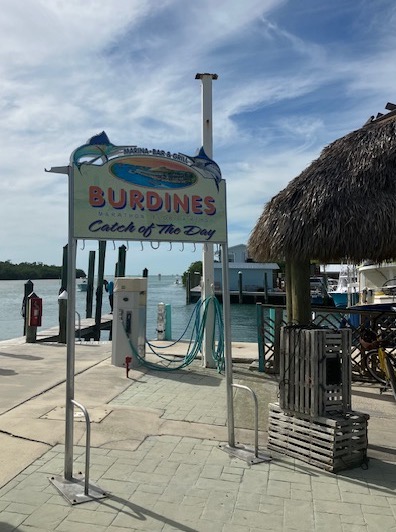
From there, we headed to Burdines for lunch. This restaurant had been recommended to Butch and Marian by a local shopkeeper. Earlier in the week, we attempted to eat at Burdines, but the unseasonably cool air and brisk wind pushed us away from this open air restaurant.
(Photo Bill Pike)
Today, we hoped to do better under a partly sunny sky. Initially, we were seated on the side of the restaurant where a brisk wind was coming off the water of Boot Key Harbor. Sensing this uncomfortable shaded coolness, Butch negotiated a seating location change for us with the hostess.
Off the main highway, Burdines is ideally located next to a marina. It serves diners who arrive by boat or car. There is nothing fancy about Burdines as is stated on their menu: “As we say in the islands, this ain’t no fast food joint, so relax mon!”
To get us started Betsy ordered hush puppies, and they were good. Burdines might not be a “fast food joint” but I was amazed at how quickly our food arrived. Our lunch orders filled us up, and none of us were interested in ordering a piece of fried Key Lime pie to go.
Back at Tranquility Bay, the abundant sunshine was an attraction to sit by the pool. At some point, Dan and I headed to the workout room to burn off Burdines. Football was on the agenda too, as it was NFL playoff time, and then we had to make decision about dinner.
I think Marian had a hankering for spaghetti. Butch, Dan, and I made a mad dash to Publix. Under Butch’s guidance, we picked up the items so that he could create a spaghetti dinner for us.
Upon our return, we all pitched in to help our master chef prepare his special sauce. The sauce was delicious and this pasta meal hit the spot. It would be the carbo load we needed for walking around Key West on Monday.
I was excited about our day trip to Key West, and I had also enjoyed our Sunday in Marathon Key.
Even though our tour guide put my brain on information overload, I heard enough from her about the ups and downs of Henry Flagler that I would like to learn more about him. Specifically, the back stories about the creation of the Florida East Coast Railway sound very interesting. I can only begin to imagine the economic, environmental, and logistical challenges of this project.
Maybe before I croak, I’ll get to Les Standiford’s book— Last Train to Paradise: Henry Flagler and the Spectacular Rise and Fall of the Railroad That Crossed an Ocean.
Rest up Key West, we’re checking you out tomorrow.
Author’s note: My teachers: kindergarten (Mrs. Simmons at Davis Street Methodist) and first grade (Mrs. Hughes at Elon Elementary) would be disappointed in my math skills related to blog post. Obviously, seven comes before eight. So, I had day seven ready, but I forgot that post was completed. In the future, I’ll work to improve my counting skills. Thanks patient readers.
Even though we were headed to Key West today, I still went out fishing. This time next week, I’ll be back in Richmond. I will not be walking out in shorts, with a fishing rod, and casting out into a lagoon fed by The Gulf of Mexico.
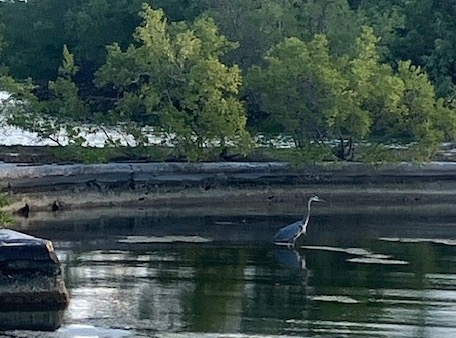
Dan joined me for a few casts, and at some point, a blue heron snuck into the shallows by an old retaining wall.
My lefty pal (Photo Bill Pike)
Maybe that is the best thing about fishing—its not what you don’t catch, its about what you see while trying to catch fish.
The quiet heron (Photo Bill Pike)
I don’t recall when we departed for Key West, but I can tell you I was excited.
From Marathon Key to Key West is about fifty miles. We knew that traffic might slow us up from time to time, but I wasn’t really thinking about the clock. I was more curious as to how the Overseas Highway was going to link together with bridges and passages overland to drop us in Key West.
We made steady progress as we checked off the assorted Keys along the way, and before we knew it, we found a street parking spot in Key West.
No sooner had we parked, when we witnessed an accident with a motor scooter. Maybe a struggle with balance and a lack of experience contributed to the fall. The young lady impacted the most by the fall seemed reluctant to get back on the scooter. I don’t blame her.
After taking care of the parking fee, we organized, and worked to find a location to make our bladders happy.
Following that break, we headed to the Southernmost Point Buoy. This buoy documents that visitors are in the southernmost point in the continental United States.
We opted not to stay in the line for a photo. Butch captured a nice solo shot of the buoy to share with everyone, and with that visit done, we headed toward Ernest Hemingway’s house.
It has been a long, long time since I have read anything by Mr. Hemingway. I loved reading his work when I was in college.
I was hoping the tour of his Key West home would be better than the one we took a few summers ago. While visiting our oldest daughter and her family in Chicago, we toured the home were Hemingway was born in Oak Park, Illinois. That was a difficult tour to endure.
Today, we opted for a self-guided tour, and I think that worked well despite the large group of people touring the home and grounds.
I can only begin to imagine the untold stories on the grounds and from the interior of the house.
Lots of the famous six toe cats were around. I didn’t bother to count. But, it was easy to see that the cats are held in high esteem here. There is even a small cat hotel constructed for them.
Concise signage helps guests find their way with good information. Of course, you pick up bits of stories from overhearing a tour guide’s scripted account, or from a very knowledgeable guest who is a devoted fan of Mr. Hemingway.
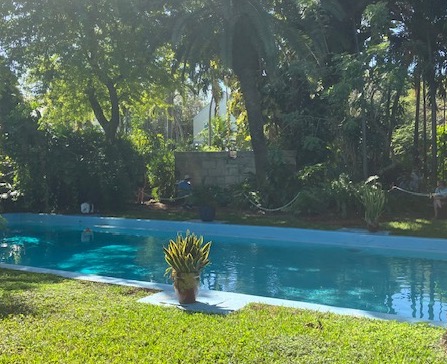
On the grounds, the long saltwater swimming pool will catch your attention.
The pretty pool (Photo Bill Pike)
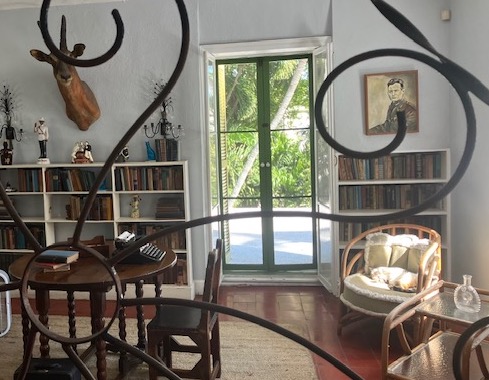
Inside, every room is a story. I can imagine hearing the sound of the typewriter keys clacking away as Mr. Hemingway wrote in the easy pace of a Key West day.
Typewriter on the table (Photo Bill Pike)
Eventually, our curiosity was satisfied, and we regrouped in a small garden near the entrance.
From the Hemingway House, we worked our way to Duval Street. Looking for lunch, we quickly chose Old Town Tavern and Beer Garden. We sat at a nice table on the porch. That gave us the opportunity to chat and watch the people traffic on Duval Street.
We had an exceptional waiter who offered guidance with the lunch menu, but who also was curious about our trip.
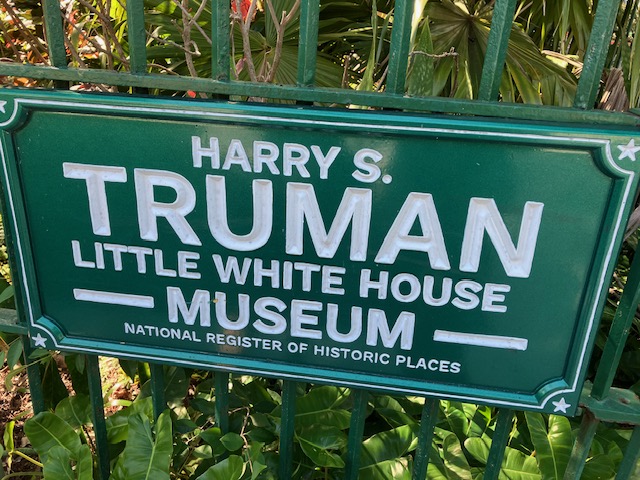
After lunch, we continued exploring Duval Street and its shops. Our timing was good as we worked our way to the Harry S. Truman Little White House. One of the afternoon tours was about to start, so we quickly purchased our tickets.
(Photo Bill Pike)
Our tour guide was perfect. He knew how to use this allotted time efficiently. The presentation throughout the house was a blend of interesting history, good back stories, and humor. Additionally, the character of the house captures the era of Truman’s service to America, and like Hemingway’s home, every room had a story.
There was no better back story than the detailed research that revealed how the editors of the Chicago Daily Tribune published the infamous headline—Dewey Defeats Truman.
In what would become a post-World War II presidency for Mr. Truman, he accomplished a lot. One of the most interesting to me were two executive orders—9980 and 9981. These orders desegregated the federal workforce and the armed forces. Sad to me that America continues to struggle with skin color today.
If you are ever in Key West, I would make the commitment to tour The Little White House. It is a snapshot into the past, but filled with opportunities to learn about Mr. Truman.
From here, Butch and I walked back to retrieve the car. The rest of the group ambled toward Duval Street.
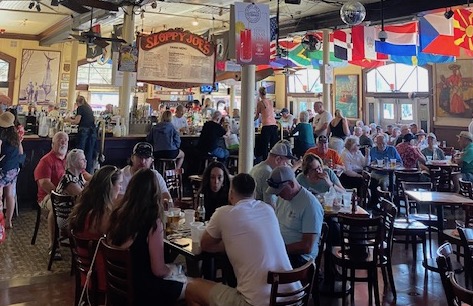
Once we reconnected, we hit the stage of the afternoon where we needed to be refreshed. Sloppy Joe’s at the corner of Duval and Greene was our destination to be restored.
This storied bar is listed on the National Register of Historic Places. We ordered our beverages, and surprise, I didn’t order a beer. I opted for a Mojito. With its origins in Cuba, the drink features rum, lime juice, simple syrup, and fresh mint. I’ll leave it to you to sort out the Hemingway myths about this tropical drink.
Inside Sloppy Joe’s (Photo Bill Pike)
Along with people watching, there is quite a bit to take in around the bar. Artifacts that are a part of the bar’s storied history are still on display.
While we were enjoying ourselves, I remember a couple of times a bell being rung at the bar. The bell comes from a Coast Guard cutter that is no longer in service. The barkeeper rings the bell to signal that a member of the waitstaff has received a large tip.
If you want a piece of Sloppy Joe’s to take back home, a gift shop with all of the usual suspects is available. For my gift, I’ll settle for the memory of visiting Sloppy Joe’s with our treasured friends. And, I’ll wonder if Mr. Hemingway’s ghost ever sneaks in for a Mojito.
After Sloppy Joe’s our focus was getting to Mallory Square.
Somehow securing a parking space was hassle free. For a bit of time, we roamed in and out of shops. The shop owners were hoping we wandering tourist might boost their income for the day.
Mallory Square is famous for its waterfront sunsets. While waiting for the sun to put on its unpredictable show of colors, there is a variety of entertainment taking place.
I was interested in one young man whose solo show reminded me of our famous Richmond, Virginia performer, Jonathan The Juggler.
This afternoon, I think the performer was Jase The Juggler, a native of Key West. His performance including juggling an assortment of items while at the top of a unicycle, and even his patter with the audience, reminded me of my friend, Jonathan, in Richmond.
Jonathan Austin knockoff (Photo Bill Pike)
Well, the sunset arrived, and it didn’t disappoint us.
The setting sun (Photo Betsy Pike)
When it was tucked away for the night into the sea, we retraced our steps through the crowd to the car. Our navigation devices wove us out of Key West, and soon we were back on the Overseas Highway driving toward Marathon Key.
With darkness upon us, Butch safely drove us into Marathon. Once back, we ate at an unremarkable restaurant. At that point, we were ready for the comfort of our Tranquility Bay condo and the opportunity to collapse.
We packed a lot into our day.
We were in constant motion, but I think that movement makes a good day for a tourist.
We saw a lot, and learned even more from these experiences.
And there is part of me that would like to return to Key West.
I know we walked by many pretty homes. If nothing else, I would simply like to gander at them more closely, but as a polite tourist.
From this photo of a driveway gate, I quickly learned what could happen to overly intrusive tourists. Year round Key West residents must develop a tolerance for sightseers.
Still, I appreciated the humor found in this signage.
(Photo Bill Pike)
As I climb the stairs toward my bed, I’m thankful for this opportunity to be on a “fishing” expedition with our friends.
Days like today confirm that enduring friendships are better than catching a fish.
On the morning of Tuesday, February 11, 2025, I went for a run.
I had to go because the weather forecasters had Richmond whipped into another winter storm frenzy. I wanted to get out before all that frozen precipitation covered the roads.
That winter storm hysteria came courtesy of local weather forecasters. I wonder if the meteorology degree curriculum has a required class: How to create craziness in snow starved communities with a winter storm forecast. If they do, it works in Richmond.
When I left the house, the temperature was 33 degrees. A northeast wind at 6 mph. created a wind chill of 27 degrees.
I was layered up for the run under a gray winter sky. Lately, I’ve been running the 5K course through our neighborhood. Years ago, our son, Andrew, created the route for a 5K sponsored by our church.
This morning, I’m running the course, but out of its usual sequence.
Maybe its my odd personality, but I enjoy a run on a cold, gray winter morning. I think it has to do with the starkness of the landscape.
I can really see how stately the trees are sculpted.Their bare branches and limbs stretch in all directions.
In some landscaped beds, the early green of anxious daffodils are popping up.
On the south retaining wall for the playground at our church, the bright yellow blooms of winter jasmine are showcased.
Even though not a single flake of snow has fallen, local school systems surrendered to the dire predictions and are closed for the day.
Out on the course, I come across people getting one last walk in with their dogs before this monster of a tempest arrives.
The storm is predicted to start as a heavy wet snow. Then conditions change in the upper levels of the atmosphere to create a switchover to sleet followed by a change to the super slick and dreaded freezing rain.
We have no affection for freezing rain in our tree laden neighborhood. That ice coating makes life miserable for trees, their limbs, and the utility lines under them.
Dominion Energy recently completed a massive project in the neighborhood by burying the power lines underground.
Because of its splendid mature trees, this neighborhood was one of the leaders in Virginia for losing power during inclement weather. While not a perfect solution to power outages, so far this winter we’ve been lucky.
I felt like an out of sync slug when I started my run. Eventually, this old sack of bones adjusted, and I felt better with each step.
When my feet arrived at the edge of our driveway, I stopped the timer on my watch. It read 35:30. Clearly, at my age, I’m no speed demon, but I truly cherish being able to go for a run.
I don’t remember the exact moment, but after breakfast the snowflakes started to fall. It was if someone had taken an ice pick and poked a hole in those full gray clouds. The flakes fell as if they had not a care in the world.
By midday, the snow retreated and sleet was pinging off hard surfaces. At one point in the afternoon, the snow returned, but to my disappointment the final switch over to freezing rain took place.
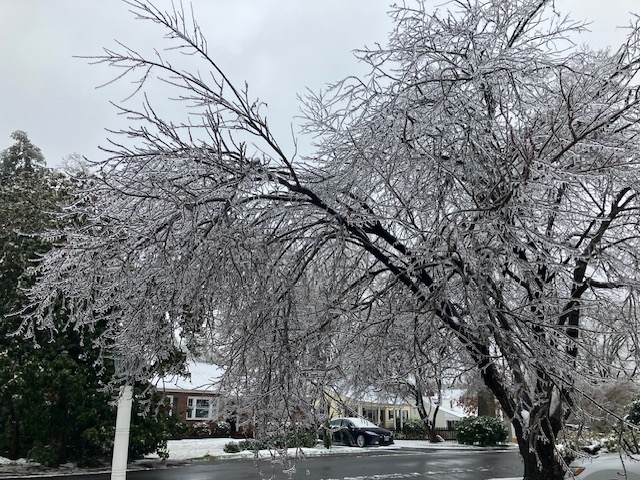
Between dinner and bedtime, we kept peeking out the windows. Our Thunder Cloud Plum near the end of our driveway was making me nervous. The ice coating its limbs kept weighing them down. I hoped that the tree could withstand the extra weight and not snap during the night.
Our weary Thunder Cloud Plum (Photo Bill Pike)
As I headed upstairs, one of the county’s snowplows came down our street. It pushed the mushy slush with no resistance.
I slept, but not through the night. At 3:30, I was awake. I tried to go back to sleep, but that didn’t work.
After 4, I gave up, and headed down to the kitchen. The freezing rain was lighter now, but the weight on the limbs kept increasing. As the sky began to lighten up in the east, I could see the icy glaze on cars, shrubs, and trees.
A little after 8, I was outside. I stepped carefully. I wanted to start our cars.
With the cars warming, I gathered my snow shovel and an old square point shovel. That aged shovel was perfect for breaking up the layer of ice on the driveway.
Soon the cars had warned enough that I could remove the thick layer of ice off the windows.
With our driveway and sidewalk cleared, I made the short walk across the street. For a few minutes, I cleared the driveway and sidewalk for our still spry, but aging neighbor.
I walked back to our house. Updated the commander supreme, grabbed my backpack, keys, and headed toward Trinity.
I turned around the car and drove down Stuart Hall Road. As I approached the intersection with Baldwin Road, I stopped quickly. An iced coated pine tree had fallen across the road.
I took out my phone and called the non-emergency number for the police department. An honest dispatcher answered. She stated they had calls all over the county for fallen limbs and trees blocking roadways.
She took the information, and as I was about to hangup, the fire truck for Station 8 pulled up on Baldwin. They were on the way back to their Patterson Avenue station from another storm related call— a downed power line.
Their truck is equipped with a small chainsaw. The firemen used this to get the pine cut into moveable sections and out of the roadway.
I told the firemen that I worked at Trinity. They reported to me that the section of Forest Avenue in front of the church was closed due to that downed power line.
Sure enough, when I parked at Trinity, police cars with their blue lights flashing had the street blocked.
For the next few minutes, I checked the grounds of the church. We had quite a few trees with snapped limbs. The trees were now scarred where the departing limbs broke away. Some trees looked like the wrong move would make a branch crack and fall at any moment.
Stressed and snapped limbs (Photo Bill Pike)
Once I was organized, I spent the remainder of my day outside. I was appreciative of our senior pastor, Brian Siegle, who earlier in the day had cleared a couple of key entry points.
Occasionally, in the distance, I could hear the unmistakable pop of a cracking limb accompanied by the violent swoosh of that limb crashing to the ground.
Numerous neighbors used our parking lot to move their vehicles out of harm’s way.
One neighbor from Francisco Road moved both of his cars to the lot. He reported that a big limb had crashed through the roof of his house. Luckily, no one was injured. But, this gentleman reported that he had had it up to here with the storm as he pointed to his neckline.
Not long after that encounter, I was working on the Stuart Hall Road side of the church. I heard the pop of a cracking pine limb. I looked up to see its impact as it crashed harmlessly on the hard road surface. Luckily, no humans or cars were in its path.
Fallen pine limb Stuart Hall Road (Photo Bill Pike)
Bob one of the neighbors on Stuart Hall came over with his shovel and helped me clear the big broken limb and its debris. I told Bob I owed him a beer for his kind heart. He laughed, stating these trees are part of the neighborhood, and walked back to his home.
By 3, the sidewalks and steps around the church were in good shape. Thanks to Slurry Pavers so were the parking lots.
The only troublesome spot was where the sidewalks to the playground and church office merged. All afternoon, melting ice pellets from a large pine tree had been building up on the sidewalks.
It seemed walking through this area was like trying to walk through an ice maker. I took a few minutes and shoveled the ice piles off the sidewalks.
Back in my office, I put together a brief email to our staff letting them know about the conditions of our grounds. That included what to expect the next morning. Next, I packed up and headed home.
Perhaps, you have been wondering why in the world has Bill been droning on and on about this winter storm.
The answer can be found in this scripture—Psalm 139 verse 23: “Search me, God, and know my heart; test me and know my anxious thoughts.”
If God were to search my heart and test me with questions, he would know that my anxious thoughts push beyond a winter storm. God would know that since January 20, 2025, I have been uneasy about our country.
Truth be told, I become more apprehensive everyday. I’m no different than an ice coated pine tree in this most recent winter storm. My disgust for the decisions being made in Washington make me want to snap.
My unease is nothing compared to the people who are feeling the full impact of these reckless decisions.
No question, our country for many, many years has been fraught with internal and external challenges. No one can deny that whether a Democrat or Republican had been elected as our President, these unresolved challenges were bare for all to see.
Did we need to address these challenges? Yes.
Should we deal with these challenges in the manner in which our current administration is making illogical, heartless human decisions? No.
Is this the way America is supposed to be run with nonstop executive orders and non-qualified people making these decisions? No.
As these decision continue to go unchecked, we will find more Americans whose lives are going to be devastatingly snapped like a ice stressed pine tree? Yes.
The individuals making these decisions might have a beating heart, but their hearts have no humility, no dignity, nor compassion for anyone who is impacted by their disrespectful decisions.
When America was founded with all of its imperfections, our hearts spoke. Our hearts prevailed against the British rule.
Where are our hearts now?
Their silence is unacceptable.
That next snap you hear will not be from a stressed, ice coated pine tree limb.
No that stressful snap will come from a dedicated American public servant whose life and career have been destroyed.
Destroyed by a heartless President and his inhuman peeps who only care about their selfish lives and their insatiable appetite for abusing power.
God, you now know my heart.
I’m not the only anxious heart in America.
Now God, here is the tough question for you.
God, where are you in this United States of America that is no longer “one nation under God, indivisible, with liberty and justice for all”?
God, I bared my heart, will you bare yours?
I remember these words from the movie, The Green Book: “It takes courage to change people’s hearts.”
Your son had a courageous heart.
God, help our hearts to find that courage.
Large pine down on Westham Parkway (Photo Bill Pike)