
Ok, my first photo this morning was taken at 4:50 a.m.
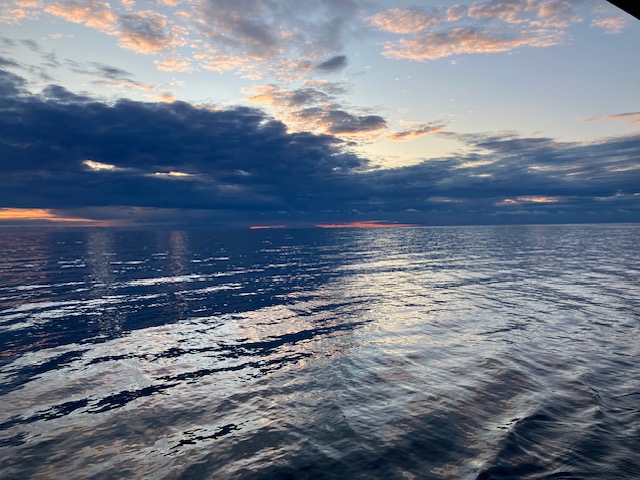
I think the photo is a keeper.
For you late sleepers out there, I’m not your guy for sleeping late.
Since arriving in Vancouver, my old body sleeps, but my old body wakes up early too.
I’m also beginning to think that the sun doesn’t sleep in this part of the world. It is light when I go to bed and light when I wake up.
The ship is equipped with a very nice fitness room. In a few minutes, I’m headed there for a workout. I’ve had the privilege of using this room some other mornings, and the experience has been good.
A row of windows on one side of the room allows passengers to take in the pretty views of the Alaskan wilderness and shoreline. This morning, a gentleman working out on a machine close to the windows reported seeing a couple of dolphins jumping. I missed that sighting.
This is our second full day at sea. Today, Saturday, July 5, 2025, we would begin the repacking process.
After breakfast, I started working through the set of specific instructions given to each passenger. Those instructions would be important to follow as we are preparing for leaving the ship on Sunday.
One order caught my eye, our luggage had to be outside our rooms by 11 p.m.
Taking a break from the preliminary packing, we opted to attend a couple of video presentations—one on whales, and the other a behind the scenes look of what it takes to run the ship during a cruise.
The piece about whales: Alaska Up Close: Pacific Giants was well done and informative.
The behind the scenes look, titled: A City On The Sea was impressive.
In this piece, what caught our attention the most was food—pounds and pounds of food.
But, we were also enlightened with the construction of the ship, including the technology used to provide water, electricity, and keeping the ship in motion.
Connected to each of those essential components is a member of the crew. From tip to tip of the ship, the key factor for me is the dedication of the crew.
After this enlightenment, we attempt to attend the Dutch brunch, but there was fifteen minute wait. So, we walked to the Lido dining room where they were celebrating Cake Me Away! If you were a cake lover, this was the place you needed to be.
Our afternoon was unremarkable—walking the deck, reading, napping, and finalizing our packing.
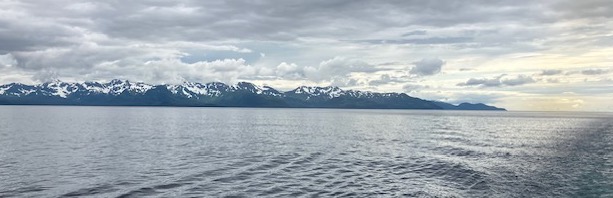
We could have opted to participate in the Polar Bear Plunge at the Sea View Pool, but our sanity prevailed.
Throughout the afternoon the scenery continued to be enjoyable as the Captain and his crew pushed the ship toward College Fjord.
College Fjord was discovered in 1899. Located along a twenty mile section of Prince William Sound, the glaciers located here are named after East Coast colleges. Schools for women and men are included in the naming.
Here we would be able to view Harvard Glacier.
Located in Prince William Sound, the Harvard Glacier is a beast.
The face of the glacier is 1.5 miles. The glacier is 300 feet thick, 24 miles long, and covers 120,000 acres in the Chugach National Forest.
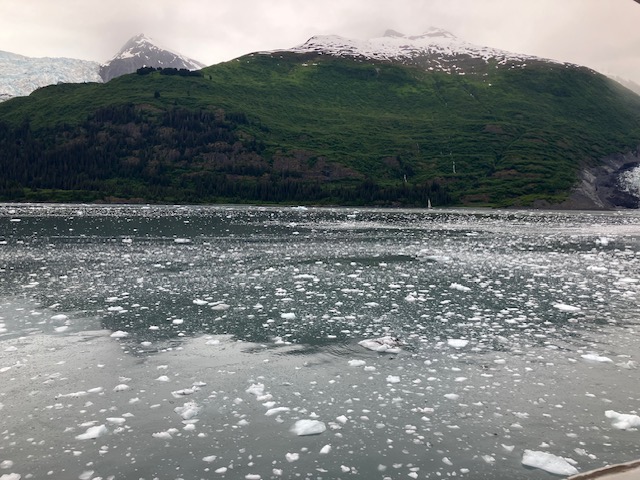
Additionally, the glacier is known for its calving and blue ice. Calving is when large chunks of the glacier break off crashing in the water below.
While we were viewing, this calving happened several times.
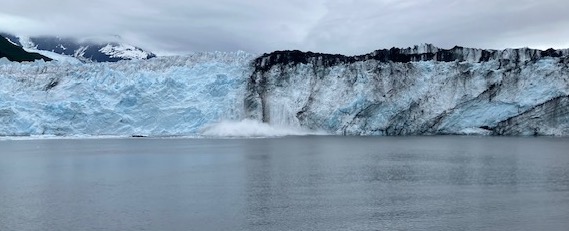
With the calving, when the large pieces of the glacier hit the water, waves immediately start to roll across College Fjord.
I overheard a lady comment that the rumblings of the glacier reminded her of thunder rolling and echoing off the parched land of a Midwest prairie.
I admired her description.
That glacier thunder is an indescribable sound. There is no flash of lightning. Some where deep in the chasms of the ancient ice a silent fracture becomes a resounding clash and crash of percussive sound— a thunder clap. That thunderous calving disrupts any tranquillity in College Fjord.
That thunder is topped only by the contrast in the colors of the glacier. For sure sections of snowy white are present. From that white, we saw contrast into shades of gray and coal black. Unfortunately, some of those darker shades are related to pollution.
Yet among, the grays and dark charcoal colors are various shades of blue—a blue that your eyes will never forget.
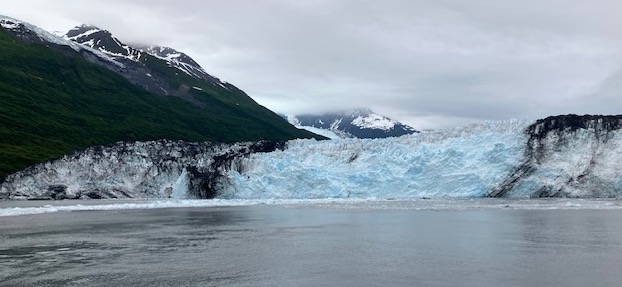
Here is one explanation for the blue color of the glacier from the USGS: “Glacier ice is blue because the red (long wavelengths) part of white light is absorbed by ice and the blue (short wavelengths) light is transmitted and scattered.
This glacier viewing experience was enhanced by commentary from the ship’s Wildlife Guide.
Our last night of dining on the ship, we had reservations at the Pinnacle restaurant. I opted for grilled halibut. I wasn’t disappointed.
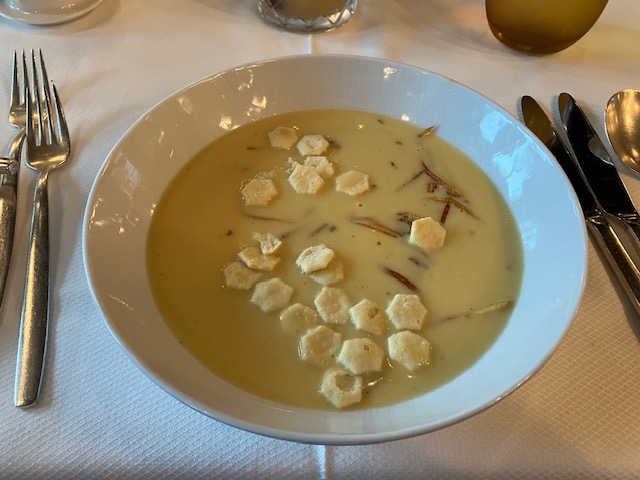
Gradually, the ship was charting a course away from the College Fjord. The Captain and crew intended for us to have a late night docking in Whittier, Alaska.
Back at the room, we finished up the packing, and placed our properly tagged luggage in the hallway.
Couldn’t resist a few minutes on our deck/porch/veranda!
Staring into the wilderness beyond the rocky shorelines. the majestic deep green of the trees inch their way up the inclines of the mountains.
With these two days on the water, sometimes, the green is broken from the silent intrusion of a waterfall. Like a ribbon of white, it cascades down toward the shoreline.
Near the rocky peaks of the mountains, snow is still hanging around. The snow like me is reluctant to leave this pretty place.
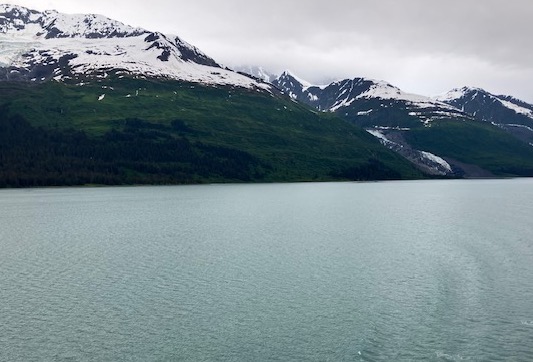
Just as memorable as the glacier blue is the surface of water moving away from College Fjord. It is dotted with dollops of ice.
I hope Alaskans and Americans will continue to preserve this precious land and water.

 might be baloney
wonderful photos and the soup looks delicious! Truly enjoy reading your post and looking at the photos, they are very calming for the heart.❤️
LikeLike
Thank you very much, the soup was very good. Appreciate your kind comments about the words and photos, I try. Be safe.
LikeLike