Letter to the Editor: Grateful for Alaska’s outstretched hand
JUNEAU EMPIRE The Voice of Alaska’s Capital Since 1912 Wednesday, July 30, 2025
From June 29 to July 10, my wife, along with two couples from college, and I traveled into Alaska. Twelve days out from our indescribable trip, I’m still suffering from chowder withdrawal.
Even though Mr. Moose didn’t appear on every corner, Alaska captured us. No matter if we were on a ship, train, bus or foot, the landscape was spectacular.
Our views were enhanced from the knowledge of exceptional guides who expressed their love and respect for this cherished land. Their devotion made us appreciate even more the stories about the courage of the original settlers and their respect for their heritage.
And while Denali was shy, I had ample opportunities to appreciate other snowcapped peaks, rolling rivers, cascading falls, deep forests, and the stunning blue ice of glaciers.
In Fairbanks, from so many angles, the Museum of the North really captured the spirit of Alaska and its people. It is my hope that the people of Alaska will never lose their loyalty or will to always protect this precious and priceless land.
After an early morning run along the Chena River, some of us stopped at the statue of Walter Harper. I loved the simple beauty of his outstretched hand, a hand up ready to help no matter the person or circumstances. In the short amount of time I have left in this weary old world, I hope I will become better at following Walter Harper’s heart by outstretching my hand.
Thanks Alaska for outstretching your hands to us.
Bill Pike
Author’s note: I was honored to have my Letter to the Editor published in the July 30, 2025 edition of the Juneau Times.
After breakfast, we quickly gathered our belongings and headed toward checking out.
In the parking lot, the Commander Supreme made her final checks, and our journey to the Point Reyes National Seashore started.
We traveled the back roads of California toward the visitor’s center. Wisps of low clouds, lots of twists and turns, rolling hills with pretty land, and massive redwoods greeted us. Occasionally, we encountered brave bicycle riders on these narrow roads that offered very few straight sections for easy peddling.
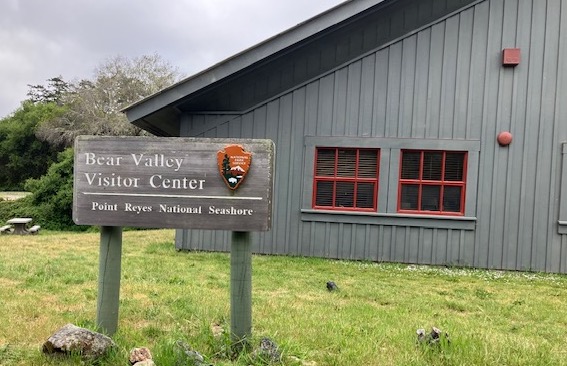
Upon our arrival at the Bear Valley Visitor Center in the Point Reyes National Seashore, we were greeted by a few quietly grazing deer in the rolling pastures around the building.
(Photo Bill Pike)
The visitor center has extremely helpful national park employees. No matter your questions, these knowledgeable and patient staff have the answers.
The center also has a nice layout of effective displays giving visitors a glimpse of what they might encounter during their visit.
From the visitor center, our goal was to visit the historical Point Reyes Lighthouse. The ride to the lighthouse was remarkable.
I’m sure I will repeat myself, but no matter where our eyes took us, we were greeted with striking scenery.
I didn’t expect to see beef and dairy cattle grazing on this magnificent land. But occasionally, we’d come across a weather battered farmhouse with barns and out buildings scattered around. I wondered about the loneliness that might brew in this isolated beauty.
Some of the pastures on the way to Point Reyes (Photo Bill Pike)
If you travel this road, you will come across the historic KPH Radio building. Set off the road, you will walk a straight path lined on both sides with magnificent Monterey cypress trees. This tree-lined walk toward the building will never leave your memory.
The walk toward the KPH building. (Photo Bill Pike)
It’s not long before we reach the parking area for the lighthouse.
According to the National Park Service, the Point Reyes Headlands ‘jut ten miles out to sea.’ This probe out into the Pacific Ocean creates a potential nautical challenge for ships venturing north of San Francisco.
In 1870, this lighthouse was constructed to serve as a warning to ship captains and their crews. In 1975, the United States Coast Guard put to rest the first light. A new automated light was installed adjacent to the original lighthouse.
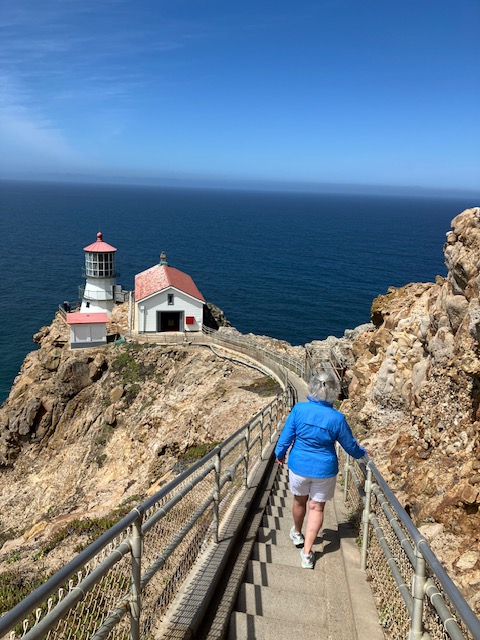
To truly encounter this magnificent lighthouse, visitors must descend 313 steps. This requires an alert patience in going down and coming back up, but the challenge of the walk is worth it. You will not want to stop taking pictures.
The walk down. (Photo Bill Pike)
Additionally, park rangers are on site to answer questions and guide you. It is worth a chat alone to hear about the extreme weather conditions that impact Point Reyes.
Fog to the south (Photo Bill Pike)
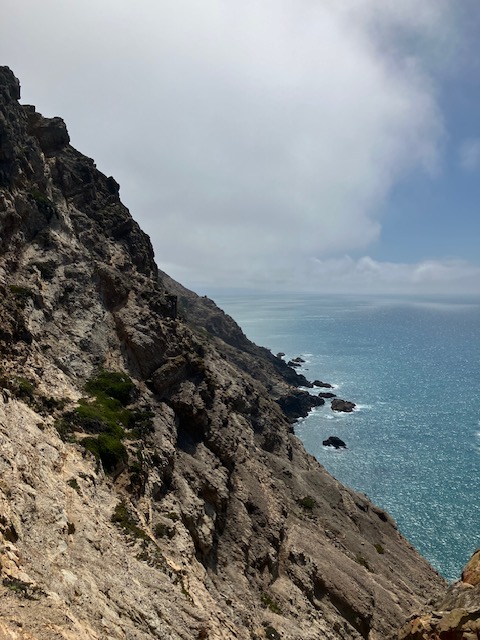
On the steps back to the parking lot, we paused a couple of times, caught our breath, and admired the view.
(Photo Bill Pike)
We regrouped in the parking lot, and from there we made stops at Chimney Rock, South Beach, and briefly explored a trail that were an ideal habitat for elk. And in each of those treks, wildflowers greeted us.
From a trail looking toward the Pacific. (Photo Bill Pike)
Again, I reminded myself of the people who had the vision and the will to preserve this priceless national park.
Land worth preserving. (Photo Bill Pike)
As we worked our way out of the national park, we stopped at the Tavern X Market for a sandwich. After lunch, I noticed the sign ‘Happy Trails’ hanging over the parking lot exit. Hopefully, the traffic gods would grant us ‘happy trails’ during the remainder of our afternoon driving toward Monterey.
Now following an interstate route, we skirted past Oakland. From a distance, we could see its attempts to re-invent itself, though graffiti was still a dominant nuisance in some stretches.
Occasionally, the traffic snarled with slow downs, but we kept moving.
The closer to Monterey, the more frequently we began to see the impact of farming on the outskirts of the Salinas Valley. But when we left the interstate, the farming communities really came into focus. Sure there was equipment, but I was more drawn to the richness of soil.
That soil reminded me of deep shades of chocolate and roasted coffee beans contrasted with healthy rows of green. Those fields were a tribute to the artistry of the farmers and their farmhands who year after year grow our nutrition.
Approaching the city limits of Monterey, the waters of the Pacific changed the backdrop.
It was Sunday afternoon, Mother’s Day, Monterey was still restless.
Our hotel on a side street in the city came into view.
We checked in.
Friendly staff at the front desk, guided our footsteps toward the Alvarado Street Brewery for dinner.
The walk back in the cool coastal air prepped us for our collapse and sleep.
Saturday, May 10 was our transition day. We would be leaving San Francisco and exploring more of California.
Our day started with a disappointing breakfast and service at the hotel’s restaurant. Hampton Inn does breakfast better.
We checked out and made the short walk to rent the car.
This started well too. They couldn’t find the Commander’s original reservation. Once that was sorted out, the real excitement started—driving out of the city.
I only made one significant error in leaving the city, I missed the overlook stop for the Golden Gate Bridge.
From that miscue, we found our way into Tiburon. A pretty town on the bay. Here, we were to meet the Commander’s sister, Abby, husband, Art, Betsy’s niece, Ashley, husband Rob, and most importantly their precious daughter, Bridgette.
This would be the Commander’s first visit with Bridgette. She was excited.
Gradually, we all met in the designated parking lot to catch the ferry over to Angel’s Island.
The ferry ride to Angel Island is short and pretty. Views abound in every direction.
Angel Island Ferry (Photo Bill Pike)
Angel Island’s founding dates back to 1775 when the Spanish ship, San Carlos, entered San Francisco Bay.
If you make a trip to San Francisco, you must set aside time to visit Angel Island State Park. The beauty of the island and its impact on California and America are remarkable.
The island has been a “cattle ranch, U. S. Army post, from 1910-1940 the processing center for thousands of immigrants, and in World War II German and Japanese prisoners of war were held here.” (California State Parks)
Additionally, Angel Island was “a transition point for U.S. military personnel returning from the Pacific following World War II, the 50s and 60s it was the site of a Nike missile base, and today, two active Coast Guard stations make the island their home.” (California State Parks)
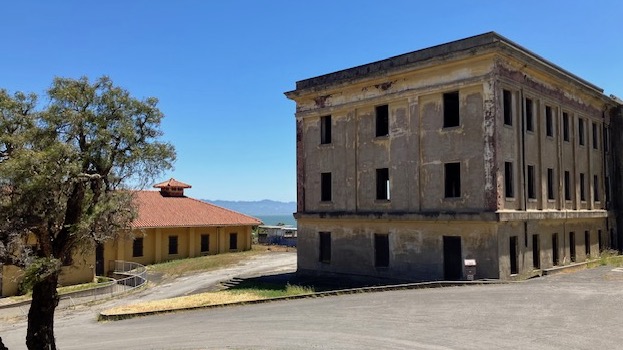
We opted to take a tram ride to assorted points around the island. This guided tour not only took us to remote points, but afforded us the opportunity to walk around at numerous stops. Many of the buildings from the island’s assorted uses are still in place. These snapshots into the past gave us a feel for how the immigration process worked. That important history combined with the island’s natural beauty makes quite a background for storytelling.
Assorted buildings Angel Island (Photo Bill Pike)
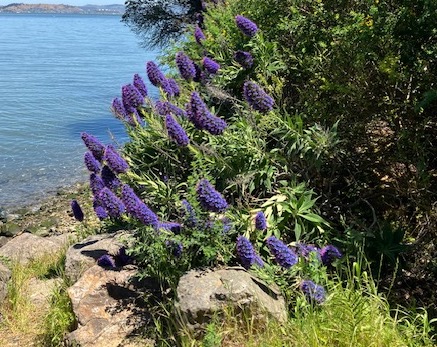
The shoreline is a mix of rolling hills filled with shrubs, trees, wildflowers, and rock. Most noticeable in the plant landscape is the Pride of Madeira (Echium candicans).
A stand out on the island (Photo Bill Pike)
We worked our way back to our entry point.
Soon the ferry had us back in Tiburon. Ashley and Rob led us to a waterfront restaurant, Sam’s, where we enjoyed a late lunch, and Bridgette continued to be a happy traveler.
It is always special to catch up with family, and Tiburon and Angel Island provided another pretty setting for a good visit. We said our goodbyes, and started our drive to Novato.
In Novato, we checked into our hotel. Then, we opted for some more steps as we took a short hike at the Buck Gulch Falls Trail, a part of the Ignacio Valley Open Space Preserve.
After the hike, we stopped at the HopMonk Tavern for dinner. This is basically a beer bar with live music. A very competent trio was playing, and I enjoyed a highly praised California beer, Pliny The Elder.
Our drive back to the hotel was quiet.
Tomorrow would bring another opportunity to explore a section of the California coast where we had never visited.
And that made me think more about Angel Island.
From its first Spanish explorers to the last immigrants, I wonder where they found their courage to leave their homelands and make this journey?
I put on my running gear, did some stretches, and found my way down to the lobby and out into the cool 52 degree air.
The sun was up. My goal was to run along Fisherman’s Wharf. I managed to run just past Pier 1.
This was a flat run, no challenging San Francisco hills.
Even though it was early, there was lots of activity.
Seagulls were scavenging trash bins.
I could hear the early morning squawking of the harbor seals.
Delivery workers were hustling in various spots along the wharf. Most of them could make their deliveries blindfolded.
Caretakers were hosing down entrances to dock areas, public restrooms were tidied up, and trash bins emptied.
There were runners, walkers, and bicycle riders. Some acknowledge my timid wave or quiet good morning. A few were in their zone focused, oblivious of an old fool from Virginia.
A solitary homeless man striding at a hurried pace was yelling into his phone, “I’m going to kill him, I’m going to kill him.”
I came upon the architecturally stunning San Francisco Ferry Building. This eye catching structure opened in 1898.
Before the construction of bridges, the Ferry Building was the base for the ferries that brought people in and out of the city. Today, in addition to being a smaller hub for ferries the building houses office space and a food hall.
The centerpiece for the building is a 245 foot clock tower.
I made it back to the hotel. Cleaned up, and we had breakfast.
After breakfast, we quickly organized ourselves, and headed down to meet our Uber.
It is interesting to note the differences in the personalities of the Uber drivers. I’m sure the Commander Supreme cringes, but I always attempt to chat a bit with them.
The driver this morning was friendly. However, he was more interested in pitching a ride with him to Santa Cruz. We had to refocus him on our goal for the morning— Golden State Park.
He did attempt to use music to soothe us. When we told him that we were from Virginia, he played the John Denver song “ Take Me Home Country Roads.” The lyrics mention West Virginia. I was not impressed with the driver’s smoozing.
Once we figured out our drop off point, our exploration started of this 1,017 acre park. If you travel to San Francisco, and you have a pretty day, you must come to this park. I say that because the park offers something for everyone.
Our feet did not grace all 1,017 acres, but at times we felt like we had.
Our exploration started at the de Young Museum. Here there is an amazing observation deck. Helpful museum personnel guided us to the deck. Good news, visitors can go to the observation deck for free. Admission to the museum and its exhibits is separate.
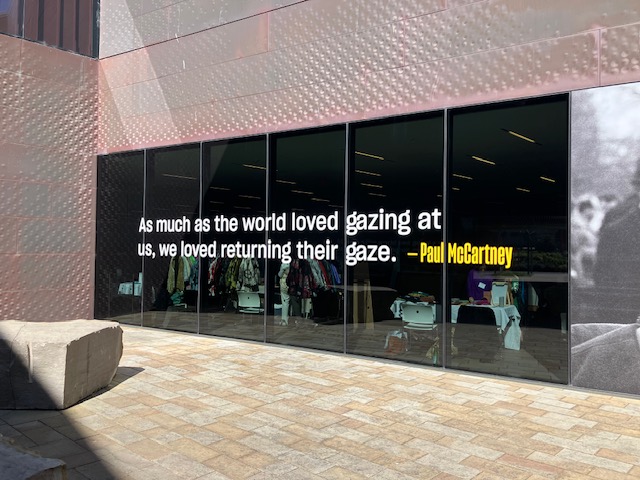
I will admit that I was powerfully tempted to tour the exhibit: Paul McCartney Photographs 1963-64: Eyes of the Storm. I passed. In walking to the museum, I had seen some of the park’s beauty. I wanted to explore and see more. Sorry, Sir Paul, maybe another time.
A tempting exhibit (Photo Bill Pike)
Twelve unique gardens make up the park. We didn’t see them all. But, the ones we saw were stunning.
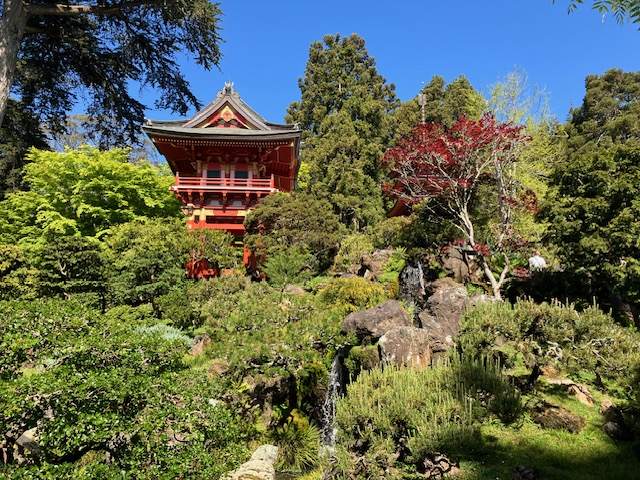
Our first stop was the Japanese Tea Garden. The origins of this garden date back to 1894. The plantings, layout, and the Japanese architecture are nicely synced together.
(Photo Bill Pike)
A bonus in Golden Gate Park is the San Francisco Botanical Garden. These 55 acres featuring over 8,000 plants from around the world doesn’t disappoint. Visitors can roam from an Andean Cloud Forest to Temperate Asia.
Most impressive to me was the Redwood Trail. This section featured the Coast Redwoods. In a setting similar to a coastal redwood forest, there is a quiet respect for these majestic trees. Adding to that tranquility are over 100 species of native California plants perfectly matched in the cool shade of the redwoods.
Beautiful trunk bark of a Coast Redwood (Photo Bill Pike)
As the morning progressed, we were conscious of timing our stay for a walk to the Beach Chalet for lunch. It is a long walk to this ocean view restaurant, but worth the walk. Of course, I made the walk longer and more adventurous, when I suggested the wrong direction.
After lunch, we took a Uber back into the city to visit Amoeba Music, the world’s largest independent record store. I probably could have spent a couple of days there. I think we were out of the store in less than an hour.
Our next destination was to find the famous Painted Ladies houses. This required walking through the Panhandle an extension of Golden Gate Park. The Panhandle is pretty green space. It provides multiple locations for sun worshipers to start their tan lines before summer arrives.
Gradually, we made our way to Alamo Square, also a park where the Painted Ladies houses come into view.
The Painted Ladies are Victorian and Edwardian style houses that regained popularity in the 1960s when new owners started repainting them. Often the repainting was completed in a variety of colors as a way to enhance their architectural style. Located on Steiner Street, the houses have been seen in assorted movies, television shows, and marketing campaigns.
From here we took an Uber back to the hotel. We had a bit of quiet time before heading down to the lobby for happy hour.
A couple from Canada sat across from us. They were in San Francisco for her husband to participate in a training and transition program at Guide Dogs For The Blind. We learned a lot about this outstanding organization.
After happy hour, we opted to walk back to the Boudin Bakery for dinner.
Another hearty meal at the Boudin Bakery (Photo Bill Pike)
We had a nice dinner at Boudin, and when we arrived back at our room we were beat.
Tomorrow, we would say goodbye to San Francisco. We talked briefly about our Saturday plans including renting a car.
We had another good day of walking right at nine miles
Today was another example of admiring the vision of people to preserve and protect land that has been converted into parks for communities to enjoy.
Golden Gate Park is an outstanding example of how space can be preserved in a variety of unique ways.
I’m thankful for people who have the vision to value how land can be creatively saved for the good of all.
I hope we can hold on to these priceless places forever.
On the evening of Thursday, July 10, 2025, our red-eye flight from Fairbanks, Alaska to Minneapolis-St. Paul to Raleigh, North Carolina was delayed.
A passenger became ill, and the plane had to taxi back to the Fairbanks terminal.
Before our early morning landing in Minnesota, our airline notified us that our connecting flight to Raleigh was delayed.
That delay gave me some hope. Hope that I might be able sample an August Schell beer in the airport. Guidance for this pursuit came from Scott Hislop, the Senior Distributor Sales Manager, for the August Schell Brewing Company.
As soon we disembarked from the plane, I stopped at each bar/restaurant in the terminal. I checked the tap handles and asked friendly employees if they carried August Schell. Their kind response was “sorry, no.”
As my wife followed her crazed husband, in the distance, in the middle of the corridor of terminal one, I saw the words Stone Arch. That was the name of the one place Scott had referenced for sampling an August Schell beer.
Stone Arch employees were busy with breakfast customers. It took a few minutes for me to flag down one of their employees who handled beverages.
Finally, a nice young man paused as I flagged him down. His hurried steps came to a halt. I explained what I was trying to accomplish. He could not have been nicer.
First, he confirmed that Schell’s Light an American lager was on tap. Additionally, he showed me two sixteen ounce cans that were available, but I opted for the draft.
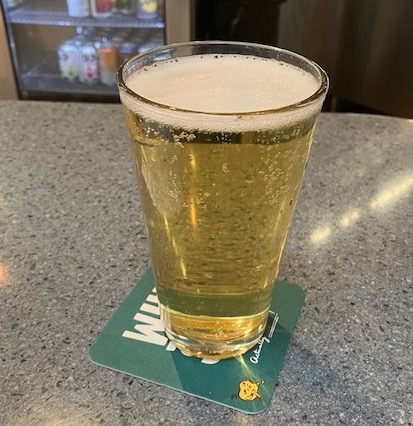
A couple of minutes later, he returned with a perfectly poured glass of Schell Light. This clear, pale lager, was full of carbonation bubbles and a thin head of foam.
While I’m not a fan of light beers, this one hit the spot at 7:20 a.m. on Friday, July 11.
I was reminded of the song “Roadhouse Blues” from the Doors’ album Morrison Hotel: “Well, I woke up this morning and I got myself a beer, the future’s uncertain and the end is always near.”
At my old age, I have never purposely abused my affection for beer. Out of respect for the beverage, I’ve worked to be doggedly rigid in my self-control when consuming beer, I’m basically—‘one and done.’
But, I will admit that for a long, long time lurking in the back of my mind were the lyrics from “Roadhouse Blues.”
So now, I can mark the drinking of an early morning beer off any unimportant bucket list.
Yet, there is a more important point, and that is Scott Hislop.
In our fast paced, impatient world, Scott took the time to respond to my original email. To me that is admirable.
I can’t tell you how many times I have sent a complimentary email to published authors. Rarely, do I receive a note of thanks back.
Scott’s response is a valuable lesson for any company small or large—that personal contact, the opportunity to build even a brief relationship with a potential consumer or customer is important.
That quick encounter with me also shows Scott’s loyalty to August Schell and its customers. No matter if they are devoted Midwestern supporters of August Schell, or a grumpy, rapidly aging geezer from Virginia passing through the Minneapolis-St. Paul airport, Scott understands the value of communication and building a relationship.
Finally, my pursuit in sampling an August Schell beer was grounded out of respect for their perseverance.
Located in New Ulm, Minnesota, August Schell is the second oldest family run brewery in America. From their beginnings, the brewery has continued to survive. In that survival, you will find risk taking combined with the ability to respect the foundation of the past with the will to adapt for the future.
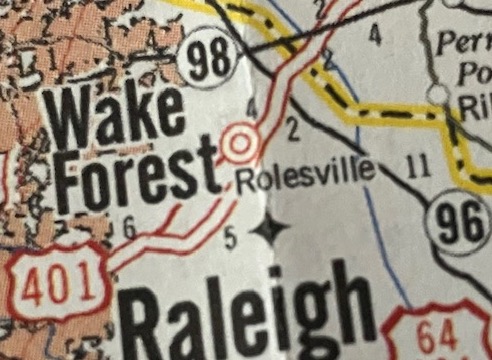
From the 2023-24 official state transportation map of North Carolina (Photo Bill Pike)
Good morning, I’m Bill Pike, and it is my honor to be with you this Sunday as the pinch hitter for Enon’s pastor, Michael Dettmer.
No matter if you are with us in the Sanctuary or watching on-line, we are glad to have you with us this morning.
Before we start, I need to share some disclaimers.
First, I’m not a Biblical scholar, nor a degreed theologian, but I do have a certification as a lay speaker from the Virginia Conference of the United Methodist Church.
My wife and I were traveling with dear friends from college when I listened to Michael’s voice mail. We had a good conversation when I called him back, but he said something dangerous to me.
Michael told me by phone and later in a follow-up email that I could preach on any topic of my liking.
That’s not a good offer to a person like me, who has what American writer, Dave Barry calls “brain sludge.” Mr. Barry defines “brain sludge” as useless information in the minds of men.
However, with Michael’s offer, my “brain sludge cells” started tossing out ideas.
Knowing that we are in Hanover County, home of the famous Hanover tomatoes, maybe, I should speak about the fruits and vegetables that are listed in the Bible.
In light of the recent water crisis that impacted the Richmond region, maybe I should talk about water. After all the Bible references water over 500 times.
Or since it is baseball season, maybe I should talk about the movie Moneyball, and offer suggestions to what churches might learn from characters Billy Beane and Peter Brand and their statistical thinking about baseball.
Or maybe, I can tell you some stories about my thirty one years of work in public schools, or my last fourteen years of work at Trinity, or maybe I should just let my heart do the talking.
Who knows, maybe I’ll be lucky, and something from my old heart might resonate with your hearts.
How about we start with a prayer: Father of us all, forgive my old heart. Amen.
The gospel reading this morning comes from Luke Chapter 10 verses 38-42. Let’s take another look at those four verses:
“As Jesus and his disciples were on their way, he came to a village where a woman named Martha opened her home to him. She had a sister called Mary, who sat at the Lord’s feet listening to what he said. But Martha was distracted by all the preparations that had to be made. She came to him and asked, “Lord, don’t you care that my sister has left me to do the work by myself? Tell her to help me!” “Martha, Martha,” the Lord answered, “you are worried and upset about many things, but few things are needed—or indeed only one. Mary has chosen what is better, and it will not be taken away from her.”
I’m sorry, but I think Martha has a point. She has opened her home to Jesus and his disciples. Including Martha and Mary, that’s at least fifteen mouths to feed.
I can see Martha scurrying around her home, prepping food, finding serving pieces, and while she is burning all this energy, it suddenly dawns on her, I need some help.
Look at my sister, she is sitting at the feet of Jesus hanging on every word that he is saying. Why isn’t she helping me?
In our own kitchens with our families, we’ve seen similar scenes play out when we have special guests in our homes. We want the meal and the fellowship to go well. For that meal and fellowship to go well, we are probably going to need some extra hands.
But, Jesus, doesn’t see it that way. I think he can see and feel Martha’s sense of urgency in this moment.
While his reply to Martha acknowledges that she is worried and upset about many things, he offers no real relief—other than basically— hey, Martha, cool your jets.
By this time, Martha might be headed toward a nuclear meltdown.
Maybe she is thinking to herself: “I’m trying to be a good host, no one is helping me, sounds like Jesus told me to trim the menu down, and that Mary has chosen more wisely than me and that her choice will not be altered. I guess, I’ll just keep plugging along.”
In the May 23 edition of the news magazine The Week, I read an obituary about Joseph Nye. Dr. Nye was a political scientist who had a distinguished career in academia and politics.
The Washington Post reported that the future Dr. Nye grew up on a farm. He attended Princeton University. It was at Princeton that “he briefly considered studying for the ministry—until he read the Bible all the way through.”
I’ll be honest with you— I have days like that with the Bible. Days when I have no earthly idea how I can understand or rationalize what is written.
And I’ll take that honesty a bit further, these four verses about Martha and Mary are difficult for me to understand.
My vision, my practical thinking sees this home visit by Jesus from Martha’s perspective. I hear and understand her plea.
But in the footnotes of the 1973 edition of the The Oxford Annotated Bible, the Revised Standard Version, I’ll give you a bit more to ponder: “With delicate ambiguity Jesus rebuked Martha’s choice of values; a simple meal (one dish) is sufficient for hospitality. Jesus approved Mary’s preference for listening to his teachings as contrasted with Martha’s unneeded acts of hospitality.”
“Unneeded acts of hospitality” sorry, but I need to think about that comment for a while, maybe longer than you want to be here this morning.
On the evening of Thursday, July 10, my wife and I were on a redeye flight from Fairbanks, Alaska to Minneapolis-St. Paul to Raleigh.
We experienced a brief delay for our flight to Raleigh, but other than that all went well.
Even though I grew up in North Carolina, I have never figured out the roads in Raleigh.
This is despite many trips to Raleigh to visit our youngest daughter.
We were on US 1 north headed out of the city into Wake County.
And I have no idea why on this Friday afternoon, my eyes were drawn to an exit sign for Rolesville.
But, my brain locked on to that name— Rolesville.
I’ve never been to Rolesville, don’t know if I will ever go to Rolesville, but the town was founded in 1837 by William H. Roles. Today, it is the second largest city in Wake County with a population of 9,745. (Wikipedia)
Luckily, my jet lag did not impact my driving, and we made it back to Richmond safely.
Yet, my old brain would not let go of Rolesville.
Late on Saturday evening, I started doing some preliminary prep for this morning, and when I consulted the lectionary for the gospel reading, Rolesville nudged me again.
And that’s when it hit me, what is my ‘role’ in this cantankerous, weary, and worn out old world?
Mary and Martha both have roles in this scripture.
What is your role in this world?
How do you impact your family, your friends, your community, your work environment, and how do you impact Enon?
What is our role, our responsibility?
How can we use our role, our responsibility to make a positive impact?
You may never visit Rolesville, but I hope you will revisit everyday what your ‘role’ is in this world. Never stop evaluating how your ‘role’ can bring about change.
A few years ago, I stumbled upon this quote from E. B. White: “The only sense that is common in the long run, is the sense of change and we all instinctively avoid it.”
How about in your ‘role’ in this life, do you “instinctively avoid change?”
When I read a book, an article in a magazine, or the daily devotional in the Upper Room, I use a highlighter. If I come upon wisdom that resonates with me I will highlight it and that includes highlighting the page number.
I recently read The Secret World Of Weather by Tristan Gooley. In the book, Mr. Gooley shares with readers how to read weather signs ‘in every cloud, breeze, hill, street, plant, animal, and dew drop.’
If you are intrigued by our daily weather, you might want to read this book.
Now, I haven’t gone back in the book and counted how may times the word ‘change’ is used by the author to make his points, but ‘change’ is used a lot.
Our seasons and their weather force us to change our routines. Yes, we might complain about the weather, but do we really ever consider how it initiates change?
These weather changes force us to adapt.
In the New Testament isn’t that Jesus’ role? Isn’t he nudging us to change?
With every interaction with every parable, isn’t he working to initiate change, to make us think, to make us uneasy, to nudge us out of our comfort zones? Doesn’t he want us to take on a different ‘role’ in the reality of our own Rolesville?
Who in your Rolesville needs you?
Is it an aging parent, a student who needs a mentor, a struggling co-worker, a church member, a stressed out neighbor, or a stranger rummaging through a dumpster in the back of a fast food restaurant?
You, me, we, us have a ‘role’ to fill in our communities.
And, I’m not sure about your thinking, but I sense God and Jesus are not much different from Martha. Maybe they don’t want to admit it, but they need us to take more of an active ‘role’ in this raging old world.
We are at a point in all of the Rolesvilles across the world where we can no longer “instinctively avoid change.”
Perhaps you are aware that in Luke Chapter 10, just before the story of Mary and Martha is the story of the Good Samaritan.
What a ‘role’ this man played in saving a stranger’s life.
The last four words that Jesus speaks in that parable are “go and do likewise.”
I wonder if I’d be able to offer the same type of assistance to a stranger today like the Good Samaritan did?
I love music.
I have a deep appreciation for musicians.
I can’t sing or play any instrument.
At home, if I were to attempt to sing in the solitary confinement of our shower, I’m certain all of the dogs in our neighborhood would howl in anguish.
The Steep Canyon Rangers are a bluegrass/Americana band from Asheville, North Carolina.
Unlike me, they are gifted songwriters, musicians, and singers.
The lyrics from their song “Down That Road Again” made me pause and think:
“Don’t let me go down that road again I know where it leads and how it ends Right now I need the kind of friend Who won’t let me go down that road again” (Written by Graham Paul Sharp of The Steep Canyon Rangers from their album Radio on Rounder Records 2015)
At this very moment, there is someone in your life who doesn’t want to go down that road again. This individual needs someone from Rolesville to be the ‘role’ of a friend ‘who won’t let them go down that road again.’
Jesus was honest in his assessment of Mary and Martha, and I’ll be honest with you.
Each of us has a ‘role’ to play in this world full of hurting people.
It is time for us to put into action the words from Jesus: ‘go and do likewise.’
Near the end of June, I turned 72.
There is a little voice inside of me that whispers, “Bill, you don’t have much time left, you need to get busy.”
That whispering voice is correct, I don’t have much time left, I need to get busy.
How about you?
In the time that you have left, how are you going to get busy?
What ‘role’ are you going to play?
Maybe you know the name Dr. Mae Jemison. Dr. Jemison was the first African American woman to travel in space. She was a mission specialist in 1992 on the space shuttle Endeavour.
This wisdom from Dr. Jemison makes me think a lot about the time I have left: “Never limit yourself because of others’ limited imagination; never limit others because of your own limited imagination.”
I told you earlier this morning—I’m not a Biblical scholar or a degreed theologian, but I’ll tell you what I think about Mary and Martha.
My old heart tells me that God and Jesus both need Mary and Martha, and we do too.
We need to hear the words from Jesus, but we also must put those words into action, and we must not think about our limitations.
Dr. Jemison never allowed limits to slow the pursuit of her goals.
Nor should we, as we position ourselves to “go and do likewise.”
Mary and Martha had limits in offering hospitality to Jesus and his disciples. But, I suspect that Mary and Martha came away from that experience a little wiser.
The Good Samaritan set no limits for himself to ensure that the robbed and injured traveler received the care he needed.
The person in the Steep Canyon Rangers’ song “Down That Road Again,” requested the help of a friend to keep them from making the same mistakes again. Tomorrow, you might be that friend who keeps a friend on the right road.
And grounded in the each of these examples is the E. B. White quote about change.
At this stage in my life, I can no longer “instinctively avoid change.”
If I avoid ‘change,’ then I will be incapable of playing the ‘role’ that Jesus charged me with— “now go and do likewise.”
Doesn’t matter if we are down in Rolesville or at Enon United Methodist Church— it is time for our hearts to “go and do likewise” in our communities.
Time isn’t on our side.
We need to get busy.
Talk to your heart.
“Go and do likewise.”
Author’s note: Today, I had the privilege of “pinch hitting” in the pulpit at Enon United Methodist Church in Hanover County, Virginia. A special thanks to the church staff and congregation for their hospitality and patience.
Ok Roanoke, this is your warning—the Methodist are coming.
From June 11-14, Methodists from across Virginia will be gathering for their Annual Conference at the Berglund Center.
I attended the annual conference as a district delegate in June 2019. That gathering is chiseled inside my body’s thermostat. Outside the Berglund Center was June perfect. Inside the building was freezing.
Maybe, conference leaders requested the frigid air to keep participants awake, or to keep emotions cooled when heated topics were debated.
Might be hard to believe, but methodical Methodist can get riled up. In case you don’t know, it took our denomination what seemed like centuries to work out differences over gay clergy and LGBTQ issues.
That grueling, hot-blooded debate caused some Methodist congregations to leave the denomination. The disaffiliation process was grounded in paperwork, property, and pennies.
I wonder if church researchers are investigating how those disaffiliated churches fared?
Trends in religion and houses of worship continue to be a source of interest for researchers.
A February 2025 study from the Pew Research Center featured this headline: “Decline of Christianity In The U.S. Has Slowed, May Have Leveled Off.” That might be encouraging news for church leaders in America, but I believe churches and the Methodists at the Berglund Center still have their work cut out for them.
The Pew report goes on to state: “But, despite these signs of recent stabilization and abiding spirituality, other indicators suggest we may see further declines in the American religious landscape in future years.” The key point made is that “younger Americans remain far less religious than older adults.”
I’m one of those older Americans. I see that trend at my church, Trinity United Methodist, in Richmond, Virginia.
If researchers reviewed the age demographics for the Methodists attending this year’s conference, I suspect they would find more older adults in attendance than younger adults.
Let’s be honest, churches were in trouble before COVID-19. Data captured by assorted researchers revealed declines in attendance, decreases in giving, aging congregations, and deteriorating buildings.
We are six years past COVID-19. Churches, including Methodist, continue to be challenged to address these on-going issues.
I sense our Bishop for the Virginia Annual Conference of the United Methodist Church, Sue Haupert-Johnson, is a very competent leader. Bishop Sue is a career switcher— business to law to theology. She has the task of leading Virginia Methodists through these challenges and whatever remaining baggage exists from the under current of our divides.
As a life long Methodist, we put ourselves into this mess, how do we pull ourselves out? Here are some thoughts.
In the baseball movie, Moneyball, there is a pivotal scene between a recently hired young executive, who is skilled in data analysis, and the seasoned general manager of the team. The young executive makes a bold statement: “Baseball thinking is medieval, they are asking all the wrong questions.”
Are conference leaders using available data about our churches and their congregations to ask the “right questions?”
For example, how many of our churches are hanging by their fingernails? What is the plan for gently closing these churches and merging their congregations into more stable churches within their communities? How might these now vacant properties be converted into affordable housing to help Virginia ease its housing crisis?
To reduce future closures, might churches benefit from participating in an accreditation process? On an annual basis, pastors and their congregations would be required to assess key components related to attendance, finances, programs, outreach, safety, leadership, technology, and property.
Over the last fourteen years, I’ve learned quite a bit about church operations. Churches can be tough places to navigate. How does morale impact the feel of the church’s emotional and physical environment for the pastor, employees, congregation, and visitors?
In looking to the future, Methodists would be wise to give serious thought to “discretionary time.” The key to attracting and sustaining young adults and young families is where does church fit in their overbooked schedules?
The theme for this year’s conference is “Movement of the Heart.” A part of that theme will focus on how Methodists can become “agents of change.”
If Methodists desire to become “agents of change,” they must avoid “medieval thinking” and asking “wrong questions.”
Pat Conroy wrote in his book My Losing Season: “Loss invites reflection and reformulating and a change of strategies.”
In plotting their future, Virginia’s Methodists ought to initiate Mr. Conroy’s wisdom.
Author’s note: On June 8, 2025, just before the start of the Annual Conference for the Virginia United Methodist Church, this op-ed piece was submitted to the Roanoke Times. The piece was not accepted by the newspaper’s editors.
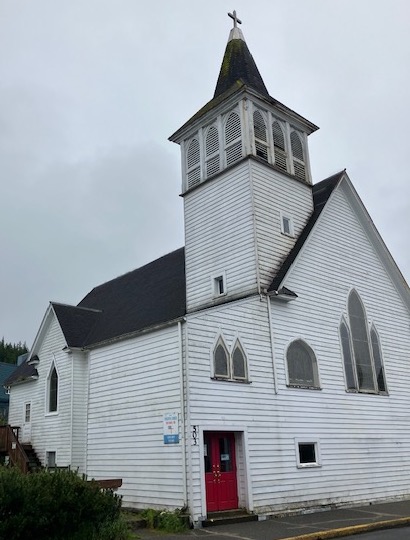
An Episcopal church in Ketchikan, Alaska (Photo Bill Pike)
Near the end of June, my wife and I travelled with college friends to Vancouver. As Americans, we appreciated your hospitality and your will to preserve precious land.
From your stunning airport terminal to our hike in Lynn Canyon, we enjoyed every footstep of our exploration. In turn, we worked to be considerate guests at every place we visited. During our visit, we saw the diversity of your city and how your community embraced a pretty June Saturday along the beaches on English Bay.
We noted similar challenges that we experience in our communities along the east coast of America — the high cost of housing, the struggles of the homeless, maintaining infrastructure, and the snarls of traffic. No community is immune from those challenges.
I will never forget my early morning run along the Stanley Park seawall. Captured forever are four herons gathered on a point, the scattered purple pieces of mussel shells on a soundless beach, magnificent trees, and the quiet exchange of “good mornings” with fellow runners and walkers.
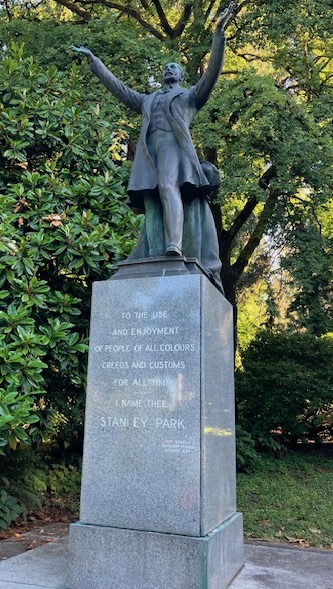
As much as I will cherish that run, my old heart will value even more a discovery we made in Stanley Park on our last morning in Vancouver. I know nothing about the qualities of Governor-General Lord Stanley, but I loved the vision of his words on his statue in the park: “To the use and enjoyment of people of all colours, creeds, and customs for all time.”
That is a powerful and visionary statement for 1889. Sadly, in the United States, that foresight continues to erode from our thinking.
In the time I have remaining in this cantankerous old world, I plan to share Lord Stanley’s wisdom as a reminder to everyone in my community that as Americans, we have an obligation to support “people of all colours, creeds, and customs for all time.”
Thanks, Vancouver, for the reminder.
Bill Pike, Richmond, Virginia
Author’s note: From June 25-July 10, 2025, my wife and I had the privilege of traveling with dear friends from college to Vancouver, Canada and Alaska. I was honored to have this letter published in the Vancouver Sun newspaper on July 8, 2025.









 might be baloney