Upstaged by Santa

On the Beatles’ Revolver album, the band’s lead guitarist, George Harrison contributes three songs. One of those songs—“Love You To” features Harrison playing the sitar backed by other musicians from India.

The opening line to the song is “Each day just goes so fast, I turn around its passed.”

Right now that’s the way I feel. I keep asking myself how did Christmas arrive so quickly this year?

As to why Christmas arrived so swiftly, the answer is very clear—it is my aging.

My days move fast. I barely recall what I did yesterday.

However, I do remember the Christmas of 2023. That Christmas will always be remembered as the one dominated by germs—stomach crud, flu, and COVID-19.


We were in Summerfield, North Carolina with our daughter, Lauren, and her family.

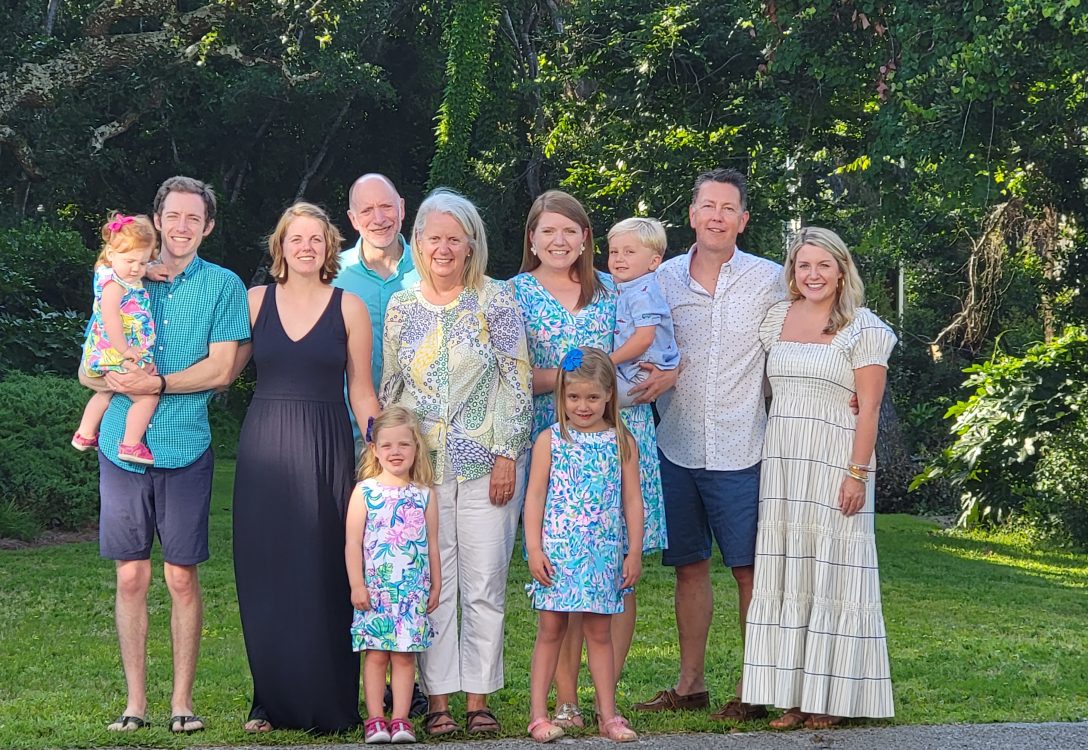
Before the germs attacked, I remember us sitting around the dining room table. I’m not sure what sparked this observation from our oldest granddaughter, Caroline, but I’ve been carrying her question around with me for a year—“I wonder how baby Jesus feels about being upstaged by Santa?”

At his birth, Santa was not on baby Jesus’ mind. Yet, I’d wager that Jesus might ponder Santa quite a bit today.

Back in October 2024, the National Retail Federation predicted Americans might spend “between $979.5 billion and $989 billion in total holiday shopping. This is a 2.5 to 3.5% growth from 2023.”

Santa and a few of his reindeer hanging over Devon Road in Henrico County, Virginia (Photo by Bill Pike)

Contrast that spending to these findings from the Pew Research Center. For many years, Pew researchers have been keeping track of religious trends in America.

A Pew report released on March 15, 2024 revealed the following: “80% of U.S. adults say religion’s role in American life is shrinking – a percentage that’s as high as it’s ever been in our surveys.”

In truth, I’m not surprised by this projected spending increase and the decline of religion in our lives.

It is difficult to block out the commercialization of Christmas. Retailers drum Christmas into our every waking moment. This relentless pursuit of our attention starts in October and ends when the last store closes on Christmas Eve.

For church leaders there is a pursuit, but it isn’t relentless. They don’t have the advertising pennies. Their focus is grounded upon too much reliance on tired and predictable templates.

I sense churches fear change. Perhaps, churches are like the wisemen in the Christmas story. When the angel of the Lord came upon them, “they were so afraid.”

Those wisemen moved past this initial fear. Churches must move past their initial fear of change too. No longer can change be a quiet whisper in the resistant souls of churches.

Perhaps, you recall the opening chatter of voices from the movie, It’s A Wonderful Life.

Multiple prayers from family and friends of George Bailey have sounded an alarm in heaven.

The powers that be in that blue yonder summon a wingless angel, Clarence, to become George’s guardian angel.

In briefing Clarence about George, the script reads as follows:

CLARENCE’S VOICE
You sent for me, sir?

FRANKLIN’S VOICE
Yes, Clarence. A man down on earth needs
our help.

CLARENCE’S VOICE
Splendid! Is he sick?

FRANKLIN’S VOICE
No, worse. He’s discouraged.

I don’t know about you, but in my day to day living I often feel discouraged.

My feeling discouraged is grounded in headlines: school shooting in Madison, Wisconsin, man sets fire to passenger on a New York City subway, car plows into German Christmas Market, and in my own county—17 year old found dead in backyard after shooting.

Those heartbreaking headlines are a far cry from the Christmas song written by George Wyle and Eddie Pola that emphatically sings to us “it’s the most wonderful time of the year.”

You, me, we, us know there is nothing wonderful to be found in the Madison, New York City, Germany, and Henrico County headlines.

Even these unacceptable headlines do not slow down the retail drive of Christmas.


And yet, I wonder if these tragedies push caring, kind people further away from the church? I assume they question just like I question—where were God and Jesus? Couldn’t they intervene with a miracle? Maybe in our mean old world, miracles only happen in Hollywood scripts.

In their Christmas song “Have Yourself A Merry Little Christmas” I love this line from songwriters Hugh Martin and Ralph Bane—“From now on, we’ll have to muddle through somehow.”

Perhaps that’s what people have been doing for thousands of years, finding a way “to muddle through somehow.”

I think muddling through life depends upon our hearts. I wonder if the perpetrators in these senseless killings lost their hearts?

A new year is on the horizon. As George Harrison noted in his song, our days will continue to go fast.

In a blink, Christmas 2025 will be here, and undoubtedly Caroline’s observation about Santa upstaging Jesus isn’t going to change in a year.

Despite feeling discouraged like George Bailey, I do find glimmers of hope.

On some morning runs, a flitting flash of blue with fluttering wings will dart in front of me. I find hope in bluebirds.

I find hope in medical updates from my cousin Alice in her battle with cancer. I love the hope in these words from her doctors: “the tumors are shrinking, and some have completely disappeared.”

In attending holiday themed dance recitals for two of our granddaughters, I find hope in the courage of dancers who fully embraced their roles despite not fitting the typical physical image of ballerinas.

On cold December mornings, I find hope in the light of the rising sun as it rays angle into the heart of our church building—the sanctuary. I know that light can put hope into hearts.

For some reason every Christmas, the carol “In The Bleak Midwinter” resonates with me. Something about the last three words: “give my heart.”

On the evening of December 11, I met three friends for dinner. We call ourselves the 53. That name came from our founder, Don Purkall, who figured out we were all born in 1953.

After that cheerful dinner, I was driving back home on Grove Avenue. At the corner of Grove and Wisteria, I saw a pretty, meticulously kept house.

On its front porch was a huge peace symbol adorned in strings of colorful lights.

That image stayed with me.

Early in the still dark dawn of December 23, I drove back to Grove and Wisteria.

I parked my car and quietly walked to the house.

With my dependable iPhone, I took a few photos of the fully lit, but resting peace symbol.

Peace symbol on front porch in Richmond, Virginia (Photo by Bill Pike)

Silently, I returned to my car and drove off.

I wonder how discouraged the world is by the tragic headlines we create every year?

I believe our spinning, wobbly world is tired of being discouraged.

The world wants the same in its heart that you, me, we, us want in ours—peace.

Maybe the path to that elusive peace can be found in these words from Psalm 23 verse 3: “He restores my soul.”

The path to restoring our souls is our hearts.

As we muddle through the remnants of another Christmas and head into a new year, we can’t let fear upstage our hearts.

When a school day goes wrong

In Henrico County, sleep might have been non-existent or extremely restless for school system and county government personnel on the evening of December 4. Earlier that day, a student was stabbed at Henrico High School.

Shortly after twelve noon, two students were involved in an isolated confrontation. One student used a knife to attack and stab a fellow student.

Early news reports stated that the wounded student was fighting for his life. Today, Thursday, December 5, local media reported that following surgery the student’s condition had stabilized.

I’m sure that news brought a slight sense of relief to the victim’s family and the personnel who responded to this unacceptable behavior.

As the investigation continues, maybe we will learn the reason for such a vicious attack. What school system and county leaders learn from this severe disruption of the school day might help to prevent similar conflicts in the future.

For 31 years, I served in the public schools of Virginia. As a teacher, assistant principal, and principal, I remember difficult moments when the day went wrong. When the life of the school is disrupted with extreme violence, students, parents, and school personnel can’t push an erase button. That day stays with them.

No matter how much is budgeted toward security systems, resource officers, extensive safety training for personnel, state and federal legislation, and a stringent code of conduct for students, school systems have no immunity from unsafe, violent disruptions of the school environment.

During the course of a school year, our Virginia public schools are required to make reports about student code of conduct violations. I’m not opposed to the reporting of this data. But, I want to know how the Virginia Department of Education and school systems use this data.

For example, can the review of this data be used to help schools reduce severe disruptions in the school day?

What can we learn about the frequency, timing, and location of these disruptions?

How early are we able to track tendencies of non-compliant student behaviors?

What triggers their non-compliance? Is it unsuccessful academic performance? Poor interpersonal skills? Instability at home? Mental/physical health trauma?

What might we lean about the two students involved with the stabbing at Henrico High School by asking similar questions?

Additionally, more probing questions must be directed at public school systems to understand how non-compliant students impact the morale of the school. For example:

How many students do we have in our high schools who should be rising seniors, but who are still considered freshmen because of not earning enough academic credits?

What type of audits are in place to determine if alternative education programs are truly meeting the academic and behavior needs of non-compliant students?

How many faculty and staff members file workmen compensation claims based upon injuries from breaking up dangerous fights or attempting to restrain an out of control student?

How many teachers resign each year from the pressure and stress of attempting to work with difficult students in challenging school environments?

If we have all of this data, and we aren’t using it to ask deeper questions to find ways to reduce disruptive behaviors and to make our school environments safer and more conducive for learning, then why do we continue to value its collection?

In the movie Moneyball, Peter Brand, an evaluator of the skills of baseball players, tells his general manager, Billy Beane, “There is an epidemic failure within the game to understand what is really happening.”

With our public schools in Virginia, I think there is an “epidemic failure” to understand the impact that vicious generational cycles of community neglect have on the daily performance of students who struggle academically, behaviorally, or both.

I will go to my grave wondering why we fail to see how the erosion and instability of our families impacts our schools. If we think our families aren’t in challenging circumstances, then how do we explain the creation of Family Advocate positions in our school systems?

As the investigation of this life threatening stabbing unfolds, we can expect finger pointing. Finger pointing makes for headlines and sound bytes, but rarely does it solve problems.

In our classrooms, data is a part of our instructional curriculum.

To improve our schools, when a school day goes wrong, don’t we owe our students, parents, teachers, and communities a thorough review of each incident including pivotal corresponding data about students and their families?

We know the answer is yes.

If we neglect the study of this information, we can expect more serious student incidents in our schools and less sleep for students, parents, teachers, and communities.

And that is unacceptable.

(Photo by Bill Pike)

“I believe in Opie”

Scripture: James 1:6

In the 1960s, the Andy Griffith Show was a popular television series. Set in the fictional town of Mayberry, North Carolina, writers created scripts that made viewers laugh while offering wisdom too.

One episode, finds Sheriff Andy Taylor struggling to believe his son, Opie. Andy assumes Opie is using his imagination to create an imaginary friend, Mr. McVeebee. When Andy confronts him, Opie is adamant—Mr. McVeebee is real.

After hearing Opie out, Sheriff Taylor, despite his doubts, tells his Aunt Bee and Deputy Barney Fife that he “believes in Opie.”

Unlike Sheriff Taylor who believes in his son, when it comes to the Christmas story, I’m like James 1:6: “you must believe and not doubt, because the one who doubts is like a wave of the sea, blown and tossed by the wind.”

Clearly, there have been many times in my life when our complicated world has ‘blown and tossed’ me further away from this Christmas story of love.

And yet when I drift away, it is the loyalty of love found with Abraham and his son, Isaac, the Good Samaritan saving the beaten, robbed stranger, and Mary’s unshakeable love of God, Joseph, and Jesus that draws me back to believing.

Even Sheriff Taylor wasn’t tossed by the sea. His power of believing was affirmed when he really encounters Mr. McVeebee.

This Christmas, it is time to toss my doubts, and believe.

Prayer: God, this Christmas anchor my heart to believe in your loyal love. Amen


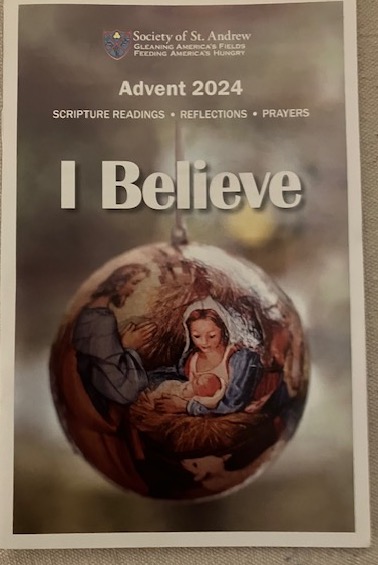
Note from the author: On Friday, December 20, 2024, I was honored to have “I Believe In Opie” published in the Advent devotional booklet by the Society of St. Andrew.

Cover for the Society of St. Andrew Advent devotional booklet. (Photo of cover by Bill Pike)

Christmas Glue

Recently, in a classroom at our church’s pre-school, the tabletops looked like a disaster area. Boys and girls were making Christmas decorations. Everyone was busy with materials and glue. Some students were even covered in materials and glue. One student asked his teacher about glue. How is it made? Where is it made?

Preschool glue (Photo by Bill Pike)

That tidbit of conversation made me think about glue from a different perspective. What bonds my life together? What keeps me from unraveling? Who is the glue in my life?

During Christmas, the pursuit of perfection can make a person become unglued. It all starts before Halloween when big box stores start displaying Christmas decorations. In the words of Barney Fife, those early unnecessary displays “just frost me!”

When I consider what holds me together, I think of my late parents. I grew up in a stable family with a mother and father who were strong role models for loving, caring, and providing for my sister and me.

In that framework was a weekly guarantee—going to church. Unless someone was “half-past dead,” we were in church on Sunday. I’m not sure that is always the case with families today.

Just before Christmas in 1972, my mother and sister were on their way home from running errands. A driver who ran a stop sign broadsided my mother and sister. The impact severely injured our mother. In the aftermath of the accident, one of the key factors in her recovery was her faith and the support of our church. That unwavering glue helped her to heal.

In my life, my wife is a vital piece in keeping me intact. Without my commander supreme, I’m in trouble. Her “to do lists” are a reminder of her attention to details, details that drive her professionally and in managing our home.

However, I’m certain my wife would tell anyone that the traditional expectations of Christmas and all its trimmings create extra stress. Christmas isn’t as simple as it once might have been.

For years, I was an Easter and Christmas church person. With the arrival of our children, we returned to church. Today church is part of my glue. In many ways, church is another family for me. Without a daily devotional, scripture reading, prayer, and interaction with my church family, I would unravel.

I can name people who continue to be a part of the glue in my life, but Christmas glue boils down to my heart. A time worn Christmas carol “In The Bleak Midwinter” states what the good Lord needs from me: “Yet what can I give Him, give my heart.”

Turbulent headlines from around the world can make our hearts bleak, but in the book of James, we are encouraged to: “be patient, strengthen your hearts, for the coming of the Lord is near.”

Undoubtedly, the commercial blitz of Christmas is a distraction for me.

Yet each Christmas, part of my Christmas glue is— hope. Hope that my heart can shift away and change from being overawed by the commercial marketing of Christmas.

To do this, perhaps I need to revisit the simple innocence of the chaos created by the children in that classroom with their glue and materials.

I wonder how these words from Kathleen Norris apply: “Disconnecting from change does not recapture the past. It loses the future.”

Maybe with guidance from those creative and curious pre-school children, I can use scissors, materials, and glue to figure out how to disconnect from the commercial weariness of Christmas.

Pursuing that change means means finding a balance from the past to ensure that in the future my heart is strengthened by the hope found in the glue of Christmas.

Author’s Note: On 12-17-14, this piece was submitted to the Richmond Times-Dispatch for publication consideration for the Faith and Values column. I believe it was published with submissions from other local contributors in the Christmas Day edition of the paper. The version posted here was edited for the blog post.

Hey Clarence, can you get us back?

Tucked away deep in the storage vaults of our brains are memories. Neatly filed away, available for recall, some pleasant, some not so pleasant, and categorized on just about any subject matter, like Christmas.

Over the last several days, I’ve put my brain in the search mode for Christmas memories.

Because of my great dependence upon my parents, I can remember as a youngster being pushed out of my comfort zone to talk with Santa Claus at the Sears in downtown Burlington, North Carolina.

I can also recall as a fourth grader looking for something in my parents’ closet one afternoon. Surprisingly, I found unwrapped toys. These were the same choices that I had communicated to Santa that I wanted for Christmas. I was puzzled.

I was even more puzzled as an adult taking an early morning run on a reservoir trail in West Hartford, Connecticut. It was a cold Christmas Eve morning.

At some point, I looked up and saw Santa Claus. He was gliding over the gray tree tops of the Connecticut hills in a hot air balloon.

Alma Coble triggered a Christmas memory. Coble as I called her was a kind hearted former neighbor.

Early in our lives, my sister and I spent a lot of time in Coble’s house. Coble and her family took care of my sister and me and other children while our parents were at work.
Coble was a true Southern cook who made real fruit cakes. Her kitchen was an like an artist’s studio at Christmas.

Family visits with the relatives were simple. Christmas Eve with my Dad’s side of the family, Christmas Day with my mother’s side of the family.

On Christmas Eve, before heading to Greensboro where the Pike’s gathered, we drove to Snow Camp. Snow Camp is where Uncle Everett lived all alone. Everett was my grandmother’s brother.

Everett was almost toothless, difficult to understand his speech, and missing a finger or two from working in the feed mill. The big heart of my dad always made sure that Everett was present at the Christmas Eve gathering. Everett left those gatherings with a covered plate of food and a few gifts.

My mom’s side of the family had their equivalent of Uncle Everett —Aunt Nellie. She wasn’t toothless, had all her fingers, and she was articulate in her speech.

Aunt Nellie was a loner too. She lived by herself, but I’m not exactly sure why. Maybe she was difficult to be around or maybe, she was misunderstood. As a kid, I remember hearing whispers about her. I never recall Aunt Nellie attending a Christmas gathering.

As a lover of snow, I recall one Christmas that was almost white. Seems like a freezing rain, with sleet pellets, and a few snowflakes storm hit us the day before Christmas Eve. It wasn’t pretty, but maybe it extended my winter weather hope.

When I married Betsy in 1975, the potential for snow at Christmas improved. We started spending this holiday time at her parents home in West Hartford.

One year, a few days before Christmas, in our tightly packed Ford Pinto, we left Martinsville, Virginia headed for New England. North of Baltimore, the sky was winter gray.

As we neared the Delaware state line, cars heading south had snow on them. By the time we reached the Delaware Memorial Bridge, it was snowing so hard that we could barely make out the massive framing of the bridge.

Yet, I think my best snow memory was a Christmas Eve in West Hartford. There was no prediction of snow, but when we came out of the midnight service at St. James Episcopal Church everything was covered in snow.

To contrast the beauty of that snow covered scene, there was the Christmas of 1972.

My dad and I were at home trying to figure out what the game plan was for dinner. My mom and sister were out shopping. Even though we didn’t say anything to each other, I think my Dad and I knew that they were way overdue to be home by now.

Then, the phone call came. It was the Burlington police. My mom and sister had been broadsided by a car that ran a stop sign. The collision had been on the driver’s side of the car. Our mother took all of the impact. It was too close of a call.

My sister had bumps, cuts, and bruises. Our mother had multiple internal injuries including a nasty concussion. Yet, somehow she had the strength and the will to recover.

The arrival of our children dramatically changed operation Christmas. Packing our car for the road trip to Connecticut wasn’t fun. I cursed the luggage, the presents, and all of the items needed to sustain three kids. I dreamed of loading the car and all that stuff into the cargo bay of the massive military C-5 Galaxy cargo plane.

Without a doubt, the craziest trip was the one where we planned to drive through the night to West Hartford.
Our parental instincts convinced us that the three kids would sleep during this dark trip.

We were wrong. Maybe an hour from West Hartford the car was finally quiet.

However, it was the stress of these pilgrimages that helped us to put our feet down. We diplomatically told our families that we were starting our own Christmas traditions by staying at home in Richmond. I can tell you that the first one in Richmond was the most relaxed Christmas we’ve ever had.

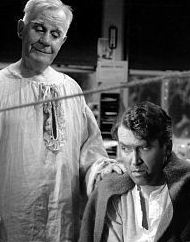
Christmas memories, everyone has them, and I could easily fill a few more pages, but I want to talk about Clarence. You know Clarence, the angel recruit who is trying to earn his angel wings by redirecting George Bailey back to reality in the classic holiday movie, It’s A Wonderful Life.

Clarence and George Bailey. (Photo Public Domain)

As Clarence helps George to reflect about his life, he finally gets George to the point to where George desperately states to this hopeful angel: “ Clarence, get me back.”


During this Christmas season, it seems to me that like George Bailey, we are in dire need for Clarence to “get us back” too.

This Christmas as we reflect about the year that is almost at its end, what will we remember— the country that was demolished by Hurricane Mitch, the possible impeachment of our President, the ethical struggles of Congress, bombs dropped and cruise missiles fired toward a devilish leader that will probably never hit him, or the people of America who appear to be slowly losing their way from acknowledging the heavenly Clarence and his colleagues.

Clarence knew that George Bailey had the capacity within to get himself back and regain his senses. To do this Clarence had to help George regain his sight, both internal and external.

In fact, the opportunity to renew that capacity within ourselves is only five days away when we celebrate the birth of Clarence’s teacher, coach, trainer, mentor, and leader.

When Clarence is successful in getting George back, the bell rang , and he earned his wings.

The bells ring for us each Christmas with the arrival of a very special angel—Jesus.

Let this be the Christmas that we hear the bells ring within our hearts to carry forth the work of Clarence and his very special friend.

Author’s note: This piece was written as a devotion for the Outreach Sunday School Class at Trinity United Methodist Church in Richmond, Virginia on Sunday, December 20, 1998. This post has been edited. Merry Christmas.

Fishing for Christmas

Matthew 4, verse 19: “Follow me, and I will make you fishers of men”.

The last time I took the day before Thanksgiving off was twenty-six years ago. I took that day off for a good reason. It allowed me to travel to West Hartford, Connecticut, and on the Saturday of that Thanksgiving weekend I married the best lady in the whole world.

Twenty-six years later, I was driving our oldest daughter to the Outer Banks of North Carolina. Lauren, a freshman at Virginia Tech, was home for her fall break.

For several years, my wife’s parents have been renting an ocean front beach house during the Thanksgiving week. My family and I had the good fortune of being invited each year to spend the Thanksgiving weekend with them.
Since Lauren wanted to be back in Richmond on Saturday, we thought we would go down to the Outer Banks a day earlier. Selfishly, I liked going a day earlier because that would give me an extra day of surf fishing.

I awakened our sleepy college student before dawn, and shortly after 6:00 a.m. we were on the road. Our drive down through the peanut and cotton farms was uneventful.

We were both anxious to reach the twin span bridges that would carry us across the Currituck Sound. Once across the sound, we pulled off a not so crowded Highway 168, and made the left turn on to Highway 12. Southern Shores, Duck, and five streets passed the Sanderling sign we made the turn that took us to this year’s beach house.

Hugs and greetings were exchanged with my in-laws, and my wife’s brother and his family. Then Lauren and I started to unload the car. After this, we made a quick trip to the grocery story, ate a little late morning snack, and we charted out our plans for the afternoon. My plans were to put on the old waders, grab the gear and the bait, and head for the beach.

Surf rod, tackle box, tubular sand spikes, and a bucket, were in my hands as I waddled in my waders down the wooden stairs to the shoreline. I found a spot to park my gear, located an old piece of two by four to use as a cutting board for my bait, and I started getting everything ready.

That afternoon a good breeze was rolling in off the ocean. The waves pounded the sandy shore. I alternated back and forth between cut bait, and those magical lures.

Periodically, I would check my watch and remind myself about where I would normally be at this time of day. I fished for over two hours, and while I had no nibbles, I did have fun.

The next four days brought the same disappointment. Whether it was morning or afternoon, my luck did not change. The fish weren’t taking what I had to offer. I was beginning to doubt whether any fish were in the ocean at all. That changed a little on Friday morning.

It was low tide. I had found a place on the beach where I could walk out a few yards without a sharp drop off from the shore line. This allowed me to cast our further into the almost calm waters.

In doing this, I started to feel the slightest nibble on my line. Those nibbles aroused my curiosity and hope. Maybe I might get lucky.

My bait on the hook was even stripped away a couple of times. I figured it must be a hungry crab, but I was wrong.

Once, I responded to the tug of the line in just the right manner. As I reeled the line in closer to me, I could still feel some resistance. Then just a few yards from me I finally saw what was teasing me— a small bluefish.

Bluefish known as ferocious feeders obviously start chomping on bait at an early age. Not more than six inches, I would call this a “diaper blue”. These little fish were too small to bite the big hook, but armed with enough teeth to attach to the bait and munch all the way toward the shore.

When the fish are not tempted by the fisherman’s entrees, fishermen do a lot of pondering. During those five days, I had plenty of time to ponder about the world I could observe.

I calculated that it had been at least six years, since I had caught a real fish on this narrow ribbon of fragile land.

Despite that drought, I was hooked on watching the effortless glide of the brown pelicans. I was amazed as they flew within inches of the tops of cresting waves.

I observed the powerfully fast and efficient dive of the gannets trying like me to catch fish.

At different times, the surface of the water would be broken as a small group of porpoise worked their way south down the shoreline.

I wondered what it would be like to glide with the pellies or swim like the porpoise.

And there I was holding the rod, gazing out to the horizon when I saw a huge spray of water shoot up off the ocean’s surface. It reminded me of a cannonball hitting the water, but there was no sound. When I returned to the house for a break that day, my father-in-law asked me if I had seen the whale offshore. Now I know what caused that huge plume of spray.

Back on the shoreline, I heard the the occasional cry of the sea gulls, and the steady pounding of the breakers smacking the sand. But the sound that caught my attention most frequently was the tinkling of the crushed shells that clashed together in the retreating undertow.

And on those mornings when I hit the beach before sunrise, the mixed hues of brilliant colors in the sky could not be matched in a super box of Crayola crayons.

Sun rising out of the Atlantic Ocean, Duck, North Carolina on the Outer Banks. (Photo Bill Pike)

Despite this beauty, I was still disappointed. I had not caught any fish.

But the more I pondered my dissatisfaction, the more I realized that I should be ashamed of my self-proclaimed grumbling. Did I know why I should be ashamed of my grumbling? Yes, I figured it out. The reason was 9-11.

The losses from that terrible day went very deep. The further I thought, the more I realized that now there are children who will never have the opportunity to go fishing with their fathers.

Husbands and wives will no longer share their dreams in the rising sun of the new day. Gone for them is the glide of the pelican, the dive of the gannet, the frolics of the porpoise, the tinkling of the shells, and the spray from the whale.

And yet, hope is not gone. A fisherman always has hope.

Toward the end of December, we will celebrate the birth of the infant who became quite a fisherman. It is the birth of Jesus that brings us hope. Christmas is hope.

And as we prepare for His arrival, let it be hope that will push us to follow His lead to truly become “fishers of men” By doing this, we can deliver hope to those in need.

Prayer:
Father of us all, help us as we cast our lines to find hope in Christmas. Allow us to use this hope to meet the needs of those who are struggling. In your name we pray, Amen.

Note from author: Prior to the start of our blog, Might Be Baloney, I wrote many, many reflections about wobbling through life. Some were used as devotionals as a part of the Outreach Sunday school class at Trinity UMC in Richmond, Virginia. Between now and the end of December 2024, I hope to post a few of those pieces that are linked to Christmas. Fishing For Christmas(this piece has been edited) was written in late 2001. Thanks for reading our blog. Your comments and shares are appreciated. Be safe, love, Bill Pike

Art work: “I’ve got to think.”

In college, our youngest daughter was an art history major. If my memory is correct, this degree also had a concentration in studio arts.

I often wonder how she uses that degree working in marketing for an East Asia computer company. In truth, I believe her marketing skills come from her percipient eyes and her ability to build relationships with customers.

Throughout high school and college, she dabbled enough in art to create some very pretty pieces.

Over the years, with our daughter, and my wife the Commander Supreme, I’ve enjoyed visits to art museums to view an assortment of exhibits. Although, as we have taken in these exhibits, the Commander and she are wary of hanging too close to me in an art museum.

I’m usually the guy who will be reminded by a polite, but humorless guard, “Sir, could you take a step back? You just encroached the boundary line protecting the art.”

While I always politely comply, my perspicacious eyes note that my daughter and the Commander have briskly walked away and turned their backs on me.

From my thirty one years of work in public education, I developed a deep appreciation for student art. That admiration included the skilled art teachers who were able to help these students develop their gift.

There is nothing like student artwork displayed through the halls of a school building. That artwork can impact the environment of the school.

I love when public buildings in our communities feature student artwork in their lobbies and hallways. Those are special opportunities for students to showcase their talent.

I know there are lots of starving artists in this world. I also know that sometimes an artist can become quite successful with lots of pennies flowing into their bank account.

Speaking of pennies, perhaps, you have been following the story about a recent art auction that featured a real banana taped to a wall held by a piece of duct tape.

This piece featuring the banana held by duct tape is titled Comedian. It was created by Italian artist, Maurizio Cattelan. Back in 2019, the piece debuted at Art Basel In Miami Beach.

At the time, this piece created such interest that the gallery withdrew it from public display. Artist Cattelan created three editions of the duct taped banana that sold between $120,000 to $150,000.

Fast forward to Wednesday, November 20, at an auction at Sotheby’s in New York, the banana and duct tape sold for $6.2 million dollars. It was purchased by Justin Sun who is the founder of the cryptocurrency, TRON.

Then nine days later on November 29, the purchaser, Justin Sun, ate the $6.2 million dollar banana. (Associated Press, NPR, New York Times)

I know nothing about Mr. Sun. To develop a platform for cryptocurrency, I assume that he must be smarter than the average bear. Yet, I’m not so sure this banana and duct tape purchase was his best thinking.

In a silly scene from the movie, Sgt. Bilko, actor Steve Martin, who portrays United States Army Master Sergeant, Ernest G. Bilko, is facing a surprise inspection with his unit. With the pending inspection just minutes away, and in desperate need of a plan to counter the review, Bilko blurts out, “I’ve got to think.”

As this purchase was developing, I wonder if Mr. Sun’s internal voice whispered to him “I’ve got to think”. If that quiet voice spoke, Mr. Sun failed to listen.

Even if you are barely aware of the current events where you live or in this old world, I’d wager that you know many people in desperate circumstances who could have benefitted from Mr. Sun’s $6.2 million.

For example, at this very moment, Christmas Mothers and their staffs of volunteers in metro Richmond are working to ensure they will be able to meet the needs of the families who have applied for assistance this Christmas.

Families from Florida through southwest Virginia are trying to figure out Christmas and the rest of their lives following the catastrophic devastation from Hurricane Helene.

The war between Ukraine and Russia has spiked the homeless population in Ukraine to almost twenty-five percent.

Additionally, the war between Israel and Palestine has created a severe homeless situation. Some agencies report this crisis at 2.2 million who have lost their housing.

And beyond those bold headlines, there are the silent headlines—stories of quiet people in the shadows of life who are struggling with their mental health. Those lonely struggles are in sharp contrast to the traditional December celebrations that take place with family and friends.

This time of year, I’m drawn to a line of scripture from the first chapter of Luke verse 29: “But she (Mary) was much perplexed by his words and pondered what sort of greeting this might be.” The angel Gabriel has visited Mary to share with her the pending birth of Jesus.

From this chapter, the words “perplexed and pondered” capture my attention.

Many times in my seventy one years of living, my thinking has been less that perfect. People around me were probably perplexed and pondered—what in the world was Bill thinking?

I feel the same way about Mr. Sun’s art purchase.

With all these real human needs swirling around this old world— what was he thinking?

No matter how much time I have left in this rapidly eroding old world “I’ve got to think.”

I must ponder and find in my heart the best path to advocate for and help the people in need.

Art work: The Brain Plunger by Bill Pike (Photo Bill Pike)