Word Daily shows up in my email everyday.
I guess someone believes I need to improve my vocabulary.
I agree.
I don’t believe the words sent are sticking to me like pine tree sap, but I do hang on to a few of the words.
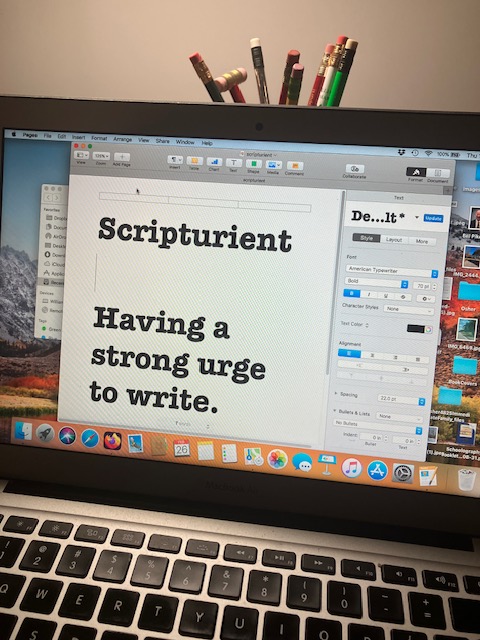
Recently, the word—scripturient was sent.
Scripturient is defined as “having a strong urge to write.”
Rightly or wrongly that is me.
As a scripturient, I have learned that rejection is part of the territory.
I hope with every piece I submit to a publication that it might make the cut.
At least I know if the piece is rejected, I can share the failed writing with you on Might Be Baloney.
So today, I share with you two rejected letters to the editor.
I know they aren’t perfect, and that’s ok.
I tried.
In William Faulkner’s acceptance speech for the Nobel Prize in literature, he wrote: “I believe that man will not merely endure: he will prevail. He is immortal, not because he alone among creatures has an inexhaustible voice, but because he has a soul, a spirit capable of compassion and sacrifice and endurance.”
For America, I hope Mr. Faulkner is right.
This letter to the editor was written solely by Bill Pike. It is exclusive to the New York Times. Submitted 2/3/26
Everyday, reporters from the New York Times write stories about America’s leaders and the decisions they are making in Washington, D. C.
Doesn’t matter if it is the closing of the Kennedy Center, the chaos and tragedy created by ICE personnel in Minneapolis, or the removal of a slavery exhibit at Philadelphia’s Independence Mall, America is eroding.
From “sea to shining” sea, this erosion is grounded in a President who is more attuned to greed, disrespect, incivility, selfishness, abusive power, vindictiveness, and a complete disregard for the truth.
Clearly, Mr. Trump has a heart beating inside his chest, but the President’s heart has no understanding of the compassion needed to lead our country. His heartless leadership is hurting America.
In 1962, James Baldwin wrote in an essay for the New York Times: “Not everything that is faced can be changed; but nothing can be changed until it is faced.”
America, our shortcomings, including the President’s cold-hearted, ruthless leadership are overdue to be faced.
This letter to the editor was written solely by Bill Pike. It is exclusive to the Washington Post. Submitted 2/5/26
As reported in the Washington Post, I’m disappointed, but not surprised that the owner, Jeff Bezos, gutted the newspaper of 300 employees.
When Mr. Bezos made the purchase of the Washington Post in 2013, he didn’t do his homework.
With 76 Pulitzer Prizes, Mr. Bezos purchased one of the most prestigious newspapers in the world. However, did Mr. Bezos know of the downward spiraling of newspapers that began in the 1990s?
Was he aware of Northwestern University’s Medill School of Journalism’s report that found between 2005 and 2025, we lost 3,400 newspapers in America.
More importantly, people like Mr. Bezos, with gobs of money, but who know nothing about the day to day operation of a newspaper shouldn’t be allowed to buy one.
From this latest announcement, I suspect the U. S. Geological Survey detected numerous seismic shifts sparked by previous Washington Post editors and reporters rolling in their graves.
Unfortunately, I don’t think we’re done with newspapers dying in America.
And yet, we live in a time where we desperately need the courage of editors and reporters to be accountable in reporting to readers the truth—“nothing, but the truth, so help them God.”
President Trump’s disdain for the truth and the newspaper journalists who diligently pursue the truth in their work is adding to the erosion of America.
I’m no expert on newspapers, but in hindsight, I believe newspaper editors will look back with regret that they didn’t do a better job of reporting to their subscribers the operating challenges they were experiencing.
In his book, “The Paper: The Life and Death of The New York Herald Tribune” Richard Kluger wrote: “Every time a newspaper dies, even a bad one, the country moves a little closer to authoritarianism.”
This is urgent, we can’t let the Washington Post die.
 might be baloney