How much longer can your church hang on?

Growing up in Burlington, North Carolina, every Sunday, I was in church— Sunday school, worship service, and a youth program later that evening. Illness was the only interruption.

That church, Davis Street United Methodist, is now closed. Congregation voted to shutdown. With declining attendance and financial support, staying open wasn’t logical.

To their credit church leaders did their homework. A buyer for the building was found. Over a period of time, the Davis Street congregation opted to merge with another Methodist church.

Over the last fourteen years, I’ve had the privilege of working at my church, Trinity United Methodist. During that time, I’ve learned a lot about churches.


Whether they want to admit it, churches, no matter their size or status, aren’t immune from wondering how much longer can they hang on.

No question, the pandemic had an impact on churches.

Yet, respected research organizations like Gallup and Pew have been reporting for years that churches were struggling.

Six years past the pandemic, congregations are still challenged to address declining attendance, giving, aging members, and deteriorating buildings.

In March of 2024, Gallup reported: “On any given weekend, about three in 10 U.S. adults attend religious services, down from 42% two decades ago.”

A February 2025 study from the Pew Research Center found some stabilization in their data. However, when looking toward the future, this key point was made: “younger Americans remain far less religious than older adults.”

Daniel Silliman, in Christianity Today, and Francis Wilkinson, in Bloomberg, have written about the possible impact that Donald Trump has made in contributing to the decline of church attendance.

No matter who takes the blame, I wonder how frequently church leaders point the finger of blame back at their own shortcomings?

In the baseball movie, Moneyball, there is a pivotal scene between a rookie executive, who is skilled in player analysis, and the seasoned general manager of the team.


The young executive makes a bold statement: “Baseball thinking is medieval, they are asking all the wrong questions.”

Part of me believes that “church thinking is medieval, they are they asking all the wrong questions.”

I’m no expert on churches. However, in this current environment, I think church leaders and congregations are overdue to ask tough questions. That is the only way to determine their current standing in order to determine a path forward.

Part of me believes that churches would benefit from participating in an accreditation process. That process would require churches on an annual basis to assess key evaluative criteria related to: program offerings, finances, outreach, personnel, facilities, safety, technology, and the ability to make meaningful connections.

Conducting an annual review could potentially help churches in making difficult decisions relate to budgets, personnel, facilities, and the effectiveness of their program offerings.

With a need to attract young families, I think churches often overlook the concept of “discretionary time.” Young families often over extend, they are always on the go.

So, how does a church help young families find a fit that works for them? Can churches develop flexibility in their seemingly inflexible traditional schedules for young families?

How can churches be more welcoming to those exploring churches? On a first visit, a nervous visitor doesn’t need to hear the unwelcoming: “Sorry, sonny, but your sitting in my pew.”

Finding their footing for the future means churches can’t fear change.

Churches must embrace change. The path forward will not be found in producing more predictable sameness. Congregations should consider this question—do you want the autopsy for your church to state: cause of death—stubbornly resistant to change.

And speaking of death, why must a funeral be the time to learn all about a church member? Churches must become stronger in building ‘living’ relationships within and outside the walls of the church.

That means becoming more adept in capturing and sharing significant stories within the congregation and community.

How much longer your church can hang on isn’t up to me.

Hanging on depends on your congregation and its leadership, and the willingness to take some risks.

Here are five simple risks:

Compile all essential data about your church for detailed research and review.

From this review, determine what works and what isn’t working within your church.

Resolve to tell the truth from these findings.

Write a report of findings for the congregation that clearly reveals the challenges and strengths of the church.

Use the report of findings as the pivot point for determining how to move forward.

More church closings are unavoidable.

Maybe that’s why this Og Mandino wisdom keeps coming back to me: “I have never heard anything about the resolutions of the apostles, but a good deal about their acts.”

Churches now is the time to act.

(Photo Bill Pike)

Methodist In Roanoke

Ok Roanoke, this is your warning—the Methodist are coming.

From June 11-14, Methodists from across Virginia will be gathering for their Annual Conference at the Berglund Center.

I attended the annual conference as a district delegate in June 2019. That gathering is chiseled inside my body’s thermostat. Outside the Berglund Center was June perfect. Inside the building was freezing.

Maybe, conference leaders requested the frigid air to keep participants awake, or to keep emotions cooled when heated topics were debated.

Might be hard to believe, but methodical Methodist can get riled up. In case you don’t know, it took our denomination what seemed like centuries to work out differences over gay clergy and LGBTQ issues.

That grueling, hot-blooded debate caused some Methodist congregations to leave the denomination. The disaffiliation process was grounded in paperwork, property, and pennies.

I wonder if church researchers are investigating how those disaffiliated churches fared?

Trends in religion and houses of worship continue to be a source of interest for researchers.

A February 2025 study from the Pew Research Center featured this headline: “Decline of Christianity In The U.S. Has Slowed, May Have Leveled Off.” That might be encouraging news for church leaders in America, but I believe churches and the Methodists at the Berglund Center still have their work cut out for them.

The Pew report goes on to state: “But, despite these signs of recent stabilization and abiding spirituality, other indicators suggest we may see further declines in the American religious landscape in future years.” The key point made is that “younger Americans remain far less religious than older adults.”

I’m one of those older Americans. I see that trend at my church, Trinity United Methodist, in Richmond, Virginia.

If researchers reviewed the age demographics for the Methodists attending this year’s conference, I suspect they would find more older adults in attendance than younger adults.

Let’s be honest, churches were in trouble before COVID-19. Data captured by assorted researchers revealed declines in attendance, decreases in giving, aging congregations, and deteriorating buildings.

We are six years past COVID-19. Churches, including Methodist, continue to be challenged to address these on-going issues.

I sense our Bishop for the Virginia Annual Conference of the United Methodist Church, Sue Haupert-Johnson, is a very competent leader. Bishop Sue is a career switcher— business to law to theology. She has the task of leading Virginia Methodists through these challenges and whatever remaining baggage exists from the under current of our divides.

As a life long Methodist, we put ourselves into this mess, how do we pull ourselves out? Here are some thoughts.

In the baseball movie, Moneyball, there is a pivotal scene between a recently hired young executive, who is skilled in data analysis, and the seasoned general manager of the team. The young executive makes a bold statement: “Baseball thinking is medieval, they are asking all the wrong questions.”

Are conference leaders using available data about our churches and their congregations to ask the “right questions?”

For example, how many of our churches are hanging by their fingernails? What is the plan for gently closing these churches and merging their congregations into more stable churches within their communities? How might these now vacant properties be converted into affordable housing to help Virginia ease its housing crisis?

To reduce future closures, might churches benefit from participating in an accreditation process? On an annual basis, pastors and their congregations would be required to assess key components related to attendance, finances, programs, outreach, safety, leadership, technology, and property.

Over the last fourteen years, I’ve learned quite a bit about church operations. Churches can be tough places to navigate. How does morale impact the feel of the church’s emotional and physical environment for the pastor, employees, congregation, and visitors?

In looking to the future, Methodists would be wise to give serious thought to “discretionary time.” The key to attracting and sustaining young adults and young families is where does church fit in their overbooked schedules?

The theme for this year’s conference is “Movement of the Heart.” A part of that theme will focus on how Methodists can become “agents of change.”

If Methodists desire to become “agents of change,” they must avoid “medieval thinking” and asking “wrong questions.”

Pat Conroy wrote in his book My Losing Season: “Loss invites reflection and reformulating and a change of strategies.”

In plotting their future, Virginia’s Methodists ought to initiate Mr. Conroy’s wisdom.

Author’s note: On June 8, 2025, just before the start of the Annual Conference for the Virginia United Methodist Church, this op-ed piece was submitted to the Roanoke Times. The piece was not accepted by the newspaper’s editors.

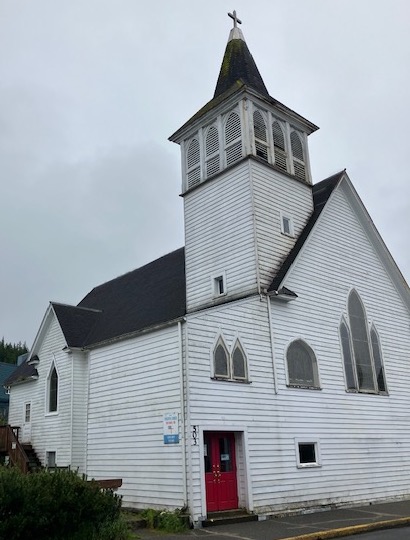
An Episcopal church in Ketchikan, Alaska (Photo Bill Pike)