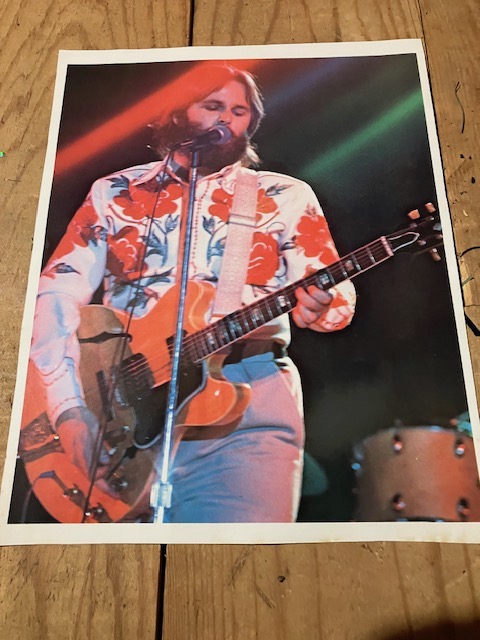
Today, Sunday, December 21 is the anniversary of Carl Wilson’s birth date. Born in 1946, had he beaten back the cancer that took his life, Carl would have turned 79 today.
Ultimately, Carl’s passing broke up the group, the Beach Boys, that he helped found.
The Beach Boys continued to perform and record after the passing of drummer, Dennis Wilson in 1983.
But with Carl’s death, the remaining members— cousins Brian Wilson and Mike Love, Al Jardine, and Bruce Johnston fractured and split like a California vault line. This seismic shift resulted in multiple business disagreements and countless lawsuits.
Of course in 2012, those remaining members put aside their differences for a new album and a world tour in honor of their 50th anniversary.
Still, I will always wonder what the Beach Boys would have been like if Carl had lived, and that applies to his brother, Dennis, a bit too.
Author Kent Crowley’s book, Long Promised Road, takes us into the ups and downs of the Beach Boys. There is a lot of coastline to cover in Carl’s life with and without the Beach Boys. Crowley attempts to capture this journey.
I can only begin to think what it must have been like for Carl as the youngest brother to Brian and Dennis. Their mother, Audree, must have had her hands full raising these distinct personalities.
Her husband, Murry, by all accounts could be challenging too. Yet, the love of music in the Wilson household was linked to Murry, a businessman, and a frustrated songwriter.
Early on, the oldest son, Brian showed promise in music. Most documented writings about the Beach Boys reference a story when Brian requests that his mother make Carl sing with him rather than allowing Carl to join in a neighborhood baseball game.
Mothers tend to have an intuitive sense about their children. According to longtime Beach Boys’ historian, David Leaf, Audree Wilson noted this about her youngest son: “Carl was born 30.”
In 1961, when the Beach Boys first started finding traction around Los Angeles, Carl was their 15 year old lead guitarist.
Three years later in December 1964, Carl’s maturity would steady the band on the concert road when Brian experienced his first nervous breakdown.
With the exception of a period time in the spring and summer of 1981, Carl led the Beach Boys when they toured. Carl departed in 1981 to tour as a solo artist in support of his first solo album.
He opted to return to continue his work with the Beach Boys, but with this mandate to his bandmates—1981 must mean as much as 1961 once did. With that ultimatum Carl set out to reinvigorate the groups’ live performances.
One of my favorite periods for the Beach Boys was from 1970 through 1973. Carl was at the heart of this productive period for the group in the studio and on the road.
Four strong studio albums released by Warner Brothers/Reprise/Brother Records: Sunflower(1970), Surf’s Up(1971), Carl and the Passions “So Tough”(1972), Holland(1973), and The Beach Boys In Concert(1973), found favor with their fan base and music critics too.
Always strong live performers, through the mid-70s, the Beach Boys became a top concert draw again. Their trademark harmonies and musicianship led the way.
Recording engineer, Stephen Desper, a visionary manager, Jack Rieley, and Carl’s steadiness in working with each member of the band in the studio and on the road helped to facilitate this turnaround.
That surge pushed into 1975, when Capitol Records released the Beach Boys’ album Endless Summer. This double album introduced a new generation of fans to the groups’ deep catalog of hit records.
Endless Summer was a huge commercial success. That success translated to even more people attending their concerts at larger venues across America.
Ironically, the triumph of Endless Summer actually brought an end to that early 1970s stretch of songwriting creativity from the Beach Boys.
For the remainder of their careers when the Beach Boys performed live, they became an oldies act. Sure, they did the obligatory promotional performances of new singles from their latest studio albums, and on occasion, a setlist included a rarely performed nugget, but by and large, they became a jukebox with the old hit songs dominating the show.
Through all of these changes, Carl Wilson endured. He led the group on stage ensuring that the singing and playing met his high expectations.
I have no idea how many times I saw the Beach Boys in concert, but Carl’s singing and playing were always a treat for me. His voice rang true whether singing lead or blending into the harmonies.
No matter if Carl’s lead was a tender love song like “Only With You”(from the Holland album), or a rocker like “Darlin’”(from the Wild Honey album), or a fan favorite like “God Only Knows” from the Pet Sounds album, his voice was unmistakeable.
From the Sunflower album, early in the song “Cool Water,” there is a marvelous section of interplay with the background vocals from Carl and his brother, Brian. I’m sure glad that Audree made Carl sing with Brian when they were growing up. Examples like this capture the chemistry of their vocal cords that only brothers could have.
With his guitar playing, Carl had all of the required chops and more.
Whether playing a solo or supporting the structure of a song, he knew the sound he needed to capture for live performances. Carl was competent on six string acoustic or electric, and twelve string as well.
During his career, Carl played guitars made by Fender, Gibson, Epiphone, and Rickenbacker. In 2000, Rickenbacker guitars released a new signature model guitar named after Carl.
In October of 1989, I was able to meet Carl Wilson. This is a longer story that I will document some day. But, he could not have been kinder to me.
Cancer continues to be one of the most rotten things on earth. I absolutely despise it. I don’t know why cancer had to destroy such a gifted musician. But again, I do know why cancer robbed us of Carl—cancer doesn’t care who it invades.
Although I play no musical instrument, nor can I carry a tune, I have a deep admiration for musicians.
There is something special about music and its capacity to touch our souls.
I think Carl Wilson’s gift of music touched many souls.
For some reason, Psalm 32:7 makes me think about Carl: “You are my hiding place, you will protect me from trouble and surround me with songs of deliverance.”
I think music can be a hiding place. A place where the troubles of the world can be soothed by songs that can transport us ever so briefly from the tough realities of the moment.
Sometimes, that is all we need—the strength of a song to buffer us through the challenge before us.
Like me, Carl Wilson was an imperfect human being.
Yet, I admired his endurance with the musical contributions he made to the Beach Boys.
I also appreciated the spirit of his battle to beat back the cancer that took him.
Yes, I miss Carl Wilson.
I’m certain his family misses him too.
But at the very least, I can still listen to the music he made with and without the Beach Boys.
And on those days when I need a distraction, one of those songs for a few minutes will humbly touch my sagging, old heart.
In that joyful sound, I will appreciate God’s gift to Carl.
After his death in 2000, the album Like A Brother was released. This album was a collaborative effort featuring Gerry Beckley from America, Robert Lamm from Chicago, and Carl Wilson from the Beach Boys.
The album features the songwriting, singing, and musicianship from each of these gifted musicians who had been friends for many years.
From this recording, one of Carl’s songs “I Wish For You” has been a favorite. Carl collaborated with Robert White Johnson and Phil Galdston on this effort.
The song features a pretty lead vocal from Carl and heartfelt lyrics.
With Christmas a few days away sharing these two lines from the song seem appropriate:
“I wish you hope through your share of tears,
I wish you peace all your living years.”
At this very moment, no matter where you are in your life, I wish and your families hope and peace this Christmas and in 2026.
Good Lord knows we need it.
Love you all, be safe.

 might be baloney