Old, ugly legs in the long shadow of the morning sun

Back on Saturday, March 26, 2022, I made a unwise decision.

I ran in the Douglas Freeman High School Maverick Miles 5K.

This was a careless choice because my left hamstring was misbehaving.

In fact, the unhappy hamstring had started to annoy me as early as March 20. That morning, I cut a run short. In a miserable voice, the hamstring’s order was clear—“stop.”

I tried to make the hamstring happy. Heat treatments, moderate stretching, ibuprofen, and aspercreme rubs failed to settle down the irritated hammy. And early on, I consulted with our son, Andrew, who from his high school running days knows the temperamental hamstring.

Since, March 26, I have impatiently waited for the hamstring to heal.

A part of that impatience has been watching other runners trek through our neighborhood without a care in the world. They freely stride straight stretches, curves, and hills. My old sack of bones wants to join.

During this road absence, I have ridden our stationary bike in the basement. I’ve tried to enlighten myself by listening to interviews on the NPR show Fresh Air. The variety of guests is diverse, but more amazing are the stories of the resilence of the human spirit during challenging times.

I have also supplemented the bike workouts with a few neighborhood walks.

Plus each morning, I revisit some ancient calisthenics from Miss Alma Joyner’s fourth grade class on the blacktop basketball court at Hillcrest Elementary School. I guess Miss Joyner would be proud that I did retain something from her year of attempting to teach me.

With the pandemic still hovering, I have not returned to the Tuckahoe YMCA. So, sit ups, push ups, and light weights are in my early morning routine.

But on the morning of Monday, May 23, I resolved to go for a run. I had to find out if the hammy would allow me to return to the sluggish pounding that my soul had missed.

Around 6:20, I took a few, short tentative steps on Sweetbriar Road.

The hammy was quiet.

My feet took me down Stuart Hall’s winter sledding hill, across Baldwin, and back up another Stuart Hall hill heading toward Forest Avenue.

I hooked a left into the Trinity UMC driveway that parallels Forest. Took another left on to Rock Creek Road and headed for a right on Baldwin.

The hammy was still quiet, but I was battling my brain. Should I take one of my traditional routes, or should I alter my route, and not push the luck of my hamstring?

Luckily, my brain chose a shorter route. I curved left on to Westham Parkway, worked through the crisscross at Brookside, and headed up Brynmawr’s challenging hill.

At the top of the hill, I turned left on to Woodberry, and another left back on Sweetbriar, and then I was home.

The hammy was attempting to speak, but in a whispered tone.

Overall, I was pleased with my twenty minute slog. Mentally, I made a note to venture out again on Wednesday morning.

My old soul has missed my runs.

I know if I continue to pound the pavement, at some point, my body will say to me—“you’re done.”

I live in fear of that day.
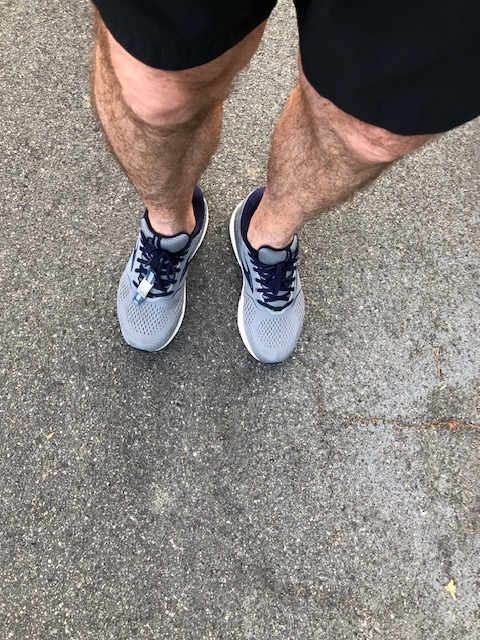
My old, ugly legs Photo by Bill Pike

That disconnect will spin my mind into recalling snapshots deep in the vaults of my old noggin.

I’ll travel back to hear the clear hoots of an owl on a crisp fall morning.

See a misplaced deer nibbling on tender new foliage in a neighbor’s front yard.

Watch the silent, but efficient glide of the heron in a gray sky heading toward Westhampton Lake.

Enjoy the teasing swirl of snowflakes in a gust of winter wind.

Encounter a weary, young mother pushing a stroller with a crabby passenger.

Hear the whirring of tires and chatter of bike riders as they zoom past my tired legs.

And miss cleansing the meanness of my soul when summer heat, humidity, and dew point collide, and drench me in perspiration.

On Tuesday, May 24, my legs, especially my quads are not happy. They feel the strain of not running since March. Courtesy of my wise friend, Bruce Bowen, I know the cure—an even slower run on Wednesday morning.

Somewhere, in this hamstring whine, the good Lord has been at work too.

All the scenery, all that beauty, and the wonder of this world that I have enjoyed on my runs are courtesy of his touch.

As I continue to age, I must commit to helping preserve all that beauty and wonder.

Failing to commit only hurts the future.

And that isn’t acceptable as our grandchildren are in that future.

My shadow in the early morning sun Photo by Bill Pike

Commentary: We must repair our social infrastructure to reduce gun violence

Friends, today Friday, June 10, I was honored to have the following op-ed piece published in the Roanoke Times.

COMMENTARY
Pike: We must repair our social infrastructure to reduce gun violence
Bill Pike


On Tuesday, May 24, I called a college friend. May 24 is a tough day for my friend and his wife. Three years ago, they lost their youngest son to an encounter with a stranger and his handgun.


Later that afternoon, my wife reported to me the tragedy at an elementary school in Uvalde, Texas. My wife has a niece with three children in Texas.


Even though her niece doesn’t reside in Uvalde, my wife was concerned. Doesn’t matter where you live in America, there is no immunity from gun violence.


For too long, Americans have become senselessly skilled at taking human life with firearms.
For 31 years, I had the privilege of working in the public schools of Virginia.

As an assistant principal at a large high school outside of Richmond, sometimes we found ourselves working with a student who brought a handgun to school. Fortunately, we never had to deal with a tragedy. However, the real tragedy was that a high school student could so easily gain access to a handgun.

Situations like that forced school systems to work to improve security. Consultation with local police departments resulted in resource officers being assigned to schools.


School personnel participated in staff development programs presented by experts who had researched data and conducted countless interviews with responding officers, school officials, survivors, and sometimes the shooter. From this work, security plans were developed and implemented. Safety drills occurred at every grade level.


Concerned community leaders worked with local, state, and federal agencies to advocate for new legislation with the goal to make purchasing a firearm more difficult.


And despite these efforts, we continue to be confronted with unacceptable shootings in our schools and communities.


Why?


Have we become numb to this epidemic and lost our compassion to care?


Have we lost our ability to recognize and understand the truth about the challenges America faces?


Do we realize America is a mess, and that we have been slowly eroding for a long time?


With regard to those questions, here are my thoughts.


I think we still care. But I’m not sure we care enough. If we did, we should have solved this madness a long time ago.


The last few years have clearly illustrated our desire to believe more in disinformation rather than digging out the hard truths of our dysfunction.


No one wants to admit we are a mess, but America is a mess. We need to do the unthinkable — sit down with our differences and division, and in a civil, cooperative manner resolve to stop this murderous mess.


Our post tragedy templates are very predictable. Lots of talk, lots of finger pointing, lots of promises, and no solutions developed.


We were wise to support and fund the ongoing restoration of our aging infrastructure systems. But when will we realize that our vicious human infrastructure cycles of poverty, housing, mental health, education and justice are in critical need of support, too? Which is more important: spending billions to explore space, or solving the desperate needs of our human infrastructure?


The longer I worked in schools, the more I realized how fragile our families had become.


According to a 2019 Pew Research Center study, the United States has the world’s highest rate of children living in single-parent households. That rate topped out at 23% — almost a quarter of our population.


Even in a normal family setting, parenting is challenging work. I can’t imagine the challenges a single parent faces trying to manage day to day living in an unstable environment.


How many challenges for schools, communities, and juvenile justice systems emerge from those single parent environments? How many shooters materialized from America’s inability to stabilize our families?


As a parent, grandparent, and retired educator my heart has ached through too many of these senseless tragedies.


America is overdue to develop and commit to a plan to stop this unacceptable loss of human life. It is shameful that America with its public and private resources can’t come together to solve this cruel sickness.


This matter is urgent. It is not going away.


The quietness of our collective voices can no longer be silent.


If we remain silent with no moral fiber to stop these deplorable tragedies, then we will continue to see the human erosion of America from sea to shining sea.


Our stubborn, inconsiderate, divided hearts must do better. We must stop our procrastination. Failure to respond will mean more of the same, and that isn’t acceptable.

Pike is a retired educator who has served on his local school board in Henrico County.

The Passion of The Rockers

I’m not sure of the exact moment that Brad Bennett and Steve Hodge were bitten by the music bug. But, I do know this—once that bug was flowing through their bloodstreams, it never left them.

I first encountered their music bug in 1971.

Late that summer, I started my freshman year at Greensboro College. So did Brad and Steve. They were roommates. Both were from Winston-Salem, and if my memory was correct, they played in the same band, Freiburg.

Gradually, I became friends with these guys. Music was the connector. We listened to records in their room. I recall Brad was a huge Moody Blues fan. And Steve might be listening to a band just under the radar, like Dan Hicks and The Hot Licks.

Brad played guitar and Steve played bass. Both could handle lead and background vocals. Throughout their four years of college, their band played assorted shows in all types of venues in the Piedmont triad area of North Carolina.

Sometimes, I helped as a roadie, and once I was a mock manager. I recall landing them one job at was then named Elon College.

At some point, Steve and Brad pulled off a major coup. They convinced a college administrator to allow them to store their band equipment in a large, empty storage area, and to use the adjoining lecture hall as a setting for rehearsals.

Frequently on Saturday and Sunday afternoons, the band, Freiburg, rehearsed. I often found myself sitting in that lecture hall hearing the band practicing songs in the set list, or learning a new one.

Perhaps, because I have no singing voice, and I never learned how to play a musical instrument, I was drawn to the friendly access of Brad and Steve’s musicianship.

If you know a bit about rock and roll history, keeping a band together is challenging. After we graduated from college, I believe Freiburg eventually went their separate ways. But, Steve and Brad’s friendship and their love of music never left them.

Both have participated in recording sessions for their own individual material, and with other bands too. They managed their music while maintaining careers, and doing the most important work being husbands and fathers.

If you are a musician, you also have lots of equipment. Miles of cords, amplifiers, keyboards, sound systems, and the latest gadget to enhance your sound, and of course guitars—lots of guitars.

I know quite a bit about Steve’s guitar collection, but not as much about Brad’s. In some ways, those guitars are like family members. Each instrument has a story. Each has a special quality and purpose whether for a concert, a recording session, or just goofing off.

For better or worse, Steve Boone, Dan Callow, Steve Hodge, Doug Kinney, Butch Sherrill, and I have maintained our friendships after graduating from Greensboro College. Since 1975, at least once, and sometimes twice a year, we find a date and gather in North Carolina, Virginia, or Maryland. Wives, significant others, children, and grandchildren have been part of those gatherings.

During the weekend of May 13-15, 2022, we all made our way to Greensboro. The home of Butch and Marian Sherrill was our base for the gathering. And it just so happened that Brad and Steve were playing an early show at the Roar in Winston-Salem on Saturday evening May 14.

Located in downtown Winston-Salem on North Liberty Street, the Roar is housed in the former home of the Twin City Motor Building. The extensive renovation has turned the large multi-floor building into a food hall and entertainment center.

We left Greensboro, worked our way into downtown Winston-Salem, and since it was Saturday night finding a place to park was tricky. But, we found a couple of places and made the short walk to Roar.

Inside the building, it was like COVID-19 was a speck in a rearview mirror. People were everywhere. As we got our bearings, we walked to a large open area in Ford’s Food Hall, and off to our left Brad and Steve were set up and playing.

We scrambled around and found some chairs to set up in front of where The Rockers were holding court. Brad’s wife, Sue, a Greensboro College graduate too, helped us to get settled.
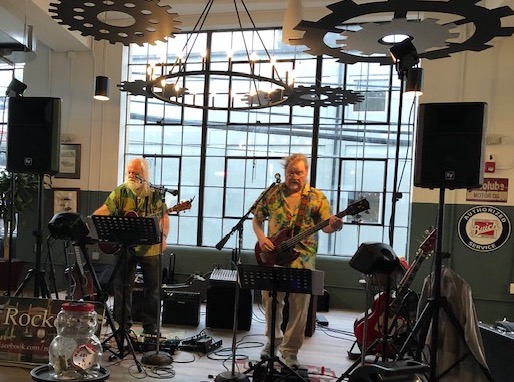
Steve was playing bass, Brad acoustic guitar, and he had access to an electronic keyboard too. I don’t recall the song they were playing when we arrived. But as we listened and watched, The Rockers played a very diverse set list. A set list that could reach the mix of the audience as well.

It was clear with each song that Brad and Steve had worked hard to capture the original musicality of a song. To do this means The Rockers have paid their dues with practice time.

They have pride in their musicianship. No short cuts were taken in the rendering of any song they played. Without a doubt, it was still very clear to me that Brad and Steve have the same passion for music as they did when they first picked up their guitars as teenagers.

During a break, we chatted. I peppered Steve with questions about the guitars he had on stage, and he patiently answered in detail.

The next set started, and they worked in some originals including Steve’s “Cheese Sandwich” which I think he wrote in tribute to the dining room food at Greensboro College.

At some point for our group, our ears started hearing the whine of our bodies for dinner. We politely waved goodbye and started our walk over to the Cugino Forno Pizzeria.

After the delicious pizza, we walked back to our cars. Dan, Doug, and Steve Boone decided to stick around and be roadies. They helped those old rockers do the equipment load out.

I had an excuse for not being a roadie. I was needed back in Summerfield where I was going to relieve a babysitter who had been watching over our three year old grandson. The rest of his family was at a dance recital where his sister, Caroline, was performing.

It was good to see Brad and Steve playing live at Roar. I love and admire their passion for music. I hope their ability to keep playing is like the title to the Neil Young song “Long May You Run.”

For Brad and Steve, long may your fingers run along a guitar neck, may your vocal chords quiver in harmony, may your minds muddle through song lyrics without a stumble, and may you ears keep you in tune.

Long may the passion of the music run in the hearts of The Rockers.

P.S. Maybe the time has come for a reunion of Freiburg. I can see the group on the cover of Rolling Stone, or at least a front page story on The Yadkin Ripple.

The Rockers, Brad Bennett and Steve Hodge, at the Roar in Winston-Salem, North Carolina 5/14/22 Photo by Bill Pike

Memorial Day 2022: Broken Promises

Last night or tonight, somewhere in America, a peaceful night of sleep is disrupted by a nightmare.

This unwanted intruder is courtesy of a broken promise.

Before reporting to dangerous military duty, a wife, a mother, a father, a brother, a sister, a friend looked their husband, son, daughter, brother, sister, friend in the eye and said: “Promise me that you will be careful, and promise me that you will come back.”

No matter where America has sent its military personnel into perilous conflicts, sadly, the coming back part of the promise has been broken too frequently.

War breaks promises.

Soldiers, sailors, aviators die.

No matter the depth of training, quality of equipment, and individual skills—war breaks promises.

I am certain that my grandparents, Charley and Izetta Pike, had that conversation with their oldest son, Boyd.

During World War II, Boyd was a sailor on the destroyer, the USS Simms. Boyd did not come back to Greensboro, North Carolina as promised. His body disappeared into the Coral Sea after the Simms was attacked by Japanese war planes.

The Pikes were God fearing, church going people.

I wonder how my grandparents felt about God when they were notified that Boyd had perished.

Without question, my grandparents would have held on to these words from Psalm 91 verse 11: “For he will command his angels concerning you to guard you in all your ways.”

They like other families were counting on those angels to guard their sons and daughters. But, war breaks promises, and God’s angels.
 
Years after Boyd’s passing, my father revealed a nightmare where he could hear Boyd desperately calling for his help. I don’t think my father ever forgot that helpless agony.

When a family loses a loved one to military duty, the agony never leaves.

My friend, Mike Cross, served our country in the Vietnam War as a sergeant in the Marine Corps. Mike rarely speaks about his tour of duty in Vietnam. I respect his silence.

At some point during our friendship, Mike gave me a small paperback book—A Paratrooper’s Faith.

This book started out as a “pocket-size notebook” that had been put together by the father of George Bowler Tullidge III, Sergeant of 507th Parachute Infantry, 82nd Airborne Division.

George’s father had filled the notebook with “poems, excerpts, and Bible verses.” The family’s hope was that the book might help George in combating the mental fatigue of his duty.

On June 8, 1944 during the invasion of France, twenty year old George Tullidge broke his promise to his family in Staunton, Virginia.

Near St. Mere Eglise, France, allied troops needed to secure the main road. This road came under attack.
George responded by setting up a light machine gun and holding off the enemy. Though wounded during this attack, George refused to withdraw until the position was secured.(Descriptive extract regarding George Tullidge’s Bronze Star Medal)

In December of 2021, my wife and I attended her nephew’s wedding in Hawaii.

While in Honolulu, we made two significant stops—Pearl Harbor and the National Memorial Cemetery of the Pacific.

Each site carries a quiet, honored dignity on the shoulders of their meticulous grounds.

The perfection of the displays and the calm beauty of the landscape are well removed from the hostile environments that created these memorials.

While walking the grounds of the National Memorial Cemetery of the Pacific, I came across the following quote on a plaque. The words are attributed to a Chaplain from the 6th Marine Division at a cemetery in Okinawa in 1945:

“This is not a bivouac of the dead. It is a colony of heaven. And some part of us all is buried here.”

From the National Memorial Cemetery of the Pacific December 2021 photo Bill Pike

Those words, reaffirmed for me a simple truth— we can never forget the sacrifices buried in Memorial Day.

We must vow to always remember the men and women who broke their promises for our freedom.

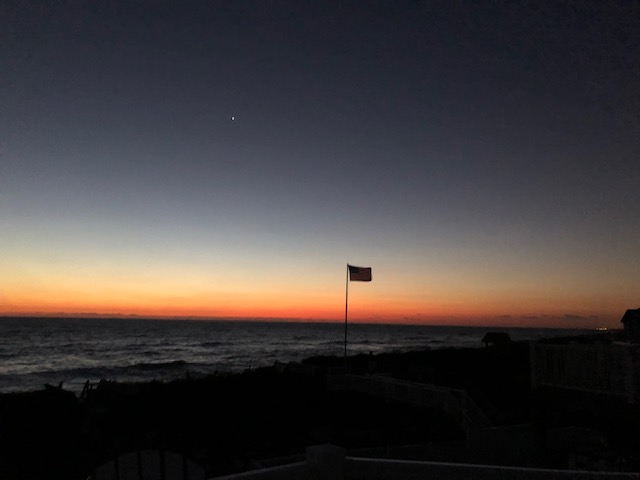
American flag at dawn on the coast of Duck, North Carolina photo by Bill Pike

Recycling the Beach Boys, Again

On April 28, I know you were anxiously awaiting this press release from Capitol Records to commemorate the 60th anniversary of the Beach Boys:

To kick off the yearlong celebration and provide the perfect summer soundtrack, Capitol Records and UMe will release a newly remastered and expanded edition of The Beach Boys career-spanning greatest hits collection, Sounds Of Summer: The Very Best Of The Beach Boys, on June 17. Originally released in 2003, the album soared to no. 16 in the US and stayed on the chart for 104 weeks. Now certified 4x platinum for sales of nearly four and a half million albums, the collection has been updated in both number of songs and audio quality, expanding the original 30-track best of with 50 more of the band’s most beloved songs for a total of 80 tracks that span their earliest hits to deeper fan-favorite cuts and from their 1962 debut album, Surfin’ Safari through to 1989’s Still Cruisin’.

I know where you will be on June 17. You will be at your local record store waiting for an employee to unlock the door so you can rush in and be the first in your neighborhood to make this purchase.

There could be a slight problem with you making the trip to your local record store. Depending upon where you live, your community might not have a local record store anymore. Of course that is another story too— how independent record stores and bookstores manage to stay open.
But, before we go any further, I must confess. I am a long time fan of the Beach Boys and Brian Wilson. I have disclosed this before in other post about the Beach Boys.

In someways, I guess it is sad that a 68 year old man still keeps up with these now ancient singers, songwriters, and musicians. Yet, there is something about the music created by the Beach Boys that tugs at my old heart and sometimes moistens my eyes.

This isn’t the first time that Capitol Records has recycled the hit records of the Beach Boys. The first was on July 5, 1966 when Capitol released Best of The Beach Boys.

That album contained twelve songs and not all of the songs were top ten hits. The album appeared two months after the release of the Pet Sounds album. Some speculate that Capitol quickly compiled this album to counter the lackluster sales of Pet Sounds.

Eight years later on June 24, 1974, Capitol released Endless Summer a double album of greatest hits. Four months later this album hit number one on the album sales charts.

Since 1974 to the present, a wide range of greatest hits albums have been released in America and around the world. Some have been very successful in their sales. I’m sure this makes record company executives and the Beach Boys happy.

But to be truthful with you, this eighty song release to celebrate the band’s 60th anniversary is a disappointment. I believe Capitol Records missed an opportunity to focus on the band’s live in concert recordings.

Despite all of the ups and downs the Beach Boys experienced in their sixty years of work, there’s been one constant—they have always toured.

In the lean years from 1967 to 1969, when their record sales fell into a deep ocean trench, touring saved them. This was especially true when they played in Great Britain and Europe.

All that touring forced Al, Mike, Dennis, Carl, and Bruce to really work at their musicianship. And it necessitated adding other competent musicians to more fully capture the studio recordings in a concert setting.

From 1970 -1975, the Beach Boys gradually became a hot in concert band. Rolling Stone magazine at the end of 1974 proclaimed the Beach Boys their band of the year. This was an affirmation of how strong the group’s concert performances had become.

Clearly, Capitol Records would have plenty of concert material to pull from the well stocked vaults of the Beach Boys. Over the years, fans have been treated to some unreleased live recordings being a part of compilations and box sets that have been released.

You can hear how the band’s concert sound evolved with those recordings.

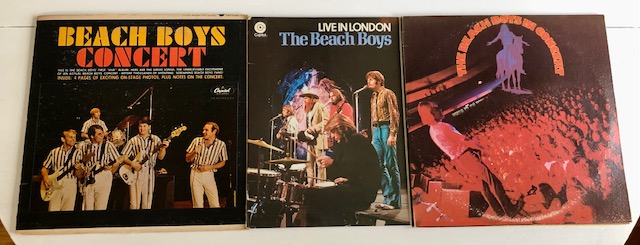
From the first live album Beach Boys Concert in 1964, we hear the screams from the audience, the nervous tightness of the band, and the silly banter of Mike Love

The 1970 Live In London captures a fuller sound with the addition of a horn section and keyboards. And this recording also captures the adoration of the audience, and the bold a cappella performance of “Their Hearts Were Full Of Spring.”

In 1973, the double album offering The Beach Boys In Concert captures a balance of the band’s oldies with their new songs, plus a few songs rarely performed in concert. If you doubt the band was cherished in America, listen to the audience’s reaction when Carl Wilson sings the opening “I” to “Good Vibrations.”

And, I’ll toss in one more live album—“Good Timin’” Live at Knebworth.” This concert in England was recorded in 1980, but was not released until 2003. This performance was captured on film too. The concert is noteworthy in that the three Wilson brothers Brian, Dennis, and Carl were all present as were Mike Love, Al Jardine, and Bruce Johnston. Song selections for this concert were predictable.

I’m sure archivist Mark Linett and Alan Boyd have found in the vaults plenty of live recordings to sift through.

An example of this took place over the last few years when to protect copyrights, Capitol Records released several live recordings and studio sessions from the mid to late sixties. This included Lei’d In Hawaii concert recordings.

And yes, the Beach Boys 2012 50th Anniversary Tour did birth a live album capturing forty one songs from the fifty song set. However, I will stubbornly hang on to the premise that the live recordings from the 1970s are better.

Linett and Boyd’s work from the Sunflower and Surf’s Up Sessions included a sprinkling of live tracks that really showcased how strong the band’s concert performances were in the early 1970s. It is remarkable how the group performed the very beautiful and complicated song “Surf’s Up” in concert.

For me, my favorite years as a fan were from 1970-75. I thought the group was at their best in the studio and in concert. I will never forget seeing the Beach Boys concert in November of 1972 at Appalachian State University.

The architect of their resurgence in the early 1970s was their manager, Jack Rieley.

Before the start of the show, Mr. Rieley introduced the band by gently telling the audience that the concert would be in two sets. He asked that all requests be held until the end of the second set. Then, he would call each band member by name, and ask the audience to welcome the Beach Boys.

That concert was fifty years ago. The performance has never left my gray matter. That night, the Beach Boys were exceptional, and the audience could feel the passion of their performance.

So, Capitol Records, thanks, but I will not be among the purchasers of this June 17 release. My old ears probably can’t detect any enhancements from new technology tweaks in the remixing of the songs. Plus, I know I have all of the songs featured in this release.

And I’ll agitate Capitol executives a bit further. You should have used Bruce Johnston’s “Endless Harmony” to close out the eighty songs, not “California Feeling.”

But, if it makes you feel any better, I was excited to read in the press release that Mr. Linett and Mr. Boyd have been readying for a fall 2022 release archival sessions featuring two more Beach Boys’ albums: Carl and the Passions “So Tough” from 1972 and Holland from 1973.

You can put me down for a pre-order on that set.

And finally, if you’ve never been a fan of the Beach Boys, this eighty song compilation would be worth adding to your record collection. The endurance of their sound, the legendary vocals, the songwriting, the production, and musicianship are captured here.

Who knows maybe these songs will touch your heart and moisten your eyes too.

Staging and photo of album covers by Elizabeth Pike

Hey God, mothers aren’t suppose to die at 39.

On the morning of Friday, April 22, the text message came to me—“Keri Marston is at home in hospice.”

Saturday morning, April 23, another text appeared—“Keri passed away last night.”

I responded to the first text with—“boo!”

With the second text, I responded—“Long talk with God coming up, this isn’t acceptable.”

Of course, this is all courtesy of our dearly beloved friend—cancer.

I had the privilege of working with Keri at our church. She was our communication specialist.

We, our staff, and our congregation benefitted from her expertise. In fact, anyone who worked with Keri within the realm of church communication learned and grew because of her set of skills.

But more importantly, anyone who encountered Keri gained more than communication competency.

Keri’s more was grounded in a sincere desire to give of herself for the betterment of others. That all came from her heart, and her capacity to connect with people. Keri’s heart was both passion and compassion for people.

We eventually lost Keri to her home church. There she continued to make a difference in helping the church grow and touching the lives of the congregation.

On the morning of Thursday, April 28, I and two other staff members from our church attended the funeral service for Keri.

The service was perfection. The music, the selected scriptures, and the words of the speakers captured and celebrated Keri’s short life. Mothers are not supposed to die at 39.

I was touched that Keri’s two school age daughters shared their hearts about their mother. This was tough duty. Keri would have been proud. In their own unique way, each daughter captured their mother.


Even in their emotional pain, Rachel and Rebecca made us laugh. They spent so much time at the church with their mother that the girls considered themselves to be a part of the Shady Grove staff. I’m sure Keri knew that humor too as both of her parents are Methodist ministers.

Perhaps, you recall the hurricane scene in the movie, Forrest Gump. Forrest, and his friend, Lieutenant Dan, are attempting to ride out the storm on Forrest’s shrimp boat. The storm is fierce. Their survival is uncertain.

In the height of the storm, on the deck of the shrimper with wind, waves, and rain crashing around him, Lieutenant Dan, decides to confront God. He curses God, and shouts out to God: “It’s time for a showdown, you and me.”

I’m sorry God, but right now, at this very moment, I feel like Lieutenant Dan—“It’s time for a showdown.”

Keri’s funeral had a very polite tone, but I’d wager every heart in that sanctuary was asking the same question my heart is asking—“How in the world could God let this happen?”

I wonder what pastors are thinking during a funeral service like Keri’s.

I wonder if they are thinking—“Thanks God, you just made my job tougher. I have a whole sanctuary full of people who believe in you, your words, and yet, one of your pillars is gone. These people want to know why you didn’t intervene, why didn’t you stop this cancer, and guess what God, I’m right there with them.”

1 Thessalonians 5 verse 17 states: “pray without ceasing.” What do you think we have been doing since Keri was diagnosed with cancer? I want to know, are my prayers and the people I pray for worth the time?

Were you in that sanctuary on Thursday morning? Did you hear the tears from Keri’s youngest daughter? Did you see the grim faces of Keri’s parents as they recessed out of the Sanctuary?

Hebrews 11:6 reads: “And without faith it is impossible to please God, for whoever would approach him must believe that he exists, and that he rewards those who seek them.”

Are you telling me and everyone who knew Keri that she didn’t have faith? That is absurd, and you know it. How is cancer a reward for having faith?

And then there is one of my favorite verses from the Bible, Jeremiah 29:11: “For surely I know the plans I have for you, says the Lord, plans for your welfare and not for harm, to give you a future with hope.”

How does this verse apply to Keri? Where was her welfare, her future, her hope? Cancer wasn’t a good plan for Keri, nor is it for anyone else. God, what were you thinking?

And the real crusher for me is in Matthew 9 verses 20-22: “ Then suddenly a woman who had been suffering from hemorrhages for twelve years came up behind him and touched the fringe of his cloak, for she said to herself, “If I only touch his cloak, I will be made well.” Jesus turned, and seeing her he said, “Take heart, daughter; your faith has made you well.” And instantly the woman was made well.”

One single touch of his cloak, and instantly this woman is made well!! Keri had faith. How come she had no touch of his cloak?

Look God, you’ve known me a long, long time. Yes, by my name, there is a substantial list of black marks on your checklist documenting my wrongs. Despite that list, I must tell you, I’m not the only person down here who is asking these frustrating questions.

Yes, I am happy that Keri is no longer being battered by that vile cancer.

But, God, I have another question for you—how can Keri’s life in heaven as an angel be worry free as she looks down upon her daughters on earth?

How will their father, Chris, attempt to nurture their daughters without the presence of his wife and their mother?

And God while I’m in the whining mode, I’ll take a poke at our own thinking here on earth—the money angle.

Consider the following:
James Webb telescope cost $10 billion dollars
New York Mets pitcher, Max Scherzer’s contract $43 million
Three private citizens paid $55 million a piece to spend eight days in space

Elon Musk purchases Twitter for $44 billion

University of Virginia Athletics Department announced that a former athlete has pledged $40 million dollars

I know individuals have the freedom to do what they want with their pennies. But, I wonder if we might be closer to knocking cancer out if our spare change thinking was better?

This past Christmas, our youngest daughter, Elizabeth, gave her mother an Amazon Echo Dot. The Echo Dot resides in the kitchen. I’ve enjoyed asking Alexa to play a variety of songs while prepping a meal or cleaning up dishes.

The other morning, Alexa played “Into Each Life Some Rain Must Fall.” The song written by Allan Robert and Doris Fisher was recorded in 1944 by the Ink Spots and Ella Fitzgerald. The song is based on a line in the Henry Wadsworth Longfellow poem “Rainy Day.”

The lyrics to the opening verse appealed to me:
Into each life some rain must fall
But too much is falling in mine
Into each heart some tears must fall
But some day the sun will shine

When a person and their family are dealing with cancer, they must feel like the weariness of the rain never stops.

And I know for Keri’s family and friends tears are still falling in their hearts.

Those tears are likely to linger for a long, long, long time.

But in losses like this, we have a responsibility, and that is to help the family to hang on until the day that the sun will shine.

And despite my anger at you God, deep in my heart, I know at some point the sun will shine for Keri’s family.

Sunrise Cape Newagen, Maine photo by Bill Pike

Letter: Work together to tackle what ails our schools

Honored to have this letter published in the May 4, 2022 edition of the Roanoke Times.

Dear Editor,

Before the 2021 governor’s race in Virginia, our public schools already produced headlines for the news media.

Accreditation, safety, equity, funding, morale, race, and deteriorating buildings could attain front page coverage in any region.

For two years, COVID-19 added to the headlines as schools faced multiple challenges. Academic and social recovery from the pandemic is on-going. Catching students up is a daunting task.

Truthfully, our public schools have always faced challenges. With little hesitation, society looks to our schools to solve problems that students, their families, and our communities face. Often, these impactful intrusions are beyond a school’s control.

I wonder why researchers, policymakers, politicians, and educational leaders fail to study more carefully data in those habitual cycles that are beyond a school’s control?

Fixing the challenges in our schools lies in breaking vicious cycles in economic deprivation, housing, employment, mental health, and perhaps the most important— parenting.

Even in normal circumstances, parenting is stressful. I can only imagine the demands a single parent faces in an unstable environment.

Is their a solution?

Maybe.

Is it possible for Virginia to tackle the virulent cycles that impact schools as a collective team rather than individual silos?

Could Virginia recruit practical thinkers from nonprofits, established agencies in social services, health, and justice, school systems(including students/parents), and academia to confront these malignant cycles and frame a workable template for a feasible fix?

Consider how rapidly a vaccine was developed to combat COVID-19.

Why can’t Virginia have the same urgency to solve these longstanding disruptive cycles that impact our schools?

Perhaps, our political leaders feel this urgency is better served in the recently implemented “tip line” to tattle on teachers.

Sadly, a “tip line” doesn’t solve problems.

It only widens our divide.

Bill Pike

Henrico County, Virginia

Post Easter Quarterbacking: Warning Light On The Dashboard

My Good Friday started early.

At our church, I switched out the purple cloth on the cross to a black cloth.

Later that morning, the Commander Supreme and I would be driving to Summerfield, North Carolina.

Our oldest daughter, and her family were hosting the Pike side of the family for a Easter gathering and Easter egg hunt on Saturday afternoon.

The Commander Supreme and I drove separately. That would allow me to return to Richmond late on Saturday afternoon so I could be available to help at Trinity for our four services on Easter Sunday.

Aside from a low tire pressure warning light showing up on my dashboard, my drive was uneventful.

From that tire warning light, I learned the following: on a road trip, always have a tire pressure gauge and quarters.
We had a good family gathering on Saturday afternoon. Our one living uncle Harry and his wife, Carol, were there, and it was good to see cousins who I hadn’t seen recently.

The kids enjoyed the Easter egg hunt. In the weeks ahead, I expect a few undiscovered eggs will be found around the yard.

When we drive to Summerfield, we take what I call the back way. The main roads are U. S. Highways—60, 360, 58, and 29.

Truthfully, there isn’t much to see along this route. Lots of small towns whose names have “ville” in their spelling—Danville, Turbeville, Keysville, Farmville, Burkeville, Jetersville.

Coming back on Saturday, in the outer city limits of Danville, I started counting churches. I’m sure I missed a few, but as I neared U. S. 60 in Powhatan County, I stopped counting. At that point, I was in the mid-twenties.

And with that I asked my curious questions about these churches—what was planned for Easter, how were these small, rural churches holding up, will they still be around next Easter?

Back at the house, I unloaded, fixed something to eat, and headed for bed.

Sunday morning would come early. The sunrise service had a 6:30 start time.

I opened up the church. Next, I headed to the front lawn to transition the cross from the black cloth to chicken wire. The chicken wire would allow the congregation to add fresh flowers to the cross.

I’ll admit, the tangled chicken wire tried my patience.

Yet, we made it through all four services, and attendance was good.

We saw new faces, faces we hadn’t seen during the pandemic, and the tried and true.

The highlight was the modern worship service with lots of young families and their children.

Just like Christmas services, the challenge for churches following Easter Sunday is always this— how do we lure all those people back into the building?

The plain hard truth is that many will not be back the next Sunday, or the one after that. In fact, in some instances, it will be Christmas before they return.

Why is that?

Maybe churches burn so much energy on Easter Sunday that they forget about the next Sunday. In truth, the next Sunday should be just as important as Easter Sunday.

Out on 58 and 360, there is lots of time to think, and here is something I asked myself related to Easter: Why can’t Easter Sunday become a permanent date?

Some years, Easter is in March. Other years, Easter is in April.

I’m sure there is a very carefully thought out process as to when Easter takes place.

For example, imagine if Easter was always the third Sunday in April. We would keep the forty days of Lent, but give Easter Sunday a permanent home.

I know the answer. Easter will never have a standing date.

A church change like that would mean the end of the world, and an assurance that Bill Pike will burn in hell.

On Thursday, April 21, I went out to the front lawn of the church to remove the weary flowers from the chicken wire wrapped cross.

I managed to untangle the chicken wire from the cross, and I returned it to the Eaton Hall mechanical room where it will rest until next year.

Despite trying to keep in shape, I struggled to pull the wooden cross out of the ground. My upper body strength is fading just like those flowers faded on the cross.

Once out of the ground, the cross felt heavier this year. The walk to the Eaton Hall mechanical room was an effort.

I angled the cross down the old concrete steps, slid it through the double doors, and into its resting place in the mechanical room.

Silently, I thought to myself, I wonder if I’ll be able to do this next year?

And in truth, that is part of my question for the hope that Easter is supposed to bring us.

Despite the hope of the cross, the life challenging headlines don’t stop for Easter.

I struggle with the Easter story every year.

I want its hope not to be a one and done day.

But it seems each year, we creep further and further away from the cross, and its hope.

Just like that low tire pressure warning light appeared on the dashboard of my car, the warning lights on the dashboard of the church have been flashing for a number of years.

And in truth there are warning lights flashing inside of me.

At times, I sense the pace of life pushes me to ignore those warning signals.

Maybe Easter is a warning light.

Perhaps, Easter is a reminder about how tough life can be when I fail to be patient, to listen, to be kind, to understand, and to love.

After all, wasn’t “to love one another” the essential take away from the short life of Jesus?

Stained glass window Trinity UMC photo by Bill Pike

Easter Hope

Monday, April 11, 2022

Dear Editor,

As an imperfect Christian, I struggle every year with the season of Lent, the events of Holy Week, and Easter.

This is despite studying scripture from the Bible, reading thoughtful devotionals about Lent, and listening to sermons on Sunday mornings.

From my naive perspective, a good person, Jesus, lost his life on the cross for challenging us to love each other.

For the first time in two years, we will have four in person worship services at our church on Easter morning.

The slog through the pandemic for churches has been painful.

But, not as painful as the loss of life on that cross.

I wonder if you, me, we, us, are ever going to wake up and love as Jesus suggested?

How many of our senseless societal tragedies in our daily living might have been avoided if we could set aside our differences, our division, and soften our stubborn hearts with love?

For too long, we have become very good at destroying ourselves.

When are we going to say enough?

Regardless of my personal struggles with Lent, Holy Week, and Easter, I still hold on to hope.

Hope that our hearts can change.

Bill Pike
Henrico County, Virginia

Easter morning Trinity UMC in Henrico County, Virginia photo by Bill Pike