The last hours of the sprint to Christmas Day are upon us.
As I continue to rapidly age, time blitzes me.
Time moves faster than a desperate group of shoppers descending upon their last store of hope. Their bundled mass swirls into the store like agitated yellow jackets who have been jarred awake in their ground nest by the accidental step of an unaware intruder.
From Thanksgiving to this most anticipated eve, the days have no pause. Their motion is unrestrained and constant.
It is as if the earth spins uncontrollably on its axis charging hastily into each new dawn. I sense the spinning world wants to quickly place the faults of 2023 into its rearview mirror.
You have heard my whine before about our rush into the Christmas season. I will not whine today. You know how I feel about that gallop.
Back on November 28, our oldest daughter, Lauren, was driving her children, Caroline and Hudson, to their elementary school.
Caroline made this observation: “I bet Jesus would be really happy to see all of these decorations for his birthday.”
I love Caroline’s honest, simple reflection. What I loved even more was the fact that she was thinking about the birthday of Jesus at this early morning hour.
Not sure about your hometown, but here in Richmond, Virginia from late November through the end of December we have Tacky Light Tours. All across the Richmond region homeowners overly decorate the exteriors of their homes with Christmas lights and seasonal displays.
Maps are produced of these approved locations, people rent limos, and even tour buses to view these showy displays. Kids love them, parents gawk like their kids, Clark Griswold would be envious, and our electricity supplier, Dominion Energy, is delirious.
I will confess that over the years, we piled our kids, in-laws, and out of town guests into cars to view some of these nearby tacky lights.
In truth, these displays leave no lasting impression on me. Clearly, I admire the passion of the displayers. These tacky displays require planning, setting up, taking down, storing, and finding the pennies to pay the electric bill.
In my Grinch and Scrooge grounded aging, I’m more attracted to simple seasonal displays. For years in our neighborhood, I was drawn to a singular star in the front yard of a home.
This heavenly light was attached by a line to a large tree limb. The star gracefully dangled from its perch to be clearly seen on Baldwin Road in either direction.
Sadly, the family who displayed the star moved to California. But, my sludged brain has not released the memory of that star cast against a dark December sky.
At some point during the last days of November, I was driving west on Patterson Avenue. I had just passed the intersection with Forest Avenue. A rapidly approaching December was already practicing its early nightfall routine saying goodbye to a speedy setting sun.
As I drove up the crest of a hill, to my right, my eyes were drawn to a display of Christmas lights at the edge of a yard. I was so captured by the sight that I promised myself to come back the next morning to take a photograph.
In the predawn light of Friday, December 1, I made the short drive to the house on Patterson Avenue. The Christmas lights were still on. From the median turn lane, I hooked a left into east bound Patterson, and pulled off to park on a side street.
Wearing a reflective safety vest, I made sure no early commuting drivers would flatten me, and I took my photos of this simple display illuminating the word—“PEACE.”
Yes, I think Caroline’s assessment about the decorations in honor of the birthday of Jesus is correct. I imagine the combination of tacky lights and simple seasonal displays are a sight for Jesus to behold from heaven.
At this point in my life, I also believe the best birthday present that I could give him is peace— a sustainable worldwide peace.
Despite the breakneck speed of time, I keep hoping and praying that our pace will slow, and jolt us awake in order to commit to making peace around this whole world.
Psalm 34 verse 14 reminds us: “Depart from evil, and do good; seek peace, and pursue it.”
You, me, we, us are overdue to pursue peace, and we can’t let fear stop us.
My friends the leaves are being stubborn this fall.
I guess they are reluctant to leave the comforts of the trees where they were birthed last spring.
From their perch in massive oaks, I think they have figured out how messy the world can be.
Some fallen leaves will gracefully decompose. Others might be run over by a shredding lawn mower blade. For some, they will be blown by a leaf blower with hurricane force wind into another neighbor’s yard. And even a single leaf can be gobbled up by a leaf vacuum where it is shredded, and dumped without care into a dark cavernous bag.
Our leaf pile has been at the edge of the front yard for several weeks. I’ve been adding to the pile on a weekly basis. In order to have the pile disappear by the end of December, we had to meet a November sign up deadline with our county.
I appreciate all that our trees do for our environment, but in truth, I dread the fall when they without a care cascade down into our yard.
I mutter internally from the first whisk of the rake tines to the last run over the yard with the lawnmower. Yes, I could pay a landscape company to come out and attack our leaves, but I’m still too much of a cheapskate. Besides, I think the leaf work is good for my health, and it does give me time to daydream.
The afternoon of Thursday, December 7 was just about perfect. Bright sun, pretty blue sky, cool temperature, but not too cool. An occasional gust of unexpected wind had me appreciating this opportunity to work on our leaves.
In the backyard across a neighbor’s leaning wooden fence, I could hear the broken English chatter of the framing crew working on a new addition.
When I moved to the front yard, the banter came from the neighbor’s boys across the street. These brothers and their friends were involved in bike riding, and then a kickball game. I was tempted to ask if I could join the game.
And, I noticed something else in my leaf work, the sun sets faster in December. I looked up and out toward the west, the sun had started its descent.
Thousands of feet up in the atmosphere, I can pick out commercial jets with their normally white contrails. In the sinking last rays of the sun, the contrails are an array of constantly changing pastels of orange and pink. With daylight fading, I had to pickup my pace.
The seasonal hustle of December automatically quickens our pace. With winter almost here, our daylight begins to shrink. That is a tough adjustment for some. Those last angles of sunlight that skim a rooftop, twist through barren trim limbs, and gradually disappear down Stuart Hall and Sweetbriar hills mean something to a person whose hope lies in that sunlight.
As December pushes us to a faster pace on its treadmill, I need to remember—I’m going to encounter people who lives haven’t been a graceful fall, who feel life has shredded them like a mulching blade, their daily living has been blown so far off course that their hope is gone, and some are buried in the burden of a singular loneliness at the bottom of leaf bag.
Yes, the sun does set faster in December.
And yet, we can’t let that stop us from being the light for those around us who struggle with December and Christmas.
Genesis 1:4 states: “and God saw that the light was good,”
Let you, me, we, us be the good light of hope to those we encounter whose lives sink fast in the sunsets of December.
I wonder if Mary worried? Luke 2:19 states: “But, Mary treasured all these things and pondered them in her heart.”
In her circumstances, Mary had much to ponder, but did the light and hope of the angels counter her worries?
Despite the light and hope of Advent, I’m a worrier. In fact, my middle name should be worry. I’m fairly certain I inherited my mother’s worry gene.
I’m convinced she worried because she loved. She wanted life to be worry-free for those whom she loved.
Growing up, I contributed to the weary lines of worry on her pretty face. I was a horrible high school student. No question she and God did a lot of pondering in their hearts nudging me through high school and into college.
In my Bible, I keep an old church bulletin. I highlighted the following words from the opening prayer: “In your strength, enable us to drop our burdens and set aside our anxiety about life.”
I read those words every morning. Some days, I’m able to set aside my worries.
During Advent, my worries shift to family, health, travel, and I work to avoid being consumed by the seasonal commercial pursuit of perfection.
I might not ever conquer my worrying, but I can improve something my mother and Mary had in common—an unyielding faith and trust in God.
Prayer: Father of us all, in this season of Advent, help us to cast aside our worries, and trust in you. Amen.
Bill Pike | Richmond, VA
Author’s note: Thanks to Chesley Vohden from the Society of St. Andrew for allowing me to contribute this piece to their annual Advent devotional book. It is the devotional for today, Monday, December 11, 2023.
I have always appreciated artwork created by children and students in a school setting. That artwork when properly and publicly displayed can transform the environment of any building.
It is not always easy to coax artwork out of a child. But, with the patience of Job and the capacity to encourage, teachers often pull this off.
On the morning of Wednesday, November 29, 2023, I was on my feet a lot.
I needed to make sure that the steam boiler for the Sanctuary was in a good mood. Elevator inspectors were scheduled to arrive for the annual checkup of our three elevators. And, I needed to revisit plans for Friday, as the final push to ready the building for the first Sunday in Advent was staring us down.
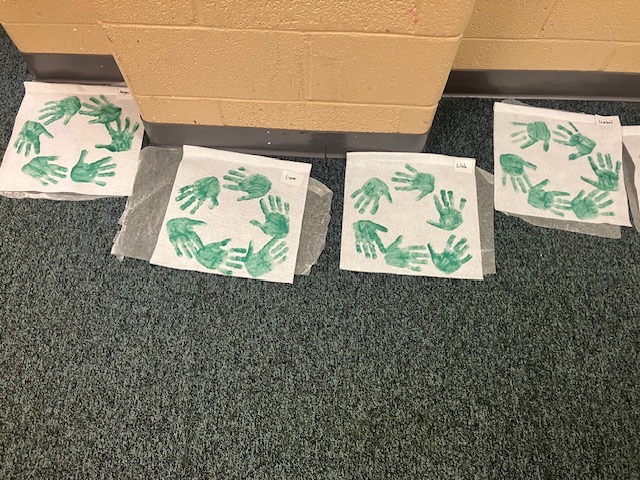
I walked through the Preschool wing, and in a couple of places recently completed student artwork was safely drying on the ancient hallway carpet.
Each square of paper featured the precious image of six green hand prints. The name of the student was taped in the upper right corner.
I’m sure capturing those priceless hand prints required careful planning and lots of instruction to ensure that the green paint didn’t coat the students and teachers. From what I saw, each piece was masterfully done with no stray smudges to detract from those irreplaceable hands.
These handprints will put a smile on the faces of parents. And who knows, maybe for just a moment those tiny fingers will push parents to pause in the chaos of Christmas. And just maybe in that quiet moment, parents will realize—time is flying, in a blink those hands will be grown.
As I gazed into the hand prints, I wondered what those hands might become. I hope they become good, compassionate, practical hands. Hands that can step back, assess, and determine—hey old world, this isn’t working, we must improve, our hands need to unite for the good of all.
Even though they are now grown, I suspect that somewhere in our old house, we might have the hand prints of our three children.
I can remember holding one of them. I sometimes felt a tiny hand patting my back. Maybe our children sensed that I am the world’s best worrier. It was like that little hand was saying—its ok Dad, things will get better.
Despite his sometimes prickly personality, Ted Williams, the former star hitter for the Boston Red Sox had a soft heart.
In Leigh Montville’s biography of Mr. Williams, the author relates a story from former Red Sox second baseman, Mike Andrews.
The famous slugger went to visit a kid who was dying. The kid grabbed one of Mr. Williams’ fingers and wouldn’t let go. Mr. Williams “pulled a cot next to him and slept there all night, the kid holding Ted’s finger.” (Montville page 345)
I wonder what pushed Mr. Williams to react in this manner?
I wonder how I would respond if I found myself in a similar situation?
Would I pull up a cot and hold that tiny finger?
The steam boiler fired up, the elevators passed inspection, and somehow our hands pulling together will guide us through Friday’s logistical needs.
And I’m thankful for the artwork hand prints I encountered this morning.
Maybe, those precious hands will help me to be better at living this quote from Maya Angelo: “I’ve learned that you shouldn’t go through life with a catcher’s mitt on both hands; you need to be able to throw something back.”
(Graphic design Paula Cadden, Kim Tingler, photos Bill Pike)
In Pat Conroy’s commencement address at The Citadel in 2001, he tells the cadets, “Listen up, I don’t have much time. They don’t give you much time for graduation speeches.”
Those of you here in the Sanctuary and anyone watching at home, listen up, they don’t give grumpy old geezers who volunteer to speak at a Thanksgiving Eve service much time.
For the next couple of hours, I want you, me, we, us to think a little bit about Ecclesiastes Chapter 3, but first let’s have a prayer.
Father of us all, I pray that you will be with us the next few minutes, touch our hearts as only you can. Amen. And before I say another word, one more important item—please remember— I’m not a theologian.
My first exposure to Ecclesiastes Chapter 3 came in December 1965. I was twelve years old. The American band, The Byrds, had released a song titled “Turn, Turn, Turn.”
In 1959, American folksinger, Pete Seeger, wrote “Turn, Turn, Turn” based on the scripture found in Ecclesiastes Chapter 3. The Byrds electric version of this song became a number one hit.
Luckily for you, I’m not going to attempt to play or sing the song.
But, I do want us to ponder the words in this famous chapter that starts with “For everything there is a season, and a time for every matter under heaven.”
On the afternoon of Friday, November 10, our house was in chaos. Before entering our home, I could almost feel the surging pulse of energy from the presence of our four grandchildren.
I stumbled over four pairs of shoes as I entered through the kitchen door.
The kitchen table was a snack disaster zone.
The normally tidy den and living room were littered with toys.
My wife, the Commander Supreme, their Nana, was hanging on for life, but enjoying every minute of this happy havoc.
But in just a blink the happy havoc was gone.
A footrace had erupted.
Excited feet pounded on the hardwood track rambling through the kitchen, den, dining room, and back to the living room, and then the crash occurred.
Ellie, the youngest, slipped. Her lower lip collided with the oak hardwood.
For the next several minutes, Ellie cried and sobbed as first aid was rendered. Eventually, comfort came from her tattered “purple,” her friendly thumb, and an Australian cartoon character—Bluey.
But, as Ecclesiastes Chapter 3 reminds us: “there is a time to weep.” And when your lower lip is injured, you have a right to weep.
When I left Trinity on the afternoon of Thursday, August 17, a few drops of rain pattered me as I walked to my car.
There were no severe thunderstorm watches or warnings posted by the National Weather Service for western Henrico County.
But, in just a blink, a short-lived, angry thunderstorm snapped two massive pine trees and a utility pole that came crashing down across Forest Avenue just below Tuckahoe Elementary School.
Ecclesiastes Chapter 3 reminds us: “there is a time to tear down.”
That same tempest snapped a limb from an oak tree in our neighbor’s yard. With great force, the limb landed on the service drop line that feeds power to our house.
About mid-morning on Friday, Dominion Power linemen were able to restore power to our home. I had to laugh as one of the linemen said, “in a matter of seconds mother nature can knock down a power line, but it takes us two hours to put the line back into service.”
Ecclesiastes Chapter 3 reminds us: “there is a time to laugh.”
In just a blink, on Wednesday, October 25 in Lewiston, Maine, forty year old, Robert Card, ended the lives of 18 people in a mass shooting that also injured 13.
As you might recall, Ecclesiastes Chapter 3 does state: “there is a time to die, and a time to kill.” Sadly, this is not how we want to die by being killed by an unstable person firing a firearm. I wonder if America will ever find the courage to address this endless, mindless violence?
I think one of the reasons I’m drawn to Ecclesiastes Chapter Three is the very real human qualities of its words. We know these words. They are familiar to us.
And despite our acquaintance with these words, I believe we struggle with some of them. Why is it so difficult for us to heal, love, and mend?
By contrast, why does it appear to be so easy for us to hate, kill, and declare war?
Look at these conflicts, the wars with Russia-Ukraine, Israel-Palestine, and Sudan. Don’t we want to be better than this?
Sometimes, I wonder—are we capable of being better than this?
The suggested gospel reading from the Lectionary for Thanksgiving Day was Luke Chapter 17 verses 11-19.
What’s remaining of my non-theological brain believes this is a misguided scripture selection for Thanksgiving.
It is the story of the ten lepers that Jesus encounters as he traveled the region between Samaria and Galilee.
As he enters a village, Jesus is approached by ten lepers. They keep their distance, but they shout out to him: “Jesus, Master, have mercy on us!”
And in just a blink, Jesus says to them: “Go and show yourselves to the priests.” And as they went, they were made clean.
From that group of ten men, only one, who realizes that he has been healed returns to praise God and thank Jesus.
This man was a Samaritan.
And Jesus responds with the following:
Then Jesus asked, “Were not ten made clean? But the other nine, where are they?
Was none of them found to return and give praise to God except this foreigner?”
Then he said to him, “Get up and go on your way; your faith has made you well.”
Tomorrow is Thanksgiving, maybe this scripture is not misplaced, and here’s why.
I find myself asking two questions—how thankful am I for my blessings, and am I no different from the nine lepers who didn’t return to thank Jesus?
It only takes a blink to say thank you.
How often do I use that blink to say thank you?
But here is the real question for me, and who knows, maybe it is the same question for you.
In just a blink, Jesus heals ten men with leprosy.
Where was Jesus when Robert Card went on his shooting rampage in Lewiston, Maine?
Where was Jesus in Ukraine, Russia, Israel, Palestine, and Sudan when these wars started?
The Bible, theologians, preachers tell us— Jesus is coming again.
And I want to say to Jesus, get down here now.
We need you.
But then, I think—why in the world would Jesus want to come down here to this mess we have created.
As God and Jesus look down upon us, I wonder what they are thinking.
Are they thinking, where did we go wrong?
God says to Jesus, “Where are these so called people of faith when we need them the most? Don’t they realize that you and I can’t do it all?”
God continues, “I’m becoming more and more impatient, let’s end this misery now and start over.”
Jesus looks at his father and says, “let’s give them more time.”
Jesus continues, “I’ve been reviewing recent angel compiled data, and I found some signs of hope. Some of our faithful are shedding their silence and speaking out.”
Remember in Ecclesiastes Chapter 3, the verse about “ a time to throw away stones and a time to gather stones together?”
With his persistence and perseverance, attorney Bryan Stevenson has become one of our best stone catchers at the Equal Justice Initiative.
In his book Just Mercy, Mr. Stevenson describes how we have allowed our self-righteousness, fear, and anger to hurl stones at the people who fall down, even when we know we should forgive or show compassion.” (Just Mercy page 309)
With her courage and compassion for the underdogs, author Beth Macy through her books Dopesick and Raising Lazarus has exposed the opioid crisis.
Thanks to the Lara Teague Curry Memorial 5K, even the cantankerous, whiner Bill Pike wears a wrist band that states—“Be Kind.”
And at the Trinity Preschool students in Mrs. Castro’s class filled with food one of the one hundred Thanksgiving bags for the Sherbourne Food Pantry.
Yes, there is hope—“For everything there is a season, and a time for every matter under heaven.”
In just a blink, tomorrow is Thanksgiving.
I love Thanksgiving.
But, unfortunately, we impatient Americans are more loyal to seasonal retail mantras. We sprint from Halloween to Christmas and hurdle over Thanksgiving.
“Over the river and through the woods” has become a gallop to Black Friday sales.
Back on September 3, I thought I was going to have a Walter Mitty moment at Lowes.
It was 96 degrees outside, and I came upon a display of fully lit Christmas trees.
I was powerfully tempted to go purchase some chains and padlocks, and chain myself to one of those Christmas trees. Then I would start shouting—“take them down, take them down, take them down.”
But, in just a blink, reality returned.
Despite loving me and my many imperfections for forty eight years, my wife would not have bailed me out of jail for my civil disobedience.
And in just a blink, Advent and Christmas arrive.
At Trinity, our Advent theme for this Christmas is It Is Time.
In Leigh Montville’s biography of Ted Williams, the author captures Ted’s passion for fishing.
An aging Ted Williams, in the summer of 1993 makes his last fishing trip to his beloved Miramichi (mere ah me she) River in New Brunswick, Canada.
Mr. Williams states, “The greatest experience a fisherman can have is to hook an Atlantic Salmon. There is nothing else in angling like it. One word tells it all—anticipation! One word—anticipation!”
For you, me, we, us—Christmas is all about our passionate anticipation of its arrival.
Christmas is suppose to be our greatest catch.
But, in just a blink, Christmas will be gone, and we shove it back to wherever we store it.
“For everything there is a season, and a time for every matter under heaven.”
When Pat Conroy made his commencement speech at The Citadel one of the last things he told the cadets was this: “I want you to know how swift time is, and there is nothing as swift, a heartbeat, an eye blink. This is the way life is. It is the only great surprise in life.”
Pat Conroy’s wisdom about time and living is correct.
This past June, I turned seventy.
I don’t have much time left.
In just a blink, I’ll be gone.
But, before I blink out, I need a favor from you.
It is time for you, me, we, us to commit to Ecclesiastes Chapter 3.
As God and Jesus look down upon us, they need us to take the lead in helping our neighborhood, county, city, state, America, and this old world to heal, mend, and love our way to peace.
“For everything there is a season, and a time for every matter under heaven.”
Don’t waste another blink.
It is time.
Author’s note: On the evening of Wednesday, November 22, 2023, I had the privilege of being the speaker for the Thanksgiving Eve Service at Trinity United Methodist Church in Richmond, Virginia. My message is titled In Just A Blink. I hope you have a good Thanksgiving.
Over the last couple of years, I have come to realize that time is flying by me.
How else can I explain that we are five days into November.
America’s most overlooked holiday, Thanksgiving, will be here in eighteen days.
And out on US 360 east near Burkeville, Virginia, the Country Basket at Sunny Slope Orchard will be shutting down for the season on November 15.
On our drives back from visiting our oldest daughter and her family in Summerfield, North Carolina, the Country Basket has become a regular stop for my wife and me.
In the late spring, we stop for strawberries, summer— peaches and assorted vegetables, and fall— apples and sweet potatoes.
The manager/owner, Jonathan, understands the importance of quality customer service, and he knows the story behind every fruit and vegetable he sells.
My guess is wherever you live, you might have a Country Basket, or a farmer’s market that you frequent. To me, there is nothing like the crunch of a fresh apple and the baked richness found in a sweet potato.
On Saturday, November 4, we stopped at the Country Basket. I pried my stiff body out of the car. Slowly, I walked over to the worn, but steadfast building.
Except for baskets of Pink Lady apples and a couple of large wooden crates holding soil coated sweet potatoes, the small store was almost bare. This was a sharp contrast to the peak of the seasonal harvests that farmers and their families put their hearts and souls into for us.
I grabbed a bag, and picked out some sweet potatoes from one of the crates. The chalky dust from the soil where the potatoes were grown stuck to my fingers.
I picked up a small basket of Pink Ladies with their skin of green and red hues. I wonder what a paint namer might call these nature created colors—maybe checker board red or tarty green.
As I checked out, I asked Jonathan if this year of selling had been a good one, and he acknowledged that it had been.
I asked what he does during the off season.
He quickly responded, “I’m going to sleep for two weeks.” But then he added, “I do tax work during the off season.”
I know from my college friend, Dan Callow, how hectic tax season can be for an accountant. I imagine Jonathan will need another two weeks of sleep after filing all those income tax forms.
I thanked him for being here on our drives back to Richmond, and walked back to the car.
On the drive back, my mind wandered to Monday, October 30. That’s when the church office was notified of the unexpected death of Mike Eunice.
Mike and his wife, Ridley, were at their river home. On this beautiful October morning, Mike was mowing the yard. He collapsed and died. Mike’s seasons of living had come to an end.
Deep inside, I was crushed. Mike was only 79. He still had lots of life to give to this old world.
Over the years, I had gotten to know Mike. I have never forgotten his mission moment when he shared with our congregation his experiences from a mission trip grounded in home repairs. That was Mike’s forte—anything related to building.
Mike was one of our Trustees for the church. He had a curious heart and inquisitive eyes related to Trustee projects. This past summer, he led the installation of new cabinets in the Welcome Center.
He found the best price on the cabinets, and coordinated the delivery. With his friend, David Priest, one of his partners in the aptly named Pro Bono Construction, the basic installation was completed with professional precision. And, Mike carefully oversaw the selection and challenging placement of the countertop too.
In working with Mike, it was very clear that he was a people person. Mike was connected.
When we needed a pew resized from the renovation of our Chapel, Mike knew the right carpenter to call. In a matter of minutes, this master craftsman had made the difficult cut.
The completion of these projects put a smile on Mike’s face and heart.
If you are a people connector, that means a person is willing to give of their time to others, and that was part of Mike’s make up.
A couple of years ago, Mike took the time to meet with me and a roofing contractor. The roof at our house needed replacement. Mike’s experience and expertise guided my wife and me through that process.
And in Mike’s quiet, humbleness, he served our country as an Air Force Captain during the Vietnam War. At some point during his time in southeast Asia, Mike was awarded the Bronze Star Medal.
Hopefully, next spring, Jonathan will reopen the Country Basket. With a bit of luck, the quiet fields of the farmers will slowly come back to life, and the bins at the store front will be replenished with fruit and vegetables.
We never know when our season of living in this crazy old world will come to an end.
Yes, Mike’s heart gave out on him.
But, I’ll never forget how his heart gave to me and countless others in his season of living.
Just before 6:30 on the morning of Wednesday, October 18, I took a phone call. A neighbor was calling from the back parking lot of our church.
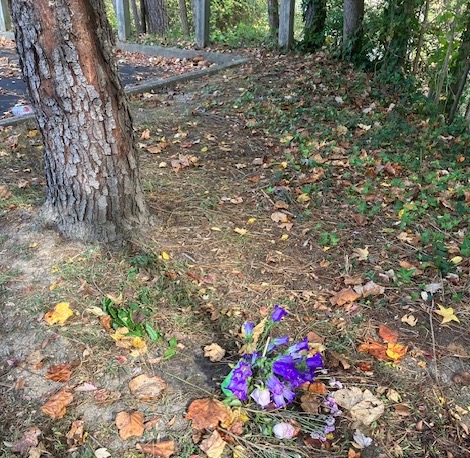
Our neighbor is an early morning walker. She has a circuit that wraps through our church property. She had unsettling news. Police officers were on site. Sadly, the officers were working a death by suicide.
I was dishearten to learn this news. Our neighbor was also calling on behalf of the police. She had informed them that she works in the church’s preschool, and the officers asked if the church staff might be able to coordinate the cleanup. My response was yes, and I told her I was on the way.
I grabbed my backpack and made the two block drive to church. I parked and walked to the section of the lot where the officers were located.
An officer greeted me. Then a detective came over. The detective explained that the self-inflicted wound left quite a pool of blood under a limbed up evergreen tree. The officers didn’t want the blood to trigger more unease for anyone who might discover it. I told the detective that I would do the required cleanup.
Many years ago when I was an assistant principal at a large high school in Henrico County, Virginia, I remember all faculty and staff attending a workshop on blood borne pathogens.
Part of that training required that we all had on our person or in close proximity, the proper gloves to wear in case we were exposed to blood from an accident, sport injury, or a couple of students involved in a fight.
We also learned the required protocols for cleaning up a blood incident. Our building caretakers were excellent in following those procedures.
I’m not good around blood. I struggle when blood is drawn from my arm at the doctor’s office. At a very early age our son had significant surgery. When the nurses brought him into the recovery room, I had to walk out.
After the police departed, I located the blood and devised a plan. I decided to take the the church’s pick up truck and use it to carry buckets of hot water to the site. In a couple of buckets, I added a light dose of bleach.
From the church’s kitchen, I filled the buckets, loaded them on the back of the truck, and then drove slowly to the evergreen tree. In the path of the headlights, I carefully walked each bucket to the spot, and gently tilted the bucket over. Steam rose from the buckets in the cool morning air, and the slight slope of the land allowed the water to do its work.
I made several trips, and between the headlights and the increasing sunlight the area under the evergreen improved.
At some point, I let our senior pastor know what had taken place. I also called my wife. Sadly, our family knows death by suicide. Many years ago, my wife lost her oldest sister. I don’t think the rawness of that news ever left my wife’s parents.
Since Wednesday morning, I’ve thought about how I was asked to assist. But in truth, I’ve thought more about the person’s family. I wonder how they are holding up? I wonder what they need? And I know, they will spend the rest of their lives wondering what they might have done differently.
Despite an increased awareness about the importance of mental health and suicide prevention, the Centers for Disease Control and Prevention reported 48,183 Americans died by suicide in 2021.
And yet, in that disheartening number, I look for pockets of hope.
Thanks to the FCC, 988 has been designated as the nationwide number for Mental Health Crisis and Suicide Prevention, and in August 2023 the US Department of Health and Human Services allocated $64 million in grants to fund mental health services. Even with this progress, we still have discouraging reports of long wait times for appointments and a shortage of qualified mental health practitioners.
In Jackson Browne’s song “Bright Baby Blues” he writes: “No matter how fast I run, I can never seem to get away from me.”
I’m no mental health expert, but I think a person who is contemplating suicide might fit into those lyrics. No matter how hard the person has worked to confront the demons of darkness, the person just can’t seem to get away and find the needed stability.
I wear two wristbands on my right wrist. One of them has the words “Be Kind” printed on it.
In the time I have left in this old world, I need to become better at being kind to people.
Perhaps, this unattributable quote says it best: “Be kind, for everyone you meet is fighting a hard battle.”
Author’s note: Let me be honest, I miss the daily arrival of a hard copy of the Richmond Times-Dispatch to our house. Any number of my friends have acknowledged—there is nothing like holding the daily newspaper in our hands. I agree. But because of subscription price increases and reduction in newspaper staff, we stopped our home delivery. We now receive the paper in a digital format. Included here are two letters to the editor that I submitted to the Richmond Times-Dispatch. Neither was accepted for publication, and I’m fine with that. But, I still remain disappointed that the Times-Dispatch, and perhaps other local newspapers are not properly reporting to their remaining readers the stories of the challenges they face in publishing a paper everyday. Bill Pike
Sunday, October 1, 2023
In October 2021, my wife and I stopped our subscription and the home delivery of the Richmond Times-Dispatch. We switched to an E-edition. I have not adjusted to this change. I absolutely despise trying to read the Times-Dispatch in this format.
Because of this change, I’m a less informed member of the Richmond community. I barely skim the paper. Rarely do I go back for an in-depth reading of an article that caught my attention. I have missed the obituaries of cherished colleagues because of my stubbornness.
I’m sure running a newspaper today is a challenge. In June 2022, the Medill School of Journalism at Northwestern University reported that two newspapers per week in America shutdown. When a local newspaper shuts its doors, a “news desert” is created. This can lead to communities receiving no local news or inaccurate reporting of important stories.
In March 2020, Lee Enterprises acquired the Richmond Times-Dispatch. Declines in readership, revenue, and cuts in staff had already impacted the paper. Clearly, I’m no expert on the running of a newspaper, but I believe Lee Enterprises is focused on one thing—turning a profit.
Times-Dispatch readers might be surprised to note during one month how many advertisements appear in the A section of the newspaper compared to the number of Letters to the Editor. The advertisements trounce the letters.
With Lee Enterprises, I sense a significant shortcoming to the readers of the Times-Dispatch is the newspaper’s inability to report its own untold story.
The Times-Dispatch regularly peers into the lives of the people in our community for stories. Shouldn’t loyal readers expect the same introspective journalism into the daily operation of its newspaper?
Bill Pike Henrico County, Virginia
Wednesday, October 25, 2023
With great interest I read the following headline in the Sunday, October 22 edition of the Richmond Times-Dispatch: The Times-Dispatch launching Reader Advisory Board. Several thoughts ran through my mind as I pondered the headline—about time, too little too late, and a silent chuckle.
Newspapers have become comatose dinosaurs in America. In June 2022, the Medill School of Journalism at Northwestern University reported that two newspapers per week in America shutdown. In their shift away from hard copy to on-line versions, newspapers have left a trail of disgruntled former loyal readers. I’m one of those displeased readers.
October 2021, my wife and I stopped our subscription and the home delivery of the Times-Dispatch. We switched to an E-edition. I have not adjusted to this change. I absolutely despise trying to read the Times-Dispatch in this format.
The Times-Dispatch is owned by Lee Enterprises. From my perspective, today’s newspaper owners are driven by one thing—money, turning a profit. How else do you explain the significant reduction in newspaper staff and the elimination of cherished local features in the paper.
This money driven dysfunction comes at a time when our communities need more than ever dedicated, honorable journalists reporting the facts, not misinformation.
What is even more disconcerting to me is the Times-Dispatch’s inability to report to its remaining readers the paper’s own internal struggle to keep publishing. Style Weekly and Axios Richmond have done a better job of reporting this story.
Editor Coates is correct “Great story ideas are the lifeblood of any strong news organization.” Clearly, Richmond has many story possibilities.
But there is another critical “lifeblood” piece to writing those stories—journalists. Has the Lee Enterprises’ scalpel in newsrooms made the coverage of new story pursuits unachievable?
Bill Pike Henrico County, Virginia
Photo by Bill Pike from a copy of the paper that I purchased.
To tell you the truth, I don’t remember the last time I slept in. I’m not sure my old body has that concept in its metabolism.
On Sunday, October 15, I’m up early in Summerfield, North Carolina. Our oldest daughter, her husband, their two children, and my boss, the Commander Supreme, are sleeping.
I’m quietly working to carry out my plan to take a run on the Atlantic and Yadkin Greenway. The now asphalt path was once a part of the Atlantic-Yadkin Railway. Just after sunrise, I’m going to drive to the trail head and park in a small lot off Strawberry Road.
This morning, I’m the first one to arrive in the parking lot. So, I carefully back my car into a space. I make sure I have the car key, and I walk a few steps to the start of the greenway.
I’m greeted by a bold red sign with this message—CAUTION: Rough Greenway Conditions Ahead. I didn’t let that warning deter me, but it wasn’t long before I understood the advisory.
(Photo by Bill Pike)
Sections of the asphalt surface were being prepared for a new paving. Every so often, the base asphalt was uneven, riveted with narrow ridges, and occasionally a shallow pothole. In these sections, I took extra care to watch where my feet landed.
Early on, the Greenway has a wooden timbered foot bridge that takes me across Lake Brandt. I catch a quick glimpse of a spectacular splash of sunrise color before the tree line blocks my view.
Squirrels dart along the underbrush. At about knee height, low flying birds quietly crisscross the path.
Further up, in a singular pond off to my left, a startled Blue Heron awkwardly leaves the shallows. With a few flaps of its long wings, the Heron finds its graceful stability, and flies off to find another silent shoreline faraway from an ungraceful old runner.
I encounter a few singular runners and dog walkers. The greenway twists and turns in some sections including a few inclines tossed in just to keep runners honest. Courtesy of October’s cooler temperatures and a fading warm sun, in a few spots, my shoes rustle through a thin layer of leaves.
At about seventeen minutes out, the Greenway merges into a street. Not wanting to explore, I retrace my steps back to the Strawberry Road lot.
On early morning runs, I do something dangerous—I think.
This morning, I keep thinking about the words on the caution sign—rough greenway conditions ahead. I think those words could apply to our daily living too. Caution—rough human conditions ahead.
Right now, it doesn’t matter your news feed, the headlines are discouraging with Israel and Palestine dominating our daily updates followed closely by Russia and Ukraine.
I am no historian or theologian, but I think it is safe to say the world has always had a caution sign warning us about rough conditions ahead.
No matter how hard we might try, peace is absent.
Why is that?
Is it because we are incapable of letting go of our differences and offering love instead of conflict?
Some days, I wonder why God doesn’t say to himself: “Ok, this is it. I’ve had enough, I’m going to put Earth out of its misery—kaboom, and we’re gone.”
As frustrated as God and Jesus must be with us, perhaps they are hoping that you, me, we, us will finally wake up and apply these words to every lingering conflict in the world, America, Virginia, Richmond, Henrico, and Trinity—“love your neighbor as yourself.”
Just before three o’clock on the afternoon of Thursday, October 12, the Commander Supreme started our drive to Summerfield, North Carolina. We were heading to our oldest daughter’s home.
On Friday, October 13, we would be attending Viking Day at Summerfield Elementary School. Our grandchildren, Caroline and Hudson, would be participating in this fall field day. Caroline, a second grader, and Hudson, a kindergarten student had morning time slots.
We arrived at the designated time and watched as the second graders entered the dew soaked playing field attired in the matching bright green t-shirts. The school’s physical education teacher had coordinated six different activities for the students to enjoy, and from what I saw they were all good listeners, and they had fun.
A gap of time was in the schedule before the kindergarten classes came out on to the field, so the Commander and I ran a couple of family errands. We made it back in time to watch the kindergarten classes enter the field sporting their bright orange t-shirts. Again, they were good listeners, and the students received good guidance from parent volunteers and faculty members about each activity.
I loved watching their energy at each activity, but I think my favorite stop was the plumber’s plunger toss. Students had to toss the plunger toward a large square with a circle in the middle. The goal was to get your plunger to land in the circle upright.
Our grandson, Hudson, is a lefty. To me, I think lefties have a different touch with tossing objects. Hudson didn’t get his plunger to land upright in the circle, but he did coax his plunger to landing upright in the square.
We said our goodbyes, and we drove back to the house. From about noon until late in the afternoon, we did chores in the front yard. But, there were some good breaks worked into the afternoon when Caroline and Hudson came home from school.
At some point, the Commander put aside her work gloves, and played with Caroline. All things Barbie were on the agenda.
Hudson wanted to play catch. So, we set up on a section of the driveway. Hudson had his glove and a tennis ball. I tossed him slow rollers, grounders that bounced, and pop flies.
Eventually, Hudson let me return to the yard work, but soon he came back. This time, Hudson wanted to set up the front yard with bases, and he wanted me to pitch to him.
I pitched, he hit, and ran the bases. Sometimes, an imaginary ghost runner would be stranded on first, second, or third while Hudson went back to bat.
No matter what pitch I threw, Hudson was able to hit the ball. He scored a bunch of runs before I was able to accumulate three tough outs. Now, I could bat, and attempt to catch up.
I scored a few runs, but I never could catch up. The Summerfield Pirates stomped the Richmond Snuggy Bugs.
We stopped in time so that I could take a shower before we went out to dinner.
On Saturday morning, heavy rain showers drenched Oscar Court Field. All baseball games and groundwork were paused.
My sister, Lisa, drove over from Snow Camp in Alamance County. We had a good visit with her. Hudson hustled some of his artwork on Lisa, and Caroline painted Lisa’s nails.
After Lisa’s visit, we headed out in the rain dampness to run some errands. By early afternoon, the rain had moved out, and partly sunny skies had arrived.
I was back at the yard work, and our son-in-law, Doug, was checking his infrastructure to prepare for setting up a few Halloween inflatables.
Hudson came out and helped with some raking of ground cover and shrub clippings, and then he asked for more baseball time.
Once again, he was hitting that tennis ball all over the front yard, and hustling to the bases after his old grandpa couldn’t move quick enough to snag an easy out. We took a short break, and I returned to my yard chores.
I knew that I was going to run out of time as neighbors and their two boys were coming over for dinner. Before I knew, Colton and Cooper had joined Hudson, and even Caroline took a couple of swings at the ball.
Let’s just leave at this—those kids pounded me. That tennis ball travelled all over the front yard. Hard grounders, line drives, and balls hit in the natural green monster consisting of four broad and tall holly shrubs. Finally, I called time, this humiliation needed closure.
For the next few minutes, I tackled an annoying patch of weeds, and I thought about the three boys and Caroline. There could not have been a better way to spend a pretty October afternoon.
These youngsters laughed at my lousy humor. They were polite. They listened. I think they had fun, but I don’t think they know how much fun I had.
Oh, how I love October.
You are my favorite month of the year.
And this afternoon, on the Oscar Court Field, October you added to my admiration.







 might be baloney