Veterans Day 2024: “humility”

I did not serve my country in military service.

Yet, for many years, I have developed a deep respect for our Veterans.

If I notice an older gentleman wearing a hat proclaiming their service in a branch of our military, I make a point of stopping to thank this man for his dedication.

In those brief seconds, the response is a humble smile and thank you.

I also note license plates that indicate a range of links to serving in the military. If I see Bronze Star or Purple Heart, I’m curious about the story behind this recognition.

With a Veteran, there is always a story. Quite often, the Veteran has little desire to share those stories.

My mother’s brother, Sam, was a tail gunner in World II. He was assigned to a bomber, the B-24. I was never allowed to ask Sam anything about his military time. I’ve read enough historical accounts about what those bombing missions were like to understand the reluctance to talk about those perilous flights over enemy territory.

This past year, I had the privilege to make a second visit to Pearl Harbor and the National Memorial Cemetery of the Pacific at the Punchbowl in Honolulu, Hawaii. Both places put into perspective, the horrors of war.

Additionally in May, my wife and I on our visit to New Orleans spent a day exploring and learning at the National World War II Museum. Every square inch of this museum was worthy of our time.

This quote from Private First Class Harry Parley, 116th Infantry Regiment, U. S. 29th Division caught my attention about D-Day and Omaha Beach: “As our boat touched sand and the ramp went down, I became a visitor to hell. I shut everything out and concentrated on following the men in front of me down the ramp and into the water.”

I can’t imagine the hell these young men experienced.

In July, I and three pals from college traveled to Oshkosh, Wisconsin for the Experimental Aircraft Association annual air show and convention.

If you like airplanes, this is where you want to be. If it has wings and an engine, chances are that plane will be at Oshkosh. Annually, the airfields host 600,000 visitors and10,000 airplanes.

Many organizations and private individuals have worked diligently to restore and maintain planes from the World War II era.

One morning at breakfast, my friend Dan Callow and I had the privilege of talking with two of the Veterans who were part of the crew for one of the two B-29 bombers at the show. You might recall that the B-29 was the plane used to drop the atomic bomb on Japan.

I could have stayed for hours and peppered those two Veterans about their experiences flying the B-29. Knowing they had a full day of activities ahead of them, we thanked them for their service, and wished them well.

As respectful and appreciative as I am of our Veterans, I know many of them face challenges in their current day to day living.

For example, “the U.S. Department of Housing and Urban Development(HUD) estimates that 40,056 Veterans are homeless on any given night. Only 7% of the general population can claim veteran status, but nearly 13% of the homeless adult population are veterans.” (National Coalition for Homeless Veterans)

Mental health is another concern for Veterans.

Consider this data from an article appearing in The Conversation on November 7, 2024: “America’s military veterans make up about 6% of the adult population, but account for about 20% of all suicides. That means that each day, about 18 Veterans will die by suicide. In the U.S., the overall rate of suicide has largely increased since the start of the millennium, but Veterans are disproportionately represented among this tragic trend.”

Homelessness and death by suicide lead me to this quote from James Bradley’s book Flyboys.

Veteran Rowdy Dow, who was a gunner in a torpedo bomber, told author Bradley the following: “If we had given in to our fears, we wouldn’t have won that war. There were no replacements out there. Our country was depending on us and we were all ready to die for our country. There was a job to do. We did it.”

I’m not sure about your feelings, but I feel we have an obligation to support and take care of our Veterans. They were willing to die for America. They did their jobs. Why can’t we be better in meeting their housing and mental health needs?

I’m one lucky man.

Because of the sacrifices of the women and men who have served our country, I’ve been able to freely travel to Honolulu, New Orleans, and Oshkosh.

I cherish those trips with family and friends.

But since returning from New Orleans, I periodically go back and look at photos I took while at the National World War II Museum.

Inscribed on a large cut piece of stone, I keep coming back to this quote from Dwight Eisenhower: “Humility must always be the portion of any man who receives acclaim earned in the blood of his followers and the sacrifices of his friends.”

Statue of General Eisenhower at the National World War II Museum (Photo Bill Pike)

On this Veterans Day, and those in the years ahead, I pray we will never forget the humble humility of the countless sacrifices made by our Veterans to preserve our freedoms.

Too frequently and foolishly, we take these sacrifices and our freedoms for granted.

You, me, we, us can’t disregard humility.

“Humility must always be” an essential “portion” of our character.

Leaders who lack humility are blind to the struggles of real life.

And one last gentle reminder—any day is a good day to stop and thank our Veterans.

The B-29 bomber “Fifi” on the tarmac at Oshkosh Air Show July 2024 (Photo Bill Pike)

No fur, feathers, or fins

At 2227 West Front Street, in Burlington, fur, feathers, and fins were scarce. In our household, when my sister and I were growing up, we had no long term pets.

That absence was a holdover from when our parents were growing up. For my mother, it was surviving a journey from Mississippi to North Carolina after her father deserted his wife and their three children.

My father’s family was a different type of survival. He was one of ten children whose parents miraculously made a living as tenant farmers in Alamance and Guilford counties.

I sense shelter, food, and clothing were the essentials that my grandparents held as a priority for their children, not kittens and puppies.

Yes, I do remember short timers on West Front Street. From the circus at the Greensboro Coliseum, my father purchased me a small turtle.

At some point, I had a chameleon. I kept him in a homemade terrarium in a shoebox. Once I pinched the tip of his tail with the top. My mother told me the tip would grow back. I think the chameleon died before the tip returned.

One spring, a handcrafted cage arrived in the backyard. A few days later, my sister was the proud owner of white rabbit.

Then there was a day when the bunny slipped out of the cage while being fed. In the uncertain chaos that followed, lots of coaxing took place to get the stubborn rabbit back into its home.

Neighbors around us had dogs. I remember Maverick, Brownie, and Penny.

A few times, I was the dog sitter for Brownie when our neighbors were out of town.

As it turns out, my sister and her husband who reside in Snow Camp are the animal lovers. My sister’s childhood love of horses continued. Over the years, she has owned and cared for several. Her knowledge and skills are impressive, and everyone of these beautiful horses has a story.

Chickens are a part of their farm landscape too. I’ve heard the stories about sly black snakes sleuthing for eggs, red tailed hawks skydiving on an unsuspecting hen, and the carnage left from a neighbor’s roaming dog who attacked when no one was at home.

My real introduction to pets came from my wife’s family. I still recall meeting their Cape Cod black lab, Joshua. What I took away from our first meeting was that Josh had more energy than anything powered by an Energizer battery. Josh exuded an exuberant excitement like greeting a long lost friend.

An aging Josh. (Photo courtesy of Ken Cloud)

Also, in this household was a huge black and white cat named Kiwi. During Christmas visits, the bedroom where my wife and I slept had a trundle bed. Unknown to me that trundle bed was a favorite sleeping place for Kiwi. One night, I woke to hear what sounded like human footsteps trudging across the carpet. I looked down to see Kiwi walking toward the bedroom door.

Turns out my father-in-law had a soft heart for all creatures. There might have been one exception to that affection, a beagle named George.

At some point during George’s tenure with the family, he thought it would be a good idea to urinate on my father-in-law’s foot. Not long after that irrigation, George found a new home with the milkman.

When my wife and I started our family, we occasionally had conversations about pets. From my childhood experience, I politely held to no dogs and cats. Goldfish and a few hermit crabs mingled with our three children during their youth. When our children asked about having a cat or dog, my standard line to them was “when you’re 21, out on your own, you can have whatever pet you want.” To this date, none of them have any pets.

Now, I don’t want you to think I’m an anti-pet person. I appreciate the joy pets bring into families. But, I’ve also seen the wear and tear. Veterinarian bills, putting a beloved family friend down when the cherished pet becomes incapacitated, and the hopeless fear when a pet goes missing and never returns.

Over the years, I’ve enjoyed hearing pet stories at the dinner table shared by friends and neighbors.

Our across the street neighbors, Barbara and David tell a good story about a former dog, Dwayne. Dwayne learned how to jump their backyard fence. He also knew how to navigate the city streets to where Barbara’s parents lived.

One day, Dwayne showed up at her parents house with two unopened packs of dinner rolls. Clever Dwayne figured out access to the dumpster at the A&P grocery store on the way.

Another neighbor tells the harrowing story of how a maintenance worker at the University of Richmond saved their cherish dog from drowning in the university’s lake. The dog had become entangled with a drain pipe.

Over the years, I’ve learned that pets are similar to humans. Sometimes, they just need a bit of attention.

Etched in my memory forever is a former neighbor’s yellow lab. On pretty fall afternoons, when I was in the heat of my annual battles with leaves, Zip would wander into our yard with his slobber covered tennis ball.

Zip wanted to play. He’d drop the ball at my feet. With my gloved hand, I’d pick it up and toss the worn ball a few yards away. Even though Zip was aging, he would scurry off and bring the ball back every time.

Despite pets never being a permanent part of my life, they offer something that has become a rarity in our often divided, impatient, and selfish world—loyalty.

That bond, that loyalty between a pet and its owner is “a sight to behold” as Gomer noted when admiring a car on the Andy Griffith Show.

From my no pets experience, I wonder if my take away is this—might our world improve if we could become more loyal to each other, especially on those days when everything goes wrong.

Author’s note: This piece was submitted to the essay contest for O. Henry magazine. I was notified today(11/6/24) that the piece didn’t make the cut. Internally, I knew these ramblings had no chance, but I enjoyed trying.

She still has hope

Let’s start with the confession. I have not read any of Doris Kearns Goodwin’s books.

But after attending the Weinstein-Rosenthal Forum on the evening of Monday, October 7 at the University of Richmond, before I croak I will read her books.

Author Goodwin’s four books about “her guys”—Abraham Lincoln, Teddy Roosevelt, Franklin Roosevelt, and Lyndon Johnson have forever placed her as the extraordinary storyteller of the lives of these unique American presidents.

For over an hour, she handled every question from former University of Richmond president, Ed Ayers, who served as the moderator.

A fast talker, Mrs. Goodwin explained why her books have been so successful—she knows how to tell the stories that formed the lives of her subjects. She answered with transparency, grace, dignity, respect, humor, deep thought, and personal anecdotes about her focused research and writing on these presidents.

The Steven Spielberg movie, Lincoln, is based upon Goodwin’s book, The Political Genius of Abraham Lincoln. She took the audience on a brief, but insightful walk into how the movie was developed from a behind the scenes perspective.

Throughout the interview, Mrs. Goodwin gave the audience lots to ponder. She easily transitioned on topics from the past to the present.

She cited examples of leadership from each president. And it was very clear that each man possessed a dogged determination and endurance to lead America.


Without any hesitation, Mrs. Goodwin said that “empathy and humility” are essential leadership traits that are sorely absent in many of America’s political candidates today.

And despite the internal and world challenges that America now faces, Mrs. Goodwin still has hope for our country.

Her hope is grounded in her study of our history.

She reminded the audience that America persevered through the challenges of the Civil War, the Great Depression, World War II, our struggles with racial injustices and the Vietnam War.

I agree with Mrs. Goodwin that we persevered. However in my 71 years of living, I have never been so concerned about the internal instability of our imperfect America.

In the movie, Lincoln, there is an intense scene where President Lincoln is working to secure two votes for the 13th Amendment to abolish slavery.

Around a table, emotionally charged statements and questions are rapidly fired at him from Preston Blair, James Ashley, and Montgomery Blair.

In the midst of this verbal fury, Mr. Lincoln slams his hand down on the table. For a few seconds, the room becomes quiet.

Then, Mr. Lincoln launches his own passionate points countering their objections.

Screenwriter, Tony Kushner’s words in that scene are compelling. I’m reminded of America’s current political situation, when Mr. Lincoln states: “See what is before you, see the here and now, that’s the hardest thing, the only thing that accounts.”


Our empathy and humility have been blindsided by our political division. I fear we are incapable of seeing what is currently before us. Our ailment, our nonstop political bickering, prevents us from seeing the urgency of our here and now.

Why is it so hard for us to see that these political liabilities can potentially lead to a complete downfall of America?

Is this what we want for our children and grandchildren?

Monday night, I could hear in Mrs. Goodwin’s voice that hope has not departed her soul.

With hurricanes pounding our shores, a perilous November election rapidly approaching, and troubling turmoil throughout the world, it would be easy to abandon hope and let doom and gloom sink our hearts.

Yet, my old heart hopes that we, Americans, will do the hardest thing— regain our sight with empathy and humility so that we can see the “here and now of what is before us.”

Photo of program (Photo Bill Pike)

Sabbath: throwing away Jesus

If I read the Bible correctly, I should be dead.

Several times in the Bible especially in Exodus, the writer states: “For six days shall work be done, but the seventh day is a sabbath of solemn rest, holy to the Lord; whoever does any work on the sabbath day shall be put to death.” (Exodus 31:15).

In my 71 years of living, I have worked on many sabbaths/Sundays.

When I started working for our church, I worked on Sundays. I was responsible for opening and closing the building. That included the impossible interior climate control of temperatures. I say impossible because every church member has their own personal body thermostat.

In April of 2024, our church started an intense renovation project.

This project also had a tough completion deadline—August 23. Meeting this goal would allow our preschool to open on time.

Despite multiple internal “landmines” during the renovation, the contractor met the goal. I’m pretty sure God and his angels were sweating with us in those hectic final days.

In prepping for a renovation project, there is a monster lurking inside worn down church buildings. I call this beast— the catacombs clutter monster. From the top floor to the bowels of the basement, churches are experts in hoarding clutter.

Every storage room, every closet, every empty corner, every vacant room, backstage area, and mechanical room has clutter.

Congregations hoard this clutter because deep inside our personal catacombs, we believe that something from 1957 might find its way into service again in 2017. Sadly, we are resistant to clearing out clutter.

However, if this renovation was going to work, we had to remove the clutter.

Sometimes with complete transparency clutter landed in a dumpster.

Sometimes, the clutter found a good home outside the church’s walls.

Sometimes, a clandestine plan was developed, and clutter vanished into Richmond’s sweltering summer air.


Based upon the number of discarded coffee makers we found throughout our building, I’m certain the manufacturers of coffee makers love adult Sunday school classes. I imagine the Smithsonian could dedicate an entire exhibit to these hospitality contraptions.

And sometimes, there were exceptions to heaving items. Sorry, but my sympathetic heart would not allow me to callously toss multiple portraits of Jesus into a dumpster.

Fear factored into that decision.

Pinging in my conscience, I could hear the quivering questioning voice of an elderly widowed matriarch: “Where is that portrait of Jesus that my long gone Jimmy and I donated to the church in 1959?”

While I respect my elders, under the wrong set of circumstances, sweet looking matriarchs can become quite vicious.


Yet, as an imperfect Christian, many times in my life, I have thrown Jesus away.

I’m certain heavenly angels have a well-documented file of me tossing Jesus.

However, I think I could counter those heavenly defections by reflecting on the moments when despite a high degree of difficulty—Jesus didn’t toss me.

On this sabbath thing and getting rest, the Mayberry likeness of my youth in Burlington, North Carolina is basically dead and buried.

If I want a biscuit on Sunday morning, I can drive to a fast food chain and buy one.

If my car needs a windshield wiper, I can drive to an auto supply store and purchase one.

If I wanted to, I can even buy a new car on Sunday.

You get the idea, as a society we have already tossed the Sabbath. Sunday as a day of rest has vanished. Truthfully, declines in church attendance across America acknowledge that we are gradually tossing out Jesus too.

On the afternoon of Sunday, October 20, we held our fall festival on the grounds of our church. Contrary to Exodus 31:15, staff members, congregational volunteers, the technician who set up three bouncy houses, and the firefighters from Station #8 worked this event.

Several hundred people came out for this free happening of grilled hot dogs, bouncy houses, face painting, the gaga pit, a raffle, trunk or treat, a scavenger hunt in the pumpkin patch, and a fire truck.

Parents with their children in tow wandered through the displays. We depleted our supply of hotdogs, and every kid left with enough candy to make local dentist dream deliriously of dollars signs in the dazzling October sun.

Out of the blue, a young mother walked up to me. She asked me this thoughtful question: “How many times do you think children should be able to collect candy related to Halloween?”

I loved her question.

My answer was once, only on Halloween night.

Surprisingly, she agreed with me.

We talked further.

She made it clear that her family has not fallen into commercialization of Halloween. In other words, the front yard of their home hasn’t become a shrine for all things Halloween.

Additionally, we both bemoaned how Thanksgiving is becoming lost between the retail push for Halloween and Christmas.

At 5 p.m. this event will end. We’ll pat ourselves on the back about the size of the crowd.

Kindhearted volunteers will cleanup.

At some point they will all be gone.

I can secure the building, and go home.

I worked another Sabbath, and I’m still alive.

I haven’t been put to death yet.

Why is that?

Maybe, the answer is in an excerpt of an article that I recently read written by David Brooks in the July 26 volume of the The Week. Mr. Brooks wrote about “The secrets of late bloomers.”

When he was a lot younger, Mr. Brooks shares a question he asked of two of his mentors, William F. Buckley and Milton Friedman.

Mr. Brooks asked Buckley and Friedman, “if they ever felt completion, if they ever had a sense that they’d done their work and now they had crossed the finish line and could relax.”

Brooks wrote that he felt like “neither man even understood my question. They were never at rest, pushing for what they saw as a better society all the days of their lives.”

I am no scholar on Buckley and Friedman, but I was taken by Mr. Brooks’ concluding paragraph—“I’ve noticed this pattern again and again: Slow at the start, late bloomers are still sprinting during that final lap—they do not slow down as age brings decay. They are seeking. They are striving. They are in it with all their heart.”

Sabbath or no sabbath, my old heart isn’t ready to quit.

And while the good Lord might take me out tomorrow, I don’t think he wants you, me, we, us to quit.

Bloom late, don’t quit.

God and Jesus still need our hearts.

One of the multiple renderings of Jesus that I couldn’t toss. (Photo by Bill Pike)

Peeling back the layers

The renovation project at our church started in April of 2024.

This was an early start designed to give the HVAC contractor an edge in the preliminary work for the complicated new system.

That jump start also included the abatement company. Their personnel would be tearing out cantankerous ceilings, floors, and properly following safety protocols for anything with the dreaded “a” word—asbestos.

Exposed ceiling and new HVAC components (Photo Bill Pike)

A project with an extremely tight time line for a completion date needs every advantage related to how the clock ticks.

Despite a carefully designed plan by all participants, in an old building it is always the unexpected surprises that are found when the layers are peeled away.

Those unexpected surprises create heartburn. With this project, we had our share of days with high antacid intake.

At our home, I started a seemingly easy project—removing the paint on two exterior doors. Clearly, I guessed wrong on the degree of difficulty scale. Every swipe with the sander, and every rub with the chemical stripper revealed another coat of paint.

Peeling away the layers (Photo Bill Pike)

As of yesterday, the doors are finally bare enough for a coat of primer.

Almost ready (Photo Bill Pike)

Back in the summer, my wife traveled to Peoria, Illinois. She spent a few days visiting with two dear friends from high school—Leslie and Sarah.

Knowing that I like to read, Leslie’s husband, Dave, sent back a book for me. If Dave knew that I read books at the pace of a slug, he might not have given the book to Betsy to bring back to Richmond.

For several weeks, I’ve been plodding through The Hidden Life of Trees by Peter Wohlleben. Mr. Wohlleben is a German forester. Let me tell you—he knows his trees.

Also, let me tell you, trees might look simple in our day to day viewing of them, but trees are complicated. Beyond their bark, limbs, and leaves, trees are as complex and nuanced as our human bodies. Their resilience to weather, animals, and invaders of all types is amazing.

Even though I dread my annual battle with the fallen leaves in our yard, I love the month of October. At some point in October, we start to notice the green of our tree leaves changing into dazzling colors.
Yellow, orange, red, and assorted shades of brown like cocoa powder always capture my attention. Cast against a crisp blue sky there is nothing like an October daydream.

I wonder if Jesus was captured by October?

In his world was the changing of the seasons as significant as they are for us in the middle Atlantic states?

I wonder if pumpkins grew in the farmland that Jesus and his disciples passed as their feet carried from town to town?

I wonder what he might think about Halloween?

This is the time of the year when the pace of the remaining days of the calendar move quicker.

In a blink, January 2025 will be here.

With all that is swirling around in our chaotic world, there are days I wonder if we will still be here for the start of a new year?

On the evening of Monday, October 7, my wife and I attended the Weinstein-Rosenthal Forum at the University of Richmond. The forum is a focus on faith, ethics, and global society. The guest was Doris Kearns Goodwin. Mrs. Godwin is a writer, and author of books about four unique American presidents: Abraham Lincoln, Teddy Roosevelt, Franklin Roosevelt, and Lyndon Johnson.

In the course of answering questions, the moderator, former University of Richmond President, Ed Ayers, noted that Mrs. Goodwin still has hope in these turbulent times.

Mrs. Goodwin stated that her hope is found in our history. She noted that despite the difficulties America faced with the Civil War, the Great Depression, World War II, racial injustice, and the Vietnam War, we persevered.

It can be a challenge to peel back the layers of an old building, the internal workings of a tree, our history, and the pressure and stress of our day to day living.

Perhaps, the biggest challenge we face is peeling back the layers of our hearts.

For it is in our hearts where we wrestle with the layers of life.

We wrestle with everything in our hearts—good, bad, right, wrong, yes, no, family, friends, neighbors, and strangers.

Sometimes, it is our hearts that give us the resilience to persevere.

As we peel back the layers of our complicated hearts, my hope for you, me, we, us is that our hearts will help us to persevere with empathy and humility.

And I wonder during the course of a year, a month, a week, a day how often do I fail my heart when empathy and humility are absent in my living?

In those moments, I must nudge myself to remember the words from 1 Samuel 16:7. It’s not about peeling back the layers of my outward appearance. No, it’s all about what the Lord sees as he looks at my old heart.

At this stage of my life, I think I need to stop disappointing his heart.

On Wednesday mornings, my car still smells like pizza

Once a month, on a Wednesday morning, my car still smells like pizza.

That’s because on Sunday or Monday, I place an on-line order for pizzas.

Then on Tuesday afternoon, I drive over to Sparrow’s Pizza to pick them up. Sparrow’s Pizza is about the size of a matchbox.

Mr. Sparrow greets me as I walk in the door, and the pizzas are always ready. One of his friendly employees, usually a student from Virginia Commonwealth University, will carry the six boxes of pizza out to my car.

Once a month at WayGone Brewery, our church offers Pub Theology. The pizzas are a part of that gathering.

In 2016, we started this beyond the walls of the church offering at Ardent Craft Ales in Scotts Addition in Richmond.

At some point, COVID shut us down.

When COVID retreated, we brought Pub Theology back.

This time we met at Kindred Spirit Brewery in Goochland County. We met there for a year.

And when we learned that WayGone was going to open on Patterson Avenue in Henrico County, we reached out to the owners to see if they might be willing to let Pub Theology meet there. Fortunately for us, the owners were willing.

The idea for Pub Theology was stolen.

My family and I were in Snow Camp, North Carolina for Easter. We were staying at the home of my sister and her husband. On Friday and Saturday, we had been prepping for our traditional Pike family lunch gathering on Easter Sunday.

That Sunday morning, some of us were able to attend worship services at Haw River United Methodist Church.

In their packed sanctuary, the church’s minister welcomed everyone. She quickly talked about upcoming activities at the church. One program caught my ears. She invited the congregation to join her for Pints With The Pastor.

Pints With The Pastor took place at the Eddy Pub just across the Haw River from the church. The pastor billed the gathering as an opportunity to talk.

Intrigued, I brought the idea back to our church. Our senior pastor at the time, Larry Lenow, did his homework. He discovered that a pastor from the Midwest had authored a book, Pub Theology. The book was an accounting of conversations he had with people in assorted watering holes over the years.

When we launched Pub Theology at Ardent Craft Ales, our game plan was simple. Even today, we use the same template: the program is open to our congregation and anyone curious at the brewery, we offer pizza, ask for a five dollar donation toward offsetting the cost of the pizza, attendees are responsible for their beverage purchase, we eat and converse, and at the appropriate time, a staff member presents a topic for discussion.

In working with the brewery, they reserve us a meeting spot in the taproom. We always aim for Tuesday evenings. Tuesdays are usually a lighter day at craft breweries. Additionally, the brewery charges us no fee for the reserved space, and we promise not to strong-arm anyone about our church.

Because people have packed calendars, our attendance is a roller coaster. Some Tuesdays, we are below ten in attendance. Other times, we run out of pizza.

In our post-COVID revival of Pub Theology, our programs have been diverse. We’ve screened an episode of the Andy Griffith Show, discussed Bible verses with today’s headlines, pondered the lyrics of popular songs, discussed books, and interviewed special guests from our community.

Back on August 13, we had a special guest for our Community Conversation interview at Pub Theology. Our Bishop for the Virginia Conference of the United Methodist Church, Sue Haupert Johnson, joined us.

Over thirty people from our church attended. Bishop Sue was delightful. She even allowed me to buy her a beer. Who knows that might become a good working title for a country song— “Hey Preacher Let Me Buy You A Beer.”

One of the key pieces of our Pub Theology program has been the hospitality of the personnel at the brewery. No matter where we have met, the staff of each brewery has been outstanding. They have been accommodating and flexible.

And, I can say the same for our regulars who attend Pub Theology. If we’ve had some curious onlookers join us, our regulars have been quick to make them feel welcome.

I don’t know how much longer we will continue to offer Pub Theology.

And in truth, I’m not real clear on what keeps people coming back—maybe, its the scrumptious Sparrow’s pizza.

Perhaps, it is our program content. We work hard to present something different each month.

And yet, the more I ponder Pub Theology, I keep coming back to a couple of observations.

I sense people are drawn to the setting. At a craft brewery, they aren’t confined by the formality of church walls.

That informality allows our pub theologers to more deeply share in the conversations and discussions we have during the evening.

Ultimately, that sharing gives our hearts the opportunity to grow and learn.

And on those Wednesday mornings when the aroma of pizza lingers in my car, I travel back to Tuesday evening.

I think to myself— that was fun.

I probe further—why was it enjoyable?

Well, my takeaway is grounded in this: our shared fellowship, opens our hearts a bit, and when our hearts open, we learn about ourselves, but more importantly, our hearts learn from each other.

Those moments when our hearts share and learn are priceless in the chaos of today’s world.

Pizzas loaded for Pub Theology (Photo by Bill Pike)

Running in heavy air

I am no expert at running.

A long time ago, I subscribed to Runner’s World magazine. I never read the magazine in great detail. What I learned about running came from experiences and the wisdom of friends.

My friend, Bruce Bowen, a former successful Cross Country coach at Hermitage High School put together my training for the Richmond Marathon. It was a good plan. While I barely made it to the finish line, I would have never crossed that finish line without Bruce’s help.

I’m dreading the day when what’s left of my old body conveys to me, “Sorry, Bill, but the working parts of your body have decided that we can’t take you out for a run any more.”

When that day happens, my cherished early morning runs will end, and I expect I will cry.

Over the last few years, I’ve stopped running long distances. I keep enough of a base so that I could sign up and run a 5K, a mere 3.1 miles.

I look for 5Ks that support a good cause.

On the afternoon of Thursday, September 26, my Commander Supreme drove us out to the Hardywood Brewery in Goochland County. The Dominion Energy Charity Classic had a 6 p.m. start time.

With this 5K, individuals could sign up to run/walk for a favorite local nonprofit. I signed up to represent Home Again. I’m proud to say that Home Again finished third in the number of participants who signed up for the 5K. Home Again does good work in helping individuals overcome homelessness.

I rarely go for an afternoon run. I can only think of one other time when I ran in a 5K with a late afternoon start. But here I was in the starting area, awaiting instructions for the beginning of the race.

The Hardywood Brewery is a pretty site for the 5K. My architect friend, Rohn Price, and his team really did a nice job designing the facility and its grounds. The entire place is very user friendly.

I timed my entry into the start area so that I would not be waiting a long time for the beginning of the race. I was ready to go.

I had no concerns about what appeared to be a gently rolling course. No, my concern was the heavy air.

Just as the 5K was about to start, the dew point was 72 and the humidity 85%. That was some heavy, damp air for a run.

Right on time, we moved across the start line. The beginning is always sluggish as walkers and runners are maneuvering finding their space, stride, and pace.

Eventually, the course opens up, and I’m slogging along.

The course is a loop on the main road into the West Creek Business Park. Numerous Richmond based corporations have their headquarters on these pretty parcels of land. Well landscaped and maintained, the route has a natural flow to it.

With officers from the Goochland Sheriff’s department at key points on the route, participants don’t need to worry about a clueless driver intruding.

It doesn’t take long for my old body to respond to the heavy air. Within the first mile, I’m sweating. The further I go, the more I drip.

Some runners adjusted to this smothering air by doing a combination of running and walking. I’m managing my pace and trying not to let this wet blanket of air wear me down.

At the water stop, I do my usual routine: grab a cup, rinse out my dry mouth, and then I take a swallow of the water before tossing the cup into the trash can.

I keep pushing.

I pass the two mile sign.

It seems like I will never reach the three mile sign, but I do.

Seeing that sign, my old sack of bones silently cheers, and my legs push me up the hill toward the finish line.

After crossing the finish line, with hesitancy, I took the medal I was offered. All finishers received one.

I worked my way to a patio where the Commander was sitting at a table enjoying a glass of wine. I grabbed a cup and filled it up with water. She snapped a photo of me, and I sat down for a few minutes.

(Photo by Betsy Pike)

At the bottom of my bib number was a tear off strip. This strip entitled me to a free beer. So, I gingerly removed the strip and ordered a Farmhouse Pumpkin Ale.

Before leaving, we saw our church friend, Ashley Marshall. She talked about the challenges from the heavy water laden air too.

Then, the Commander and I started our walk back to the car.

There I covered my seat with a towel. Next, I peeled off my wet shirt and put on a dry one.

And, I thought to myself, “thanks old bones for getting me across the finish line.”

But, I also thought, thanks to Dominion Energy for putting together the 5K, and for the staff at Home Again, and all of their work with the homeless.

And I looked at me, and thought how lucky I am, we’re driving home to our house, and I’ve never been homeless.

Part II: More Water

Little did I know that another encounter with water would greet me on Friday morning at Trinity.

At 8:15, on Friday, September 27, I had to meet installers to finish window treatments for the nearly completed renovation project.

As I was walking down the brick sidewalk from the church office, I heard water, lots of water.

I looked to my right, and in the corner of the Bicentennial Garden, water was pouring out of a sprinkler system pipe.

I met the installers, got them into the building.

Then I hustled back to the gushing water. The water was a couple of inches deep in the rock boarder next to the foundation.

I learned a long time ago that water has a mind of its own. At this very moment, the water was gushing into two crawl space wells.

None of the shutoffs at the disconnected pipe were responding. I drenched myself thinking I could reconnect the pipe. I made a decision to shutdown the water from the street connection until I could get to the shutoff valve for the sprinkler system.

It took me a few tries, but I finally was able to shutdown the water. The flow at the dislodged pipe connection stopped.

Disconnected sprinkler pipe (Photo Bill Pike)

With some help from Chris Howell, a project manager from Century Construction, I was redirected to a new interior water shutoff valve. We put this valve into the off position, and I went back to the street connection and turned the water back on.


The new turnoff valve worked. No water flowed out of the disconnected sprinkler system pipe.

Next, I made preparations to enter the crawl space via the Trinity Hall mechanical room. I needed to locate the shutoff valve for the sprinkler system.

I took our building caretaker, Ronnie Johnson, with me to be my contact person in case the monsters from the crawl space abducted me.

Armed with a flashlight and pliers, I took the step up into the crawl space.

Of course, as I was inside the crawl, Ronnie reminded me that years ago, a raccoon was found in there. That was just the encouragement I needed.

For a while, I could stand with a slight crouch. Gradually, I had to switch to a crawl.

Soon, I came across an area where the water had cut an interior gulley into the orange, red clay. This was beneath the plastic vapor barrier. I kept going, and I had to scrunch lower to crawl under pipes.

With the help of the flashlight, I located the valve. I could also see the water’s entry points. The force of the water had cut another ravine parallel to the foundation wall. I pushed the valve’s lever into the off position.

Then, I headed back to my entry point. By the time I reached Ronnie, I was covered in orange mud and grit.

Out of the crawl space, we walked back to the new shutoff valve, and turned it back to the on position, I could hear the pressure of the water return.

With that on, we rechecked the dislodged pipe in the Bicentennial Garden, and there was good news—no water was flowing. The shutoff valve held.

Not wanting to make another mess, I opted to walk home to change out of the muddy and wet clothes.

I was aggravated at the pipe that had mysteriously come lose. I’m certain the county was going to enjoy this water billing. No telling how many hours the water had gushed unencumbered.

My whining continued as I considered how my plans for today had been derailed by a disconnected sprinkler pipe.

As I restarted my day, I learned that my water encounter was nothing compared to Americans who had been in the direct path of Hurricane Helene.

My family sent me a photo of homes in the mountains of North Carolina. All that could be seen were the rooftops of these homes. Muddy orange water was seen in every direction around them.

No matter where Helene touched, the storm created problems. Unfortunately, the problems created by Helene will take a long, long time to correct.

In times like this, I ask myself how can America be better prepared to work through these natural disasters? No matter how accurate our weather forecasting, it is the aftermath of the storm that makes life very, very difficult.

We invest billions and billions in the space program, and just as ridiculous we spend billions, billions, and billions trying to elect people into office who truly aren’t qualified to hold office.
And consequently, we continue to struggle improving the basics of our infrastructure when natural disasters smack us.

Years ago, when a hurricane impacted our Richmond neighborhood, I stumbled upon this Bible verse from 1 Kings 18:44: “At the seventh time he said, ‘Look, a little cloud no bigger than a person’s hand is rising out of the sea.’ Then he said, ‘Go and say to Ahab, “Harness your chariot and go down before the rain stops you.”’

Way out in the ocean, Helene started as a little cloud. All the right atmospheric conditions conspired to build a catastrophic storm. Its winds, storm surge, and buckets of rain stopped the daily routines of people from every walk of life.

Now, some are dead, some missing, some traumatized from the experience, and some no matter the support given will never recover from this hurricane.

My heavy air slog on Thursday evening, and my soaking on Friday morning from the disconnected sprinkler pipe are nothing in comparison to the hurricane experiences from Helene.

In the days ahead of us, we must nudge our hearts to be a part of this long term recovery.

We can’t let our fellow Americans down.

In his book, October 1964, David Halberstam references former Negro League baseball star, Buck O’Neil. Halberstam writes about O’Neil’s code of life: “He believed that there was almost nothing in life that could not be solved by hard work.” (October 64 pages 147-148)

Our fellow Americans need the hard work of our hearts.

We need to be like that “little cloud rising out of the sea.”

Our collective hard work must rise together to make a difference in the lives of every person in every state that was impacted by Helene.

They need us.

Now.

“I love you James”

My wife, the Commander Supreme, used her best logistical skills to plan our Sunday afternoon on September 15, 2024. This was for our trip to Wolf Trap National Park for the Performing Arts just outside of Vienna, Virginia.

She navigated purchasing the tickets on the lawn.

Researched the protocols for parking, seating, picnicking, lodging, and navigating the local streets to the Wolf Trap grounds.

Her timing for checking us into the hotel, departure time to the venue, and following the rules as we entered the amphitheater were impeccable. A naval admiral or army general would have been envious.

We even avoided the notoriously, naughty I-95 in our ride from Richmond to Vienna. Steadily, we traveled Virginia’s back highways and the historic U.S. 1. On a couple of occasions, we saw at overpasses the stalled traffic on I-95.

With the help of U.S. National Park rangers, we entered the proper line for lawn ticket holders like ourselves.

While waiting for the gates to open at 6:30 p.m. We were fortunate to have in front and behind us experienced Wolf Trap lawn ticket holders. No matter our question, their wisdom made our experience better. We both were impressed with their kindness and patience.

Their best advice was for us to split before entering the steeply grassed amphitheater. I was to secure a spot for us to sit, and the Commander was to rent two of the padded chairs with adjustable backs for our seating.

Our pre-entry coaching payed off. I found a suitable spot and quickly spread our picnic blanket. In a matter of minutes, I was directing the commander to my location. She found me, and with some teamwork, we conquered our chairs.

Settled into our seats, we people watched, and studied the venue. The stage appeared to be a million miles away. But in front of us, we had a supersized TV monitor for easy viewing of the stage.

(Photo by Bill Pike)

Gradually, we started paying attention to the delights of our picnic.

While we ate, we watched the staging of the entry of the ticket holders who would be sitting in the reserved seats under the covered pavilion.

About ten minutes to the eight o’clock start time, what sounded like a large bell was rung. This was a final nudge to everyone— find your seats. And while the perfection of starting exactly at eight was missed, when the lights dimmed, the crowd was largely seated.

My introduction to James Taylor was in 1968. I remember hearing the first single from his initial album on The Beatles’Apple Records. That song “Carolina In My Mind” launched Mr. Taylor’s successful career. I still remember the disc jockey stating that Mr. Taylor was from Chapel Hill.

The concert this evening started with a series of linked together video clips featuring Mr. Taylor performing the song “Something In The Way She Moves.” At some point, Mr. Taylor and his All Star Band took the stage, and the song transitions into a real time performance.

After completing this song, Mr. Taylor, who is an engaging storyteller, shared how he auditioned “Something In The Way She Moves” for George Harrison and Paul McCartney at the Apple Records headquarters. To this day, Mr. Taylor marvels at how he accomplished auditioning that song with two Beatles listening to him.

Mr. Taylor turned 76 in March. This was the final night of his summer tour. He and his band played three nights on the Wolf Trap stage. His voice was a bit hoarse at times. Yet, he still possess a powerful voice with the ability to carry lead vocals and blend nicely with three gifted backup singers.

Speaking of gifted, the musicians in the band are extraordinary masters in their own right. Each has a fascinating legacy and story in the music industry. Near the end of the second set, Mr. Taylor’s wife, Kim came out and joined the backup singers.

At some point during the show, Mr. Taylor spoke about the challenges of putting together the set list of songs for each concert. As a gifted songwriter, making the selections is a difficult task for him.

Making those choices is even more demanding because of his ability to create hit records by covering songs written by other songwriters like Carole King, Buddy Holly, and the exceptional Motown team of Holland-Dozier-Holland.

This concert featured songs for every fan of James Taylor.

Early in the first set, during a pause between songs, a lady in the reserved seats yelled out, “I love you James.”

Now, I’m not quoting Mr. Taylor’s follow-up verbatim, but he responded with something like this, “Well, thank you, I love you too.” But then he continued, “In this public setting, I also think that we should see other people.”

Mr. Taylor’s easy patter to his admiring fan made everyone in the audience affectionately chuckle.

At the close of the encore, Mr. Taylor thanked everyone again, and stated he hoped to come back next year, and then he and his band bowed and walked off stage.

Even if you are a mild follower of James Taylor, if you have the opportunity to hear him in concert, I would tell you don’t miss him.

As much as my old heart and ears enjoyed Mr. Taylor’s skills tonight, none of this would have been possible without the heart and vision of Catherine Filene Shouse.

In 1966, she donated the land and the funds to the United States government to build this stunning facility. This led Congress to declare the Wolf Trap Farm as the Wolf Trap National Park for the performing arts. For over fifty years, this stage has left audiences appreciative of the artistry of performers from all over the world. (Wolf Trap website)

I’m not sure I could tell you my favorite James Taylor song.

I’ve always loved this line of lyrics from his song “Fire and Rain”:
Won’t you look down upon me, Jesus,
You’ve got to help me make a stand,
You’ve just got to see me through another day.
My body’s aching and my time is at hand,
And I won’t make it any other way.

Some days, I look around and wonder who is going to help people make a stand and get them through another day?

Who gets to the people Jesus can’t get to?

I think the answer to that question is you, me, we, and us.

When the adoring fan shouted out “I love you James,” truth be told there are lots of people who love Mr. Taylor’s music. Clearly, his work has touched many hearts.

But the real challenge that lies in front of me, the real hard work is becoming better at trying to love and understand the people who I’m incapable of loving.

In Mr. Taylor’s song, “Shower The People,” he reminds us:

                Just shower the people you love with love
                Show them the way that you feel
                Things are gonna work out fine
                If you only will
                Do as I say

Seems I recall that Jesus was very capable of stating to us “do as I say.”

Doesn’t he want us to find a way to shower people with love who need help making a stand and getting through another day?

Just like Catherine Filene Shouse had a vision for her cherished Wolf Trap Farm, haven’t God and Jesus had a vision for us?

John 13:34 states it best: “I give you a new commandment, that you love one another, just as I have loved you, you also should love one another.”

Clearly, my heart and I have lots of work to do.

How about you?

Grocery store market shares, I still miss Ukrops

I read with interest the Times-Dispatch’s reporting of market share for grocery stores in Richmond. Within easy driving distance to our home are six grocery stores. When I think about those stores and their offerings, I say to myself—I still miss Ukrops.

Amazing to me that Ukrops for many years was the leading grocer in Richmond. While not perfect, I always felt like the heart and soul of their company was customer service. I wonder which grocery store in Richmond would claim the best customer service market share now?

As much as I am curious about the Food World report and its findings, I find fault with it.

I think there should be separate categories for drugstores, convenience stores, big box stores, and membership clubs. Because I have the privilege of living near six grocery stores, I don’t go into CVS, Walgreens, 7-11, or Wawa to grocery shop.

How different would the top twenty list of grocery stores look without pharmacies, convenience and big box stores taking up space? Might Tom Leonard, Libbie Market, Elwood Thompson, and the Market At 25th have a presence with this realignment?

Every Friday our church collects groceries for three food pantries in local Methodist churches. I know Food World looks strictly at retailers, but how much market share might these food pantries and Feed More have in our Richmond neighborhoods? These outlets distribute hundreds of pounds of food each week to families who are unable to shop at a grocery store.

Feed More and neighborhood food pantries also receive from grocery stores a wide variety of donated food. These donations consist of fresh fruit, meats, and vegetables. I’d be interested to learn which grocery retailer in Richmond would be the market share leader in food donations.

Another interesting point in reporter, Eric Kolenich’s, story is his reference to the fast growth in Richmond’s Manchester district. But, despite this growth “no major grocery chain has opened there.”

Why is that?

What do planners for grocery store chains not see in Manchester that keeps them from investing? Kolenich’s states grocery store analysts consider Richmond to be “overstored.” That might hold true for certain zip codes in Richmond, but many neighborhoods remain as “food deserts” with no grocery store present.


Speaking of “food deserts” how is the Market at 25th doing? This bold community investment resulted in the store opening in April of 2019 in Church Hill. Has this “food desert” been transformed by the opening of the store? Its been five years since its opening, how is the store doing financially? If the store is in good financial shape, why hasn’t this model been applied to other Richmond neighborhoods?

While their strength might be strictly seasonal, where are our local farmers markets in the Food World reporting? Additionally, how many customers at farmers markets are using SNAP/EBT cards to improve their diets by purchasing fresh fruits and vegetables?

In terms of accessing food, a key point for the consumer is— do they have reliable transportation?

Since transportation can be an issue for obtaining groceries, how might communities work together to form food co-ops to open as pop up grocery stores in ‘food desert” neighborhoods? Could there be tax incentives for property owners in Richmond who own storefronts that could be transformed into small neighborhood grocery stores? Might major grocery store chains be interested in partnering with a community grocery co-op?

Despite selling their stores in 2010, Ukrops still touches grocery stores. Their prepared foods are sold to some of their former competitors. In 2020, Ukrops opened Market Hall by renovating a church building. This retail space offers Ukrops prepared foods and baked goods. Could this conversion of space be a template to follow in our “food deserts”?

To me, these examples are an indication that Ukrops hasn’t lost its touch. It remains capable of producing quality products and consistent customer service. But on a broader scale, it also says to me— might Ukrops be the perfect partner to make significant improvements in decreasing the number of “food deserts” in Richmond.

No doubt, the Times-Dispatch will report Food World’s annual findings about market share for our grocery stores. Those findings will continue to be very predictable with the bigger grocery chains slugging each other for percentage points.

A better outcome for Richmond would be to use the Food World findings as the pivot point to significantly reduce our “food deserts.”

In The Boys In The Boat, author Daniel James Brown, makes this observation about the collegiate rowers who would compete in the 1936 Olympics: “They looked at impediments and saw opportunity.”

Richmond’s “food deserts” are an impediment to our community.

We need to look at them as an opportunity to solve a problem.

Year round staging area for Belmont food pantry (Photo Bill Pike)

On Fridays

Scripture: “For you always have the poor with you, and you can show kindness to them whenever you wish; but you will not always have me.” Mark 14:7

Jesus was wise.

In Mark 14:7, he stated: “For you always have the poor with you, and you can show kindness to them whenever you wish; but you will not always have me.”

Despite our efforts, he knew the poor would be present.

Regardless, he encouraged us to show kindness to them.

Surprisingly, Jesus tells us, you will not always have me.

I interpret not having him as a challenge, a lifelong reminder—that we need to be the feeders of his sheep— we must respond.

On Fridays at our church, we work to respond. Our congregation is encouraged to deliver food for three church based food pantries.

Through a weekly video announcement, we inform our congregational disciples how much we collected, communicate any changes in food requests, and thank their kind hearts.

The following week, we deliver the food to the pantries. I’m always inspired by the volunteers on the distribution end. These distribution disciples work diligently to meet the nutritional needs of the people in their communities.

Each food pantry is a different setting, the communities unique, and undeniably, the success in meeting the community’s needs is grounded in the nudge from Jesus—feed my sheep.

Without question, the nutritional benefit for the recipients is undisputed. Yet, a gentle spiritual feeding of the sheep can be found from the distributing disciples—an encouraging smile, patient ears, and neighborly love make an impact too.

Prayer: Father of us all, always guide us to feed your sheep. Amen

Bill Pike
Richmond, Virginia

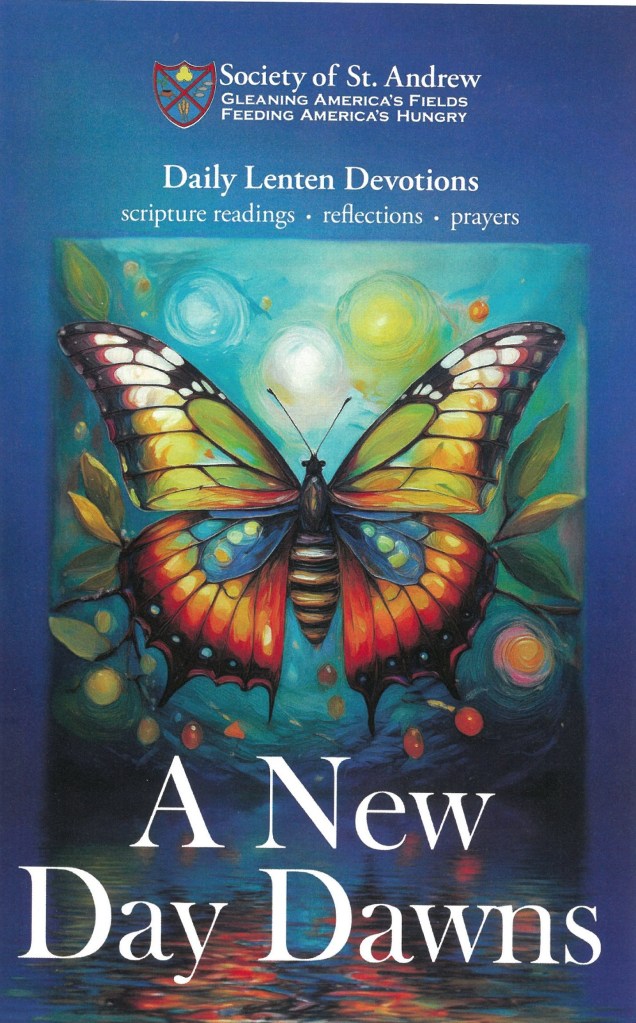
From the author: I was honored to have this piece published in the Hunger Action Month devotional book for the Society of St. Andrews on Saturday, September 14, 2024.