The email arrived on January 15, 2026.
It was from Tommy Yow.
At one time, Tommy had served as the Youth Director at Davis Street United Methodist Church in Burlington, North Carolina.
Davis Street was the church we attended when I was growing up.
The email was from the North Carolina Conference of the United Methodist Church. It was a request for prayers.
Penny Farmer a retired Methodist minister had been moved into hospice care.
When I was growing up at Davis Street, Penny Farmer was Penny Dollar.
Penny was a part of the youth group at Davis Street, and she was a classmate at Walter Williams High School. We graduated in 1971.
I often wondered how she felt about her name. Did people tease her? Dd they ask foolish questions as jokes? Hey Penny, you dropped a penny. Hey Penny, do you have any dollars?
I will confess I haven’t been a good friend or Christian in keeping up with people over the years.
Yet, Penny had a distinguished and impactful career as a Methodist minister. No matter where she served in eastern North Carolina, no matter her title, people in those congregations held her in high esteem.
Her accomplishments, her leadership, and her ability to impact the lives of people no matter their age was impressive.
Penny’s partner in life has been her husband, John, who is also a Methodist minister.
With the news about hospice care, I added Penny to my prayer list.
On Saturday, January 24, my sister, Lisa, texted me that Penny had passed.
Moments like this make me pause. I pause and ask lots of internal faith questions.
I know Penny’s health had been declining, but I also always want to know why such a good person, a loyal servant, and a person who walked the walk and talked the talk much better than me isn’t still with us.
I also question the sad losses that Penny experienced in her life two brothers and a granddaughter, how can these losses happen to a committed Christian?
I know, I know what you are thinking, Bill, that’s the way life is. Bad things happen to good people everyday. You can’t do anything about it.
Yes, that is all true, but I always want to know why didn’t God intervene?
Where are God’s angels?
Where is the gentle touch of Jesus?
I think about all of those New Testament stories in the Bible where just the touch of Jesus or the presence of Jesus changed circumstance for individuals.
Where was that touch for Penny and others like her?
Come on Bill, you always get riled up and question God in moments like this. One of these days, God is going to say—all right Pike, I’ve had enough, you’re out of here.
But, deep in my heart, I know that you have the same questions, you’re just not as crazy as I am.
By now, you know that I listen to the National Public Radio Show Fresh Air. I listen to Fresh Air because I always learn from the interviews.
Recently, I listened to an interview with British author, Julian Barnes. I confess I have never read any of Mr. Barnes’ books. Part of that interview with host, Terry Gross, caught my attention.
In 2008, Mr. Barnes lost his wife in thirty-seven days from a very aggressive brain cancer. Mr. Barnes stated this was the most “appalling, the blackest” thing to happen in his life.
Mr. Barnes describes himself as an agnostic. He doesn’t believe in God.
Terry Gross asked Mr. Barnes: “Do you ever wish you could believe in a loving, comforting God who was your friend and a heaven where you’d be reunited with your wife of 30 years, and, you know, things would be calm and beautiful?”
Mr. Barnes responds: “No. I’ve never thought that. I’ve never had any religious belief. I think that life is all we have, and there’s nothing after it. It’s very hard to believe in a calm and loving God when you look at the state of the world.”
As the interview continues, Mr. Barnes cites an interview he heard with actor, Stephen Fry. Mr. Fry was asked: “So give me one reason why you don’t believe in God. And Stephen Fry answered, child cancer.”
To this line of thought, Mr. Barnes adds more comments:
“If he’s a loving God, then why does – why do the just do badly? Why do the unjust succeed? Why does – why do innocent people get suddenly killed? It makes no sense, except that the defense from the religious angle is God moves in mysterious ways. We simply don’t know. We’ll find out later. That’s sort of not good enough for me.”
I think about what Mr. Barnes stated.
Part of me reckons, if we are truthful with each other, we have asked those questions at various points in our lives.
We still subscribe to Southern Living magazine. I love the Grumpy Gardener, but I love even more the column by Rick Bragg. Mr. Bragg makes me laugh.
Perhaps you know that Mr. Bragg is a Pulitzer Prize winning journalist. His book “Somebody Told Me” is a compilation of newspaper stories he wrote for the Birmingham News, St. Petersburg Times, and The New York Times.
The first chapter of the book is titled—Survivors. In this opening chapter, Mr. Bragg writes about the devastating tornado that struck Piedmont, Alabama on March 27, 1994.
Twenty people were killed when the tornado hit Goshen United Methodist Church. It was Palm Sunday.
Six of the dead were children. One of those children was the four year old daughter of the church’s pastor, Reverend Kelly Clem. Her husband, Dale is also a minister.
In Mr. Bragg’s article, Robyn Tucker King states: “We are trained not to question God. But why? she said. Why a church? Why those little children? Why? Why? Why?”
Could it be that God might wish that “why” wasn’t a part of our language?
And yet, the curiosity of “why” can also be applied to Lara Love Hardin and her book—“The Many Lives of Mama Love.”
A New York Times Bestseller and an Oprah Book Club pick in 2024, this book is a true store of the author’s downfall and ultimate redemption. It involves the ugliness of addiction, arrest, incarceration, and the post-jail challenges of breaking free.
Some how, some way, Lara Love Hardin beat the odds, reinvented herself, and encountered a remarkable redemption—why?
Was it her random heartfelt prayers?
Was it her unyielding resolve not to lose her four sons?
Was it her relentless determination not to become another statistic of recidivism?
Was it luck, timing, her long buried gift of writing?
Why does Lara Love Hardin turn her life around, and thousands of other women who have been incarcerated fail?
Everyday, Tommy Yow forwards me an email. It is a meditation from Richard Rohr’s Center For Action and Contemplation.
On Friday, January 30, the meditation was written by Liz Charlotte Grant. The topic was how she reads the Bible today.
The last paragraph caught my attention:
“You too have permission to question the sacred without fearing a backslide into unbelief. Knock loudly. Listen to your gut and let your tears run. Reject answers that do not admit complication. Seek the resonance at the base of the story. The seeking is the point. Because there, in your wandering, God is.”
It should be obvious that I would be drawn to “permission to question.”
I will also admit that losing good people like Penny Dollar, Julian Barnes’ feelings about God, and that Piedmont, Alabama tornado make me contemplate “a backslide into unbelief.”
Yet, some how, I’m still a wondering wanderer.
Maybe, Lara Love Hardin’s turnaround has something to do with that.
Late on the afternoon of Thursday, January 29, 2026, I needed a quiet place to organize paperwork at Trinity the church where I work.
The winter storm that hit Richmond made the first three days of this week challenging. The challenge was attempting to clear the church’s sidewalks of a ridiculously thick layer of frozen snow, sleet, and freezing rain. Why God didn’t you just send snow?
I went to room 317, the classroom where the Book Seekers class meets on Sunday mornings. This group of ageless wonders has lots of wisdom.
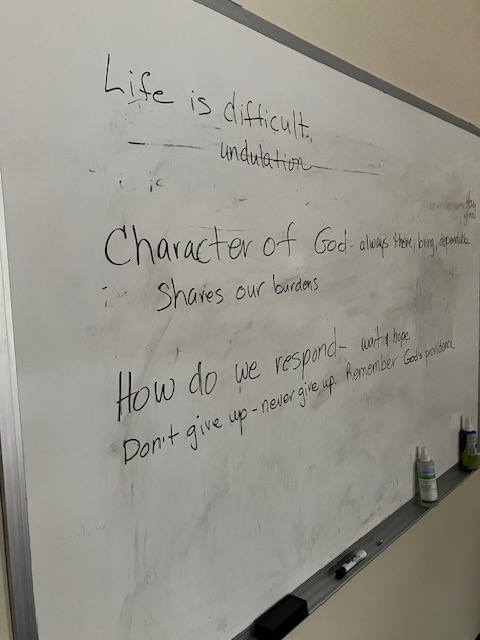
As I was finishing up my work, I looked at the whiteboard on one of the walls.
Scribbled out in black dry-erase marker was some wisdom.
The first line caught my attention—Life is difficult.
I think to myself, yes it is.
Followed by—Character of God—always there, loving, dependable. Share our burdens.
Here, I start to struggle.
Always there, loving, dependable—is he? Shares our burdens—does he? Immediately, I’m thinking about troublesome headlines in America and the world.
Last line starts with a question—How do we respond? Wait and hope. Don’t give up-never give up. Remember God’s providence.
Maybe God is waiting for us to respond to those troublesome headlines.
Is he in a holding pattern up there?
Is he looking down hoping that we will wake up?
Is he hoping that we will never give up on ourselves or God’s providence?
Penny Elizabeth Dollar Farmer knew life was difficult.
Penny saw it with her own family and the congregations she served in her career.
But in the burdens of difficult lives, she knew and saw in her work the character of God—always there, loving, and dependable.
No matter the circumstances, Penny always responded. She could wait out with hope, she never gave up.
Why?
She always, always remembered God’s providence.
And so should we.

 might be baloney