I never met my father’s oldest brother, Boyd Pike. But, I think of Boyd every Memorial Day.
Boyd was a Fireman Third Class aboard the USS Sims, a United States Navy destroyer. In early May 1942, my grandparents received the notification from the Navy that no parents want—Boyd was missing in action.
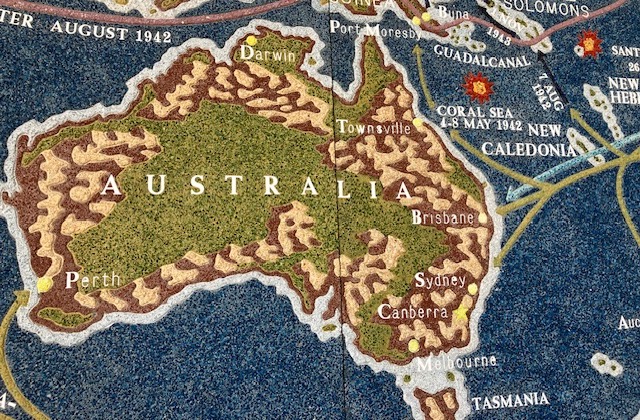
In the Coral Sea, the Sims had been escorting an oiler, the Neosho, when both ships were attacked by Japanese fighter planes. Unfortunately, the Sims could not withstand the fierce attack. The ship sunk. Thirteen survived. Boyd was not one of them.
A year later, the family received official notification from the Navy declaring Boyd dead. Boyd’s parents and nine siblings are now deceased. Yet, the nieces and nephews in the family make a point of not forgetting Boyd’s sacrifice.
In an United States military cemetery in the Philippines, there is a grave marker for Boyd. In the cemetery, at the family’s home church, Mt. Pleasant United Methodist in Guilford County, North Carolina, a gravestone honors Boyd.
I don’t expect in my life time to make an excursion to the Coral Sea or the cemetery in the Philippines to honor Boyd. Yet, I hold in deep respect Boyd and the United States military personnel who gave their lives to preserve our freedoms.
In January 2024, with friends from college, my wife and I had the privilege of making our second trip to Hawaii. During this visit, we made a point of taking our friends to the Pearl Harbor National Memorial and to the National Memorial Cemetery of the Pacific.
Each memorial is distinct in their offerings to the public. At Pearl Harbor, the displays capture what took place on the morning of the attack. But for me, the most moving part of Pearl Harbor is the boat ride to the USS Arizona Memorial.
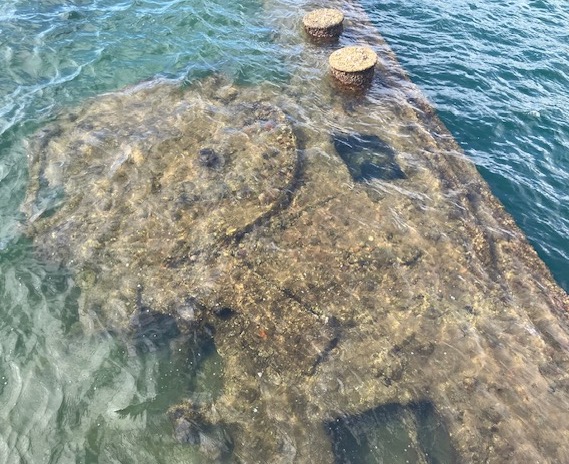
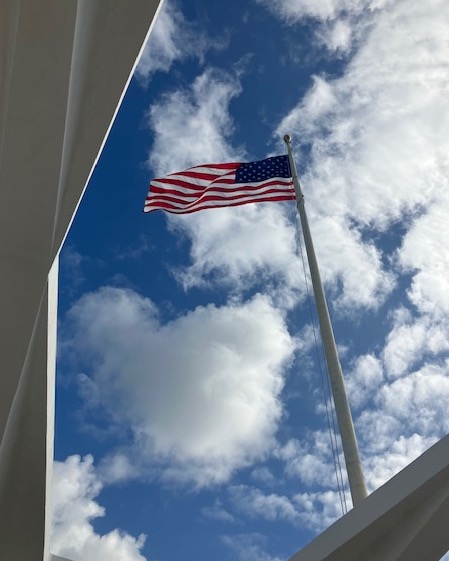
Before boarding the boat, an atmosphere of quiet reverence hushes all visitors. That restraint is maintained throughout the visit. At the Arizona’s memorial, the stillness is broken by the American flag flapping in the breeze, and the solemn voice of a docent carefully recanting what the crew of the Arizona experienced on the fateful morning.
At the National Memorial Cemetery of the Pacific, a quiet reverence is also present. Here, the setting is in the crater of an extinct volcano. The cemetery is nicknamed the “punchbowl.”
The meticulously maintained grounds frame out the grand stairs with their majestic panels. These panels form eight courts. Inscribed on the panels are the 18,095 names of the missing from the battles in the Pacific during World War II.

At the top of the stairs, visitors will find another area of displays capturing the battles in the Pacific. Rendered in mosaic tiles, I found the Coral Sea with the posted days that the attacks took place in May 1942.
The walk to the area of the overlook is worth it. At this point, visitors look down over Honolulu with the blue Pacific Ocean forming a sun sparkled backdrop.
When my wife and I returned from our Hawaiian trip, we started to work on our plans for a visit to New Orleans. My main purpose for making this journey was to visit The National World War II Museum.
On Thursday, May 9, we spent our entire day at this museum. The museum’s location in New Orleans is tied to the Higgins boats. These landing craft were built in the city. They were used to transport our troops to the beaches of Normandy on D-Day.

The museum is massive. Curators missed no details in capturing World War II from its beginning until the final victory. To take in the museum in a day, we had to hustle.
Yet, our quick, but focused pace allowed us to appreciate the hearts and souls, and sacrifices of all Americans during the war. Their determination is well documented.
No question that films, short videos, and photographic displays add much to the telling of the World War II story. However, my wife and I were touched by multiple recorded interviews with our military personnel who gave firsthand accounts about their experiences during the war.
I wonder what my Uncle Boyd’s story would have been if he had survived?
As an imperfect American, one thing is very clear to me— we can’t allow ourselves to forget the stories from World War II.
At various points around the museum are quotes from famous leaders. Inscribed in stone, I’ve been thinking quite a bit about this quote from George C. Marshall: “The soldier’s heart, the soldier’s spirit, the soldier’s soul are everything.”
This Memorial Day, and those in my future, I hope I never fail to understand that my existence is forever linked to the heart, spirit, and soul of those soldiers and their sacrifice.

 might be baloney
LikeLike
Thanks for sharing.
LikeLiked by 1 person
Very moving! While in England we went to the American War Cemetery at Cambridge. It was so peaceful and respectful.
LikeLike
Thanks, we hope to visit England some day, and visit WWII sites.
LikeLike