Historic Vote
As a lifelong member of the United Methodist Church, I’m relieved with the news from Charlotte, North Carolina.
On May 1, multiple news outlets reported that members attending the General Conference of the United Methodist Church “by a 692-51 vote, passed several rules without debate, including overturning both its ban on gay clergy and the penalties for holding same-sex marriages.”
From my perspective, it’s about time for the church to initiate this change.
This emotional issue has resulted in many Methodist churches in America leaving the denomination through a disaffiliation process. Methodists aren’t the only mainline denomination to be walloped with challenges related to human sexuality.
For many years, data has a revealed a steady decline in church attendance across America. While it is true that the pandemic added to the woes of churches, churches were struggling before COVID-19 hit. Declining attendance, shrinking budgets, and deteriorating facilities are among the challenges experienced by churches that resulted in closures.
In Virginia, I had the privilege of attending three annual conferences. At each annual conference a handful of churches were closed because of challenges related to attendance and finances.
Even if the reorganization plan gives relief to the church’s stance on human sexuality, challenges related to attendance, finance, and facilities are not going away.
With a decline in church attendance and religion in America, the release of a January 2024 report from the Pew Research Center has an interesting finding.
The Pew report found that the “religious ‘Nones’ are now the largest religiously unaffiliated cohort in America at 28%. The ‘Nones’ are larger than Catholics 23% and evangelical Protestants 24%.”
I wonder how many of the ‘Nones’ are from the LGBTQ community, or individuals who didn’t grow up in the church, or who had an unpleasant church experience? Also, I wonder if the Methodist church or any other mainline denomination can find ways to bring the ‘Nones’ back to church?
For the last twelve years, I’ve had the privilege of working at the Methodist church where my family and I are members. With this work, and in my previous career in public education, I’ve come to realize that churches like schools are interesting places as they both center upon working with people.
I find church leaders and their congregations to be good people who care deeply about their church. However, these good people are often reluctant or incapable of making needed changes. This inability to change has hurt churches more than they realize.
Whether related to human sexuality, declining attendance, drops in revenue, and deteriorating facilities, I don’t think we’ve seen the end of church closings. And there is part of me that wonders if churches would benefit from undergoing an accreditation process. Schools, fire/police departments, non-profits, and some professions are familiar with this practice.
I’m curious to learn if the challenges that churches are experiencing could have been avoided or corrected with a rigorous “self-study.” This diligent internal examination would require churches to carefully assess their programming, personnel, finances, facilities, outreach, and communication.
Even if an accreditation process was available to church leaders and their congregations, I’m not certain they would pursue taking a hard look at themselves. It is easier to develop a strategic plan that collects dust rather than asking difficult internal questions about your operations.
However, if churches have any desire to slow their downward spiral, leaders and their congregations must work quickly to assess their fiscal, mental, physical, and spiritual health status.
Our current church times are in sharp contrast to the boom of the 50s and 60s. Then the mentality was if we build a church—they will come.
Within easy driving distance to our church are five other Methodist churches. Today, any of those congregations could be nervously thinking— ok, we’ve built this church, but do we have capacity to sustain it?
In her book, Factory Man, author, Beth Macy, wrote about John Bassett III, and the challenges he faced in America’s furniture industry. I love this advice from Mr. Bassett— “be willing to change and improve repeatedly.”
If the United Methodist Church has any hope
of being around for fifty more years, church leaders and congregations must “be willing to change and improve repeatedly.”
Failure to change beyond the Charlotte vote guarantees two things: the ‘Nones’ will continue to grow, and more Methodist churches will close.
Yes, I’m encouraged by the Charlotte vote.
But now, the real work must start.
An impatient world will be watching to see if Methodists can truly become more inclusive.
I hope we can.
Post Conference Reflections
I am a lifelong Methodist.
But, I did not attend the General Conference of the United Methodist Church that was held in Charlotte, North Carolina from April 23 – May 3, 2024.
Nor did I carefully follow any pre-Conference wrangling, or any daily news reports about what was taking place at the conference.
Personally, I wasn’t optimistic that we Methodist could agree to settle our differences found in the Book of Discipline related to ordaining gay clergy and clergy having permission to perform same-sex marriages.
On May 1, multiple news outlets reported that members attending the General Conference of the United Methodist Church “by a 692-51 vote, passed several rules without debate, including overturning both its ban on gay clergy and the penalties for holding same-sex marriages.”
From my perspective, it’s about time for the church to initiate this change. And, I can’t believe that making this change took over fifty years.
Now, the tough work must begin.
No one can deny that the COVID-19 pandemic walloped churches. But the truth is that churches were in trouble prior to the pandemic. Attendance was down, financial giving slipping, and facilities were feeling the impact of neglect. Add to this to the struggle to understand a changing world related to LGBTQ communities, and churches were in trouble.
For Methodist, even with this historic vote, we have lots of work to do to attempt to slow the multiple challenges that church leaders and congregations face. Personally, I don’t sense we are done with churches closing.
In her book, Factory Man, author, Beth Macy, wrote about John Bassett III, and the challenges he faced in America’s furniture industry. I love this advice from Mr. Bassett— “be willing to change and improve repeatedly.”
If the United Methodist Church has any hopeof being around for fifty more years, church leaders and congregations must “be willing to change and improve repeatedly.”
I’m not sure if Methodist leaders and their congregations realize how much the church has been hurt by the paralyzing inability to change.
In David Halberstam’s book The Teammates, he writes about a 1997 decision made by the management of the Boston Red Sox to let go a long time coach and team legend, Johnny Pesky. This wasn’t a popular decision in Boston.
Five years later, the Red Sox were sold. One of the first things the new owner did was to bring back Johnny Pesky.
Halberstam wrote the following when he reflected about the general manager of the team who had dismissed Johnny Pesky: “It was almost as if his strategy was designed to separate himself from the team’s rich history and lore, as if the past was more of a burden than an enhancement, and that in order to build for the future, he had to destroy the past.”
As the Methodist church looks to its future, it must not bury its past. Rather the church must understand its past to learn how to shape the future.
We Methodist are at a critical point. If we continue to mire ourselves in “that’s the way we have always done it mentality,” we’ll miss an opportunity to connect with people who are searching for a community.
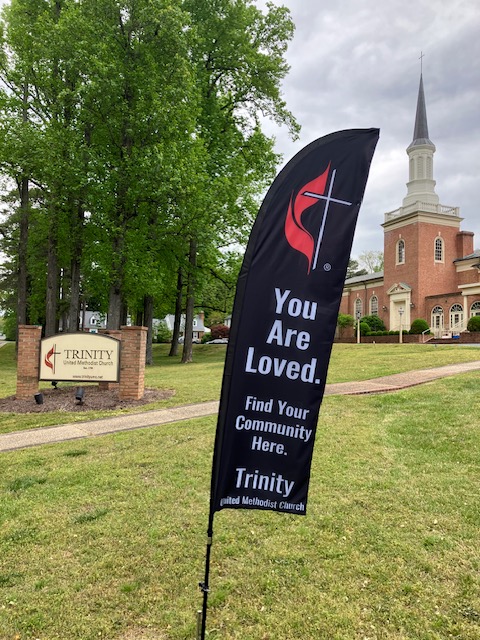
I’m not a big believer in banners that adorn the front lawns of many churches. I think a banner is a blur to a driver zipping by a church.
Yet, out on the lawn of Trinity, is a banner that reads: You Are Loved. Find Your Community Here.
Methodist— you, me, we, us are overdue to love all in our community.
The third verse of Psalm 23 states: “He restores my soul.”
Isn’t this an opportunity through love to “restore our souls”?
Isn’t this an opportunity that we can’t afford to miss?

 might be baloney
Dear Bill,
You know that I have great respect for you. You and Pat wrote my resignation from teaching with much grace. It gave me a second chance, for which I will always be grateful. Yet, I must respond to your blog “More Methodist Musings.”
In your piece, you suggest that the decline in church attendance is because “Nones” are rejected because the Church is not being inclusive to the LGBTQ community or other alternative lifestyles. The data would indicate otherwise. The churches that have maintained historical orthodox Christianity have been the churches that have been growing. The churches that have changed Biblical guidelines to accommodate the changing trends in our culture have been declining. That is not an opinion it is a fact.
The real issue here is whether the Scriptures are authoritative. Homosexuality in the Old and New Testaments is a sin. There are prohibitions in the Old Testament that you don’t see in the New that call into question whether they are absolutes. Homosexuality is not one of them; wherever it appears in the Bible, it has a negative connotation.
You might say these issues are just a difference in theology or Bible interpretation. Concerning the Scriptures, the main things are the plain things, and the plain things are the main things. In an honest reading of the Bible, one would have to conclude that the prohibition of practicing homosexuality is a plain thing. Now, if you say that the Bible is not authoritative and you can accept or reject whatever you choose, I disagree with it, but I can understand it. But if you take this stance, you are not a part of a Christian church. I wonder what John and Charles Wesley’s take on these issues would be. I don’t think we need to speculate, taking the Wesley brother’s stance on the authoritative nature of the Holy Scriptures.
I heard a Catholic Bishop recently say many members of the Catholic Church are “cafeteria Catholics.” They pick and choose what doctrines or guidelines they want. With the issues that the Church is grappling with, such as gay marriage, ordination of gay clergy, transgenderism, and the definition of a man or woman. Should we be able to pick and choose our stance about them? Genesis 1:37 NKJV says, “God created man in His own image; in the image of God He created him, male and female He created them.” If you believe in gender fluidity, you are distorting the very character of God.
Those on the other side say, can’t we just love everyone? That sounds good. But love to be real must be truthful; the only yardstick we have for determining truth is the Bible. Of course, we must not hate anyone, but to validate a lifestyle that the Holy Scriptures expressly forbid is not love but just emotion. Any church that willfully violates God’s commandments is not the Church that Jesus Christ founded and of which His Apostles wrote.
Bill, I respectfully submit this for your consideration and comment.
Ken Barnes
LikeLiked by 1 person
Ken,
Nice to hear from you.
I appreciate your gentle gracefulness in responding to one of my blog posts.
You are clearly a very, very deep theological thinker, and I am not.
I appreciate your words from a variety of angles.
For me, the LGBTQ matter is personal.
My wife has a nephew who is gay. I have a cousin who has a daughter who is lesbian. Another cousin just lost his gay youngest brother because this young man could never find his place in life.
I have five close friends from college. One of these men is gay, and we have all seen the hurt and pain he has endured for almost fifty years.
In Isabel Wilkerson’s book, The Warmth of Many Suns, she writes about the story of America’s great migration.
On page 221, Wilkerson tells the story of a young man who is leaving Mississippi. The word “fear” is a constant in the stories of people who find the courage to leave the South.
This young man had learned about fear when he was little and once passed the white people’s church. The kids came out of the church when they saw him. They threw rocks and bricks and called him the vilest names that could spring from a southern tongue. And he asked his grandparents, “What kind of god they got up inside that church?”
I am an imperfect human being, an imperfect Christian, and that is my question for the Methodist church, and any house of worship when people(the ones mentioned above and countless others) have been scarred by life and shunned: “What kind of god they got up inside that church?”
Have a quiet day, be safe, love,
Bill Pike
LikeLike
Thank you Bill for your kind response. Maybe we can dialogue sometime. I enclosed
a link of an English preacher who has same sex attraction.
Ken
https://www.youtube.com/watch?v=VnVskwil3Z4
LikeLike